

The tensile strength is an imperative properties and essential indications consumers’ look out for in purchasing a quality fabric. The objective of this study was to examine key soap on tensile strength in three washing cycles of selected Printex fabrics in Ghana. Quantitatively, the study adopted both experimental and factorial research designs. Materials for the study consisted of three fabrics with black prints and white as base colour were purchased from the market. These three fabrics had the same designs but two had different fabric finishes and the third one had no finish (plain, embossed and plisse). Six yards each of the Printex black and white fabrics with embossed, plisse and a third one which did not have any special fabric finish were used for the study. Key soap purchased from the Ghanaian market, and standard soap from Ghana Standard Authority was used for the study. Purposive and simple random techniques were used to select materials for the study. The main research instrument for the testing tensile strength was Universal tensile testing machine. Data were analysed with both descriptive and inferential statistics. The one-way analysis of variance (ANOVA) was used to test the hypothesis formulated to guide the study. The study revealed that continuous washing had degrading effects on the tensile strength. The implication is that continuous washing weakens the internal strengths of fabrics which cause them to fail or weakens their resistance to stress test. The study also found that continuous washing had degrading effects on the tensile strength of the selected fabrics. It is recommended that the Ghana Standards Authority should encourage soap producers to get their chemical compositions as close to those of the standardised soap as possible.
An Appraisal of Key Soap on Tensile Strength in Three Washing Cycles of Selected Printex Fabrics in Ghana
April 24, 2022
June 12, 2022
July 20, 2022
November 06, 2022
This is an Open Access article, distributed under the terms of the Creative Commons Attribution 4.0 International License (http://creativecommons.org/licenses/by/4.0/), which permits unrestricted use, distribution and reproduction in any medium or format, provided the original work is properly cited.
Abstract
1. Introduction
The variety of fabric structures are known to be four, which are woven, knits, braids and non-woven. Comparing with other fabrics, woven fabrics display both good dimensional stability in the warp and weft directions and highest cover yarn packing density. In selecting a woven fabric for industrial applications, a study argued that a number of design parameters may be considered. These are broken down into four basic variables which are yarn weight, thread count, weave pattern and fabric finish. The wide ranges of yarn weights provide the base for fabric design [1]. Spectacular colour effects can be achieved by varying the colours of the warp and weft threads when a fabric is woven. There is no limit to the number of colours that can be used in the warp or weft thread. Interest can also be added by varying the type of yarn used. Threads, yarns, strips/rags of fabric, ribbon, cord, braid, plastic, PVC can all be woven together to create interesting colour effects.
Hexcel continue to explain that the woven fabric is formed by two yarn series that intersect perpendicularly. In the literal sense, warp and weft are the technical terms for the two types of threads used to create a finished woven product. The warp is the tightly stretched lengthwise core of a fabric, while the weft is woven between the warp threads to create various crepe patterns [1].
Crepe is a French word meaning crinkle. It is the name given to a large class of plain-woven fabrics that have a crinkle effect produced by the use of tightly twisted yarns, tension and control of yarns in weaving or the impressing of crepe designs on thermoplastic fabrics [2]. Woven crepes are resilient, crease resistant and give soft flowing lines. Crepes are made from all the major fibres, alone or in combination. Crepe is can be in silk, wool or polyester fabric with a distinctively crisp, crimped appearance. The fabric is woven from all of the major fibres, natural or man-made. Crepe may be a family of fabrics of various constructions and weights, but all possess a crinkled or granular surface achieved through weaving variations, chemical treatment, or embossing. Surface textures range from fine, flat crepes to pebbled and mossy effects; some surfaces resemble tree bark. Popular crepes include Canton, crepe-back satin, crepe de Chine (Chinese crepe), Georgette, marocain, faille, lingerie, mossy, romaine, and rough. Crepe is a supple fabric with a twisted, pebbled or puckered appearance. The distinctive crepe surface can be the result of tight weaving, twisting or knotting the fibres prior to weaving, using irregular patterns during the weaving process or by embossing a finished fabric with rollers engraved with a crepe pattern. The pattern is permanently embedded into the fibres using a combination of heat and pressure. Several types of fibres can be used to produce crepe fabrics, notably silk, silk-like fabrics and cotton. There is a wide variety of types of crepe, including crepe de chine, plisse crepe, Moroccan crepe, wool crepe and crepe georgette [2].
The fabric is usually woven with crepe yarn, a hard-twist yarn produced either with a higher number of twists per inch than ordinary yarn or with alternate “S” and “Z” twists. In the “S” twist the twist of the yarn resembles the centre part of the letter “S”; in the “Z” twist the resemblance is to the centre part of the letter “Z”; these are sometimes referred to as left-hand and right-hand twists. One variation is to leave out certain risers interlocking of warp over filler threads) present in plain weave in order to increase the float of yarn from one to three. The high twist in yarns makes crepe fabrics more susceptible to shrinkage; therefore, careful handling of crepe fabric is required in laundering and dry-cleaning. A Crepe fabric with its good sheen and excellent drape is extremely beautiful and eye-catching. These crepe fabrics can be availed in a variety of colours, designs and patterns. Crepe yarn is used to make crepe designed fabric. High twisted yarn is called crepe yarn. It has curling properties. Various types of home textile and decorative fabrics are made by this design. Crepe weave is divided into four types which are crepe on sateen base, crepe by reversing, crepe by super imposing and crepe on a plain weave base [3].
A crepe crinkle is obtained in several ways and crepe fabrics are classified according to the way the crinkle is obtained. These are as follows:
- True crepe – crinkle is achieved by high-twist yarns.
- Crepe effect – crinkle is achieved by textured yarns, weave and finish [2].
True crepe fabrics are unbalanced plain weave fabrics containing high-twist yarns. They are made on a loom with a box attachment that can insert alternating groups of S- and Z-twist yarns to enhance the amount of crinkle. The high-twist crepe yarns are made of rayon, cotton, flax, wool and silk fibres because the liveliness of the high twist can be set by wetting and drying before weaving. Thermoplastic fibres must be set by heat, which kills their capacity to produce crinkle. The warp yarns of a true crepe fabric are often low-twist yarns of acetate fibre. Low twist in the warp enhances the crinkle achieved by the crepe yarns in the filling. In pressing true crepes, work has to be done quickly with as little pressure and moisture as possible [4]. Gray-goods crepe fabric is smooth as it comes from the loom. It is woven wide and then shrunk to develop the crinkle. Immersion in water causes the crepe-twist yarns to regain their liveliness and contract or shrink. This explains why a crepe will shrink when it gets wet and why garment size is so much more easily controlled by dry cleaning than by washing. Filling-crepe fabrics have high-twist crepe yarns in the filling direction and low-twist yarns in the warp direction. Multifilament and French crepe are the smoothest and most lustrous of the true crepe family. This is because they are smooth; they are washable and are used in lingerie, and sometimes in blouses. They contain crepe yarns of the lowest twist.
Flat crepe is the most widely used filling crepe. It has a dull-crepe surface. Rough irregular surface are often produced by using special prepared warp and weft yarns which have a high twist factor that causes them to crimp or curl when the woven fabric is being finished. These yarns are known as crepe yarns and generally the fabrics are produced from them are of plain cloth. Crepe weave is used to produce shirting, decorative purpose, home furnishing, ladies wear, etc. The main properties of crepe weave are that, crimp or curling is found in the fabric. There are two distinct varieties of the textile: soft, Canton or Oriental crepe, and hard or crisped crepe. It can be used to create clothing such as blouses, suits and dresses. Polyester crepe is machine-washable, while rayon and silk crepes need to be dry-cleaned [4].
Crepe de Chine is thinner and comes in three different weights – two-ply, used for lingerie and blouses; three-ply, used for dresses, fuller pants and dresses; and four-ply, the nicest of the three, used for coats and trousers [3]. Crepe de chine is a lightweight fabric, usually made of silk, without a pronounced crepe finish. It tends to have a smooth, pebbled, matte finish and is used to make luxury garments and evening wear. The fabric is made with highly twisted, worsted yarns in the weft and silk yarns in the warp, or of just silk warps and wefts. It weakens when exposed to perspiration or sunlight. Traditionally, Crepe de Chine is a very sheer, pebbly, washable silk with the fabric degummed to produce crinkle. Today, it is a sheer, flat crepe in silk or man-made fibres. It is used for lingerie, dresses and blouses. Crepe-Back Satin is a satin fabric in which highly twisted yarns are used in the filling direction [4]. The floating yarns are made with low twist and may be of either high or low lustre. If the crepe effect is the right side of the fabric, the fabric is called satin-back crepe. Crepe Silk or Silk Crepe is a luxurious fabric with a good sheen and a pebbly texture obtained by using high twist yarns. Silk Crepe has a beautiful drape, and is extensively used to make dresses, slacks, skirts, lightweight suits, bridal gowns, and evening wear. This implies that the tensile strength of the fabric must be of a good quality
1.1. Laundry Soap and Tensile Strength of Fabrics
Tensile strength of a fabric is one of the most important performance properties buyers look out for in purchasing a fabric. The strength of a textile material under tension, measured through the resistance of a textile fabric to stretching in one specific direction and the force required rupturing or breaking the fabric [2]. Tensile strength is the strength of a textile material under tension. It measures the resistance of a textile fabric to stretching in one specific direction [2]. Laundering plays a significant role on the physical, mechanical, and aesthetic properties of a fabric. A research concluded that laundering changes the appearance as well as the performance properties of fabrics [5]. Laundering is a key cause of degradation in washable textiles. The complex actions of laundering are expected to cause degradation of fabric performance. Soaps and the agitation process during laundering also affect fabric properties as the soaps decrease the surface tension of the water and its ability to spread over and wet fabrics [6]. Studies have shown that the tensile strength of a fabric does not only depend on the strength of the constituent yarns, but also on the structure of yarn and fabric and many other factors (yarn linear density, yarn structure as influenced by the spinning system, yarn bending behaviour, coefficient of friction and initial modulus of the yarn, fabric geometry, warp and weft density, weave design or yarn interlacement pattern, and fabric finishing treatments) [7]. The tensile behaviour of fabrics is closely related to the inter-fibre friction effect. Tensile strength of the cotton, flannel, polyester woven fabrics decreased significantly after the fabrics were treated with rinse cycle softeners [8]. They also suggested the lubrication of the softener on fibres increased fibre mobility, resulting in weak spots and fibre slippage, which caused yarn to break more easily and reduced the tensile strength of the fabric [8]. It is expected that the warp yarns can withstand a higher maximum load as stronger yarns are selected for warp yarns to withstand the stress of the weaving process [2]. A slight increase of the maximum load the weft yarns of the machine washable wool fabric laundered with distilled water could carry, can be explained by the felting propensity of wool fibres. The scales of adjacent fibres interlocked and felted as a result. The shrinkage that took place caused a denser fabric with a higher maximum load before it broke [9].
The tenacity of all fabrics becomes lower, especially in the warp direction of the crease-resistant treated fabric as the number of laundering cycles increases [10]. For cotton fabrics, repeated laundering significantly weakens their tensile strength, but increases their fluidity. The laundering conditions, including the chemical condition which is defined by the water hardness and the added soap or other additives; the water temperature, length of washing time, method of moisture removal and intensity of the mechanical action all affect how the fabric properties are changed by laundering [10]. Fabrics should be able to withstand a reasonable number of laundering cycles in order to satisfy consumers [10]. However, loss of strength of cotton is due to progressive wash cycles with soap in that it causes a great decrease in the mass of cotton fabrics [2]. The use of biodegradable enzymes may slightly decrease a product’s life since a tiny portion of the fibres is destroyed with each laundering. The warp direction exhibits higher strength than the weft direction. This is usually the case for most fabrics as the warp yarns are required to be stronger [2].
1.2. Maximum Normal Stress Theory (Rankine’s theory)
The maximum normal stress criterion, also known as Coulomb’s or Rankine’s criterion, is based on the maximum normal stress theory [5]. The theory is adopted to predict the failure of materials or fabrics. Rankine specified that the failure of fabric occurs when the maximum (normal) principal stress reaches the ultimate strength of the fabric for simple tension (either the uniaxial tension strength or the uniaxial compression strength). The theory states that a fabric subjected to any combination of strains or stresses will yield whenever the greatest positive principal stress exceeds the tensile yield strength in a simple uniaxial tensile test of the same fabric or whenever the greatest negative principal stress exceeds the compressive yield strength. The study, therefore, adopted this theory to describe deformations and failures the printed black and white plain Printex, plisse Printex and embossed Printex undergo stress conditions.
The quest of the textile industry in Ghana to satisfy consumers’ desires to have something new has brought about a healthy competition among members of the industry. The competition is in the direction of producing a variety of fabrics with contemporary techniques of processing and designing textiles. The textile industry in Ghana is faced with recent imports perceived to be cheap textile prints as compared to made-in-Ghana prints. For the manufacturers to beat their competitors they have developed a new drive towards adding value to their products, culminating in the use of new improved designs and fabric finishes. The fabrics are therefore subjected to various processes to achieve the desired effect. These processes have the potential of reducing performance and other structural attributes. The ease of soiling the fabric especially the white colour in these fabrics due to the activities they are mostly used for is a factor for being subjected to frequent washing, after each use if one wants to maintain a clean fabric before storage. These do not come with care instructions so individuals subject them to varying care treatments. Therefore, this research sought to find out how three washing cycles in the laboratory affect the tensile strength of the black and white fabrics with the plain and crepe finishes produced by Printex. The objective of this study was to examine (the effect of) key soap on tensile strength in three washing cycles of selected Printex fabrics in Ghana. The study was guided by a research question and hypothesis; what impact can key soap have on tensile strength of the selected Printex black and white textile fabric with plain, plisse and embossed finishes after undergoing three washing cycles. H0: There is no significant difference among the tensile strength of the plain printed, embossed and plisse cotton fabrics of Printex after three washing cycles.
2. Materials and methods
Quantitatively the study adopted both experimental and factorial research designs. Materials for the study consisted of three fabrics with black prints and white as base colour were purchased from the market. These three fabrics had the same designs but two had different fabric finishes and the third one had no finish (plain, embossed and plisse). Six yards each of the Printex black and white fabrics with embossed, plisse and a third one which did not have any special fabric finish were used for the study. Key soap purchased from the Ghanaian market, and standard soap from Ghana Standard Authority was used for the study.
Purposive and simple random techniques were used to select materials for the study. Purposive sampling procedure was used in choosing the fabrics and soap for the study. Specimen totalling 219 were cut randomly from along the warp and weft directions of the Printex black and white cotton fabric with finishes (plain, embossed and plisse). The specimens were cut exactly 7cm x 30cm, which are the required sizes by the International Organisation for Standards (ISO) specific text method. The samples prepared produced 219 specimens for the experimental study. For validity and meaningful conclusions, the study was limited to the black and white fabrics that had the same designs. The pattern cutter was used to cut for weighing to determine the weight of the fabric. They were cut in a standardised circular form from the individual fabrics for the test in both warp and weft directions.
The universal tensile testing machine (Hounsfield) was used as the main research instrument to test the tensile strength for the study. It has constant rate of extension, provided with one clamp which is stationary and another clamp which moves with a constant speed throughout the test, the entire testing system being virtually free from deflection. The machine has gauge length which shows the distance between the two effective clamping points of a testing device. It also has pretension (representing the force applied to a test specimen at the beginning of certain tests) used to determine the initial length of test specimen. The machine again has extension and elongation. Extension is the increase in length of a test specimen produced, by a force, and elongation is the ratio of the extension of a test specimen to its initial length, which is expressed as a percentage. Refer to appendix A for photographs of the equipment used in collecting data.
A small piece of textile material that is to be subjected to a test is referred to as a specimen. It is usually cut from a large sample representing a lot of textile material. For the purpose of this study a wooden template was used to cut each test specimen with the length parallel to the warp or weft of the fabric (7cm wide and 30cm in length). This required measurement gave room for the necessary fringing required for the testing procedure. Threads were removed in approximately equal numbers from each of the long edges of the cut strip until 5cm width was reached. The width of the fringes was such that during testing no longitudinal threads could escape from the fringes. In total, 180 specimens/strips were prepared to test for tensile strength. This was because the strips were tested before washing and after the three cycles of washing. The laundry process of the specimens was carried out in different washing temperatures which corresponded to first, second and third washing cycles respectively.
The results were processed by using Microsoft Excel (2016) version. The data obtained were presented using both descriptive and inferential statistics. The descriptive statistics (frequencies, percentages, means and standard deviation) were used as summary statistics of variables of the study. The one-way analysis of variance (ANOVA) was used to test the hypothesis formulated to guide the study. ANOVA was used because the study tested for significant differences among three variables (three washing cycles), whereas the independent samples t-test was used to test for statistically significant differences between the performance of the fabric finishes under Key soap. A level of significance of .05 was used for the hypothesis testing to draw conclusions on statistical significance.
3. Results and discussions
3.1. Effect of Key Soap on Tensile Strength of Selected Printex Black and White Textile Fabric with Plain, Plisse and Embossed Finishes
This section presents results and discussion on the effect of Key soap on the tensile strength of the selected Printex black and white textile fabric with plain, plisse and embossed finishes after undergoing three washing cycles. This was important to assess the maximum stress capacity of each of the finishing fabrics after three washing cycles with Key soap. The tensile strength was also imperative because tensile strength of a fabric is one of the most important performance properties consumers look out for in purchasing a fabric. In other words, the tensile strength of fabrics is one of the essential indications of fabric quality. Soaps and the agitation processes during laundering affect the tensile strength of fabrics as soaps decrease the surface tension of the water and its ability to spread over and wet fabrics [6]. A previous study defined tensile strength of materials as the force required to break a large number of yarns simultaneously in either warp or weft direction. A similar scientific study supported the findings of this research and postulates that the structural attributes of textile materials determine how textile fabrics react to forces being applied in tension [12]. Issues about tensile strengths of the fabrics were done both at the warp and weft yarn directions of the fabrics. Table 1 presents detailed results on the performance of tensile strength of the three fabric finishes after three washing cycles with Key soap.
Table 1, shows that the mean control or the original tensile strengths at the warp yarn direction of the plain, plisse and embossed finished black and white cotton printed Printex fabrics respectively were 634.2, 428.5 and 729.9. Similarly, the original tensile strengths at the weft yarns of the plain, plisse and embossed black and white cotton printed Printex fabrics were 598.9, 326.7 and 658.2, respectively. The results show that the fabric with the embossed finish had the highest tensile strength in both warp and weft yarns directions, while the fabric with the plisse finish had the least tensile strength in both yarn directions. The good performance of the embossed fabric finish could be attributed to its high weight (131.32 g/m2). A previous study collaborated with the current findings, alluded that the physical properties of fabrics such as weight and thread count of the yarns influence the performance of fabrics during tensile strength testing [13]. The results also show that the warp yarns had higher tensile strength than the weft yarns. This could be attributed to the greater number of threads count at the warp yarns than the weft yarns. This agrees with the assertion of an earlier study that the warp yarns of fabrics are stronger than the weft yarns because they contain more thread counts than the weft yarns [14]. Also, warp yarns are stronger because of the tension and abrasion they undergo during weaving. At the end of the first washing cycle, the tensile strengths of plain, plisse and embossed finished fabrics at the warp yarns were 627.2, 418.3, and 703.2, respectively. In addition, the tensile strengths of plain, plisse and embossed finished fabrics at the weft yarn directions respectively were 590.4, 315, and 658.2. Thus, the tensile strengths in all the warp and weft yarns except the weft yarns of the embossed fabric reduced. The results were in agreement with the failure theories which stated that the tensile strengths of materials fail as they are subjected to stress and strain tests or uniaxial tests [5].
The implication is that the laundering process with Key soap had degrading effects on both warp and weft yarn directions of the three types of printed Printex black and white cotton fabrics. The maintenance of the original tensile strength in the weft and warp yarns of the embossed Printex cotton fabric could be explained by the fact that cotton becomes stronger when wet. Thus, that the strength of cotton increases by 20% when it absorbs water [13].
As depicted in Table 9, the tensile strengths of plain, plisse and embossed Printex fabrics at the warp yarn directions reduced to 624.6, 418.9 and 699.9 respectively at the end of the second washing cycle. Similarly, the tensile strengths in the weft yarns of the plain, plisse and embossed Printex fabric finishes respectively reduced to 582.2, 315 and 637.9 at the end of the second washing cycle. The results show that the plain finished Printex fabric broke at a higher tensile strength in the warp direction than the first washing cycle, plisse finished Printex fabric broke at the same tensile strength as the first washing cycle at the weft yarns, while the tensile strengths in the rest of the tested specimens reduced at the end of the second washing cycle in relation to their tensile strengths in the first washing cycle. The varied results on tensile strengths performance of the Printex fabric finishes could be attributed to the good abrasion resistance of cotton. Cotton has good abrasion resistance which enhances its performance during uniaxial testing [2].
Table 1 further shows that the tensile strengths for the plain, plisse and embossed finished Printex cotton fabric in the warp yarn direction at the end of the third washing cycle were 608.9, 393.9 and 697.2, respectively. Furthermore, the tensile strengths of the plain, plisse and embossed finished Printex cotton fabric in the weft yarns at the third washing cycle were 598.9, 326.7 and 658.2 respectively. The results show that the tensile strengths at the end of the third washing cycle of all the three Printex fabric finishes were lower than those at the end of the first and second washing cycles. The implication is that the fabrics lost more strengths as they underwent longer washing time with Key soap. The results agreed with the failure theories that the tensile strengths of materials fail as they are subjected to stress and strain tests or uniaxial tests [5].
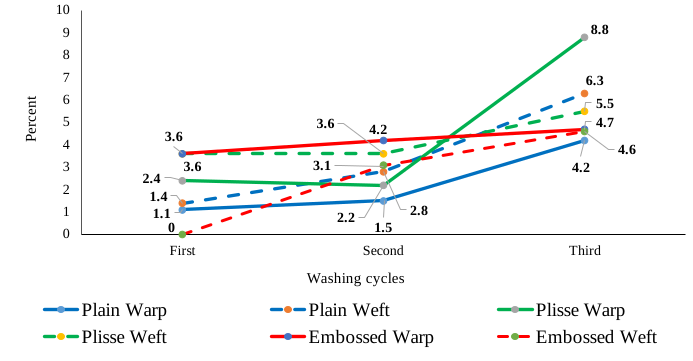
Figure 1 shows the percentage loss or gain in the tensile strengths of the three Printex fabrics over the three washing cycles with Key soap. It shows that at the end of the first washing cycle, the plain, plisse and embossed finished Printex fabrics loss 1.1 percent, 2.4 percent and 3.6 percent respectively for tensile strengths at the warp yarns, while the weft yarns recorded 1.4 percent, 3.6 percent and zero percentage loss. Comparing the extent of losses at the warp yarns with the distribution of thread count shows that the plain finished fabric with the least number of thread count had the least loss in tensile strength, while the plisse finished fabric with the highest number of thread count had the second highest loss. Similarly, comparing the degree of losses at the weft yarns with the distribution of thread count shows that the embossed fabric finish with the least thread count had the least loss. These trends disagree on the basic fibre theory, that fabrics with high number of thread counts are more able to resist the abrasive power of washing than those with low number of thread counts [14].
Results from Figure 1 further show that apart from the plain finished fabrics, there were higher losses of strengths at the warp yarns than the weft yarns in all the other finishing fabrics. This disagrees with the assertion of an earlier study that the warp yarns are stronger than the weft yarns [14]. The results further show that the plain fabric lost the least tensile strength at the warp yarns, whereas the embossed fabric lost the highest. Comparing the loss of tensile strength with the number of thread count there is evidence that the plain finished fabric, with the least number of thread count, had the least loss of tensile strength in the warp yarns after the first washing cycle, while the embossed fabric thread count had the highest reduction in tensile strength.
At the end of the second washing cycle, the plain, plisse and embossed finished fabrics respectively lost 1.5 percent, 2.2 percent and 4.2 percent of tensile strengths at the warp yarns, while the weft yarns lost 2.8 percent, 3.6 percent and 3.1 percent. The results show that the embossed fabric had the highest loss in tensile strength at the warp yarns, whereas the plain fabric had the least. However, the plisse fabric had the least loss of tensile strength at the weft yarns, while the embossed finished fabric had the highest loss.
In addition, the plain, plisse and embossed finishing fabrics respectively lost 4.2 percent, 8.8 percent and 4.7 percent of tensile strengths at the warp yarns after the third washing cycle, while the weft yarns lost 6.3 percent, 5.5 percent and 4.6 percent. The results show that the plisse fabric lost the highest tensile strength at the warp yarns, while the embossed fabric lost the least. Comparing the trend in losses at the warp yarns with the distribution of the thread count there is indication that the plisse finished fabric with the highest number of thread count had the greatest loss in tensile strength after the third washing cycle. Similarly, the plain finished fabric with the highest number of yarn count at the weft yarn direction had the greatest loss of tensile strength after the third washing cycle.
3.2. Statistical Significance of the Changes in Tensile Strengths in the Three Fabrics over the Three Washing Cycles with Key Soap
This sub-section also presents results and discussion on the Research Hypothesis - There is no Significant Difference among the Tensile Strength of the Plain, Embossed and Plisse Finished Printex Cotton Fabrics after Three Washing Cycles. The study used ANOVA to examine the statistical significance of the changes in tensile strengths in the three fabrics over the three washing cycles with Key soap. ANOVA was deemed appropriate for the testing of the first hypothesis of the study because it aimed at examining impact of Key soap on the tensile strength of three fabric finishes over three washing cycles. Analysis of variance was used to assess significant difference over one independent variable and three or more dependent variables [15]. The independent variable was washing with Key soap, whereas the dependent variables were the tensile strengths of the plain, plisse and embossed finished Printex fabrics over three washing cycles. The results are presented in Table 2.
From Table 2, there were statistically significant differences in tensile strength at the warp yarn direction of the three Printex fabric (F = 486.72, p = .006). In other words, the observed differences in the tensile strength of the fabrics over the three washing cycles were statistically different.
Table 2 further shows that there was statistically significant difference in the tensile strength of the three Printex fabrics at the weft yarns over the three washing cycles (F = 69.37, p = .003). Thus, the observed differences in the tensile strengths among the three Printex fabric finishes over the three washing cycles was not due to chance, but rather of statistically significant difference. The implication is that Key soap had statistically significant effect on both yarn directions of the selected Printex fabrics over the three washing cycles.
The results supported rejection of the null hypothesis at the alpha value of .05. In other words, Key soap had a significant degrading effect on the three Printex fabric finishes over 90 minutes of washing. This is in agreement with the failure theories that the more a material is subjected to stress or strain test the more it loses its strength. A post hoc analysis was conducted using eta square. Thus, the eta square was computed to assess the effect size of Key Soap on the tensile strength of the Printex fabric finishes over three washing cycles. An eta square value of 0.03 meant that the magnitude of the differences in the means was very small since an eta square value of 0.03 is a small effect, 0.06 is moderate effect and 0.14 is large effect [15]. This meant that the loss of tensile strength from the three Printex fabric finishes over the three washing cycles with Key Soap was small.
4. Conclusions and Discussions
The study revealed that continuous washing had degrading effects on the tensile strength. The implication is that continuous washing weakens the internal strengths of fabrics which cause them to fail or weakens their resistance to stress test. The study also found that continuous washing had degrading effects on the tensile strength of the selected fabrics. It is recommended that the Ghana Standards Authority should encourage soap producers to get their chemical compositions as close to those of the standardised soap as possible. This would help to reduce the degrading effect of some of the soaps on the performance of fabrics with crepe finishes and plain fabrics during washing. Thus, the maintenance of the chemical properties of washing soaps close to the standard properties would help to improve the quality, durability and lifespan of fabrics with crepe finishes and plain fabric during its use and care. This could be done by providing both upper and lower ranges of the chemical properties required in washing soaps. Such restrictions would compel soap producers to maintain the chemical composition of the soaps within limits that would reduce the degrading effect of soaps on the performance of fabric with crepe finishes and plain fabrics.
Author Contributions: Conceptualization; methodology; formal analysis; investigation; Resources; data curation; writing-original draft preparation; writing-review and editing; visualisation; supervision; project administration; Author has read and agreed to the published version of the manuscript.
Funding: “This research received no external funding”
Data Availability Statement: Data is available on request from the corresponding author.
Acknowledgments: I acknowledge respondents for their time with us.
Conflicts of Interest: “The author has declared no conflict of interest.” “No funders had any role in the design of the study; in the collection, analyses, or interpretation of data; in the writing of the manuscript, or in the decision to publish the results”.
References
- Hexcel, (2010). Technical fabrics handbook. Texas: Author.
- Kadolph, S. J. (2010). Textiles. New Jersey: Pearson Education.
- Welch, C. M., & Peters, J. G. (2000). Textile chemist and colourist. American Dyestuff Reporter, 32(10), 37-41.
- Welch, C. M. (1991). Formaldehyde-free durable press finishing with BTCA in the presence of polar nitrogenous additives. Textile Chemist and Colourist, 7, 29-33.
- Rankine, W. (1850). On the stability of loose earth. Philosophical Transactions of the Royal Society of London, 147, 57-67.
- Orzada, B. T., Moore, M. A., Collier B. J., & Chen, J. Y. (2009). Effect of laundering on fabric drape, bending and shear. International Journal of Clothing Science and Technology, 21(1), 44-55.[CrossRef]
- Chattopadhyay, R. (2008). Design of apparel fabrics: Role of fibre, yarn and fabric parameters on its functional attributes. Journal of Textile Engineering, 54, 179-190.[CrossRef]
- Chiweshe, A., & Crews, P. C. (2000). Influence of household fabric softeners and laundry enzymes on pilling and breaking strength. Textile Chemist and Colourist and America Dyestuff Reporter, 32(9), 41-47.
- Liu, X., & Wang, X. (2007). A comparative study on the felting propensity of animal fibres. Textile Research Journal, 77(12), 957-963.[CrossRef]
- Shurkian, O., Amirbayat, J., & Gong, R. H. (2002). Effects of repeated laundering and crease-resistant treatment on fabric properties. Journal of Textile Engineering, 48(1), 1-4.[CrossRef]
- Uttam, M., & Gangwar, A. K. S. (2006). Effect of single yarn strength on tensile strength of cotton fabric. Man-made Textiles in India, 49(1), 30-34
- Ishtiaque, S. M., Das, B. R., Kumar, A., & Ramamoorthy, M. (2008). Static and dynamic failure mechanisms of cotton yarns. Indian Journal Fibre Textile Research, 33, 111-118.
- Vasanthan, N. (2004). Effect of heat setting temperatures on tensile mechanical properties of polyamide fibres. Textile Research Journal, 74, 545[CrossRef]
- Joseph, M. L. (1986). Introductory textile science (5th ed.). Chicago: Holt, Rhinehart and Winston.
- Pallant, J. (2005). SPSS Survival Manual. Berkshire: Open University Press.