

In contemporary society, a marked decline in humanity's intrinsic values has become a point of lamentation for many observers. This is particularly evident when one considers the recognition often bestowed upon individuals of dubious character, while those who embody exemplary virtues are frequently overlooked or forgotten. In this context, this paper seeks to pay rightful tribute to David Kwadwo Boadu—the Renaissance Man of Kyekyeku—a figure whose remarkable life reflects a profound dedication to multiplicity and benevolence. This study delves deeply into his multifaceted contributions spanning various domains, including his roles as a husband, father, farmer, herbalist, midwife, hunter, catechist, musician, builder, arbitrator, counsellor, and cacao merchant. Each of these roles highlights essential themes of generosity and diversity, serving to illustrate how such attributes shape both an individual's identity and their contributions to the broader society. Utilising qualitative approach that involved interviews and employing the Streamwrite methodology—an innovative art-based approach designed to engage with the complexities of human experiences—this study underscores the critical importance of recognising individuals who exemplify these virtues as key to restoring the eroding humaneness in our communities.
The Renaissance Man of Kyekyeku: In Celebration of Opanyin David Kwadwo Boadu's Life of Multiplicity and Benevolence
September 17, 2025
October 29, 2025
November 14, 2025
November 20, 2025
This is an Open Access article, distributed under the terms of the Creative Commons Attribution 4.0 International License (http://creativecommons.org/licenses/by/4.0/), which permits unrestricted use, distribution and reproduction in any medium or format, provided the original work is properly cited.
Abstract
1. Introduction
The creative act stands as a vital force in affirming existence and vitality, particularly in an artist's endeavour to convey profound societal insights. Renowned psychologist Rollo May underscores this notion in his work "The Courage to Create," asserting that creativity reveals previously hidden truths, thus expanding our perspectives and enabling a joyful enhancement of consciousness (Khalil and Demarin, 2023) [1]. This understanding resonates within the diverse practices of distinguished artists. Whether through Pablo Picasso's emotive brushstrokes, Caspar David Friedrich's evocative landscapes, or Ato Delaquis’ kaleidoscopic market scapes, artistic expression goes beyond reflecting societal values; it acts as a transformative vehicle for critique and progress. Crucially, it also serves to immortalise noteworthy individuals, such as Opanyin Kwadwo Boadu, whose diversified life achievements merit both recognition and celebration.
Art's potential as a catalyst for human connection and social change is extensively documented in various scholarly works. For instance, the essential role of arts in fostering community engagement and promoting well-being is evident in Maslow's hierarchy of needs, where creativity emerges as a fundamental requirement for self-actualisation (Whitlock, 2011) [2]. Similarly, contemporary studies highlight the arts' capacity to redefine individuals' connections with their surroundings, fostering catharsis and personal growth (Serlin, 2020) [3]. Moreover, the arts promote solidarity in diverse communities, functioning as essential tools for psychological intervention and healing, as noted by Gustrén et al. (2021) [4]. This reinforces the legacy of Kwadwo Boadu, who exemplifies a life dedicated to benevolence and community service, embodying the vital essence of altruism and the selfless pursuit of social betterment.
This paper argues that the legacy of Opanyin Kwadwo Boadu epitomises the ideals of individual multiplicity and compassion as well as serves as a crucial reminder of the significance of living a life wholeheartedly committed to community enhancement. As contemporary society grapples with numerous challenges, the arts remain an indispensable conduit for fostering empathy, resilience, and social transformation (He, 2023; Wearring et al., 2021) [5, 6]. This intersection of creativity and social responsibility exemplified by Boadu stands as a vital affirmation of the importance of communal dedication and selfless sacrifice in our collective human experience.
1.1. David Kwadwo Boadu
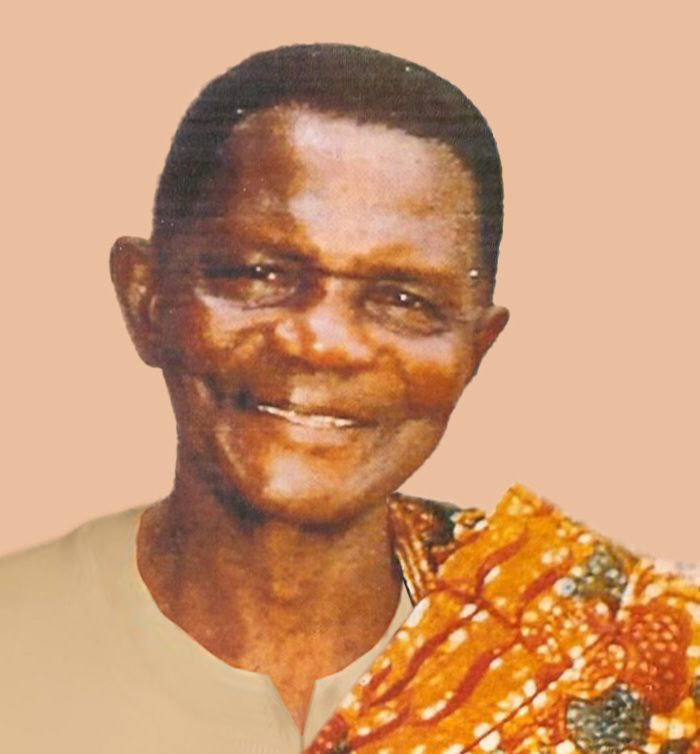
David Kwadwo Boadu (1918 – 2006), affectionately known as Wɔfa Kwadwo Boadu, was born on June 6, 1918, in Apirede - Akuapim. The offspring of Opanyin S. T. Boadu, affectionately nicknamed Kyame Lampoo from the Anyakode Clan, and Madam Lydia Odoi, fondly called Akua Kɔkɔ from the Akonede Clan both from Apirede Akuapim. As the first of ten children, young David demonstrated remarkable intelligence from an early age. He began his education at the Apirede United Primary School; however, due to an eye condition that resisted treatment, he had to discontinue his schooling after completing the third grade, although he did not lose his eyesight.
Kwadwo Boadu’s parents were prominent farmers who later moved to Kyekyeku in the Yilo Krobo District of the Eastern Region, where they acquired several acres of land to cultivate cocoa and various food crops. After leaving school, Kwadwo joined his parents in Kyekyeku, assisting with household chores and farming. Despite the disruption to his formal education, he demonstrated a remarkable capacity for self-directed learning, mastering reading and writing in three languages: Twi, English, and the Guan Language.
His intellectual pursuits extended beyond academics; he became an active member of the Boys Scouts of the Gold Coast, serving as a patrol leader and sounding the bugle to signal important directives. David Boadu's legacy in scouting lives on through his family. His son Geoffrey joined scouting and enrolled his two sons, who progressed from Cub Scouts to Boy Scouts, becoming Eagle Scouts and serving as counsellors. Now, as young adults, they're advancing in leadership roles within the scouting venturing crew, preserving their grandfather's passion for scouting and its values of character building, responsible citizenship, and self-resilience
In addition to his academic and leadership endeavours, Kwadwo Boadu excelled in sports, particularly football. He was known for his skilful play, often competing alongside W. A. Kumi and Odikro Obuobi. Kwadwo was celebrated for employing the “Korle Bu style” of play, while W. A. Kumi was known for his “Achimota style.”
Kwadwo Boadu was also influenced by his uncle, Opanyin Kwaku Obuobi, a respected herbalist in their village specialising in treating barrenness. Young Kwadwo, eager to learn, quickly absorbed the teachings of herbal medicine during his time assisting his uncle. Recognising Kwadwo's aptitude, his uncle publicly thanked him, stating, “You have picked up my profession faster than I expected. I bless you in the name of the Lord to undertake and practice herbal medicine forever.” This moment reflected the importance of herbal medicine in both the African context and globally, particularly during a time when it had prominence in the United States until the early 20th century shift led by modern medical practices.
As an adult, Kwadwo Boadu emerged as a handsome, intelligent, and respected individual. Upon reaching marriageable age, he fell in love with a gentle, fair-skinned lady named Abena Asabea. Following traditional customs, Kwadwo sought the permission of his parents to marry her, and they dutifully facilitated the required rites. The couple remained together, blessed with six children; three girls and three boys.
On February 3, 1965, Kwadwo Boadu obtained his license as a qualified midwife from the then Akropong Akuapem Local Council, now known as the Akwapim North District Assembly. His midwifery services extended well beyond the immediate community, with clients hailing from Nigeria, Burkina Faso, Côte d'Ivoire, Half-Asini, Tarkwa, Koforidua, Somanya, and throughout Ghana. The author can personally attest to his significant contributions, recalling, as told by his mother that his own birth was facilitated by Kwadwo Boadu, who revived him after a stillbirth by clearing phlegm from his nose, allowing his first cry!
The legacy of Wɔfa David Kwadwo Boadu remains woven into the fabric of Kyekyeku and beyond, as many parents have honoured him by naming their children after this distinguished person, who lived a life of respect and proficiency within his community.
2. Methodology
The methodology is qualitative, structured into three interconnected components, each aiming to provide a distinct perspective on his contributions and enduring legacy within the community.
2.1. Personal Observations
The first area of exploration is grounded in personal observations amassed during long visits to Kyekyeku, cumulatively about five years, where Wɔfa Kwadwo Boadu resides and contributes his efforts to human upliftment. These observations some of which are participatory, are focused on an array of daily activities, encompassing his interactions with members of his household, patients, and community along with his distinctive approaches to problem-solving. Meticulous observations are made of salient routines, events, behaviours, habitual practices, and value systems that characteristically define him.
These personal observations provide critical insights regarding Opanyin Kwadwo Boadu's unwavering commitment to community service, as well as his established role as a mentor and leader. As a direct observer, I have the distinct privilege of witnessing his diverse engagements firsthand. This includes his dedication to agriculture, herbalism, arbitration, and proactive community initiatives, which collectively highlights the transformative impact of his endeavours on the lives of individuals within the community. The rich qualitative data I gather from these observations inform the study's framework, establishing a foundational appreciation of his beliefs character and way of life.
2.2. Interviews with Community Members and Family
The second methodological component involve conducting in-depth, semi-structured interviews with family members and individuals from the community who share a connection with Opanyin Kwadwo Boadu. The intent of these interviews is to elicit personal narratives and perceptions that illuminate his multifaceted life—thereby offering a deeper understanding of his influence on the surrounding community.
The semi-structured format of the interviews facilitates open dialogue, allowing participants to articulate their thoughts and feelings without constraint. Through these narratives, rich insights emerge regarding Opanyin Kwadwo Boadu’s diverse roles—as a farmer, herbalist, minister of the Gospel, builder, arbitrator, and counsellor—demonstrating his integral part in community life. Respondents articulate memories emphasising his kindness, generosity, and unwavering dedication to community welfare, while family members reminisce about his nurturing disposition and affection towards his loved ones.
2.3. The Streamwrite
The third area of methodology employed in this study is the Streamwrite, which creatively captures the essence of Opanyin Kwadwo Boadu's life and contributions. This segment incorporates a range of literary instruments—including flash fiction, creative nonfiction, dialogue-driven scenes, metaphors, and poetry—to offer a layered and expressive exploration of his experiences, values, and the impact he had on his community.
Utilising the Streamwrite allows for an innovative reflection on Opanyin Kwadwo Boadu's life characterising it in a manner that transcends conventional academic discourse. This approach facilitated a rich narrative tapestry which encapsulates the complex emotions and profound themes that arise from both observational data and interview transcripts, enabling an often-heightened emotional resonance with the material. The emphasis on literary instruments illustrates the intricacies and richness of his life experiences, ultimately presenting a compelling case for understanding his enduring impact on those around him.
3. Limitations
Personal Observations: The reliance on personal observations presents inherent biases that may affect the objectivity of the data gathered. It has been noted that while participant observation enriches the researcher’s understanding, it is also subject to pitfalls of subjectivity, which can skew findings (Mwita, 2022) [7]. Additionally, as Mwita (2022) [7] stresses, there is a risk of the Hawthorne effect, which was not particularly the case though, where individuals alter their behaviour when they know they are being observed, leading to potentially less authentic data (Mwita, 2022) [7].
Interviews with Community Members and Family: While semi-structured interviews allow for open dialogue and rich narrative collection, they are susceptible to social desirability bias, where respondents may provide answers, they believe are more acceptable or favourable rather than their true feelings (Mwita, 2022) [7]. This limitation can affect the authenticity of the narratives provided by participants. Additionally, the qualitative nature of interview data can result in challenges concerning generalisability; the insights gained may not be transferable to other contexts or communities due to the non-representative nature of selected interview subjects, particularly if their relationships with Opanyin Kwadwo Boadu are closely tied to familial or personal connections (Mwita, 2022) [7].
The Streamwrite: Utilising creative literary methods such as flash fiction, poetry, and dialogue-driven scenes introduces additional layers of interpretation that may detract from the rigour expected in traditional academic discourse. The subjectivity inherent in creative writing can lead to varied interpretations of Kwadwo Boadu's life and contributions, wherein the artifice of storytelling may overshadow factual accuracy. Moreover, this methodology does not lend itself to systematic evaluation; while creative methods can enhance engagement, they may cloud critical analysis and understanding of the factual information surrounding Boadu's contributions (Mwita, 2022) [7].
4. The Many Faces of Kwadwo Boadu
The author frequently reflects on the remarkable endeavours of Wɔfa Boadu, often contemplating how such a high level of productivity could be achieved within a single lifetime. Inspired by this contemplation, I have longed to write a tribute that celebrates this extraordinary life, beautifully lived and richly experienced.
4.1. Husband and Father
Opanyin Kwadwo Boadu exemplified the role of a devoted husband and father throughout his life. He married Abena Asabea, a kind and beautiful woman whom he loved deeply. Recognising her interest in baking, Boadu went the extra mile to support her passion by extending their kitchen in order to create space for the construction of a large oven, laying the foundation for her baking venture.
Together, they raised six children—three sons and three daughters—instilling in them values of hard work, integrity, and community service. Boadu actively participated in their upbringing, ensuring they received a well-rounded education to become esteemed members of society. His enduring love and dedication to his family not only fostered individual success but also cultivated a legacy of positive contributions to their community.
4.2. Farmer
Kwadwo Boadu’s agricultural endeavours were predominantly centred on the cultivation of cocoa and a diverse array of food crops, which allowed him to provide essential nourishment not only for his immediate family but also for the wider community. His commitment to farming extended beyond mere subsistence; it positioned him as a linchpin within the agricultural economy of Kyekyeku in the Yilo Krobo District – Eastern Region. He contributed to food security and cultivated a sense of community through shared agricultural efforts.
4.3. Herbalist - Specialist in Infertility
Boadu's role as an herbalist and an accredited midwife considerably transformed the health landscape of his region. He administered countless individuals with traditional herbal remedies, demonstrating an acumen for natural medicine that resonated deeply within the community. Notably, he successfully handled over 3,500 deliveries, emerging as a vital healthcare provider during a transformative period for maternal care in Ghana. In fact, records available in his note-books indicate that he was able to “…cure 4,335 couples of infertilities and helped deliver 3,505 babies” (Biography, 2006) [8] His exalted status among his peers and clients exemplified the vital role he played in both traditional and modern healthcare paradigms, marking him an indispensable figure in the realm of health and wellness.
4.4. Hunter
Kwadwo Boadu, an excellent marksman possessed several collections of guns. In his bedroom, where honoured errands brought me few times, I counted five single-barrels and two double-barrel guns. His relationship with nature as a hunter further exemplified his multifaceted contributions as a provider. His nightly excursions into the bush emphasised a deep respect for the environment and a commitment to sustaining his family's dietary needs. These ventures not only ensured food security for his household but also reinforced community bonds through the sharing of his harvest.
4.5. Catechist, Preacher, and Musician
In the realm of spiritual leadership, Kwadwo Boadu distinguished himself as a prominent catechist and overseer of the Methodist Church in Kyekyeku. To enhance the worship experience in his local Assembly, he invested in an accordion, which he played in accompaniment to hymns and gospel songs, bringing a musical dimension to the services. His exceptional singing ability, characterised by a warm and resonant baritone voice, further enriched the spiritual atmosphere. His steadfast commitment to providing spiritual guidance was a true reflection of his personal faith, serving to strengthen community morals and foster unity. Through his preaching and teachings, he sought to instil core values such as kindness, generosity, and a spirit of service within the hearts and minds of those that attended to him. In doing so, he perpetuated a cycle of benevolence, inspiring others to contribute positively to their community.
5. The Builder and Arbitrator
5.1. Builder and Carpenter
Boadu's remarkable skills in construction were evident in various thoughtful projects he undertook, including his own home, which served as a welcoming sanctuary that embraced multiple generations. His architectural creativity transcended mere structural integrity; it encompassed a holistic design that fostered community gatherings and familial warmth. The spaces he created became more than mere physical structures—they were imbued with the spirit of togetherness and shared memories.
5.2. Arbitrator and Counsellor
As an arbitrator, Boadu played a pivotal role in resolving conflicts and fostering dialogue within the community. Through evening gatherings in his compound, he provided a safe space for discourse among community members, promoting harmony, understanding, and collaborative resolution of disputes. This practice helped to mend fraying relationships as well as also fortified communal ties, reinforcing the notion that, even conflict can lead to stronger bonds when approached with empathy and respect.
6. The Benevolent Boadu
6.1. Relationships with Family and Community
Boadu's impact extended far beyond his biological family; he embraced the role of caretaker for countless others within the broader community. This unique capacity to foster care and support created a strong ethos of collective responsibility, ensuring that no one felt abandoned or without resources. His relationships demonstrated a genuine commitment to nurturing, buttressing the idea that family can extend beyond blood ties.
6.2. Impact of His Benevolence
The resonance of Kwadwo Boadu's benevolence was felt throughout the community, manifesting itself in both tangible support and moral guidance. His acts of generosity significantly contributed to the socio-economic fabric of Kyekyeku, helping to alleviate hardships and instilling a profound sense of gratitude among those he assisted. His legacy as a beloved figure as father is deeply entrenched, not merely as a benefactor but as a pillar of strength and moral integrity.
7. Artistic Tribute
7.1. The Streamwrite
Prologue: In the heart of Kyekyeku, where the sun kisses the earth in a warm embrace, a man of many hats once walked. His name? Kwadwo Boadu—a name that resonates like the rhythmic beat of the drum, echoing the stories of a life splendidly lived. Let us venture into his world through prose and poetry, interlaced with dialogue and metaphor, honouring a legacy that transcends time.
1. Benevolent Father and Husband
In quiet moments, he cherished family—“Abena,” he whispers, taking her hand,“Together, we weave a legacy of love.”
His children laugh; their joy echo through time,“Father, you teach us to care—do you see?” spoke a daughter.“In every act of kindness,” he smiles, “we become more human.”Fatherhood is a garden: tended with love,Each child a flower blooming in the sun,Rooted in compassion, watered with wisdom.
2. Farmer
He tilled the rich Gold Coast soil, arms sturdy like ancient oaks.“Harvest is bountiful today, Abena,” he calls to his beloved wife,As he wipes the sweat from his brow. “These crops shall bring joy!”
The earth cradles his hands, teaching him patience and rhythm,Every seed planted is a promise—a hope for tomorrow,Kwadwo knows well the language of the land.A farmer's dream is a tapestry woven from dirt and rain,Each crop a vibrant thread—from cocoa blooms to cassava roots.In every harvest, he finds the pulse of life.
3. Herbalist and Midwife
At the break of dawn, the village stirs as his porch activates,“Come, dear woman,” he beckons, eyes full with wisdom,“For health is a treasure we must guard carefully.”
“Your child thrives in the womb, we see him soon” his words soothed,
“Nature whispers secrets. Together, we shall listen.”With herbs of green and remedies of the heart, he heals.“Doctor Boadu, can you cure my pain?” a sharp mother asked.“Pain is part of the journey, my friend,” he replies gently.“With care and herbs, we navigate these waters.”
4. Hunter
As twilight descended, he became a shadow,“Tonight, the forest sings,” he whispers, gun in hand.The night embraces him—whispering secrets of the hunt.
The moonlight reflects his determination,With nimble steps, he creeps silently through the brush,Each sound an invitation, every rustle a promise.A hunter is a poet, writing verses of survival—Each captured beast a stanza, each lonely dawn a brief interlude,His skill is a quiet dialogue with nature.
5. Catechist and Preacher
“Kwadwo, shall we gather the souls?” the church bell chime.With hands raised high, he speaks, “Faith is a river,That flows through the spirit, uniting us all.”
The congregation listen, eyes wide with dreams,“In unity, we rise like the sun at dawn,With love in our hearts, we chase away shadows.”“Reverend, your words ignite hope,” a woman mutter.“Hope is the kindling of our souls,” he replies,“Remember, every story we share is a candle in the dark.”
6. Builder and Carpenter
Wood became his canvas; he sculpted dreams into reality,“I will build a home where laughter dwells,” he declares.With every nail, each beam become a heartbeat,Welcoming all who sought the solace of family.A carpenter is a sculptor of memories—Transforming timber into legacy;Every room a chapter, every corner a whisper.
7. Arbitrator and Counsellor
Evenings bring wisdom, beneath the vast tent of stars,“Gather ‘round, let us resolve,” he beckoned,Voices mingle, stories unfold, healing begins.
“Conflict is like a storm; we must weather it together,”He listens—truly listens, his heart opens wide,“Let us find common ground—a harmony in debate.”“Do you think we can trust each other again?” an elder asked.“With patience, trust is born anew,” replied Kwadwo.“Let us sow seeds of understanding.”
8. Community Pillar
Upon the streets of Kyekyeku, Kwadwo stands,A rock for the weary, a beacon for the lost,His arms open like branches of the Odum tree.
“Together, we stand stronger than alone,” he proclaims,“Community is the embrace that holds us tight,We are threads in a vibrant tapestry of life.”“What will we do without you in our lives?” the linguist asks,“My spirit lives within each act of kindness,” he replies,“Carry my lessons forward; share love freely.”
9. Legacy of Art
As seasons change, so too does the tale,Art shall immortalise the essence of Kwadwo,Through strokes of paint and rhythms of words.
“Let us gather, to honour his spirit,” the village agrees,Every brushstroke a story, every note a memory,Celebrating the man who lived with multiplicity.Art is a river—flowing through the village,It carries stories on its current, reflecting life’s beauty,Kwadwo’s legacy—a vibrant splash upon its surface.
10. Conclusion
And so, in the heart of Kyekyeku, his spirit resides,Kwadwo Boadu—the Renaissance man of our day,A reminder that in multiplicity, we find our strength.
Through love and compassion, he forged a path,In every heart he touched, the seeds of kindness bloom,“Carry my spirit with you,” he whispers through time.In remembering Kwadwo, may we cultivate his garden,Nurturing the bonds that weave us together,Creating a legacy brighter than the sun’s embrace.
So here’s to the legacy, a life splendidly lived,A tribute to a soul who endlessly gives.In every heart, his spirit shall dance,For in his embrace, we all had the chance,
To rise, to shine, to savour the day—Kwadwo Boadu, forever we say,With voices united, hear this refrain:In the tapestry of life, his thread shall remain!
In honouring Boadu’s extensive legacy, the utilisation of artistic expression emerges as a dynamic tool for commemorating individuals who mould and shape the human experience. The artistic renditions of his life serve not only as a tribute to his multifaceted existence but also as a profound reminder of the collective identity that can be forged through communal efforts and shared values. These endeavours illustrate the power of art as a medium through which the essence of notable figures can be captured and celebrated.
7.2. Intersection of Art and Community
The approach of leveraging the arts to amplify Opanyin Kwadwo Boadu's diverse life intertwines historical legacy with contemporary identity, inviting the community to reflect on and engage with shared values and aspirations. Such artistic expressions not only enrich the narrative surrounding his life but also reinforce the importance of recognising and valuing individual contributions that collectively shape societal well-being. This concept is supported by Wehbi, who discusses the integration of creative arts within social work as a means to enhance engagement and tackle issues of social justice, thereby contributing to community health (Wehbi, 2017) [9]. Similarly, it has been recognised that the acknowledgment of personal narratives in artistic practices can foster deeper connections within communities, ultimately facilitating societal reflection and action (Hellreich, 2021) [10].
Through the confrontation and celebration of these narratives, we bolster the understanding of community dynamics and the human experience. For instance, Hellreich (2021) [10] established that art serves as a mode of transmitting and communicating lived experiences, empowering communities to express their unique identities and collective histories. Furthermore, Feiten et al. explore how artistic creativity can act as a catalyst for meaningful dialogue and cohesion within various social structures (Feiten et al., 2023) [11]. Such engagements deepen the understanding of how art not only reflects but also shapes community identities, highlighting the role of individual narratives in constructing a shared societal vision (Sjöqvist et al., 2020) [12].
8. Conclusion
Kwadwo Boadu's life serves as an exemplary case study in the enduring power of multiplicity and benevolence. His multitude of roles and avenues of contribution underscore how an individual’s identity can both shape and be shaped by the broader community context. As we take the time to reflect on his lasting legacy, it becomes increasingly vital to recognise and celebrate similar figures within our own communities to restore the essential humaneness that is rapidly dissipating from societal consciousness. Acknowledging and honouring individuals like Kwadwo Boadu, helps us affirm the core values of community, compassion, and multiplicity, forging a more humane society grounded in love gratitude and mutual respect for one another.
References
- Khalil R, Demarin V. (2023). Creative therapy in health and disease: Inner vision. CNS Neurosci Ther. 2024;30:e14266. doi:10.1111/cns.14266[CrossRef] [PubMed]
- Whitlock, K. (2011). Nurturing Creativity Through Cognitive Design Therapy. Design Management Review, 22(2), 42-49. doi:10.1111/j.1948-7169.2011.00142.x[CrossRef]
- Serlin, I. (2020). Dance/Movement Therapy: A Whole Person Approach to Working with Trauma and Building Resilience. American Journal of Dance Therapy, 42(1), 65-82. doi:10.1007/s10465-020-09335-6[CrossRef] [PubMed]
- Gustrén, M., Andersson, L., & Rösler, A. (2021). Artistic Means of Social Change: Arts-Based Interventions for Addressing Marginalisation in a European Context. Invisibilidades, 15, 2-14. doi:10.24981/16470508.15.2[CrossRef]
- He, Q. (2023). Multiple Expressions of Contemporary Visual Art. Art and Performance Letters, 5(1), 91-105. doi:10.23977/artpl.2023.040801[CrossRef]
- Wearring, D., Boshier, J., & Cummings, J. (2021). Pivoting post-pandemic: Not-for-profit arts and culture organisations and a new focus on social impact. Cosmopolitan Civil Societies: An Interdisciplinary Journal, 13(2), 1-15. doi:10.5130/ccs.v13.i2.7729[CrossRef]
- Mwita, K. (2022). Strengths and weaknesses of qualitative research in social science studies. International Journal of Research in Business and Social Science (2147- 4478), 11(6), 618–625. https://doi.org/10.20525/ijrbs.v11i6.1920[CrossRef]
- Biography (2006). Celebration of Life, Opanyin David Kwadwo Boadu Aged 88. A publication for the burial and funeral service – Apirede Akuapim.
- Wehbi, S. (2017). Ethics, Art, and Social Work. Canadian Social Work Review, 34(1), 77-91. doi:10.7202/1040994ar[CrossRef]
- Hellreich, C. (2021). Migration and Art: Exploring Experiential and Theoretical Connections. Ryerson University Press. doi:10.32920/ryerson.14654574.v1[CrossRef]
- Feiten, S., Steinberg, D., & Johnson, L. (2023). Constructive Constraints: On the Role of Chance and Complexity in Artistic Creativity. Possibility Studies & Society, 2(1), 98-115. doi:10.1177/27538699231193539[CrossRef]
- Sjöqvist, L., Lindgren, K., & Fagrell, B. (2020). The Arts: A Precious Part of Special Education? How Principals Value and Organise Arts Education in Compulsory School for Pupils with Intellectual Disability in Sweden. European Journal of Special Needs Education, 35(4), 460-474. doi:10.1080/08856257.2020.1764809[CrossRef]