

The main purpose of this study is to investigate students’ awareness, understanding and use of the information on care labels. Quantitatively, the study adopted a cross-sectional survey design. The population of the study comprised all the Family and Consumer Science students at the University for Development Studies, Nyankpala campus, Tamale. Morgan and Krejcie chart, was used to select 159 out 270 students. Data collected were analysed using IBM SPSS with descriptive statistics which included mean, standard deviation, frequencies and percentages. Findings of this study proved that students do not always use the information on care labels when purchasing and caring for clothes and cannot identify the symbols on care labels that do not directly link with their meaning. This study has practical implications for students by using the information on care labels when purchasing and caring for clothes. Students should likewise find ways of identifying the symbols even without their meanings. The Social Implication implications of this study also postulates that local clothes manufacturers should be encouraged to create their labelling schemes for care labels that will be peculiar to how Ghanaians care for their clothes as they exist in other countries. Organizations and bodies that formulate the symbols should make sure the shape of the symbols has a direct link with their meaning to aid in their understanding and usage.
Students’ Understanding and Use of Information on Care Labels on Clothes
March 12, 2023
April 21, 2023
May 26, 2023
June 26, 2023
This is an Open Access article, distributed under the terms of the Creative Commons Attribution 4.0 International License (http://creativecommons.org/licenses/by/4.0/), which permits unrestricted use, distribution and reproduction in any medium or format, provided the original work is properly cited.
Abstract
Introduction
Ready-to-wear clothes usually come with a label that spells out how the clothes need to be cared for. However, the findings of a study show that the majority of clothes made and worn locally by dressmakers and tailors in several parts of Ghana do not have any kind of label [2]. Clothes must be taken care of to lengthen their lifespan so that buyers get the greatest value for their money. Washing, drying, ironing, and dry cleaning are all aspects of caring for clothes, as are the right methods for storing and laundering. Knowing the precise fibre(s) from which a garment is manufactured is also required in order to properly care for it. If producers want their customers to be able to maintain their clothes, they must include thorough care instructions. These instructions must be written in a style and form that is easy for customers to read and comprehend in order to be effective. A researcher observed, some consumers completely remove the labels from the clothes because they find them to be bothersome and irritating, especially if they are sewn or affixed to the back neckline [3]. However, care instructions are now routinely written within knit clothes, near the neckline, thanks to current technology. For "itch-free" care labelling, this offers a durable solution [4]. The disadvantage of this labelling method is that regular washing can wash away the lettering and symbols. However, to be successful, a care label must remain legible for the whole life of the garment [5]. To help consumers properly care for their clothes, manufacturers add fibre content to the care label information. Instead of following the symbols or care instructions, several customers claimed to use their understanding of how to care for different types of fibres in clothes [6]. This means that producers must provide a brief description of the relevant fibre, specifically indicating how to care for it, in order for consumers to use the specific fibre in the care of their clothes. Also as observed by others, pieces of information on care labels, especially the symbols can be confusing at first glance, which makes some consumers ignore this information when caring for clothes [7].
Additionally, based on anecdotal data and first-hand experience, some people ruin the appearance and shape of clothes by using the wrong laundry method or procedure. These occasionally lead to damages like fading, clothes losing their shape, the surface of some woollen garments becoming shiny from the direct application of hot iron or from using the incorrect heat setting, and the bleeding of colours or dyes from one clothe to another, among other things. A study revealed that, if consumers go contrary to the instructions on care labels as a result of ignorance and negligence, the beauty and lifespan of the clothes can be affected [8]. This means that consumers need to understand the information and instruction on care labels to maintain their clothes. As a result of the aforementioned, it is very necessary to investigate whether consumers are aware of care labels and their importance as well as their knowledge and understanding level of the information on care labels, especially the symbols. Therefore, the objective of this study is to investigate Family and Consumer Sciences students’ awareness, understanding and use of the information on care labels.
The findings of this study are meant to assist local clothes manufacturers in creating their labelling scheme, especially with the symbols that will be peculiar to how Ghanaians care for their clothes as some countries have mandatory standards for care label instruction. Local clothes manufacturers will also use the findings to see the need to attach care labels to their products. They will likewise be helpful to Home Economics and Family and Consumer Science departments in various schools to intensify the teaching of the information on care labels. Last but not least, organizations and bodies responsible for the formulation of these symbols can use the findings to assess the effectiveness of the symbols.
1.1. Literature Review
Care labels are written instructions on pieces of fabric that are usually stitched to the inside of clothes or other items. Labelling, in the opinion of a researcher is also regarded as a form of communication between the producer or maker and the consumer [9]. They might be sewn to the back neckline, side seams, or waist seam of the garment [10]. These labels are seen as a simple and approachable way to notify customers about clothes, including the size, fibre content, and care recommendations [11]. Additionally, the care label code is simply expressed by visual symbols for washing, bleaching, tumble drying, ironing, and dry cleaning [12].
The care label's main function is to provide comprehensive instructions for handling the item. These include knowing how much it will cost to maintain the goods, particularly if they have to be sent to a dry cleaner, how to clean the clothes items (certain cleaning techniques to use), and how to avoid damage [13]. The fibre composition, suggested washing methods, brand name, and country of origin are only a few of the details listed on care labels [14]. Some of these instructions or informational presentations employ symbols. Due to people's increased awareness of the products they use and wear, as well as the abundance of information available to consumers on how to meet their clothing needs, care labels should not only become more practical but also easier for customers to understand [15, 16].
Below are examples of care labels: (Source: [13])
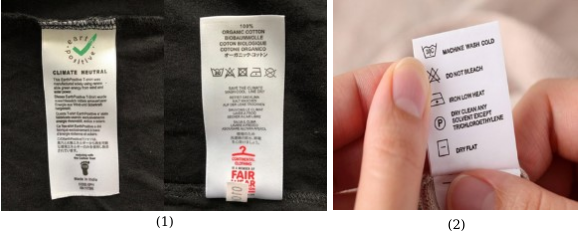
Plate 1 displays a care label with symbols that have no meaning attached to them. The care label in Plate 2 includes care symbols and their meanings. Care labels with symbols and their meanings are advised for effectiveness and for consumers' better understanding [12]. For instance, the first instruction on Plate 2 is "machine wash cold," which would be difficult for the average person to understand if it weren't written down.
Additionally, for symbols such as 


 . which means hand wash, any bleach (when needed), tumble dry (normal, low heat) and iron (low) respectively, a consumer without a Clothes and Textile background will find it difficult to use such information. Symbols that are employed in conjunction with words have a deeper meaning [17]. Care labels belong to the category of symbols known as cognitive/perceptual symbols [18]. A study categorises perceptual symbols as modal because there may be no connection between their structure and perceptual state or meaning [19]. As a result, not all of the symbols used correspond to their intended meaning, such as the symbol for "tumble dry" which is a square with a circle inside it.
Customers should carefully read and analyse the instructions on care labels before making a purchase. The majority of Canadian consumers read the care label before purchasing and caring for clothes, according to research [20]. However, shopping wisely will lead to the acquisition of clothes of superior quality. This entails taking into account both the intended usage of the item and the level of maintenance it will require, which may be established by reading the care label [21]. Another finding found that women use care label information more frequently while purchasing clothes [20]. This is probably due to the fact that women or female household members are often in charge of laundry and clothes maintenance at home.
According to other studies, consumers may not understand and use the information on care labels at a high enough rate [22, 23]. A study involving housewives found that respondents were able to identify the washing and ironing symbols but were not able to identify the bleaching and drying symbols [12]. If customers are unable to interpret those symbols, they will find it difficult to understand and use the information which could affect the longevity of the clothes. Furthermore, researchers contend that customers would experience less worry while purchasing a product if they were well informed about it and confident in their abilities to take care of it [24].
2. Materials and Methods
2.1. Research design
The study was quantitative in nature and gathered data through a cross-sectional survey design to achieve the aim of the study. Descriptive statistics were used to analyse the primary data.
2.2. Sample and sampling procedure
The target population consisted of all Family and Consumer Sciences students at the University for Development Studies, Nyankpala campus. This was made up of 270 students. Strengthening individual and family well-being across the lifespan is one of the objectives of Family and Consumer Sciences education. Since its inception, this discipline has been focused on applying knowledge to raise individual and family standards of living [25, 26]. Students studying Family and Consumer Sciences take courses in Clothes and Textiles that cover fibres with a variety of characteristics and methods of care. As a result, they are expected to comprehend the meanings of the symbols found on care labels and apply them to the maintenance of their clothes. Using Morgan and Krejcie’s chart, the sample size adopted for the study was 159 [27].
2.3. Instrument for collecting primary data
The instrument adopted for the study was a seven-item questionnaire. This included a five-point Likert scale ranging from strongly agree, agree, not sure, disagree and strongly disagree as well as a descriptive table where respondents were asked to give or write the meaning of the symbols on care labels. The instrument was used to seek information on the awareness level of the students on care labels, their understanding level of the information on care labels (especially with the symbols) and whether as consumers, they use the care label information in caring for their clothes. This was divided into four sections. Section ‘A’ asked for the demographic information of respondents such as gender, age, marital status and qualification. Section B assessed students’ awareness as well as their usage of the information on care labels. Section C examined students’ perception of care labels and lastly, Section D assessed students understanding level of the information particularly the symbols on care labels. Students were provided with the symbols and their meanings and were made to write the meaning of those symbols beside them. The content and face validity of the questionnaire were established with the assistance of colleagues in the Department of Family and Consumer Sciences, the Faculty of Agriculture, Food and Consumer Sciences, University for Development Studies. Their comments and suggestions were incorporated to make the instrument valid before pretesting it. The questionnaires were administered in person to respondents because this gives the researcher an opportunity to establish rapport and explain terms that are not clear to respondents [12].
3. Results
3.1. Demographic Characteristics of the Students
The demographic characteristics of the students were investigated. These included gender, age, marital status and level. The results of the analysis are presented in Table 1.
The findings in Table 1 reveal that more females (84.3%) than males (15.7%) participated in this study with more of the respondents between the age range of 17-22 (71.7%). Also, there was a fair representation of all the Department of Family and Consumer Sciences levels with 27.0% from level 100, 20.1% from level 200, 27.7% from level 300 and 25.2% from level 400.
3.2. Students’ usage of care labels
3.2.1. Students’ awareness of care labels on clothes
Students were asked to state whether they are aware of care labels on clothes. The results are presented in Table 2.
The results in Table 2 show that most students (76.7%) are aware that clothes have care labels attached to them even though some students (11.9%) were not sure whether clothes have care labels. However, 11.3% of the students do not know there are care labels on clothes.
3.2.2. How often students use the information on care labels when purchasing clothes
The researcher further investigated how often students use the information on care labels when purchasing clothes. The results are presented in Table 3.
The findings in Table 3 revealed that quite a number of the students (49.1%) use the information on care labels once in a while when purchasing clothes. 22.0% and 10.7% sometimes and always use the information respectively when making purchases whiles 8.2% never use the information.
3.2.3. How often students use the information on care labels when caring for clothes (washing, drying, ironing, dry cleaning).
Students were asked to state how often they use the information on care labels when caring for clothes and Table 4 presents the findings.
Table 4 revealed that almost half of the students (49.7%) sometimes use the information on care labels when caring for clothes with 19.5% using the information once in a while. Some of the students (15.1%) were not sure whether they use the information with 5.7% never using the information when caring for clothes.
3.3. Students’ attitudes toward care labels
Students were asked to state what they do to care labels on clothes, whether they cut them off or keep them, the results are presented in Table 5.
The findings in Table 5 showed that most students (74.8%) keep the care labels on clothes with quite a few (25.2%) cutting them off.
3.3.1. Students’ understanding of the information on care labels
Students were asked whether they understand the information on care labels. The results are presented in Table 6.
Table 6 revealed that more than half of the students (57.9%) admitted that they understand the information on care labels even though 42.1% do not understand them.
3.3.2. Students’ perception of care labels on clothes
Table 7 shows the results of the perceptions of students on care labels on clothes.
From Table 7, it can be seen that most students with a mean score of 1.50 and 1.94 agree that care labels are very important and provide all the necessary information needed to care for clothes respectively. However, students with a mean score of 2.53 were not sure it is easy to understand the information on care labels whiles care labels not being seen as a cause of irritation scored a mean of 2.45 which was also moving towards not sure. Also, most students with a mean score of 3.21 were not sure whether all the clothes they buy have care labels.
Based on Table 8, the percentages of students who were able to give the correct meaning of the symbols are presented in Table 9. These are arranged according to the symbols with the highest percentage.
The findings in Table 9 revealed that most students could identify the symbols such as do not wring (84.9%), hand wash (79.9), do not iron (79.2%), iron (high) (78.6%), do not wash (74.2%), do not steam (71.7%), iron (low) (71.7), iron (medium) (69.8%), only chlorine bleach is allowed (67.3%), iron in any temperature (steam or dry) (66.3%), do not dry clean (56.0%) and machine wash (cold) (50.3%). However, symbols such as only non-chlorine bleaching is allowed (40.9%), dry clean (40.9%), tumble dry (40.3%), bleaching is allowed (37.7 %), machine wash (warm) (34.0%), do not tumble dry (30.2%) and line dry (25.2%) were not identified by most students.
4. Discussion
More females participating in the study affirm that the majority of universities’ Family Science courses such as Family and Consumer Sciences and Family Studies are female dominated [28, 29].
Based on the results of this study students are aware that clothes have care labels attached to them which is encouraging and is in line with the result of the third European barometer for care labelling by GINETEX which showed that 74% of Europeans never or rarely buy a garment without a care label. Awareness of an item is paramount to the usage of that item [30]. Most students being aware that clothes have care labels is good because it can influence their usage.
The results of this study show that even though students are aware that clothes have care labels, most students do not always use the information on care labels when purchasing clothes but rather use them once in a while which is contrary to the findings of other studies [20]. If students do not read or use the information during a purchase, they will not know whether they will be able to give the required treatment or care for the clothes. Also, examining and reading care labels before purchasing clothes will result in purchasing high-quality clothes because the clothes intended usage and the level of maintenance they will require will be known [21].
Based on the results, it can rightly be said that students do not always use the information on care labels when caring for clothes which is contrary to a similar study showed that the majority of Canadian consumers (63.1%) always use the care labels when maintaining clothes [20]. This can affect the treatment that is mostly given to clothes which can likewise affect the lifespan of clothes and their durability.
Based on the results, it can be seen that most students do not cut the care labels off but rather keep them which can help them in caring for their clothes. Basically, some consumers cut the care labels because they find it to be a cause of irritation which is not the case for respondents in this study [3]. Additionally, most European consumers cut off their clothes labels while most British prefer to keep them [30]. This goes to show that consumers have different ways of reacting to care labels on their clothes.
Understanding the information on care labels is very important because for students to be able to use the information, they need to understand the information. However, the percentage of students who admitted that they do not understand the information shows that much education is needed to help such students. Previously other studies showed that the rate at which consumers comprehend the information on care labels may be low [22, 23]. However, respondents in this study proved otherwise. If consumers understand the information on care labels, they would be more at ease to purchase their clothes [24].
Based on the results, it can be said that students have positive perceptions of care labels. They see care labels to be very important like most Europeans [30]. However, some students did not see the information on care labels to be easy to understand since they were not sure with regards to that perception. Nevertheless, for a label to be effective, it needs to be understandable [31]. Students likewise did not see care labels as a cause of irritation, others reported that keeping the care label on their clothes is unclear [16]. Students are not sure whether all the clothes they buy have care labels which also explains why they reported not always using the information on care labels when purchasing clothes, unlike Europeans who never buy clothes without care labels [30].
From the results, it can be seen that the shape and structure of the symbols affect the understanding of consumers. This is because students were able to identify symbols that have a direct bearing on their meaning, for example, the symbol which means do not wring, which has the shape looking like something which is being wrung and crossed, showing that it is a warning sign; the hand wash symbol has a hand in a basin; the iron high symbol which has an iron with three dots which can be differentiated from the ones with one and two dots; do not wash symbol which has the basin crossed which proved that it is a warning sign regarding washing. The results of studies showed that consumers see many of the symbols as not intuitively linked to their meaning which makes them unrecognizable and that they prefer care labels that are written out in words [20, 30]. This goes to show that care labels should not only be in symbol form but be attached to their meanings, because symbols that are used in conjunction with words have a deeper meaning [12, 32]. Consumers should be able to get the meaning of the information on care labels and easy to understand [15]. As a result of consumers’ inability to understand the meaning of all the symbols on care labels, GINETEX has developed a mobile application known as "MY CARE LABEL" to help Europeans to understand the symbols on care labels [30].
5. Conclusion
Care labels are necessary for maintaining the quality of clothes and to get the most out of them, consumers need to have a better understanding of all the information on them including the symbols. The study involved all Family and Consumer Sciences students which included students who have no Home Economics background as such they had no idea about the information on care labels. Also, all the levels have their different schedules which affected the data collection period.
Based on the findings of this study, it can be concluded that the students are aware of care labels on clothes but do not always use the information on care labels when purchasing and caring for clothes. This can also mean that they do not care for their clothes using the right method which can affect the life span of their clothes even though they keep the care labels on their clothes.
Additionally, the students agree that care labels are important and provide all the necessary information needed to care for clothes but are not sure whether it is easy to understand the information on care labels, that they are a cause of irritation and whether all the clothes they buy have care labels. This likewise explains why the students do not always use care labels when purchasing clothes because they do not inspect clothes to ascertain whether they have care labels or not.
The students were able to identify the symbols that have a link with their meaning. This means that the students were not able to identify some of the symbols which can affect their usage. If students in the Family and Consumer Sciences department are not able to identify these symbols, then it is likewise going to be difficult for students in other departments to do so. This likewise may be partly a reflection of the general consuming public in Ghana.
Practical and Social Implication: Based on the findings of this study, local clothes manufacturers should be encouraged to formulate mandatory standards or their scheme for labelling for care labels that will be peculiar to how Ghanaians care for their clothes as they exist in other countries. Organizations and bodies that formulate the symbols should make sure the shape of the symbols has a direct link with their meaning to aid in their understanding and usage. Better still, the symbols should always come with their meaning. Teachers at all levels should also be encouraged to use seminars and other means to educate students on the information on care labels, especially the symbols. The Family and Consumer Sciences Department should encourage students to always use the information on care labels when purchasing and caring for clothes. Students should also be encouraged to educate other students about care labels since they have positive perceptions of care labels.
Author Contributions: Conceptualization, AB and BED; methodology AB and BED; validation AB and BED; formal analysis, AB and BED.; investigation, AB and BED; resources, AB and BED; data curation, AB and BED; writing—original draft preparation, AB and BED; writing—review and editing, AB and BED; visualization, AB and BED; supervision AB and BED,; project administration, AB and BED; All authors have read and agreed to the published version of the manuscript.
Funding: “This research received no external funding”
Data Availability Statement: Data is available on request from the corresponding author.
Acknowledgments: we acknowledge the participants in this study.
Conflicts of Interest: “The authors declare no conflict of interest.” “No funders had any role in the design of the study; in the collection, analyses, or interpretation of data; in the writing of the manuscript, or in the decision to publish the results”.
References
- Berger, J. (2017). Are luxury brand labels and “green” labels costly signals of social status? An extended replication. PloS one, 12(2), e0170216.[CrossRef] [PubMed]
- Esseku, J. F., & Duku, F. K. (2020). Clothes brand label: the case of Ghana. International Journal of Creative Research Thoughts, vol. 8, no. 8.
- Newman, C. L., Burton, S., Andrews, J. C., Netemeyer, R. G., & Kees, J. (2018). Marketers’ use of alternative front-of-package nutrition symbols: An examination of effects on product evaluations. Journal of the Academy of Marketing Science, 46, 453-476.[CrossRef]
- Byrd, S. (2000). Clothes and Textiles project area guide- Beginner, Family and Consumer Sciences 4-H Series, The University of Tennessee.
- Ghosh, S. K., Das, A. B., & Bhattacharyya, R. (2014). Care label issues of silk fabric. International Journal of Research in Engineering and Technology, vol. 3 no.7, pp. 176-179.[CrossRef]
- Feltham, T., & Martin, L. (2006). Apparel care labels: understanding consumers' use of information. Marketing, 27(3), 231-244.
- Ali, S., & Latore, S. (2021). How to Read Clothing Care Labels. Available at How to Read Clothing Care Labels: 15 Steps (with Pictures) (wikihow.com). viewed 5 June 2023
- Das, S. (2008). Indian Silk. Indian Journal of Natural Products and Resources, vol. 47, no. 1, pp. 19-21.
- Petrescu, M., & Krishen, A. S. (2018). Novel retail technologies and marketing analytics. Journal of Marketing Analytics, 6, 69-71.[CrossRef]
- Forster, P. (2014). Clothes and Textiles. Accra-North, Ghana: Winmat Publishers Ltd.
- Shin, S. (2000). Consumers’ use of care-label information in the laundering of apparel products. The Journal of the Textile Institute, vol. 2 no. 1, pp. 20-28.[CrossRef]
- Mupfumira, I. M., & Jinga, N. (2013). An investigation into care-label knowledge on textile products by Chesvingo residents in Masvingo Zimbabwe. Journal of Studies in Social Sciences, 3(1), 80-100.
- Sewport Support Team, (2022). Garment labelling requirements for clothes (full guide).Available at https://sewport.com/learn/garment-labelling-and-requirements, viewed 12 December 2022.
- Gavor, M. E., Ampong, I., & Tetteh-Cofie, D. (2014). Clothes and Textiles for schools and college. Legon, Accra: Adwinsa Publications (Gh) Ltd.
- Kiron, M. I. (2021). Care label and care symbol guidelines for garments. Available at https://textilelearner.net/care-label-guidelines-forgarments/, viewed 13 February 2023.
- Burton, O. (2018). How to understand your clothes labels and why it’s important. Available at https://ecowarriorprincess.net/2018/07/how-to-understand-your-clothes-label-and-why-its-important/, viewed 17 January 2023.
- Rahman, O., Fung, B. C., Chen, Z., & Gao, X. (2017). A cross-national study of apparel consumer preferences and the role of product-evaluative cues. Asia Pacific Journal of Marketing and Logistics.[CrossRef]
- Komasi, S. E. (2018). Clothes care and management practices of senior members in the University of Cape Coast (thesis). University of Cape Coast: Sam Jonah Library.
- Barat, A. H. (2007). Human perception and knowledge organization: visual imagery. Library Hi Tech, vol. 25, no. 3, pp. 338-351.[CrossRef]
- Feltham, T. S., & Martin, L. A., (2006). Apparel care labels: understanding consumers’ use of information. University of Manitoba. Available at https://ssrn.comabstract=1809865, viewed 01 March 2023.
- Baker, M. M. (2007). Clothes repair (CT-MMB147). University of Kentucky- College of Agriculture.
- Davis, L. L. (1987). Consumer use of label information in rating of clothes quality and clothes fashionability. Clothes Textile Research Journal, vol. 6, no. 1, pp. 8-14.[CrossRef]
- Lim, S. J. (1978). Study of consumers’ interest in garment label. Journal of Korean Society of Clothes and Textiles, vol. 2, no. 2, pp. 19-28.
- Yan, R., Yurchisin, J., & Watchravesringkan, K. (2008). Use of care labels: linking need for cognition with consumer confidence and perceived risk. Journal of Fashion Marketing and Management, vol. 12 no. 4, pp. 532-544.[CrossRef]
- Laster, J., & Johnson, J. (2001). Family and Consumer Sciences, in Curriculum Handbook, Association for Supervision and Curriculum Development, Alexandria, VA:
- Vail, A., Fox, W. S & Wild, P. (2000). Leadership for change: national standards for Family and Consumer Sciences, in Family and Consumer Sciences Teacher Education Yearbook 20, Peria, IL: Glencoe/McGraw-Hill.
- Morgan, D. W., & Krejcie, R.V. (1970). Determining Sample Size for Research Activities, Educational and Psychological Measurement.
- Darling, C. A., & Cassidy, D. (2014). Family life education: working with families across the lifespan (3rd ed.). Long Grove, IL: Waveland Press.
- Olson, R. (2014). Percentage of bachelor’s degrees conferred to women, by major (1970–2012). [Blog post], Available at http://www.randalolson.com/2014/06/14/percen tage-of-bachelors-degrees-conferred-to-women-by-major-1970-2012/, accessed 1 March 2023.
- GINETEX: The International Association for Textile Care Labelling, (2021). Textile care: environmental concerns now central to Europeans new habits. The third European IPSOS barometer for 2021.
- Petrescu, D. C., Ioan, I., Bran, F., & Rădulescu, C. V. (2016). Clothes label and ecological label: a missed opportunity or a powerful tool in the marketplace? Industria Textila, vol. 67, no. 6, p. 413.
- Kadolph, P. (1993). Textile Technology. London: McMillan Education Ltd.