

This charge-ahead paper suggests that transitioning the automotive industry towards a zero-carbon ecosystem from material to end-of-life can be accomplished through disruptive zero-carbon manufacturing in the broad area of all-electric vehicle production technology. To accomplish zero carbon emission automotive manufacturing in the vehicle assembly domain, future paradigms must converge on the decoupling of carbon dioxide emissions from automobile manufacturing and use the design, processing, and manufacturing conditions. The envisioned zero carbon emission vehicle manufacturing domain consists of two complementary components: (a) making more efficient use of energy and (b) reducing carbon in energy use. This paper presents the status of key scientific and technological advancements to bring the manufacturing model of today to a zero-carbon ecosystem for the entire automotive industry of tomorrow. This paper suggests the groundbreaking application of dynamic and distributed predictive scheduling algorithms and open sensing and visualization technology to meet the zero carbon emission vehicle manufacturing goals. Power-aware high-performance computing clusters have recently become a viable solution for sustainable production. Advances in scalable and self-adaptive monitoring, predictive analytics, timeline-based machine learning, and digital replica of cyber-physical systems are also seen co-evolving in the zero carbon manufacturing future. These methods are inspired by initiatives to decouple gross domestic product growth and energy-related carbon dioxide emissions. Stakeholders could co-design and implement shared roadmaps to transition the automotive manufacturing sector with relevant societal and environmental benefits. The automated mobility sector offers a program, an industry-leading example of transforming an automotive production facility to carbon neutrality status. The conclusions from this paper challenge automotive manufacturers to engage in industry offsetting and carbon tax programs to drive continuous improvement and circular vehicle flows via a multi-directional zero-carbon smart grid.
Zero Carbon Manufacturing in the Automotive Industry: Integrating Predictive Analytics to Achieve Sustainable Production
July 09, 2023
September 27, 2023
October 29, 2023
November 16, 2023
This is an Open Access article, distributed under the terms of the Creative Commons Attribution 4.0 International License (http://creativecommons.org/licenses/by/4.0/), which permits unrestricted use, distribution and reproduction in any medium or format, provided the original work is properly cited.
Abstract
1. Introduction
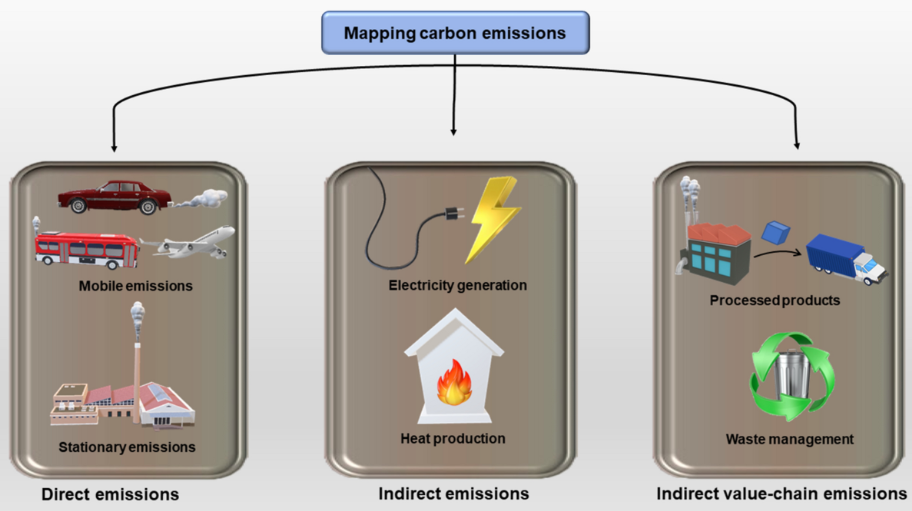
Automotive production contributes a significant proportion of carbon emissions, and as such, there is an ever-increasing need to reduce and ultimately eliminate carbon output from the manufacturing process. At the operational level of a modern, complex manufacturing system, many small inefficiencies can add up to contribute to significant energy use. This chapter serves to illustrate the increasing need to address carbon emissions within automotive manufacturing operations. Reducing energy use and carbon emissions requires the assessment and management of energy consumption at all levels within the manufacturing process. This in turn requires the accurate prediction and estimation not only of anticipated energy requirements but also provides the capability for complex decision-making about how variation in product and process conditions can be controlled to moderate and optimize both manufacturing process energy demand, as well as manage the available renewable power supply [2].
Traditional methods of facility energy models create a disparity when assessing complex manufacturing operations as they estimate energy demand based upon factors such as direct meter readings, static models, statistical and aggregate data, and models based on historical usage behavior across all elements of a sector. However, the inherent heterogeneity of manufacturing operations means that such aggregate models lack the sophistication to evaluate or predict energy demand at the operational level, opting for a high-level perspective instead. This cohort is interested in achieving zero carbon manufacturing, and the in-depth visibility obtained from individual operational energy models provides a crucial role in understanding the necessary system capability to track and minimize manufacturing energy demand at a process level. The practical solution is enabling companies to predict within a sufficient level of detail the energy requirements of their manufacturing operations and adapt these according to an ever-changing energy-consuming process. Therefore, the application of a predictive model is of utmost importance not only for zero carbon manufacturing aims but also for production management and optimization needs [4].
1.1. Background and Significance
The use of technologies, such as robotics and automation, in concert with mass customization and compact modular production, allows for an innovative zero-carbon approach to be adopted within current and potentially new manufacturing systems. The zero carbon approach changes industry focus from carbon price and seeking to reduce energy costs within production to one where the purpose is to do business without making a negative impact. This fundamentally changes the manufacturing model from one that aims to improve carbon efficiency to a business model that has zero carbon ambition by default. This outlines the integration of the existing manufacturing via wireless and sensor technologies with big sensors, social media, predictive, and advanced analytics; and big data methods to enable individual sector roadmaps for the implementation of zero carbon production methods [1].
The paper has seven main sections. The first provides background on zero carbon production. The second identifies challenges for big data methods in industry, and these are used to guide the discussion in the case of key enabling technologies that will allow for the development of zero carbon manufacturing roadmaps for key industry sectors. These two sections are then used to articulate the conceptual framework and demonstrate its use in a case study of the automotive industry. A final section concludes and outlines areas for future work [3].
1.2. Research Objectives
Description: The aim is to integrate and develop predictive analytics tools to optimize low-carbon manufacturing in Witty Gigafactory grants. Witty develops advanced processing techniques for thermoset resin composites. In this largest funding phase, the company has identified a growing market and a need for resource-efficient manufacturing processes that will truly enable cost-efficient scalability. The technology uses existing types of thermoset materials that are available in abundance for a relatively low cost. These materials are more easily recyclable and less hazardous in use and disposal than metals, thermoplastics, or other reinforcing chemistries typically used in composites. However, incumbent process techniques have so far failed to establish significant positions within the global fiber-reinforced polymer market because they have only been able to deliver small quantities in a slow, labor-intensive, and therefore expensive way. The process of manufacturing very large quantities at very low costs is called massive manufacturing, and therefore the construction of large component structures of a massive production line is called the establishment of a gigafactory [6].
Modeling and smart control aim to implement zero-carbon and low-cost manufacturing within a realistic time frame that would provide access to significant market opportunities to sell as many composite rebar product tons as can be manufactured in gigafactories. As a key research goal, predictive analytics tools such as applied mathematics, algorithm development, and data mining are used to establish a scalable process and to design equipment capable of producing ultra-fast welding speeds. The goal is to set ambitious targets to achieve zero-carbon and low-cost manufacturing in new groundbreaking automated process lines that will be demonstrated for the use of highly durable sustainable concrete reinforcement and packaging for goods [5].
Equation 1: Carbon Footprint Calculation
The total carbon footprint (CF) of the manufacturing process can be represented as:
Where:
= Total Carbon Footprint (kg CO2)
=Energy consumption of process (kWh)
= Emission factor for process (kg CO2/kWh)
= Total number of processes
2. Zero Carbon Manufacturing in the Automotive Industry
The global automotive industry is fast approaching a fundamental transformation. Over the last 30 years, manufacturing agility and productivity have dramatically increased, where sophisticated automation and technology have optimized operations to deliver a substantial reduction in the carbon footprints of finished vehicles. Innovative manufacturing processes, integrated with advanced supply chains, have rapidly transformed from a point where automotive manufacturing plants were major pollutants 30 years ago to today, where a plant’s carbon intensity in producing a vehicle has been reduced by more than 40%. Looking into the future, to address customer and legislative demands, the vehicle industry’s advanced engineering projects are committed to continuous improvement on the journey to achieving zero carbon production processes, where the manufacturing of every part and their delivery to the production line have been completely decarbonized. Consequently, to achieve zero carbon manufacturing, we are dedicated to the strategic trend that will shift all production to operate on sustainable power platforms to avoid the need for offset carbon compensation [8].
In the broader context, a prototypic 'zero carbon economy' can only be achieved when the national level manufacturing material inputs become 100% sustainable and non-finite resources will either be replaced or eliminated from use, for example, plastic components are manufactured by engineered plants. With the established overarching objective to provide environmentally benign and efficient manufacturing operations that do not generate emissions relative to the size or scale of operations, the strategy to accomplish this task has been founded on the implementation of the principles of the circular economy and the deployment of a range of advanced production technology and systems coupled with comprehensive data analytics. The challenge for the automotive industry will be to meet and exceed their customers’ high expectations for agility, ease of ownership, and comfort, while at the same time adopting compelling innovative, and practical 'green' solutions, able to truly ensure the long-term sustainability of their operations and products, aligning with the achievement of the zero-carbon status [10].
2.1. Current State of Carbon Emissions in Automotive Manufacturing
Direct manufacturing of automotive products, such as body, chassis, and powertrain, accounts for the majority of emissions in the sector. In this context, the lifespan approach to vehicle production chain emissions details the important role that the materials used play in influencing the amount of emissions, and it has been found that aluminum causes the least embedded emissions due to its lower density. With the demand for EVs increasing, the question of long-term sustainability due to the substantial energy and mining resources needed to produce batteries has also been raised. An alternative way to decrease energy use and emissions from the production of internal combustion vehicles, as well as from that of EVs, is to switch to zero-carbon manufacturing [9].
Ironically, an answer to the potential sustainability challenge is the fact that high-energy-producing automotive manufacturing plants in regions that have a high average share of low-carbon power production can switch to zero-carbon manufacturing much more readily. With the share of low-carbon electricity projected to increase over time, the opportunity for automakers to become zero-carbon manufacturing-ready is growing. The purpose of this paper is to take a step toward the realization of that goal. We use a comprehensive review of automotive manufacturing performance metrics to help develop a predictive model that can provide near-real-time insight into the energy dynamics and costs of making automotive production zero carbon [43]. We then analyze the performance of one state-of-the-art power electronics manufacturing facility by comparing actual energy use data with the insights gained using our model. We hope that this research can help pave the way for increased interest in and adoption of these value-enhancing activities within automotive manufacturing supply chains, enabling businesses to become better prepared over time to react to the inevitable increasing stringency of carbon emissions goals [12].
2.2. Challenges and Opportunities for Zero Carbon Manufacturing
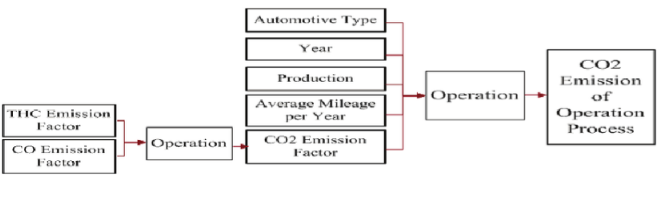
Given that the majority of automotive manufacturers' carbon emissions result from combustion during paint curing, body framing, body pressing, and plastic molding, in the short term, manufacturers may attempt to mitigate other emissions. For instance, optimization at body framing lines or direct interaction with the grid operator to avoid high emission times for painting could drive a reduction in the carbon footprint of the supply chain [42]. However, these emissions are still linked to electricity usage. At best, lockdown offers a one-off reduction based on last year's power generation, with no direct influence on future patterns. It is the rapid production ramp-up post-lockdown that enabled local grids and power producers to manage electricity demand and reduce reliance on the most carbon-intensive sources such as coal-fired power stations. While these interventions reduced the carbon intensity associated with electricity usage, there is no immediate prospect of offering that as a longer-term answer within the current use of electricity outlined above [11].
Despite their large carbon footprint, the relationship and authority of the large OEMs over their suppliers could enable them to compel subcontracted operations to adopt cleaner technologies at the OEMs' expense if that technology provides other benefits such as reduced power usage, increased flexibility, and more efficient use of space. Uptake of these manufacturing technologies, including virtualizing operations to minimize intercontinental travel, constructing environment-tailored production planning tools, and involving bidders who offer best-in-class solutions for the opportunity at the project and detailed design in the review of overall strategies, optimizing climate control systems, and the economies offered by technologies deployed in collaborative robotization projects with augmented reality for teleoperations would provide knock-on improvements about supplier environmental standards. To be successful, such activities may be presented as part of the story of corporate social responsibility, in addition to or instead of an investment in low-carbon technologies.
Equation 2: Emission Reduction Target
To achieve zero carbon emissions, the reduction in emissions (R) can be defined as:
Where:
= Current carbon footprint
= Target carbon footprint (ideally 0)
3. Predictive Analytics in Manufacturing
3.1. Implementing Predictive Analytics in Manufacturing
Predictive analytics involves a process that can be used to predict which process parameters have major influences on the performance of the process and to identify influencing factors to target. This represents controlling and using the process variables within target design specifications to guarantee quality output. Vast amounts of data throughout the manufacturing process are collected from multiple sensors that are employed within the manufacturing environment [41]. The data that is collected is used to enhance decision-making and provide insight. Thus, conditions that indicate a future problem will ultimately prevent it from taking place. The maintenance of equipment and resources becomes more effective and can be represented by condition-based monitoring. This modifies a time-based method to regular maintenance schedules or on the performance of a device. Therefore, condition-based monitoring provides real-time functionality, which is beneficial in maintaining performance standards and detecting any potential process issues. The use, adoption, and benefits of these specific methodologies in several industries are discussed below [13].
3.2. Predictive Analytics in the Manufacturing Industry
Also, the benefits of implementing predictive analytics in different industries are analyzed. As indicated previously, enormous quantities of data are collected from sensors and other sources within the advanced manufacturing environment. The data needs to be effectively managed and capable of matching the real-time processing environment required. Manufacturing industries can collect and analyze data in real time [40]. The methodologies they use enable the management of data as well as the visualization tools. The large quantity of data presents an opportunity for applying predictive and/or prescriptive analytics to enhance the production process, ensure product quality, and reduce the consumption of total energy. The benefits are elaborated upon below [15].

3.3. Definition and Applications
Manufacturing, which surged with the onset of the Industrial Revolution, is a significant contributor to global emissions and climate-altering greenhouse gases such as carbon dioxide. Therefore, in the automotive industry, which is faced with numerous emission challenges, zero carbon manufacturing may well be the only viable long-term sustainable solution. This study aims to demonstrate the potential of predictive analytics in a variety of automotive production contexts in achieving dramatic emissions reduction, zero carbon manufacturing, and moving toward a sustainable future. The results of the study confirm that performance gains, such as lower emissions, production costs, less waste, higher flexibility, and improved responsiveness to customer and market needs, are simultaneously achieved with predictive analytics and zero carbon manufacturing, fostering a successful automotive industry strategy. Over the next few decades, the most substantial transformation in the industry may be that it becomes more analytical [39]. Data are providing a reserve of massive quantities of otherwise ignored but potentially valuable knowledge, often referred to as big data. While there is significant potential to gain from big data in traditional enterprise decision-making, the opportunities in the production function appear to be the greatest. Predictive analytics, the use of data, statistical algorithms, and machine-learning techniques to recognize the probability of future outcomes based on historical data, are emerging in various system development contexts. In many smart production systems, indicators of such prepared data are influencing the work components, either in processes on this site or externally. The data are thus moving the three stages of the production function forward at an increased pace – intelligent, efficient, and adaptive. Where production is increasingly data-guided and data-enhanced, it generates the most significant industry improvement. With so much potential, how might predictive analytics contribute to zero-carbon manufacturing and the transition to a sustainable production system? What value could it add to the system or ambient components and aspects? In addition, can the basis of our work in this study, particularly focusing on the automotive industry, be justified? We address these three questions in this section of the chapter [14].
3.4. Benefits and Limitations
Manufacturing processes in the automotive industry are complex and require accurate and stringent control, necessitating a good understanding of the input characteristics that drive the process and overall systems. For this reason, one of the main benefits of leveraging big data in manufacturing is predictive analytics, by which we gain knowledge about what will likely happen in the future based on both big data analysis and traditional hypothesis testing. Although there does not exist a model that is 100% accurate, predictive experimentation can reduce this percentage of inaccuracy and can also expose the likelihood of the prediction, which allows for better and more robust decisions, therefore achieving continuous improvement and performance optimization [38]. This is extremely relevant in the massive application of high-power lasers in the automotive industry, especially in the development of electric vehicle and battery electric vehicle production lines [16].
Many big data analytics also provide the service of automatic feature selection, prioritizing some characteristics over others during decision-making and modeling. This particular point has important implications: as well as reducing the impact of human biases, feature selection can help speed up the response of production systems and be prohibitive in deciding the speed of decision-making in regulated markets. Zero-emission production of electric vehicles relies heavily on laser machining processes, which in turn depend on the continuity of inputs, allowing the process to accommodate the reduced environmental impact and induced cost control at the same time. The focus of managerial decisions is therefore shifted from the ability to predict to finding and hunting for patterns—both good and erroneous—within the model and understanding the underlying mechanism [18].
4. Integration of Predictive Analytics in Achieving Zero Carbon Manufacturing
Forecasting and actual actuation is a perpetual endeavor. Equilibrium between them enhances productivity and sustains profitability. The pandemic is compelling many industries to reorganize their manufacturing practices, to optimize productivity. The convergence of multiple prevailing and emergent technologies will revolutionize smart manufacturing by addressing the strategic sustainability challenges the auto manufacturing industry faces in the new green, low-carbon economy. Our research work aims to model, capture, and shape the future strategic advantage that smart automotive manufacturers can enjoy through the development and implementation of an integrated data analytics tool [17].
Our interpretable natural language system deciphers and utilizes significant time series data to predict the operational sustainability for automotive manufacturers by contributing a strategic framework on smart manufacturing for zero carbon manufacturing. What differentiates our data analytics model from traditional predictive statistics tools is the use of a comprehensive depth of significant autoregressive factors with encoding [37]. Carrying energy productivity to new levels will require significant technology innovation, demanding significant capital investment. We present the significant role predictive analytics models can play given the volume of data available in offering potential answers everywhere in a manufacturing process. We demonstrate that by applying only a few simple predictive analytics models, further responsible integration of advanced manufacturing technologies and process adaptation can drive zero-carbon manufacturing forward [19].
4.1. Case Studies and Best Practices
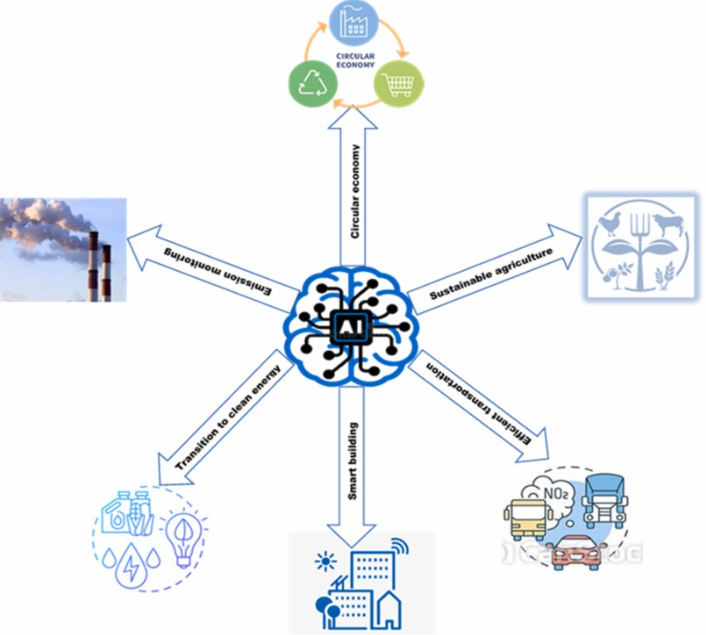
A selection of good practical examples is called for to x-ray the domain. The following section organizes the case studies of zero carbon manufacturing in the processing, large assembly, final assembly, and life cycle stages in the production of an internal combustion engine vehicle, a serial hybrid battery electric vehicle passenger car, and a battery electric vehicle with longer range and better comfort. For moving towards more stringent standards, challenges and success factors are proposed. They inform the zero-carbon partnership process dynamics and identify some of the most relevant gaps and opportunities for industry, government, and institutions, to combine efforts and contribute to the common goal of decarbonizing industry. The following case studies are read as a matter of current course methods in the automotive area and are addressed to other fields interested in a journey to zero-carbon manufacturing [21].
By analyzing and benchmarking industrial top-tier enterprises, best practices containing both in-rail and advanced sustainable development methodologies can be further proposed and adjusted to guide small and medium enterprises in the future, helping them to achieve a win-win with resource rational arrangements while still improving production performance [36]. Predictable operational maintenance in advanced factories can largely reduce downtime and even change maintenance operations from majorly outage time-dependent scheduling that halts continuous production line to a condition performance-based model that is designed based on variant chassis and fixtures that are fixed right after maintenance operations. Such adoptions can directly reduce the load of robots needed, as well as energy costs and the necessary fixed facility investment can also be more accurately estimated, decreasing the initial investment and operational risk [23].
4.2. Technological Solutions
In essence, the same activities that take place during warranty are incorporated into the production process. Ongoing cloud-based data analysis of real-time diagnostic data emanating from individual parts is starting to become practical [35]. Products provide real-time diagnostics with a high degree of confidence in individual parts. Providing a known good part of the assembly process reduces the need for complex predictive analysis and removes complexity from the overall system. It provides a much higher level of confidence when predicting the performance of parts built in other parts of the large distributed additive manufacturing system using different equipment and filters. It also makes production using new, unproven materials possible. The quality of the parts also lessens the need for rapid feedback control in the LMD process, enabling higher-speed production. With known good parts support, the unattended processes have added advantages for Saturday operations. Metal additive parts are well able to withstand challenging outside environmental conditions [20].
It requires zero dark factory support. It makes the entire manufacturing process significantly more sustainable. Furthermore, a package of known good parts and automatic Dynamic Manufacturing Management software support will make it practical to develop and build products not commercially feasible using conventional LMD equipment [34]. Many present-day products that are too costly or impossible could become new businesses using the new equipment and the new methods. These factors offer a vision and a roadmap toward high-quality, high-speed unattended production. The journey to extreme automation, zero waste, and rapid throughput for multi-material, multi-scale, multi-purpose products, making them zero carbon with minimum cost. The most challenging targets for sustainable production ever established by a modern company for a manufacturing process. We aim to produce higher quality, lower cost specialty products in real-time. Nonetheless, the real target is to have our requested merit of zero or negative marginal cost economic return [24].
Equation 3: Efficiency Improvement
The efficiency improvement () required can be modeled as:
5. Conclusion
In conclusion, sustainable production involves striving toward the goal of sustainability—meeting the needs of the present without compromising the ability of future generations to meet their own needs. We have proposed the concept of zero carbon manufacturing, defined as the application of predictive analytics to production processes with the primary goal of enabling sustainable production with minimal or no net generation of carbon emissions [33]. We contend that zero carbon manufacturing is feasible and important as a real-life sustainability goal that should be achievable within the next decade and suggest that the term zero carbon manufacturing contributes to operations and production management literature on sustainable production by attracting heightened attention from production engineers, researchers in academia, and industry managers. We believe that a concerted research effort pushing the state of the art in predictive analytics is necessary to promote multifaceted attractive possibilities. Beyond minimizing carbon footprint in economic production batches featuring such desirable context-specific characteristics as minimum energy and other resource consumption per unit of product, zero carbon manufacturing can lead to shorter wait times between customer order placement and product fulfillment. By reducing lead times and cutting inventories to allowable minimums, the added agility of businesses incorporating zero-carbon manufacturing will translate into fewer shortages and stockouts [26].
5.1. Summary of Key Findings
This paper presents a detailed review of academic research papers in the field of dark data, predictive analytics, and sustainable manufacturing 4.0 within the context of global climate change, notably called Zero Carbon Manufacturing (ZCM). The key focus is the automotive industry, which is under increasing pressure to reduce greenhouse gas (GHG) emissions associated with production and the use of its vehicles. The review research questions focused on understanding: (1) what ZCM means for the automotive industry; (2) the need for predictive analytics to establish the optimal parameters that enable ZCM; and (3) future research areas [28].
The findings from this paper illustrate a range of specific challenges that predetermine the green transition towards ZCM and have been orchestrated across the existing basic elements of Industry 4.0 characterized as the Internet of Things, Big Data and Analytics, Autonomous Robotics, Simulation, Horizontal and Vertical System Integration, the Industrial Internet of Things, Cybersecurity, the Cloud, and Additive Manufacturing. The key finding of this paper is the need to integrate the high-performance computing capabilities of predictive analytics with the design and optimization of sustainable closed-loop supply chains [32]. Other findings include implementable research propositions and conclusions to address current state-of-the-art limitations of effective integration of predictive analytics with ZCM and manufacturing 4.0. Recommendations for investment decisions to advance energy-efficient methods for cleaner production and to avoid a further increase in GHG during the manufacturing processes have to be prioritized [30].
5.2. Future Research Directions
While the literature identifies several factors contributing to the achievement of sustainability in manufacturing, complicated models and data-intensive techniques are still needed to integrate these solutions into a lean production framework. At present, there is no proposed comprehensive methodology or algorithm with which to integrate these solutions and suggestions [31]. This review highlights the potential of predictive and prescriptive analytics as essential tools to efficiently steer manufacturing systems to adapt to varying eco-sustainability needs in many areas also affected by parameters' variability. This study can be extended by applying data fusion to integrate intrinsic and extrinsic predictors, and by combining predictive analytics and statistical approaches to gain full insight into the many causalities that exist between these factors. In addition, it is evident from this review that the main focus of the studies in the field of green analytics in the automotive industry is the study of waste minimization in the back-end process of vehicle manufacturing. There are likely numerous other application areas, from energy consumption to the design and integration of related standards in the planning phase [29].
References
- Mandala, V. (2021). The Role of Artificial Intelligence in Predicting and Preventing Automotive Failures in High-Stakes Environments. Indian Journal of Artificial Intelligence Research (INDJAIR), 1(1).
- Laxminarayana Korada, & Vijay Kartik Sikha. (2022). Enterprises Are Challenged by Industry-Specific Cloud Adaptation - Microsoft Industry Cloud Custom-Fits, Outpaces Competition and Eases Integration. Journal of Scientific and Engineering Research. https://doi.org/10.5281/ZENODO.13348175.
- Bansal, A. (2023). Power BI Semantic Models to enhance Data Analytics and Decision-Making. International Journal of Management (IJM), 14(5), 136-142.
- Perumal, A. P., Deshmukh, H., Chintale, P., Molleti, R., Najana, M., & Desaboyina, G. Leveraging machine learning in the analytics of cyber security threat intelligence in Microsoft azure.
- Shah, C., Sabbella, V. R. R., & Buvvaji, H. V. (2022). From Deterministic to Data-Driven: AI and Machine Learning for Next-Generation Production Line Optimization. Journal of Artificial Intelligence and Big Data, 21-31.[CrossRef]
- Kommisetty, P. D. N. K. (2022). Leading the Future: Big Data Solutions, Cloud Migration, and AI-Driven Decision-Making in Modern Enterprises. Educational Administration: Theory and Practice, 28(03), 352-364.
- Avacharmal, R., Pamulaparthyvenkata, S., & Gudala, L. (2023). Unveiling the Pandora's Box: A Multifaceted Exploration of Ethical Considerations in Generative AI for Financial Services and Healthcare. Hong Kong Journal of AI and Medicine, 3(1), 84-99.
- Nampalli, R. C. R. (2023). Moderlizing AI Applications In Ticketing And Reservation Systems: Revolutionizing Passenger Transport Services. In Journal for ReAttach Therapy and Developmental Diversities. Green Publication. https://doi.org/10.53555/jrtdd.v6i10s(2).3280[CrossRef]
- Ravi Aravind, Srinivas Naveen D Surabhi, Chirag Vinalbhai Shah. (2023). Remote Vehicle Access:Leveraging Cloud Infrastructure for Secure and Efficient OTA Updates with Advanced AI. EuropeanEconomic Letters (EEL), 13(4), 1308–1319. Retrieved fromhttps://www.eelet.org.uk/index.php/journal/article/view/1587
- Syed, S. (2023). Shaping The Future Of Large-Scale Vehicle Manufacturing: Planet 2050 Initiatives And The Role Of Predictive Analytics. Nanotechnology Perceptions, 19(3), 103-116.
- Danda, R. R. Digital Transformation In Agriculture: The Role Of Precision Farming Technologies.
- Mandala, V., & Surabhi, S. N. R. D. Intelligent Systems for Vehicle Reliability and Safety: Exploring AI in Predictive Failure Analysis.
- Sikha, V. K., Siramgari, D., & Korada, L. (2023). Mastering Prompt Engineering: Optimizing Interaction with Generative AI Agents. Journal of Engineering and Applied Sciences Technology. SRC/JEAST-E117. DOI: doi. org/10.47363/JEAST/2023 (5) E117 J Eng App Sci Technol, 5(6), 2-8.[CrossRef]
- Bansal, A. Advanced Approaches to Estimating and Utilizing Customer Lifetime Value in Business Strategy.
- Perumal, A. P., Deshmukh, H., Chintale, P., Desaboyina, G., & Najana, M. Implementing zero trust architecture in financial services cloud environments in Microsoft azure security framework.
- Vehicle Control Systems: Integrating Edge AI and ML for Enhanced Safety and Performance. (2022).International Journal of Scientific Research and Management (IJSRM), 10(04), 871-886.https://doi.org/10.18535/ijsrm/v10i4.ec10[CrossRef]
- Avacharmal, R., Sadhu, A. K. R., & Bojja, S. G. R. (2023). Forging Interdisciplinary Pathways: A Comprehensive Exploration of Cross-Disciplinary Approaches to Bolstering Artificial Intelligence Robustness and Reliability. Journal of AI-Assisted Scientific Discovery, 3(2), 364-370.
- Nampalli, R. C. R. (2022). Neural Networks for Enhancing Rail Safety and Security: Real-Time Monitoring and Incident Prediction. In Journal of Artificial Intelligence and Big Data (Vol. 2, Issue 1, pp. 49–63). Science Publications (SCIPUB). https://doi.org/10.31586/jaibd.2022.1155[CrossRef]
- Aravind, R., & Surabhii, S. N. R. D. Harnessing Artificial Intelligence for Enhanced Vehicle Control and Diagnostics.
- Syed, S. Big Data Analytics In Heavy Vehicle Manufacturing: Advancing Planet 2050 Goals For A Sustainable Automotive Industry.
- Danda, R. R. (2022). Innovations in Agricultural Machinery: Assessing the Impact of Advanced Technologies on Farm Efficiency. In Journal of Artificial Intelligence and Big Data (Vol. 2, Issue 1, pp. 64–83). Science Publications (SCIPUB). https://doi.org/10.31586/jaibd.2022.1156[CrossRef]
- Korada, L. (2023). AIOps and MLOps: Redefining Software Engineering Lifecycles and Professional Skills for the Modern Era. In Journal of Engineering and Applied Sciences Technology (pp. 1–7). Scientific Research and Community Ltd. https://doi.org/10.47363/jeast/2023(5)271[CrossRef]
- Bansal, A. (2022). Establishing a Framework for a Successful Center of Excellence in Advanced Analytics. ESP Journal of Engineering & Technology Advancements (ESP-JETA), 2(3), 76-84.
- Perumal, A. P., & Chintale, P. Improving operational efficiency and productivity through the fusion of DevOps and SRE practices in multi-cloud operations.
- Avacharmal, R., Gudala, L., & Venkataramanan, S. (2023). Navigating The Labyrinth: A Comprehensive Review Of Emerging Artificial Intelligence Technologies, Ethical Considerations, And Global Governance Models In The Pursuit Of Trustworthy AI. Australian Journal of Machine Learning Research & Applications, 3(2), 331-347.
- Nampalli, R. C. R. (2022). Machine Learning Applications in Fleet Electrification: Optimizing Vehicle Maintenance and Energy Consumption. In Educational Administration: Theory and Practice. Green Publication. https://doi.org/10.53555/kuey.v28i4.8258[CrossRef]
- Aravind, R., Shah, C. V & Manogna Dolu. AI-Enabled Unified Diagnostic Services: Ensuring Secure andEfficient OTA Updates Over Ethernet/IP. International Advanced Research Journal in Science, Engineeringand Technology. DOI: 10.17148/IARJSET.2023.101019[CrossRef]
- Syed, S. (2022). Towards Autonomous Analytics: The Evolution of Self-Service BI Platforms with Machine Learning Integration. In Journal of Artificial Intelligence and Big Data (Vol. 2, Issue 1, pp. 84–96). Science Publications (SCIPUB). https://doi.org/10.31586/jaibd.2022.1157[CrossRef]
- Danda, R. R. (2021). Sustainability in Construction: Exploring the Development of Eco-Friendly Equipment. In Journal of Artificial Intelligence and Big Data (Vol. 1, Issue 1, pp. 100–110). Science Publications (SCIPUB). https://doi.org/10.31586/jaibd.2021.1153[CrossRef]
- Korada, L. (2023). Leverage Azure Purview and Accelerate Co-Pilot Adoption. In International Journal of Science and Research (IJSR) (Vol. 12, Issue 4, pp. 1852–1954). International Journal of Science and Research. https://doi.org/10.21275/sr23416091442[CrossRef]
- Bansal, A. (2022). REVOLUTIONIZING REVENUE: THE POWER OF AUTOMATED PROMO ENGINES. INTERNATIONAL JOURNAL OF ELECTRONICS AND COMMUNICATION ENGINEERING AND TECHNOLOGY (IJECET), 13(3), 30-37.
- Chintale, P. (2020). Designing a secure self-onboarding system for internet customers using Google cloud SaaS framework. IJAR, 6(5), 482-487.
- Avacharmal, R. (2022). ADVANCES IN UNSUPERVISED LEARNING TECHNIQUES FOR ANOMALY DETECTION AND FRAUD IDENTIFICATION IN FINANCIAL TRANSACTIONS. NeuroQuantology, 20(5), 5570.
- Rama Chandra Rao Nampalli. (2022). Deep Learning-Based Predictive Models For Rail Signaling And Control Systems: Improving Operational Efficiency And Safety. Migration Letters, 19(6), 1065–1077. Retrieved from https://migrationletters.com/index.php/ml/article/view/11335
- Aravind, R., Shah, C. V., & Surabhi, M. D. (2022). Machine Learning Applications in Predictive Maintenancefor Vehicles: Case Studies. International Journal of Engineering and Computer Science, 11(11), 25628–25640.https://doi.org/10.18535/ijecs/v11i11.4707[CrossRef]
- Syed, S. (2022). Integrating Predictive Analytics Into Manufacturing Finance: A Case Study On Cost Control And Zero-Carbon Goals In Automotive Production. Migration Letters, 19(6), 1078-1090.
- Danda, R. R. (2020). Predictive Modeling with AI and ML for Small Business Health Plans: Improving Employee Health Outcomes and Reducing Costs. In International Journal of Engineering and Computer Science (Vol. 9, Issue 12, pp. 25275–25288). Valley International. https://doi.org/10.18535/ijecs/v9i12.4572[CrossRef]
- Korada, L., & Somepalli, S. (2023). Security is the Best Enabler and Blocker of AI Adoption. In International Journal of Science and Research (IJSR) (Vol. 12, Issue 2, pp. 1759–1765). International Journal of Science and Research. https://doi.org/10.21275/sr24919131620[CrossRef]
- Bansal, A. (2021). OPTIMIZING WITHDRAWAL RISK ASSESSMENT FOR GUARANTEED MINIMUM WITHDRAWAL BENEFITS IN INSURANCE USING ARTIFICIAL INTELLIGENCE TECHNIQUES. INTERNATIONAL JOURNAL OF INFORMATION TECHNOLOGY AND MANAGEMENT INFORMATION SYSTEMS (IJITMIS), 12(1), 97-107.
- Chintale, P. SCALABLE AND COST-EFFECTIVE SELF-ONBOARDING SOLUTIONS FOR HOME INTERNET USERS UTILIZING GOOGLE CLOUD'S SAAS FRAMEWORK.
- Avacharmal, R., & Pamulaparthyvenkata, S. (2022). Enhancing Algorithmic Efficacy: A Comprehensive Exploration of Machine Learning Model Lifecycle Management from Inception to Operationalization. Distributed Learning and Broad Applications in Scientific Research, 8, 29-45.
- Nampalli, R. C. R. (2021). Leveraging AI in Urban Traffic Management: Addressing Congestion and Traffic Flow with Intelligent Systems. In Journal of Artificial Intelligence and Big Data (Vol. 1, Issue 1, pp. 86–99). Science Publications (SCIPUB). https://doi.org/10.31586/jaibd.2021.1151[CrossRef]
- Syed, S. (2021). Financial Implications of Predictive Analytics in Vehicle Manufacturing: Insights for Budget Optimization and Resource Allocation. Journal of Artificial Intelligence and Big Data, 1(1), 111–125. Retrieved from https://www.scipublications.com/journal/index.php/jaibd/article/view/1154[CrossRef]