

The Internationalization of higher education has plummeted since the 2010 tightening of migration policies. This study aims to examine the retention and graduation rates of international students at Northern Arizona University (NAU). Using a quantitative analysis approach, the study utilized secondary data from the Center for International Admission and Recruitment Office at NAU to examine the university’s recruitment, graduation, and retention strategies. The aim was to evaluate the impact of internationalization strategies on application and enrolment numbers. The study sample consisted over 2000 international students from fourteen countries, including China, India, Vietnam, Kuwait, Nepal, Ghana, Nigeria, United Kingdom, Spain, Germany, Canada, Mexico, France, and Iran in four cultural groups (Asia, Europe, Africa, and North America). A random sampling technique was used to select these countries partly because of their highest applications, enrolment numbers, as well as their adoption of recruitment strategies like those used by higher education institutions in the United States. A descriptive graphic representation, focusing on full-time undergraduate students during fall semesters, specifically freshmen international students, is illustrated. To facilitate a cross-country comparison of international students, this study presents an analysis of retention and graduation data across different countries spanning the past five years, from 2016 to 2020.
An Appraisal of International Students Retention and Graduation at Northern Arizona University
October 20, 2022
March 16, 2023
November 20, 2023
December 25, 2023
This is an Open Access article, distributed under the terms of the Creative Commons Attribution 4.0 International License (http://creativecommons.org/licenses/by/4.0/), which permits unrestricted use, distribution and reproduction in any medium or format, provided the original work is properly cited.
Abstract
1. Introduction
The number of students seeking to study abroad and the number of Higher Education Institutions (HEIs) recruiting international students is increasing [1]. Higher education institutions are seeking internationalization and using different strategies to realize this goal. A study on higher education internationalization reveals three primary strategies including: 1). study abroad programs 2). Internationalization at home, and 3). Diverse academic curriculum to recruit students globally [2, 3, 4, 5]. As part of internationalization initiatives, higher education institutions have introduced several practices, including marketing plans targeting specific countries or regions [6]. The dynamics related to this relationship between international students seeking higher education in the U.S. and the institutions seeking to recruit these students reveals an area of interest, especially for both parties. This research therefore undertakes an endeavor to understand the interest and to discern both difficulties and benefits for international programs, international recruiters, and higher education administrators.
One significant of globalization has been the international flow of students seeking graduate-level higher education at universities in the U.S. that market to international students. The American higher education system is vast and varied, including more than 4,700 degree-awarding institutions and more than 21 million students enrolling [7]. Universities invest significant resources to attract the most talented and those most able to seek admission. The aim is to increase, develop and maintain an image of high-quality advanced study that, in turn, influences potential international students to prefer and select that specific U.S. institution rather than another [8, 9]. In this study, the researcher reviews one university, Northern Arizona University (NAU), Flagstaff, Arizona, USA, to determine components of how this process functions and how effective it is toward international student recruitment.
Internationalization is not new to U.S. universities and colleges. Since the early 1980s, the influx of students seeking higher education has increased [9]. National leaders and educators are urging universities and colleges to engage in a broader range of activities and extend initiatives to strengthen internationalization, as Americans become more aware that they live in a globally interdependent era. Recommendations on internationalization have been presented to enhance international education and research, promote students and faculty participation in exchange programs, and strengthen the study of foreign languages [10]. Others, however, have been responding in more limited ways in internationalizing their institutions and programs. The problem remains because there is such variability of low applications, low retention rates and high attrition rates among colleges in the United States. Although much research has been conducted on study abroad, reasons for low retention, recruitment strategies, students’ mobility, brain drain, and the incorporation of international content and materials into the curriculum, as far as could be ascertained, little research is done on evaluating a single university using a sociological approach and a kind of approach done in program planning and evaluation.
The use of a sociological macro lens touches upon academic administration in this study. In other words, it explores the relationship between educational administration and international program marketing. What makes this study sociological and why the researcher used this sociological approach was that sociology systems theory tends to explain organizations/institutions and how to evaluate programs. The researcher has sought to discover some aspects of programs that suggest effective marketing, leadership challenges to promote equity and inclusion, and "best" recruitment and retention strategies. Without using a sociological approach emphasizing systems, and particularly, program planning and evaluation developed in a sociological context, this research would not be focused on answering the researcher’s questions adequately. Therefore, there is a need for this type of research to identify the nature and extent of the internationalization efforts of higher education institutions and the relationship between those efforts and their institutional features. This study intended to examine and evaluate the internationalization efforts about recruitment and retention strategies for the areas recruiters use in different countries to see how those compare to the application and enrolment numbers. Specifically, the study has identified the success of Northern Arizona University's international recruitment program in terms of the number of applicants, number of admissions, retention rate, and number of degrees granted to evaluate the trend of accomplishments. Therefore, the research questions guiding this study are:
To what extent does Northern Arizona University utilize the best recruitment strategies and practices?
What is Northern Arizona University's international program's success in terms of the number of applicants, number of admissions, and number of degrees granted?
1.1. International Student Retention
Since the establishment of formal education, student retention rates have been a significant problem for tertiary institutions around the world [11, 12]. For example, not all students can complete their study program and academic goals. While the majority of international students fail to graduate for various reasons, some choose to voluntarily withdraw from their study programs [13]. A plethora of studies have shown that a university's success depends on international student retention, which affects the institution's ranking, reputation, and financial well-being. A study by [14], further highlighted the need to improve student retention with such a focus. The author pointed out that the public and social benefits of retaining students are too great to leave to chance. Enhancing retention and understanding attrition will increase earnings, lower unemployment, and strengthen civic engagement. However, the failure to admit and retain adequately skilled international students ultimately enervates both the university’s reputation and credibility [15]. Thus, by selecting international students, both graduate and undergraduate, regardless of citizenship or proficiency in English, recruiters should enroll those who desire the success of completion [15].
Furthermore, student success, some authors revealed that the matriculation procedure is critical and should not be underrated because it is crucial for students’ success. A considerable amount of research stresses the fact that students at various levels of matriculation are likely to boost satisfaction in their institutions [16, 17]. A foundational study added that in the U.S., the proportion of international student degrees has mainly remained stagnant for more than 20 years [14], and thus there is a need to develop more efficient, tailored strategies to promote student success and timely graduation by knowing certain retention strategies. Moreover, [18] found that factors that can enhance international students’ satisfaction and retention include effective guidance and advising, inclusive community, faculty-student interaction, and comprehensive orientation programs for assimilation. Similar research that studies this sub-group utilized existing data from the registrar, enrollment services, academic affairs, and other university services to build statistical models to investigate retention rates. The study further predicted students’ attrition from freshman to sophomore year with an 82 per cent precision rate using state-of-the-art data analytics techniques, including artificial neural networks, decision trees, and support vector machines [14]. A study discovered that “while adjustment issues, academic difficulty, and isolation contribute to students' attrition, the most important factor is the number of credit hours completed compared to the number of credit hours the students enrolled in the first semester of college”. In a surmise, the author highlighted that “this is a complex problem to deal with, and it is a combination of both social and emotional factors” [19].
Moreover, a preliminary study focused on the factors influencing international students’ satisfaction in Korean universities. The study's overall findings indicated a rising student satisfaction resulting from the provision of support systems through continuous advising [20]. Student satisfaction has been defined as “the sum of students’ behavioral beliefs and attitudes that result from aggregating all the benefits that a student receives from a pluralistic system [21].” A previous study has shown that engaging in positive word-of-mouth contact to educate acquaintances and colleagues can attract new students [20]. Other research explored Students’ Satisfaction and Retention Model (SSRM) to hypothesize that attitudes may predict an individual’s intentions and behaviors [22]. Another literature has outlined that the Student Satisfaction and Retention Model is argued to be a more robust retention model that takes into account the effect of a particular set of variables to describe student retention for higher education institutions [23]. Additionally, a study explored the relationship between student satisfaction and academic performance in Armenian (a country in Asia) higher education. The statistical analysis revealed in the survey indicated a significant difference in student satisfaction and academic performance, that is, students who reported lower satisfaction had lower academic performances. The study further pointed out that student satisfaction impacts the quality of students who graduate and are placed in the workforce community [24]. Thus, graduates’ quality can become questionable if their academic performance is low. This, in turn, can negatively affect the image of an educational institution and create challenges for graduates as they enter the labour force [23]. When international students do not meet colleges’ or universities' educational expectations in the U.S., they are likely to encounter academic dismissal due to poor academic performance. Students’ academic performance in higher education results from socioeconomic, psychological, and environmental factors that are likely to influence retention [15].
The study further identified a perfect illustration for explaining international students' push and pull factors. The study referred to the Push-and-Pull Moorings (PPM) theory, which explains the reasons why service customers (students) may want to switch their service providers (academic institutions) [18]. The authors pointed out that push variables are related to the current service provider's poor value delivery, such as service failure, unmet or disconfirmed requirements, poor handling of grievances, or high perceived costs. Conversely, pull factors were associated with the appeal of competitive alternatives in the decision to switch or transfer. The study further explored the Planned Behavior Theory, pointing out that students' satisfaction leads to intentions to stay, which ultimately leads to students’ retention. Overall, this research indicated that students’ persistence relates to students’ willingness and behaviours to stay in college until graduation. Thus, retaining students is an institutional effort to support students through college admission graduation. Therefore, it is crucial not to underestimate students’ retention at universities but to observe that academic performance and increasing retention rate enhance academic excellence [25, 26].
1.2. Theoretical Framework
To guide the research and to evaluate the findings, the theoretical framework for this study is based on “systems theory” developed originally by Talcott Parsons. Utilizing a systems approach allows the research to view organizations in a holistic environment that is ever-changing. How an organization responds to these changes often determines the organization’s effectiveness. By considering inputs the organization receives from the environment, an effective organization can provide outputs valued in that environment. As such, systems theory provides a useful approach to research design, analysis and understanding about how an organization and/or institution is structured, and how it functions [27, 28]. As Parsons theorized, an organization is like an organism that is made-up of several parts (subsystems) that must operate effectively and efficiently for the larger system to function as intended. Systems theory asserts that organizational success relies on synergy (collaboration) between subsystems and interconnections with environment. Systems theory has been successfully applied to a wide variety of subjects in different fields over several years, including cognition, consciousness, skills, learning, and language acquisition, psychology, economics, politics, sociology, and all social science [29, 30]. In addition, there are four possibilities for the formation of systems, according to Parsons: adaptive systems, goal-oriented systems, systems based on system integration (e.g., the society conceived as a community), and systems responsible for the preservation of long-term patterns (e.g., cultural institutions in society). Adaptation, goal accomplishment, incorporation, and latency form the fundamental characteristics of social action for Parsons. In other words, Parson's solution lies in the idea of the "interpenetration" of distinct action subsystems [31]. Parsons argues that to study social change, there needs to be a reference point from which change occurs. Therefore, a new theory-based framework of higher education internationalization focusing on defining, developing, and strengthening internationalization would be an excellent contribution to the nature and practices of internationalization of higher education [32].
The social, cultural, and personality processes are examples of systems [33]. Interdependent parts, order or equilibrium, and a propensity to preserve the boundaries and relationships of the parts to the whole are all characteristics of systems. The entire society and its structures or institutions (economy, educational institutions, legal system, religious institutions) and smaller subsystems (family or individual) may all be included. These are action systems because they entail social action. Each system has specific needs or conditions necessary for the survival and continued operation of the system. One characteristic of system theory Zhou pointed out is communication [34]. However, communication mechanisms must be in place for organizational structures to exchange relevant information with their environment. It, therefore, provides for the flow of information among subsystems. Besides, systems are goal-oriented and engage in feedback to meet the organization's goals.
A prior study reveals that “through the internationalization of higher education, countries with strategic value within a region can collaborate to achieve goals and introduce activities such as high-quality teaching, institutional transformation, creative approaches, and business-higher education integration” [35]. Researchers indicated that Turkish institutions had modified their higher education system by entering the Bologna Process to benefit from collaborations. This strategy strengthens Turkey's international education system. Also, it has established higher education institutions developments in Europe through regional partnerships in the Balkans, the Arab world, and Africa. “The Bologna Process is therefore a compilation of European government meetings and agreements to ensure higher education qualifications and equivalency in terms of standards and quality” [36]. Thus, effective communication and the ability to relate communication effectively with individuals and partner recruiters is one objective that the system theory hopes to achieve [34, 37]. The system theory deals with complexity, takes a holistic view in organizations, recognizes the importance of supersystems, and can easily manage change through interaction with the environment to improve partnership as a growth strategy in a broader range of stakeholders [38]. Systems theory has manifested in practitioners' work in many disciplines.
2. Materials and Methods
Using a quantitative analysis approach, the writer utilized a secondary data from the Center for International Admission and Recruitment Office at NAU to examine the university’s recruitment, graduation, and retention strategies. The aim was to evaluate the impact of internationalization strategies on application and enrolment numbers. The study sample consisted over 2000 international students from fourteen countries, including China, India, Vietnam, Kuwait, Nepal, Ghana, Nigeria, United Kingdom, Spain, Germany, Canada, Mexico, France, and Iran in four cultural groups (Asia, Europe, Africa, and North America). A random sampling technique was used to select these countries partly because of their highest applications, enrolment numbers, as well as their adoption of recruitment strategies like those used by higher education institutions in the United States. A descriptive graphic representation, focusing on full-time undergraduate students during fall semesters, specifically freshmen international students, is illustrated. To facilitate a cross-country comparison of international students, this study presents an analysis of retention and graduation data across different countries spanning the past five years, from 2016 to 2020. The study further analyzed the data using the one-way analysis of Variance (ANOVA) to control the Type 1 error, and therefore the confidence for the statistical significance was improved. The test was used to evaluate the variation between the sample data to distinguish any meaningful discrepancy between the means in the sample data. The test was used to evaluate the variation between the sample data in order to distinguish any meaning discrepancy between the means of foreign data in the sample. A study on the significant differences between international and domestic students' retention intentions will influence my discussion regarding reducing students’ attrition and cultural shock among international students to increase assimilation. Research explicitly documented that counselling, extracurricular activities, study workshops on housing resources, and other programs to help learn how to deal with new learning environments are critical for encouraging international students to stay in an institution [18].
Given the context that this study occurred during a global pandemic, the researcher found that intrinsic factors may be critical to understanding the nuances of any strategy at this time in history. To accomplish this goal, the researcher followed a paradigm examining existing data that was supplemented with interpretation from administrative personnel within the Center for International Education, NAU. The researcher solicited these individuals for assistance in collecting the data and for highlighting the study purpose. Data collection for the study extensively relied on existing historical data acquired from the Center for International Education (CIE) Northern Arizona University, International Admissions and Recruitment (IAR) between the years 2016 to 2020.
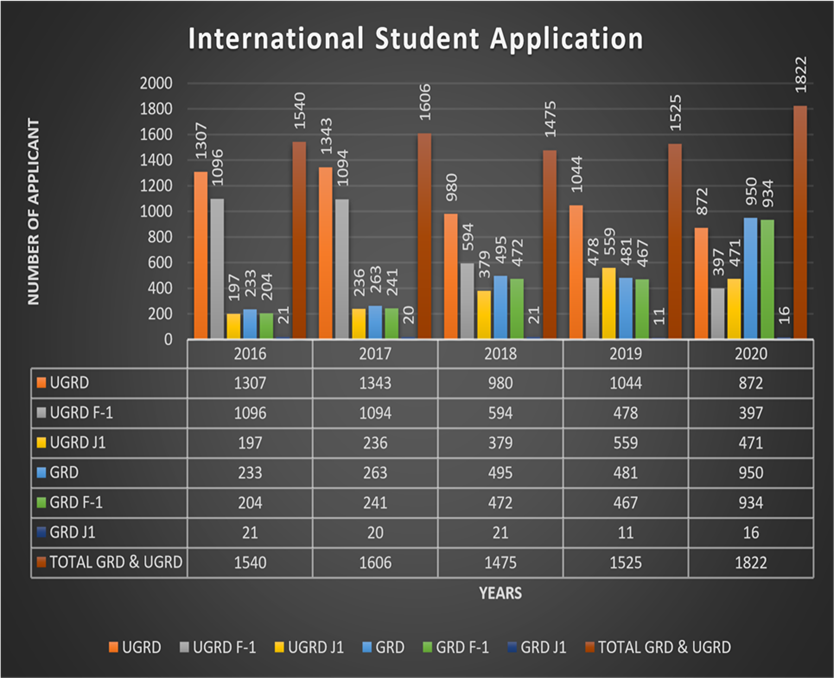
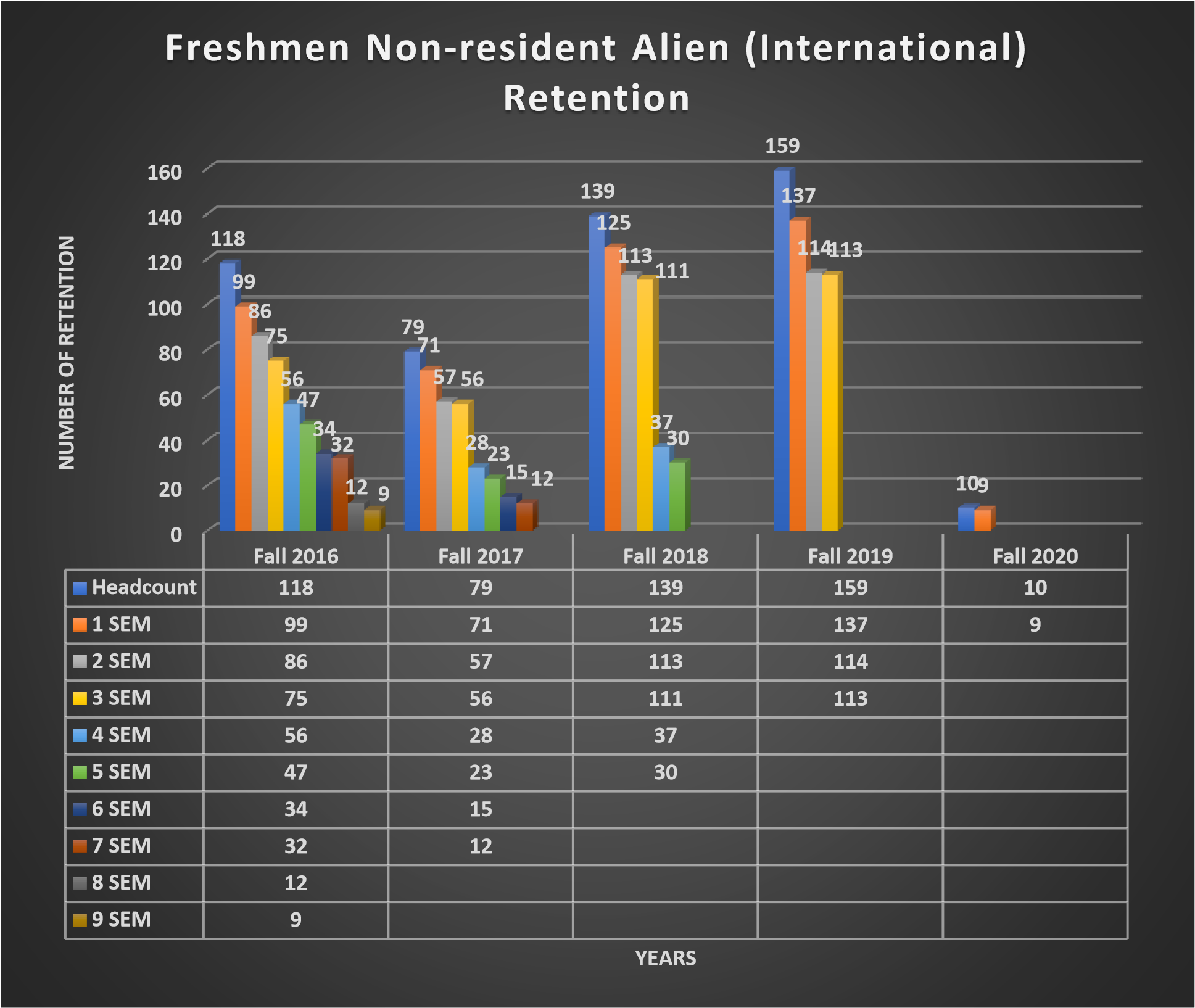
By analyzing the data, Figures 1 and 2 below offers a graphic representation (bar graph) of full-time undergraduate application and retention analysis for fall semesters of freshmen international students. A bar graph is one way to summarize data in descriptive statistics. Bar graph is utilized in the study because it is one of the many techniques used to present data in a visual form so that the reader may readily recognize patterns or trends. Moreover, the bar graph represents an observation point, and since this study is performing a trend analysis, the graph tells of the rise and fall of a data point with respect to years. A bar diagram makes it easy to compare sets of data between different groups at a glance. The graph represents categories on one axis and a discrete value on the other. To visualize the data in a plot, the data visualization feature of Excel was employed.
To make sure that the studies compared similar things, the study examined retention analysis for the past five years, from 2016 to 2020. One thing to know is that international students are put in the freshmen category if they have 12 credits or fewer, transfer credits if they are transferring in, or if their high school graduation year is the same as they start. We could see the headcount for freshmen in 2016 was 118, which dramatically dropped in 2017 with 79 students and rose again to 139 in 2018 and finally, with a decrease in numbers in 2020. In order to understand changes in the retention rate over time, the study described the changes in percentages. We see a significant drop from one semester to one year due to the dropout rate for first-year students overall. If we go to the first (1st) semester in 2016, the reader sees a significant drop of 83.9% to 72.9% in semester 3, and it follows, 63.6%, to 47.5%, to 39.8%, to 28.8%, to 27.1% and lastly to 10.2% in the semester 8. Thus, that is what a standard retention rate looks like for international students. In the year 2018, the first semester recorded 89.9%, and by the fifth semester, it had dropped to 21.6%, and no retention rate was recorded for the subsequent years. Most importantly, there is a huge drop varying over the years, so you do not see the magnitude of change in the same way.
Most literature on retention focuses on freshmen year because getting students from the freshmen to the sophomore year is critical. It is therefore important to retain students because the rate of losses is more significant. It is also important to address that many factors go into the rise and fall in the retention rate. Specifically, the concern is that international undergraduates collectively struggle academically (term grade point average [GPA] below 2.0 [C]) due to English weakness; however, they are likely to drop out [39]. Additionally, students are likely to be in the following category. That is why we may see a drop in retention rates:
- Short-Term Program (Non-degree Seeking): Undergraduate students may enroll at NAU for one semester or one academic year. Partner University in China, hereafter (XXX), recognizes and accepts the credits students earn at NAU.
- 2+2 Dual Degree Program (2+2 Program): XXX bachelor’s degree-seeking students will complete the first two years of coursework at XXX and then enroll at NAU for the last two years or until the requirements for the 2+2 program have been completed.
- 1+2+1 Dual Degree Program: After XXX students complete their first year of study in China, students will travel to NAU to complete an undergraduate degree program. Students will return to China to finish their senior year at XXX in the final year of the program. Students completing all institutions’ bachelor’s programs' requirements will be granted bachelor's degrees from each institution (the United States partner university and the Chinese partner university).
- Joint Program (Sino-US Dual Bachelor’s Degree Program): This program is based on the 3+1 or 4+0 model.
- 3+1 means that students will be based at XXX for the first three years of study, then spend the final year (or as long as required to graduate) at NAU completing the requirements for the bachelor’s degree. Upon completing the degree's requirements, students participating in this model will be awarded one degree from NAU and one degree from XXX.
- 4+0 means that students who stay at XXX for four years and elect not to go to NAU for the final year can only be awarded a bachelor's degree from XXX.
The above descriptions result in the reasons why most students coming from China especially may look like they dropped out of the institution but instead, they completed their program of study. Using this concept, the strengths of computers are used to convert numbers into images, and the strength of humans to process visual data is leveraged to interpret and make meaning out of the data.
3. Results and Discussion
Efforts to improve the rate of retention and graduation by answering the research questions, “To what extent does Northern Arizona University utilize best recruitment strategies and practices”, and “What is Northern Arizona University's international program's success in terms of the number of applicants, number of admissions, and number of degrees granted” is explained below. An effort to improve the number of admissions and matriculate students in higher education has recently become more complicated due to the dramatic rise in their nonimmigrant international student populations. Several institutions have admitted and enrolled increasing numbers of students from other countries after the great recession of 2008 [40]. Owing to the substantial rise in nonimmigrant student populations, efforts to raise the retention and graduation rates in higher education in the United States have recently become more complex. In the years following the Great Recession of 2008, many universities have accepted and enrolled a growing number of international students. According to the Institute of International Education’s (IIE) annual Open Doors reports, international undergraduates’ enrollment in American universities increased by 1.3% in 2009–10, 5.7% in 2010–11, 6.5% in 2011–12, 9.8% in 2012–13, 7.7% in 2013–14, and 3.0% in 2014–15 (IIE 2015a). In this study on undergraduate student recruitment, it was evident that students invest a large amount of money in applying to NAU. Still, fewer numbers are enrolled into the institutions or out of the enrolled undergraduate students, only a small percentage chose NAU independent of any established pathway or program. The study’s findings tell a story that there are upswings and downswings in undergraduate applications and enrolment. In Figure 1, the highest number of undergraduate applications numbered 1343 occurred in 2017, followed by a decrease of 980 applications in 2018, and a remarkable increase of 1044 in 2019, only to experience a subsequent decline in applications of 872 in 2020. Out of 7968 application data points, new international students’ of 2188 undergraduates and graduates have been enrolled in NAU in the last five years. Despite a substantial increase in enrolment from the side undergraduate cohorts of 448 in 2017, 501 in 2018, and 543 in 2019, it ultimately dropped in 2020 due to the COVID-19 pandemic. There is still a significant chance of a decrease in enrollment. Besides, a decrease in enrolment and application rate results from; a decline in aggressive marketing and the absence of international recruiters, changing policies in host countries that extend visa stays, and the perceptions of discrimination against international students, particularly against students from the Middle East [41]. As countries such as China and France increase their international student enrollment rates due to strategic recruitment efforts, the total percentage of U.S. international student enrollment has been decreasing [42]. Thus, Northern Arizona University could increase its international student enrollment rates and retention rates through strategic recruitment efforts such as:
- Extensive outreach programs: This is an essential part of an institution's retention strategy, and including students, alumni, and faculty members can play a crucial role.
- Network student support: Students' success movement on social media and campus to address the persistent graduation gaps for students, especially those who are first-generation or from low-income backgrounds/ or developing countries.
- Strategies for refurbishing work-study programs and providing opportunities for students to earn income.
Secondly, problems of bias of access to a college or university in the U.S. stemming from low recruitment and high attrition rates are critical issues most higher education institutions face. A leadership challenge to promote inclusion and equity has also become a skyrocketing menace for most U.S. institutions. New leadership means new knowledge, new tools, and an entirely new level of courage in doing things. Leadership involves change, and while it may be true that change is a part of everything in the U.S., and everything around us, social change, while inevitable, is difficult. Today, while NAU thrives to the degree that it can foster a sense of diversity, inclusion, and strong affiliation with the succeeding generation of students and alumni, higher education administrators must show courage, and compassion and inspire courage in others to defend what is most important to the group. It should therefore be known that leaders have the responsibility to nurture diversity within a group (domestic students). Therefore, a conscious effort to increase inclusion and equity in terms of recruiting should be a priority.
As mentioned previously in this study, the bias introduced in recruiting students from diverse countries is not equal. The frame of criterion for recruiting international students means that not all countries are represented in the population. NAU has varying recruitment strategies depending on the land they find themselves recruiting from. These include direct recruitment/agent relationships, with one full-time staff in Flagstaff and one full-time staff in India, program development/agent relationships/direct recruitment, with one part-time staff in Colombo, Ghana/Nigeria – Direct recruitment, Kenya – Program development. However, the diversified nature of recruitment strategies may create disparity in the criteria for recruitment.
Furthermore, the study revealed that the key partner countries are China, India, Vietnam, the UK, etc., due to the high stability in enrollment over the past five years. These high-potential nations have been marked for expanding marketing activities and are given much attention when recruiting and retaining students. Still, the findings that result from this study may prove helpful to policymakers interested in international student migration trends to the U.S. to consider the sample frame of countries' selection to recruit. The design of the study may be helpful for future researchers as more information is made available. In that sense, cultural groups should not be overrepresented than other groups on campus or in the recruitment process. Recruiters and practitioners should recognize these realities and relate them to the application process's challenges by retaining international students.
Inclusion is important for maintaining group identity, but any group or organization that does not enrich itself by including new members, new skills, and even forming new identities will not last long. Equity and inclusion eventually come to matter to the future of any educational institutions because it is central to the process of adaptation. The love for diversity can be a statement made with absolute and total conviction. Inclusion and diversity in the same breath, but how often do one feel uneasy, unsure, or ambiguous when educators, faculties, higher education leaders and administrators have to work together to accomplish them? And how often do they encounter outright opposition? Perhaps this explains why such work is so difficult. Most significantly, leaders play a critical role in shaping and promoting diversity within and on behalf of a group. There is a logical tension here, and it necessitates leaders who can see beyond it, negotiate, maintain a vision, and step toward it with meaning, commitment, and imagination. The only way to do this is to sincerely and convincingly indicate what goes into international students travelling outside of their country, the challenges faced by international students, and also tie the advantages of diversity to NAU’s most essential principles and priorities. This is a creative act, not in the cynical sense of that term. On the contrary, because we have all seen it before, anyone can detect a false dedication to inclusion and fairness. The essential benefits of egalitarianism in an organization must have clearly articulated, carefully reasoned, and plausible relations.
4. Conclusion and Recommendations
The study indicates that it is crucial to recognize commonalities. Therefore, appreciating cultural differences and the extensive use of social media plays a key role. The study further revealed that there are many reasons to explore potential future applications into NAU. Social media technology's promise as a strategic supplement to traditional student development, engagement, and advocacy seems significant. The size and reach of social technology as a strategic higher education investment by students and internationalizing institutions seeking to serve more internationally diverse student bodies should be reinforced by combining student familiarity and comfort with technology distribution platforms and the growing global expectation for expediency in knowledge dissemination. The use of extensive social media platforms such as Facebook, Instagram and LinkedIn can publicize the institution and free online study platforms such as Coursera and Udemy to make the institution worldwide. Global students get to know about U.S. institutions through online study platforms. Faculty members in various departments can make an effort to collaborate with the international offices and provide free online courses to students outside the United States.
Author’s Contributions: Conceptualization; methodology; validation; formal analysis; investigation; resources; data curation; writing—original draft preparation; writing—review and editing; visualization; supervision; project administration. All authors have read and agreed to the published version of the manuscript.
Funding: “This research received no external funding”
Data Availability Statement: Data is available on request from the corresponding author.
Acknowledgements: I acknowledge the respondents for their time and patience.
Conflicts of Interest: “The author declares no conflict of interest.” “No funders had any role in the design of the study; in the collection, analyses, or interpretation of data; in the writing of the manuscript, or in the decision to publish the results”.
- Abd Aziz, M. I., & Abdullah, D. (2014). Finding the next 'wave ‘in the internationalization of higher education: Focus on Malaysia. Asia Pacific Education Review, 15(3), 493-502.[CrossRef]
- Childress, L. K. (2010). The twenty-first-century university: Developing faculty engagement in internationalization (Vol. 32). Peter Lang.
- Tarrant, Michael A., Donald L. Rubin, and Lee Stoner. (2014). The added value of study abroad: Fostering a global citizenry. Journal of Studies in International Education,18 (2), 141-161.[CrossRef]
- Lee, B. K., & Cai, H. (2019). Evaluation of an online "Internationalization at Home" course on the social contexts of addiction. Journal of Studies in International Education, 23(3), 365-388.[CrossRef]
- Lucey, T. A., & Giannangelo, D. M. (2006). Shortchanged: The importance of facilitating equitable financial education in urban society. Education and urban society, 38(3), 268-287.[CrossRef]
- Groarke, Sarah & Durst, Christina (2019). Attracting and retaining international higher education students: Ireland (No. 88). Research Series Number 88 May 2019. Unspecified.[CrossRef]
- Brajkovic L., Jooste N., & Dewit., J. (2018). Internationalization in the United States: Data, Trends, and Trump. International Briefs for Higher Education Leaders: The Boston College Center for International Higher Education.
- Sin, Cristina, Dominik Antonowicz, and Jannecke Wiers-Jenssen. (2019). Attracting International Students to Semi-peripheral Countries: A Comparative Study of Norway, Poland and Portugal. Higher Education Policy, 1-24.[CrossRef]
- Alves, H., & Raposo, M. (2010). The influence of university image on student behaviour. International journal of educational management, 24(1), 73-85.[CrossRef]
- Harari, M. (1992). The internationalization of the curriculum. Bridges to the future: Strategies for internationalizing higher education, 52-79.
- Crosling, G., Heagney, M., & Thomas, L. (2009). Improving student retention in higher education: Improving teaching and learning. Australian Universities' Review, 51(2), 9-18.[CrossRef]
- De-Freitas, S. I., Morgan, J., & Gibson, D. (2015). Will MOOCs transform learning and teaching in higher education? Engagement and course retention in online learning provision. British Journal of Educational Technology, 46(3), 455-471.[CrossRef]
- Aljohani, O. (2016). A Comprehensive Review of the Major Studies and Theoretical Models of Student Retention in Higher Education. Higher education studies, 6(2), 1-18.[CrossRef]
- Delen, D. (2017). Improve retention, improve lives: Why student retention is important to society. News and Information. https://news.okstate.edu/articles/business/2017/improve-retentionimprove-lives-why-student-retention-is-important-to-society.html
- Van Nelson, C., Nelson, J. S., & Malone, B. G. (2004). Predicting success of international graduate students in an American university. College and University, 80(1), 19.
- Schreiner, L. A., Louis, M. C., & Nelson, D. D. (Eds.). (2020). Thriving in transitions: A research-based approach to college student success. Stylus Publishing, LLC.
- Carlblom, D. A. (2013). The impact of pre-matriculation variables on the persistence of freshman students to their sophomore year (Doctoral dissertation, Capella University).
- Haverila, M. J., Haverila, K., & McLaughlin, C. (2020). Variables affecting the retention intentions of students in higher education institutions: A comparison between international and domestic students. Journal of International Students, 10(2), 358-382.[CrossRef]
- Jolly, P. M., Kong, D. T., & Kim, K. Y. (2021). Social support at work: An integrative review. Journal of Organizational Behavior, 42(2), 229-251.[CrossRef]
- Alemu, Aye Mengistu, and Cordier, Jason (2017). "Factors influencing international student satisfaction in Korean universities." International Journal of Educational Development, 57: 54-64.[CrossRef]
- Wu, Jen-Her. Tennyson, Robert. Hisa, Tzyh-Lih. (2010). A study of student satisfaction in a blended e-learning system environment. Computers & Education, 55(1), 155-164.[CrossRef]
- Ajzen, I. (1980). Understanding attitudes and predictiing social behavior. Englewood cliffs.
- Aljohani, O. (2016). A Review of the Contemporary International Literature on Student Retention in Higher Education. International Journal of Education and Literacy Studies, 4(1), 40-52.[CrossRef]
- Martirosyan, N. M., Saxon, D. P., & Wanjohi, R. (2014). Student satisfaction and academic performance in Armenian higher education. American International Journal of Contemporary Research, 4(2), 1-5.
- Jacobs, Glen. (2002). "Non-academic factors affecting the academic success of Grenadian students at St. George’s University (SGU)."
- Lyons, S., & Kuron, L. (2014). Generational differences in the workplace: A review of the evidence and directions for future research. Journal of Organizational Behavior, 35(S1), S139-S157.[CrossRef]
- Kast, F. E., & Rosenzweig, J. E. (1972). General systems theory: Applications for organization and management. Academy of management journal, 15(4), 447-465.[CrossRef]
- von Bary, N., Rebentisch, E., & Becerril, L. (2018). Simulation-based value analysis of organizational complexity in product development projects. In DS 96: The 20th International DSM Conference (pp. 035-045).
- Carlucci, D., Lerro, A., & Skaržauskienė, A. (2010). Managing complexity: systems thinking as a catalyst of the organization performance. Measuring business excellence.[CrossRef]
- Spencer, J. P., Austin, A., and Schutte, A. R. (2012). Contributions of dynamic systems theory to cognitive development. Cognitive Development, 27(4), 401-418.[CrossRef] [PubMed]
- Munch, R. (1981). Talcott Parsons and the theory of action. I. The structure of the Kantian Core. American Journal of Sociy, 86(4), 709-739.[CrossRef]
- [32] Robson, S., & Wihlborg, M. (2019). Internationalization of higher education: Impacts, challenges and future possibilities.[CrossRef]
- Wallace, Ruth A. and Alison Wolf (1995). Contemporary Sociological Theory: Continuing the Classical Tradition, fourth edition, Englewood Cliffs, New Jersey, Prentice-Hall.
- Zhou, Jiangyuan (2016). A Dynamic Systems Approach t-o Internationalization of Higher Education. Journal of International Education and Leadership, 6(1), n1.
- Brajkovic L., Jooste N., and Dewit., J. (2018). Internationalization in the United States: Data, Trends, and Trump. International Briefs for Higher Education Leaders: The Boston College Center for International Higher Education.
- Verger, A., & Hermo, J. P. (2010). The governance of higher education regionalization: comparative analysis of the Bologna Process and MERCOSUR‐Educativo. Globalization, Societies and Education, 8(1), 105-120.[CrossRef]
- James-MacEachern, M., & Yun, D. (2017). Exploring factors influencing international students’ decision to choose a higher education institution: A comparison between Chinese and other students. International Journal of Educational Management, 31(3), 343-363.[CrossRef]
- Parsons, Talcott (1951). The Social System, New York, Free Press. HM51 P35.
- Fass-Holmes, B. (2016). International Undergraduates' Retention, Graduation, and Time to Degree. Journal of International Students, 6(4), 933-955.[CrossRef]
- Ford, K. S., Rosinger, K. O., & Zhu, Q. (2021). Consolidation of Class Advantages in the Wake of the Great Recession: University Enrollments, Educational Opportunity and Stratification. Research in Higher Education, 1-27.[CrossRef] [PubMed]
- Lee, Jenny J., & Rice, Charles (2007). "Welcome to America? International student perceptions of discrimination." Higher education 53(3), 381-409.[CrossRef]
- Qianru, S., &Terry Wotherspoon (2013). "International student mobility and highly skilled migration: A comparative study of Canada, the United States, and the United Kingdom." SpringerPlus 2 (1), 1-14.[CrossRef] [PubMed]