

The COVID-19 pandemic has had a significant impact on individuals worldwide, affecting not only their educational futures but also their mental health. This paper aims to explore college students' perceived barriers to accessing mental health services during the pandemic. The study finds that there is a significant difference between stigma-related and non-stigma-related barriers, with non-stigma items being rated higher on average. The most commonly reported non-stigma barriers include wanting to solve the problem independently, financial constraints, and the belief that the issue will resolve itself. Stigma-related barriers include feeling embarrassed or ashamed, concern about having a mental health problem on medical records, and fear of being seen as crazy or weak. This research sheds light on the challenges students face in seeking mental health care during the pandemic and highlights the need to address these barriers.
The COVID-19 Pandemic & College Students’ Perceptions of Access to Mental Health Services
January 03, 2024
February 06, 2024
February 17, 2024
February 19, 2024
This is an Open Access article, distributed under the terms of the Creative Commons Attribution 4.0 International License (http://creativecommons.org/licenses/by/4.0/), which permits unrestricted use, distribution and reproduction in any medium or format, provided the original work is properly cited.
Abstract
1. Background: Barriers to Access to Care
According to Sahu [1], the COVID-19 pandemic has wreaked havoc on the lives of individuals across the world, creating a sense of uncertainty about the future. The impacts are far-reaching including not only uncertainties about what will their educational futures hold, but also impacting the mental health of students. Some of the questions that arose from the COVID-19 pandemic are what students' perceived barriers to access to care.
Due to the outbreak of COVID-19 mental health issues are impacting the world globally [2]. Vast resources have been spent to counteract the spreading of the coronavirus, but additional strategies are still needed to respond to the mental health issues that arose as a result [2]. In a study conducted by Cao et al. [3] undergraduates of Changzhi medical college (N = 7143) were sampled to assess their mental health during the COVID-19 pandemic. Nearly 25% of the participants of this study described mild, moderate, and severe levels of anxiety.
Clement et al. [4] conducted an empirical study examining the barriers to mental health care and stigma by applying the Barriers to Access to Care Evaluation scale (BACE) in addition to a stigma subscale. The participants studied were eighteen and over, completed the survey online, and had received care within the past 12 months at a secondary mental health service. Clement et al. [4] began with 172 identified barriers and condensed them into a comprehensive list of 30 identified barriers that entailed the type of stigma tied to them. Overall this study showed evidence of stigma being connected to perceived barriers to mental health care.
Jegede et al. [5] conducted a study to assess perceived structural vulnerability, barriers to access care, and discrimination of African American patients who are currently receiving treatment at an inpatient facility for substance use disorder. 58 African American participants were selected from the inpatient facility and took the surveys of the Barriers to Access Care Evaluation-3 (BACE-3), the Questionnaire on Anticipated Discrimination (QUAD) scales, and the structural vulnerability tool (SVAT). Jegede et al. [5] identified these barriers as the highest concerns: ‘wanting to solve the problem on my own’, ‘concern that I might be seen as weak for having a mental problem’, ‘problems with transport or traveling to appointments’, ‘thinking the problem would get better by itself’, and ‘concern about what my family might think, say, do or feel’. With structural vulnerability, a majority of participants reported that they did not have financial security, lacked a safe/stable home, didn't feel safe in the places they spent most of their day, and faced some level of discrimination. In conclusion, Jegede et al. [5] found that structural and interpersonal factors continue to be linked with sources of stigma, discrimination, and vulnerability for African Americans who suffer from substance use disorders.
Jones [6] gathered 219 participants, ages ranging from 18 to 92, and education ranged from no high school diploma to a doctorate, to determine if there was a correlation between age and education to potential perceived barriers to mental health care. To measure the perceived barriers, the participants took the Barriers to Access to Care Evaluation (BACE-3) survey. Jones [6] did not find a significant correlation between age and education concerning mental health-seeking behaviors. The highest-rated barrier from the BACE-3 survey was related to the cost of mental health care. Outside of the BACE-3 assessment, participants responded to why they thought mental health is a problem and an overall theme was lack of education and overreliance on medication.
Kasam et al. [7] collected data from 100 medical undergraduates in India to examine barriers to seeking mental health care along with any correlation tied to demographic factors. Those 100 participants felt the need for mental health care services. Kasam et al. [7] collected responses to the Barriers to Access to Care Evaluation (BACE) and found these barriers to be highest rated: ‘they may be seen as crazy if people found out they were taking professional care’, ‘feeling embarrassed to accept help’, ‘wants to solve the problem on their own’, ‘difficulty taking time off work’, and ‘being too unwell to ask for help’. Although they did find a significant correlation between the BACE subscales, Kasam et al. [7] stated that this could be due to the underlying stigma connected with mental health care that could majorly influence attitudes toward seeking care. Lastly, with the BACE subscales having a high correlation to each other, Kasam suggests that reducing stigma barriers would in turn reduce attitudinal and instrumental barriers.
Miranda [8] assessed the barriers to mental health in Portugal with properly translated scales such as Barriers to Access to Care Evaluation (BACE-3), Illness and Helping-Seeking Behavior Scale (IHSBS), 36-Item Short-Form Health Survey (SF-SP), and the Stigma Scale (SS). The 162 participants chosen had been diagnosed with a mental health disorder and were currently in the process of receiving care from primary healthcare or specialized care. The disorders varied, but the most common were depressive and anxiety disorders. The top stigma-related barriers that Miranda [8] found were ‘feeling embarrassed or ashamed’, ‘concern that I might be seen as weak for having a mental health problem’, ‘concern that it might harm my chances when applying for jobs’, and ‘concern about what people at work might think, say or do’. ‘Fear of being put in the hospital against my will’, ‘dislike of talking about my feelings, emotions, and thoughts’, and ‘wanting to solve the problem on my own’ had the highest reporting percentages in the attitudinal barriers section. In the instrumental barriers rating, ‘difficulty taking time off work’, ‘being unsure where to go to get professional care’, and ‘being too unwell to ask for help’ were the highest scoring items.
Negash et al. [9] collected data from 1135 undergraduate university students in Ethiopia regarding mental distress, perceived need for care, and barriers to accessing mental health care. The purpose of the study was to determine the prevalence of mental distress and the barriers that college students from low and middle-income countries face. The participants completed four surveys: the Demographic Characteristic Questionnaire, the Self-Reported Questionnaire (SRQ-20), the Perceived Need for Professional Mental Health Care Questionnaire, and the Barriers to Access to Care Evaluation (BACE-3). Negash et al. [9] discovered the prevalence of mental distress at 34.6% and out of the 339 participants with higher mental distress, over 70% reported a need for mental health services in the last three months, but 239 of them didn’t seek care due to barriers. From the BACE-3 survey, the top five perceived barriers were: ‘thinking the problem would get better by itself’, ‘being unsure where to go to get professional care’, ‘wanting to solve the problem by own’, ‘denying mental health problem’, and ‘preferring to get alternative forms of care’.
Salaheddin and Mason [10] conducted a cross-sectional survey to obtain information from adults aged 18-25 from the United Kingdom’s general population to understand why an individual may not want to seek out mental health care. The measurements used by Salaheddin and Mason [10] included questionnaires that focused on barriers, psychological distress, and if they had tried to seek help before, along with the Barriers to Access to Care Evaluation (BACE) scale. The participants who said they were experiencing emotional or mental health distress were asked an open-ended question asking why they did not seek care. From the BACE scale results, Salaheddin and Mason [10] determined that the highest ranked stigma barrier was ‘feeling embarrassed or ashamed’, along with the attitudinal barrier of ‘dislike of talking about my feelings, emotions or thoughts’, and lastly the barrier of ‘not being able to afford the financial costs’. Overall Salaheddin and Mason [10] results discovered that 35% of participants did not seek mental health care when experiencing emotional or mental health distress. In comparison to other existing literature, Salaheddin and Mason [10] study shows trends of young adults seeking help more than previously recorded, but the stigma remains prevalent.
2. Aims of this Study
This study aimed to:
- Determine if there was a difference in the BACE Stigma subscale averages among levels of concern or worry about COVID-19.
- Determine if there was e a difference in the BACE Non-Stigma subscale averages among levels of concern or worry about COVID-19.
- Determine if there a difference between the BACE Stigma subscale average and the BACE Non-Stigma subscale average? In other words, do participants rate stigma or non-stigma items differently?
3. Research Methods and Findings
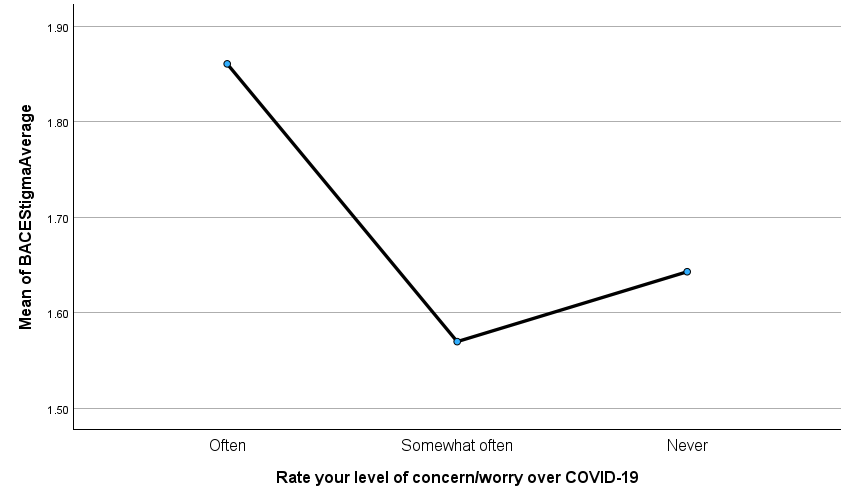
The research questions and findings of this study are designated below. Figure 1 and Figure 2 provide a graph of the stigma and non-stigma subscale averages of the BACE by COVID-19 Worry Level. Described in Tables 1 and 2 are the descriptive statistics for the stigma and non-stigma subscales of the BACE scale by COVID-19 Worry Level. Table 3 provides the descriptive statistics for the stigma and non-stigma subscales of the BACE. Within Table 4 are the participant demographics describing who participated in the study. Table 5 below provides the mean scores and frequencies for each non-stigma barrier in the BACE. Table 6 outlines the mean scores and frequencies for each stigma barrier in the BACE.
Research Question for first ANOVA: Is there a difference in the BACE Stigma subscale averages among levels of concern or worry about COVID-19 (often, somewhat often, never)?
No significant difference in BACE Stigma subscale averages among worry levels, F(2, 111) = 1.23, p = .296 (Table 1).
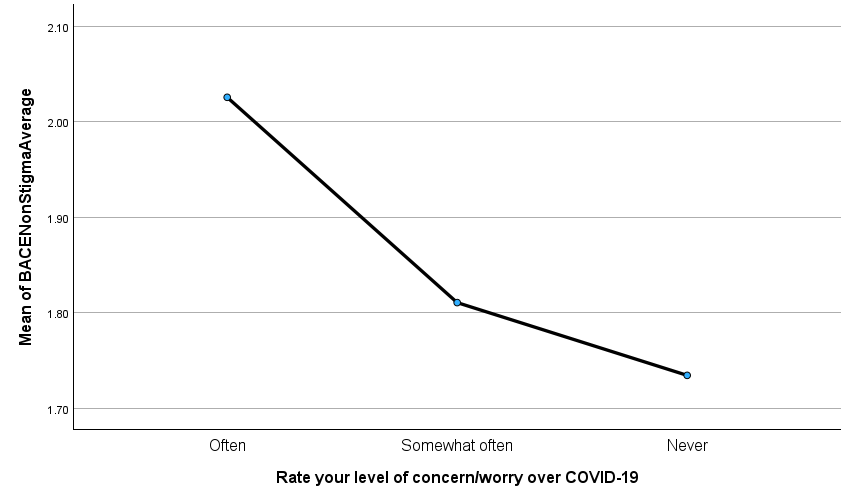
Research Question for first ANOVA: Is there a difference in the BACE Non-Stigma subscale averages among levels of concern or worry about COVID-19 (often, somewhat often, never)?
No significant difference in BACE Non-Stigma subscale averages among worry levels was found, F(2, 111) = 1.29, p = .280. (Table 2).
Research Question: Is there a difference between the BACE Stigma subscale average and the BACE Non-Stigma subscale average? In other words, do participants rate stigma or non-stigma items differently?
A significant difference between the BACE Stigma subscale and the BACE Non-Stigma subscale was found, F(1, 116) = 31.35, p < .001, partial 2 = .21. The Non-Stigma subscale (M = 1.81, SD = .60) average was significantly higher than the Stigma subscale average (M = 1.63, SD = .66). This means that on average the non-stigma items were rated higher than the stigma items. But looking at the means, we see that the averages were low (fall between not at all and a little).
4. Conclusions and Implications for Further Research
Although there was a significant difference found between the stigma and non-stigma related items, where on average the non-stigma items were rated higher than the stigma items, looking at the means, we see that the averages were low (fall between not at all and a little). Non-stigma related barriers reported at the highest rate were wanting to solve the problem on my own, not being able to afford the financial costs involved, and thinking the problem would get better by itself. Stigma-related barriers reported at the highest rate were feeling embarrassed or ashamed, not wanting a mental health problem to be on my medical records, concern that I might be seen as crazy, and concern that I might be seen as weak for having a mental health problem. Participants were mostly female, white, seniors in college or graduate students taking online classes in the health and human services field. Guevrekian et al. [11] reported that gender impacted barriers to treatment. Further research should be done looking at stigma and non-stigma related variables specifically at women and men and comparing the two on perceived barriers to access to care. This might provide the counseling world with information on what impedes some men and women from seeking counseling.
References
- Sahu, P. (2020) Closure of Universities Due to Coronavirus Disease 2019 (COVID-19): Impact on Education and Mental Health of Students and Academic Staff. Cureus 12(4): e7541. doi: 10.7759/cureus.7541.[CrossRef]
- Torales, J., O’Higgins, M., Castaldelli-Maia, J. M., & Ventriglio, A. (2020). The outbreak of COVID-19 coronavirus and its impact on global mental health. International Journal of Social Psychiatry 1-4. doi: 10.1177/0020764020915212.[CrossRef] [PubMed]
- Cao, W., Fang, Z., Hou, G., Han, M., Xu, X., Dong, J., Zheng, J. (2020). The psychological impact of the COVID-19 epidemic on college students in China. Psychiatry Research 287 (2020) 12934. https://doi.org/10.1016/j.psychres.2020.112934[CrossRef] [PubMed]
- Clement, S., Brohan, E., Jeffery, D., Henderson, C., Hatch, L. S., & Thornicroft, G. (2012). Development and psychometric properties the barriers to access to care evaluation scale (BACE) related to people with mental ill health. BMC Psychiatry, 12(36).[CrossRef] [PubMed]
- Jegede, O., Muvvala, S., Katehis, E., Paul, S., Soipe, A., & Jolayemi, A. (2020). Perceived barriers to access to care, anticipated discrimination, and structural vulnerability among African Americans with substance use disorders. International Journal of Social Psychiatry, 67(2). https://doi.org/10.1177/0020764020934512[CrossRef] [PubMed]
- Jones, V. L. (2015). Barriers to mental healthcare across age and education level. (Master’s thesis, Missouri State University). Missouri State Bear Works. https://bearworks.missouristate.edu/cgi/viewcontent.cgi?article=2830&context=theses
- Kasam, L. K., Macharapu, R., Gade, V., Mallepalli. P. K. R., Babu, R. S., & Manjula, S. (2020). A cross-sectional study of the barriers for seeking mental health care among medical undergraduates. Archives of Mental Health, 21(1), 16-20. http://doi.org/10.4103/AMH.AMH 17 19[CrossRef]
- Miranda, A. F. P., (2018). Barriers to access to care evaluation: Portuguese adaptation of a mental healthcare psychometric instrument. [Master’s thesis, University of Colombia]. University of Colombia Scientific Repository. http://hdl.handle.net/10316/82664
- Negash, A., Khan, M. A., Medhin, G., Wondimagegn, D., & Araya, M. (2020). Mental distress, perceived need, and barriers to receive professional mental health care among university students in Ethiopia. BMC Psychiatry, 20(187). https://doi.org/10.1186/s12888-020-02602-3[CrossRef] [PubMed]
- Salaheddin, K., & Mason, B. (2016). Identifying barriers to mental health help-seeking among young adults in the UK: a cross-sectional survey. The British Journal of General Practice, 66(651), 686–692. https://doi.org/10.3399/bjgp16X687313[CrossRef] [PubMed]
- Guevrekian, T., Lopez, T., Parekh, B., & Ganguly, A. (2020). Acculturative influences on psychological well-being and health risk behaviors in Armenian Americans. Journal of Addiction and Psychology, 4(2). https://doi.org/10.33552/OAJAP.2020.04.000584[CrossRef]