

A spherical shape ultra-wideband antenna is a microstrip patch antenna whose emitted signal bandwidth exceeds the lesser of 500 MHz. One of the major issues hindering the ultra-wideband antennas is poor diversity factors, poor voltage standing wave ratio and poor power efficiency to transmit the required signals. In this research work, the method of approach is the design and analysis of a spherical shape ultra-wideband antenna with the use of computer simulation technology (CST). This antenna is working under the resonant frequency of 6 GHz on a frequency bandwidth of 4-9 GHz. However, this research work has made an intensive review of related works. A spherical shape microstrip antenna with a diameter of 13mm and a radius of 6.5mm was designed, after which a simulation was carried out using the computer simulation technology software. The result from the radiated power shows how high the radiative efficiency is and from the results we were able to observe that the ultra-wideband antenna uses a very low amount of power but can transmit a better outgoing power from the 0.5 watts stimulated power. In this research work, an evaluation process on the envelope correlation coefficient of the antenna s-parameters was carried out, with a good result was obtained. Most importantly the diversity gain of the antenna proves to be good and efficient due to the effectiveness of the antenna radiation efficiency. The results of this antenna produce a very good voltage standing wave ratio (VSWR), the voltage standing wave ratio of this spherical ultra-wideband antenna is less than 2% with a very low return loss reflection. In conclusion, the spherical shape antenna is good for ultra-wideband purposes because of its robustness in delivering high-quality signals with a very low return loss. So, it stands the chance of recommendations in the communication industries due to its high radiation efficiency rate and good VSWR.
Performance Analysis of an Ultra-Wide Band (UWB) Antenna for Communication System
July 15, 2022
August 14, 2022
August 22, 2022
August 24, 2022
This is an Open Access article, distributed under the terms of the Creative Commons Attribution 4.0 International License (http://creativecommons.org/licenses/by/4.0/), which permits unrestricted use, distribution and reproduction in any medium or format, provided the original work is properly cited.
Abstract
1. Introduction
1.1. Background of the Study
Ultra-wideband technology has become the most promising technology since FCC (Federal Communication Commission) approved the 3.1-10.6 GHz band for unlicensed radio frequency applications. It has the advantages of low power consumption, high data transmission, less complexity, low cost etc. However, the design of compact, low profile and efficient antennas for UWB applications is still a major challenge [1]. Microstrip antennas are mainly used in aircraft, spacecraft, satellite and missile applications where high performances, ease of installation, low cost and small size are major constraints. Wireless local area network (WLAN) is operating in the 5.15-5.825 GHz band. The interferences caused by this narrowband can be reduced by using spatial filters, but this approach is expansive [2].
The antenna has an important issue in an ultra-wideband radar system. This Antenna has one of the most important features of receiving and transmitting the pulse wave. The element is designed for radiating and receiving the pulse wave having the information be processed
The microstrip Ultra-wideband antenna is commonly used in radar applications. This antenna is having several features, which is having a lot of attention, such as simple structure, easy integration with microwave integrated circuit and easy fabrication. The geometrical shape of a microstrip patch antenna is having the radiating elements on the dielectric substrate and the other side is grounded. Currently, numbers of patch antennas are available, such as circular, rectangular, semicircular etc. But one of the most used antennas is the rectangular antenna. Based on previous reviews from different related works on the design of UWB antenna, the major problem that has been consistently observed is a poor Voltage signal wave ratio. This poor voltage signal wave ratio has been a major challenge for antennae since it affects the radiation efficiency of the antenna propagation. This results in excessive return losses, so when the return losses are higher it means that the antenna is observing heavy negative radiation.
In this research work, we would be presenting a spherical shape ultra-wideband microstrip antenna operating at 4 GHz – 9 GHz bandwidth and carry out a performance Analysis of an ultra-wideband (UWB) antenna for the communication system.
1.2. Review of Related Works
According to [3], they designed an ultra-wideband (UWB) antenna which is capable of producing notches at lower frequencies of the UWB band presented in their research work. The notch can be adjusted to attain desired frequency by changing the size and the distance between the two studs placed between the circular patches. The defected ground structure has been applied to improve the antenna performance. The VSWR and radiation plots approve the suppression of the desired notched frequency. A compact UWB antenna for wideband application is purposed with rejected notch bands at the lower frequencies by introducing two studs right above the centre of the circular patch surface of the antenna. At first, a circular patch microstrip antenna was designed with bandwidth operating from 3.1 to 15 GHz.
According to [4] designed a new ultra-wideband (UWB) microstrip patch antenna with notch band characteristics for wireless local area network (WLAN) application is presented in their research work. The proposed antenna consists of a rectangular patch with a partial ground plane that is fed by a 50 Ω microstrip line. A notch band function is created by inserting overlapped one U-shape and one C-shape slot on the radiator patch, adding the patch to the ground plane side and slit in the truncated ground plane. The proposed antenna potentially minimized frequency interference between the WLAN and UWB system. This antenna with a size of 26 mm × 32 mm (W×L) and the simulated results show that the antenna can operate over the frequency band between 3.1 and 10.45 GHz for voltage standing wave ratio (VSWR) > 2 with band notch 5.06-5.825 GHz.
According to [2] in their research work, they have proposed a design of a microstrip rectangular antenna with the use of Advance Design System Momentum (ADS) software. This antenna is working under the resonant frequency of 4.1 GHz and the reflection coefficient is lower than -10dB for the frequency range is 4-5 GHz. This antenna is proposed with the use of Glass Epoxy Substrate (FR4) having the dielectric constant (Ir=4.4). The transmission lines of the specific length and width are used for exciting this patch antenna. Different parameters such as S parameters, directivity, gain and efficiency of the designed patch antenna have been calculated from ADS Momentum [6].
According to [7], a compact UWB-MIMO antenna was proposed in their research work. All the performance parameters of the proposed antenna i.e., S parameter, gain, radiation patterns and ECC have been analyzed properly and the results satisfy the criteria for UWB transmission. Further, the isolation between the antenna is enhanced by a Y-shaped slot implemented in the ground plane. The proposed design is quite fit for UWB application.
2. Materials and Method
2.1. Method
In this research work, the method adopted was design, Analysis, and simulation.
2.2. Designing of UWB Antenna
The main characteristic of the UWB antenna is bandwidth. There are two ways to express bandwidth [4]:
- Ratio of the upper frequency and lower frequency. The UWB has approximately higher frequency: lower frequency= 3:1
- The fractional bandwidth of a system is the ratio of the bandwidth to the centre frequency.
The bandwidth of the system is often described relative to the centre frequency, fc which is calculated using equation (2).
When designing the UWB antenna shape, we first consider the length, width and thickness of the substrate and the dielectric constant of the material. We can furtherly say that,
Putting fr= 6.5 GHz and
Where L is the length of the substrate and W is the width of the substrate, Fr is the resonance frequency and is the dielectric constant, L= 20mm, and W= 25mm.
So, we can also consider the ground plane of the antenna length to be
We can get the diameter of the spherical antenna using the resonance frequency of the proposed antenna 6.5 GHz. In the case of circular monopole-based ultra-wideband antennas, the resonance frequency is determined by using the disc diameter (D) which roughly corresponds to the quarter wavelength . Therefore, the relationship is given by
For the velocity of light, and dielectric constant,, the corresponding wavelength at a given frequency, f can be determined from the following equation
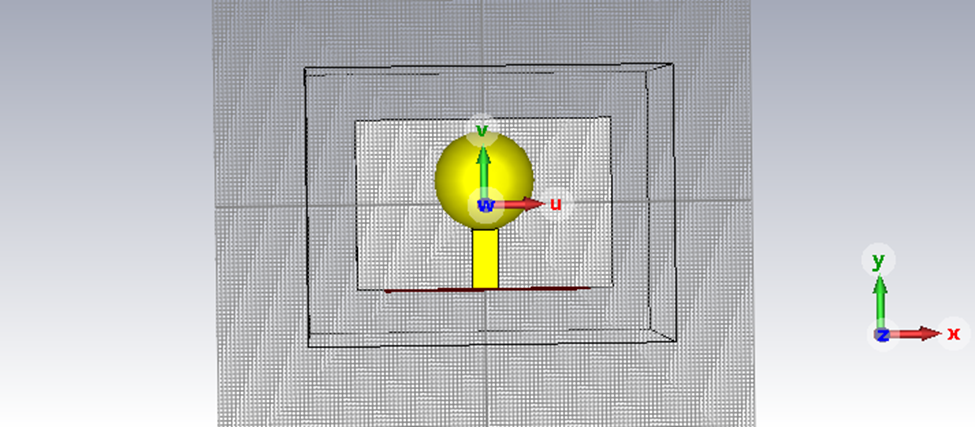
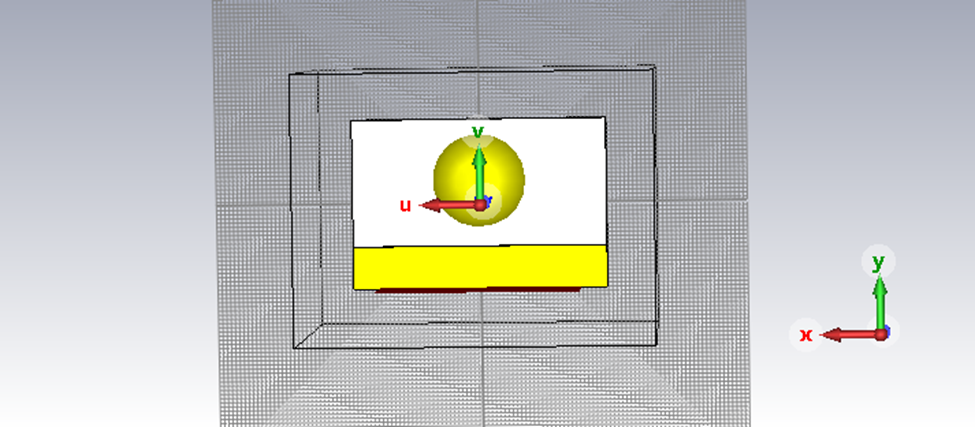
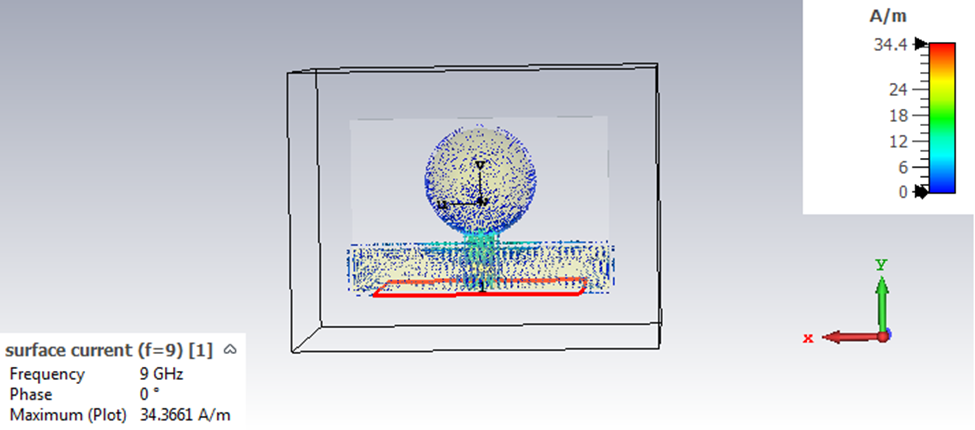
Using equation (8), for the substrate the dielectric constant, , then the radius R is 6.5mm while the diameter D of the circle is 13 mm. From figure 1 we can see the shape of the UWB antenna and figure 2 displays the back view of the UWB antenna while figure 3 shows the surface current flow of the antenna.
2.3. Envelope Correlation Coefficient Evaluation of the S-Parameters
The correlation coefficient can be calculated from radiation patterns or scattering parameters. Assuming a uniform environment, the envelope correlation (Ec) simple square of the correlation coefficient (Cc), can be calculated conveniently and quickly from the S- parameters of the UWB antenna [4].
So, we can also denote that the total active reflection coefficient of the single spherical UWB antenna can be expressed as follows:
2.4. Antenna Diversity Gain
The diversity gain of the antenna system is closely related to the calculated ECC value of the UWB antenna system. The relation between ECC and DG can be expressed by equation (11)
2.5. UWB Spherical Antenna Radiation Efficiency
The radiated efficiency of the antenna equals the radiated power of the antenna over the input power of the antenna. So, we can easily say that the radiative efficiency of the antenna can be denoted as [8]:
Where is the antenna radiated efficiency, input power and is the radiated power. We can furtherly denote our total efficiency to be [9]:
Where is the total efficiency and is the mismatched loss.
2.6. Impedance Matching and Voltage Standing Ratio Evaluation
The impedance is a complex value since the electric and magnetic fields are not necessarily in phase. If an impedance of a transmission line or a feedline(Z0) and the antenna impedance (ZA) are not identical and there will be a mismatch to the antenna terminal and some of the signal of incidents will be reflected to the source. This reflection is thereby characterized by reflection coefficient (Rc) which is the ratio of the reflected voltage to the transmitted voltage .
The other parameter frequently used to characterize impedance matching is voltage standing wave ratio (VSWR). The VSWR is defined as the ratio of the peak voltage maximum to peak voltage minimum in the standing wave pattern at an impedance discontinuity
For the perfect matching VSWR =1, this means that there is no reflection and return loss. In the real UWB system, it is very hard to achieve a perfect over wide frequency. So, it is defined that the VSWR should be less than 2 which is still good.
3. Results and Discussion
3.1. Results of the S Parameters of the UWB Antenna Presentation
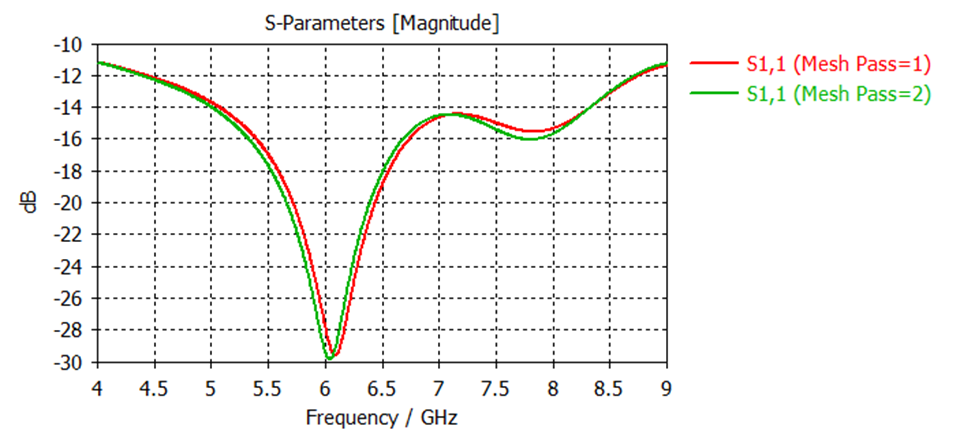
The result in figure 4 shows the characteristics result of the UWB spherical shape antenna, at 4 GHz to 9GHz with a response frequency between 6GHz respectively. The result shows that the radiation of the electromagnetic wave from the antenna has a good response and a better efficiency. Also, we can see the frequency response gap that is wide, this wide gap indicates that the antenna is a wide gap antenna other than that of the narrow band that will have a narrow frequency gap.
3.2. Antenna Impedance Characteristics
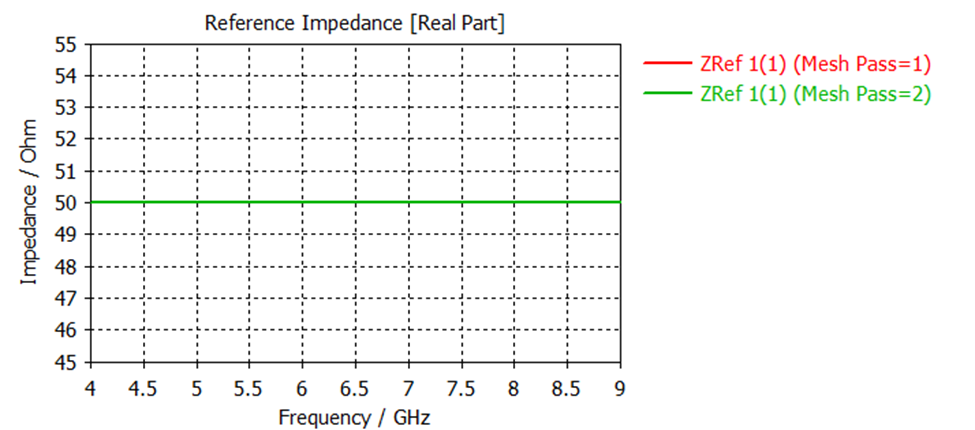
To maintain accuracy and radiative efficiency, it is wise to make sure the impedance of the feedline antenna isn’t lower or higher than 5o ohms. From the results in figure 5, we can see that the impedance of the antenna feedline is 50 ohms and the result of the S- Parameters has been influenced by the impedance for effective radiation.
3.3. Radiation Power of the Antenna
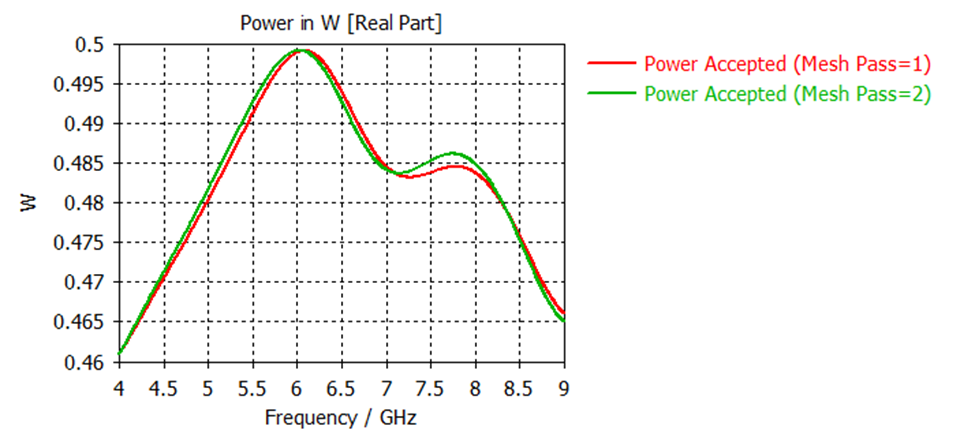
From figure 6 we can see the results of the antenna accepted power, knowing that the stimulating power of the antenna is 0.5 watts then the accepted power is 0.46 watts. This result has made it known that the UWB antenna consumes lesser of power and recorded a very low loss of power, however, the accepted power from the result has proven that the lost power will be very small, and the radiation power will be high.
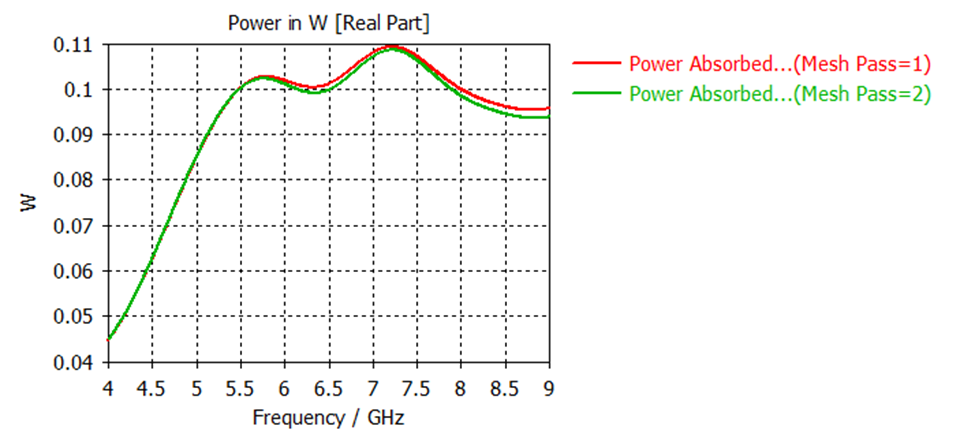
There must be an absorbed power since the signals are being transferred through a metallic medium (copper). However, this technique of antenna made the loss to be very minimal. As we can see from figure 7 the absorbed power of the antenna is very low compared to the simulated power, the results show that 0.04 watts of power are absorbed in 4 GHz, and at 0.5-watt power absorption we have the 6GHz then power absorption dropped back at 9GHz to 0.95 watts.
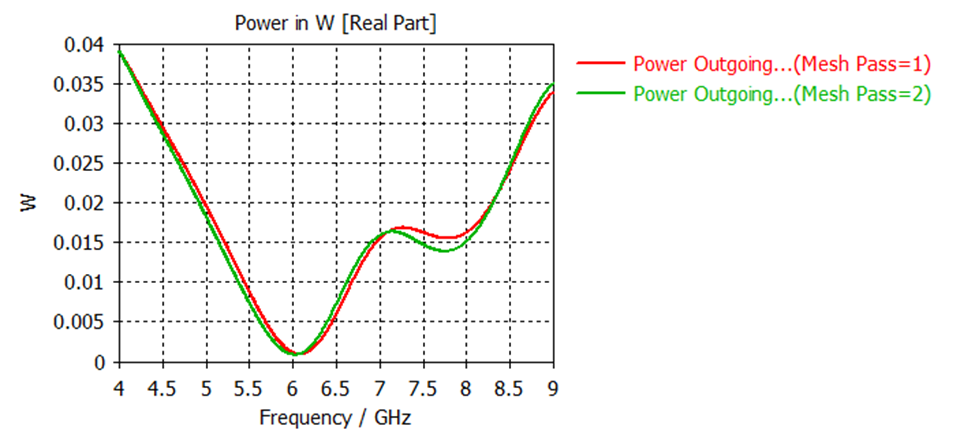
The results in figure 8 have illustrated the outgoing power of the signals in the antenna. The result below shows that the UWB antenna is very good when going for an antenna with very low power consumption and yet with an effective result. This antenna’s outgoing power result here has just shown that at 4GHz the power dropped from 0.04 watts to 0.005 watts at 6GHz which is the response frequency of the antenna and at 9GHz the outgoing power rise to 0.35 watts respectively. This result shows how the antenna responds to low power effectively.
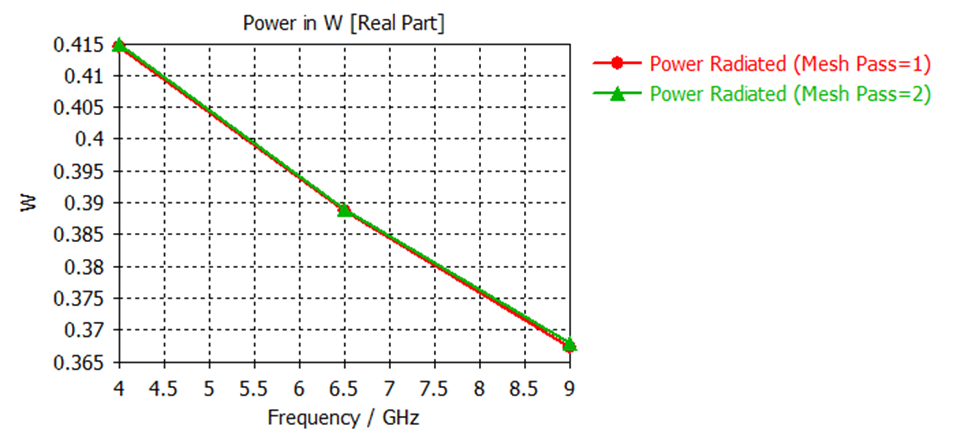
Radiated power of the antenna is one of the most concentrated parts of the antenna because we need to monitor the efficiency and the radiation strength of electromagnetic waves through the antenna. The result in figure 9 has just illustrated that the radiation power of the antenna is very effective and strong, even at its effectiveness it still main low power consumption. We can see that the highest power radiated was from 4GHz at 0.415 watts and 9GHz at 0.366 watts.
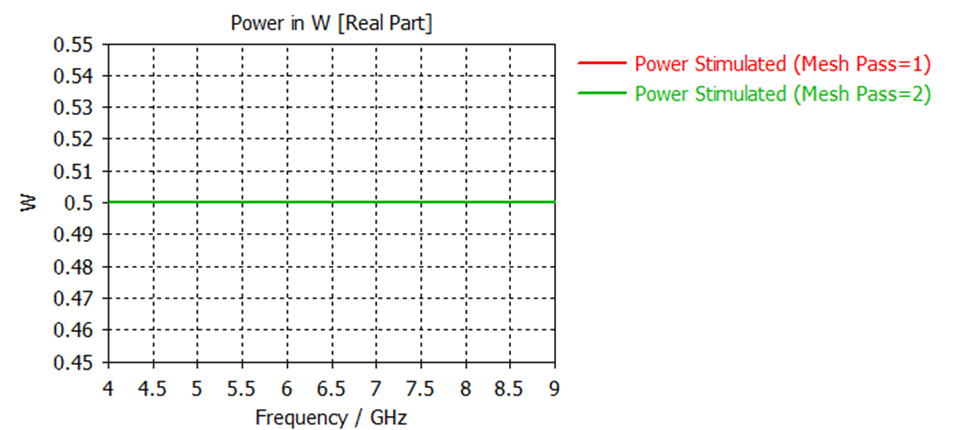
We can also see the simulated power of the antenna, in figure 10 the result shows that the simulated power is 0.5 watts. This clearly shows that this antenna is not just an effective antenna but also a low-power consumption antenna. As low as 0.5 watts, the antenna can function effectively and deliver a good radiative efficiency with a very low loss. While figure 4.8 displays the field energy of the antenna from -120 dB to 0dB.
3.4. Antenna Voltage Standing Wave Ratio
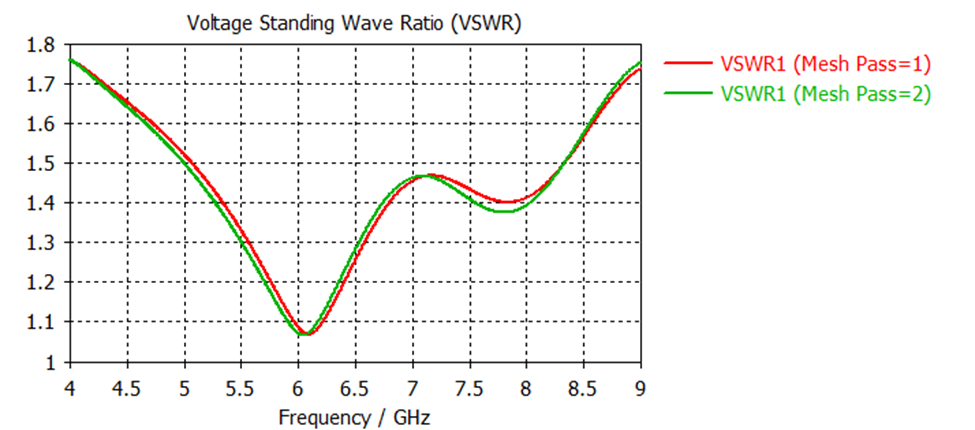
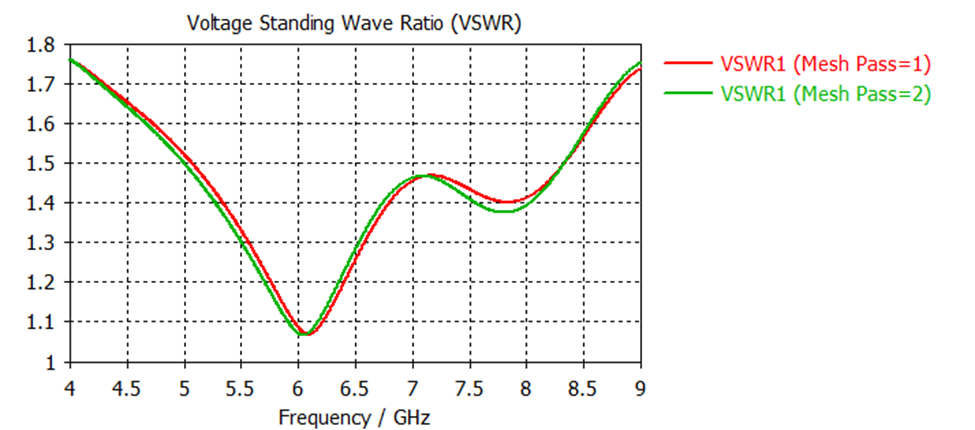
The voltage standing wave ratio of the antenna is a major area to look at, when specifying the radiated efficiency and forward and reversed reflections of the antenna the result in figure 11 has illustrated that the result of this spherical UWB antenna has a good ratio because the VSWR is lesser than 2% but greater than, this shows that the reflection of the electromagnetic wave of the antenna is a positive reflection and a good reflection. The result shows that the VSWR is 1.77.
3.5. Far Field Radiation Efficiency of the Antenna
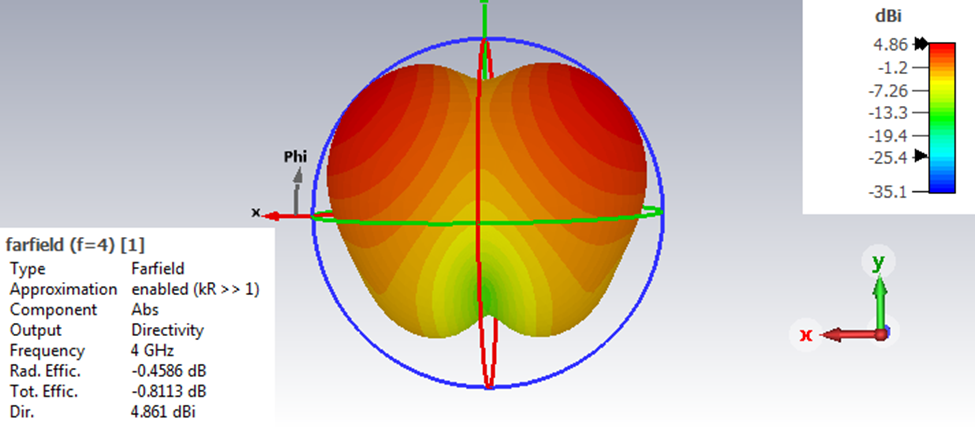
The far-field radiation pattern and radiation efficiency are described here in figure 12, at 4GHz the radiation efficiency falls within -0.4586dB with a total efficiency of -0.8113Db, then at 6.5GHz the radiation efficiency is at -1.029dB and -1.092dB for its total radiation efficiency and finally for 9GHz, the radiation efficiency is at -1.017dB and the total radiation power is -1.332dB. however, directivity is the maximum gain obtainable in a particular direction. So, the diversity gain of the antenna is 4.851 dBi.
3.6. Comparative Results of VSWR of Different Antennas
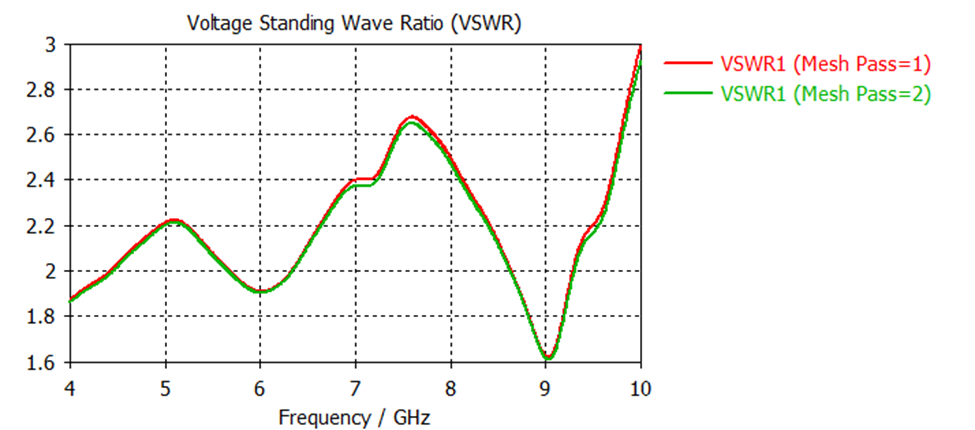
As we can see from the results in figures 13 and 14, we can note that these are results from two different antennas, figure 13 denotes a rectangular antenna UWB and while figure 14 represents the spherical shape UWB antenna, from figure 13, the VSWR is above 1.8% and rise above 2% and while that of figure 14 is below 1.8% at 4 GHz respectively and fell below 1.8%. These results just prove that the spherical shape UWB antenna at 4 GHz to 10Ghz has a better voltage standing wave ratio when compared to the rectangular UWB antenna.
4. Conclusion and Recommendations
4.1. Conclusion
This research work has been able to design a spherical shape UWB antenna for a communication system. In this research work, the length and width of the substrate and ground plane were determined following the resonance frequency of the antenna and the diameter of the circular shape patch is 13mm with a radius of 6.5 respectively and a good impedance matching with an impedance of 50 ohms. This research work also evaluates the envelope correlation of the s- parameters of the antenna, total active reflection coefficient and the diversity factor. It was made known that the diversity gain of the antenna is in a good condition. From the simulated results of the antenna, we can observe how effective the radiation of the antenna is, the radiation efficiency is high with a very low negative reflection. The results of the S-Parameters of the 4-9GHz bandwidth have shown that the spherical shape UWB antenna is effective for a communication system with a good impedance matching and a good VSWR that is lesser than 2. The antenna has proven that its low power consumption antenna, has a lesser return and power loss with good radiative power from the simulated results.
4.2. Recommendations
The spherical shape patched UWB antenna has proven itself to be better when it comes to a single patch UWB antenna system. Its results capability has made it to be the next choice and be recommended when seeking a UWB antenna. The spherical-shaped patched UWB antenna has a better diversity gain, good VSWR that is lesser than 2, good response frequency at a bandwidth of 4-6GHz, and good radiating power factor with a low power consumption rate.
References
- In-Kyu K., Jiwan G., Janam M., Iram N., Sun-Woong K., & Dong-You C. (2019) ‘Ultra-Wideband (UWB) Microstrip Patch Antenna with Adjustable Notch Frequencies’, Dept. of Information and Communications Engineering, Chosun University, Republic of Korea
- Omprakash K., & Surender K., S. (2016), ‘Design and Analysis of Ultra-wideband Micro Strip Patch Antenna with Notch Band Characteristics’, National Institute of Technology, ECE Department, Hamirpur, Himachal Pradesh, India.
- Muneer K., & Anil C., (2019), Design of ‘Ultra-Wideband Microstrip Patch Antenna’ Birla Institute of Applied Sciences, Bhimtal, India.
- Nandanwar D. K. & Pawar, S. S. (2014). “Analysis of elliptical planar metal plate monopole antenna with different feeding strip length for UWB application,” International Journal of Advanced Technology in Engineering and Science, vol. 2, pp. 532–536.
- Yang., Z., Yang., H., & Cui., H. (2016) “A compact MIMO antenna with inverted C-shaped ground branches for mobile terminals,” International Journal of Antennas and Propagation, vol. 2016, Article ID 3080563.[CrossRef]
- Yanjie et al (2018), Design of a Compact UWB MIMO Antenna without Decoupling Structure, School of Physics and Optoelectronic Engineering, Guangdong University of Technology, Guangzhou 510006, China
- Avnish et al (2017). ‘Design of a compact UWB- MIMO Antenna’, IEEE Trans. Antennas Propagation. 45(10). 2884–2887.
- P. Elechi and P.O. Richard-John “Improved Multiband Rectangular Microstrip Patch Antenna for 5G Application”, Journal of Telecommunication, Electronic and Computer Engineering, vol. 14, no. 2, pp. 7-14, 2022.
- P. Elechi, S. Orike, and C.E. Ikpo “Performance Analysis of Patch Antenna for Ultra-Wideband using Particle Swarm Optimization” Journal of Telecommunication, Electronic and Computer Engineering, vol. 13, no. 3, pp. 53-59, 2021.