

In military battle, the unmanned combat aerial vehicle (UCAV) plays a critical role. The UCAV avoids the fatal military zone as well as radars. If there is just a narrow path between the defensive areas, it is dan-gerous. It chooses the quickest and safest path. The balance evolution technique is used to improve the path planning of UCAV in this study, which results in a novel artificial bee colony. To regulate the position of a swarm of UCAVs, a particle swarm network is used to communicate between the UCAVs in the swarm. According to simulation data, the particle swarm network technique is more efficient than the ABC ap-proach. The intelligence system is taught via an artificial neural network.
Article
Open Access
April 22, 2022
Particle Swarm Network Design for UCAV Intelligence System Path Planning
1
School of Software, Northwestren Polytechnical University, Xian, China
2
School of Computer Science, University of Haripur, Haripur, Pakistan
Page(s):
1-8
Received
March 13, 2022
March 13, 2022
Revised
April 12, 2022
April 12, 2022
Accepted
April 20, 2022
April 20, 2022
Published
April 22, 2022
April 22, 2022
Creative Commons
This is an Open Access article, distributed under the terms of the Creative Commons Attribution 4.0 International License (http://creativecommons.org/licenses/by/4.0/), which permits unrestricted use, distribution and reproduction in any medium or format, provided the original work is properly cited.
Copyright: Copyright © The Author(s), 2022. Published by Scientific Publications
Abstract
1. Introduction
Several new strategies arose as a result of the Gulf and Kosovo Wars, and air power's dominance was cemented. As the Gulf War revealed [1] strategic air superiority alone cannot win a war. According to military planners, air power will have a significant impact on the outcome of future battles. The UCAV component is automatically moved to the top of the list as a consequence of these conversations. With the UCAV, combat losses are kept at a minimal while simultaneously overcoming different human limitations. Human-piloted combat aircraft are expected to be more agile, faster, and smaller than unmanned aerial vehicles (UAVs) [1, 2]. In a heavily populated air defense battle sector, such unmanned vehicles could be used in place of manned aircraft using low-looking radars and QRMs (quick reaction missiles). It will be simple for them to keep a careful check on the adversary's activities and send that information to the command stations. The UCAV concept is technically feasible, despite its theoretical plausibility. This type of unmanned aerial vehicle might address operational needs while also fitting into a larger design. The historical preference for manned aircraft should not preclude them from being welcomed in future fights driven entirely by technological progress. To use these forces effectively, one must first understand them. Before ground soldiers can engage in serious combat with the enemy side, major battles will very definitely be won by air power in the near future. Unmanned combat aerial vehicles (UCAVs) will almost certainly play a key role in the future development of air power [3, 4].As a result, they will be utilized for reconnaissance, scouting, and disrupting the enemy's air defense system. "Not only does the UCAV have the attractiveness of decreasing combat casualties, but it also overcomes human constraints on Gcrunching techniques and a pleasant cockpit environment for the pilot's safety and survival," says the author. The invention of the synthetic UCAV can identify the adversary army's marketing activity. Avoid being spotted by radar and arterially by your foes. To this end, the module and set of rules for the UCAV must be laid out. The module will identify the potential danger zone and warn aircraft to stay away from it. Researchers have gradually turned their interests away from deterministic algorithms in order to cope with the increased complexity of modeling a fighting region. ABC is an artificial bee colony cognitive algorithm based on honeybee swarm foraging behavior. The majority of the swarm is made up of three types of bees. There are three sorts of bees: employ bees, observation bees, and scout bees [5]. Using a bee, determine the profitability, distance, and direction of linked food. The information obtained by employed bees was examined by onlooker bees to assess the possibility of food and direction [6]. Scout bees are in charge of locating new food once the old food has gone out. Foraging's purpose is to find as much food as possible. Unmanned combat air vehicles (UCAVs), which will be important in augmenting air power, are often included in these debates. It is theoretically possible, and it has been demonstrated in recent air battles. This type of unmanned aerial vehicle can fulfill operational needs while also fitting into a larger strategy. There should be no historical prejudice against unmanned aircraft that precludes us from implementing this technology in future technologically driven warfare.
2. Materials and Methods
2.1. Intelligent system based on artificial neural networks
The network formed by a particle swarm network resembles a flock of birds. If the swarm comes across a dangerous location with a limited path, and only one UCAV travels through it, the swarm utilizes artificial neural network communication to instruct the other drones to plan the path experience of the drone that passes through the narrow way to avoid drone collision [7].This strategy is employed to address this issue. Particle swarm was inspired by a flock of flying animals. The entire flock of birds moves in a swarm when hunting for prey, and communication between them is comparable to that of a Mesh network. Calculate reason, see relationships and analogies, learn from experience, store and retrieve data from memory, solve problems, comprehend sophisticated ideas, communicate effectively in natural language, classify, generalize, and adapt to new situations are just a few of the capabilities of an algorithm. Linguistic intelligence, musical intelligence, logical-mathematical intelligence, spatial intelligence, intrapersonal intelligence, and interpersonal intelligence are all artificial intelligence domains that might benefit from more research. Only the UCAV Intelligence system is discussed in this study.
2.2. Algorithm of Particle Swarms
2.3.1. (a) UCAV Swarm Path Planning Combat Field Modeling
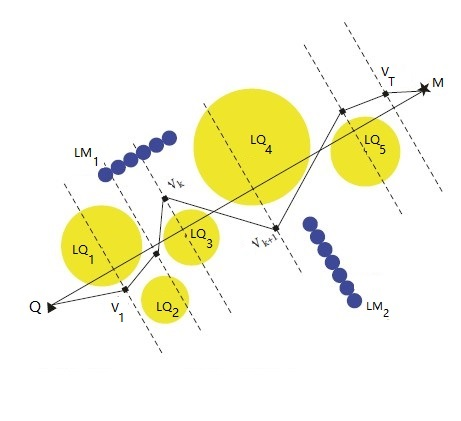
UCAV proposed method (autonomous combat aerial vehicle path planning) is a global optimization issue involving the creation of a collection of waypoints from a starting point Q to a destination point M while avoiding flying outside of the map or being captured by threats. There are two types of environmental risks, according to our research: mobile and static threats. Static threats are obstacles that remain at a fixed position in space (represented by yellow circles with a set radius); mobile threats are obstructions that move dynamically and with a known constant velocity (denoted as blue circles). The straight-line QM divides the flight path into (M+1) segments, each representing one waypoint along the route [3], as illustrated in Figure 1. The initial population of particles is created in an active zone of particles separated by barrier sites, forcing a particle to follow the best path in a more constrained region. Throughout the search process, the acceleration coefficient and inertia weight of particles are adjusted adaptively as the number of iterations increases [8, 9]. A transformation of a coordinate system is designed to lessen the complexity of the computing process in the path planning for the UCAV, as shown in Figure 2.
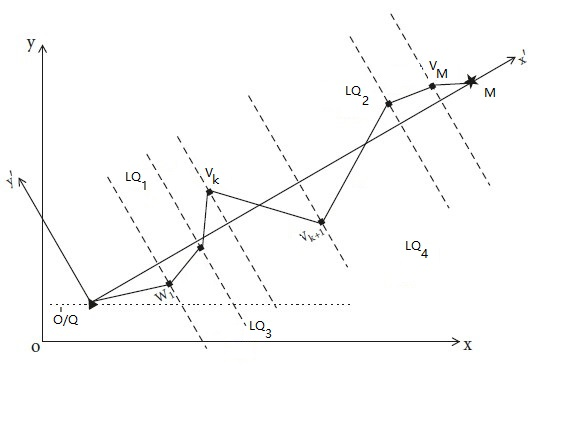
The new x-axis is the straight line between Q and M (QM), and the new coordinate origin is the UCAV start point (S), yielding a new coordinate system (x', 0', y') that differs from the previous coordinate system (xoy). The link between the original and converted coordinates in the two coordinate systems may be represented as follows [3] if the coordinates of a waypoint in the (xoy) system and the (x', 0', y') system are provided as (x 0, y 0)L and (x t, y t)L, respectively.
When M is the beginning point's location in the original coordinate system (x Q,y Q)M, the cost of mobile threats is calculated as follows:The horizontal component of |c | is represented by the symbol |(c x) |, whereas the vertical component is represented by the symbol |(c y) |. The letter "m" also represents the ant's exposure to mobile threats, as well as the distance between sites I and j, where |c denotes a mobile threat and |(c x) | denotes the threat's horizontal component. The distance between places I and j contains a horizontal component x ij of d ij, a vertical component y ij of d ij, and a horizontal component x ij of d ij. Finally, when an ant or pheromone moves, the position of the ant or pheromone is updated in real time.
J T I and J F I represent the mobile threat cost and the fuel cost, respectively, for each ith sub path from Wi to Wi+1. The mobile threat cost of a sub path is approximated in Fig 2 by utilizing blue circles along the sub path to estimate the mobile threat cost. The threat cost is determined as follows if the ith sub path (Wi, Wi+1) is within the effect range:
The number of mobile threats encountered is denoted by Nt, the length of the ith sub route is denoted by L, and the weight of each mobile threat encountered is denoted by TK. The cost of each mobile threat [12, 13], which is estimated using the technique, is denoted by CK (5). Furthermore, because WF stands for fuel weight, the following is the fuel cost for the ith sub route.
2.3.2. (b) ABC and (PSN) Particle Swarm Network combined
When the distance between the two risks is short, the drones in a swarm communicate with one another using a neural network. The first drone uses neural networks to provide data to other drones about how many degrees you arrive in which pattern and how many altitudes you arrive in [14, 15]. This program keeps the drones from colliding and chooses their path on their own. The suggested swarm UCAV neural network is shown in Figure 4, while the limited path modeling is shown in Figure 3.
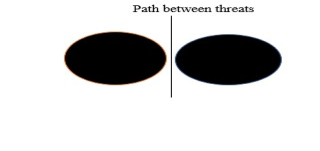
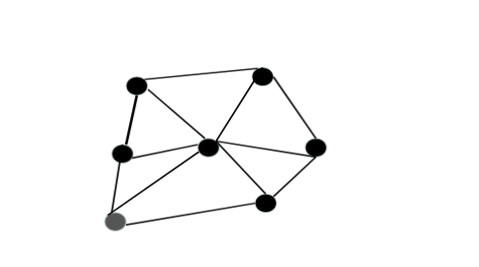
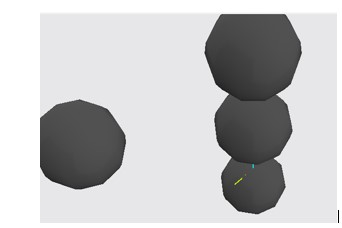
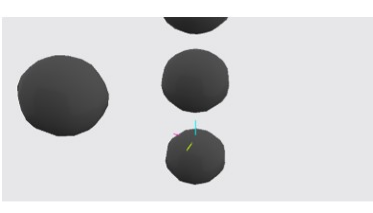
The massage is transmitted in via UAVC, which is based on the Particle Swarm Algorithm, as a neural network from layer to layer. The drones are flying forward, looking for the track and sending signals to the other drones, telling them to organize their positions in line with the course, relay the location, and select which angles new drones should approach from. The forward position drone does this task by transmitting a message to the layer, following which the drone positions itself to avoid collision [16]. Figure 5 depicts the movement of the drone pattern.
3. Results of Proposed Model
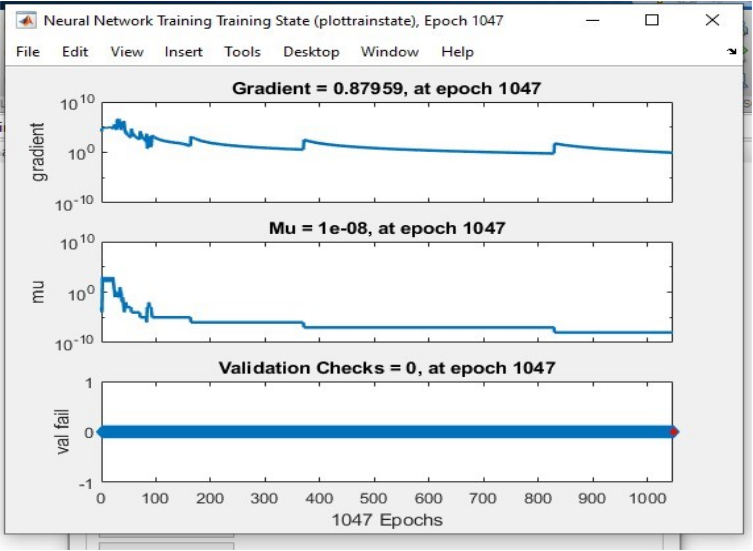
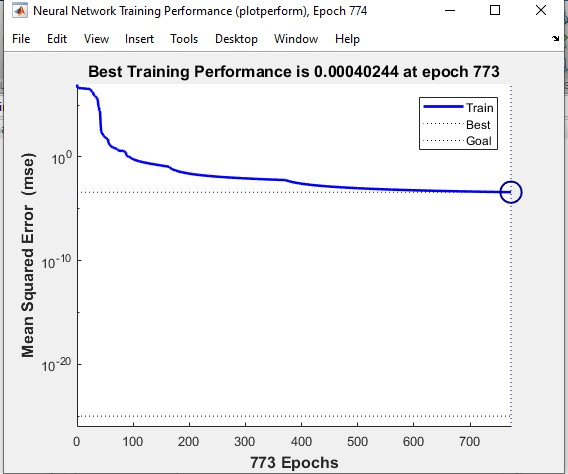
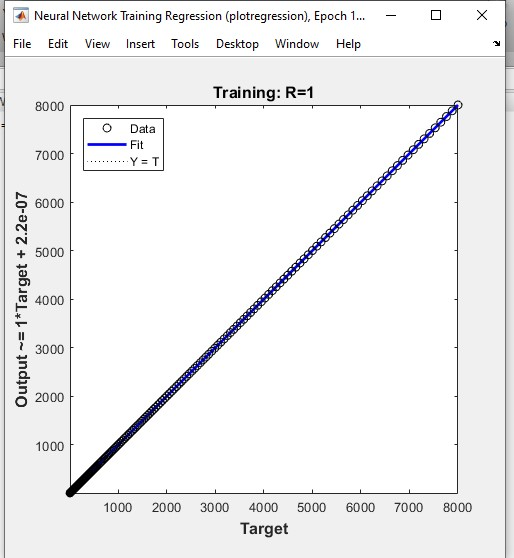
To train elevation angel, PS position, and direction, the UCAV has a separate parameter. These characteristics are under our control, and they are utilized to plan the swarm's course. We have taken one input and output the sigmoid of that input to the output. The activation function is sigmoid, and the input is passed to the output. The neural network's performance is shown in Figure 7 and Figure 8 below. The train data graph regression is shown in Figure 9 below.
4. Conclusions
First, we have an enhanced ABC algorithm, but the key issue with it is that if there is a location for one drone to pass another down, the algorithm does not have a method for passing through between two hazard regions. We employed the particle swarm technique to prevent colliding. Particle Swarm Network Algorithm is the term we came up with for it. The first drone communicates with others using an artificial neural network to warn them of a barrier in their route as well as the angle and altitude at which they should proceed in a line. The PSO algorithm generates ANN. The built intelligent route planning system solved the present system's path planning difficulty.
Author Contributions: “Conceptualization, Sheharyar Khan; methodology; software; validation,; formal analysis; investigation; resources; data curation, Sheharyar Khan.; writing—original draft preparation; writing—review and editing, Sohrab. Khan; visualization, Sohrab Khan; supervision, Sheharyar Khan; project administration, Sheharyar Khan; funding acquisition. All authors have read and agreed to the published version of the manuscript.” Please turn to the Credit taxonomy for the term explanation. Authorship must be limited to those who have contributed substantially to the work reported.
Data Availability Statement:
Data can be provided on demand through the email:shksherry@gmail.com
References
- Air Vice Marshal R.A. Mason, "War in the Third Dimension" in Air Marshal Sir Michael Armitage, ed., Manned and Unmanned Aircraft (London: Brassey's Defence Publishers, 1986) p. 193.
- Application of Unmanned Combat Aerial Vehicles in Future Battles of the Subcontinent by C.N. Ghosh, Strategic Analysis: A Journal of the IDSA, July 2001 (Vol. XXV No. 4).
- Chenxi Huang, Yisha Lan, Yuchen Liu, Wen Zhou, Hongbin Pei, Longzhi Yang, Yongqiang Cheng, Yongtao Hao, and Yonghong Peng, A new dynamic path planning approach for unmanned aerial vehicles. Complexity, 2018.[CrossRef]
- X. Peng and D. Xu, “Intelligent Online Path Planning for UAVs in Adversarial Environments,” International Journal of Advanced Robotic Systems, vol. 9, no. 1, p. 3, 2012.[CrossRef]
- Melingui, R. Merzouki, J. B. Mbede, and T. Chettibi, “A novel approach to integrate artificial potential Feld and fuzzy logic into a common framework for robots autonomous navigation,” Proceedings of the Institution of Mechanical Engineers, Part I: Journal of Systems and Control Engineering, vol. 228, no. 10, pp. 787–801, 2014.[CrossRef]
- H. Duan, Y. Zhang, and S. Liu, “Multiple UAVs/UGVs heterogeneous coordinated technique based on Receding Horizon Control (RHC) and velocity vector control,” Science China Technological Sciences, vol. 54, no. 4, pp. 869–876, 2011.[CrossRef]
- S. Zhai and T. Jiang, “A new sense-through-foliage target recognition method based on hybrid differential evolution and self-adaptive particle swarm optimization-based support vector machine,” Neuro computing, vol. 149, pp. 573–584, 2015.[CrossRef]
- B. Song, Z. Wang, and L. Zou, “On Global Smooth Path Planning for Mobile Robots using a Novel Multimodal Delayed PSO Algorithm,” Cognitive Computation, vol. 9, no. 1, pp. 5–17, 2017.[CrossRef]
- E. G. Tsardoulias, A. Iliakopoulou, A. Kargakos, and L. Petrou, “A Review of Global Path Planning Methods for Occupancy Grid Maps Regardless of Obstacle Density,” Journal of Intelligent & Robotic Systems, vol. 84, no. 1-4, pp. 829–858, 2016.[CrossRef]
- Y. Liu, X. Zhang, X. Guan, and D. Delahaye, “Potential Odor Intensity Grid Based UAV Path Planning Algorithm with Particle Swarm Optimization Approach,” Mathematical Problems in Engineering, vol. 2016, 2016.[CrossRef]
- M. Yao and M. Zhao, “Unmanned aerial vehicle dynamic path planning in an uncertain environment,” Robotica, vol. 33, no. 3, pp. 611–621, 2015.[CrossRef]
- M. G. Park and M. C. Lee, “A new technique to escape local minimum in artificial potential Feld based path planning,” KSME International Journal, vol. 17, no. 12, pp. 1876–1885, 2003.[CrossRef]
- N. Zeng, H. Zhang, W. Liu, J. Liang, and F. E. Alsaadi, “A switching delayed PSO optimized extreme learning machine for short-term load forecasting,” Neuro computing, vol. 240, pp. 175– 182, 2017.[CrossRef]
- J. H. Holland, Adaptation in Natural and Artificial Systems, University of Michigan Press, Ann Arbor, Michigan, USA, 2nd edition, 1975.
- X. Yuan, M. Elhoseny, H. K. El-Minir, and A. M. Raid, “A Genetic Algorithm-Based, Dynamic Clustering Method Towards Improved WSN Longevity,” Journal of Network and Systems Management, vol. 25, no. 1, pp. 21–46, 2017.[CrossRef]
- R. J. Szczerba, P. Galkowski, I. S. Glickstein, and N. Ternullo, “Robust algorithm for real-time route planning,” IEEE Transactions on Aerospace and Electronic Systems, vol. 36, no. 3, pp. 869–878, 2000.[CrossRef]