

The technologies for cloud ERP (Enterprise Resource Planning) have revolutionized the field of information technologies. Any kind of business can benefit from their flexibility, affordability, scalability, adaptation, availability, and customizable data. An advancement of classic ERP, cloud enterprise resource planning (C-ERP) provides the benefits of cloud computing (CC), including resource elasticity and ease of use. The rise of cloud computing affects on-premise ERP systems in terms of architecture and cost. Cloud-based ERP systems make the claim to be appropriate for digital corporate settings. System quality, security, vendor lock-in, and data accessibility are recognized as the technological issues. Industry 4.0 refers to the re-engineering and revitalization of modern factories through the integration of cloud-based operations, industrial internet connectivity, additive manufacturing, and cybersecurity platforms. One of the four main pillars of Industry 4.0, cloud-based Enterprise Resource Planning (Cloud ERP), is a component of cloud operations that aids in achieving greater standards of sustainable performance.
Success Factors of Adopting Cloud Enterprise Resource Planning
October 12, 2023
November 17, 2023
December 05, 2023
December 06, 2023
This is an Open Access article, distributed under the terms of the Creative Commons Attribution 4.0 International License (http://creativecommons.org/licenses/by/4.0/), which permits unrestricted use, distribution and reproduction in any medium or format, provided the original work is properly cited.
Abstract
1. Introduction
The field of cloud computing has grown at an extraordinary rate in the previous few decades. It's a model for easy, everywhere, and anytime access to computer resources that can be made available with the least amount of administrative work and service provider interaction [1]. Even though cloud computing is still a relatively new concept, it has already had a big impact on businesses and everyday lives. Cloud computing provides businesses with speedier innovation, more affordable specialized services, cost savings, and the guarantee that new services live up to client expectations [2]. Global adoption of cloud-based enterprise resource planning (ERP) has increased dramatically in recent years. A new ERP distribution strategy called "cloud ERP" might give a business financial and competitive advantages [3]. Cloud ERP has a number of advantages over traditional ERP, including lower application and support costs, quicker execution, and increased agility, which enables businesses to adapt to changing market conditions. Cloud ERP systems have been deployed, or are in the process of being implemented, by a number of enterprises globally. An innovation's compatibility is seen to be a key component that influences how quickly it is adopted and explains how businesses use innovations [4]. One of the most crucial factors in the acceptance of information system innovations is compatibility. On the other hand, there is a claim that the innovation process in businesses is far more intricate. The primary reason for the slower rate of technology adoption is its increased complexity [5]. One of the most extensively researched innovation characteristics that looks at IT adoption at the company level—including cloud ERP adoption—is relative advantage. The majority of businesses are considering implementing cloud-based ERP because they think it will help them save time and money, improve communication, and synchronize new business concept applications more quickly than with traditional ERP systems [6]. An innovation's compatibility is seen to be a key component that influences how quickly it is adopted and explains how businesses use innovations. If both the cloud provider and the cloud ERP users have enough bandwidth with high-speed Internet, the ERP service can move fast via the cloud. To implement cloud ERP, organizations must guarantee that sufficient bandwidth for Internet connectivity is available [7]. Cloud ERP is unquestionably a cutting-edge, labor-saving technology, but because of the necessary ICT skills, its implementation is difficult and disruptive [8]. A closer examination of the ERP system reveals that it represents a number of essential functions, including finance, manufacturing operations, accounting, procurement, material and inventory management, project management, and manufacturing operations, in order to run and provide customers with information and finished goods [9]. Numerous essential business operations are connected by ERP systems, facilitating the exchange of information and data between them. By consolidating data from several sources, it lessens redundancy and, thus, removes the expense of data duplication and leakage [10]. In addition, businesses need to address the behavioral aspects that contribute to the complexity of ERP adoption and deployment in order to optimize ERP adoption through effective and efficient operationalization, independent of technical specifications [11]. At all levels of value-creating entities, an organization's inability to apply ERP will lead to a loss of competitive advantage and productivity [12]. The integrated system guarantees that performance at all organizational levels occurs at the same rate. ERP adoption necessitates significant software investments in order to tailor it to end users' needs [13]. As a result, radical adjustments to entire systems, procedures, and other social factors through teamwork and a mindset toward the desired result are necessary for successful implementation [14]. The productivity of workers is hampered by a number of global production changes, including innovation and customer demand dynamics, globally active but locally responsive markets, business-to-business (B2B) interactions between SMEs (small and medium-sized enterprises), risk management and uncertainty, and financial and operational costs [15]. In addition to assisting performance-driven businesses, the continuous development of intelligent products lowers energy and material consumption and advances environmental sustainability, public health and safety, and economic competitiveness. Increase the integration of Industry 4.0 to lower the cost of advanced data analytics, modelling, and simulation in critical production processes; develop pre-competitive infrastructure with network technology and information; foster collaboration and shared business data; create and make widely accessible next-generation sensors, such as inexpensive sensing and sensor fusion technologies; and establish intelligent production bedside testing beds that are accessible to businesses of all sizes are all goals of this initiative [16, 17, 18]. To provide accurate test data, the panel services specifically targeted decision-makers in the consumer products sector who had access to ERP. A statistical analysis of the gathered data was done before the testing phase started in order to assess the internal consistency and dependability. Regression analysis was the main focus of the test that followed in order to determine the factors' association. In addition, the decision support tool was put into use as soon as the survey results were gathered. Research on adoption factors for cloud computing is being done in both academic and non-academic publications. Nevertheless, very little research is done in a single sector setting on cloud ERP [19, 20]. ERP enables the organization-wide integration of business activities and systems. Opportunity and concern perceptions may vary depending on the nation, industry, size, and level of competition. The kind of industry that should use cloud ERP is not well covered in the literature since different sized businesses have varied perspectives on the advantages and disadvantages. Adopting Cloud ERP is typically viewed as a strategic organizational choice. With the aid of a decision-support tool based on the theories of innovation diffusion and technology, environment, and organization, this research seeks to assist managers in evaluating the opportunities and concerns in the consumer products business [21].
2. Cloud Enterprise Resource Planning (ERP) Adaptation
Adopting Cloud ERP is typically viewed as a strategic organizational choice. With the aid of a decision-support tool based on the theories of innovation diffusion and technology, environment, and organization, this research seeks to assist managers in evaluating the opportunities and concerns in the consumer products business. The four characteristics that form the basis of the conventional definition are pay as you go, agility, on-demand, and virtualization. The concept of Cloud ERP is similarly ambiguous, with vendors and academics unable to come to a consensus on a single, accepted definition. As a result, this study will employ Cloud ERP definition types, which are consistent with the NIST specification [22]. Cloud Computing enables businesses to use IT services that lower costs and increase business agility [23]. The two pillars of Cloud Computing strength are its service-oriented offers and technological maturity. The initial equipment was developed as a result of technological advancements in data centers, high-performance networks, and server virtualization [24, 25]. As the demand for services prospects increased, the latter resulted. Businesses can gain more from the combination of ERP and Cloud Computing than from ERP implemented on-site. A Cloud ERP framework encourages. Later resulted from growing potential for services need. Businesses can gain more from the combination of ERP and Cloud Computing than from ERP implemented on-site. Enterprise-wide process and business function standardization are facilitated by a Cloud ERP system [26].
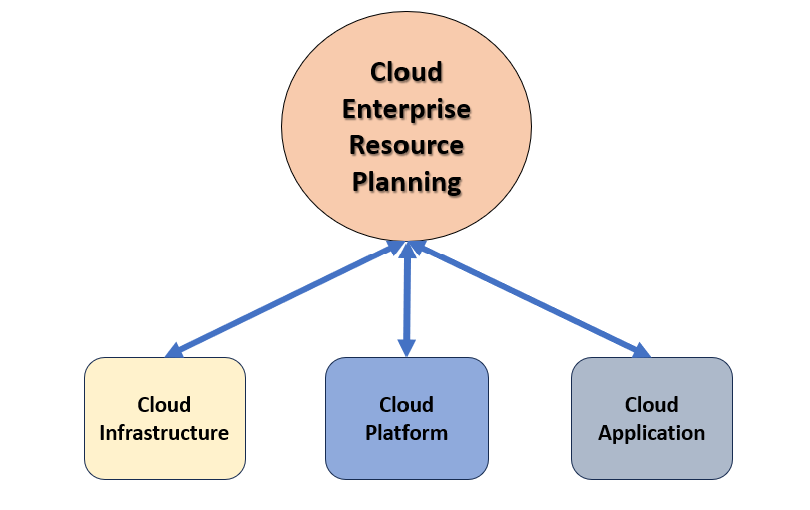
The benefits of cloud computing include accessibility from anywhere, simplicity in purchase and upkeep, and automatic payment like utilities. Cloud ERP is still in its early stages of development, and depending on business fit, certain organizations are more likely than others to adopt it. The infrastructure uses a pay per usage basis, which is how traditional ERP and ERP IaaS vary from one another [27]. In a comparable way, we find that for mission-critical systems and strong security requirements, major organizations prefer to have ERP on-premises. PaaS is described by Boillat and Legner as the development or deployment environment for developers. It provides all the infrastructure and programming tool services required by developers to create applications via the internet. Small businesses without the initial funding to adopt ERP are better served by ERP SaaS, which is an affordable option that comes with a lesser security level. Depending on security, investment value, and organization size, SMEs and large-scale organizations can select between three solutions, such as classic ERP systems, ERP on SaaS, and ERP on IaaS. When an organization has critical and sensitive data that is required for the growth of a business or large-scale organization that may incur more expenditures for ERP implementation on a local server, the classic ERP technique can be employed. Alternatively, SME organizations that lack the financial means to invest more can utilize these two additional cloud-based ERP systems (SaaS or IaaS). ERP in SaaS can be used by a small organization with minimal oversight or security because it is cloud-managed by cloud providers and is more expensive than ERP in IaaS. On the other hand, ERP in SaaS can be used by midsize organizations with limited investment or security. The adoption of an ERP system in large organizations increases organizational expenditures, which may act as a roadblock to a successful ERP implementation. Organizations must hire additional IT personnel to implement the Cloud ERP program, provide system users with assistance, troubleshoot ERP issues, and update to the newest versions of the system in order to prolong ERP system operation and reap the benefits of the Cloud ERP system. It is quite challenging to provide all staff members in a large organization with timely training in the newest IT techniques. In addition, compared to SMEs, resistance to adopting a new system may be greater. Aside from business complexity, integration, monitoring, security, restricted performance, efficiency, and supplier integrity, SMEs and large organizations face different issues. Among these select few difficulties with cloud ERP, security has emerged as a key worry for big and small businesses alike. Large-scale organizations and SMEs could need specialized operations for their purposes, in which case SMEs should make use of the services offered by cloud service providers (CSPs). An SME will find it easy to deal with cost overruns and customization, which can drive up the cost of the ERP package.
3. Cloud Enterprise Resource Planning (ERP) Deployment
The company has a variety of service deployment models to choose from, including communal, hybrid, public, and private. Because each service deployment model has a relationship to costs, possibilities, and advantages, it is connected to the demands of each organization. Big businesses are worried about ERP on the cloud and would rather create a private cloud computing environment to protect sensitive data [28]. Large organizations that need to protect sensitive data for business continuity and can afford to deploy a server are better suited for traditional ERP. Small businesses without the initial funding to adopt ERP are better served by ERP SaaS, which is an affordable option that comes with a lesser security level. Depending on security, investment value, and organization size, SMEs and large-scale organizations can select between three solutions, such as classic ERP systems, ERP on SaaS, and ERP on IaaS. When an organization has critical and sensitive data that is required for the growth of a business or large-scale organization that may incur more expenditures for ERP implementation on a local server, the classic ERP technique can be employed. Alternatively, SME organizations that lack the financial means to invest more can utilize these two additional cloud-based ERP systems (SaaS or IaaS). ERP in SaaS can be used by a small organization with minimal oversight or security because it is cloud-managed by cloud providers and is more expensive than ERP in IaaS. On the other hand, ERP in SaaS can be used by midsize organizations with limited investment or security. The adoption of an ERP system in large organizations increases organizational expenditures, which may act as a roadblock to a successful ERP implementation. Organizations must hire additional IT personnel to implement the C-ERP program, provide system users with assistance, troubleshoot ERP issues, and update to the newest versions of the system in order to prolong ERP system operation and reap the benefits of the C-ERP system. It is quite challenging to provide all staff members in a large organization with timely training in the newest IT techniques. In addition, compared to SMEs, resistance to adopting a new system may be greater. Compared to large organizations, SMEs can train their staff more quickly because they have fewer people overall. Aside from business complexity, integration, monitoring, security, restricted performance, efficiency, and supplier integrity, SMEs and large organizations face different issues. Among these select few difficulties with cloud ERP, security has emerged as a key worry for big and small businesses alike. Large-scale organizations and SMEs could need specialized operations for their purposes, in which case SMEs should make use of the services offered by cloud service providers (CSPs). An SME will find it easy to deal with cost overruns and customization, which can drive up the cost of the ERP package.
4. Conclusion
Cloud ERP is in high demand with businesses overcoming obstacles in the marketplace. Nevertheless, little study has been done to examine the variables impacting the adoption of cloud ERP. We looked at the variables impacting the adoption and use of ERP in Bangladeshi manufacturing and service companies, including resistance to change, perceived credibility, social influence, performance expectancy, effort expectancy, and facilitating condition. With the exception of effort expectations and aversion to change, all of these variables have a substantial impact on the acceptance and deployment of an ERP system.
Reference
- Mell P and Grance T (2011) The NIST definition of cloud computing. NIST Special Publication 800-145. Computer Security Division, U.S. Department of Commerce.[CrossRef]
- Bellamy M (2013) Adoption of cloud computing services by public sector organizations. IEEE Ninth World Congress on Services, Santa Clara, CA, USA, 28 June-3 July, pp.201–208. IEEE.[CrossRef]
- Duan J, Faker P, Fesak A and Stuart T (2013) Benefits and drawbacks of cloud-based versus traditional ERP systems. Proceedings of the 2012-13 course on Advanced Resource Planning.
- Cooper RB and Zmud RW (1990) Information technology implementation research: A technological diffusion approach. Management Science 36(2):123–139.[CrossRef]
- Premkumar G and Ramamurthy K (1995) The role of interorganizational and organizational factors on the decision mode for adoption of inter-organizational systems. Decision Sciences 26(3):303–336.[CrossRef]
- ow C, Chen Y and Wu M (2011) Understanding the determinants of cloud computing adoption. Industrial Management & Data Systems 111(7):1006–1023.[CrossRef]
- Chopra M, Mungi J and Chopra K (2013) A survey on use of cloud computing in various fields. International Journal of Science, Engineering and Technology Research (IJSETR) 2(2).
- Marston S, Li Z, Bandyopadhyay S, Zhang J and Ghalsasi A (2011) Cloud computing—The business perspective. Decision Support Systems 51(1):176–189.[CrossRef]
- Reitsma, E., & Hilletofth, P. (2018). Critical success factors for ERP system implementation: A user perspective. European Business Review, 30(3), 285–310.[CrossRef]
- Ali, M., & Miller, L. (2017). ERP system implementation in large enterprises–a systematic literature review. Journal of Enterprise Information Management, 30(4), 666–692.[CrossRef]
- Awa, H. O., Uko, J. P., & Ukoha, O. (2017). An empirical study of some critical adoption factors of ERP software. International Journal of Human–Computer Interaction, 33(8), 609–622.[CrossRef]
- Addo, R.-T., & Helo, P. (2011). Enterprise resource planning (ERP): A review literature report. In Proceeding of the World Congress on Engineering and Computer Science (vol. 2).
- Doom, C., Milis, K., Poelmans, S., & Bloemen, E. (2010). Critical success factors for ERP implementations in Belgian SMEs. Journal of Enterprise Information Management, 23(3), 378–406.[CrossRef]
- Kwahk, K.-Y., & Kim, H.-W. (2008). Managing readiness in enterprise systems-driven organizational change. Behaviour & Information Technology, 27(1), 79–87.[CrossRef]
- Smart Manufacturing Leadership Coalition. Implementing 21st Century Smart Manufacturing; Pfizer IBM Summit, Workshop Summary Report, 9 Nov 2011.
- Zheng, P.; Wang, H.; Sang, Z.; Zhong, R.Y.; Liu, Y.; Liu, C.; Mubarok, K.; Yu, S.; Xu, X. Smart manufacturing systems for Industry 4.0: Conceptual framework, scenarios, and future perspectives. Front. Mech. Eng. 2018, 13, 137–150.[CrossRef]
- Mittal, S.; Khan, M.A.; Romero, D.; Wuest, T. A critical review of smart manufacturing & Industry 4.0 maturity models: Implications for small and medium-sized enterprises (SMEs). J. Manuf. Syst. 2018, 49, 194–214.[CrossRef]
- Frank, A.G.; Dalenogare, L.S.; Ayala, N.F. Industry 4.0 technologies: Implementation patterns in manufacturing companies. Int. J. Prod. Econ. 2019, 210, 15–26.[CrossRef]
- Zhong, M.E.; Rohde, F. Cloud computing and ERP: A framework of promises and challenges. In Proceedings of the 25th Australasian Conference on Information Systems, Auckland, New Zealand, 8–10 December 2014.
- Salleh, S.M.; Teoh, S.Y.; Chan, C. Cloud Enterprise Systems: A Review of Literature and Its Adoption. In Proceedings of the 16th Pacific Asia Conference on Information Systems, Ho Chi Minh City, Vietnam, 11–15 July 2012; p. 76.
- Bazi, H.R.; Hassanzadeh, A.; Moeini, A. A comprehensive framework for cloud computing migration using Meta-synthesis approach. J. Syst. Softw. 2017, 128, 87–105.[CrossRef]
- Bazi, H.R.; Hassanzadeh, A.; Moeini, A. A comprehensive framework for cloud computing migration using Meta-synthesis approach. J. Syst. Softw. 2017, 128, 87–105.[CrossRef]
- Alkhalil, A.; Sahandi, R.; John, D. A Review of the Current Level of Support to Aid Decisions for Migrating to Cloud Computing. In Proceedings of the International Conference on Internet of Things and Cloud Computing, Cambridge, UK, 22–23 March 2016; pp. 1–8.[CrossRef]
- Singh, B.; Dhawan, S.; Arora, A.; Patail, A. A View of Cloud Computing. Int. J. Comput. Technol. 2013, 4, 387–392.[CrossRef]
- Ali, A.; Warren, D.; Mathiassen, L. Cloud-based business services innovation: A risk management model. Int. J. Inf. Manag. 2017, 37, 639–649.[CrossRef]
- Carter, U.; Dan, H.; Michael, H.; Muthu, M. ERP in the Cloud—Is It Ready? Are you? Booz&Co.: New York, NY, USA, 2013; pp. 1–9.
- Al-Ghofaili, A.A.; Al-Mashari, M.A. ERP system adoption traditional ERP systems vs. cloud-based ERP systems. In Proceedings of the 4th International Conference on Innovative Computing Technology, INTECH 2014 and 3rd International Conference on Future Generation Communication Technologies, FGCT 2014, Luton, UK, 13–15 August 2014; pp. 135–139.[CrossRef]
- Navaneethakrishnan, C.M. A Comparative Study of Cloud based ERP systems with Traditional ERP and Analysis of Cloud ERP implementation. Int. J. Eng. Comput. Sci. 2013, 2, 2866–2869.