

The future of e-money is crypocurrencies, it is the decentralize digital and virtual currency that is secured by cryptography. It has become increasingly popular in recent years attracting the attention of the individual, investor, media, academia and governments worldwide. This study aims to model and forecast the volatilities and returns of three top cryptocurrencies, namely; Bitcoin, Ethereum and Binance Coin. The data utilized in the study was extracted from the higher market capitalization at 31st December, 2021 and the data for the period starting from 9th November, 2017 to 31st December 2021. The Generalised Autoregressive conditional heteroscedasticity (GARCH) type models with several distributions were fitted to the three cryptocurrencies dataset with their performances assessed using some model criterion tests. The result shows that the mean of all the returns are positive indicating the fact that the price of this three crptocurrencies increase throughout the period of study. The ARCH-LM test shows that there is no ARCH effect in volatility of Bitcoin and Ethereum but present in Binance Coin. The GARCH model was fitted on Binance Coin, the AIC and log L shows that the CGARCH is the best model for Binance Coin. Automatic forecasting was perform based on the selected ARIMA (2,0,1), ARIMA (0,1,2) and the random walk model which has the lowest AIC for ETH-USD, BNB-USD and BTC-USD respectively. This finding could aid investors in determining a cryptocurrency's unique risk-reward characteristics. The study contributes to a better deployment of investor’s resources and prediction of the future prices the three cryptocurrencies.
Modeling and Forecasting Cryptocurrency Returns and Volatility: An Application of GARCH Models
August 01, 2022
October 31, 2022
November 08, 2022
November 10, 2022
This is an Open Access article, distributed under the terms of the Creative Commons Attribution 4.0 International License (http://creativecommons.org/licenses/by/4.0/), which permits unrestricted use, distribution and reproduction in any medium or format, provided the original work is properly cited.
Abstract
1. Introduction
A cryptocurrency or crypto, termed “future of money”. Satoshi Nakamoto invented Bitcoin the first cryptocurrency iin 2008. Cryptocureny is secured by cryptography, this make cryptocurency a secured online transaction to counterfeit or double-spend, and this characteristics solve the problem of online money payment that existed before cryptocurrency [1]. Cryptocurrency is not issued by a central authority and does not exist in tangible form like paper money does [2]. The adoption and interest has make their market capitalization increased exponentially yearly From virtually nothing in 2009 to 11.0 billion dollars at the start of 2014, and nearly 2.75 trillion dollars by the end of 2021, this increment has follow an high returns and this have attracted new investors and users of cryptocurrencies. cryptocurrency on the other hand, is regarded as a high-yielding investment option due to its high volatility [3, 4] and [5]. The phrase "altcoins" refers to coins that were established after Bitcoin [6]. Satoshi Nakamoto conceived and built the technical mechanism on which decentralized cryptocurrency are formed and based in 2008. To create scarcity, most cryptocurrencies are designed to progressively decrease output and create new ones this concept is used to set a limit on the total amount of currency that will ever be produced and circulated [7, 8] and [9]. Cryptocurrency is an interesting technique to reduce mistake in money provided by the government that reduces the money supply is recorded in the database the government effectively has editing privileges, allowing them to make additional money at any time, this raises the number of errors in the database, call money [10] and [11]. Moreover, cryptocurrency does not have any intrinsic value. So, if cryptocurrency does have no intrinsic value, what could be the fundamental that drives the cryptocurrency price [12]. It has been argued in the literature that the value of cryptocurrency price is driven by fundamental demand and supply forces also market expectation about the future price of cryptocurrencies that might be reflected in public collective sentiment of view of them [13] and [14]. [15] looked at Bitcoin volatility using a number of GARCH-type models with normally distributed errors and came to the conclusion that AR (1)-CGARCH (1, 1) is the most accurate model for estimating Bitcoin. [16] Use Hurst exponent analysis to investigate Bitcoin returns' time-varying volatility and long-memory behavior and find out that daily returns exhibit persistent behavior in the first half of study period. [17] compared the forecast values of the one-step-ahead volatility and value-at-risk of Bitcoin using several volatility models. Their result indicated that robust procedures outperformed non-robust ones when forecasting the volatility and estimating the value-at-risk. [18] also forecast the volatility of Bitcoin/USD exchange rate. It assess and compare the predictive ability of the generalized autoregressiove conditional heteroscedasticity (GARCH) (1,1), the exponentially weighted moving average (EWMA) and the exponential generalized autoregressive conditional heteroscedasticity (EGARCH) (1,1). Their result shows that EGARCH (1,1) model outperform the GARCH (1,1) and EWMA models in both in and out of sample contexts with increased accuracy in the out of sample period.
2. Literature Review
In the last few years, studies on modeling of crypto – currency has increased with so much research in the areas of volatility modeling of several types of cryptocurren-cies. [19] used a GARCH (1, 1) model to analyse daily Bitcoin prices and search trends on Google,Wikipedia and tweets on Twitter. They found that Bitcoin prices were in-fluenced by popularity, but also that web content and Bitcoin prices had some pre-dictable power. [20] estimated the volatility of the Bitcoin, Gold and the US Dollar us-ing the GARCH and asymmetric EGARCH models and concludes that they have simi-larities and respond the same way to variables in the GARCH model, arguing that it can be used for hedging. [21] suggests that Bitcoin returns not only exhibit higher vola-tility than conventional fiat currencies but also non-normal and heavy-tailed charac-teristics. Another important feature of cryptocurrencies is that as opposed to sovereign currencies in a one-money economy there are several types of such cryptocurrencies available in the market. [22] analyzed the Bitcoin volatility using a range of GARCH-type models assuming normally distributed errors and concludes that AR (1)-CGARCH (1, 1) is the best model to estimate Bitcoin returns volatility. [23] study the time-varying realized volatility of Bitcoin and conclude that it is significantly big-ger compared to that of fiat currencies. [24] investigate the time-varying volatility the behaviour of long memory on Bitcoin returns using the Hurst exponent analysis. [25] estimated the volatility of seven cryptocurrencies using GARCH-type models with different innovations distributions and conclude that the IGARCH (1, 1) model is the most appropriate in estimating Bitcoin volatility. [26] compare the performance of the normal reciprocal inverse Gaussian (NRIG) with the normal distribution and the Stu-dent’s t error distributions under the GARCH framework and concludes that the GARCH-type model with Student’s, t distributed innovations outperform the new heavy-tailed distribution in modelling the Bitcoin returns. [27] model a range of GARCH volatility models and analysis the hedging ability of the crypto-coin against other currencies. In terms of different innovations distributions. [28] replicate the study of Katsiampa considering the presence of extreme observations and using jump-filtered returns and the AR (1)-GARCH (1, 1) model is selected as the optimal model. [29] applied the GARCH model to study the volatility of Bitcoin by employing time series data throughout 2011 to 2018 and found strong evidence that the GARCH model performs well in forecasting Bitcoin volatility. [30] focuses on modelling the volatility dynamics of eight most popular cryptocurrencies from 2015 to 2018. The study utilized optimal GARCH-type models to simulate out-of-sample volatility fore-casts which are in turn utilized to estimate the one-day-ahead VAR forecasts. The re-sults demonstrate that the optimal in-sample GARCH-type specifications vary from the selected out-of-sample VAR forecasts models for all cryptocurrencies. Whilst the empirical results do not guarantee a straightforward preference among GARCH-type models, the asymmetric GARCH models with long memory property and heavy-tailed innovations distributions overall perform better for all cryptocurrencies.
Several studies have been directed towards modeling the volatility of cryptocur-rencies using some GARCH-type models, the summary of the studies reviewed indi-cated that studies on modeling the volatility and returns of three top cryptocurrencies like; Bitcoin, Ethereum and Binance coin have not been examined so far. This study shall therefore fill the research gaps and provide a solution to the established prob-lems. This study will contribute to existing literature by providing returns and volatil-ity model for Bitcoin, Ethereum and Binance. The selected GARCH-model was also uti-lized to provide out-of-sample volatility forecast for the period of one year model.
3. Materials and Methods
3.1. Data
This study used secondary data obtained from, BTC-USD (2022) [31], ETH-USD (2022) [32], BNB-USD (2022) [33]. The data collected is the price of the daily closing exchange rates of the three cryptocurencies. The data for this study was collected between November 9th, 2017 and December 31st, 2021. This section discusses the strategy to investigate the volatility and returns of cryptocurrency using time series data start for Bitcoin (BTC), Ethereum (ETH), and Binance Coin (BNB) from November 9th, 2017 to December 31st, 2021. The LM-ARCH test will be used to determine whether ARCH is present. Similarly, the GARCH model will be used to model the volatility of the cryptocurrency with ARCH effect while ARIMA model will be used to estimate future prices.
3.2. The GARCH Models
Let R denote the percentage log-returns on cryptocurrency interest rates at time t. The general Markov-Switching GARCH specification [34] is used:
Where:
(, t, k) is a continuous distribution with mean and time-varying variance zero and ℎ𝑘,𝑡, respectively. And additional shape parameters contained in the vector 𝜃𝑘.
According to [35] the conditional variance of yt is assumed to be the result of a GARCH process. This isn't limited to the standard GARCH model:
where (•) defines and ensures the conditional variance filter is positive. However, some GARCH parameters are considered, such as:
SGARCH [36]
EGARCH [37]
TGARCH [38]
IGARCH [36]
PARCH [39]
CGARCH [40]
As for distribution mixture models, suppose that: 𝑦𝑡~(𝑝1, … , 𝑝𝑘; 𝜇1, … , 𝜇𝑘; ℎ1, … , ℎ𝑘), t Essentially, this is a blend of densities in the following form:
Where; [𝑝1, … , 𝑝𝑘] is the mixing law, 𝑓 denotes the density function.
It has been suggested by [41] that the distribution mixing model might be thought of as a more constrained variation of Markov switching GARCH models. Where the likelihood of transition is unaffected by the previous state. If Q variances are supposed to follow a mix of distributions.
The following is the definition of the normal mixture standard GARCH (1, 1) model:
The overall conditional variance will then be:
3.3. Autoregressive Integrated Moving Average (ARIMA)
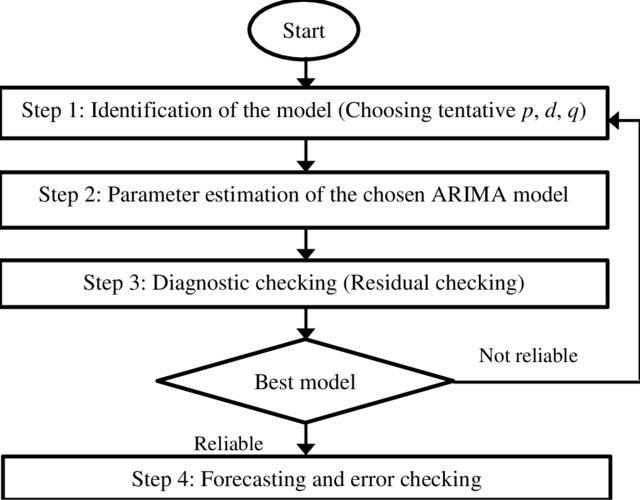
The ARIMA was made by combining (AR) and (MA) and differencing the result. Given a time series of data Xt, where εt is an integer index and Xt is a collection of real numbers. An ARMA (p’, q) model is given by:
3.4. Stationarity test
The stationarity test is used to ensure that the data returned is stable. The test is performed on returns data, this is conducted by the using of Augmented Dickey-Fuller. If the data does not contain the unit root, it indicates that it is stationary. Otherwise, the data is not stationary if it contains a unit root. The data that doesn't have a unit root can subsequently be used for statistical analysis. Differencing can be performed on data with unit root to make it become stationary data. The ADF hypothesis to be tested is:
H0: there are unit roots
H1: there are no unit root
3.5. Heteroscedasticity Test
The heteroscedasticity test aims to discover whether the variance from the return data is constant or time varying. We find equation of moving average with the least square method and to conduct the heteroscedasticity test with Heteroscedasticity Test of ARCH-LM Test. The hypothesis of heteroscedasticity test is:
H0: volatility homoscedastic
H1: volatility heteroscedastic
4. Empirical Result
The graphical representations are presented in Figures 2. The time plot shows the Bitcoin experience a high increase in price from the first quarter of 2020 to first quarter of 2021 before a significant drop in price. The time plot shows the Binance coin started an increase in price from the second quarter of 2020 to first quarter of 2021 before a significant drop in price. Figure 3 shows that returns over the periods. All the cryptocurrency prices experienced volatility clustering, taking positive and negative values with different magnitude. The ups and downs in return clustering throughout the investigation indicate that the cryptocurrency series is volatile. But, merely looking at the trends, a strong conclusion may not be drawn until a full statistical analysis is done.
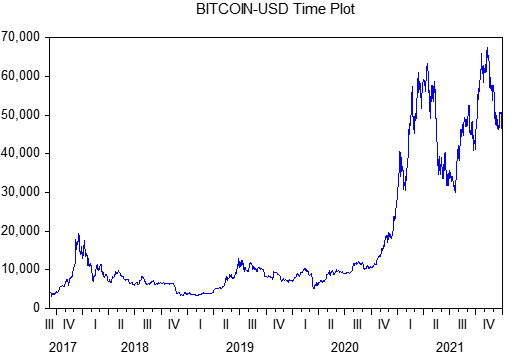
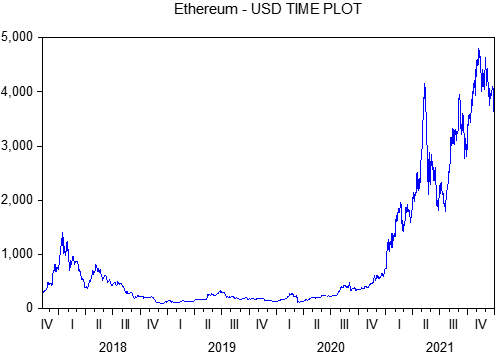
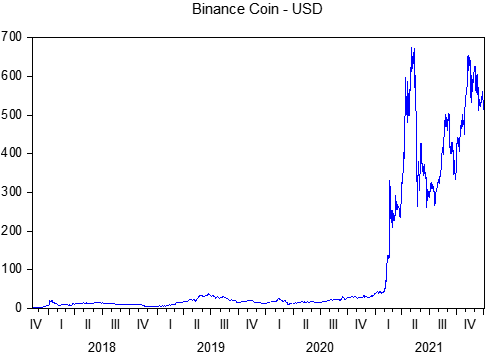
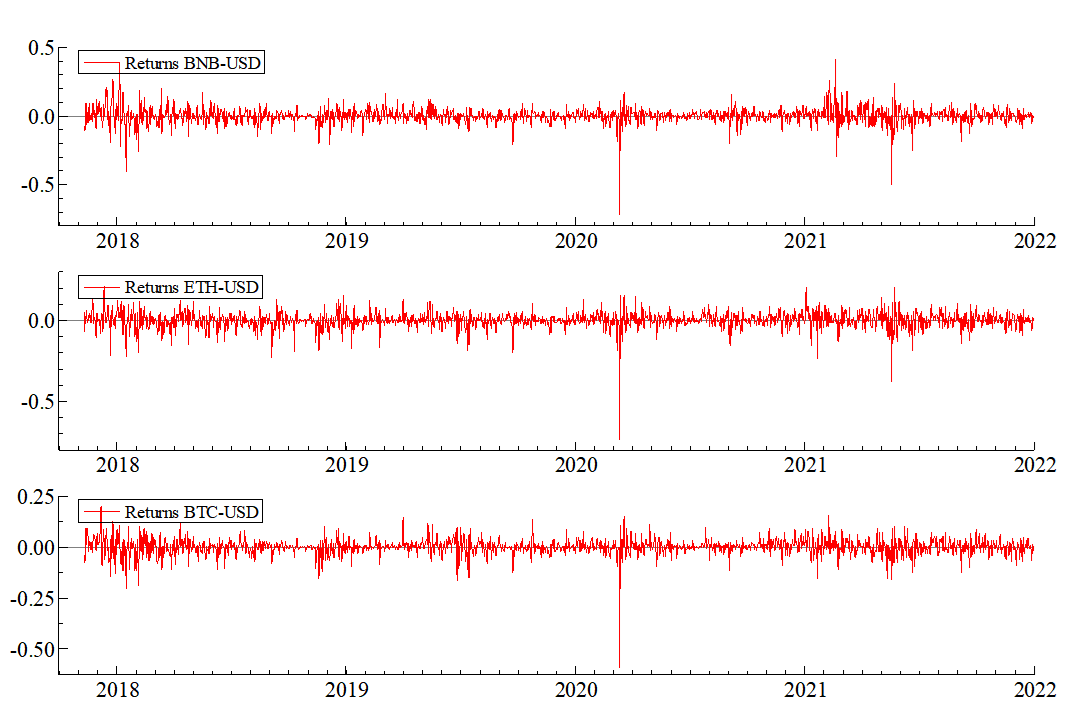
Table 1 shows the statistical summary for the three cryptocurrencies. The table also includes their returns statistics. The table shows that the mean returns for all cryptocurrencies is positive (i.e. 0.000200, 0.001717, 0.000353 for Ethereum, Binance Coin and Bitcoin Returns, respectively) indicating the fact that prices have increase throughout the study period. It also reveals that the three return series are negatively skewed, indicating a low possibility of receiving returns that are less than the mean, all of which are positive. The kurtosis for all the return series is > 3, which implies that all the returns series have a fat tail and Jarque-Bera test result also show that, and do not follow a normal distribution. The Jarque-Bera test result in table 1 rejects normality at 5%. Table 2 presents the results of the unit root test study on the three cryptocurrencies considered. The three cryptocurrency series returns are stationary at first difference. The ADF statistics for the return series at first difference are less than the crucial levels and all the p-values are also less down 0.05. The study will work with the stationary data and hence reliable results for the policy will be derived.
4.1. ARCH Effect Test
The ARCH – LM test will be used to see if the return series has ARCH effect. First, the model is pacified as an ARIMA (1,1) model, with the help of the ACF and PACF functions. The errors of the ARIMA (1,1) model are saved and then squared () to form the variable. The variance of the error () are then utilized to create additional variables. The model below was run:
Where and , i = 1,p are non-negative constants.
Table 3 inferred that the test statistics for all the stock returns of Ethereum and Bitcon are not significant. Since p > 0.05 at 5%, the null hypothesis "no arch effect" is not rejected, rejecting the presence of the ARCH effect in the residuals of the Ethereum and Binance coin time series data and as a result, we can't proceed with the GARCH family Model estimation for the two. On the other hand, the test statistic for the Binance Coin returns series shows a P< 0.05, which is highly significant at 5% level. The null hypothesis of "no arch effect" is rejected, and concluded that the ARCH effect is present in the residual of the Binance coin's residual value is true. As a result, we continue to estimate the GARCH family models on the Binance coin.
4.2. ARCH/GARCH Estimation Results
The presence of the ARCH effect in combination with other estimated stylized facts from these series, a student's t distribution was used to facilitate the estimate of ARCH/GARCH family models for Binance coin returns as seen in Table 4. The return series coefficients of the ARCH models are all positive, satisfying the ARCH family model's necessary and sufficient requirements.
Except for EGARCH, the ARCH model's intercept and ARCH term are both positive and significant at 5%. The ARCH coefficient shows that square lagged previous error terms have a positive and significant effect on Binance Coin returns at current time. Price volatility also responds fast to market occurrences. The GARCH (1, 1) model shows that the variance equation parameter of all estimations is significant at 5%, as well as the GARCH term's coefficient, consequently, historical period volatility has a significant impact on current period conditional volatility. The ARCH coefficient also demonstrated that earlier error terms had a positive and large impact on present period volatility, in addition to a high level of volatility in response to market occurrences. With the exception of EGARCH and TGARCH models, the result shows that the total for all estimated models is high; therefore shocks to returns of this coin die off quite slowly. The IGARCH (1, 1) model, on the other hand, has the largest volatility persistence because the value is close to 1, As a result, it takes into consideration volatility persistence more, and the persistence would gradually go away. The long-run average variance, also known as the unconditional variance of returns, is a measure of the variability of returns (µ) over time is 0.001717. The ARCH and GARCH terms are positive and very significant in the EGARCH model, whereas the intercept parameter is negative and significant. The ARCH phrase implies that Binance coin returns have a considerable tendency to react to shocks, and that the amount to which they react to these shocks is high. Also, because 1 is less than 1, historical period volatility has no effect on current period volatility and is covariance stationarity. The leverage impact term is significant at 5%, showing a leverage effect. In the TGARCH model, the ARCH term and intercept matter. That is, the squared lagged error has a large impact on current-period volatility, and the pace with which volatility reacts to market shocks is fast. The GARCH coefficient also implies that prior period variance has an impact on conditional volatility, as well as a high level of volatility persistence. The long run average is (1 - β – α1 – γ/2 11 1–/2 = 0.029581). At the 5% level, the leverage impact is significant and large, implying that a positive shock creates equivalent magnitude volatility. The PARCH model shows that the coefficients are all positive and significant when d = 1. Volatility responds to market shocks with a moderate degree of reactivity, and volatility persistence is low. According to parameter estimations, except of the intercept all other coefficients in the CGARCH model are positive and significant in the result. The rate at which volatility reacts to market developments is extremely fast. CGARCH is the best fitting model for Binance coin returns when all estimated models are compared using information criterion and log likelihood statistics. The null hypothesis of no ARCH effect in the models is not rejected at 5% significant level. In Table 5, the estimated model's residuals' conformity to homoscedasticity is an indication of goodness of fit, while the probability value for all lags, implying that the Q-statistics in are greater than 0.05, demonstrates that there is no serial correlation in the computed models' residuals at the 5% significance level (see Table 6). Table 7 reveals that the volatility models chosen capture the major trends as well as times of high and low equity returns, as shown by the GARCH models' conditional volatilities. Diagnostics tests results are presented in Table 5 and 6. ETH-USD White noise variance is 5733.73 with 1511 degrees of freedom, BNB-USD white noise variance is 1511.60 with 1511 degrees of freedom. Table 7 provided the forecast future values of ETH-USD, BNB-USD and BTC-USD. By linking present data to prior data and prior noise, this model predicts future data best. The output summarizes the model's statistical significance presented in Table 8 shows that the statistically significant terms are those with P<0.05 at 95% confidence. P-values below 0.05 indicate that AR (2) and MA (1) terms for ETH-USD are significantly different from zero. The input white noise's calculated standard deviation is 75.7214 with an estimated standard deviation of 12.3127 for the input white noise, the P-value for the MA (2) term in BNB-USD is less than 0.05 as seen in Table 9.
4.3. Model Comparison for ETH-USD
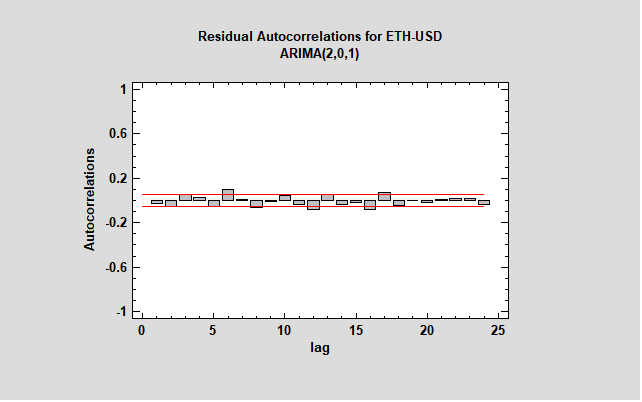
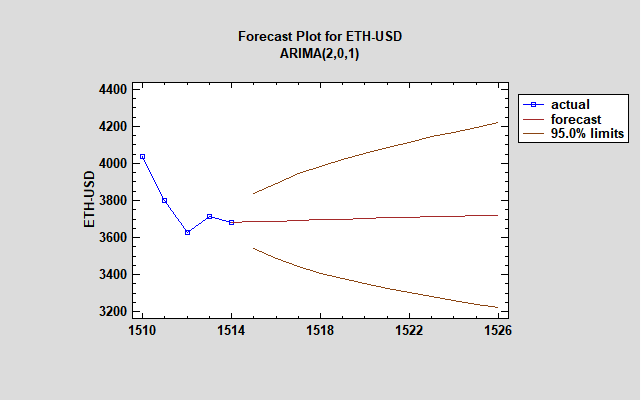
Table 10a and 10b compares the results of various models fitting to the ETH-USD data. The forecasts were made using Model M, which has the lowest AIC. Table 10a also shows the results of five residual tests used to assess each model's suitability. A model passes a test if it is OKed. It fails with a one * at 95% confidence level. Two *s mean it fails at 99% confidence level fails with three *s at 99.9% confidence level. It's worth noting that the model you're looking at right now, model M passes three of the tests. A different model can be used if one or more tests are statistically significant at 95% confidence level or higher. Figure 4a shows the calculated residual autocorrelations with various lags. In this case, the lag k autocorrelation coefficient measures the residuals' correlation. The 95.0 percent probability boundaries are also shown if the probability boundaries for a given lag do not contain the estimated coefficient, the link is statistically significant with 95% confidence. 8 of the 24 autocorrelation coefficients are statistically significant, indicating that the residuals are not totally random (white noise).
4.4. Model Comparison for BNB-USD
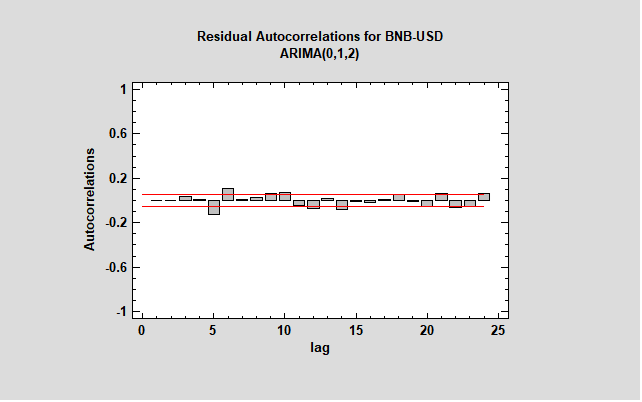
Tables 11a and b presented the Data variable for BNB-USD. The number of observations = 1514, Start index = 1.0, Sampling interval = 1.0. The value of the estimated models, (A) Random walk, (B) Random walk with drift = 0.336892, (C) Constant mean = 104.024, (D) Linear trend = -112.112 + 0.285327 t, (E) Quadratic trend = 99.3878 + -0.551742 t + 0.000552521 t^2, (F) Exponential trend = exp(1.30058 + 0.00279941 t), (G) S-curve trend = exp(3.46766 + -8.91688 /t), (H) Simple moving average of 2 terms, (I) Simple exponential smoothing with alpha = 0.8691, (J) Brown's linear exp. smoothing with alpha = 0.4338, (K) Holt's linear exp. smoothing with alpha = 0.8704 and beta = 0.0017, (L) Brown's quadratic exp. smoothing with alpha = 0.2935, (M) ARIMA(0,1,2), (N) ARIMA(1,0,2), (O) ARIMA(1,1,2), (P) ARIMA(2,1,0) and (Q) ARIMA(2,1,2). Table 11a & b compares the results of various data fitting models. The forecasts were made using Model M, which has the lowest AIC. Table 11a & b also provides the results of five residual tests to see if each model fits the data. If the model passes the test, it is OK. At the 95% confidence threshold, it fails with a *. At the 99% confidence threshold, it fails with two *'s. Three *s indicate a failure at the 99.9% confidence level. It's worth noting that the present model, model M only passes one of the tests. We can switch models if one or more tests are statistically significant at 95% or above. Figure 4b shows the calculated residual autocorrelations with various lags. In this case, the lag k autocorrelation coefficient measures the residuals' correlation. The 95.0% probability bounds around 0 are also indicated. There is a statistically significant association at the 95.0 % confidence level if the probability bounds for a certain lag do not contain the calculated coefficient. At the 95.0 % confidence level, 10 of the 24 autocorrelation coefficients are statistically significant, showing that the residuals may not be fully random (white noise).
4.5. Model Comparison for BTC-USD
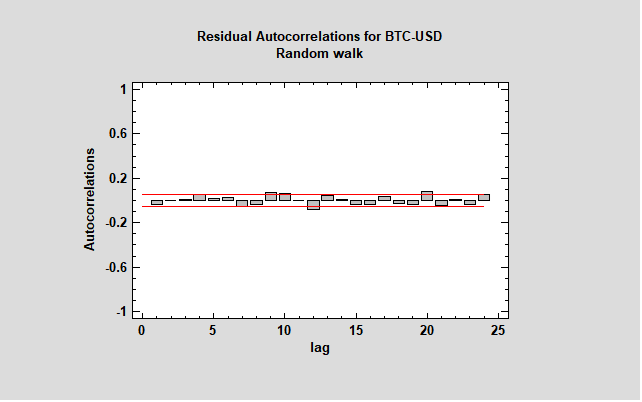
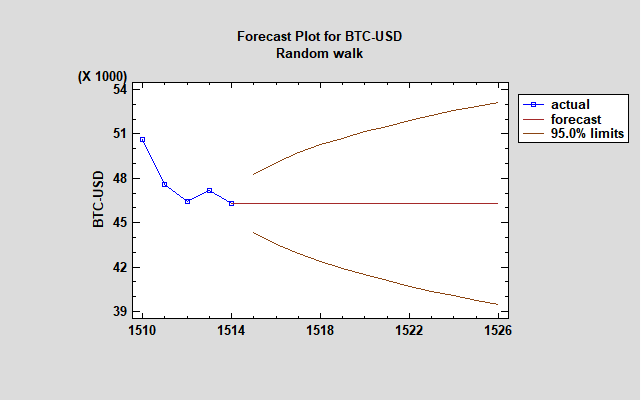
Tables 12a and b The Data variable for BTC-USD are; number of observations = 1514, Start index = 1.0, Sampling interval = 1.0, (A) Random walk, (B) Random walk with drift = 25.8842, (C) Constant mean = 18162.0, (D) Linear trend = -4605.29 + 30.0558 t, (E) Quadratic trend = 15796.2 + -50.6889 t + 0.0532968 t^2, (F) Exponential trend = exp(8.33389 + 0.00144316 t), (G) S-curve trend = exp(9.43608 + -1.72219 /t), (H) Simple moving average of 2 terms, (I) Simple exponential smoothing with alpha = 0.9661, (J) Brown's linear exp. smoothing with alpha = 0.4687, (K) Holt's linear exp. smoothing with alpha = 0.9604 and beta = 0.0106, (L) Brown's quadratic exp. smoothing with alpha = 0.3157, (M) ARIMA(0,1,0)(N) ARIMA(1,1,0), (O) ARIMA(0,1,1), (P) ARIMA(1,0,0). Table 12a compares the results of various data fitting models. Model A, which generated the forecasts, had the lowest AIC. Table 12a also provides the results of five residual tests to see if each model fits the data. If the model passes the test, it is OK. At the 95 % confidence threshold, it fails with a *. At the % confidence threshold, it fails with two *'s. Three *s indicate a failure at the 99.9% confidence level. Notably, the present model A, passes two tests. We can switch models if one or more tests are statistically significant at 95% or above. Figure 4c shows the calculated residual autocorrelations with various lags. The lag k autocorrelation coefficient measures the residuals' correlation between t and t-k. The 95.0 % probability bounds around 0 are also indicated. If the probability boundaries for a given lag do not contain the estimated coefficient, the association is statistically significant with 95% confidence. 7 of the 24 autocorrelation coefficients are statistically significant, indicating that the residuals are not totally random (white noise). Figure 4c displays the graph of the forecasted BNB-USD values. The graphic also shows 95.0 percent projected limits. With 95.0 % confidence, these boundaries shows where the true value of BNB-USD will be at any point in the future.
Figure 5a displays the graph of the forecasted BNB-USD values. The graphic also shows 95.0 percent projected limits. With 95.0 % confidence, these boundaries shows where the true value of BNB-USD will be at any point in the future. Figure 5b projects the plot of ETH-USD values are shown in this graph. The plot also includes 95.0 % forecasted limits for the projections. With 95.0 % confidence, these boundaries show where the true value of ETH-USD will be at any point in the future. Figure 5c projected the BTC-USD values are shown in this graph. The plot also includes 95.0 % forecasted limits for the projections. With 95.0 % confidence, these boundaries show where the true value of BTC-USD will be at any point in the future.

5. Discussions
Except for EGARCH, the ARCH model's intercept and ARCH term for Binance currency are positive and significant at the 5% level. The ARCH coefficient shows that square lagged error terms have a positive and large impact on Binance coin returns present volatility. This finding is consistent with [42] and [43], whose result indicated the presence of positive return volatility relationship which is different from other traditional assets. The GARCH (1, 1) model predicts that all variance equation parameter estimates are significant at 5%, as is the GARCH term's coefficient. Thus, historical period volatility affects current period conditional volatility. The ARCH coefficient also demonstrated that earlier error terms had a positive and large impact on present period volatility, as well as extreme volatility in market reactions. With the exception of EGARCH models, the total of all estimated models is high, therefore shocks to returns of this beverage peter off relatively slowly. The IGARCH (1, 1) model, on the other hand, has the largest volatility persistence because the value is close to one implying that it takes into account volatility persistence more, and the persistence will gradually fade down. Our finding corroborated with the study from [25] and [44] whose study found that the IGARCH models provide the best fits, in terms of modelling of the volatility in the most popular and largest cryptocurrencies. The IGARCH model falls within the standard GARCH framework and contains a conditional volatility process which is highly persistent with infinite memory. Unconditional variance of returns (µ), or long run average variance, is 0.001717. The research also provided the forecast future values of ETH-USD, BNB-USD and BTC-USD. The data cover 1514 time periods and ETH-USD, BNB-USD, ARIMA model were utilized. This study posits a parametric model linking the most recent data value to preceding data values and noise. Results shows a considerable difference between the AR (2) and MA(1) terms for ETH-USD because the p-value < 0.005 which implies that they are significant. The estimated standard deviation of the input white noise equals 75.7214 while the P-value for the MA(2) term in BNB-USD is less than 0.05, this finding is similar to [29, 45] and [46]. As a result, with an estimated standard deviation of 12.3127 for the input white noise, it is significantly different from 0. Also in table 4.8 shows the forecast future values of BTC-USD. A random walk model was selected. This model predicts future data using the last known value.
6. Conclusion
The CGARCH was chosen as the best volatility model for Binance coin based on model selection criteria. The random walk model best forecast the price of Bitcoin, ARIMA (2,0,1) and ARIMA (0,1,2) best forecast the future price of Ethereum and Binance coin respectively. It has become obvious that the factors behind changes in volatility may be potent enough to create necessary directions in overall cryptocurrencies performance in the world. The result from this research shows that cryptocurrncy is safe-haven and good investment oppoutunity in the last five years as we seen that the mean of all the three coin is positive and there skewness is negative. However, this pace of development should be handled with care because any false movements in the cryptocurrencies market might have a huge impact on the entire financial sector, if not the entire economy. This finding of this study could aid investors in determining a cryptocurrency's unique risk-reward characteristics, can provide a better deployment of investor’s resources and prediction of the future prices the three cryptocurrencies.
Limitation of the Study
Although some GARCH-type model was utilized in this study to investigated the returns and volatilities of three cryptocurrencies, this study has some limitations. First, out of the numerous types of cryptocurrencies, only three was investigated in this studied. Second, this study utilized only five GARCH-type models like; CGRACH, EGARCH, IGARCH, SGARCH and TGARCH and third, limited data was utilized in this study, which is the period from 9th November, 2017 to 31st December 2021.
Contribution of Authors
This study was created and is the work of all authors. The final version of this manuscript has been approved by all authors, who all participated in the process of revising it.
Acknowledgement
The researchers would like to express their gratitude to the department of Statistics, University of Abuja for their support during the period of writing this research.
Reference
- Nakamoto, S. (2008) Bitcoin: A Peer-to-Peer Electronic Cash System. https://bitcom.org/bitcoin.pdf
- Allison, I. (2015). If Banks Want Benefits of Blockchains, They Must Go Permissionless. International Business Times.
- Bedi, P. and Nashier, T. (2020). On the Investment Credentials of Bitcoin: A Cross-Currency Perspective. Research in International Business Finance, 51(7), 1-15 https://doi.org/10.1016/j.ribaf.2019.101087[CrossRef]
- Baur, D.G., Lee, A.D. and Hong, K. (2018). Bitcoin: Medium of Exchange or Speculative Assets? Journal of International Financial Market, Institutions and Money, 54, 177–189. https://doi.org/10.1016/j.intfin.2017.12.004[CrossRef]
- Ajayi, A., Adams, S.O., Akano, R.O. (2019). Modelling Nigeria Naira Exchange Rate against some selected Country’s Currencies Volatility: Application of GARCH Model. Asian Journal of Probability and Statistics, 5(1):1 – 13. https://doi:10.9734/AJPAS/2019/v5i130128[CrossRef]
- Paul V (2017). Which Digital Currency Will Be the Next Bitcoin? The Wall Street Journal. Britlo & Castilo 2013. Bitcoin: A primer for policymakers
- Akano, R.O., Adams, S.O. (2019). Nigeria Government’s Expenditure on Economic and Social Service Development: A Canonical Correlation Analysis Approach. Archives of Current Research International, 18(04), 1 – 12. https://doi.org/10.9734/acri/2019/v18i430142.[CrossRef]
- Adams, S.O., Balogun, P.O. (2020). Panel Data Analysis on Corporate Effective Tax Rates of Some Listed Large Firms in Nigeria. Dutch Journal of Finance and Management, 4(2):1-9, em0068. 2542–4750. https://doi.org/10.21601/djfm/9345[CrossRef]
- Musk, E. (2021). Cryptocurrency Fixes the Error in Money. https://finbold.com/elon-musk- cryptocurrency-fixes-the-error-in-money/
- Adams, S.O., Bamanga, M.A. and Mbusube, A. (2019). Principal Component Analysis of Nigerian Economy from 2006 – 2017. Asian Journal of Advanced Research and Reports, 5(4):1 – 9. Article. https://doi.org/10.9734/ajarr/2019/v5i430139[CrossRef]
- Yermack, D. (2015). Is Bitcoin a Real Currency? An Economic Appraisal. Handbook of Digital Currency, 31-43. https://doi.org/10.1016/B978-0-12-802117-0-00002-3[CrossRef]
- Luther, W., & White, L. (2014). Can Bitcoin become a Major Currency? GMU Working Paper in Economic No 14-17, 1-9. https://dx.doi.org/10.2139/ssrn.2446604[CrossRef]
- Shcherbak, S. (2015). How Should Bitcoin be Regulated. HeinOnline European Journal of Legal Studies, 7, 41.
- Katsiampa, P. (2017). Volatility Estimation for Bitcoin: A Comparison of GARCH Models. Economics Letters, 158, 3-6. https://doi.org/10.1016/j.econlet.2017.06.023[CrossRef]
- Bariviera, A.F. (2017). The In-efficiency of Bitcoin Revisited: A Dynamic Approach. Economics Letters, 161, 1- 4. https://doi.org/10.1016/j.econlet.2017.09.013[CrossRef]
- Urquhart, A. and Zhang, H. (2018). Is Bitcoin a Hedge or Safe-Haven for Currencies? An Intraday Analysis. 1- 25. https://doi.org/10.2139/ssrn.3114108[CrossRef]
- Trucious, C. (2018). Forecasting Bitcoin Risk Measures: A Robust Approach. International Journal of Forecasting, 35, 836-847. https://doi.org/10.1016/j.ijforecast.2019.01.003[CrossRef]
- Naimy, V.Y. and Hayek, M.R. (2018). Modelling and Predicting the Bitcoin Volatility using GARCH Models. International Journal of Mathematical Modelling and Numerical Optimisation, 8(3), 197-215. https://doi.org/10.1504/IJMMNO.2018.088994[CrossRef]
- Letra, Ivo José Santos. (2016). What Drives Cryptocurrency Value? A volatility and predictability analysis. https://www.repository.utl.pt/handle/10400.5/12556
- Dyhrberg, A.H. (2016) Bitcoin, Gold and the Dollar: A GARCH Volatility Analysis. Finance Research Letters, 16, 85-92. https://doi.org/10.1016/j.frl.2015.10.008[CrossRef]
- Osterrieder, J. and Lorenz, J. (2017) A Statistical Risk Assessment of Bitcoin and Its Extreme Tail Behavior. Annals of Financial Economics, 12, https://doi.org/10.1142/S2010495217500038[CrossRef]
- Katsiampa, P. (2017) Volatility Estimation for Bitcoin: A Comparison of GARCH Models. Economics Letters, 158, 3-6. https://doi.org/10.1016/j.econlet.2017.06.023[CrossRef]
- Pichl, L. and Kaizoji, T. (2017) Volatility Analysis of Bitcoin. Quantitative Finance and Economics, 1, 474-485. https://doi.org/10.3934/QFE.2017.4.474[CrossRef]
- Bariviera, A.F. (2017) The Ineffciency of Bitcoin Revisited: A Dynamic Approach. Economics Letters, 161, 1-4. https://doi.org/10.1016/j.econlet.2017.09.013[CrossRef]
- Chu, J., Chan, S., Nadarajah, S. and Osterrieder, J. (2017) Garch Modelling of Cryptocurrencies. Journal of Risk and Financial Management, 10, 17. https://doi.org/10.3390/jrfm10040017[CrossRef]
- Liu, Y. and Tsyvinski, A. (2018) Risks and Returns of Cryptocurrency. Technical Report, National Bureau of Economic Research, Cambridge. https://doi.org/10.3386/w24877[CrossRef]
- Urquhart, A. and Zhang, H. (2018) Is Bitcoin a Hedge or Safe-Haven for Currencies. An Intraday Analysis. 1-25. https://doi.org/10.2139/ssrn.3114108[CrossRef]
- Charles, A. and Darne, O. (2018) Volatility Estimation for Bitcoin: Replication and Robustness. International Economics, 157, 23-32. https://doi.org/10.1016/j.inteco.2018.06.004[CrossRef]
- Ardia, D., Bluteau, K., and Rüede, M. (2019), Regime changes in bitcoin GARCH volatility dynamics, Finance Research Letters, 29, 266-271. https://doi.org/10.1016/j.frl.2018.08.009[CrossRef]
- Ngunyi, A., Mundia,S. and Omari, C. (2019) Modelling Volatility Dynamics of Cryptocurrencies Using GARCH Models. Journal of Mathematical Finance, 9, 591-615. https://doi.org/10.4236/jmf.2019.94030[CrossRef]
- Bitcoin USD (2022). https://finance.yahoo.com/quote/BTC-USD
- Ethereum USD (2022). https://finance.yahoo.com/quote/ETH-USD
- BNB USD (2022). https://finance.yahoo.com/quote/BNB-USD
- Ardia, D., Bluteau, K., Rüede, M. (2018b). Regime changes in Bitcoin GARCH volatility dynamics. Finance Research Letters. https://doi.org/10.1016/j.frl.2018.08.009[CrossRef]
- Haas, M., Mittnik, S., Paolella, M.S. (2004). A New Approach to Markov-switching GARCH Models. Journal of Financial Econometrics 2, 493-530. https://doi.org/10.1093/jjfinec/nbh020[CrossRef]
- Bollerslev, T. (1986) Generalized Autoregressive Conditional Heteroskedasticity. Journal of Econometrics, 31, 307-327. https://doi.org/10.1016/0304-4076(86)90063-1[CrossRef]
- Nelson, D.B. (1991). Conditional heteroskedasticity in asset returns: A new approach. Econometrica, 59, 347-370. https://doi.org/10.2307/2938260[CrossRef]
- Zakoian, J.M. (1994). Threshold Heteroskedastic Models. Journal of Economic Dynamics & Control, 18, 931-955. https://doi.org/10.1016/0165-1889(94)90039-6[CrossRef]
- Ding, Z., Granger, C.W. and Engle, R.F. (1993). A Long Memory Property of Stock Market Returns and a New Model. Journal of Empirical Finance, 1(1), 83-106. https://doi.org/10.1016/0927-5398(93)90006-D[CrossRef]
- Ding and Granger (1996). Modeling Volatility Persistence of Speculative Returns: A New Approach. Journal of Econometric, 73(1), 185-215. https://doi.org/10.1016/0304-4076(95)01737-2[CrossRef]
- Alexander, C. and Lazar, E. (2006). Normal Mixture GARCH (1, 1): Applications to Exchange Rate modelling. Journal of Applied Econometrics, 21(3), 307-336. http://www.jstor.org/stable/25146429[CrossRef]
- Al-Yahyaee, K. H., Mensi, W., Ko, H. U., Yoon, S. M., and Kang, S. H. (2020). Why Cryptocurrency Markets are Inefficient: The Impact of Liquidity and Volatility. The North American Journal of Economics and Finance, 52(C), 101168. https://doi.org/10.1016/j.najef.2020.101168 [CrossRef]
- Cheikh, N. B., Zaied, Y. B., and Chevallier, J. (2020), Asymmetric volatility in Cryptocurrency Markets: New Evidence from Smooth Transition GARCH Models, Finance Research Letters, 35(2), 101293. https://doi.org/10.1016/j.fri.2019.09.008[CrossRef]
- Caporale, G. M., Pittis, N. and Spagnolo, N. (2003). IGARCH Models and Structural Breaks. Applied Economics Letters, 10(12), 765–768. https://doi.org/10.1080/1350485032000138403[CrossRef]
- Katsiampa, P. (2019), Volatility Co-Movement Between Bitcoin and Ether, Finance Research Letters, 30, 221-227. https://doi.otg/10.1016/j.frl.2018.10.005[CrossRef]
- Bauwens, L., Preminger, A., and Rombouts, J. V. K. (2010), Theory and Inference for a Markov Switching GARCH Model, Econometrics Journal, 13(2), 218-244, https://doi.org/10.1111/j.1368-423X.2009.00307.x[CrossRef]