

This paper addresses the labial-palatalization process in Akuapem, a dialect of Akan. In this paper, we study the labial-palatalization, and the tonal processes related to the verbal prefix bɛ when cliticized to reduplicative verbs in the Akuapem dialect of Akan. Based on labial-palatalization, it is not all the Akuapem dialect that labial-palatalizes a C in a CUa/e string that triggers the labial-palatalization process. The study also concluded that when the verbal prefix or the modal marker bɛ is cliticized to reduplicated class I verbs, all the reduplicant and the base form of the verb assume different tonal melody in all the sub-dialect of Akuapem.
Critical Overview
Open Access
August 23, 2022
Labial-Palatalization and Tone: A Critical Overview in Akuapem Phonology
Page(s):
1-9
Received
July 16, 2021
July 16, 2021
Revised
March 12, 2022
March 12, 2022
Accepted
May 20, 2022
May 20, 2022
Published
August 23, 2022
August 23, 2022
Creative Commons
This is an Open Access article, distributed under the terms of the Creative Commons Attribution 4.0 International License (http://creativecommons.org/licenses/by/4.0/), which permits unrestricted use, distribution and reproduction in any medium or format, provided the original work is properly cited.
Copyright: Copyright © The Author(s), 2022. Published by Scientific Publications
Abstract
1. Introduction
This paper studies the labial-palatalization and the tonal processes related to the verbal prefix bɛ in the Akuapem dialect of Akan. The present study focuses on the analysis of how these assimilatory and tonal processes are realized at the phonetic level in Akuapem. As pointed out in a study that, the labial-palatalization process occurs in Akan when a consonant occur in a CUa/e string [1]. The consonant being labial, coronal or dorsal undergoes the labial-palatalization process in Akuapem. It will be shown that at the lexical level and morpheme boundary, it is usually Ofie sub-dialect of Akuapem that labial-palatalize the C in the CUa/e string. In the Akuapem dialect of Akan, there is tonal perturbation of the simple future bέ ‘will’ and immediate future bὲ ‘come’ markers when they occur with class I and II verbs. With the class I verbs, the tonal changes surfaces on the verbs when they undergo complete or partial reduplication forms with the immediate future marker. Ofie and Kamena sub-dialect of Akuapem performs different tonal melody on the marker. It will be realized that, the immediate future marker is realized as an H in Ofie and Akwamu sub-dialect while L in Kamena. The simple future marker as does not always connote a future occurrence of an activity when it is cliticized to the auxiliary verb ‘tumi’ ‘be able to’ but rather, the ability to perform the task [2]. Even when the simple future marker occurs with the auxiliary verb, Ofie sub-dialect of Akuapem performs the same HL tonal melody with that of the class II verbs.
Akan has as many as ten (10) dialects, spoken in six of the sixteen regions in Ghana. Within these ten dialects, three of them are classified as the major dialects including Akuapem Twi, Asante Twi and Fante. These three dialects are classified ‘major’ primarily because of the fact that they have received appreciable amount of research attention over the years and have well-developed literatures. The three major dialects are taught in some schools in many parts the country. The name Akan refer to the people who live in most of the coastal and forest areas of Ghana and Ivory Coast [3].
2. Materials and Methods
The methodology employed was to tape-record using a VN-702PC Olympus Digital Voice recorder of Akuapem Twi conversation of friends and relatives on various occasions from the Eastern Region of Ghana. The conversations were made up of recordings in a friend’s home with his family and friends. Conversations at funeral grounds, fitting shops, markets, lorry stations and students were recorded. Some of the radio and TV presenters and invited guests involved in discussions were recorded. Adwoa Mirekua Ampomah was recorded at Atinka TV (The Clinic Show), M’akora Asiedu Ansah was recorded at Rainbow FM (Morning and Evening News presenter) and a Political lecturer at Legon Dr. Essah Asante on a UTV program (Critical Issues) hosted by Afia Pokua, all in Accra, Ghana. The main two districts elicited in the region are Okuapeman and Asuogyaman. These two districts are mainly known for speaking the Akuapem language.
3. Results and Discussion
3.1. Labial-Palatalization in Akuapem Formalized
Labial-Palatalization as an assimilatory process has received a great deal of research in Akan (Akuapem, Asante and Fante) [1]. It is a process whereby a vowel that is specified as [CORONAL] and [LABIAL] superimpose their C-Place [CORONAL] and [LABIAL] articulator feature on a preceding consonant [1]. In this, an environment or a sequence of a CUa/e string is created to trigger the process. The U represent an archiphoneme for [+/-ATR] labial vowel u/ʊ. Labial-palatalization term as labial-coronalization process in that, the vowel that superimpose it feature in causing the labialize consonant to surface as labial-palatalize is redundantly a coronal vowel since in Akan, coronal vowels are always palatal. The labial-palatalization process occurs mostly in the Akuapem dialect of Akan [1]. The dialect labial-palatalizes a C in a CUa/e string both lexically and across word boundaries so far as the environment is created. The rule below was coined as the process in which labial-palatalization occur in Akan [1].
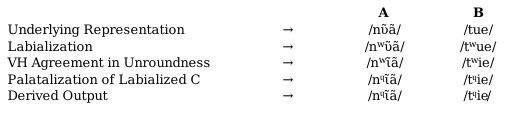
The rule above explains that, the U in the CUa/e string spread its inherent [+Round] feature to the preceding C to yield a CwUa and Cwue respectively. The V-Place [CORONAL] counterpart of U which is the [+/-ATR] ɪ/i replaces the U to yield Cwɪa and Cwie agreeing in terms of vowel harmony (VH). The V-Place [CORONAL] ɪ/i then spread its coronal or palatal feature to the preceding labialized C to yield a labial-palatalized [Cɥɪa] and [Cɥie] in the output form.
Let’s examine data (1) below.
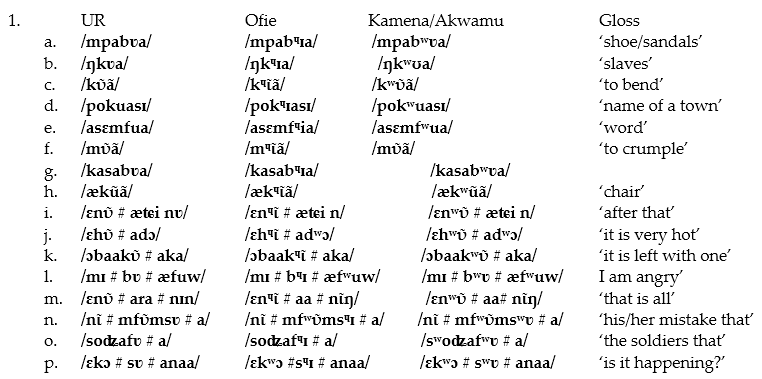
It is discernible from the data above that, in all the sub-dialect of Akuapem, Ofie applies the labial-palatalization process in lexical words more extensively as in (1a - h) than Akwamu and Kamena. It is realized that even across word boundary as in (1i - p), Ofie labial-palatalize the C provided the environment is created than Akwamu and Kamena sub-dialect of Akuapem.
3.2. The bɛ Verbal Prefix in Akuapem
In almost all literature on Akan syntax, the verbal prefix (morpheme) ‘bɛ-’ is treated as a future marker [2, 3]. As a future marker, ‘bɛ-’ is used to express the idea that the event described by the verb will happen or occur later than the utterance time. The main function of this prefix is to indicate future time reference [2]. In her study of Modality in Akan, Owusu (2014) stated clearly that, there are other contexts in the Akan language where the morpheme has no future reading at all. Let’s examine data (2) adapted from [2].
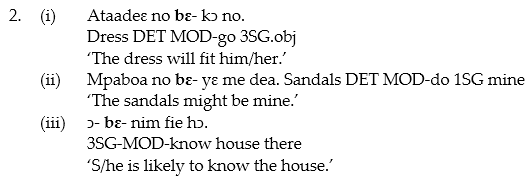
From data (2) above, the focus of the morpheme ‘bɛ-’ in these examples is not to draw the addressee’s attention to the time the action will take place but the speaker here is more concerned with the possibility or probability of the preposition taken place. Since the purpose of this section looks at the tone of the morpheme occurring with verbs in Akuapem, I won’t go into detail, the syntactic and semantic analysis of the prefix. The morpheme ‘bɛ-’ is said on a High tone in the simple future and Low tone in the immediate future tense in Akuapem. When the prefix (morpheme) of the simple future marker ‘bέ-’ ‘will’ and the immediate future ‘bὲ-’ ‘come’ which also functions as the ingressive prefix (the latter) indicating a movement towards the speaker that is required before the action indicated by the verb occur in some tense or aspect form of the verb, there is tonal change in the verbs especially with the reduplicated class I verbs [4].
The Akan verbs have been classified into three main classes based on their underlying tone melodies [4]. Class I, II and III verbs have underlying H, HL and LH tone melodies respectively in phonological representation. With this, the Akuapem dialect of Akan class II and III verbs has identical LH tone melody in phonological representation. This brings us to the tone melody of Akuapem verbs into 2 classes as I (H-tone) and II (LH-tone) in the Twi dialect of Akan as Akuapem Twi or Asante Twi [4]. For the sake of our analysis, I posit two classes of verbs (i.e. class I and II) for the Akuapem dialect of Akan. Let us examine the class of verbs below as (3).
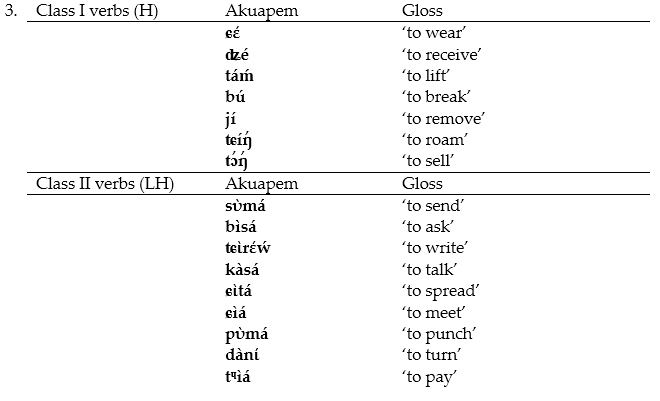
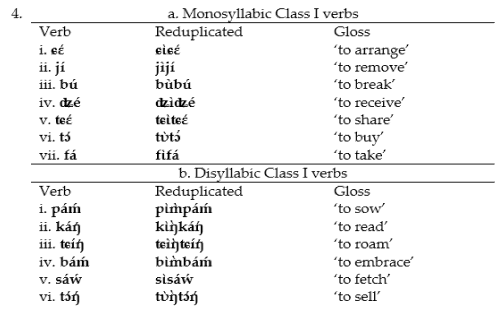
In his study on Tone and Morphology of the Akan Reduplication Construction, the researcher makes it clear that, when the verbs in Class I whether monosyllabic or disyllabic are reduplicated, the reduplicant is prefixed to the base with a default L tone [4]. Let us examine data (4) below.
3.3. Immediate Future Marker bὲ vrs Class I Verbs
When the immediate marker (bὲ) is cliticized to the reduplicated class I verbs, there is tonal change to the reduplicant verbs that receives L as default at the phonetic level. Let’s examine data (5) below.
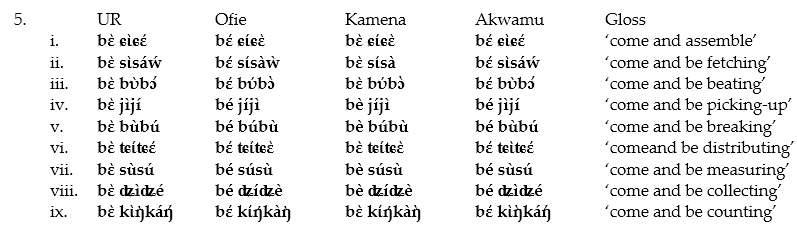
It is discernible from the data above that, all the sub-dialect of Akuapem perform different tonal melody at the P-level. At the underlying level of representation, the morpheme is released as L but becomes H in Ofie and Akwamu while it is still realized as an L in Kamena. Though it as H in Ofie and Akwamu but the semantic meaning of the morpheme does not denote a simple future tense but rather immediate. Again, with the underlying LH melody on the reduplicated verbs, it is realized as HL in Ofie and Kamena while an LH in Akwamu. At this point, I draw attention to the fact that the reduplicant which receive L at the Underlying level is said on H in Ofie and Kamena while the base verb with H is also said on L. Akwamu in this context performs the same tonal melody of the reduplicated verbs in the UR. The vowel of the morpheme harmonizes with that of the verb root in (5 iv, v, vii, viii). The vowels in the root verbs raises in the partial reduplication form to become either /ɪ/ or /ʊ/ in the reduplicant (see Adomako 2012 for a detail study of vowel raising in Akan).
3.4. Simple Future Marker bέ vrs Class II Verbs
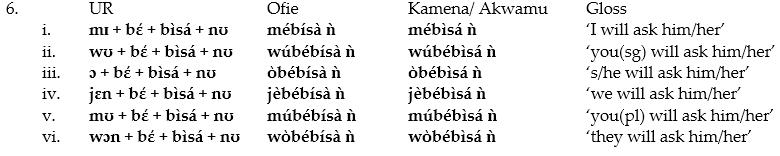
When the pronominal functions as a subject, the tonal melody of the simple future marker bέ spread differently when cliticized to the class II verbs. When the pronominal subject is 1sg, 2sg and 2pl, the H of the morpheme spread to the pronominal in all the sub-dialect of Akuapem. In Ofie, it also spread and dislodges the underlying L of the verb root. The dislodged L does not cause a downstep of the following H but dislodges it. The 3sg, 1pl and 3pl receive L as default in all the sub-dialect. This is evident in the (6) below.
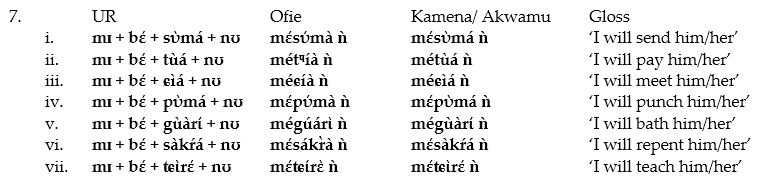
Let’s capture data (6) above graphically as (8) below.
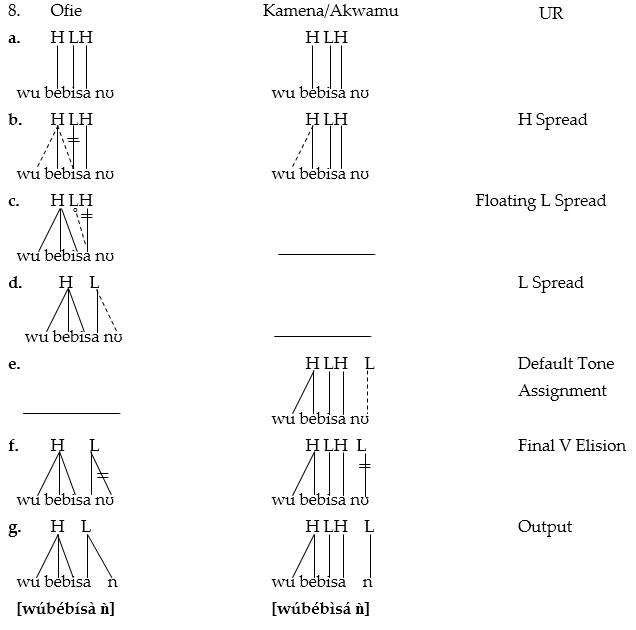
(8a) is the underlying representation. In (8b), the H of the morpheme spread to the toneless pronominal in all the sub-dialect of Akuapem while it spread to the initial syllable of the verb root in Ofie only. The floating L then spread and dislodges the H of the second syllable in (8c). The L of the final syllable spread to the toneless pronominal at the sentence final in (8d) while in (8e) it receives L as default in Akwamu and Kamena. In (8f), the vowel of the pronominal at the sentence final deletes in all the sub-dialect. (8g) is the output.
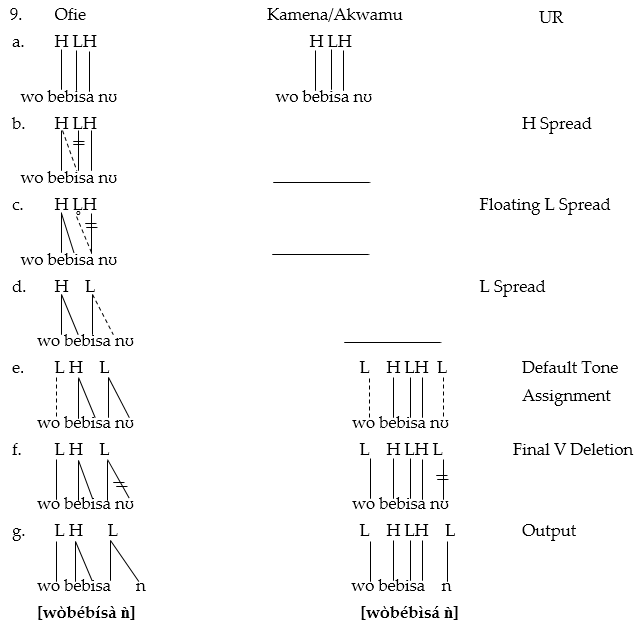
(9a) is the underlying representation. In (9b), the H of the simple future morpheme spread and dislodges the underlying L of the verb root while the floating L also dislodges the following H of the final syllable in (9c) in Ofie only. The L on the verb root spread unto the toneless pronominal at the sentence final in (8d) while the toneless pronominal at the subject position in all the subdialect receive L as default in (9e). The final vowel of the pronominal deletes at the sentence final in all the sub-dialect in (9f). (9g) is the final output.
3.5. Simple Future Marker and Auxiliary Verb
Bέ (simple future marker) has the ability to express a deontic modality when attached to the verb hia ‘to need’ and yɛ ‘to be good’ when an advice or information is given by the speaker at different point in time [2]. But the morpheme becomes epistemic modality when it has the ability to express or give a possibility or probability interpretation when combine or cliticized to the auxiliary verb tumi. ‘tumi’ ‘be able to’ in Akan is an auxiliary verb. This verb is used to show that a Noun Phrase (NP) has the ability to do an activity described by a lexical verb it occurs with [2]. Being a verb, it has an underlying LH tone melody as ‘tùmí’ but becomes noun with underlying HH tone melody as ‘túmí’ ‘power’. When the simple future marker/morpheme is cliticized to the verb, the Akuapem dialect demonstrate same tonal melody as that of class II verbs. Let’s examine data (10) below.

From the above examples, one thing that is obvious is that all the actions are yet to occur; it is epistemic interpretation that is associated with the future interpretation. It is discernible from the data above that, the underlying H tone of the morpheme (bέ) spread and dislodges the L of the first syllable of the verb in Ofie only. The toneless [+Low] vocalic segment at the underlying representation assimilate the final high vowel of the auxiliary verb at the phonetic level in all the sub-dialect of Akuapem. Let’s capture this graphically as (11) below.
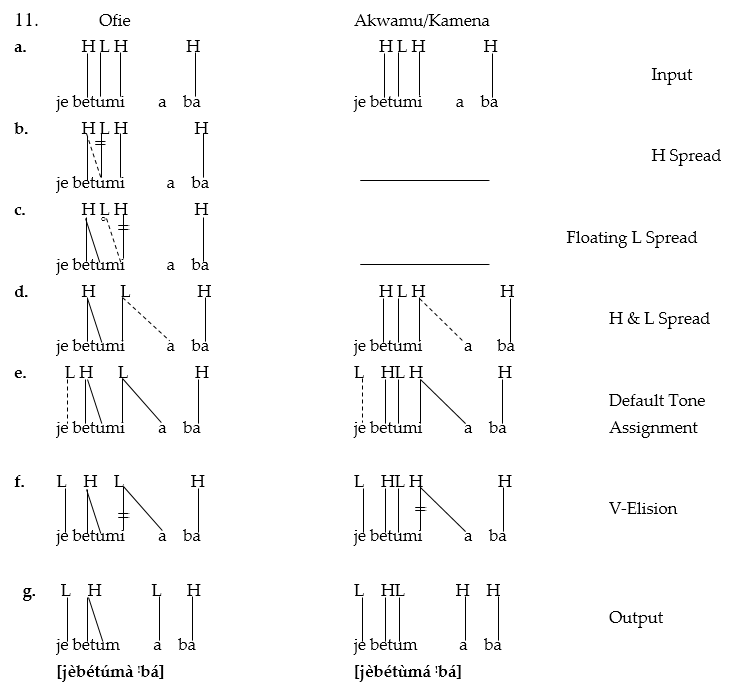
(11a) is the underlying representation. In (11b), the H of the future morpheme spread rightwards to the initial syllable of the verb and dislodges its underlying L which then float in Ofie only. The floating L does not cause a downstep to the following H but spread again to the final syllable and dislodges it in (11c). In (11d), the L and H of the final syllable spread to the toneless [+Low] vocalic segment respectively in Ofie, Akwamu and Kamena respectively. The pronominal at the subject position receives L as default in all the sub-dialect in (11e). In (11f), the final vowel deletes in all the sub-dialects letting the [+Low] vocalic segment ‘a’ replaces its position at the phonetic level. (11g) is the final output.
4. Conclusion
The study indicated that assimilatory and tonal processes in the phonology of the secondary modification like labial-palatalization in Akuapem. It has been realized that when some segments occur in an environment required for the application of the above secondary articulation process, the target segment loses its primary articulation completely in favour of an absolutely new primary V-Place feature. The also concluded that when a segment (consonant) whether coronal, labial or dorsal occur in the CUa/e environment, Ofie sub-dialect of Akuapem labial-palatalize the consonant and even across word boundary so far as the trigger environment is created.
The study also revealed the tonal melody of the simple future marker bέ ‘will’ occurring with the underlying LH tonal melody of the class II verbs in Akuapem. Underlyingly, the H of the future simple marker spread to the initial syllable of the root verb and dislodges its underlying L which also spread and dislodges the H of the following syllable in Ofie sub-dialect of Akuapem only. As discussed in this paper, the simple future marker do not interpret future occurrence of an activity when cliticized to the auxiliary verb tumi ‘be able to’ which also demonstrate or assume the same tonal perturbation in Ofie sub-dialect of Akuapem. With the immediate future marker bὲ ‘come’ occurring with the reduplicated class I verbs, it was realized as L in Kamena with HL tonal melody on the verbs, while it (the marker) was realized as H in Ofie and Akwamu with HL and LH on the verbs at the P-level.
Author Contributions: Conceptualization; methodology; formal analysis; investigation; Resources; data duration; writing-original draft preparation; writing-review and editing; visualisation; supervision; project administration; Author has read and agreed to the published version of the manuscript.
Funding: “This research received no external funding”
Data Availability Statement: Data is available on request from the corresponding author.
Acknowledgments: We acknowledge respondents for their time with us.
Conflicts of Interest: “The author has declared no conflict of interest.” “No funders had any role in the design of the study; in the collection, analyses, or interpretation of data; in the writing of the manuscript, or in the decision to publish the results”.
References
- Abakah, E. N. (2012). Some Assimilatory Processes in Akan. Journal of West African Languages 39.2, 47-82.
- Owusu, A. P. (2014). Linguistic Strategies in the Expression of Modality in Akan. M.Phil Thesis. University of Ghana: Legon
- Dolphyne, F. A. (2013). The Akan (Twi-Fante) Language: Its Sound System and Tonal Structure. Ghana Universities Press, Accra.
- Abakah, E. N. (2015). On Tone and Morphophonology of the Akan Reduplication Construction. Journal of Universal Languages 16.1, 1-47.[CrossRef]
- Adomako, K. (2012). Vowel Raising in Akan (Asante Twi) Reduplication. Legon Journal of the Humanities 23.