

This study adopted both qualitative and quantitative research approaches. The study population covered the house masters and mistresses, students, teachers, grounds prefect and WASH coordinators in the Assin Manso, Adankwaman, Nyankomasi Ahenkro, Assin Nsuta Agric Senior High Schools in the Assin South District. Simple random and purposive sampling techniques were employed to select respondents for the study. The sample size for the study was 216. Two hundred students (200) were selected from the four senior high schools in the District, that is, 50 students from each school, four (4) grounds prefects, one from each school, eight (8) house masters /mistresses, that is, two (2) from each school, and four (4) WASH coordinators one each from a school. The main tools used for the study were semi-structured questionnaires, interview guide and observation checklist. Data analysis was done using both quantitative and qualitative methods. Descriptive data were analysed qualitatively and emerging themes from the data were obtained and categorised and then interpreted through the interview guide with observation checklist digital data such as photographs were used to bring out some aspects of the schools’ surrounding. On the other hand, quantitative data were collected using questionnaire on the numbers of schools and WASH facilities, and analysed using SPSS. The study indicated that the failure of the school administration to maintain the WASH facilities will eventually lead to their breakdown, thus making it difficult for the students to use them. The study also revealed that the poor participation by the communities in the provision and maintenance of the WASH facilities stems from the fact they do not get any direct benefit from the schools. It is recommended that, in promoting WASH facilities in the schools, administrators must include maintenance of the facilities in their provision to ensure their long-term use, other than that the facilities will break down, and resources will have to be mobilized again to repair them or provide new ones. It is also recommended that, Rules and regulations concerning the use and maintenance of WASH facilities should be made by school administration and copies given to the students to guide them as they use the facilities.
Appraisal of Challenges and Community Promotion in WASH Facilities in Senior High Schools in Ghana
May 17, 2022
June 16, 2022
June 24, 2022
June 26, 2022
This is an Open Access article, distributed under the terms of the Creative Commons Attribution 4.0 International License (http://creativecommons.org/licenses/by/4.0/), which permits unrestricted use, distribution and reproduction in any medium or format, provided the original work is properly cited.
Abstract
1. Introduction
Children who have adequate WASH conditions at school are more able to integrate hygiene education into their daily lives, and can be effective messengers and agents for change in their families and the wider community [1]. Whereas, communities in which school children are exposed to diseases risk being infected because of inadequate WASH facilities at school. Families ultimately bear the burden of their children’s illness due to bad conditions at school. WASH programme is, therefore, widely recognised for its significant role in achieving the Millennium Development Goals (MDGs) particularly, those related to universal access to primary education, reducing child mortality, improving water and sanitation, and promoting gender equality [2]. Poor School WASH facilities is among the factors contributing to low school attendance of school aged children especially adolescent girls in schools. WASH in Schools is a first step towards ensuring a healthy physical learning environment. Schools with quality WASH programmes can lessen the spread of disease. Damage to children’s mental and physical development is reduced when the spread of disease is stopped. Children enduring strong infestations with whipworm miss twice as many school days as their infestation-free peers [3]. De-worming services, supported by hygiene education, help children avoid re-infestation, and water and sanitation facilities prevent children from re-exposure. Soap makes a difference.
1.1. Challenges in Promoting WASH Facilities in Schools
According to a companion to the Child Friendly Schools Manual by UNICEF a successful WASH facilities strike the right balance between cost and quality; low-cost solutions must not compromise quality. The best facilities are affordable, durable and easy to use, maintain and clean. For example, there must be proper drains for excess water at wells and surfaces that come into contact with faeces or urine must be impermeable and easy to clean. Despite higher initial investment costs, these facilities will have longer life spans, require less maintenance, and promote better health, saving money in the long term [4].
However, a well-designed facility also requires an operation and maintenance plan so that it does not swiftly deteriorate. A good operation and maintenance plan will identify who is responsible for cleaning and maintaining the facility and what costs are involved. The plan should be developed and agreed upon before the facilities are completed. An operation and maintenance plan will include the following:
- Invite children, teachers, parents and the local committee to contribute to the Continuous process of monitoring and improving hygiene practices at school.
- Protect the best interest of all children at all times. Child participation should never be child labor. Girls and boys should participate equally in cleaning and maintenance.
- Cleaning should not be used as a punishment for poor learning achievement or bad behavior. It should be Link to other school improvement efforts, such as classroom construction,
- Provide for annual or biannual training on operation and maintenance skills, Include arrangements for cost sharing by local authorities, the school and, potentially, parents or the community. For example, authorities may finance spare parts, while the school and parents provide labour and cleaning materials.
- Partners must have financial means to keep WASH facilities clean, hygienic and well maintained. For the development of long-term, sustainable and large-scale programmes, financial planning and management is crucial.
- In recent years, many WASH in Schools programmes have moved beyond their small-scale, fully subsidized beginnings, entering a phase in which they must become financially sustainable. Programmes sometimes have difficulty making this transition due to capacity problems and a lack of financial planning and management. Addressing financial sustainability during the planning and start-up phase will circumvent this difficulty. Clear financial policies can help underpin a more efficient, equitable and sustainable use of resources through the promotion of cost recovery and financing by institutions in private and faith-based schools or by government partners in public schools [5].
Water Aid and SNV in Tanzania schools on improving WASH in schools shows that there is a chronic lack of financial and human resources and commitment into construction of latrines and hand-washing. In districts with a high coverage of water supply in schools, they still have very low levels of functioning hand-washing facilities, (90 percent of schools in Siha have piped water supply, but 92 percent have no hand-washing facilities, not even a stand- pipe). This indicates that it is as much as issue of priority rather than just a lack of resources. In addition, 60 percent of teachers also reported that they have not been trained in providing hygiene education which would help them to lead healthy and productive lives. As said in the Health Believe Theory by Stretcher et al., perceived cost are burial that prevent the practice of good sanitation and hygiene [6]. In 2008, Capitation and Development Grants transferred to primary schools accounted for 6,436 TSh per students (5.1 USD per student). Only a few schools reported to be allocating some of these funds to buying soap or cleaning materials. The capitation grant is clearly inadequate to respond to the development cost associated with providing water supply, sanitation and hygiene promotion (the cost of bringing an average School up to a reasonable standard of WASH estimated at approximately USD 50/pupil) [5]. A study by UNICEF in South Asia schools on WASH for school children Provisional Draft where over the past decade impressive improvements have been achieved in respect of WASH in Schools in South Asia, challenges remain. Based on the information collected for this report, common challenges include the following:
- In recent years, WASH in Schools has gradually been transformed from mostly small-scale, non- government-funded projects, to integral components of large- scale government-led education, WASH and Health-sector programmes. In this transition, gaps in managerial and technical capacity, coordination and dedicated financing have become more prominent.
- In most countries, operation and maintenance of schools WASH facilities remain a problem due to uncertainty on responsibilities, limited technical knowledge and insufficient funding for operation and maintenance.
- Where data on the functioning of WASH facilities are collected, WASH facilities are often found to be out of order. According to data collected in India in 2010, although 90 percent of schools had toilets, only about half of schools had functional toilets. This was a decline from 2007 when 75 percent of school toilets were found functional. One of the reasons is possibly the rapid increase in the numbers of toilets at schools, which has not been met with an equal increase in capacity of schools to manage their toilets properly.
- Although several hygiene education methodologies are used in the region and many are quite successful at a small scale, the challenge of applying such methods effectively at scale remains. The problem with most methodologies is that children learn about good hygiene but are not (or only partly) motivated to put this knowledge into practice. In many schools, it is still difficult for students to apply the hygiene behaviors they have been taught in class because of problems with the availability of soap, dirty toilets that lack privacy, insufficient water at hand washing stands, etc.
- Even after many years of focusing on the importance of WASH in schools, too little information is available about the actual conditions and use of WASH facilities in schools. Many of the WASH in Schools interventions and policies are based on assumptions rather than validated knowledge [6].
According to Towards Effective Programming for WASH in Schools a manual on scaling up programmes for water, sanitation and hygiene in schools by UNICEF in 2007, the challenges faced by school programmes have existed for decades, and their number and coverage is expanding rapidly. However, the struggle to balance quantity and quality continues. In their view WASH in schools, is more than the construction of facilities. In addition to sound construction with child-friendly designs, an effective WASH in schools programme requires adequate planning, management, training and capacity-building, coordination among the institutions involved, and participatory education focusing on life skills. To succeed, WASH in Schools requires a strong focus on operation, use and maintenance of water and sanitation facilities in the school [6].
In a conference on ‘Making it a Reality’ in south Asia 2012, New Delhi, Samir Ahmad Amiri, the Adviser to the Minister of Education, Afghanistan, shared the challenges facing the country that ranged from technical design of appropriate toilets and operations and management challenges for the country, to the difficult political and social environment of addressing sanitation and hygiene challenges in a poor backward country emerging from war like conditions. MD. Sir Azulhaque, Director (Planning & Development), Bangladesh, shared the status of WASH in Schools and emerging challenges in the country. The priority of the national government remains an increased financial allocation to build new toilets in schools. This accounts for 95 percent of the money allocated for toilet construction, and repair and maintenance of sanitation infrastructure in schools only gets 0.05 percent of the budget outlay. Bangladesh needs a national policy to ensure quality WASH in schools’ infrastructure and behaviour change. Thinly Rinzin, Sr. Planning Officer, Bhutan, shared that 83 percent of the children are practising safe hygiene practices. Bhutan has prioritised WASH in Schools to ensure that 94 percent children have access to water and 97 percent of schools had access to sanitation. Bhutan lacks an effective monitoring system for the WinS facilities. In addition to achieving basic water and sanitation standards in schools, Bhutan is also promoting rainwater harvesting, ecological sanitation toilets, tippy taps and soap recycling interventions in schools [7].
Vijay Mittal, Director, Ministry of Drinking Water and Sanitation, Government of India, shared the flagship initiatives and achievements in promoting WASH in schools in India. These include central government programmes of School Sanitation and Hygiene (SSHE), Total Sanitation Campaign (TSC) and Sarva Shikha Abhiyan (SSA). In addition to this, state governments also promote school sanitation and hygiene. Overall, despite the significant allocation of financial resources, India has not been able to achieve sanitation targets, unlike that of drinking water access. Budgets in India are not a constraint but scale, complex administrative system and large geographical area is a big challenge. Linking the centre, state, district, local administration and the school administration for delivering quality WASH in school programmes, remains a challenge. Government of India is reshaping its Nirmal Gram Puraskar (an award for villages free of open defecation) and its financial subsidies to encourage sustainable adoption of safe hygiene practices and sustained behavioral changes in the entire habitation including schools. Maldives has already set foot towards integrating WinS with healthcare. It has policies regarding WinS also in place but these policies do not have priority or attention from the government. An innovative arrangement that Maldives has done is engaging nurses’ associations with WinS programmes and having one health functionary employed in schools to promote hygiene. NEPAL reported an increase in understanding of the importance of WinS in the government. Inter-department and sectoral cooperation in WinS programmes has improved. The (School Lead Total Sanitation) SLTS programme is able to reach the plan for sanitation has been put in place in 2011. The challenges faced are shortage of water and mountainous terrain. Establishing WASH infrastructure is a challenge. The government provides financial allocation for school toilets only in the difficult to reach mountain areas of the country. While the SLTS is making inroads into the community, to ensure the behavioral change and hygiene practices are sustained, monitoring and software manpower is not available [7].
BABAR MINHAS, Department of Local Government and Rural Development Department, Pakistan, joined the conference via a Skype conference call. Realising the importance of WinS, Pakistan government has decided to increase WinS budget from current allocation of 2.1 percent of GDP to 7 percent of GDP by 2015. Health and Education departments are already collaborating with local governments to provide WinS that are sensitive to children’s needs. Gender sensitive initiatives are being implemented to ensure menstrual hygiene for girl children are ensured [7].
Challenges shared for improved WiS include political interference, equity in participation and collaboration among government departments concerned with WinS. Renuka Peiris, Director of Education, School Health and Nutrition Branch, Sri Lanka, shared that the country has a functional framework that ensures quality WASH in schools in all schools. This framework was put together by the government of Sri Lanka in a collaborative and consultative partnership with UNICEF, AusAID, PLAN Sri Lanka, WFP, ADB, Nestle, and Unilever. School Health Promotion Programmes (SHPP) is the flagship programme of WiS in Sri Lanka that delivers the WASH in Schools objectives in participation with all schools and teachers. Challenges faced by the island nation are disposal of waste from the sanitation facilities, uncertainties of recovering O&M costs, mainstreaming of MHM and lack of data on qualitative and behavioral information [7].
A study by and WHO on people health that they can work and learn when they are healthy, and expanding WASH to schools shows that currently 31 percent of schools in developing countries have no access to an improved water source. In a WASH in schools in India Commitment and Action 2014, despite a favourable policy and administrative setting, there are still challenges in terms of access to quality child friendly infrastructure and capacity to influence sustained behaviour change, ensuring improved water quality and functionality of WASH systems. With water and sanitation, the urban and rural schools face similar challenges for safe drinking water and toilet facilities. 40% of schools still do not have access to safe water and toilets [8].
Basically, the companion to the Child Friendly Schools Manual Water Sanitation and Hygiene, UNICEF, the operation and maintenance of latrines is a challenge to many schools. A well-designed facility requires an operation and maintenance plan so that it does not swiftly deteriorate. A good operation and maintenance plan will identify who is responsible for cleaning and maintaining the facility and what costs are involved. In their view, he plans should be developed and agreed upon before the facilities are completed. Equally important is the fact that there are no adequate WASH facilities suitable for children, teachers and other school staff with disabilities [9]. In a study in Zambia on the criteria for successful and sustainable WASH in schools by UNICEF in 2000, a major institutional challenge faced in sustaining and expanding the programme facilities is the lack of coordination between various sectoral departments. Often the lack of inter-sectoral cooperation results in a lack of understanding on who will supervise and monitor the schools. Educational staff, including supervisors, often lack interest and transport facilities needed to go for training or to monitor activities in schools scattered over a wide geographic area. Teachers are often underpaid, have a high workload, and within this context are supposed to teach, supervise and guide their students. These factors affect their interest in sustaining additional initiatives such as WASH in Schools. Another institutional problem specifically for the education department is the high turnover rate of teachers. However, as seen in Zambia, when teachers are transferred within a district, the new schools can also benefit from getting trained teachers [10].
It has been noted by WELL in 2003 that the combination of adequate facilities, correct behavioural practices and education is meant to have a positive impact on the health and hygiene conditions of the community as a whole. The success of a school hygiene programme is, therefore, not determined only by the number of latrines constructed and the number of hand pumps installed or water connections built. Nor is the success of a programme determined simply by what children know. Knowledge that is not applied to hygiene behaviour in practice has no impact on health. WELL therefore recommends that School Sanitation and Health Education (SSHE) programme should not end when the water and sanitation facilities have been constructed [11]. Lack of reliable data on WASH in Schools is one barrier to securing the rights of children. No global database exists on the availability and status of basic facilities for school water supply and sanitation. This is captured in the Health Believe Theory as a barrier that prevents that practice of good sanitation and hygiene. UNICEF is attempting to collect available information from countries where it supports school sanitation interventions. It is therefore only possible to prepare rough estimates of WASH in School needs, based largely on assumptions [12].
1.2. Community Participation towards WASH in School
Community participation as the creation of opportunities to enable all members of a community to actively contribute to, and influence the development process and to share equitably in the fruits of development. That is, community participation concerns the engagement of individuals and communities in decisions about things that affect their lives [13]. The following are some of the key reasons for promoting community participation:
- Active participation of local residents is essential to improved democratic and service accountability.
- It enhances social cohesion because communities recognize the value of working in partnership with each other and with statutory agencies.
- It enhances effectiveness as communities bring understanding, knowledge and experience essential to the regeneration process. Community definitions of need, problems and solutions are different from those put forward by service planners and providers. It enables policy to be relevant to local communities.
- It adds economic value both through the mobilisation of voluntary contributions to deliver regeneration and through skill development, which enhances the opportunities for employment and an increase in community wealth.
- It gives residents the opportunity to develop the skills and networks that are needed to address social exclusion.
- It promotes sustainability because community members have ownership of their communities and can develop the confidence and skills to sustain developments [14].
Child Friendly Schools Manual by UNICEF in 2002, involving parents and community members can have important roles in keeping the school clean, safe and healthy, and encouraging children to adopt improved hygienic behaviour. Roles for local committees, parents and communities include the following:
- Key partners during planning and implementation: Parents and community members often provide unskilled labor and local construction materials to build school facilities. Involving them in planning can lead to a sense of ownership among the parents and community members. The community can make decisions and arrangements, for example, on community use of the school water tank or toilets if facilities are not available at the household level. To obtain commitment and consensus from the entire community, the local committee should report their findings and decisions to the community as a whole. The committee should equally represent men and women, ethnic groups and social classes to ensure a balanced view.
- Financial controllers and fund holders: If parental contribution is required for maintenance, cleaning staff, and supplies of soap and cleaning material, the parents can oversee the funds through the parent-teacher association to overcome any distrust when they must give payments to the school. Contributions may be provided as goods, such as one bar of soap or bottle of cleaning liquid brought annually by each child to the school.
- Overseers of operation and maintenance: In most communities, boards are responsible for the operation and management of water systems and sometimes of communal toilets. Involving the community from the start can help them incorporate the school facilities into their overall work. The schoolchildren or special staff can be assigned to clean the toilets.
- Community-based monitors: The community and the school have many advantages in monitoring the facilities. They will quickly know and report needed repairs and can motivate facility users by sharing the positive impact of interventions as measured by objective criteria. Information can be shared at all levels, including: the communities and schools and their specific groups, such as girls and women; local education and health authorities; programme staff and management; and programme advisers.
- Coordinators of facility use during emergencies: In many parts of the world, school buildings are used as temporary shelters for affected community members during emergencies. Adequate, well-maintained WASH facilities in schools allow for appropriate hygiene practices in times of emergency and can drastically reduce the risk and spread of infectious diseases. These efforts must be coordinated with the school, community or water board as part of the overall vision of emergency preparedness. The primary aim is to have schools open and functioning during emergencies [9]
Community participation in SSHP recognises that community participation goes beyond the provision of materials. It envisages the involvement of the community in all stages of project planning, and to involve such structures as the Village Development Committees (VDCs) and the Village Health and Water Committees (VHWCs). Community participation has attempted to improve participation through training in CBM and VLOM. The District PMTs have made serious attempts at involving the communities and this is evidenced by the level of participation, including provision of money, in some schools. One suggestion is that schools can participate by the process of “self-selection”, and that the selection criteria include existing low cost activities [15]. To ensure that school programmes are , schools and communities should cover all costs. Contributions can be in the form of materials, labour, cash or all three. Schools can join hands with families and communities to raise money possible funding options include: Contributions from parents, donations and using the general school maintenance budget [16].
A case study of Oboyambo community in the Central Region of Ghana on children’s involvement in Community-Led Total Sanitation (CLTS) shows that CLTS implementation in the community has partly contributed to the construction of a school building which started with 30 pupils. Now the school population stands at 150. In addition, the self- help spirit encouraged by CLTS has helped the people of Oboyambo to embark on a school building project for their preschoolers’. The community had earlier put up a structure with bamboo and straw as a classroom for the pre-scholars. The facility, however, collapsed after a short while. After some months, they mobilised resources to build a mud and wattle structure for the school children and employed teachers to teach the children. According to the study, communities contributed labour, sand, stones and water. The masons and carpenters were drawn from the community to put up the two classroom built with bricks. The most interesting part of the project was the involvement of children and women during the construction of the school building. They were tasked to fetch water from the stream to the building site [17].
The UNICEF study carried out in six countries in 2005 towards effective programming for WASH in schools on programmes for water, sanitation and hygiene in schools noted that common problems include limited training of teachers, rapid teacher transfer, the lack of interest or motivation among teachers and headmasters, very full teacher schedules, and competition for the attention of teachers from other educational reforms. Also the study revealed that school programmes have existed for decades, and their number and coverage is expanding rapidly. However, the struggle to balance quantity and quality continues. WASH in schools is more than construction of facilities. In addition to sound construction with child-friendly designs, an effective WASH in schools’ programme requires adequate planning, management, training and capacity-building, coordination among the institutions involved, and participatory education focusing on life skills [18]. A study by United Nations in Johannesburg revealed that communities make decisions about design, construction and location of facilities. They contribute at the beginning of the programme and help in monitoring, as well as taking part in special school events for WASH in schools. They also decide how to organise support for recurring expenditures such as soap, cleaning materials, repairs, and educational materials. Community involvement may enable a WASH in Schools programme to have a broader IMPACT. It is hoped that a WASH in schools’ programme will initiate a process of passing on health information and behavioural changes from school to household to community, or, in other words, from students to siblings, friends and neighbours [19].
In an evaluation report in 2004 on Evaluation of Strategic Sanitation and Hygiene Promotion in School Pilot Projects in Nkhata Bay and Kasungu by De Gabriel, Keast and Msukwa noted that the District Assemblies were involved in setting up the PMTs and the school selection criteria. This was done by involving them more in the planning and monitoring of activities in Phase II. In Nkhata Bay, the District Assembly requested quarterly feedback from the PMT and the DEC, and the PMT was accountable to it. The policies and guidelines of the various line ministries are well understood by the project management teams. However, the District Executive Committees and the PMTs need to realign their activities to include more training on policy, coordination, supervision and enforcement. Nkhata Bay recommended that extension workers conduct joint supervision and present joint reports to the PMT, and this can be seen as a very positive development. It also recommended that the project should also explore ways of facilitating a forum, whereby the School Management Committees would request the services of various extension CEF and partners for action for water, sanitation and hygiene in schools [20].
WASH facilities in the senior high schools in the Assin South District were inadequate and the few available ones were not well maintained. These include unhygienic and non-functional WASH facilities. In addition, there were inadequate hands washing materials such as soap, running water and towels in the schools. Toilet facilities were poorly used in the selected schools as some of the female students even disposed of their menstruation pads into them. Toilet facilities were not kept clean; used tissues were dumped just at the entrance, making the whole environment stink. Moreover, the attitude of students towards the use and maintenance of the facilities was poor. Despite the general unpleasant conditions of the latrines and urinals, most students continued to utilise the said facilities simply because they had no option. Not even the presence of maggots in and around the toilet facilities in some of the study schools would stop the students from using them [21]. The study was guided by these research questions – (1) examine the challenges encountered in promoting WASH in senior high schools in the Assin South District. (2) assess the contributions of the community in promoting WASH in senior high schools in the Assin south District.
2. Materials and Methods
This study adopted both qualitative and quantitative research approaches. The study population covered the house masters and mistresses, students, teachers, grounds prefect and WASH coordinators in the Assin Manso, Adankwaman, Nyankomasi Ahenkro, Assin Nsuta Agric Senior High Schools in the Assin South District. Simple random and purposive sampling techniques were employed to select respondents for the study. The sample size for the study was 216. Two hundred students (200) were selected from the four senior high schools in the District, that is, 50 students from each school, four (4) grounds prefects, one from each school, eight (8) house masters /mistresses, that is, two (2) from each school, and four (4) WASH coordinators one each from a school. The simple random sampling technique was employed to select respondents from the students in the various schools so that every student of each school had an equal chance of being selected to take part in the study. The purposive sampling technique was used for selecting the house masters/mistresses, WASH coordinators, teachers and grounds prefects. The main tools used for the study were semi-structured questionnaires, interview guide and observation checklist. Data analysis was done using both quantitative and qualitative methods. Descriptive data were analysed qualitatively and emerging themes from the data were obtained and categorised and then interpreted through the interview guide. Digital data such as photographs were used to bring out some aspects of the schools’ surrounding with observation checklist. On the other hand, quantitative data were collected using questionnaire on the numbers of schools and WASH facilities, and analysed using SPSS.
3. Results and Discussion
3.1. Challenges in Promoting WASH in Senior High Schools in the Assin South District
The third objective of this study was to examine the challenges encountered in promoting WASH in Senior High Schools in the Assin South District. To achieve this objective, interviews were conducted and questionnaires administered to respondents from the various schools to find out the challenges in promoting WASH in the School. In addition, the researcher made direct observations of WASH facilities in the selected schools. The interview unveiled that the schools lack money to purchase WASH facilities such as towels, soap, buckets, detergents etc. Indeed, the lack of these things hinders the promotion of WASH in the schools. The study established that no one was clearly responsibility for the provision of WASH facilities, as evidenced from a question by one of the respondents,
So who will be responsible for the provision of the soap, detergents, veronica buckets etc.? Is it the government, teachers or the students?
It was also found that some schools lack sanitary materials like waste bins, brooms, cutlasses and hoes. The researcher observed that waste materials had gathered at some particular areas on some school premises without any attempt to collect them. This is seen in Figure 1.
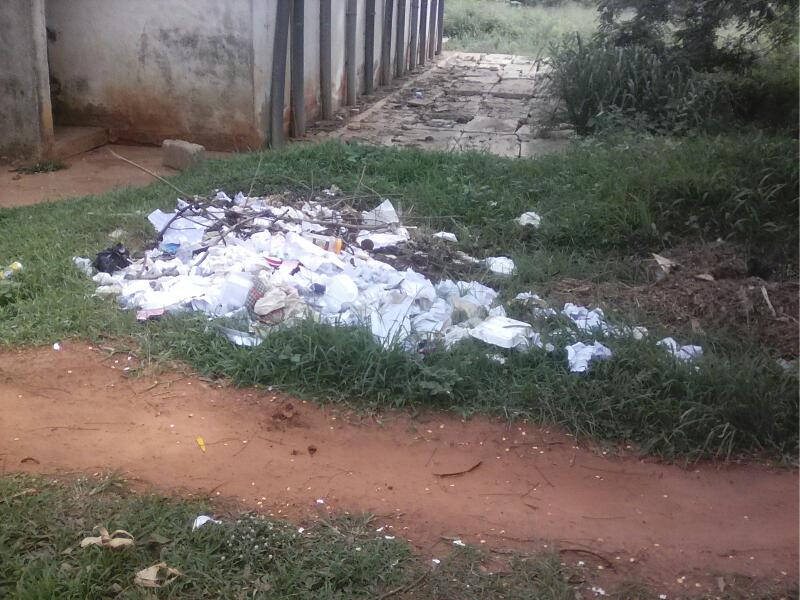
Students who were interviewed contended that there was no means of transporting the rubbish to the appropriate places. Most of the respondents (75%) agreed that the services of the Zoom Lion Waste Company were the most appropriate method of handling waste but according to them it was very expensive so the schools could not afford it. Majority of the respondents believed that a successful WASH facility strikes the balance between cost and quality as shown in the Table 1.
The survey conducted reveals in Table 1 that 75 respondents representing 37.5% strongly agreed that a successful WASH facility strikes a balance between cost and quality while 56 respondents representing 28.0% also agreed to the statements. It was realised from the survey that out of the 200 respondents 59, strongly agreed to the statement that cleaning of WASH facilities is used as punishment for poor academic achievement or bad behaviour and 48 respondents also agreed. This is seen in Figure 1. Due to this, students do not see it as their responsibility to keep their WASH facilities in good condition. They rather see it as punishment and ignore that responsibility.
The study also uncovered the fact that provision of WASH facilities is usually only about construction of the facilities without making any plans for its maintenance. After the construction of the WASH facilities, it ends there. There is no system in place for maintaining it, and so the facility easily deteriorates. This is shown in Table 2 below. Out of the 200 respondents fifty-four (54) respondents representing 27.0% strongly agreed to the statement that WASH facilities in the schools are poorly maintained and fifty-four (54) respondents representing 27.0% also agreed that after the construction of WASH facilities, there is poor maintenance of WASH facilities in the schools.
The study was supported by earlier research that, companion to the Child Friendly Schools Manual Water Sanitation and Hygiene, UNICEF, the operation and maintenance of latrines is a challenge to many schools. A well-designed facility requires an operation and maintenance plan so that it does not swiftly deteriorate. A good operation and maintenance plan will identify who is responsible for cleaning and maintaining the facility and what costs are involved. Equally important is the fact that there are no adequate WASH facilities suitable for children, teachers and other school staff with disabilities [9]. This implies that lack of WASH facilities in schools impede successful academic work.
3.2. Community Participation in Promoting WASH in Schools
The fourth objective of this study was to assess the community’s participation in promoting WASH in the Senior High Schools in the Assin South District. In addressing this objective, data were gathered through interviews and questionnaires administered to respondents in the study schools to discover how much the community participated in promoting WASH in schools. The study discovered that out of the four communities where the study schools are located, only one community participated in promoting WASH in school. According to the house masters and mistresses the researcher interviewed, the community did that by providing the school with a bore-hole. The other three schools had no community participation in promoting WASH in the school.
It was observed that out of the 200 respondents, sixty-eight (68) respondents representing 34.0% strongly disagreed to the statement that the community participated in promoting WASH in schools, and forty-nine (49) respondents representing 24.5% disagreed, as can be seen in Table 4.
With reference to the community’s participation in the schools’ Water, Sanitation and Hygiene activities, the study revealed that one community participated in the WASH activities while in the other three schools, the community did not participate in anyway. The school which enjoyed the community’s participation had the community providing labour and materials for various activities in the school. Views on whether the school management organises programmes on WASH for the students indicated that not a single programme had been organised for the students in all the four selected schools. According to one the respondents: “All seminars and symposia organised are on topics such as teenage pregnancy, drug abuse etc. I wonder if there will ever be a programme on hand washing”. In the study it came to light that it is rather the house masters and mistresses who played the role of advising the students on sanitation and hygiene during house meetings.
A study by United Nations in Johannesburg supported the findings of the study and revealed that communities make decisions about design, construction and location of facilities. They contribute at the beginning of the programme and help in monitoring, as well as taking part in special school events for WASH in schools. They also decide how to organise support for recurring expenditures such as soap, cleaning materials, repairs, and educational materials. Community involvement may enable a WASH in Schools programme to have a broader IMPACT. It is hoped that a WASH in schools’ programme will initiate a process of passing on health information and behavioural changes from school to household to community, or, in other words, from students to siblings, friends and neighbours [19]. This posit that community engagement can be used as a helping hand to improve upon the WASH facilities in schools in their catchment areas.
4. Conclusions and Recommendations
The study indicated that the failure of the school administration to maintain the WASH facilities will eventually lead to their breakdown, thus making it difficult for the students to use them. The study also revealed that the poor participation by the communities in the provision and maintenance of the WASH facilities stems from the fact they do not get any direct benefit from the schools. The students are admitted from various parts of the country, and consequently, the communities do not see any need to provide and maintain WASH facilities for schools where their wards may not be attending. It is recommended that, in promoting WASH facilities in the schools, administrators must include maintenance of the facilities in their provision to ensure their long-term use, other than that the facilities will break down, and resources will have to be mobilized again to repair them or provide new ones. In view of the fact that the communities have little interest in the provision and maintenance of WASH facilities school administrators should rather liaise with the old students’ associations and philanthropists for the provision and maintenance of the facilities. It is also recommended that, Rules and regulations concerning the use and maintenance of WASH facilities should be made by school administration and copies given to the students to guide them as they use the facilities. To ensure that students comply with the rules and regulations, those who break them must be dealt with to deter others from doing so.
Author Contributions: Conceptualization; Methodology; Validation; Formal Analysis; Investigation; Resources, Writing-Original Draft Preparation; Writing-Review and Editing, visualization; supervision; and Project Administration by the author. Author has read and agreed to the published version of the manuscript.
Funding: “This research received no external funding”
Data Availability Statement: Data is available on request from the corresponding author.
Acknowledgments: we acknowledge the participants in this study.
Conflicts of Interest: “The authors declare no conflict of interest.” “No funders had any role in the design of the study; in the collection, analyses, or interpretation of data; in the writing of the manuscript, or in the decision to publish the results”.
References
- UNICEF. (2009). Monitoring Results for Equity System (MoRES) and Country Programming Draft 3. New York: United Nations Children’s Fund
- Freeman, M. (2012). Assessing the impact of a school-based water treatment, hygiene and sanitation programme on pupil absence in Nyanza Province, Kenya: a cluster-randomized trial. Tropical Medicine and International Health 17(3), 380-391.[CrossRef] [PubMed]
- World Health Organization, (2005). Report of the Third Global Meeting of the Partners for Parasite Control: Deworming for health and development. Geneva: WHO.
- Water and Sanitation Programme, (2004). The Case for Marketing Sanitation. Water and Sanitation Programme Field Note, August 2004.
- UNICEF, (2008). UNICEF handbook on water equality. New York, USA: UNICEF.
- UNICEF, (2007). Towards effective programming for WASH in Schools. Delft, The Netherlands: IRC international Water and Sanitation Centre. (Technical paper series no. 40).
- UNICEF (2012). Raising even more clean hands: advancing health, learning and equity through WASH in schools. New York: United Nations Children’s Fund
- WHO/UNICEF, (2008). Progress on Drinking Water and Sanitation. Special Focuson Sanitation. New York: UNICEF. Retrieved from on 3rd March, 2021.
- UNICEF (2002). Sanitation in Uganda Schools: Stories of promise, progress and challenges. Kampala, Uganda.
- UNICEF Zambia. (2011). Child Friendly Schools and Sanitation: Snapshot of school children’s perceptions and utilisation of water and sanitation facilities in some selected schools in rural Zambia. Lusaka: United Nations Children’s Fund.
- WELL (2003). WELL fact sheet: School Sanitation and Hygiene Education. From www.lboro.ac.uk/well/resources/fact-sheets/fact-sheets-htm/ssahe.htm Accessed Dec. 10, 2021.
- Mooijman, A, (2006). ‘Manual on Hygiene Education in Schools: Teachers Guidebook’, CCF-UNICEF, Colombo, Sri Lanka,
- United Nations (2002) The Millennium Development Goals Report. Retrieved online on 21-04-2021
- Burns, D. Haywood, F., Wilde, P. & Wilson, M. (2004). The politics of decentralization. London: Macmillan
- Kariuki, M. (2000) Lessons Learned from the WUP Project No. 5, Durban Congress, Water Utilities Partnership, unpublished document
- IRC -International Water and Sanitation Centre, (2004). Sustainability of Hygiene Behaviour and the Effectiveness of change interventions: Lessons learned on research methodologies and research implementation from a multi-country research study. The Netherlands: Jaap Zomerplaag
- Appiah, K., Du, J. & Sarpong, P. B. (2017) Non-Revenue Water Management in Ghana: The Opportunities and Challenges. Journal of Environment and Earth Science, 7, 59-67.
- UNICEF (2003) The State of the World’s Children 2003. Available at . [(Accessed on 15 June 2016)].
- UNICEF, (2003). Assessing the Performance of Water and Sanitation Sector. New York: UNICEF.
- World Health Organization (2015). Water, sanitation and hygiene in health care facilities: status in low and middle income countries and way forward. WHO Press.
- Tudagbe-Obour, I., & Obeng, J. I. (2021). Assessing the Status and Effects of Water, Sanitation and Hygiene (Wash) in Senior High Schools in the Assin South District. Education Journal, 4 (2), 17-39.[CrossRef]