

The purpose of present study was to investigate the therapeutic outcome of clinical application of CSC telescopic denture with magnetic attachment in treating the occlusion, mastication and speaking problems due to individual affected severe teeth missing. Similar to above conditions, there are many dental clinicians may choose to use the removable denture with bilateral I-bar application. The other way also can use the bilateral implant application. Little or limited literatures reported the use of removable denture combined with magnetic attachment application. The present case presented one modified approach related to oral rehabilization of mandibular posterior teeth using bilateral magnetic attachments combined with CSC telescopic denture (CSCTD) application. Result showed a remarkable clinical appearance and occlusal function of the improvement between outer crowns with magnet attachment and inner abutment with magnet attachments for a long time evaluation. It can be concluded that the design of the CSCTD combined with magnetic attachment appears to be an effectiveness method and provided the other modified approach in treating bilateral missing problems of posterior premolar and molar teeth.
Oral Rehabilization of CSC Telescopic Denture with Magnetic Attachments in Treating Bilateral Molars Missing of Mandibular Arch
June 03, 2024
July 20, 2024
August 31, 2024
September 03, 2024
This is an Open Access article, distributed under the terms of the Creative Commons Attribution 4.0 International License (http://creativecommons.org/licenses/by/4.0/), which permits unrestricted use, distribution and reproduction in any medium or format, provided the original work is properly cited.
Abstract
1. Introduction
The periodontal treatment and prognosis of tooth affected mild to moderate alveolar bone loss with single root are simple among former literatures, [1, 2] while the teeth with multiple roots are often limited by the angle of the instrument because of the complexity of the shape. In addition, a clinical evaluation of periodontal and prosthetic treatment using radiographic and retrospective observation also illustrated that molars affected with severe furcation involvement (FI) are more prone to decreasing periodontal attachments [3, 4]. Predictable and effective treatment of molars affected FI of severe advanced periodontitis such as molar tunnel preparation, furcation plasty, root amputation, root separation. These techniques exhibit discrepancies in the success rate and their complications are still controversial [5, 6, 7, 8, 9, 10].
Long-term observations using retrospective and radiographic image analysis to evaluate periodontal treatment outcomes found that multi-root molars with severe angular bony defects are more likely to lose periodontal attachment tissue, eventually requiring tooth extraction [11]. Current periodontal treatments for tooth-focused tooth treatments for molar affected FI lesions include: furcationplasty, hemisection, root amputation, and root separation, however, these methods vary in the assessment of sequelae, as residual roots are not easily cleaned in their morphologically anatomical form. In order to solve the problem of molars with severe class II or II FI lesions with poor morphological root patterns that remain after receiving root separation or root resection, we have developed an improved method, namely root separation and/or resection (RSR) combined with the special design of CSC telescopic denture (CSCTD). Keep the functional-based teeth that retain most of the residual natural teeth as abutments [12]. The objective of this study was to apply a combination of occlusal, periodontal and prosthetic therapy to treat patients with severe advanced periodontitis (SAP), retrospectively and dental radiographic evaluation for teeth affected with vertical bone destruction (angular bony destruction), as a change on the abutments of CSCTD for the cumulative radiographic alveolar bone levels [13].
Although, most cases can easy to constructed or oral rehabilization using implants, but unfavorable periodontal alveolar bone thickness and height support usually resulted in an unfavorably condition for implant. In addition, expensive is the primary consideration. The other way for the patient affected bilateral loss of mandibular premolars and molars was can also reconstructed the CSC telescopic denture with magnetic attachment. Recently, a case report was documented a clinical application of CSCTD combined with magnetic attachment in treating patient affected class III molar FI [14].
Little or limited literature concerning the complete missing on both premolar and molar teeth was treated using the CSCTD with magnetic attachment. The present report was to illustrate the advantages of CSCTD with magnetic attachment as compared to those of transitional removal denture.
2. Representative Case
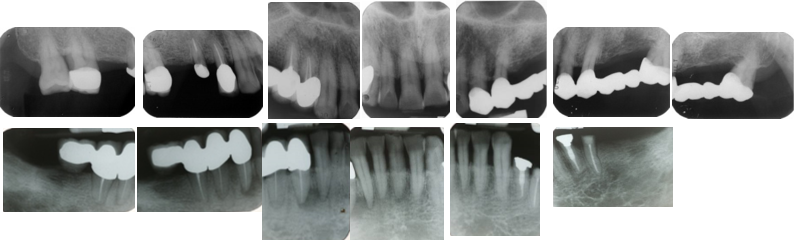
A 62 year-old male retired teacher visit our clinics with chief complaints of inability to chew, speaking problems, and missing teeth on the both mandibular posterior teeth included molar teeth #37, # 36 and residual roots on the premolar # 34, and #35. In addition, ill fitted bridge was noted from the #43, # 44, #45, #46, and # 47 on 9 April, 2002. Clinical examination of Intraoral fixed crown of right maxillary second molar (#17~#15 with missing #16), single crown of #14. Left maxillary fixed bridge of #24~#28 with missing #26 and # 27 molars. Clinical examination of intra-oral fixed bridge of #43~#46, with pontic of #47. In addition, nature teeth from # 33 to #42 with a residual tooth of #34 were noted. All the other teeth were missing included #35~#38, #47 and #48. Fig. 1 showed that the dental periapical radiographs of full mouth at the baseline.
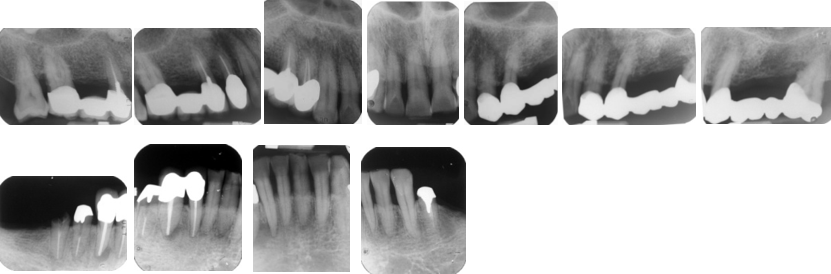
The symptoms including, gingival bleeding, slight mobility, gingival recession, and inability to chew, had been observed since he was 6 years ago. He had visited some dental clinics been told that the mobile molar with advanced Class II to III should be extracted. Based on the periodontal examination slight gingival recession, heavy deposits of calculus, moderate plaque retention, and Class II molar FI were noted on the maxillary 2nd molar (#17). Clinical assessment included plaque index (Pll), [15] gingival index GI, [16], and alveolar bone loss score, probing depth (PD), and clinical attachment level (CAL) which were measured from the baseline (2005) until treatment was completed 14 years (2019). Radiographs illustrated a moderate bone loss of #17 on the furcation roof and infra-furcation area of right maxillary 2nd molar. A final diagnosis of moderate adult periodontitis with Class II molar FI of #17 was made. Figure 2 revealed that maxillary right molar bridge and mandibular magnetic attachments of #34 and # 44 were constructed.
3. Treatment
Patient was instructed in personal and professional plaque controls before basic periodontal therapy consisted of basic and routine meticulous subgingival scaling, root planning, and subgingival curettage followed by pocket irrigation with chlorhexidine gluconate 0.12% and undertaken once a week for 3 months. Supportive periodontal therapy was established every 2 to 4 weeks for 12 months.
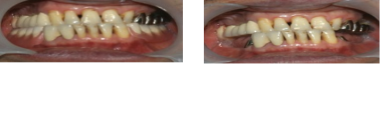
Figure 1 showed that the dental periapical radiographs of full mouth at the baseline. (2002/4/9) Figure 2 revealed that maxillary right molar bridge and mandibular magnetic attachments of #34 and # 44 were constructed. Figures 3a~3e illustrated the mandibular CSC telescopic denture with magnetic abutments of # 33 and # 44. Figures 4a, 4b indicated the facial views with and without application of mandibular CSC telescopic dentures.

4. Discussion
The clinical and radiographic symptoms of periodontal compromised teeth with SAP were characterized as highest risk factors of teeth mortality rate. Lindhe & Nyman [17] and Rosling et al. [18] reported that an effect of following proper periodontal therapy (teeth which exhibit severely reduced but healthy periodontium still exhibit a permanently increased mobility), does not diminish the increased mobility of the tooth, splinting of the teeth may be considered. This type of treatment is only in cases, however, during the recall phase or even during the pre-surgical period. It becomes obvious that the reduced periodontal support around the teeth either in the entire dentition or in several parts of the individual’s arches with SAP may be insufficient to withstand force resulted from torque, occlusal, lateral directions. Left alone before, and following periodontal therapy, such teeth may be subjected to forces large enough, sooner or later to mechanically deteriorate the receiving periodontal supports and to extract the teeth. The clinical data, reported from Nyman et al. [19] showed that permanent periodontal prosthesis can be hyper-mobility of isolated abutment teeth, especially even the prosthesis with a cross-arch design. Early bilateral mandibular molars loss happened in this case via a long-term time are resulted in the occlusal disturbance, inability to chew, and speaking problems.
The study of Hou et al. [11] used root separation or resection(RSR) and CSC telescopic dentures (CSCTD) to treat molars with molar FI lesions, and after follow-up for a mean of 6.67 years (5~13 years), it was found that the mean attachment gains of molars with molar FI lesions of the maxilla was 0.72mm after RSR and 1.07mm for the mandible, while the mean attachment gain obtained was lower than those without RSR, and the mean periodontal attachment gains of the maxilla was 0.21mm and the mean attachment gains of the mandible 0.56mm [11]. The other study by Hong et al., [20] it was found that for severe molar FI using RSR for treatment, after one year of observation, the mean periodontal attachment gain was 0.34 (±0.66) mm; and in this study, long-term observation was done according to the same method of RSR and CSCTD, and it was found that teeth with severe molar FI lesions were obtained a mean 1.08 (±0.90) mm alveolar bone gain, the results showed that patients who received the treatment of both RSR and CSCTD with periodic recall visit to the clinics had good treatment results. Therefore, the bilateral molars missing affected this case, the perioprosthetic design of CSCTD with bilateral magnetic attachments seemed to be a valuable reference in treating case like this philosophy.
The published data addressed that non-surgical periodontal therapy (NSPT) may not only dramatically improves clinical and microbiological parameters, but also resolves inflammation and arrests adult periodontitis [11, 12, 13]. There existed some problematic areas, such as, FED, furcal concavity, osseous defects, usually correlated with deep pockets that may adversely respond to NSPT because of these sites limited access to debride bacterial deposits. In addition, clinical studies, reported from some investigators indicated that deep pockets within the molar FIs have prone to more attachment loss and higher mortality rate when observed over many years [21, 22, 23, 24]. There exists conflicting data regarding the bone fills of angular defects following surgical and non-surgical periodontal therapy. Renvert et al. [25] indicated that limited repair in treating intra-osseous defects using flap operation and there was virtually no bone fill after root planning. In conclusion, the finding of minimal bone fills after scaling and root planning was in contrast to the findings of bone fills, which reported by Rosling et al. [26] and Polson & Heijl [27] that abundant bone repair, post-surgically.
References
- Becker W, Berg L, Becker BE. The long-term evaluation of periodontal treatment and maintenance in 95 patients. Int J Periodontics Restorative Dent 1984; 4: 54 - 71.
- Becker W, Becker BF, Berg L, et al. New attachment after treatment with root isolation procedures: report for treated Class III and Class II furcation and vertical osseous defects. Intern J Periodontics Restorative Dent 1988; 8: 9 - 23.
- Hirschfeld L, & Wasserman B. A long-term survey of bone loss in 600 treated periodontal patients. J Periodontol 1978; 49: 222 - 237.[CrossRef] [PubMed]
- Ross FI and Thompson RH. A long-term study of root retention in the treatment of maxillary molars with furcation. J Periodontol 1978; 49: 238 - 244.[CrossRef] [PubMed]
- Muller HP, Eger DE. Management of furcation-involved teeth. A retrospect- tive analysis. J Clin Periodontol 1995; 22: 911-917.[CrossRef] [PubMed]
- Hou GL, Chen SF, Tsai CC. Furcation entrance dimension, divergent angle, and length of CEJ to Furcation entrance related to periodontal therapy. Kaohsiung J Med Sci. 1996; 12: 705-715.
- Hamp SE, Nyman S, Lindhe J. Periodontal treatment of multirooted teeth. Results after 5 years. Clin J Periodontol 1975; 2: 126-135.[CrossRef] [PubMed]
- Carneval G, Febo GD, Tonetti MP, et al. A retrospective analysis of the periodontal - prosthesis treatment of molars with inter-radicular lesions. Inter J Perio Restor Dent 1991; 11: 189-205.
- Langer B, Stein SD, Wagenberg B. An evaluation of root resection. A ten-year study. J Periodontol 1981; 52: 719-722.[CrossRef] [PubMed]
- Wagenberg J. The furcation problem: Etiology, pathogenesis, diagnosis, therapy, and prognosis. J Clin Periodontol 1980; 7: 73-95.[CrossRef] [PubMed]
- Hou GL, Tsai CC, Weisgold AS. Treatment of molar furcation involvement using root separation and a crown and sleeve-coping telescopic denture. A longitudinal study. J Periodontol 1999; 70: 1098 -1109.[CrossRef] [PubMed]
- Hou GL, Tsai CC, Weisgold AS.Periodontal and prosthetic therapy in severely advanced periodontitis by the use of the crown and sleeve coping telescopic denture. A longitudinal case report. Aust Dent J 1997; 42: 169-174.[CrossRef] [PubMed]
- Hou GL, Hou LT. Therapeutic outcomes using the Sandwich’s technique in treating severe advanced periodontitis with secondary occlusal traumatism: A long-term study for 5.1 - 39 years. Inter J of Dentistry and Oral Health 2019; Vol. 5 Issue 6, August : 48 - 58.
- Hou GL. Clinical application of CSC telescopic denture with magnetic attachment in treating class III molar furcation involvement - A case report. Intern J Dentistry and Oral Health 2020; Volume 6, Issue 6: 1-4.[CrossRef]
- Silness J, Loe H. Periodontal disease in pregnancy: II. Correlation between oral hygiene and periodontal condition. Acta Odont Scand 22: 121-135.PlI[CrossRef] [PubMed]
- Loe H, Silness J. Periodontal disease in pregnancy: I. Prevalence and severity. Acta Odont Scand 21: 533-551. Gl[CrossRef] [PubMed]
- Lindhe J, Nyman S. The effect of plaque control and surgical pocket elimination on the establishment and maintenance of periodontal health. A longitudinal study of periodontal therapy in cases of advanced disease. J Clin Periodontol 1975; 2: 67-79.[CrossRef] [PubMed]
- Rosling B, Nyman S, Lindhe J. The effect of systematic plaque control on bone regeneration in infra-bony pockets. J Clin Periodontol 1976; 3: 38 - 53.[CrossRef] [PubMed]
- Nyman S, Rosling B, Lindhe J. Effect of professional tooth cleaning on healing after periodontal surgery. J Clin Periodontol 1975; 2: 80 - 86.[CrossRef] [PubMed]
- Hong YY, Hou GL. Clinical evaluation of molars with advanced furcation involvements using root separation/resection. Thesis of Master of Dental science, Kaohsiung Medical University, Graduate Institute of Dental Science, June 2003.
- Hou GL, Tsai CC. Relationship between periodontal furcation involvement and molar cervical enamel projection. J Periodontol 1987; 58: 715 - 721.[CrossRef] [PubMed]
- Ramfjord SP, Caffesse RG, Morrison EC, et al. 4 modalities of periodontal treatment compared over 5 years. J Clin Periodontol 1987; 14: 445 - 452.[CrossRef] [PubMed]
- Hirschfeld L, Wasserman BA. A long-term survey of tooth loss in 600 treated periodontal patients. J Periodontol 1978; 49(5): 225 - 237.[CrossRef] [PubMed]
- McFall, jr., WT. Tooth loss in 100 treatment patients with periodontal disease: a long-term study. J Periodontol 1982; 53: 535 - 549.[CrossRef] [PubMed]
- Renvert S, Badersten A, Nilveus R, et al. Healing after treatment of periodontal intraosseous defects. I. Comparative study of clinical methods. J Clin Periodontol 1981; 3: 38-53.
- Rosling B, Nyman S, Lindhe J. The effect of systematic plaque control on bone regeneration in intra-bony pockets. J Clin Periodontol 1976; 3: 38-53.[CrossRef] [PubMed]
- Polson AM, Heijl LC. Osseous repair in infra-bony periodontal defects. J Clin Periodontol 1978; 5(1): 13-23.[CrossRef] [PubMed]