

Marcus Gunn syndrome or unilateral trigemino-oculomotor syncinesis is a very rare autosomal dominant genetic disorder characterised by a combination of congenital ptosis and mandibulopalpebral syncinesis during certain mandibular movements. We report a series of two cases of children with Marcus Gunn syndrome. Case 1: A 5-year-old boy with no previous pathological findings presented with unilateral ptosis of the left upper eyelid at the age of 4 months. His visual acuity was 10/10 in right eye on the right and 5/10 in left eye. Second case: a 7-year-old girl, brought in by her parents for a ptosis of the left eye noted at birth. This is a 7-year-old girl brought in by her parents for ptosis of the left eye, diagnosed at birth. She had no particular pathological antecedents. Her visual acuity was 10/10 in right occlusion and 3/10 in left occlusion. Both children had undergone sectioning of the superior levator muscle with frontal suspension using prolene sutures, with good progression, followed by total optical correction and treatment of the amblyopia.
Between Ptosis and Mandibular Contraction, there is a Hidden Marcus Gunn Syndrome
January 10, 2025
February 27, 2025
March 06, 2025
March 08, 2025
This is an Open Access article, distributed under the terms of the Creative Commons Attribution 4.0 International License (http://creativecommons.org/licenses/by/4.0/), which permits unrestricted use, distribution and reproduction in any medium or format, provided the original work is properly cited.
Abstract
1. Introduction
Marcus Gunn syndrome or unilateral trigemino-oculomotor syncinesis is a very rare autosomal dominant genetic disorder characterised by a combination of congenital ptosis and mandibulopalpebral syncinesis during certain mandibular movements.
The Marin Amat phenomenon is an autosomal dominant disorder which is the reverse of Marcus Gunn syndrome, i.e. the closure of one eye caused by a wide opening of the mouth, was described by Marin Amat in 1918 [1].
2. Objectives and Methods
This is a description of a case series of patients seen in the emergency department of the ophthalmology service at CHU Mohammed VI d'Oujda, with the aim of describing the etiopathogenic, clinical and therapeutic aspects of Marcus Gunn syndrome.
The diagnosis of Marcus Gunn syndrome was based on the elements of syndromic definition of the disease described in our introduction.
3. Observations
We report a series of two cases of children with Marcus Gunn syndrome.
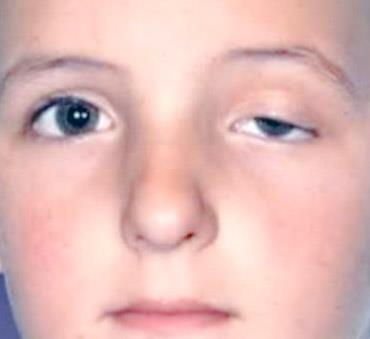
Case 1: A 5-year-old boy with no previous pathological findings presented with unilateral ptosis of the left upper eyelid at the age of 4 months.
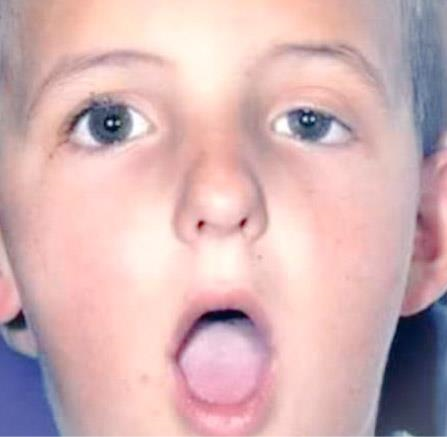
His visual acuity was 10/10 in right eye on the right and 5/10 in left eye (As shown in Figure 1 and Figure 2).
Appendages showed ptosis on the left with no upper palpebral crease, and no associated oculomotor paralysis or strabismus.
Examination of the anterior and posterior segments was unremarkable in both eyes.
We observed retraction of the upper eyelid when opening the mouth and chewing.
Second case: a 7-year-old girl, brought in by her parents for a ptosis of the left eye noted at birth. This is a 7-year-old girl brought in by her parents for ptosis of the left eye, diagnosed at birth. She had no particular pathological antecedents.
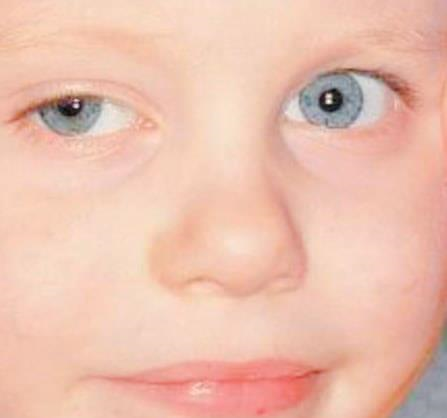
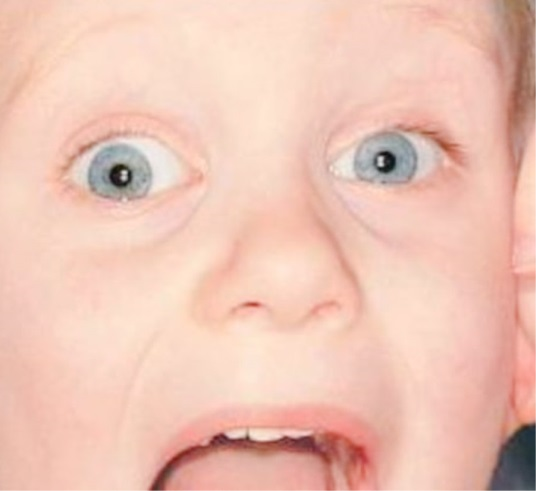
Her visual acuity was 10/10 in right occlusion and 3/10 in left occlusion (As shown in Figure 3 and Figure 4).
Adnexal findings included partial ptosis of the left eye, with retraction of the upper eyelid when opening the mouth and chewing.
The rest of the ophthalmological examination was unremarkable.
We noted amblyopia on the left, and the somatic examination was unremarkable in both children.
Orbital and head CT scans were normal in both children. Both children had undergone sectioning of the superior levator muscle with frontal suspension using prolene sutures, with good progression, followed by total optical correction and treatment of the amblyopia.
4. Discussion
Marcus Gunn syndrome is a very rare condition affecting 2-13% of cases of congenital ptosis. The first case was described by the British physician Robert Marcus Gunn in 1883 under the name “blinking jaw phenomenon” or ″Jaw-Winking phenomen″ [1, 2].
It is characterized by unilateral ptosis associated with mandibulo-palpebral synkinesis, i.e. ptosis that is corrected by mouth opening or mandibular deduction [1, 3]. It may be isolated or associated with oculomotor disorders.
Our two cases present a clinical picture that corroborates the description in the literature.
Marcus Gunn syndrome is an autosomal dominant genetic disorder, but it can also occur in certain circumstances (during systemic inflammatory processes, after childhood trauma, or even after tumor involvement) [4].
The surgical technique involves muscle resection or suspension of the upper eyelid from the frontalis muscle.
It is important to point out that the surgical techniques proposed in the literature are numerous, but the choice of technique depends on the degree of ptosis, mandibulo-palpebral syncinesis and the action of the levator [2].
We can perform a tarso-conjunctivo-müllérienne resection without correction of mandibulo-palpebral synkinesis, a section-denervation of the levator of the upper eyelid on the affected side and unilateral or bilateral suspension of the eyelid from the frontal muscle, resection of the upper eyelid levator muscle without correction of mandibulopalpebral synkinesis, bilateral section-denervation of the upper eyelid levator and bilateral suspension of both eyelids from the frontal muscle [3].
Marcus Gunn syndrome may be associated with other oculomotor disorders, such as hypotropia and Stilling-Duane syndrome.
Amblyopia and strabismus are the associated disorders most frequently observed in patients with Marcus Gunn syndrome when management is delayed. They can lead to total blindness, and to psychological and psychic disorders (such as manic-depressive psychosis, nervousness, etc.) due to a lack of vision of the environment.
5. Conclusion
Marcus Gunn syndrome is a rare disorder characterized by congenital ptosis and mandibulopalpebral syncinesia. Its etiopathogeny remains poorly elucidated.
Its management is an absolute emergency, as the occurrence of amblyopia depends on it.
The choice of surgical technique is difficult, as it must correct both ptosis and syncinesis.
The aim of treatment is to abolish syncinesis, eliminate ptosis in order to establish good palpebral dynamics and statics, and treat associated disorders such as amblyopia and strabismus.
References
- Awan KJ.Marcus Gunn (jaw-winking) syndrome. Am J Ophthalmol. 1976 Sep;82(3):503-4.[CrossRef] [PubMed]
- Nan Xiang, Wei-Kun Hu, Bin Li, Rong Liu. Management of morderate-to-severe Marcus-Gunn syndrome by anastomosis of levator and frontal muscles. Int J Ophthalmol. 2010;3(4):342-345.
- Beard D C. A new treatment for severe unilateral congenital ptosis and for ptosis with jaw-winking. Am J Ophthalmol. 1965 Feb;59:252-8.[CrossRef]
- Altman K. The Marcus Gunn (jaw-winking) phenomen: a case report. Br J Oral Maxillofac Surg. 1990 Feb;28(1):53-4.[CrossRef] [PubMed]