

Nodal marginal zone lymphomas are indolent and rare non-Hodgkin lymphomas, most often diagnosed at an advanced stage. Their clinical presentations are typically insidious, which can lead to delayed diagnosis. The concomitant secretion of IgM and IgG immunoglobulins with kappa light chains constitutes an exceptional feature in this type of lymphoma, as illustrated by our case. We report the case of a 62-year-old man with a history of treated syphilis and inferior vena cava thrombosis managed with rivaroxaban, who presented with a left inguinal mass evolving over three months, accompanied by fever, night sweats, and weight loss. Clinical examination revealed non-inflammatory left inguinal lymphadenopathy without other abnormalities. Laboratory tests showed non-regenerative anemia, leukopenia, and elevated LDH levels. Protein electrophoresis revealed a monoclonal peak in the gamma region, confirmed by serum immunofixation showing two monoclonal bands of IgG kappa and IgM kappa types. Biopsy of the inguinal lymph node revealed histological and immunohistochemical features consistent with a small B-cell marginal zone lymphoma, staged as IV based on the extension workup. A chemotherapy regimen consisting of rituximab, cyclophosphamide, doxorubicin, vincristine, and prednisone (R-CHOP) was initiated, resulting in a partial response after four cycles. The coexpression of IgM and IgG kappa light chains in nodal marginal zone lymphomas, which are already rare, is an unusual finding. This particularity warrants multicenter studies to better assess its diagnostic, prognostic, and therapeutic implications.
Nodal Marginal Zone Lymphoma with IgG and IgM Secretion of Kappa Light Chain: Case Report
May 29, 2025
June 26, 2025
July 07, 2025
July 12, 2025
This is an Open Access article, distributed under the terms of the Creative Commons Attribution 4.0 International License (http://creativecommons.org/licenses/by/4.0/), which permits unrestricted use, distribution and reproduction in any medium or format, provided the original work is properly cited.
Abstract
1. Introduction
Nodal marginal zone lymphomas (NMZL) are part of non-Hodgkin lymphomas, a heterogeneous group of cancers of the lymphatic system. They are classified as indolent lymphomas and account for approximately 7% of non-Hodgkin lymphomas. Marginal zone lymphomas include three distinct subtypes: mucosa-associated lymphoid tissue (MALT) lymphoma, which represents about 70% of cases, splenic marginal zone lymphoma (20%), and nodal marginal zone lymphoma (10%) [1]. Clinically, NMZL is characterized by generally asymptomatic peripheral lymph node involvement, with an indolent progression and often diagnosed at an advanced stage. The median age at diagnosis is around 60 years. Rituximab is the treatment of choice for advanced-stage NMZL. Although its progression is slow, the prognosis is considered less favorable compared to other lymphomas in the same category [2, 3]. In addition to the rarity of this subtype, the simultaneous expression of IgM and IgG with kappa light chains is relatively uncommon.
2. Case report
A 62-year-old Moroccan man presented with a left inguinal swelling that had been progressing for three months. He also reported fever, night sweats, and weight loss over the past month. His medical history included treated syphilis and inferior vena cava thrombosis managed with rivaroxaban. Clinical examination revealed non-inflammatory left inguinal lymphadenopathy. The remainder of the physical examination was unremarkable.
Initial laboratory tests showed normochromic normocytic non-regenerative anemia, leukopenia, moderate neutropenia, lymphopenia, marked 24-hour proteinuria, and elevated LDH levels. Renal and liver function tests, as well as vitamin levels, were within normal limits. Serology for hepatitis B and C, HIV, and syphilis was negative (Table 1).
The peripheral blood smear showed 8% medium-sized lymphoid cells, characterized by a low nucleus-to-cytoplasm ratio, occasionally irregular or notched nuclei with intermediate chromatin, and slightly basophilic cytoplasm. Protein electrophoresis revealed a monoclonal spike migrating in the gamma globulin region, quantified at 8.3 g/L, associated with hypoalbuminemia and decreased beta-2 globulin levels (Figure 1). Serum immunofixation identified two monoclonal bands of the IgG kappa and IgM kappa types (Figure 2). Serum free light chain assay showed an increase in monoclonal kappa light chains, with a normal kappa/lambda ratio. Urine analysis did not reveal any Bence-Jones proteinuria (Table 1).
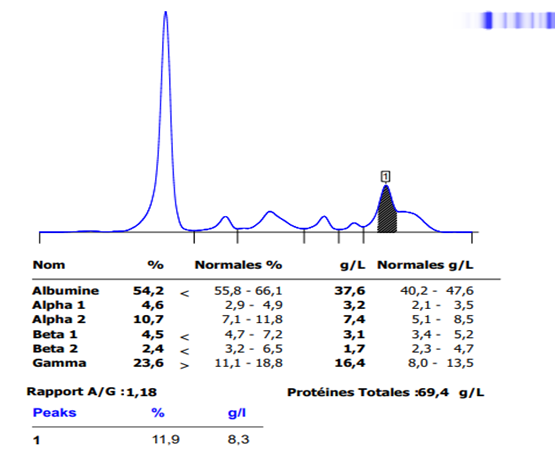
Serum Protein electrophoresis showing a monoclonal spike migrating in the gamma globulin region, quantified at 8.3 g/L, associated with hypoalbuminemia (37,6 g/l) and low beta-2 globulin levels (1,7 g/l)
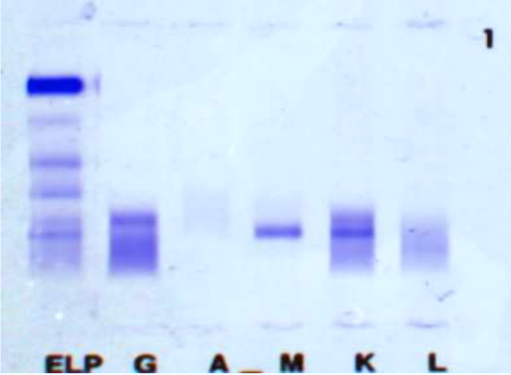
Serum immunofixation electrophoresis confirmed the presence of two monoclonal immunoglobulin bands in the gamma region: one typed as IgG kappa and the other as IgM kappa.
Thoraco-abdominopelvic scan revealed both supra- and infradiaphragmatic lymphadenopathy. Biopsy of the inguinal lymph node showed histological and immunohistochemical features consistent with nodal involvement by a small B-cell marginal zone lymphoma. The tumor cells showed strong and diffuse expression of CD20 and BCL2. In contrast, CD5, CD23, cyclin D1, CD10, and BCL6 were not expressed. Ki-67, a proliferation marker, was estimated at 30%. As part of the staging workup, bone marrow biopsy revealed lymphomatous infiltration, resulting in classification of the lymphoma as stage IV.
According to the Follicular Lymphoma Study Group criteria, chemotherapy with the Rituximab–CHOP regimen (Cyclophosphamide, Hydroxydaunorubicin, Oncovin, and Prednisone) was initiated. After four treatment cycles, follow-up Thoraco-abdominopelvic scan showed a 40% reduction in the size of multiple supradiaphragmatic and infradiaphragmatic lymphadenopathies.
3. Discussion
Nodal Marginal Zone Lymphoma is a small B-cell neoplasm, accounting for approximately 1.5 to 1.8% of all non-Hodgkin lymphomas and 10% of marginal zone lymphomas. It originates in the lymph nodes and may subsequently infiltrate the spleen and bone marrow. The diagnosis is often made at an advanced stage (III–IV), with disseminated involvement affecting the cervical, abdominal, and inguinal lymph nodes, as well as frequent infiltration of the bone marrow [2]. NMZL primarily affects elderly individuals, with a median age at diagnosis of 69 years, and is more common in men than in women. Advanced age and advanced stage are considered unfavorable prognostic factors [1]. NMZL shares pathological features with splenic and extranodal marginal zone lymphomas, particularly in cases exhibiting splenic or extranodal involvement [2]. In approximately 10% of cases, NMZL may produce an IgM paraprotein, which can complicate the diagnosis by mimicking Waldenström’s macroglobulinemia [3].
NMZL generally expresses IgM and IgD, sometimes IgM alone, as well as IgG and IgD, and more rarely IgM/IgA or IgA alone [4]. In a study by Traverse-Glehen et al., involving 21 cases of NMZL, frequent expression of IgM was observed in 7 cases, while co-expression of IgM and IgD was noted in 2 cases, and IgG expression was reported as rare, with only 1 case [5]. Studies from small retrospective series or including various histopathologies have shown that 75% of NMZL cases are positive for IgM. Co-expression of IgM and IgD is found in 30% of cases, while IgG expression remains relatively rare [1]. Co-expression of kappa IgM and kappa IgG has also been observed in other types of lymphomas, notably in a patient with primary gastric lymphoma. Neoplastic cells containing IgM were morphologically different from those expressing IgG [6].
Several hypotheses may explain the heterogeneity of isotype expression in NMZL, notably somatic hypermutations of the immunoglobulin gene. Furthermore, normal B lymphocytes undergo isotype class switching under the influence of microenvironmental signals, particularly cytokines such as interleukin-4 and transforming growth factor beta [7, 8]. Compared to other types of lymphomas, including splenic marginal zone lymphoma and MALT lymphomas, NMZL is characterized by a less favorable prognosis, although its course is indolent. However, the presence of both IgG and IgM kappa could be associated with a more aggressive behavior in some cases.
4. Conclusion
Due to the rarity of NMZL and the diversity of immunoglobulin and light chain expression, conducting prospective trials is challenging. This highlights the need for an international collaborative effort to better understand its biological characteristics, notably the co-expression of IgM and IgG immunoglobulins with kappa light chains, and to develop evidence-based therapeutic recommendations. Future studies are essential to determine whether this co-expression carries prognostic and therapeutic significance.
Acknowledgments
Acknowledgments to all the personnel of the Central Laboratory of the University Hospital Mohammed VI of Oujda, who participated in the realization of this study.
Funding Information
None
Authors' contributions
The authors acknowledge having actively participated in the work, having read the content of the article and having given their agreement to this content.
Conflict of interest statement
The authors have no conflict of interests.
References
- Angelopoulou MK, Kalpadakis C, Pangalis GA, Kyrtsonis M-C, Vassilakopoulos TP. Nodal marginal zone lymphoma. Leuk Lymphoma 2014;55:1240–50. https://doi.org/10.3109/10428194.2013.840888.[CrossRef] [PubMed]
- Isnard P, Bousdira G, Brière J, Bruneau J, Molina TJ. Le lymphome de la zone marginale ganglionnaire. Rev Francoph Lab 2022;2022:62–9. https://doi.org/10.1016/S1773-035X(21)00379-8.[CrossRef]
- Cheah CY, Seymour JF. Marginal zone lymphoma: 2023 update on diagnosis and management. Am J Hematol 2023;98:1645–57. https://doi.org/10.1002/ajh.27058.[CrossRef] [PubMed]
- Baseggio L, Thieblemont C. Aspects biologiques et thérapeutiques des lymphomes de la zone marginale. Rev Francoph Lab 2021;2021:56–63. https://doi.org/10.1016/S1773-035X(21)00143-X.[CrossRef]
- Traverse-Glehen A, Felman P, Callet-Bauchu E, Gazzo S, Baseggio L, Bryon PA, et al. A clinicopathological study of nodal marginal zone B-cell lymphoma. A report on 21 cases. Histopathology 2006;48:162–73. https://doi.org/10.1111/j.1365-2559.2005.02309.x.[CrossRef] [PubMed]
- Gomi H, Solomkin JS, Schlossberg D, Okamoto K, Takada T, Strasberg SM, et al. Tokyo Guidelines 2018: antimicrobial therapy for acute cholangitis and cholecystitis. J Hepato-Biliary-Pancreat Sci 2018;25:3–16. https://doi.org/10.1002/jhbp.518.[CrossRef] [PubMed]
- Yatabe Y, Mori N, Oka K, Asai J. A case with primary gastric lymphoma producing IgM and IgG immunoglobulins. Arch Pathol Lab Med 1994;118:655–8.
- Issaoui H, Ghazzaui N, Denizot Y. L’énigmatique recombinaison isotypique vers les IgD. médecine/sciences 2018;34:294–6. https://doi.org/10.1051/medsci/20183404005.[CrossRef] [PubMed]