

The purpose of the study was to examine Carl Rogers' humanistic approach to supporting women in leadership positions to make a formed decision on how to manage the challenges they face. A qualitative approach was adopted for the study. The population of the study included fifteen (15) headmistresses and housemistresses in the Senior High Schools in the New Juaben Municipality in the Eastern Region. The purposive sampling technique was used to select schools, headmistresses and housemistresses in the schools. The schools selected were Oyoko Methodist Senior High School (OMESS), SDA Senior High School (SEDASS), Ghana Senior High School (GHANASS), Koforidua Technical Institute (KOTECH), Nana Kwaku Boateng Senior High School (OBOSS) and New Juaben Senior High School (NJUASCO). The main instruments used for data collection were a semi-structured interview guide and Reflective dialogue. Data was analysed through the use of the thematic approach. Within-case and across-case analytical technique was used to analyse the qualitative data. This was done through the identification of themes, categories and sub-categories the analytical tool for the qualitative data through interviews and reflective dialogue (RD). Themes that were extracted from the interview corresponding to Carl Rogers' humanistic person-centred) the approach were; inherent potentialities, support, motivation, power relation, INSET, cultural dimension, and guidance and counselling. The study revealed that women face challenges using inadequate school facilities they do their best possible to manage their challenges with the few facilities available, the introduction of Carl Rogers' intervention, and women became more aware of their potential in managing the challenges they face at work in their leadership positions. It is recommended that guidance programmes should be conducted often to inform both teachers and students about the potential of women. It has also emerged that women leaders do not know who they are and therefore they should undergo counselling in order to be self-actualised.
Managing Challenges Women Face in Leadership Positions: Carl Rogers' Humanistic Approach
October 13, 2021
June 12, 2022
July 30, 2022
August 22, 2022
This is an Open Access article, distributed under the terms of the Creative Commons Attribution 4.0 International License (http://creativecommons.org/licenses/by/4.0/), which permits unrestricted use, distribution and reproduction in any medium or format, provided the original work is properly cited.
Abstract
1. Introduction
Leadership exists in every known community, organization or institution, be it formal or informal, ancient or modern, simple or sophisticated [1]. Various concepts of leadership have been reported in leadership studies over the years. Leadership is therefore a universal and complex phenomenon, and its definitions are equally numerous. Leadership is 'the reciprocal process of mobilizing persons with certain motives and values, various economic, political, and other resources in a context of competition and conflict in order to realize goals independently or mutually held by both leaders and followers' [2]. Traits, situational and behaviourists theories presents leadership as a 'bargaining' or 'reward/exchange' relationship between the leader and the subordinate. Leadership is a process by which a person influences others to accomplish an objective and directs the organization in a way that makes it more cohesive and coherent. Leadership is perceived as one of the most important ingredients needed for improvement of any educational organisation [2, 3, 4]. 'Leadership is a process whereby an individual influences a group of individuals to achieve a common goal'. Leadership also exercise of power or influence in social groups, organization, communities or nations to meet needs of the group [5].
From the above definitions one can deduce that leadership is a comprehensive process that torches core aspects of lives of individuals and entire organizations, thus it is a universal phenomenon; no society can do without it. None of these definitions made emphasis to the fact that leadership is meant for only males. Leaders are motivational but the skill of being able to motivate is a characteristic of leadership but is not a requirement for strong management. Some managers benefit from having leadership skills, which makes them eligible for upper level positions or even school administration. The stronger school administrators are able to motivate teachers, parents and students, the more recognition they receive in the community. Through their actions they motivate others to support their school's overall purpose of education.
A study defined leadership as 'intentional influence' [6]. It explained that if leadership is truly intentional influence, then we can propose every thinking human being begins attempting to lead from birth, attempting to influence the world as they wish to experience it. It also states that if it appears that one is visibly influencing enough people to break over an unnamed threshold, then you are labelled a leader. It further states that circumstances, traits, and genetics do lend themselves to the development of leaders, that everyone possesses leadership skills to some degree and can improve on them, increasing their influence [6]. Fluency of speech may price leadership quality for the purpose of motivating the masses. But when influencing individual interpersonal relationships, listening skills may be more important [7]. Effective or purposeful leadership is generally accepted as being a central component in securing and sustaining school improvement. The evidence from the school improvement literature consistently highlights that effective leaders exercise an indirect but powerful influence on schools' capacity to improve upon the achievement of students. From the above, any person being a male or female with influential characteristics could become a leader [8]. Fears or doubts about women in leadership are baseless, in studies on school administration [9].
Historically, leadership has carried the notion of masculinity and the belief that men make better leaders than women is still common today. Although the numbers of female leaders have increased, they are often named as an afterthought. The societal conventions regarding gender and leadership traditionally exclude women, and top leadership is viewed as a masculine domain [10]. History of psychological research on gender has portrayed human behaviour with a 'male dominant theme [11, 12]. The same author further argues that the cultural construction of leadership in itself instigates difference and this is only now being transformed or contested as women have started to gain access to leadership positions. However, the relevance of leadership is its ability to guide and propel the organization toward its assigned and objectives.
On the contrary, the interest of some early researchers was not so much on the performance of the leader but greater interest was on the unique traits which were known to be common among effective leaders across the globe [1]. There were some key qualities or attributes that good leaders possessed, these included stature, height and looks. Some critiques opine that the idea is male biased [13]. In African societies, it is believed that men lead and women follow [14]. It is common in rural areas in Africa to find the man literally walking ahead of the woman. Different reasons may be advanced for this but ultimately it illustrates the deeply held notion of leadership as a masculine realm. This was the time when people believed that leaders were born with certain leadership traits. It was believed that the leader was born with attributes related to values, skills, confidence and personality which are the characteristics that all leaders should have [15]. However, current thinking on leadership assumes that leadership can be taught and learned and trained, hence the many leadership-training programs [16]. Traits commonly associated with leadership as effective communication skills, task completion, responsibility, problem solving, originality, decision making, action taking, vision, self-awareness, confidence, experience and power [16]. One of the most congruent findings from recent studies of effective leadership is that authority to lead need not be located in the person of the leader but can be dispersed within the school in between and among [2, 7]
Leaders as people "who provide vision and meaning for an institute on and embody the ideals toward which the organization strives" [9]. From that perspective, leaders are alike and genderless. Research studies suggest that fears or doubts about women are baseless. Studies on school administration, found that schools with female administrators are better managed (the quality of pupil learning and professional performance of teachers is higher), and on the average perform better than those managed by men [9]. A study on female representation in leadership positions in education administration in South West Nigeria, postulates that women are observed to portray a more participatory approach, are more democratic, allow for power and information sharing are more sensitive, more nurturing than men, focus on relationships and enable other to make contributions through delegation, one of the most congruent findings from recent studies of effective leadership is that authority to lead need not be located in the person of the leader but can be dispersed within the school in between and among people [7, 9, 10, 11, 12, 13, 14, 15, 16]. A similar study noted that characteristics such as building coalitions, advancing and community development are construct that women display in their relational styles [17]. Women are also better at conflict management, having better listening skills and show more tolerance and empathy. While men and women do have different leadership styles, should not mean that one is dominant over the other. It has been observed that the differences we see in leadership style are partly due to the way men view leadership as leading, while see leadership as facilitating [9].
Sadly, in a situation where accepting women as leaders is problematic, it is possible to overlook their positive leadership traits and view them as weaknesses. In fact, stereotypes of how women lead have made it difficult for women to access or even stay in leadership positions. Women who display more relational styles of leading are likely to be marginalized within their organizations and viewed as 'outsiders' [17]. Even more disconcerting is the fact that women who seem to 'make it' as leaders often end up conforming to the strong male culture in the work place, and adopt male leadership styles. Female leaders see gender as a hindrance, they are compelled to lead the way men do as it is considered the norm. In their view, utilizing men's methods of leadership is not only the easiest way for a woman to be hired for any position of leadership, but is the most successful method of attracting promotion and recognition [9].
African perception on knowledge and leadership has a lot to do with its colonization historical background. Most Africans were made to believe that their knowledge system was primitive and that as Africans they needed white leadership to survive. African indigenous knowledge systems were ignored and undermined [18]. This was further filtered to women who according to the African tradition were being classified together with children and thus undermined. In South Africa the ideology of looking down upon African women with respect to their leadership skills was further perpetrated by the apartheid regime, which segregated people according to race and culture. Women felt the double oppression as they were oppressed by the apartheid regime and by their communities. Their knowledge and personal experiences were rated as zero [18].
Curriculum in South Africa was designed in such a way that it strengthened the ideology that blacks were inferior and that they cannot govern by educating boys [19, 20]. Thus, most girls do not continue their education after high school. The key developmental areas in the values of boys in the Ghanaian society are assertiveness, risk taking, Independence, innovativeness and achievement orientation. What the Ghanaian male achieves through intimate connection with others, he must manage as a by man by disconnecting, by separating himself and asserting his right to be distinct [21]. Ghanaian women, on the other hand, are not expected to develop such qualities. They are not encouraged to display the same degree of assuredness in their abilities [22]. They bear the primary responsibility for child-nurturing, cooking, washing and collecting fuel-wood and water [21]. They are socialised to be gentle, to put the needs of others before their but never to be winners. Moreover, sanctions are imposed on women when they go md beyond the boundaries governing the sexual division of labour [22]. They are subjected to malicious gossip and ostracised when they behave outside the economic and social norms set by the society [23]. One of the most congruent findings from recent studies of effective leadership is that authority to lead need not be located in the person of the leader but can be dispersed within the school in between and among people ret [2, 16].
Classroom discipline falls within a gray area between the differences of school leadership and management. A leader decides what an appropriate discipline should be as the result of a violation, while a manager processes the paperwork and administers the discipline. Leadership requires that students be shaped and moulded through discipline while management ensures that discipline is enforced and appropriately documented. School administrative responsibilities are management driven. Classroom management is thought of as the process of maintaining the day-to-day functions of the class. These include, but are not limited to, such administrative tasks as talking to parents about student progress, working with school administrators on budget requirements and filling end-of-year reports. While a good leader completes these tasks as part of her responsibilities, a strong manager is not necessarily a leader.
An outcome of the different socialisation of the genders is that women -may not believe in their own ability to achieve in the way that men do [21]. In princiiu888ple, the Ghanaian educational system is designed to serve girls and boys equally [19, 20]. The curriculum, however, divides the practical subjects into those suitable for girls and those suitable for boys. During adolescence, boys and girls are presented with different expectations of their potential based on their gender [23]. In addition, women are increasingly channeled into secondary jobs, mainly as a result of limited access to education and training [22]. It is explained that in traditional societies, the major role of a women is to ensure the continuity of the family lineage. She is therefore, expected to marry soon after puberty and does not need formal education to perform this role. Moreover, a man is expected to provide for his wife and children. Since education is a means to highly paid jobs in the formal sector, it is considered more important for boys to have formal education to enable execution of their roles as breadwinners in the family [22].
In addition, the education of Ghanaian females is hindered by the overall cost of education, (female ritual slavery) and the perception of parents that educating girls is not as rewarding as educating boys. [24]. Others do not even complete an elementary level of education because they are withdrawn from school to help with household chores and family businesses [20]. This social attitude towards female education is linked to the conviction that a woman will be supported by her husband.
1.1. Counselling Implications of the Theory
The model explores how to gaining self-knowledge, Expectancies to problems from clients, Self-actualization, Equal relationships between client and counsellor, need to be motivated Need for positive regards and acceptance in order to develop into true self. Self-realisation is about the basic premise of self-realization is that there exists an authentic self which has to be discovered by psychological or spiritual self-striving. Self-realization can be a gradual or instantaneous phenomenon depending on the school of thought but in all cases it involves extensive preparation of mind and emotions to recognize self-realization when it occurs. Self-realization is maturing of the ego or personality to accept its own evanescence and thus allow space for the true Self to reveal itself. Another theme that came up strongly during the interview was motivation. Motivation became crucial factor because Carl Rogers' and Maslow's ideas tend to suggest that motivation is a factor that can be used to manage challenges and empower women in leadership positions.
Human beings are motivated by unsatisfied needs and that certain lower factors need to be satisfied before higher order needs can be satisfied. He further states that for adequate work place, motivation is important that leadership understands the active need for individual employee [25]. Women are motivated in their work place as leaders they improve upon their work. Working with and through other people was prioritized [26]. Intrinsic motivation can be facilitated by increasing workers’ perceptions of competences and expertise through the use of positive feedback [27]. Female leaders in education have expressed the need for motivation. They have touched on both intrinsic and extrinsic motivation for instance they mentioned that the love that they have for the work motivates them. Such motivational issues focus on support power relations.
1.1.1. Support
On support and to the context of the study, housemistresses and Counsellors should provide women managers with strategies for coping with role conflicts limiting obligations and manipulating schedules to accommodate demands, unsupportive relationship, delegating task roles and support from others. The three coping strategies, these are:
- Structural role definition (changing the expectation of others to reduce the number of obligations.
- Personal role definition (changing one's own perception of one's role demands).
- Reactive role behaviour (attempting to meet all demands and please everyone [28].
1.1.2. Power
On the issue of power role of ideology/hegemony which 'is not the supreme exercise of power to get another or others to have the desires you want them to have?' [29]. 'False consciousness' for Marxists, the source and exercise of power is not always readily apparent and therefore needs to be deciphered; hence the great ability of power to be 'hidden' and not immediately obvious. Marxism Analysed "The simple idea is that the policy process, far from being a rational weighing up of alternatives, is driven by powerful socio-economic forces that set the agenda, structure decision-makers choices, constrain implementation and ensure that the interests of the most powerful (or of the system as a whole) determines the outputs and the outcomes of the political system" [30]. This standard theory is that power is the capacity for influence and that influence is based on the control of resources valued or desired by others.
1.2. Carl Rogers Person Centered Approach
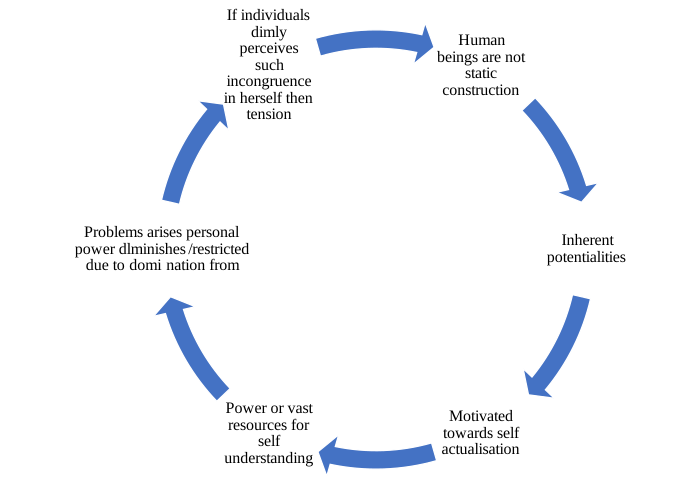
The following ideas of Carl Rogers informed the study:
- He considers it as the entry into the persons' unique phenomenological world.
- Freeing a person and removing obstacles so that normal growth and development can proceed and the person can become more independent and self-directed.
- Rogers's theory focuses on self and how to overcome challenges.
- Problems arise and these personal powers diminish or restricted due to domination from others either overt (martial law) or covert (finding oneself in manipulative relationship)
- When self-power diminishes discrepancies between perceived ideal self and real self may lead to psychological distress.
- Human experiences are unique and if given appropriate conditions for self-exploration and inquiry people will shed defenses.
- Rogers believe in the inherent positive potentialities of every individual.
- Human beings have personal power or vast resources for self-understanding for altering self-concept, his attitude and his self-directed behaviour.
- Openness to Experience
- Trust in One's Organism
- An Internal Locus of Evaluation
- Willingness to be a Process
According to Carl Rogers human dignity implies that a person should be accepted for what she or he is [31]. This fulfils Carl Rogers's conditions of warmth. She further states that Carl Rogers focused his argument on three core conditions of worth, the second is sometimes referred to as acceptance, unconditional positive regard or caring. (Carl Rogers's three core conditions are unconditional positive regard, warmth and empathy). It is believed that, through self-increased determination and already developed relationship skills, many women will gain greater power in the American culture [32]. She further Postulates that it is important for women to bring to their relationships nothing less than a strong, assertive, independent, and authentic self. In recent years, a number of initiatives have appeared which, while influenced significantly by humanistic ideas and theories, have in new directions. Perhaps the most significant is positive psychology, a term coined by Dr. Martin Seligman when he was a President of the American Psychological [33]. Positive psychology, like the humanistic approach, focuses on enhancing human potential, women are motivated in their work place as leaders they improve upon their work [34, 35]. They further state that intrinsic and extrinsic motivation causes people to work to obtain tangible rewards. Another school of taught have argued in contrast to intrinsic and extrinsic motivation cause people to persist longer, work harder, and produce work of higher equity [34]. Humanistic psychologists highlight that self-actualization or reaching ones’ full potential is achieved through congruence between self-image and ideal self; we feel a higher sense of self-worth when our behaviour is consistent with our self-image as well as our ideal self [36]. Self-empowerment of women intended for a wide audience. They further state that poor women in poor countries are celebrating new powers and setting out to change their own lives and those of their people [32]. Ghanaian women want to earn enough money so that they could feed, clothe, and generally take better care of their children. This presupposes that women have that inner potentiality to develop and make a better living [37]. Intrinsic motivation can be facilitated by increasing workers’ perceptions of competence and expertise through the use of positive feedback [38]. They continued by saying that external rewards which produce an increase in extrinsic motivation, can also enhance worker performance. External rewards are important to the worker, people work for reasons that are related to both intrinsic and extrinsic; intrinsic versus extrinsic factors dominate in determining peoples work performance is not clear [38].
In sum, when the perception of 'you are a woman is eliminated, and women are motivated they would work effectively [39].
Even though women in leadership positions in the new Juabeng Municipality are performing as required, there have been lots of challenges in relation to how they are performing in their leadership positions. Practically, they appear to be overwhelmed by the challenges confronting them as they perform, as a result of this, this study seeks to use a counselling model (Carl Rogers' Humanistic approach) to support women to effectively deliver in the position they occupy. The purpose of the study was to examine Carl Rogers' humanistic approach in supporting women in leadership positions to make formed decision on how to manage the challenges they face. The study was guided by this research question – what are the use of Carl Rogers' humanistic approach to support women in leadership positions to make formed decision on how to manage the challenges they face?
2. Materials and Methods
Qualitative approached was adopted for the study. The population of the study included fifteen (15) headmistresses and housemistresses in the Senior High Schools in the New Juaben Municipality in the Eastern Region. Purposive sampling technique was use to select schools and headmistresses and housemistresses. The house staff comprised the senior house mistresses and the house mistresses in SHS making the population for the study. The schools selected were Oyoko Methodist Senior High School (OMESS), SDA Senior High School (SEDASS), Ghana Senior High School (GHANASS), Koforidua Technical Institute (KOTECH), Nana Kwaku Boateng Senior High School (OBOSS) and New Juaben Senior High School (NJUASCO). The main instruments used for data collection data for the study were a semi-structured interview guide and Reflective dialogue. A semi-structured interview guide was designed and used to elicit information about the challenges facing the respondents. Reflective dialogue, based on focus group discussions was also used to determine what strategies need to be adopted to manage the challenges they face since they share common characteristics. Data was analysed through the use of the thematic approach. Within-case and across-case analytical technique was used to analyse the qualitative data. This was done through the identification of themes, categories and sub-categories the analytical tool for the qualitative fata through interviews and reflective dialogue (RD). Themes that were extracted from the interview corresponding to Carl Rogers' humanistic person centred) approach were; inherent potentialities, support, motivation, power relation, INSET, cultural dimension, and guidance and counselling.
3. Results and Discussions
This section presents results and discussions on the research question - What would be the effect on the work ethics of female leaders if they are introduced to Carl Rogers's ideas of self-exploration and inquiry? Respondents received Carl Rogers's ideas about humanistic approach and worked with it after about six weeks. Unfortunately, there was a vacation within the six weeks so they used the intervention for about three weeks which was not enough to a strong effect on the usage of the approach. The following were some questions asked them
After the researcher has interacted with respondents using Carl Rogers humanistic approach the themes that came out of the interaction are learning; learning, self-realisation, self-actualization and need for change. From the analysis it could be deduced that the respondents justified that they have learnt from Rogers's humanistic approach in relation to resolving issues that the things they find difficult to resolve are now easy to manage due to the understanding and the usage of the approach. Lewinian oriented psychologists, subscribe to the theory that human behaviour is a result of the interaction of persons with their environment; when you generate an action theory from your own expenses and then continually modify it to improve its effectiveness, you are learning experientially. They said experiential learning affects the learner in three ways; these are; Cognitive structures are altered; attitudes are modified; and behavioural skills are expanded [40].
3.1. Learning
Respondents came out strongly to confirm that, being in the leadership position and going through the ideas behind Carl Rogers' theory provide them with the skills to change their attitudes towards their students after they have received the knowledge about Carl Rogers's humanistic approach. They now find it easy to handle students who pose problems to them. Women have justified that they are still learning because they wouldn't say they are too good for what they have learnt. The following are some comments made by the respondents;
After the last meeting with you I have learnt a lot of things. I won't say I am too good at it but I think I have learnt a lot as to how to resolve issues with regard to my students. I now find it quite easy to some of the issues I was facing previously.
Besides what women have realised about the change in the management of their issues they again added that other people have commented positively on their work. This is how she puts it;
I don't want to brag but one or two people have made comments about the way I go about my work. Sometimes you hear them telling you madam we know you can do this. We leave it to you and we hope you will be able to make it. We now realises that the potentials are there so you can make it.
When respondents were asked whether they see any difference in the way they manage their challenges they came out by expressing their understanding on individual differences, they said they have learnt that no two persons are alike so the method of resolving issues that is a method used to resolve one person's issue may not be ideal for another person. One said she was presuming that what one person does, imply all others have the same behaviour. She said that;
Sometimes a day or two after they have reported they still want to go back, initially I was not patient with them when they come. I could not tolerate the way they went about things but of late I have decided or I have taken to allow them to come out with their problems because sometimes some of them have genuine issues and that have been the difference. Female leaders have also responded that they have seen changes in the way they were addressing problems they encounter).
Another also said this:
“Yes, I have seen a change. I have said earlier on that previously students come with some problems, for numerous reasons I did not really have the patience with them but after this issue I have learnt to listen to them and I think I am much more tolerant with them than I used to do previously”.
By answering to the question; do you think there is /are differences in the previous way of resolving issues and now? Respondents responded that they actually see a change because the world is dynamic there is the need for them also to change with time. This response is actually in tune with Carl Rogers's humanistic approach that says that human beings are dynamic but women have also said that the world is also dynamic and as such they need to change in order to fit into the society and the world at large.
3.2. Self-Realisation
Realising and recognising ones-self was an issue that came out strongly from the analysis. When respondents were asked about what people have said about their work, several responses were given, some relating to having positive impact were given and these include the following;
I don't want to brag but one or two people have made comments about the way I go about my work. Now you have time for everybody who comes to you. Sometimes they say we know madam can do this so we leave it to you and we hope you will be able to make it. We realise the potentials are there.
Another respondent also answered by saying; People appreciate my work; they feel happy coming to me.
In a nut shell women thought shouting at students because they prejudice that certain period of time does not permit students to seek assistance but after going through Rogers approach the understanding has been created and that students now find it easier to approach them.
3.3. Self-actualisation
Self-actualisation is another issue that came up from the analysis. The responses that came out from the analysis were that after the researcher has taken them through Rogers's humanistic i approach, the respondents saw self- actualisation and the need for support now for managing challenges have been easier. This is what one said;
I think in resolving problems because of what you taught us, the discussions we had the other day concerning self- actualisation and the need for support, it has really helped me a lot to make my resolutions very easy, it has made my work easier in terms of resolving problems. I really understand whatever I decide to do.
I Another respondent answered by saying that from the last meeting she has learnt a lot of things and that is actually helping her to manage the challenges she faces. This is what she said;
Well after the last meeting with you, I have learnt a lot of things. I won't say I am too good at it but I think I have learnt a lot as to how to resolve issues with regard to my students. I now find it quite easy to some of the issues previously I was facing.
In conclusion, taking the respondents through what they need to do to actually realise and come out with their own support was crucial when one is in the leadership position and for effectiveness.
3.4. Tolerance
Another issue that came up was tolerance and the question that elicited this was; is there any difference in what you were doing previously and what you are doing now? Respondents came out that previously they were not tolerating the students on the grounds that it does not make sense when a student comes from home today and then decides to go back the next day or within the week. The following are some responses;
“Previously our students most often will like to go home, sometimes a day or two after they have reported they still want to go back home. Initially, I was not patient with them when they came, I could not tolerate the way they went about things but of late I have decided or I have taken to allowing them to come out with their is-sues because sometimes some of them have genuine issues and that has been the difference. Previously probably I was prejudiced, you know students because of what one or two people might have done earlier on then I assume that all of them are the same but I have learnt that no sometimes some of them have genuine issues”.
Another respondent contributed by saying that;
Before I learnt this approach I was not having time for the students when they come to me I can just snob them because coming to me with a lot of problems was just too much for me so I was not having time for them. I will not even get time to listen to what they are telling me. I interfere and just ask them to go but since you thought us this type of approach I have time for them, I listen to them, I made them finish with whatever problems they have come to me with and I also help them. Basically, understanding oneself in relation to managing challenges has led to understanding another person because perception is not an effective tool to resolve issues. Again, women are stressed up when the work load is too much and as such has to drive the students away when they are stresses up. It would be rather better for women to device positive stress management than to ignore their students when they are also in need.
4. Conclusions and Recommendations
The study revealed that women face challenges using inadequate school facilities they do their best possible to manage their challenges with the few facilities available, the introduction of the Carl Rogers' intervention, women became more aware of their potentialities in managing the challenges they face at work in their leadership positions. It is recommended that guidance programmes should be conducted often to inform both teachers and students about the potentialities in women. It is also emerged that women leaders do not know who they are and therefore they should undergo counselling in order to be self- actualized.
Author Contributions: Conceptualization RA and VOB; methodology, RA and VOB; validation, RA and VOB; formal analysis, RA and VOB.; investigation, RA and VOB.; resources, RA and VOB.; data curation, RA and VOB; writing—original draft preparation, RA and VOB; writing—review and editing, RA and VOB.; visualization, RA and VOB; supervision, RA and VOB.; project administration, RA and VOB; All authors have read and agreed to the published version of the manuscript.
Funding: “This research received no external funding”
Data Availability Statement: Data is available on request from the corresponding author.
Acknowledgments: we acknowledge the participants in this study.
Conflicts of Interest: “The authors declare no conflict of interest.” “No funders had any role in the design of the study; in the collection, analyses, or interpretation of data; in the writing of the manuscript, or in the decision to publish the results”.
References
- Afful- Broni, A, (2004). Theory and Practice of Educational Leadership in Ghana, Accra. TYPE Company Limited
- Jackson, A. C. (2002). Rabies pathogenesis. Journal of neuroviroiogy, 8(4), 267-269[CrossRef] [PubMed]
- Bums, J. M. (1978) Leadership. New York: Harper & Row
- Henning, M. and Jardin, A. (1977). Women in the work force. Editorial research reports on women's movement, achievements and effects by Sandra Stencel. Published by Congressional Quarterly Inc., Washington, Feb. 18, pp: 40.
- Northouse, P.O. (2013). Leadership; Theory and Practice. London: Sage
- Focus Spring, (2010). Philosophy, American Philosophical Association Committee on the Status of Women ().
- Silva, M (2002). The effectiveness of school-based sex education programs in the promotion of abstinent behavior: a meta-analysis. Health Education Research, 17 (4), 471–481.[CrossRef] [PubMed]
- Leithwood, K., & Jantzi, D. (2005). A review of transformational school leadership research 1996-2005. Leadership and policy in schools, 4(3), 177-199.[CrossRef]
- Growe & Montgomery (2000), Advancing Women in Leadership Visionary Leaders by Growe, R., & Montgomery, P. (2000). Women and the leadership paradigm: Bridging the gender gap. National Forum Journal, 17E, 1-7. Retrieved June 25, 2021, from http://www.nationalforum.com
- Hojgard, (2002). Optimal Dynamic Premium Control in Non-life Insurance. Maximizing Dividend Pay-outs. Preview Download full text. DOI: 10.1080/03461230110106291 Scandinavian Actuarial Journal J Q\ure\e 2002, Issue 4, 2002[CrossRef]
- Denmark, F. L., & Paludi Michelle, A. (1993). Psychology of Women: A Handbook of Insures and Theories. West Port Connecticut
- Paludi, M. (1995). The Psychology of Women. New Jersey: Pearson Education Porat, K.L. (1991). Women in administration: The difference is positive. Clearing House, 64(6), 412-415.[CrossRef]
- Gardner. J. W. (1989). On leadership. New York: Free Press.
- Grant. M. D. (2005). Culture and consumption. USA: Indiana University Press.
- Thomson Reuters, (2012) Journal Citation Reports® (2013) School Characteristics and Educational Outcomes: Toward an Organizational Model of Student Achievement in Middle Schools Educational Administration Quarterly. 703729,
- De la Rey, C. (2000). Gender, women and leadership. Agenda, 19(65), 4-11.
- Baxter, S., & Lansing, M. (1993). Women and politics: The invisible majority. Ann Arbor, MI: University of Michigan Press.
- Songca, R. (2006). Transdisciplinary: The dawn of an emerging approach to acquiring knowledge. South African Journal of Education, 27(3).
- Amu, N, J. (2006). The role of women in Ghana's economy. Friedrich Ebert Foundation.
- Ofei-Aboagye (2000). Structural Adjustment and Women in Ghana. In Anthony, Y. B. (Ed) (2001), The Social Dimension of Structural Adjustment in Ghana: Hallow Ads Ltd
- Boohene, R., Alison Sheridan, A. & Kotey, B. (2005) “Gender, personal values, strategies and small business performance: A Ghanaian case study”. Equal Opportunities International, Vol. Ti Iss: 3, pp.237 - 257[CrossRef]
- Dolphyne, F.A. (2000). The Emancipation of Women: An African Perspective, Ghana Universities Press, Accra.
- Greenstreet, M.(1981)." Women and the informal sector", IBS Bulletin, 12 (3), 5-6.
- Federal research division, (1999), http://ct retrieved 02/04/2014
- Marshall, J. (1984). Women managers: Travelers in a male world. John Wiley and Sons Ltd.
- Coleman, M. (2002). Gender and the orthodoxies of leadership. School Leadership & Management, 23(3), 325-339.[CrossRef]
- Harackiewicz, J. Ed., & Larson, J. R. (1986). Managing motivation: The impact of supervisor on subordinate task interest. Journal of Personality and Social Psychology, 51, 547- 55.[CrossRef]
- Hall-Taylor, B. (1997). The construction of women's management skills and the marginalization of women in senior management. Women in management review, 12(1), 255-263.[CrossRef]
- Stewart, D.W. and Shamdasani, P.N. (1990). Focus Groups: Theory and Practices. London: Sage.
- Porat, K.L. (1991). Women in administration: The difference is positive. Clearing House, 64(6), 412-415.[CrossRef]
- Bowen, A. J. Carl Rogers’ (1974). view on education. American journal of occupational therapy (Rockville, MD), 28 (4), 220-21.
- Townsend, J., Zapati, E., Roland, J.O., Alberti, P., Mercado, M. (2000); Women & Power. TransdiscipHnarity. 1, 2,221 - 232.
- Coleman, M. (2002). Gender and the orthodoxies of leadership. School Leadership & Management, 23(3), 325-339.[CrossRef]
- Deci, E. L., & Ryan, R.M. (2000). Self-determination theory and the facilitation of intrinsic motivation, social development, and well-being. American psychologist, 55(\) 68.[CrossRef] [PubMed]
- Lepper, M. R., Greene, D., & Nisbett, R. E. (1990). Undermining children's intrinsic motivation with extrinsic reward: A test of the "over-justification" hypothesis. Journal of Personality and Social Psychology, 28,129 137.[CrossRef]
- Sims, H. P. (1977). The leader as manager of reinforcement contingencies: An empirical example and a model. In J. G. Hunt & L. L. Larson (Eds.), Leadership: The cutting edge (pp. 121-137). Carbondale: Southern Illinois University Press.
- Dolphin, A. (1991). The Emancipation of Women: An African Perspective. Accra: Ghana Universities.
- Thurlow, C. (1996). Fabricating youth: New-media discourse and the technologization of young people. Language in the media: Representations, identities, ideologies, 23,213-233.
- Patterson, C. H. (1977). Insights about persons: psychological foundations of humanistic and affective education. Washington, DC, Association for Supervision and Curriculum Development.
- Berns, R. (2012). Child, family, school, community: Socialization and support. CEng age Learning. London: Sage