

The purpose of the study was to examine the use of rewards and punishment to improve discipline in Yiadom Boakye Demonstration Junior High School students (JHS) in Berekum of Ghana. A qualitative approach was adopted for the study. A case study research design was used to analyse the study. The population for the study consisted of all the eight (8) teachers in the Yiadom Boakye Demonstration Junior High School (JHS). A purposive sampling technique was used to select the eight teachers and school for the study. The main instrument used for the study was an interview. The study concluded that rewards and punishment lead to a change in the behaviours of the students affecting their academic performance their courses. The study also concluded that reward policies are needed in teaching to improve student learning by fostering enthusiasm in learning; it arouses students’ interest in learning, and change their personality traits and posture in class. The study revealed that a good punishment minimises bad behaviour, once is not having any bases on the student academic life, then it will not worsen the plight of his or her academic life. It is recommended that the colleges of education in Ghana should collaborate with Ghana Education Service and National Teaching Council to organise workshops and seminars on the use of rewards and punishments in the classroom situation.
Teachers’ Cognition of Rewards and Punishments to Improve Discipline in the General Classrooms of Ghana: A case of Yiadom Boakye Demonstration Junior High School (JHS) in Berekum
December 20, 2021
May 27, 2022
July 30, 2022
October 07, 2022
This is an Open Access article, distributed under the terms of the Creative Commons Attribution 4.0 International License (http://creativecommons.org/licenses/by/4.0/), which permits unrestricted use, distribution and reproduction in any medium or format, provided the original work is properly cited.
Abstract
Introduction
Teacher Educators use rewards and punishments to create a good classroom environment to attract the attention of students during the learning [1]. To teachers, the application of rewards and punishments encourage student learning. Use rewards and punishments based on the behaviour of students and there needs to be active interaction between the teacher and students so that rewards and punishments gives can really increase student motivation and can be expected to achieve better [1, 2]. The implementation of rewards and punishments can control student behaviour in the learning process. The classroom environment has been good such as students are happy, diligent, enthusiasm for learning increases, and students are more motivated. Punishments minimize bad behaviour and students rarely repeat [1].
To school, always support the application of rewards and punishments to improve student behaviour for the better. Schools are expected to be more creative in creating new forms of reward and punishment to increase student discipline and motivation [1]. The rewards and punishment increase students' motivation to learn and work harder. This led to a situation where rewards can motivate students to have good performance. This implies that rewards and punishment bring a lot of positive effects on students' academic performance [2, 3].
The way a child responds to teacher instructions can be viewed as indiscipline depending on whether the response is positive or negative. In addition, when teachers give rewards, the influence is mostly positive. It is only in a few instances that the teachers' use of rewards does not have any influence on the children. Similarly, the use of punishment by teachers brings about positive influence on students. However, there are a few cases in which punishment does not amount to the desired effect. The use of rewards encourages respect for school rules as well as class attendance. It also discouraged the engagement in deviant behaviour. The same case applies to the use of punishment in that its use led to curbing of deviant behaviour and encouraging respect for the school property [3, 4]
Basically, the use of rewards on pre-schoolers by teachers’ influences discipline by encouraging respect for school rules. Rewards also encourage class attendance by pre-schoolers thus generally, rewards promote good behaviour. Similarly, the use of punishment to a large extent affects discipline by reducing bad behaviour and encouraging desired behaviour instead. There are however a few instances in which the use of rewards and punishment does not achieve the desired outcome though this is rare [4, 5].
During the teaching practice assessment by the researchers’, it was observed that the implementation of rewards and punishment by teacher trainees has been ill conceived which is making students’ learning process ineffective, resulting into low motivation in learning, and academic achievement is unsatisfactory. This prompted the researchers to conduct an in-depth study into this phenomenon. There is therefore the need to research into the use of rewards and punishments to improve discipline in Basic schools in Ghana. The purpose of the study was to examine the use of rewards and punishment to improve discipline in Yiadom Boakye Demonstration Junior High School students (JHS) in Berekum. The study sought to answer this research question - what is the perception of the use of rewards and punishment to improve discipline in the general classroom?
2. Theoretical Conceptual / Framework Underpinning the Study
This research study is centered on the Theory of B. F. Skinner which is the Operant Conditioning [6]. The Operant Conditioning Theory sometimes referred to as Instrumental Conditioning, is a method of learning that occurs through rewards and punishments for behaviour. Skinner paired a dog and a bell in order to study how stimulus affects behaviour. He concluded that through operant conditioning, an association is made between a behaviour and a consequence for that behaviour. As a behaviourist, Skinner believed that internal thoughts and motivations could not be used to explain behaviour. Instead, he suggested, we should look only at the external, observable causes of human behaviour. The term operant refers to any "active behaviour that operates upon the environment to generate consequences". In other words, Skinner's theory explained how we acquire the range of learned behaviours we exhibit each and every day [5].
A reinforcer is any event that strengthens or increases the behaviour it follows. There are two kinds of reinforces: Positive reinforcers are favourable events or outcomes that are presented after the behaviour. In situations that reflect positive reinforcement, a response or behaviour is strengthened by the addition of something, such as praise or a direct reward. Negative reinforces on the other hand involve the removal of unfavourable events or outcomes after the display of a behaviour. In these situations, a response is strengthened by the removal of something considered unpleasant. In both of these cases of reinforcement, the behaviour increases. Punishment, on the other hand, is the presentation of an adverse event or outcome that causes a decrease in the behaviour it follows. There are two kinds of punishment: Positive punishment sometimes referred to as punishment by application, involves the presentation of an unfavourable event or outcome in order to weaken the response it follows. Negative punishment, also known as punishment by removal, occurs when a favourable event or outcome is removed after a behaviour occurs. In both of these cases of punishment, the behaviour decreases [5]. The below framework displays rewards and punishment as methods used to promote discipline by teachers. If teachers use rewards and punishment effectively, the resultant factor will be desired.
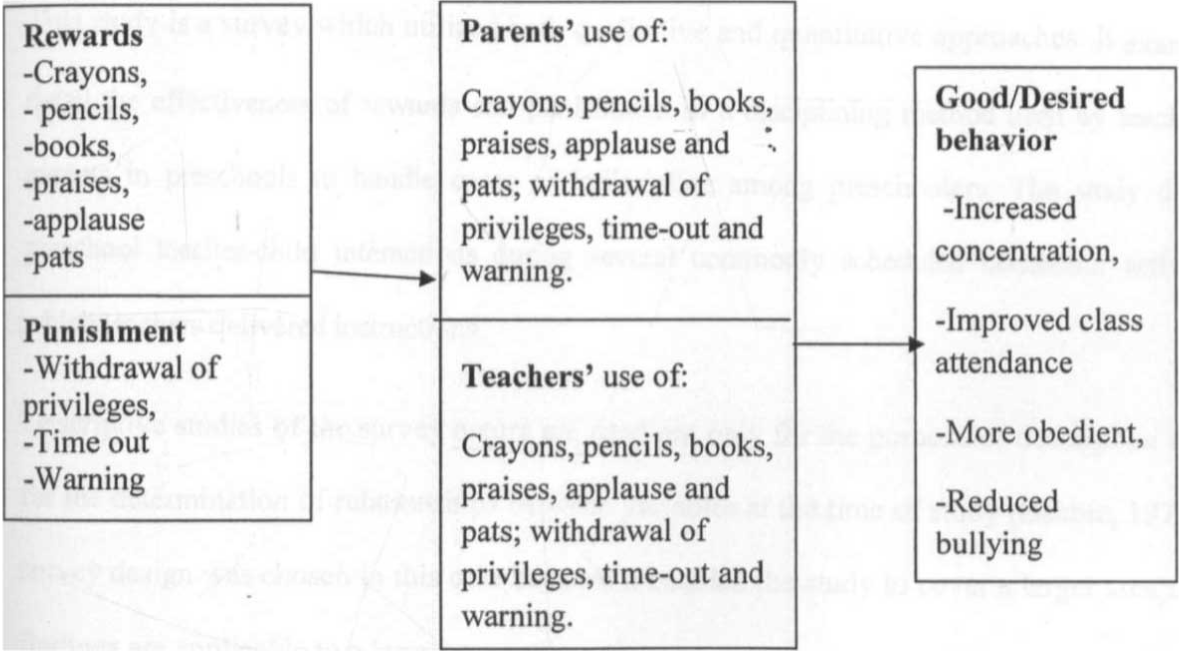
3. Methodology
Qualitative approach was adopted for the study. A case study research design was used to for the study. The population for the study consists of all the eight (8) teachers in the Yiadom Boakye Demonstration Junior High School (JHS) in Berekum. Purposive sampling technique was used to select the eight teachers and school for the study. All the eight teachers were used because the study was teachers’ cognition of rewards and punishment to improve discipline in the general classroom. The school was also purposively sampled because the researchers had earlier on assessed teacher trainees in the study school and observed how they used rewards and punishments in their teaching and learning. The researchers selected the regular teachers for study because they mentored the teacher-trainees. If they have deficiency in their use of rewards and punishments, they will continue to impact same knowledge to future teacher trainees that will be entrusted into their care. The main instrument used for the study was interview. The qualitative data was analysed based on interpretative lens and themes related to the research question.
4. Findings and Discussions
This section of the study presents findings and discussions on teachers’ cognition of rewards and punishments to improve discipline in the general classrooms of Yiadom Boakye Demonstration Junior High School (JHS) in Berekum. Qualitatively, the study was a case study research design. Eight teachers were purposively employed in the study. Findings and discussions presented below:
4.1. Perception of Rewards and Punishments
When this question was asked, “Do you use rewards and punishments in your teaching and learning? “all the respondents agreed for using rewards and punishment in the classroom. Any reason for its uses”? Reward and punishment have a positive significant impact on students' learning behaviour; whereas punishment has a greater impact and role towards learning behaviour. Reward and punishments have a positive impact that both aims to shape a good human bahaviour”.
Another respondent posits that: “Rewards and punishment lead to a change in the behaviour of the students especially affecting their academic performance and this study proved that it has resulted in the better performance of the students in their courses”.
Another respondent also posits that: “Student responses to the carrying out of rewards and punishments improve student learning and did not repeat bad behaviour. Learning motivation increases and students’ bad behaviour decreases”
Rewards and punishment strengthen or increases the behaviour of students in the classroom. It reinforces students positively and control their behaviours in the learning process. Students become happy, diligent, enthusiasm for learning increases, and are more motivated in the classroom environment (skinner 1953, Wahyuni (2021). This implies that rewards and punishment lead to a change in the behaviour of the students affecting their academic performance.
4.2. Uses of Rewards in the Classroom
What forms of rewards you give out to your students during teaching-? The respondents’ state that; “they use gestures, expressions, adding scores and giving compliments or praise or applause, books and pens”.
Why do you give such rewards to your students during teaching and learning? The respondents alluded that; “rewards can make students not bored in learning and enthusiasm in learning increases” skinner’s theoretical framework supported that positive reinforcement such as praises strengthens the behaviour of the students as teaching and learning progresses [6]. Reward policies are needed in teaching to improve student learning by fostering enthusiasm in learning [5].
Do rewards have impact on students’ learning- all respondents agreed that; “rewards serve as an engine in students’ learning. Reward gives effect to emotional intelligence through students’ ability to recognize and manage their own emotions, empathy, and cooperation. Students are active in learning after being given a reward”. The use of rewards by teachers influences discipline by encouraging respect for school rules. Rewards also encourage class attendance; rewards promote good behaviour [4]. This posit that the use of rewards improved students learning and strengths their abilities in the classroom.
When this question was asked - when you reward students in class positively what feedback do you receive from them? The response from the respondents concluded that; “it arouses students’ interest in learning, they comport themselves, it changes their personality trait and posture in class”. Negative reinforces on the other hand involve the removal of unfavourable events and discourages students in class [6]. This shows that teacher should be very circumspect in their application of rewards in class in other to not kill their learning abilities.
4.3. Uses of Punishment in the Classroom
When this question was asked - Do you agree that punishing students without any reason demotivate them to learn? The respondents say yes, with reasons that:
“Punishments can weaken the enthusiasm of student learning, but it is different from students who already have high enthusiasm for learning. It’s better to make it known to the student why he or she is being punished; the punishment was based on school rules and regulations, in other to reduce the psychological effects on him or her”
The implication here is that when punishment is used for it intended purposes, it led to curb deviant behaviour and encouraging respect for the school property [3, 4].
At this wavelength, when this question was asked; does punishments control the behaviour of students? - a respondents alluded that; “good punishments minimize bad behaviour. If the punishment is not having any effect on the student academic life, then it will not worsen the plight of his or her academic life”. Skinner’s theoretical framework supported the study that positive punishment decreases bad behaviour in student. Punishments minimize bad behaviour and students rarely repeat [1]. This posits that, positive punishment helps students to become productive learners in the classroom and motivate them to learn.
When this question was asked – do you agree that zero punishment is the good manner to encourage school pupils in to the proper route? Four of the respondents retorted that it shapes to precise the high-quality manners of students. other teachers were of the views that zero punishment excessive good manners and establishes out effective feelings consisting of pleasure and guide to fulfillment and associate versa to the low good manners that evoke unconstructive feelings and cause confrontation. A similar study on Impact of Zero Punishment on Student’s Behaviour and Classroom Learning at Government Primary Schools published in CenRaPS Journal of Social Sciences supported the findings of the study that lot of NGO’S are working to forestall the corporal punishment and observe the politeness or zero punishment approach in the schools [7].
Do punishments strengthen students’ discipline for future education? When this question was asked respondents posits that teachers must continue to execute the educative-repressive and preventive punishment at the same time by giving slothful behaviour and advice to students about school rules that must be obeyed and the punishment given to those who abuse the rules in the school. By this way the students will try to avoid things that can cause them to breach of discipline in the schools. High level of consciousness will awaken the character of students making them to be honest, tenacious, hardworking, responsible, appreciate to friends, respect to teachers and comply with school’s regulations thus supporting the educational success of students in the future. The implications of the study are in line with previous research that teachers are to execute the punishment for students who violate the discipline rules by using particular technique in the form of educative punishment with age-compromised to improve their future education discipline [8].
5. Conclusion and Recommendations
The study concluded that rewards and punishment lead to a change in the behaviour of the students affecting their academic performance. The study also concluded that reward policies are needed in teaching to improve student learning by fostering enthusiasm in learning; it arouses students’ interest in learning, and changes their personality trait and posture in class. The study revealed that a good punishment minimizes bad behaviour, once is not having any bases on the students’ academic life, then it will not worsen the plight of their academic life. It is recommended that the colleges of education in Ghana should collaborate with Ghana Education Service and National Teaching Council to organise workshops and seminars on the use of rewards and punishments in the classroom situation.
Author Contributions: Conceptualization EAK; methodology, EAK, and CAB; validation, EAK, CAB, and DR; formal analysis, EAK and CAB; investigation, EAK, CAB, and DR; resources EAK.; data curation, EAK, CAB, and DR; writing—original draft preparation, EAK and CAB; writing—review and editing, EAK.; visualization, EAK, CAB, and DR; supervision, EAK.; project administration, EAK, CAB and DR. All authors have read and agreed to the published version of the manuscript.
Funding: “This research received no external funding”
Data Availability Statement: Data is available on request from the corresponding author.
Acknowledgments: we acknowledge the warm reception given to us by the respondents.
Conflicts of Interest: “The authors declare no conflict of interest.” “No funders had any role in the design of the study; in the collection, analyses, or interpretation of data; in the writing of the manuscript, or in the decision to publish the results”.
Reference
- Wahyuni, S. (2021). The Implementation of Rewards and Punishments on Students in Teaching English of Smp 32 Mukomuko. Unpublished Thesis: State Islamic Institute of Bengkulu
- Sidin, A. S. (2020). The Application of Reward and Punishment in Teaching Adolescents. Advances in Social Science, Education and Humanities Research, 539, 252-255[CrossRef]
- Pajarillo-Aquino, I. (2019). The Effects of Rewards and Punishments on the Academic Performance of Students of the College of Teacher Education. International Journal of Advanced Research in Management and Social Sciences, 8(7), 245-253.
- Njeru, K. E. (2012). An Investigation of the Effectiveness of Rewards and Punishment in Promoting Discipline in Preschools in Chogoria Zone, Maara District of Eastern Kenya. Unpublished Masters of Education in Early Childhood Education thesis, College of Education and External Studies, University of Nairobi.
- Prasetyo, G. (2020). Teacher’s and Students’ Perception Towards Reward and Punishment in Teaching Writing to First Grade TKR 3 Of SMK PGRI 4 Kediri in Academic Year 2019/2020. University of Nusantara Pgri Kediri
- Skinner, B.F. (1953). Science and Human Behaviour. Macmillan.
- Latif, S., Islam, R. M., & Saeed, S. (2020). Impact of Zero Punishment on Student’s Behaviour and Classroom Learning at Government Primary Schools. CenRaPS Journal of Social Sciences, 2(3), 427-438.[CrossRef]
- Abbas, S., & Reflianto, R. (2017). Punishments to Strengthen Students’ Discipline for Future Education. Advances in Social Science, Education and Humanities Research (ASSEHR), 125.