
Abstract
The purpose of this study was to examine the categories of child labour children engage in and their influence on their academic work in the Sekondi-Takoradi Metropolis in the Western Region of Ghana. Purposive sampling was used to select 12 JHS teachers whilst the simple random technique was used in the selection of 120 pupils giving a sample size of 132. A questionnaire instrument was used to gather data from the respondents. Descriptive and influential statistics were used to analyse the data. Results indicate that two major categories of pupils; namely, direct offspring and house help offer services to different categories of people in the Sekondi Takoradi Metropolis to earn income. The pupils’ active involvement in child labour activities adversely affected their academic work in the school. Pupils lost interest in attending school and their grades were also poor. It is recommended that The Guidance and Counselling Unit of Ghana Education Service and the National Commission on Civic Education should educate parents on the negative impact of child labour on pupils’ academic work so that parents will not push their children into child labour. It is also recommended that the government, non-governmental organisations, religious organisations, district assemblies and individual philanthropists should support the victims of child labour to reduce the negative impact child labour has on the pupils’ academic work and their social life.
1. Introduction
Education is considered by many people as the bedrock for the development of every nation and a vehicle for cultural transmission. It serves as the principal instrument for shaping the character and behaviour of students and prepares the child to take up a personal future career in order to contribute to national development. Education is a life process whereby young and old people's innate capabilities and talents are brought out and developed. For the goals of education to be reached, children must be in school for teachers to help them (learners) develop skills and knowledge to be successful in life. Young people in every generation must be prepared, trained and oriented for growth, development and service to society [1]. The type and quality of education provided, and the level achieved by an individual determines the progress of socio-economic development every nation expects [1]. Indeed, children all over the world start work at a very early age. At the age of six or seven, they may be helping around the homes sharing household chores, running errands and helping their parents in the field. These activities are often encouraged by adults in the family because it is believed that such activities can be beneficial to a child’s growth and development. Unfortunately, in Ghana, most children are seen on the major streets as hawkers, on the rivers, sea and lakes fishing, in the markets as porters (kayayo) and on the farm as farm labourers. They do work which is far from having a positive effect on their lives and actually impedes their lives and development. This is what is known as child labour [2, 3]. Alternative time use for children deprives them of the opportunity of going to school and violates their rights under the United Nations Children’s Fund (UNICEF) and such an act affects the child in one way or the other [4]. Child labour hinders the efforts of the child to contribute to the socio-economic development of society. Kofi Annan, former Secretary General, of the United Nations, stated in an Anti-Slavery Report issued in July 2002 that, child labour has serious consequences that stay with the individual and with society for far longer than years of childhood. Young workers face dangerous working conditions such as long-term physical, intellectual and emotional stress, adulthood unemployment, and illiteracy [5].
In today’s world, the welfare of both the individual and society is increasingly becoming dependent on literacy, numeracy and intellectual competence. Children engaged in child labour are thus not only robbed of the opportunity to obtain a sound education and escape the exploitation and abuses accompanying child labour but also these children and their countries are deprived of the prospect of advancement [6]. The educated workforce has increasingly become an important prerequisite for economic development [7]. Children who engaged in child labour activities find it difficult to attend school regularly or even do not attend at all and this has serious consequences for their future as well as that of their country
Child labour influences the schooling of basic school pupils of Sekondi Takoradi Metropolis. Child labour is a worldwide occurrence and Ghana is no exception. Children need to be valued, loved and cared for but the rate at which child labour is intensifying in Sekondi Takoradi Metropolis so abhors that if the necessary steps are not taken as a matter of urgency, the unexpected could happen. The purpose of this study was to examine the categories of child labour children engage in and their influence on their academic work in the Sekondi-Takoradi Metropolis in the Western Region of Ghana. (1) What are the Categories of child labour that exist among JHS pupils in Sekondi Takoradi Metropolitan Assembly? (2) What is the influence of child labour on the pupils’ academic work? Hypothesis - Ho: There is no significant difference in the academic performance of pupils who engage in child labour in the various schools. HA: There is a significant difference in the academic performance of pupils who engage in child labour in the various schools.
1.1. Conceptual Framework
The interrelationships of past theoretical and empirical efforts enabled the proposition of a conceptual model of child labour and the academic work of J H S pupils. The conceptual framework for the topic under study was presented in Figure 1.
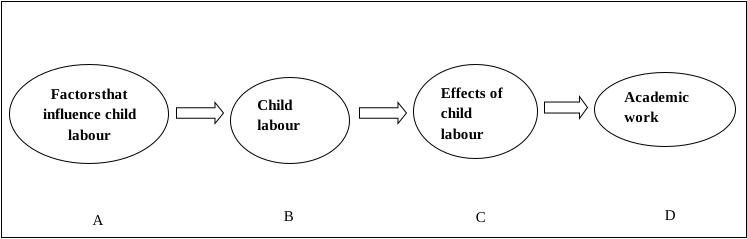
A= FACTORS THAT INFLUENCE CHILD LABOUR (cultural, social and economic factors such as poverty, large family size, low income, illiteracy, etc.)
B = CHILD LABOUR (All forms of work that a child engages in on regular bases which tend to negatively affect the child’s education can be termed as child labour).
C = EFFECT OF CHILD LABOUR (physical and cognitive development, general behaviour, and attitude to school activities.)
D = ACADEMIC WORK (participation in learning activities and learning outcome).
Child labour is work that deprives children of their childhood, their potential and their dignity, and that is harmful to physical and mental development [8]. It refers to all kinds of work which are harmful to children’s health and development [9]. Child labour is work carried out to the detriment and endangerment of the child. Besides, child labour is defined in ILO Conventions as work that children should not be doing because they are too young to work, and it is dangerous or unsuitable for them [8]. Sub-paragraph (C) of the article of the Palermo Protocol states that child labour is the employment of a child for free [8].
Cultural factors contribute to child labour. It is believed that down the ages a child should learn the skills present in the family. The tradition helps in attracting child labour. It is justified ‘by the child’s parents and employers as assisting their families and not working (Simon, 2004). Large family size is one of the major factors responsible for child labour [10]. Children are considered by parents as economic assets rather than responsibility. The major responsible factor for child labour is widespread poverty. It is for this reason that parents leave their children to fend for themselves [11].
1.2. Concept and Forms of Child Labour
A child means every human being below the age of 18 years [12]. The Population and Housing Census of Ghana in 2003 indicated that a child is someone who falls below the age of 15 years [13]. In conformity with this, the Ghana Labour Decree, Act 53 allowed children between 15 and 18 years to work for remuneration, in conformity to ILO Convention [14]. There are many works that children perform. A particular form of work can be described as child labour depending on the child’s age, how long the work is performed, how often the work is performed, the condition under which it is performed, and society’s perception of child labour [8]. All forms of work that a child engages in on a regular basis which tend to negatively affect the child’s education can be termed as child labour.
According to Ghana Living Standard Survey (GLSS) in 2003, 39.5% of Ghanaians were poor and 25% were extremely poor in 2000 [15]. In 2014, the Ghana Statistical Service found out in their survey that, the participation rate in the labour force among persons 15 years and older, is 82 per cent for males and 77 per cent for females. The data further reveals that about 26 percent of children between five years and 17 years engage in child labour, whilst another 25 percent are found in hazardous work [13]. This shows the alarming rate at which minors are engaged in income-generating ventures in the nation. There may be several reasons the issue of child labour should be looked at. Child labour is considered a violation of children’s human rights. The reason is that children are made to do difficult, harmful works that exploit them for their human rights including the right to education. Most of these may often be beyond their physical capabilities. Children involved in child labour are deprived of their freedom of childhood, their right to recreation and play, and their natural development [16].
Childhood should be a period of learning, recreation, and physical, mental, and social development. The second concern about child labour arises from its effect on the educational development of the child. Child labourers are often deprived of any form of education. Hence, child labour is the absence of investment in human capital formation and has a negative effect on the subsequent private and social returns from it. Not all work done by children should be classified as child labour. Children’s participation in work that does not affect their health and personal development nor interfere with their education is generally regarded as being something positive. Whether or not particular forms of “work” can be called “child labour” depends on the child’s age, the type and hours of work performed and the conditions under which it is performed [17].
There are many forms of child labour worldwide. Article 15 (1) of the African Charter on the Rights and Welfare of the Child opined that child labour includes all forms of economic exploitation which tend to be hazardous to the child’s physical, mental, spiritual, moral or social development. Children engage in agriculture, mining, manufacturing, domestic service, construction, scavenging and begging on the streets [18]. Others are trapped in forms of slavery in armed conflicts, forced labour and debt bondage (to pay off debts incurred by parents and grandparents) as well as in commercial sexual exploitation and illicit activities, such as drug trafficking and organized begging and in many other forms of labour [17]. Many of these activities are the worst forms of child labour because they are harmful, morally reprehensible and violate the child’s freedom and human rights. ILO further reported that child labour tends to be concentrated in the informal sector of the economy. For some work, children receive no payment in the form of cash but only food and a place to sleep. Children in informal sector work receive no payment if they are injured or become ill and can seek no protection if they suffer violence or are maltreated by their employer [17].
The perception people have about child labour is very controversial because the age limit of a child and when a child is to start work had been very controversial. Also, the causes and benefits of child labour to those who engaged in it also make it controversial [12]. Parents do not just give out their children for work for nothing; it has always been the inevitabilities of life that compel them to do so to enable them to meet some basic needs of life. The 1989 Education reform in Ghana saw basic education as compulsory and terminal [19]. This period lies between 6 and 15 years. This implies that after basic education, children could start work. The ILO made detailed specifications on the age limits. They proposed that the minimum age for light work, normal work and hazardous work should be 13, 15 and 18 years respectively [8]. The Children’s Act, Act 560 (1998) states that child labour deprives the child of his/her health, education or development [14]. The Daily Graphic on the other hand stated that Ghana needs to provide a contextual meaning to the term, otherwise all activities of children would be considered child labour). It must however be noted that, regardless of the context the Daily Graphic was referring to, the negative effects the work(s) children do have on their development renders the work(s) unacceptable [20].
All forms of child labour, particularly the worst forms, should be eliminated because they not only weaken the roots of human nature and rights but also threatens future social and economic development worldwide [17]. Trade competitiveness and economic efficiency should not be a pretext for this abuse. The worst form of child labour includes stone quarrying, fishing, small-scale mining, commercial sex work, child porters, domestic servitude and commercial farming [17]. ILO further stated that the worst forms of child labour include child trafficking and child soldiers. Article 91 (3) of the Children’s Act 560 identifies the worst forms of child labour to include, fishing, porterage of heavy goods, working in manufacturing industries where chemicals are produced and used, working in places where machines are used and working in places such as bars, hotels and places of entertainment where a person may be exposed to immoral behaviour [21]. Africa Recovery in 2001 recognised two major forms of child labour as hidden and visible child labour. The hidden include fishing in the night, prostitution, drug peddling and domestic work. The visible ones include truck pushing, hawking, stone quarrying, fishing and commercial agriculture [22].
The ILO however, identified 5 main types of work children commonly do including:
- Agriculture: This includes working with sharp tools, handling and spraying agrochemicals: caring for animals, weeding, crop harvesting and carting of foodstuffs.
- Fishing: This includes diving to a depth of about 60 meters in order to scare fish into nets and remove stuck nets.
- Domestic Services: These largely consist of young girls who perform activities such as looking after children, preparing food, house cleaning, washing and ironing and caring for the sick.
- Hawking: This includes hawking and vending goods, carrying drugs and polishing shoes.
- Industry: This includes the use of machines and chemicals in the processing, manufacturing and packing of goods [8].
IPEC similarly identified the following as forms of child labour:
- At home: This includes looking after young siblings, helping in the family business to the extent that this becomes their main and only activity, carrying out arduous work and working excessively for long hours. Child labour may not even be recognised when children work as part of the family unit. This is particularly common in agriculture, where an entire family may have to work to meet a particular quota or target and cannot afford to employ outside help. Children may also be expected to act as unpaid domestic servants in their own homes, taking care of the family's needs while both parents work.
- In agriculture: This includes farming and fishing.
- In industry: This involves working in factories and construction industries.
- According to Ghana Statistical Services (2003), the main occupations of working children in Ghana are agriculture, fishing and forestry (57.0%), sales (20.7%), production (9.5%), and other general workers such as truck-pushers, labourers, and driver mates (11.0%). It further reported that sales and production work are the dominant occupations in the urban economy (65.9%) while in the rural economy; agriculture work is predominant (67.0%) [9].
1.3. Influence of Child Labour on Children’s Academic Performance
One of the greatest changes in children’s life in recent times has been the increase in the number of children who leave school to work to supplement their parent’s income. Child labour continues to be a problem because of its impacts [24]. The UN Secretary-General, Kofi Annan March in 1999 stated that child labour has serious consequences that stay with the individual and with society for far longer than the years of childhood [25]. Child labour has non-linear educational impacts ranging from dropouts to high illiteracy rates. The Ga West District Girl-Child Programme Coordinator asserted that the major factors that affect girls’ enrolment and their continuity in education include child labour, large family size and ignorance [26]. GSS (2003) also observed that child labour is a future life destroyer to children of school-going age [13]. Again, ILO reported that, when children work, school dropout and illiteracy rate increase. Child labour increases the likelihood of dropout and a lower likelihood of entering secondary education. Child labour also has some emotional impact which tends to affect children’s futures. Child workers are constantly on call and deprived of rest and sleep. They are exposed to crude treatment and forced to work excursively. They are often branded as stupid, lazy, careless, rude and liars [8]. Child labour can leave deep and lasting psychological scars on children [27]. IPEC (2003) concluded that child labour among children of school-going age deprives them of schooling. It further stated that child labour deprives children of useful skills needed for the world of work. Child labour dehumanizes the victims. They tend to develop an inferiority complex and this affects them for their entire life. Efforts must therefore be made to address the problem of child labour. Child labour does more than deprive children of their education and mental and physical development - their childhood is stolen [9]. Immature and inexperienced child labourers may be completely unaware of the short and long-term risks involved in their work. Working long hours, child labourers are often denied a basic school education, normal social interaction, personal development and emotional support from their families [8].
2. Materials and Methods
The research design adopted for the study was the descriptive survey. The population of the study included all JHS teachers and pupils in the Sekondi Takoradi Metropolis. The target population was Junior High School teachers and pupils in the Kojokrom, Ntaamakrom, Ekuasi and Nkotompo communities in the Sekondi Takoradi metropolis. However, the accessible population was JHS One and Two teachers and pupils in Nkotompo AME Zion JHS, Ekuasi Methodist JHS, Kojokrom MA JHS and Ntaamakrom MA JHS. The teachers and pupils were selected because such categories of respondents could provide the needed information for the successful conduct of the study. The purposive and simple random sampling techniques were used to select the communities where the schools were located, teachers and pupils for the study. The purposive sampling technique was used to select twelve (12) teachers and four (4) communities with their JHSs. This sampling technique was used so that areas which suffer seriously from child labour could be studied. Again, it was used to sample the participants who could provide the needed data for the study. Also, purposive sampling makes it easy to collect data where there are limited numbers of respondents who could contribute to the study [28]. One hundred and twenty (120) students were simply randomly selected from two hundred and sixty-seven (267) students. The main instruments used for data collection in this study were questionnaires and interview schedules. The question items included both closed and open-ended questions. Data were analysed with descriptive statistics. The open-ended items on both the questionnaire and interview schedule were put into non-overlapping categories, coded and analysed. Data were classified into discrete categories and analysed using frequencies, simple percentages, tables, figures and charts. Also, an analysis of variance was used to test the hypotheses.
3. Results and Discussion
3.1. The Categories of Child Labour
This section presents and discusses results on the categories of child labour activities the pupils engaged themselves in the metropolis. It was guided by this research question: What are the Categories of child labour that exist among JHS pupils in Sekondi Takoradi Metropolitan Assembly?
From Table 1, it was found out that the pupils engaged in child labour job categories as follows: domestic services (35.8%), street-related activities (20.8%), agriculture (25%), stone quarrying (12.5%) and construction work (5.8%). In the case of the teachers, 41.6% indicated that pupils engaged in domestic services, 33.3% said pupils engaged in street-related activities and 16.7% said pupils engaged in agriculture. The results of both teachers and pupils indicated that the three child labour activities which pupils engaged in most were domestic services, street-related activities and agriculture. The study also found that the pupils engaged in domestic services included looking after children, cooking meals, house cleaning, washing, ironing and caring for the sick. Also, street-related activities were hawking, street vending as well as selling iced water, food and other items. The most prominent agricultural activities the pupils engaged in were fishing and farming. Children who engaged in agriculture in the Sekondi Takoradi Metropolis handled and sprayed agrochemicals, cared for farm animals, controlled weeds, picked crops and carted foodstuffs. Thus most of the pupils who engage in child labour activities worked during the day so had little time for their academic work. Also, 64.2% of the child labour activities the pupils engaged in were ‘visible’ as categorised by African Recovery 2001. Only 35.8% of the pupils engaged in domestic services which were classified as hidden [22]. ILO similarly supported the findings of the study and stated that children engage in agriculture, domestic services, hawking and industry [8].
These findings are supported by Africa Recovery which categorized child labour into two major forms: hidden and visible. The hidden form of child labour includes fishing in the night, prostitution, drug peddling and domestic work. The visible form of child labour includes truck pushing, hawking, stone quarrying, fishing during the day and commercial agriculture [22]. This finding is also supported by previous studies that children who engage in agriculture work with sharp tools and chemicals. They engage in crop production, rearing of farm animals and fishing. They use chemicals to control pests and diseases, store agricultural produce and control weeds. Working with chemicals is detrimental to their health [8].
Also, IPEC reported that pesticide poisoning is one of the biggest killers of child labourers [9]. In Sri Lanka, pesticides kill more children than diphtheria, malaria, polio and tetanus combined. The global death toll each year from pesticides is approximately 40,000 [9]. It also reported that growth deficiency is prevalent among working children, who tend to be shorter and lighter than other children; these deficiencies also impact their adult life. Therefore, agriculture has drastic effects on victims of child labour. The activities are detrimental to the health and development of the pupils. Engaging children in child labour activities deprives them of quality education [22]. Child labour activities do not allow the pupils to go to school, so they cannot be gainfully employed in the future. As a result, most of them resort to social vices when they grow up.
As shown in Table 2, almost half of the pupils (49.2%) were house helpers. Also, 66.7% of the teacher said the pupils were house helps. Again, both pupil and teacher respondents responded that children who were direct offspring of their parents formed the second majority of children involved in child labour. This was recorded by 22.5% of pupils and 33.3of % of teachers. Only 28.3% of the pupils were foster children and orphans while none of the teachers responded to those categories. The results imply that the presence of the children’s parents does not save them from the problem of child labour and its resultant effects. If the parents are unable to provide their children with their basic needs and send them to school, the children will be forced to engage in child labour whether they are in school or not.
An earlier study similarly reported that many families compel their children to engage in economic activities to support themselves and their families due to poverty. It further revealed, extreme poverty suffered by many families as a result of lack of economic growth and unfair distribution of the national income has aggravated the problem of child labour. Therefore, to survive, many poor families who cannot provide basic needs such as one meal a day, clothing and primary health care, have no other choice than to send their children out to work [28]. Sending children to school is expensive for many of them [29]. The majority of child labourers give their entire wages to their parents or caregivers [25]. Most, child labourers are the breadwinners of their families and without them, their families cannot survive.
As shown in Table 3, close to half of the pupils’ respondents (49.2%) said that they worked for more than three days a week while 15.0% worked for 3 days. This implies that the most of the pupils (64.2%) who engage in child labour activities spent three or more days working which is close to the average of five working days’ adults spend in the labour market. Pupils who engaged in child labour activities had fewer days for academic and other school activities and this affected their attendance and academic performance. The findings clearly support the fact that child labour irrespective of the kind of work interferes with children’s education. In other words, school attendance declines as a result of longer hours engaged in work. Children are not able to perform their homework or pay proper attention at school because of fatigue [30]. The results reveal that working hours have a statistically significant negative relationship with school attendance. A similar study concluded that children’s engagement in an economic activity or economic child labour to be precise shows a very strong relationship with school attendance [31]. It is the only predictor variable tested significantly when regressed on school attendance even when other predictor variables had been controlled.
3.2. The Influence of Child Labour on the Pupils’ Academic Work
This sub-section also presents results and discussion on the research question: What is the influence of child labour on pupils’ academic work?
In Table 4, it is observed that 86.4% of the respondents said child labour made the pupils drop out of school. While 68.2% of the respondents said child labour prevented the pupils from doing their homework, 63.6% of the respondents said the pupils performed poorly academically. The child labour activities the pupils engaged in took much of their time, so they found it difficult to do their homework and also study. Furthermore, 85.5% of the teachers said child labour made the pupils late for school. This means the pupils were unable to organise themselves properly so that they could go to school early as a result of their heavy workload. In most cases, by the time the children finished performing their duties, it was already time for school. Consequently, they went to school late. Also, 85.5% of the teacher respondents said children absented themselves from school because of the influence of child labour. Such children were not able to have the full benefit of basic education because they missed many lessons. When children miss lessons as a result of lateness or absenteeism, it becomes difficult for the pupils to build on the knowledge in subsequent lessons.
From the above results, it could be concluded that the pupils were not regular and punctual at school. Pupils who are regular and punctual are expected to perform well in school because they can participate in all the school activities. Poor performance in examinations and inability to do homework could adversely affect learners’ academic work. In similar research reports, found that child labour has serious consequences that stay with the individual people and society longer than the years of their childhood because when children work, school dropout and illiteracy rate increase [8, 25]. Child labour increases the likelihood of school dropout and lowers the likelihood of children entering secondary school. Another study also concluded that child labour deprives children of schooling and useful skills needed for the world of work [9].
Table 5 reveals that 76.7% of the pupils scored below 41 marks in English Language on the test. Similarly, 66.7%, 66.7% and 65.0% of the pupils scored below 41 marks in Science, Social Studies and Mathematics respectively. The results show that most of the pupils scored below 50 with only a few in each case scoring 51 marks and above. They are 6.7% for English, 9.4% for Science, 16% for Social Studies and 5% for Mathematics. The pupils’ performances in the tests show that the high incidence of child labour has a serious effect on pupils’ academic work. From the discussions, it becomes clear that child labour had negative effects on the pupils’ performance in almost all the core subjects in the curriculum.
In a similar study conducted in Suba and Homa-Bay Districts of Kenya reported that pupils who were not victims of child labour had a significantly higher academic achievement mean score than victims of child labour [32]. Child labour causes a loss in students' school achievement. Children and adolescents who do not work have better school performance than students who work. Up to two hours of work per day does not have a statistically significant effect on school performance, but additional hours’ decrease students’ achievement. They also reported that differences in work conditions affect school performance. Those students who only work outside the house are worse off than those who only work within the house, with test scores decreasing by 5 per cent. Pupils who work both inside and outside the house have the lowest test scores of all the working conditions, decreasing by up to 7 per cent [33]. This shows that child labour has a significant negative impact on pupils’ academic performance. Therefore, pupils should be protected from engaging in child labour activities.
3.3. Hypothesis
Ho: There is no significant difference in the academic performance of pupils who engage in child labour in the various schools.
HA: There is a significant difference in the academic performance of pupils who engage in child labour in the various schools.
Analysis of variance comparing the pupil’s performance in English Language, Mathematics, Social Studies and Integrated Science in the selected schools are shown in Tables 6,7, 8, and 9 below. The alpha level was 0.05.
From Table 6, it was observed that the F value was 1.140 and the p-value was 0.033. This shows that the difference in the pupils’ performance in English Language was statistically significant.
Again, the differences in the pupils’ performance in Mathematics were statistically significant because the F value was 1.664 and the level of significance was 0.017.
Furthermore, the F value and the level of significance for the pupil’s performance in Social Studies were 1.984 and 0.012 respectively. It can be realised that the differences observed in the pupils’ performance in Social Studies were statistically significant.
As shown in Table 9, the ANOVA results show that the F value was 5.207 and the level of significance for the pupils’ performance in Integrated Science was 0.010. This shows that the differences in the pupils’ performance in Integrated Science were statistically significant.
The F- values for the four core subjects, namely, Mathematics, Social Studies, Integrated Science and English Language were 1.140, 1.664, 1.984 and 5.207 and the p-values were 0.033, 0.017, 0.012 and 0.010 respectively. Generally, the ANOVA results show that the differences in the pupils’ performance in the core subjects were statistically significant because all the schools were affected in one way or the other with varying degrees by the influence of child labour activities. Therefore, the null hypothesis which states that there is no significant difference in the pupils’ performance in the core subjects was rejected while the alternative hypothesis was accepted. This implies that there were significant differences in the pupils’ performance in the core subjects on a school basis. A similar study found that child labour at early stages can have dire consequences on a child’s development mentally, physically and academically [34]. It is therefore very important that stakeholders in education should do everything possible to eradicate child labour to ensure high academic performance in the metropolis.
4. Conclusions and recommendations
Two major categories of pupils; namely, direct offspring and house help offer services to different categories of people in the Sekondi Takoradi Metropolis to earn income. The pupils’ active involvement in child labour activities adversely affected their academic work in the school. Pupils lost interest in attending school and their grades were also poor. It is recommended that The Guidance and Counselling Unit of Ghana Education Service and the National Commission on Civic Education should educate parents on the negative impact of child labour on pupils’ academic work so that parents will not push their children into child labour. It is also recommended that the government, non-governmental organisations, religious organisations, district assemblies and individual philanthropists should support the victims of child labour to reduce the negative impact child labour has on the pupils’ academic work and their social life.
Author’s Contributions: Conceptualization; methodology; validation; formal analysis; investigation; resources; data curation; writing—original draft preparation; writing—review and editing; visualization; supervision; project administration. All authors have read and agreed to the published version of the manuscript.
Funding: “This research received no external funding”
Data Availability Statement: Data is available on request from the corresponding author.
Acknowledgements: I acknowledge the respondents for their time and patience.
Conflicts of Interest: “The authors declare no conflict of interest.” “No funders had any role in the design of the study; in the collection, analyses, or interpretation of data; in the writing of the manuscript, or in the decision to publish the results”.
References
- Patrick, Y. (2020). Mechanisms to Eradicate Child Labour among School Children in the Kete-Krachi Area. Research on Humanities and Social Sciences, 10 (14), 46-64.
- Oforiwaa Ampomah, A. (2022). Workers needed to foster improved academic performance: Perspectives of social workers and education officers in Ghana. International Social Work, 65(3), 525-538.[CrossRef]
- Yeyie, P. (2020). Major Causes of Child Labour Among School Children in the Kete-Krachi District. Social Education Research, 159-172.[CrossRef]
- Okyere, S., Imoh, A., & Ansell, N. (2014, January). Children's participation in prohibited work in Ghana and its implications for the Convention on the Rights of the Child. In Children's Lives in an Era of Children’s Rights: the progress of the Convention on the Rights of the Child in Africa (pp. 92-104). Oxfordshire, UK: Routledge.
- Dzamboe, T. & Agave, G. (2008). More children engage in hazardous work. The Mirror, p.35.
- Becker, G. & Tomes, N. (1986). Human capital and the rise and fall of families. Journal of Labour Economics, 4, 1-39.[CrossRef] [PubMed]
- Henderson, T. (1989). The globalization of high technology production; Society space and semiconductors in the restructuring of the modern world. London: Routledge.
- International Labour Organisation -ILO (2004): Girl child labour in agriculture, domestic work and sexual exploitation: Rapid assessment on the cases of Philippines, Ghana and Ecuador. 1 & 3. Geneva.
- IPEC. (2003). World Day Against Child Labour: Trafficking in children, retrieved from http://www.ilo.org/ipec/Campaignandadvocacy/wdacl/2003/lang--en/index.htm, on June 12, 2013.
- Usman, H. & Nachrowi, D. (2004). Working Children in Indonesia: Conditions, Determinant, and Exploitation (Quantitative Study). Jakarta: PT. Grasindo.
- Ray, R. (2000). Child Labour, Child Schooling, and Their Interaction with Adult Labour: Empirical Evidence for Peru and Pakistan. World Bank Economic Review 14: 347-67.[CrossRef]
- UNICEF. (2001). The State of the World's Children: Early Childhood, retrieved on 12th April 2017 from https://www.unicef.org/sowc01/toc.htm
- Ghana Statistical Services-GSS. (2003). Population and housing census. Ghana Statistical Services, Accra Ghana.
- Siobhan, L. (1998). The 1998 Children's Act: Problems of Enforcement in Ghana. The British Journal of Social Work, 32(7) 893–905.[CrossRef]
- UNICEF. (2004). The State of the World’s Children, retrieved on 15th April 2017 from https://www.unicef.org/sowc04/sowc04_contents.html
- Anker, R. (2000). Conceptual and research frameworks for the economics of child labour and its elimination. ILO-IPEC.
- International Labour Organisation-ILO. (2007). Child labour in Africa, retrieved on 3rd May 2017 from http://www.ilo.org/ipec/Regionsandcountries/Africa/lang--en/index.htm.
- Sloth-Nielsen, J. (2017). The African Charter on the rights and welfare of the child. Child Law in South Africa. 2nd edition. Claremont: Juta, 431.
- Ministry of Education (2003). Effective literacy practice, retrieved on 8th April 2017 from http://nzcurriculum.tki.org.nz/National-Standards/Reading-and-writing-standards/Effective-literacy-practice
- Daily Graphic Editorial (November 27, 2007). Fighting child labour Accra: Daily Graphic.
- Hamenoo, E. S., Dwomoh, E. A., & Dako-Gyeke, M. (2018). Child labour in Ghana: Implications for children's education and health. Children and Youth Services Review, 93, 248-254.[CrossRef]
- African Recovery (2001). Protecting African’ Children. UN Department of Public Information, 15(3)14-16
- Ghana Statistical Service. 2004. Ghana Child Labour Survey Report, 2003. Ghana Statistical Service, Accra, Ghana.
- Kelsey, S. & Peterson, B. (2003). Human Rights: Handbooks for Ghanaian Journalists Accra: Journalists for Human Rights (JHR).
- Donnellan, C. (Ed.). (2002). Child labour. Cambridge: Independence Educational Publishers.
- Tengan, A. B. (2013). Christianity and Cultural History in Northern Ghana. Oxford: PIE Peter Lang.[CrossRef] [PubMed]
- IPEC. (2006). Action against Child Labour: Progress and future priorities retrieved on 8th April 2017 from http://www.ilo.org/ipec/Action/ lang—en/index.htm
- Saunders, M., Lewis, P. & Thornhill, A. (2012) “Research Methods for Business Students” 6th edition, Pearson Education Limited.
- UNICEF. (1997). The State of the World’s Children: Focus on Child Labour, retrieved on 12th April 2017.
- Heady, C. (2000). “What is the Effect of Child Labour on Learning Achievement? Evidence from Ghana”, Innocenti Working Paper NO. 79, Florence: UNICEF Innocenti Research Centre.
- Nyarko, A. A. (2003). Child Labour and school attendance. Master of Arts Dissertation Is Submitted to the University of Ghana, Legon, Accra, Ghana
- Ligeve, S. N. & Poipoi, M. W. (2012). The Influence of Child Labour on Academic Achievement of Primary School Pupils in Suba and Homa-Bay Districts, Kenya. International Journal of Learning and Development. 2(4).[CrossRef]
- Orazem, P. F. & Gunnarsson, V. (2003). Child labour, school attendance and academic performance: a review, ILO Working Papers 366541, International Labour Organization.
- Dogramaci, I. (1981). Parameters of child health. South Africa Medical Journal 60 (3), 49-56.