

Aiming at the time complexity of singular value spectrum weighted Hankel SVD filtering algorithm, a clutter suppression algorithm for ultrasonic color Doppler imaging based on BP neural network model is proposed in this paper. Firstly, using the PRF data collected by portable ultrasound instrument, we verify the singular value weighted Hankel SVD filtering algorithm, and the results show that the algorithm has high accuracy; Then, the BP neural network model is established based on the input and output data of singular value weighted Hankel-SVD filtering algorithm; Finally, the clutter suppression algorithm of ultrasonic color Doppler imaging based on BP neural network model is established. The experimental results show that compared with Hankel SVD filtering algorithm, the clutter suppression algorithm proposed in this paper greatly shortens the operation time without reducing the accuracy, so as to improve the real-time performance of the filtering algorithm.
Clutter Suppression Algorithm of Ultrasonic Color Doppler Imaging Based on BP Neural Network
May 07, 2022
June 06, 2022
June 14, 2022
June 16, 2022
This is an Open Access article, distributed under the terms of the Creative Commons Attribution 4.0 International License (http://creativecommons.org/licenses/by/4.0/), which permits unrestricted use, distribution and reproduction in any medium or format, provided the original work is properly cited.
Abstract
1. Introduction
As an important index of human cardiovascular disease detection, hemodynamic information has been widely used in clinical medicine. In color Doppler imaging technology, Pulse Repetition Frequency (PRF) includes the interference caused by the slow movement of blood vessel wall and perivascular tissue (hereinafter referred to as clutter interference). The existence of clutter signal leads to large deviation in the estimation of hemodynamic parameters, which seriously reduces the blood flow discrimination ability of color blood flow imaging system. Therefore, the full suppression of clutter components is of great significance to improve the imaging quality of color ultrasonic Doppler system [1, 2, 3].
Traditional clutter suppression filters, such as finite (infinite) impulse response filter and polynomial regression filter are static filters. When the clutter is a stationary signal, the clutter suppression effect is very good, but for the non-stationary clutter caused by blood vessel pulsation and tissue time-varying motion, the clutter suppression effect of the above static filters is not ideal [4]. For non-stationary clutter, Kruse et al. [5] proposed and designed a clutter filter based on eigenvalue decomposition (eigen) in 2002. The filtering algorithm has good suppression effect on non-stationary clutter, but does not have spatial adaptability [6]. In order to improve the spatial adaptability of clutter filter, Yu and Cobbold [7] proposed a singular value decomposition (SVD) filtering algorithm based on Hankel matrix in 2008. Both Eigen and Hankel SVD filters use the strict threshold method to determine the coefficients of the regression filter according to the preset threshold. Clutter suppression is achieved by discarding clutter components and retaining blood flow components, but it is difficult to achieve consistent filtering effect in the face of high-intensity time-varying movement of tissue [8, 9]. In 2016, aiming at the non-stationary clutter caused by high-intensity time-varying motion in tissue space, Wang Lutao et al. [10] proposed Hankel SVD clutter filtering algorithm based on singular value spectrum weighting. The algorithm constructs Hankel data matrix according to the echo Doppler vector in a single slow time direction, performs singular value decomposition, and uses the decomposed Hankel principal components to construct the orthogonal basis function of regression filter, At the same time, the improved sigmoid function is introduced to calculate the regression filter coefficients according to the energy normalized singular value, which makes the detection of clutter region highly specific, so as to improve the suppression ability of non-stationary clutter. From 2018 to 2021, Baranger et al. [11, 12, 13] proposed some clutter filters based on Casorati SVD, which continuously improved the clutter suppression effect by combining the spatial information provided by ultrafast composite plane wave, the spatial adaptability of eigenvalue extraction algorithm and the advantages of subregional filtering algorithm, and provided technical support for many new application research.
However, Hankel-SVD and Casorati SVD filter algorithms construct the matrix and perform singular value decomposition, the mathematical operation takes a long time, which makes the real-time performance of blood flow image based on this algorithm poor. In order to improve the real-time performance of Hankel-SVD clutter filtering algorithm based on singular value spectrum weighting, a clutter suppression algorithm for ultrasonic color Doppler imaging based on BP neural network model is proposed in this paper.
2. Color Doppler ultrasound imaging process
In color Doppler ultrasound imaging technology, ultrasonic equipment is used to send ultrasonic sound beam to scan the imaging area, and each pixel emits eight to sixteen finite pulses. The pulse repetition frequency (PRF) often affects the accuracy of blood flow detection. The number of transmitted pulses is large, and the accuracy of blood flow information at the scanning position is high [6]. PRF generally consists of three components: (1) blood flow ultrasonic echo signal (i.e. ultrasonic beam returns from moving erythrocyte scatterers), the intensity of blood flow vector component is low, but the frequency is higher than clutter vector component; (2) Clutter is generated by slowly moving or stationary tissue. It is usually 40~100dB higher than the Doppler frequency shift generated by moving blood flow, so that it occupies the dominant part in the echo signal; (3) Random white noise, caused by thermal vibration of electrons [14]. Fig. 1 shows the flow chart of color Doppler imaging processing. The Doppler echo signal is stored in the memory, and the and data are rearranged to form a slow time signal data, and then most of the clutter signals are removed by the filtering algorithm to obtain the blood flow echo signal with low power; Then, the average angular frequency and power of blood flow are obtained by autocorrelation algorithm, and then substituted into the calculation formula of hemodynamic information to obtain the estimation of blood flow velocity, and priority coding is carried out. The specific position of blood vessel is determined by estimating the pseudo image of blood flow by distinguishing blood flow signal and noise signal, and the display effect of blood flow image is improved by post-processing algorithm; Finally, the processed two-dimensional image is mapped to the color index table and superimposed with the gray image in mode B to display the color blood flow imaging image [15].
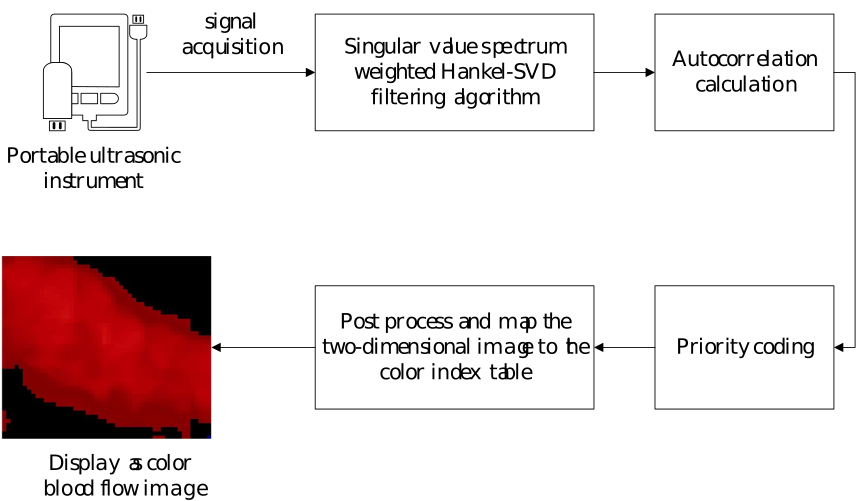
3. Clutter suppression algorithm based on BP neural network
BP (back propagation) neural network [16] is a multilayer feedforward neural network. The main feature of BP is that the signal propagates forward and the error propagates backward. After one training, the error value and the expected error result are obtained for error analysis. Taking the sum of squares of errors of all output layer nodes of the network as the objective function, the gradient descent algorithm is used to optimize the objective function, and then modify the weights and thresholds of each layer. After repeated iterative training, the network is updated to obtain the artificial neural network simulating the original problem.
3.1. Verify Hankel SVD filtering algorithm
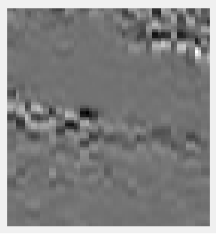
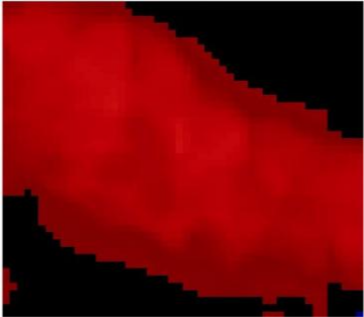
In this paper, the PRF data is collected by portable ultrasound instrument, the clutter signal is filtered by using the algorithm proposed in reference [10], and the color blood flow image is displayed in MATLAB simulation software (see Fig. 2 and Fig. 3). The experimental results show that the filtering algorithm has high accuracy and can suppress the non-stationary clutter caused by high-intensity time-varying motion of perivascular tissue.
3.2. Data collection and processing
In this paper, a handheld ultrasonic instrument is used to collect multiple PRF. PRF have the following characteristics:
- The amplitude of the original signal data fluctuates greatly, and the data range is from -1800 to 1900;
- Because the signal data contains complex envelope, the singular value filtered data still retains the phase and amplitude information related to blood flow velocity, so the filtered PRF data has high complexity.
In view of the above problems, this paper adopts multi-layer hidden layer and adjusting the network super parameters to increase the learning ability of the model. BP network is a fully connected neural network, and its nonlinear mapping ability can approach any nonlinear function with any accuracy [17]. However, from a mathematical point of view, as a local search optimization method, the weight of BP network is gradually adjusted along the local improvement, which may lead to the algorithm falling into local extremum. In order to get the optimal solution faster in BP neural network and eliminate the adverse effect of network learning caused by singular sample data, we normalized the original data in the experiment, so that multiple input set samples are in the same order of magnitude. The formula of data normalization is as follows:
In this expression, is the original data, is the mean value of the sample, is the variance of the sample, and is the normalized data. Finally, the normalized sample set is used as input to the model built by BP neural network for training.
3.3. Activation function and determination of the number of hidden layers
An important part of neural network is activation function. The introduction of appropriate activation function will make the deep neural network have strong learning ability. In this paper, the primary purpose of choosing BP neural network to replace singular value filtering algorithm is to solve the problem of time complexity of the algorithm, and the operation of relu activation function is very efficient. Its formula is as follows:
Therefore, the middle layer of BP model in this paper uses relu activation function. Then, due to the sparsity of relu activation function, if only relu activation function is referenced, some components of the network may never be updated to. Therefore, this BP model introduces sigmoid activation function in the output layer. The expression of the sigmoid function is as follows:
In order to detect the influence of different layers on the prediction results of the model, we select root mean square error (RMSE) and mean absolute error (MAE) as the evaluation indexes, and the calculation formula is as follows:
After a large number of experiments, the error of the prediction results of different hidden layers is analyzed (see Table 1 for the results), and finally the number of hidden layers is 6.
3.4. Determination of the number of nodes in each hidden layer
In the BP network designed in this paper, the number of hidden layer nodes (number of neurons) is also a super parameter that is difficult to select. It not only has a great impact on the performance of the neural network, but also is the direct cause of "over fitting" [18]. This paper uses the method of literature [18] to manually adjust the number of hidden layer nodes, and the number of nodes meets the following formula:
In this expression is the number of neurons in the input layer; m is the number of training set samples; is the number of neurons in the output layer; is a constant between [1, 10]. Number of training set samples in this paper m is 90; input layer neuron Doppler echo vector signal and combined composition (i.e.x=32); Number of neurons in output layer vector signal filtered for singular value(i.e. = 32). According to formula (5), Manually adjust the number of nodes of each hidden layer , based on a large number of experimental results, the number of neurons in each hidden layer is finally determined based on the minimum of root mean square error and average absolute error, as shown in Table 2.
3.5. Algorithm verification
The model loss value after 10000 times of training on the training set is shown in Table 3. The training error is reduced from 14.772 at the initial random initialization to 0.1872 at the end. In the initial stage of model training, the error decreases rapidly. After the training times reach about 400, the training error of the BP neural network model on the training set decreases gently and converges gradually.
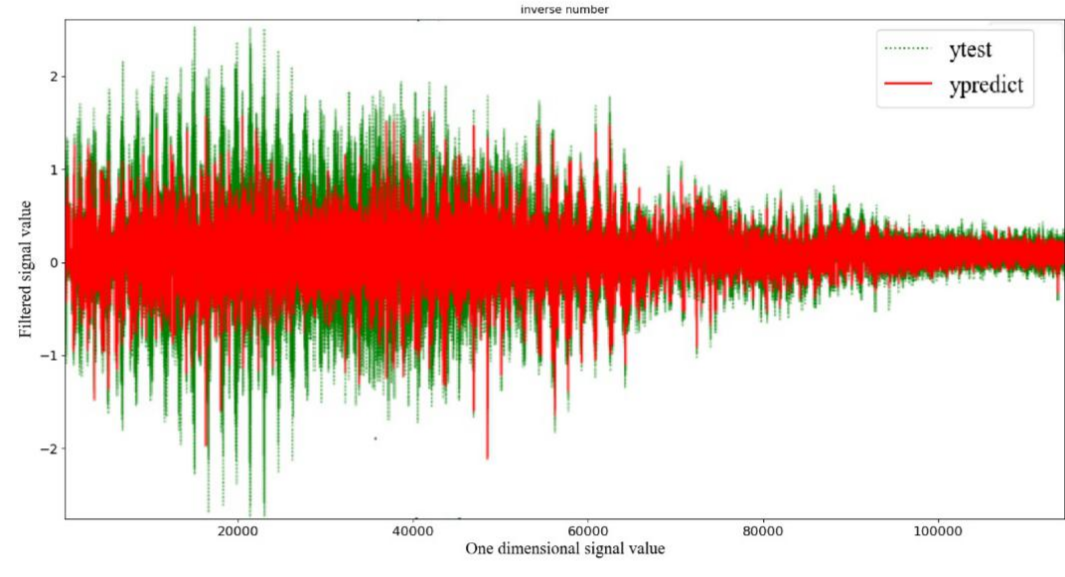
The test set is a separate ultrasonic signal data (the vector signal size is 800 * 144). We input the test set into the above built and trained BP neural network model, and compare the predicted value of the model with the real value (the signal value of the test set filtered by literature [10]). In this paper, the two-dimensional vector data is expanded into one-dimensional and compared with the real value, by observing the experimental fitting, it can be concluded that BP neural network can learn the law of singular value filtering algorithm, and the predicted data is roughly fitted with the actual real value. The comparison results are shown in Figure 4.
In order to verify the real-time performance of the algorithm in this paper, we use two groups of different PRF data for experiments. The experimental results show that the algorithm in this paper greatly reduces the filtering time compared with the algorithm in reference [4]. The filtering time of the two algorithms is shown in Table 4.
4. Conclusion
As one of the excellent clutter filtering algorithms in PRF, Hankel-SVD filter based on singular value spectrum weighting has its own advantages. However, due to the complex mathematical operation of the filter, the filtering time is too long, which hinders the application of the filter in practical clinical medicine. In order to improve the real-time performance of Hankel-SVD clutter filtering algorithm based on singular value spectrum weighting, this paper proposes a clutter suppression algorithm for ultrasonic color Doppler imaging based on BP neural network model. The algorithm establishes BP neural network model based on the input and output data of singular value weighted Hankel-SVD filtering algorithm. The experimental results show that the clutter suppression algorithm proposed in this paper is compared with Hankel-SVD filtering algorithm, On the premise of hardly reducing the accuracy, the operation time is greatly shortened, so as to improve the real-time performance of the filtering algorithm.
Compared with the algorithm in reference [10], the algorithm proposed in this paper performs well in various evaluation indexes, especially improves the real-time performance of the filtering algorithm, which provides a theoretical basis for the clinical application of the algorithm. In the next step, on the premise of ensuring real-time performance, we further improve the network structure to get better filtering effect.
Acknowledgements
This work is supported by the Scientific and Technology Project of Sichuan Provincial (Grant no. 2021YFS0379) of China, the Scientific Research Fund of Chengdu University of Information Technology (Grant no. KYTZ201820) of China.
Reference
- Bercoff J, Montaldo G, Loupas T, et al. Ultrafast compound doppler imaging: Providing full blood flow characterization, IEEE Transactions on Ultrasonics, Ferroelectrics, and Frequency Control, 2011, 58(1): 134-147.[CrossRef] [PubMed]
- Oeltze S, Lehmann D J, Kuhn A, Blood flow clustering and applications in virtual stinting of intracranial aneurysms, IEEE Transactions on Visualization and Computer Graphics, 2014, 20(5): 686-701.[CrossRef] [PubMed]
- Shung K K, Diagnostic Ultrasound: Imaging and Blood Flow Measurements, New York: Taylor Francis Group, 2006. 34-37.
- Kadi A P,Loupas T, On the performance of regression and step-initialized IIR clutter filters for color Doppler systems in diagnostic medical ultrasound, IEEE Transactions on Ultrasonics, Ferroelectrics, and Frequency Control, 1995, 42(3): 927-937.[CrossRef]
- Kruse D E, Ferrara K W, A new high resolution color flow system using an eigen decomposition-based adaptive filter for clutter rejection, IEEE Transactions on Ultrasonics, Ferroelectrics and Frequency Control, 2002, 49 (12): 1384-1399.[CrossRef] [PubMed]
- Song F, Zhang D, Gong X, Performance evaluation of eigendecomposition-based adaptive clutter filter for color flow imaging, Ultrasonics, 2006, 44 (1): 67-71.[CrossRef] [PubMed]
- Yu A C H, CobboldRS C, Single ensemble based eigen-processing methods for color flow imaging part 1 the Hankel-SVD filter, IEEE Transactions on Ultrasonics, Ferroelectrics and Frequency Control, 2008, 55( 3) : 559-573.[CrossRef] [PubMed]
- , Lovstakken L, Eigen-based clutter filter design for ultrasound color flow imaging: a review, IEEE Transactions on Ultrasonics, Ferroelectrics, and Frequency Control, 2010, 57(5): 1096-1111.[CrossRef] [PubMed]
- Wang L, Wang W, Jing G, Research on clutter suppression technology of non-stationary ultrasonic blood flow imaging based on Hankel SVD, Journal of electronics and information, 2015, 37 (4): 830-835. (In Chinese)
- Wang L, Wu X, Jing G, Zou J, A clutter suppression algorithm for ultrasonic color Doppler imaging based on singular value spectrum weighting, Acta electronica Sinica, 2016,44 (6): 1294-1299. (In Chinese)
- Baranger J, Arnal B, Perren F, et al. Adaptive spatiotemporal SVD clutter filtering for Ultrafast Doppler Imaging using similarity of spatial singular vectors, IEEE Transactions on Medical Imaging, 2018, 37(7): 1574-1586.[CrossRef] [PubMed]
- Hingot V, Brodin C, Lebrun F, et al. Early Ultrafast Ultrasound Imaging of Cerebral Perfusion correlates with Ischemic Stroke outcomes and responses to treatment in Mice, Theranostics, 2020, 10(17): 7480-7491.[CrossRef] [PubMed]
- Xu Y, Yang C, Xu J, et al, An adaptive spatiotemporal clutter suppression algorithm for ultrafast plane wave ultrasonic Doppler based on Casorati singular value decomposition, Journal of electronics and information, 2021, 43 (8): 2334-2342. (In Chinese)
- Li W, Jiang X, Chen H, et al, Based on EEMD_ Hankel_ Noise reduction method of mine microseismic signal based on SVD, Journal of coal, 2018, 43 (7): 1910-1917. (In Chinese)
- Kargel C, Höbenreich G, Trummer B, et al, Adaptive clutter rejection filtering in ultrasonic strain-flow imaging, IEEE Transactions on Ultrasonics, Ferroelectrics, and Frequency Control, 2003, 50(7): 824-835.[CrossRef] [PubMed]
- Zhang L, Wang F, Sun T, et al, A constrained optimization method based on BP neural network, Neural Computing & Applications, 2018, 29(2): 413-421.[CrossRef]
- Yang A, Zhuansun Y, Liu C, et al. Design of intrusion detection system for internet of things based on improved BP neural network, IEEE Access, 2019, 7:106043-106052.[CrossRef]
- Feisi technology product R & D Center, Neural network theory and MATLAB 7 implementation, Beijing: Electronic Industry Press, 2005. (In Chinese)