

In this paper, we will examine a rather complex case of the paradoxical nature of certain conclusions that may arise when studying the numerical convergence of a specific nonlinear recursive sequence, known in the literature as Muller’s sequence. To analyze the peculiar computational behavior of this sequence, it is necessary to employ a powerful mathematical framework in order to understand the nontrivial issues that can arise when the software implementation of this seemingly simple mathematical problem. These challenges often stem from the limitations of numerical methods and the inherent errors in computer arithmetic, which can affect the accuracy and stability of the results, particularly when dealing with iterative methods like Muller's sequence.
A Convergence of the Muller’s Sequence
July 11, 2025
August 28, 2025
September 21, 2025
September 24, 2025
This is an Open Access article, distributed under the terms of the Creative Commons Attribution 4.0 International License (http://creativecommons.org/licenses/by/4.0/), which permits unrestricted use, distribution and reproduction in any medium or format, provided the original work is properly cited.
Abstract
1. Introduction
The reliability and accuracy of computer calculations represent a linchpin in computational mathematics and computer science, guiding the design, stability, and trustworthiness of algorithms used to solve scientific, engineering, and practical problems. This issue becomes acutely pronounced in the realm of numerical methods, particularly those aimed at solving nonlinear equations—such as Muller’s method, an iterative approach valued for its rapid convergence characteristics.
At the heart of computational accuracy lies the architecture of floating-point arithmetic. Computer systems represent real numbers in finite precision, which inevitably introduces rounding errors, local truncation errors, and in larger systems, error propagation across iterations or computations. The recursive summation of floating-point numbers, for instance, is highly sensitive to the ordering and method of summation, with some approaches minimizing the accumulation of rounding errors more effectively than others. Higham [1] systematically compared multiple summation strategies, emphasizing that while no single technique is universally dominant, judicious selection of the summation algorithm, tailored to the problem context, can mitigate error accumulation and thus improve reliability of calculations.
The characteristics of floating-point arithmetic, including base choice (binary, hexadecimal, etc.), define both static and dynamic error properties. As Cody's systematic assessment suggested, design choices at the level of machine representation ripple outward to affect the accuracy of every numerical process thereafter [2].
Muller’s method is a prototypical iterative root-finding algorithm that utilizes quadratic interpolation. By fitting a parabola to three points and extrapolating its root, Muller’s method often surpasses classical techniques like the secant or Newton-Raphson methods in convergence rate, specifically near complex roots. The broader landscape of root-finding is rich with memory-based, hybrid, and derivative-free schemes, many of which leverage previous iterates or finite-difference approximations to improve both efficiency and robustness [3, 4, 5, 6, 7]. For example, Qureshi et al. introduced memory-based algorithms that thoughtfully incorporate historical information to expedite local and semilocal convergence while controlling computational expense [3].
Iterative root-finding algorithms such as Muller’s share a common vulnerability: error amplification through repeated application in floating-point environments. Rounding errors, truncation errors, and inaccuracies in evaluating derivatives or function values can accumulate or even amplify from step to step, especially in ill-conditioned or stiff systems [6, 8].
Numerical methods for root-finding are assessed not only by their order of convergence but also by their stability and sensitivity to input errors. Recent literature employs theoretical convergence analyses, symbolic computation, and computational experiments to map the stability landscapes of these algorithms, identifying regions in the complex plane where convergence is assured or erratic [6]. Basin of attraction visualizations—wherein each point in the plane represents an initial guess and is colored by the corresponding convergence outcome—offer graphical and intuitive metrics for the reliability and predictability of iterative schemes [6, 7].
Accuracy can be further scrutinized by means of verified computations, where rigorous error bounds are established for the computed solutions, using interval arithmetic or other guarantees [9]. Techniques such as iterative refinement serve as another line of defense against inaccuracy; for example, one may apply Newton's method repeatedly to refine an approximate eigenpair until the forward and backward errors fall within desired tolerances, even in the presence of floating-point inaccuracies [8].
The imperative for reliable computation scales with problem size and physical consequence. Modern engineering, physics, and data-driven science demand iterative algorithms capable of not only efficiently finding roots, but doing so with documented error margins—even as problem dimensionality expands by orders of magnitude [4, 7, 9, 10]. In nuclear physics mean-field calculations or large-scale linear systems, as in Ryssens et al. and Ozaki et al., both the method of discretization and the granularity of finite elements or mesh points must be carefully tuned for dependable results [9, 10]. As such, accuracy-guaranteed approaches become indispensable, especially when algorithmic stability and model fidelity are paramount.
2. Muller’s sequence.
So the problem of reliability (accuracy) of computer calculations is one of the fundamental problems of computer science [11, 12]. Muller’s sequence [13] and the accuracy of computer calculations are fundamental concepts in the study of numerical methods. Muller’s method, an iterative approach for finding the roots of nonlinear equations, has seen wide application in computational mathematics due to its ability to converge faster than other methods, like Newton-Raphson.
However, the accuracy of these methods is heavily influenced by the precision of the computational environment and the handling of floating-point errors. As computational technology advances, understanding how errors propagate and affect calculations is crucial for maintaining reliability in scientific and engineering applications.
At the same time, the problem is not only the possibility of an incorrect result of theoretical research. As practice shows, the consequences of incorrect computer calculations can be catastrophic. There is a famous case: on February 25, 1991, during the Gulf War I (Operation Desert Storm), a “Patriot” air defense system failed to intercept an enemy missile, and the projectile hit a barracks of US soldiers, killing 28 people. An official investigation [14] showed that 24-bit interceptor processors make a time conversion error of 0.013 seconds every hour. “Patriot” was not restarted for more than 100 hours, and as a result of the accumulation of such seemingly minor errors, during this time there was an error in calculating the position of the missile at 600 meters.
Some other examples of real losses caused by rounding errors or problems in representing numbers in computer memory are given in [15].
In paper [16], the authors considered an example of incorrect program behaviour, namely Rump's example. In addition to mathematical explanations, they focused on software-based methods for controlling the accuracy of complex computations.
This paper investigates the implications of computational accuracy, focusing on Muller's sequence and its limitations in the context of modern computer calculations.
We consider a rather complex case of the paradoxical nature of some conclusions that we will have when studying the numerical convergence of a certain nonlinear recurrent sequence, known in the literature as the Muller’s sequence.
We implement a simple Python program:
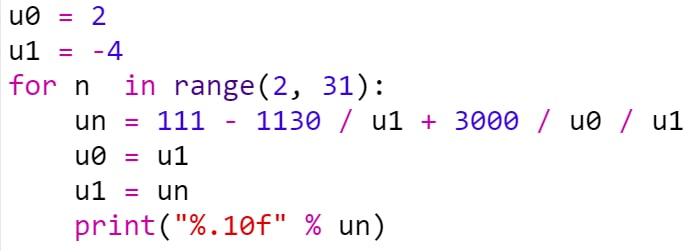
The results of this program for the first 30 values of the Muller’s sequence are displayed in Table 1 in the "Python" column.
The second and third columns of Table 1 show the control results of mathematical calculations in the form of ordinary fractions (the third column is their rational approximation with accuracy of 10 decimal places accepted in the program).
Analyzing the data in Table 1, it can be concluded that up to the 13th term of the sequence, the mathematical and computational results correlate well, and starting from the 14th term, they gradually diverge in different directions: the analytical results with increasing n will go towards the value 6, while the software calculations are also at increased n will freeze at 100.
The Muller’s sequence is a kind of unique object because the following original aspects of software calculations take place:
1) The indicated sequence (1), depending on the initial values, can both diverge and converge to one of three values: 5, 6, and 100. Therefore, the incorrect convergence of (1) at the given initial values will not cause suspicion, and it will seem that we got a quite acceptable result.
2) Incorrect convergence to the number 100 is observed not for any initial values, but only in the presence of a specific dependence
(and just such a case).
3) If we stopped our software calculations at steps 7-16, we would get a more or less correct result with a corresponding relative error in the worst case around 10%. This is too much, but it is much better than the situation that arises when . An interesting paradox arises: the more terms of the sequence we take into account, the less accurate the result becomes. On the one hand, this is a classic problem of a stable-unstable point in the process of convergence of calculations. But on the other hand, the nature of this instability still remains unknown.
For convenience in the subsequent transformations, we introduce the following vector notations.
Relatively few scientific sources are devoted to the problem of Muller’s sequence paradox. The author of [17] deals with various aspects of the issue, but he has not come across an exhaustive study of the causes of computational instability of sequence (1) and similar recurrent sequences in more general forms.
2.2. Mathematical investigation of the problem
Such a case of computational instability warrants further mathematical investigation. We apply an algebraic approach to derive a closed-form expression for the solution of sequence (1). Let us consider the expression
For convenience, we introduce the numbers , which satisfy the following relations
Accordingly, are the roots of such characteristic equation
Let’s denote
For convenience in the subsequent transformations, we introduce the following vector notations
We can then write
where denotes the scalar product of vectors and .
The main result of this paper is the following theorem.
Theorem 1. Adopting notations (4) and (5), the closed-form solution to system (2) is expressed in the following system.
Proof of Theorem 1. The proof will be conducted using mathematical induction.
We will verify if (6) is satisfied for . We obtain the following expression
After transforming the expressions in the numerator and denominator and performing cancellation, we obtain
So (2) is fulfilled and the theorem is satisfied for .
Assume the statement is true for , i.e.
And now, consider the case , which gives the following expression
Taking into account notation (3), we can write
By applying such simple identity
we get
Thus, we conclude that
This completes the proof.
Further since we have established the validity of Theorem 1 and since the following statement
is fulfilled, we can write that if then
Thus, we have obtained the sought value of the initial value
which disrupted the correctness of the calculations. By direct substitution of the specified value into , we get
therefore if then we get
Hence, we can generalize the convergence outcome of the sequence (2).
Corollary 1. Let’s consider given the sequence (2) and the numbers , . The sequence (2) is convergent, with the following possible limit values:
So now we can analyse Muller’s sequence (1). We can note that the numbers, are roots of the equation
and given initial values correspond to the second case (7). Thus the sequence (1) should converge to the value .
However, due to the known characteristics of computational processes [16, 18] we understand that due to the nature of floating-point errors, the value of the expression will not be strictly equal to 0 (if calculated in float format for Python or float or double for C++), and consequently degenerates to the third case of convergence from (7). That is why we get values close to 100 in the last column of Table 1 starting from the twentieth term of the sequence.
3. Conclusions and prospects for further research
To summarize, the reliability and accuracy of computer-based numerical calculations continue to challenge and shape the field of computational mathematics. Muller’s method, as a representative iterative scheme, stands as both a beneficiary and a casualty of advances in floating-point arithmetic, error analysis, algorithmic innovation, and verification techniques. Contemporary research has created a panoply of root-finding algorithms—leveraging memory, derivative-free techniques, and adaptive parameterization—to strike a delicate balance between convergence acceleration, cost reduction, and error control [3, 4, 5, 6, 7]. Nonetheless, the ultimate reliability of these methods rests on a systematic understanding and proactive management of numerical error sources, as elucidated in foundational and modern studies alike [1, 2, 6, 8, 9].
The authors plan to take into account the results mentioned in this paper, particularly in the computer modeling of stochastic and natural processes, which has been explored in recent studies [19, 20, 21, 22, 23, 24, 25]. Furthermore, they also intend to utilize these results in the application of computational methods for addressing applied problems, such as those found in their recent studies concerning combinatorial games [26], economic models [27], election statistics [28], and Monte Carlo techniques [29].
Author Contributions: All authors have read and agreed to the published version of the manuscript.
Funding: This work was partially supported by grants from the Simons Foundation (PDUkraine-00010584, Krykun I. H. and SFI-PD-Ukraine-00017674, Krykun I. H.)
Acknowledgments: The authors express their heartfelt gratitude to the brave soldiers of the Ukrainian Armed Forces who protect the lives of the authors and their families from Russian bloody murderers since 2014.
Conflicts of Interest: The authors declare no conflict of interest.
References
- Higham, N. The Accuracy of Floating Point Summation. SIAM J. Sci. Comput. 1993, Vol. 14, pp. 783-799.[CrossRef]
- Cody, W. Static and Dynamic Numerical Characteristics of Floating-Point Arithmetic. IEEE Transactions on Computers C-22 1973, pp. 598-601.[CrossRef]
- Qureshi, S.; Soomro, A.; Naseem, A.; Gdawiec, K.; et al., From Halley to Secant: Redefining root finding with memory‐based methods including convergence and stability. Mathematical Methods in the Applied Sciences 2024, Vol. 47, pp. 5509-5531.[CrossRef]
- Naseem, A.; Rehman, M.A.; and Abdeljawad, T. A Novel Root-Finding Algorithm With Engineering Applications and its Dynamics via Computer Technology. IEEE Access 2022, Vol. 10, pp. 19677-19684.[CrossRef]
- Özyapici, A.; Sensoy, Z.B.; and Karanfiller, T. Effective Root-Finding Methods for Nonlinear Equations Based on Multiplicative Calculi. Journal of Mathematics 2016.[CrossRef]
- Shams, M.; Kausar, N.; Araci, S.; and Kong, L. On the stability analysis of numerical schemes for solving non-linear polynomials arises in engineering problems. AIMS Mathematics 2024, Vol. 9(4), pp. 8885-8903.[CrossRef]
- Nedzhibov, G. Dynamic Mode Decomposition via Polynomial Root-Finding Methods. Mathematics 2025, Vol. 13(5), pp. 1-18.[CrossRef]
- Tisseur, F. Newton's Method in Floating Point Arithmetic and Iterative Refinement of Generalized Eigenvalue Problems. SIAM J. Matrix Anal. Appl., 2000, Vol. 22, pp. 1038-1057.[CrossRef]
- Ozaki, K.; Terao, T.; Ogita, T.; and Katagiri, T. Verified Numerical Computations for Large-Scale Linear Systems. Applications of Mathematics 2021, Vol. 66, pp. 269-285.[CrossRef]
- Ryssens, W.; Heenen, P.; and Bender, M. Numerical accuracy of mean-field calculations in coordinate space. Physical Review C 2015, Vol. 92, 064318.[CrossRef]
- Kopec, D. Classic Computer Science Problems in Python, Manning Publications: Shelter Island, NY, USA, 2019. - 224 p.
- Kopec, D. Classic Computer Science Problems in Java, Manning Publications: Shelter Island, NY, USA, 2020. - 264 p.
- Muller, J.-M.; Brisebarre, N.; de Dinechin, F.; Jeannerod, C.-P; et al., Handbook of Floating-Point Arithmetic, Birkhäuser: Basel, Switzerland, 2018. - 627 p. DOI: 10.1007/978-3-319-76526-6[CrossRef]
- Patriot Missile Defense: Software Problem Led to System Failure at Dhahran, Saudi Arabia: IMTEC-92-26, 1992. Available online: https://www.gao.gov/assets/220/215614.pdf
- Disasters due to rounding error. Available online: https://web.ma.utexas.edu/users/arbogast/misc/disasters.html
- Bilous, R.V.; Krykun, I.H. A Problem of Accuracy of Computer Calculations. Universal Journal of Computer Sciences and Communications 2022, Vol. 1, No. 1, pp. 35-40. DOI: 10.31586/ujcsc.2022.531[CrossRef]
- Kahan, W. How futile are mindless assessments of round off in floating-point computation? 2006. Available online: http://http.cs.berkeley.edu/~wkahan/Mindless.pdf
- Boldo, S.; Jeannerod, C.-P.; Melquiond, G.; and Muller, J.-M. Floating-point arithmetic. Acta Numerica 2023, Vol. 32, pp. 203-290. DOI: 10.1017/S0962492922000101[CrossRef]
- Krykun, I.H.; Makhno, S.Ya. The Peano phenomenon for Itô equations. Journal of Mathematical Sciences 2013, Vol. 192, Issue 4, pp. 441-458. DOI: 10.1007/s10958-013-1407-5[CrossRef]
- Krykun, I.H. Functional law of the iterated logarithm type for a skew Brownian motion. Theory of Probability and Mathematical Statistics 2013, Vol. 87, pp. 79-98. DOI: 10.1090/S0094-9000-2014-00906-0[CrossRef]
- Krykun, I.H. Convergence of skew Brownian motions with local times at several points that are contracted into a single one. Journal of Mathematical Sciences 2017, Vol. 221, Issue 5, pp. 671-678. DOI: 10.1007/s10958-017-3258-y[CrossRef]
- Krykun, I.H. The Arc-Sine Laws for the Skew Brownian Motion and Their Interpretation. Journal of Applied Mathematics and Physics 2018, Vol. 6, No. 2, pp. 347-357. DOI: 10.4236/jamp.2018.62033[CrossRef]
- Krykun, I.H. The Arctangent Regression and the Estimation of Parameters of the Cauchy Distribution. Journal of Mathematical Sciences 2020, Vol. 249, Issue 5, pp. 739-753. DOI: 10.1007/s10958-020-04970-3[CrossRef]
- Krykun, I.H. New Approach to Statistical Analysis of Election Results. International Journal of Mathematical, Engineering, Biological and Applied Computing 2022, 1, No. 2, pp. 68-76. DOI: 10.31586/ijmebac.2022.466[CrossRef]
- Krykun, I.H. On weak convergence of stochastic differential equations with irregular coefficients. Journal of Mathematical Sciences 2023, Vol. 273, Issue 3, pp. 398-413. DOI: 10.1007/ s10958-023-06506-x[CrossRef]
- Cherniichuk, H.P.; Krykun, I.H. Notes about Winning Strategies for Some Combinatorial Games. Journal of Mathematics Letters 2022, Vol. 1, No. 1, pp. 1-9. DOI: 10.31586/jml.2022.496[CrossRef]
- Krykun, I.H. The Black-Scholes Exotic Barrier Option Pricing Formula. Journal of Mathematics Letters 2023, Vol. 1, No. 1, pp. 10-18. DOI: 10.31586/jml.2023.604[CrossRef]
- Krykun, I.H.; Pavlov, M.S. Statistics of Electoral Systems and Methods of Election Manipulation. Journal of Social Mathematical & Human Engineering Sciences 2023, Vol. 1, No. 1, pp. 11-21. DOI: 10.31586/jsmhes.2023.610[CrossRef]
- Krykun, I. H.; Lukhverchyk, S. A. Some Software Application of the Monte Carlo Method. Universal Journal of Computer Sciences and Communications 2023, Vol. 1, No. 1, pp. 41-50. DOI: 10.31586/ujcsc.2023.704[CrossRef]