

Innovations in computing and communication technologies are reshaping finance. The seismic changes are casting uncertainty about the future of financial services. On one hand, fintech evangelists project a rosy future, asserting that the fast-moving algorithms can deliver low-cost financial services intuitively, customized to meet robust consumer expectations. On the other hand, many finance veterans fret that the traditional banking model could disintermediate, bleeding banks via a ‘death by a thousand cuts’, reducing them to passive portfolio holders with no direct customer relationship, eclipsed by digital giants which use their enormous treasure troves of customer data to offer banking as an added service with nearly free cost. Amidst the upbeat technological promises and apocalyptic forebodings, there are two constant, mostly agreed-upon, truths. The first is the vital importance of data. Advances in the internet, cloud computing, and record-keeping technologies are producing an ‘exponential growth in the volume and detail of data’. Some of this big data are personal information. Smartphones are deployed in almost all developed and emerging economies, serving as little spies; tracking, recording location histories, social networks, and app usage of their unsuspecting owners; often with a great degree of precision. ‘People are walking data-factories’ in this ‘mobile digital society’. Data are the fermentation of these global exchanges, electronic commerce and communication, and financial transactions. To just take Facebook as an example, it shares 30 million people a day through updates and posts, hosting personal information on 2.23 billion users. To the alarm of the uninformed public, much of this information is available for commercial harvest. The second constant is the rise of intelligent solutions. Consumers today—be it disclosed or not—are fed tailored clothes, music, film, holiday packages—almost anything you like, notably dynamic pricing, varying in accordance with individual profiles, or personalized search results. The availability of powerful computers has enabled comparable applications that are intended to make the system more responsive to their customer profiles and desires, or to capitalize competitive business possibilities. Such changes will transform the financial industry and occupy a prominent position among the mechanisms of policy competition, reshaping the way in which financial services are bestowed and led on the demand side.
Data-Driven Innovation in Finance: Crafting Intelligent Solutions for Customer-Centric Service Delivery and Competitive Advantage
September 09, 2019
October 18, 2019
November 30, 2019
December 27, 2019
This is an Open Access article, distributed under the terms of the Creative Commons Attribution 4.0 International License (http://creativecommons.org/licenses/by/4.0/), which permits unrestricted use, distribution and reproduction in any medium or format, provided the original work is properly cited.
Abstract
1. Introduction
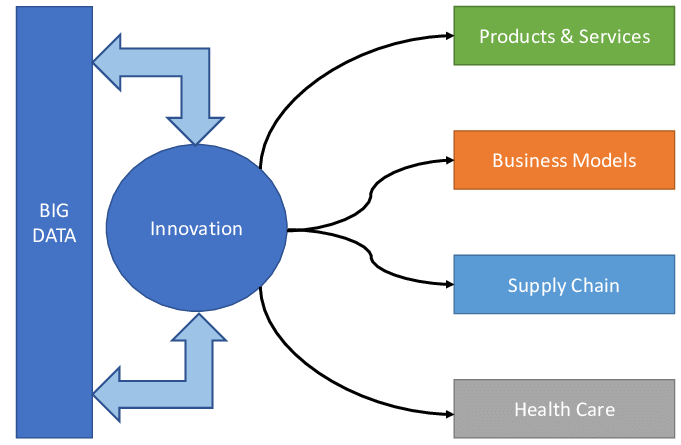
Partly embedded within technological innovations lie the building blocks to become the data architecture of the financial services industry’s future. Consumer footprints in data increase and the consumer intelligence that can be derived from this information grows. Drawing on such intelligence and connected devices, customer needs can be predicted more accurately, and customer service delivery can be geared more effectively to these customer needs, which could, among other benefits, propel competitiveness. The most successful businesses will be the ones that best harness the power of data. From every individual, minute chinks of information are generated constantly, building together a comprehensive data profile of every person. Ranging from consumer goods and devices, to services and sites, each time an interaction occurs this landscape broadens even further. This has profound implications for the financial services sector and the service delivery mechanisms that underpin it. Reality morphs away from financial needs and actual service provision and towards the best data-driven guesses one can make about individuals. Data architecture becomes the FS service infrastructure, customer intelligence gives birth to a new breed of highly targeted customer solutions and the current customer service ecosystem needs to readjust to these developments to keep the wheels of efficient service delivery spinning. This is where opportunities and challenges emerge. To find problems with the customer service delivery model is to find opportunities. In squeezing the minute chinks of data available for every individual lies the conceptual premise of the solution model proposed in this essay. Wide-ranging and all-encompassing research into a well-disingenuously explained consumer data palms model indicates the resistance to disruption within the current Mechanistic dyad (which consists of traditional FS firms and their service providers).
1.1. Background and Significance
Historically, records of individual transactions have always characterized financial operations. However, the dawn of large-scale digitization has vastly multiplied the volume of data generated mainly by business operations, threatening to overshadow its actual financial counterpart. Ironically, despite these enormous data assets, the 2008 crisis demonstrated banks’ enduring lack of accurate data on a global scale, due mainly to issues of quality and compatibility. In the contemporary era, ever-growing data flows have modified a myriad of processes and customer behaviors, shaping new, diversified services and innovative business models. In such a context, big data analytics is proving to be the tool that can enhance data leverage for financial institutions on an operational front as well as a strategic one.
Data has always been at the basis of each financial operation. They can describe a singular transaction, run across a myriad of them or between various entities. Such a historical concept seems to be still valid, with data centric business models appearing in the wake of the discontinuities in consumer behaviors and financial services’ provisions sparked by the 2007-2008 financial turmoil. Nevertheless, from that pandemonium, financial operators have indistinctly sought structured, precise data and have overlooked the potential value offered by haphazard, large-scale data flow. After over a decade, economic and financial activities give shape to much broader data streams, driven by massive digit power and inherent to most tasks. Alongside, services rule an increasing portion of practices and businesses interact with each other more and more through computational devices thus building extensive archives of such transactions. With such broad commercial infrastructure, people are increasingly used to online payments, crippling the cash cost of each transaction, hence producing vast volumes of financial data. These networks have already been causing traditional banks competitive distress, establishing themselves as financial advisors and payment intermediation platforms at the same time. On the other side, lenders and insuring institutions are increasingly blending into people’s daily routines. In such a marketplace, a dataset is built by each transaction, each mortgage installment and so forth [1].
Equation 1: Customer Lifetime Value (CLV)
where:
is the revenue generated from the customer in time period .
is the cost of servicing the customer in time period .
is the discount rate (reflecting the time value of money).
is the expected time horizon (e.g., customer retention period).
1.2. Research Aim and Objectives
This section informs the reader of the objectives that the research is aiming to achieve. It explains to the reader what the researcher has set out to do and what they will have achieved if the research is thoroughly successful. It articulates why these specific goals have been chosen, situating them in the context of current research and debates.
The objective is to enrich the theoretical and empirical understanding of how firms leverage data-driven innovation to enhance customer-centric service delivery and support their strategic positioning and differentiation in a competitive marketplace. In doing so, this research unpacks the service system of financial institutions - a sector characteristically rich in dataset and advanced technologies for data analysis - to examine how the data-centric practices of generating, sharing, and utilizing data interact with firms’ customer-centric strategies. Drawing on data gathered from 12 in-depth case studies of data-intensive financial firms and using a mixed-method research design — combining document analysis, interviews, and social network analysis — the research asks how financial institutions utilize data-driven innovation in crafting intelligent solutions to better understand and serve customers. To explore this central question, three clusters of research objectives have been defined:
- To unpack how the service system of financial institutions interacts with the data-centric practices of generating, sharing, and utilizing data. This cluster first examines the generative mechanism of data utilization that enhances firms’ situational awareness to better capture insights about competitors, customers, and market trends supporting firms’ decision-making mechanism and possible trade-offs in data utilization. This cluster then zooms into the sharing structure of generated data to unveil what role intermediaries and platforms might play in facilitating the flow of data both within the industry sector and across sectoral boundaries. This cluster, finally, scrutinizes how information collected from external data sources complements the institutional or comparative advantages of financial institutions.
- To understand what types of challenges in adopting data-centric practices firms encounter. This cluster inquires into the potential effects of differences in innovative capacities and organizational structure, as well as how regulative barriers relate to the strategies of firms in choosing data-sharing partners. It also examines how privacy protection norms accrue in response to a mix of market competition over data and stringent disclosure requirements enacted by regulators.
- To identify the role of public research institutions in supporting data-driven innovation. This cluster first unpacks how the structure of co-inventorship of patents on big data analysis techniques varies, and it assesses whether collaborative research with public research institutions performed in early stages of inventive activity becomes more exploratory. This cluster also considers how the network position of firms in the knowledge production of patents dictates the possible absorptive capacity of firms to interpret knowledge spillover.
2. The Role of Data in Finance
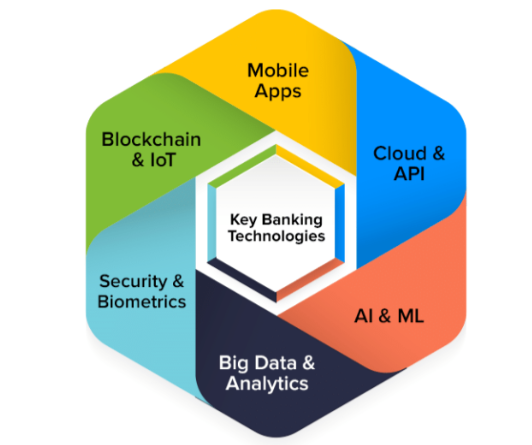
The financial services landscape is ever-changing. Disruptive competition from innovative fintechs in combination with evolving regulations and increasing customer demands are reshaping the marketspace. This transformation provides abundant opportunities for established players and newcomers to hone in on customer-centric service provision. By understanding the needs and expectations of consumers and leveraging respective data sources, institutions can ensure that financial products answer specific customer requirements. Data plays an integral part in modern financial services. It is used for informed decision-making processes, is the essence of product development and fulfills legal obligations concerning documentation and transaction transparency. Today financial institutions can access wide arrays of data sources – internal and external, structured and unstructured; originating from text, speech, or video. Since data is at the heart of every financial service, it is crucial to ensure that its product is fit for the purpose: precise, unique, and exhibits data accuracy.
Product, pricing, placement, and promotion have always been a foundation of financial services marketing. Nowadays products can be divided into physical (loans, cards, accounts, etc.) and advisory and remote (e.g. calculators). Services are becoming more and more intangible and customer views are evolving. They expect a seamless service experience across all available communication channels. The product alone is no longer the fundamental aspect of the service – the whole service delivery system becomes one. Moreover, in the financial markets landscape is not only about perfect competition but also about evolving competition due to changing customer demands and technological developments. Continuous innovation in both products and services is crucial in gaining competitive advantage. With the evolving computing capabilities and storage capacities of modern computers, it has become trivial for companies to gather – and tend to gather – all relevant data which are generated within the business. As a result, the data-driven culture starts to grow and develop within organizations, forming a new competitive advantage. All these aspects bring light to the necessity of fostering innovative data-driven solutions within modern finance.
2.1. Importance of Data in Financial Services
In the past two decades, the focus of competition between financial services has been shifting from capital to services, in line with customers' demands for continuous changes in quantity and quality. In the context of this convincing, computer equipment and data analysis ability is common everywhere, and many financial institutions have broadened their scope for the use of big data analysis. This has added more fontaine spring possibilities to financial services. To make use of big data analytics, whether of particular data collection capabilities or market challenges, has become an important opportunity for financial institutions. When compiled into Excel tables, the variability in data is not just datasets or files. A spectrum of bank transactions can be viewed to cover the date of the transaction, the transaction number, the amount of the transaction, bank charges, and the balance after the transaction. There can be ten thousands of transactions in such a procedure, and there may be countless entries as the days increase. The actual volume of data is much vaster that anyone can manage individually. A database of this kind of data contains numerous business possibilities that considerably exceed its database volume and complexity. For instance, it can be used to monitor and comprehend consumer behavior, to predict customer behavior patterns, and to identify the most profitable customers. This data might offer information about undetected marketplace trends, which enables market segmentation either explicitly or implicitly [2]. It can discard redundant or imprecise business policies relying on this analysis and develop big-data grounded policies that deliver a competitive advantage to financial institutions.
2.2. Types of Data Used in Finance
Financial services handle a wide range of structured data, like investment, insurance, and credit information. Investment is related to funding allocations that will affect the future based on current decisions. Typically, people or large clients invest in different factions, including local industries, public sectors, other commodities, and overseas business sectors, securities, and so on. Equities are the most direct and actively traded. The economic operations of countries, as well as government policies, literally all types of information in the world in the investment industry affect the fluctuation of security prices. Trying to forecast stock performance and designing financial tools consume considerable resources like time, manpower, and equipment. Therefore, there has been a long history of applying intelligent technology in seeking valuable information.
Insurance is a kind of guarantee for hazardous events whose likelihood is much lower than the normal case, but when it arises the potential consequences are immense. Consider the insurance of automobiles, houses, businesses, while related to prosperity and livelihood for individuals; it is really uncertain whether any loss will happen. One can pay yearly a small fraction, a premium, in order to prepare protection for the potential dangers. That is, insurance companies promise not to burden all expenses to the clients in case of an accident. They give proper compensation so long as clients pay the premium periodically. That is the basic mechanism of the insurance service. Provided the benefits are satisfactory, insurance is recommended. However, many kinds of hidden conditions, restrictions, and penalties can be involved and are, strictly speaking, rigid. Many consumers may feel aggrieved when they face such dilemmas, often ending up in court. These issues can be avoided if enough support is tied up in advance.
Credit information concerns the credentials and debts of an individual or firm. Because of delays in receiving mass credit information and difficulties in understanding it, special services can provide summaries to the customers. Not only a review of their present circumstances, clients also learn what further actions to proceed. To guarantee transaction safety and stimulate the efficient collaboration of trading partners, coordinators exist. Trust requires a reliable and secure atmosphere. The presented system aims to foster cooperation among teams that might be unfamiliar with each other for information exchange through a coordinator.
3. Data-Driven Innovation in Customer-Centric Service Delivery
Financial institutions are increasingly challenged to innovate. Traditionally, banks have been slow movers in the innovation game, but in an Agile/Lean start-up age, they are forced to dance over the edge and innovate. The recent adoption of the revised Payment Services Directive is one of the legislations that impose technological innovation upon the European financial industry. The directive enforces financial institutions to give access to their consumer’s data, affecting a whole range of companies and innovations. This offers ample room for exploration of the directive in the vast academic field of data-driven innovation by means of craft. Financial institutions ultimately are driven by the consumer: their businesses are based upon a value exchange with consumers. Approximately one way to grasp the chaotic seething mass of the future is to listen very carefully to what the consumer wants and shapes. Financial institutions have vast amounts of data about their customer base. Recently, an entire IT-industry emerged focusing on the user of the new extensive data sets, commonly known as Big Data. There is an opportunity for financial institutions to develop these data sets further by acquiring data from a wide variety of sources, such as third party platforms. It is argued that the big business in finance will be made investing in consumer data intelligent services that wield real-time consumer data intelligently according to consumer wish. A technology provider in the financial services industry will be used as the real-world case representing the data service provider’s side. The case presents a proposition to establish an innovative European project. The draft is outlined, addressing the purpose and perspective of the project. If a good or service offering to a customer fulfills the customer’s special needs, the customer is more likely to come back, and buy more expensive goods and services. On the other hand, for instance, customization of medical treatments or medication is prohibited for some concerns of privacy protection of the patient.
3.1. Personalization and Customization
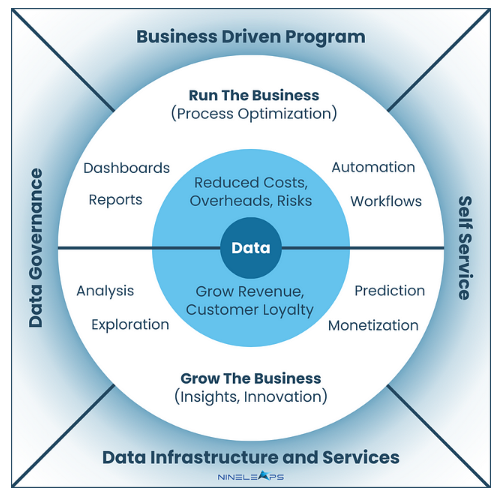
Banking, as the primary financial service, is at the core of the fintech industry. However, until industry reforms in the late twentieth and early twenty-first centuries, traditional banks have always been data-insensitive. Banking institutions rely on expert knowledge for a better understanding of the customer to make informed decisions. Personalized financial services are believed to give a competitive advantage to the banking industry and to represent the arrival of a major shift. Therefore, financial services oriented for customers’ special needs could be obtained with the analysis of vast historical and current data records. Customer preferences and behavior patterns could be learned from the analysis of those records. Tailored products and strategies could be made for each client by the data-driven, personalized service. Aside from historical performances, currently real-time recommendations could also be generated. Consequently, customers could get more enjoyable services and guarantees. A considerable increase in customer satisfaction and customer retention for banking institutions will follow by those methods.
Several strategies could be implemented by banking service provider institutions to enhance service experiences and cater to customers’ needs. As an illustration, financial service institutions could send customized travel tips to frequent travelers and optimize exchange rates when withdrawing money abroad. Several strategies of banks for tailored service delivery are presented and reasonable suggestions are made for relevant customized tools. Additionally, commercial banks could use customers’ personal account information to promote preferentially targeted products, such as offering discounted health insurance to a customer diagnosed with diabetes. Furthermore, banks can seize the opportunity to generate leads for marketing credit services or products by detecting transaction-based behavior like large cash withdrawals. Customer transaction history could be taken advantage of by customizing the rate quote for a customer applying for a home loan who has several paychecks deposited into their account monthly. A few suggestions for intern projects are tendered, and for gaining future access, selected publicly available data sources are introduced. Lastly, banks could enhance customer trust and satisfaction levels by providing account holders visibility and control over data aggregation. A bank that has embraced the fintech revolution and offered data-driven services early in its inception can be analyzed as a case study, which provides insight into the potential effects on the broader retail banking industry.
Customization is the practice of tailoring goods and services to customer needs. In practice, there are many sophisticated algorithms and technologies for customization. Recommendation algorithms are used by many popular online websites to recommend products to potential customers based on their historical shopping profiles. Examples are in China and the USA. Another example is to customize the design of products, such as the iPhone, which offers different covers or skins to its customers to choose from. In general, a successful recommendation of complex goods or services would undoubtedly lead to business strategies and economic benefits for the service providers. However, in every technology implementation, there may always be concerns including the safety and the ethics of using the personal data for customization. It is well known that personalization helps businesses significantly improve its customer retention rate and customer engagement level.
Equation 2: Data-Driven Innovation (Predictive Analytics)
where:
is the probability of a customer churning.
is the sigmoid function (for probabilities between 0 and 1).
are customer features (e.g., transaction history, interaction data).
are the weights of the features learned from data.
is the bias term.
4. Competitive Advantage through Data-Driven Innovation
The finance sector has witnessed a burst of business models and service delivery strategies underpinned by data-driven innovation: from advanced analytics in credit scoring to robo-advisors in trading platforms. Financial institutions are leveraging data and analytics in diverse and novel ways to support strategic priorities, organizational mandates, and customer needs, leading to better (and often more tailored) services than before. Other surveys highlight the relationship between a firm‘s innovation pace and its ability to commercialize or exploit insights from data: the EU noted that 92% of companies that were successful in their markets were able to leverage data generated by innovation, while NSI Ireland observed an increase in innovation performance in biopharma and chemistry enterprises due to smart data use. Being able to store and process data effectively, and to connect data effectively between businesses, were highlighted by NSI Ireland as critical to unlock the commercial value of data insights. Century-old financial corporations as well as young, purpose-based financial innovators worldwide are striving to tap into big data for sustainable competitive advantage. New market entrants offering novel fintech solutions pushing the frontier of conventional operations are dispensed. A host of examples aims to illustrate the broad spectrum of intelligent solutions crafted by financial institutions around the world to leverage data-driven efficiency, customer-centric operations, and continuous innovation. Inevitably, a regulatory framework focused on promoting responsible competition has exerted pressure to exploit data proactively to attain or maintain a competitive edge. Since the financial crisis in 2008, reforms under Basel III and Dodd-Frank have strived to strengthen the durability of financial systems and standardized traditional risk management practices.
4.1. Enhancing Decision-Making
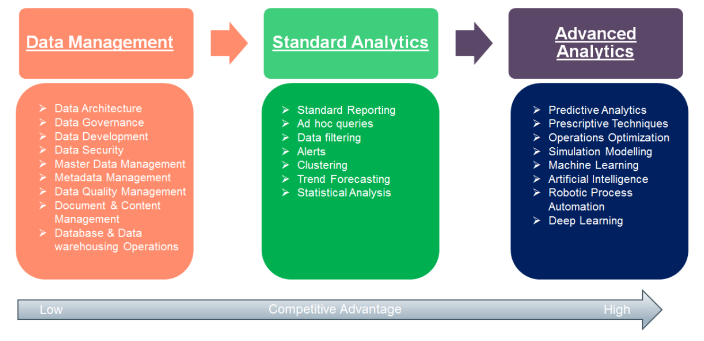
Data has increasingly become the most important asset in making informed decisions within financial institutions. Insights derived from data analytics enable professionals to monitor past performance and forecast future behavior. Data-based decision-making has proved to help finance institutions deliver better service in terms of timeliness and accuracy. Hence, financial institutions are leveraging data as much as they can to ensure effective and efficient decisions. This analysis illustrates how institutions make decisions based on an assessment of the past, predictions of the future, and the potential risk of outcomes. There are numerous statistical and analytical tools available to seasoned professionals that can be applied to develop more accurate and sophisticated forecasts and assessments [3]. The availability of real-time data provides up-to-the-minute information that can be crucial in many decision processes, especially in risk management. Many decisions are also collaborative efforts between different departments within the finance institution; data-driven decision-making may potentially foster better teamwork and mandated better data sharing practices. Finally, the emergence of big data and data analyzers has highlighted the importance for professionals within the industry to become more adept at assessing, comprehending, and making decisions based on large datasets. This involves not just learning software programs, but fostering a culture of data-driven decision-making at the organizational level. An overview of several case studies provides examples of how a well-crafted decision framework can increase the likelihood of success when it comes to strategic objectives in finance industries.
5. Challenges and Ethical Considerations in Data-Driven Finance
Banking and financial institutions are disruptive industries that continue to generate significant amounts of data. To succeed and remain competitive, these new players must leverage datasets, focusing on customer-centric service delivery as an effective strategy. Carefully and intelligently crafting value-added strategies that center around customer needs and preferences is a hallmark of successful organizations in a rapidly evolving and competitive landscape.
The use of advanced analytics and big data to meet the needs of customers can enable the generation of new value-added services, ensure faster financial process deliveries, and provide customer assessment services at different points of contact. However, even though the uses of such datasets promise significant benefits to consumers, financial institutions, and society at large, data-driven finance gives rise to numerous challenges and ethical considerations. These include but are not limited to data privacy, regulatory issues, and risks of security breaches. Such risks can expose customers to potential threats that would not be possible with the same extent in the analog world. Considering these critical issues closely, this paper aims to explore the data-driven financial industry and highlight potential risks for individuals; draw attention to the challenges of building up transparent data governance frameworks for institutions; and call policymakers to take steps to ensure that the necessary enforcement is in place, including expanding data protection guarantees and ensuring legal redress for the misuse of data; and consider the ethical implications of using advanced analytics for customer targeting, including the use of analytics for discrimination purposes, drawing attention to the need for a balance between fairness and a way that ensures legitimate business objectives.
6. Conclusion
The transformation of finance towards more personalized service uses intelligent solutions made possible through data analytics technologies [4]. Five essays provide results on ready-to-use and adaptable tools in finance offering a wide degree of personalization. Data-driven innovation is necessary to increase utilization of financial services and improve user experience and service delivery. User-centric and identified intelligent solutions address selected finance domain challenges and how competitive advantage can be gained there by the use. Challenges and limitations data-driven innovation currently faces in finance are considered, including technical constraints, difficulties in accessing data, and privacy and ethical aspects and these difficulties need to be addressed. The future outlook of intelligent solutions in financial services is an understanding of market, customer, and OEM’s needs based on data and continuous adaptation and evolution in a quickly developing industry area. The important and expected implications of wide-spread intelligent financial services for individuals, policy makers and investors and manufacturers in the internet-of-things domain are discussed. One of the outlined goals is to create food for thought for the finance domain on how to catch up and benefit from ongoing digitalization and personalization trends in user facing service industries. These essays are about presenting solutions addressing at least in parts considered challenges and posing questions to a wide audience on what approaches are considered and discussed around these topics.
The Internet-of-Things has a large potential in creating intelligent and well tailored solutions making use of already existing data and extensive spread sensing possibilities. Companies are in constant search of solutions providing competitive advantage to outstand on the market, save margins, and increase service utilization. Summarized results and considerations may also act as a best practice guide for those intending to create or commission the development of user-centric financial service offerings. From these essays companies interested in IoT for their device fleet could start by selecting either wearable sensor-equipped bands, a user habit understanding IoT networks providing them with insights into customer actual behavior patterns, or experimenting with novel means of interactive customer engagement.
Equation 3: Customer-Centric Service Delivery
where:
is the customer satisfaction score.
is personalization of service (e.g., customized recommendations).
is the speed of service (e.g., transaction processing time).
is the quality of service (e.g., error rates in transactions).
is the accuracy of service (e.g., predictive accuracy of financial models).
6.1. Future Trends
Artificial intelligence (AI), machine and deep learning will shape the future of data-driven innovation in financial services. These technologies enable applications that tend to be more intelligent, efficient and customer orientated. At the centre of strategic development, there is the objective to provide a better and multi-supervised User Experience (UX) with technologies being able to better understand the behavioural and satisfaction patterns of end users and client organisations with an always on approach rather than a point solution approach. For services, these technologies support those more personalised and adaptive ones, aimed at continuously checking contexts and data in and out the system.
The regulatory framework is pressed to evolve quickly by introducing standards for aggregated banking, insurance and financial data as a promotion of new business models, industrial eco-systems and data facilities. While these evolving regulations aims seriously fostering the adoption of new technologies in the financial services segment, as part of smart specialisation strategies and accelerating technology transfer, they will somehow mitigate effects by substantial differences in the innovation readiness of market leading companies in the industry: a certain “data apartheid” could be observed in the short term, and negative effects in terms of services to SMEs and citizens does not have access to large data pools.
A sectoral innovation approach is explored in terms of data-driven innovation. The kaleidoscopic advantage is a thorough understanding of the importance of data analytics in business model innovation and creation. Product of this interest is the disruptive advantage that hopes to provide a novel basis for the financial sector and its reliance on Big Data and other forms of analytics. Customer data analytics is the key for future competitive advantage for financial institutions, while service take-up of the same technologies represents a major potential pathway for new future financial services, both driven by the availability of new large data pools in the future. Thus, customer data analytics might foster a new generation of money-making services while service datasets feeding into one-to-one-data-based services might be exchangeable on a brand new multi million Euro market. From a positive viewpoint, integrated customer-centric service provision offers an untapped opportunity for the industry to go beyond an increasing competition and market saturation by focusing on the unique value of the service. The simplicity of these services could also be an antidote to the data security/statistical disclosure issues. Those wanting to have full control of their IoT devices could do it now, compromising many of their benefits. And yet, customer data analytics takes direct inspiration from marketing activities, using data to probe into customer behaviour and enhance the effectiveness of advertising strategies. Data might thus offer manufacturers and brands the chance to provide a new comparable level of service, linking physical, durable products with disposable and connected ones: firms providing quality marketing data tools will have a privileged position to innovate, while great importance will be given to data standards and formats. The negative outlook of this scenario describes a proliferation of opaque, untraceable data-informed non-physical bundled products and services. Non-transparent models could emerge online offering products apparently cheaper but bound to defaults and loan restructuring. The temptation might be to use data to requisition customers in a very prescriptive behaviour in order to foster a determinant service plan. There is a promising outlook on the role of Public Administrations and their own data, as this could be the ground for the creation of an ecosystem based on open and mutual data [5].
Accurate and timely data on annuities, pensions, taxes and other revenue sources of a person could be relied upon to provide a better assessment of their spending capacity and creditworthiness. Eventually, fiscal control/enforcement might turn into an advanced online service, the flow of unique fiscal data could be negotiated on a fee basis, fostering the creation of an oligopolistic and non-transparent market. From a strictly public p.o.v., instead, public bodies might be pressed towards the liberalisation of data for speculation reasons, while the control needs proper tools to avoid default and dumping. Official data access could otherwise pose serious data protection issues: the authentic platform must ensure a fully secure treatment of personal data. Independent, accredited companies might act as intermediary, the online/data provision market will provide metadata certification, the serious market actors must be fully informed and proactive, provided with ongoing data analysis as well.
Critically, the current formula takes into account a large gap between the certainty of the offered data-based services and the fuzzy treatment of ethical principles and of the possible emergence of abusive or dangerous practices. The law must be actually one river as much as the data and must integrate all the branches potentially involved in a data-driven service. At the same time regulation and supervisory bodies must always step ahead to anticipate potential imbalances and abuses. Public databases of negative and statutory data might be established, though the right to be forgotten must be strictly enforced. Swipe might be based on rapid standardised credit scoring, the smallest trades will be experimented as non-stop mode. It is absolutely necessary to enhance the diffusion of technology literate experts and legal and ethical support. Legal protection insurance and standard contracts must be taken out with all suppliers and vendors: the “standard” contracts must rather be innovative ans set the ethical use of data. Audio-video documentation of all meetings and business transactions might be used for evidential purposes. Data processes will be audited, with a personal and corporate level liability, and a brandy new figure of (data) business analysts will be increasingly called into question. Finally, are liability issues considered? Specifically, the focus is on how the “internet” of the services and its multiple folds might damage competition hereby establishing a detrimental position of dominant companies that could be flexibly re-designed even minute by minute. Hence, it is mandatory that schooling and interning programs might be understood as a delicate and impartial service by the Public Administrations. It should be smart only in terms of productivity, innovation, technological planning and shortening the distance between regions, not by adopting rules that reduce the capability of large companies to deliver and consequently suspend the market. Concertation between interested actors and the spread of best practices would be beneficial in order to afford the competitive disadvantage of SME. On the other hand, Maximum efforts must be put on security and data protection. Political Administrations must take advantage of the Digital Committee to liaise with public safety firms to guarantee the adoption of the most effective technological tools and data procedures.
References
- Vankayalapati, R. K., & Rao Nampalli, R. C. (2019). Explainable Analytics in Multi-Cloud Environments: A Framework for Transparent Decision-Making. Journal of Artificial Intelligence and Big Data, 1(1), 1228. Retrieved from https://www.scipublications.com/journal/index.php/jaibd/article/view/1228[CrossRef]
- Dilip Kumar Vaka. (2019). Cloud-Driven Excellence: A Comprehensive Evaluation of SAP S/4HANA ERP. Journal of Scientific and Engineering Research. https://doi.org/10.5281/ZENODO.11219959
- Chintale, P., Korada, L., Ranjan, P., & Malviya, R. K. (2019). Adopting Infrastructure as Code (IaC) for Efficient Financial Cloud Management. ISSN: 2096-3246, 51(04).
- Syed, S. (2019). Roadmap For Enterprise Information Management: Strategies And Approaches In 2019. International Journal Of Engineering And Computer Science, 8(12), 24907-24917.[CrossRef]
- Mandala, V. (2019). Optimizing Fleet Performance: A Deep Learning Approach on AWS IoT and Kafka Streams for Predictive Maintenance of Heavy - Duty Engines. International Journal of Science and Research (IJSR), 8(10), 1860–1864. https://doi.org/10.21275/es24516094655[CrossRef]