

The Nigerian Government both previous and present has introduced several policies and programmes to reduce or proffer remedial measures to militate against the negative impact of high inflationary levels on the Nigerian economy. All these measures have not led to a productive result as the inflation rate has continued to sour higher over the years. This paper aimed at examining the economic influence of the determinant factors that influence inflationary trends that are multi-dimensional and dynamic which continue to defy solutions. The data used for this work was sourced from the National Bureau of Statistics and Central Bank of Nigeria, from 1983 to 2020. The ordinary least square approach was used to analyze the data and the result shows that consumer’s price index, interest rate and total export has a positive effect on Nigeria inflation, but only the Consumer’s Price Index (CPI) have a statistically significant effect on the Nigeria inflation at 99% confidence interval. Result also shows that the exchange rate, foreign reserve, money supply, real GDP, real income and total imports has a negative effect though not statistically significant on the Nigeria inflation rate. The result of the granger causality test shows exchange rate and total imports to granger cause Nigeria inflation. It is recommended that Government should improve locally manufacture products to meet international demands to reduce total imports.
Economic Impact of Some Determinant Factors of Nigerian Inflation Rate
December 21, 2021
April 06, 2022
April 14, 2022
April 16, 2022
This is an Open Access article, distributed under the terms of the Creative Commons Attribution 4.0 International License (http://creativecommons.org/licenses/by/4.0/), which permits unrestricted use, distribution and reproduction in any medium or format, provided the original work is properly cited.
Abstract
1. Introduction
It is widely accepted that the pursuit of price stability is primary to long-run growth and development, and should be the concern of every economy. One of the reasons for this is the high varying inflation rate which has social and economic shocks on the economy as a result of its negative effect on price stability, savings and investment. Given this scenario, the focus of the monetary policy is primarily to be narrowed to the pursuit of low inflation rather than output or unemployment. Inflation does not happen out of a clear sky blue. An ideal and healthy economy with between 3 to 6 per cent inflation rate experiences steady positive economic growth. Inflation encourages investment and production and as such increase growth in wages and consumption. But, a high inflation rate in the range of double-digit may produce a negative economic effect. This will adversely affect the purchasing power of the consumer. It can lead to uncertainty of the value of gains and losses, borrowers and lenders as well as buyers and sellers (Abdul, Syed and Qazi, 2007)[1]. A high inflation rate results from an increase in food prices, it hurts the poor because of their high marginal propensity to consume. The main target of every nation’s monetary and fiscal policies, whether a developed or less developed nation has been the maintenance of a low and relatively stable rate of aggregate inflation. Economic stability is often regarded as the baseline for the realization of macroeconomic objectives. (Metwally and Al-Sowaidi, 2004)[2].
Since the mid-1960s, inflation has become so serious and contentions a problem in Nigeria. Though the inflation rate is not new in Nigerian economic history, the recent rates of inflation have been a cause of great concern to many. The continued overvaluation of the naira in 1980, even after the collapse of the oil boom engendered significant economic distortions in production and consumption as there was a high rate of dependence on imports which led to a balance of payment deficits. This resulted in taking loans to finance such deficits. An example was the Paris Club loan, which was a mere Five Billion, Thirty-nine million dollars ($5.39billion) in 1983 rose to twenty-one billion, six million dollars ($21.6billion) in 1999 (Metwally and Al-Sowaidi, 2004)[2]. Inflation harms the economy as a whole. In Nigeria, some of the macroeconomic variables determining inflation are the real Gross Domestic Product (GDP), exchange rate, government expenditure, money supply, interest rates, current account deficits, public debt, trade volume, foreign reserves, money supply and balance of trade, amongst other factors. The adoption of the Structural Adjustment Programme (SAP) in 1986 saw a temporal reduction in fiscal deficits and subsidies in the economy. But as the effects of the policy gathered momentum, there was a fall in the growth rate of Gross Domestic Product (GDP) in 1990 from 8.3% to 1.2% in 1994, with inflation rising from 7.5% in 1990 to 57.0% in 1994 respectively. In 1995, the inflation rate rose to 72.8% due to the increased lending rate, the policy of guided deregulation and the lagged impact of fiscal indiscipline. In addition to her contemporary fiscal and monetary policies, the Nigerian government had implemented various other policies aimed at curbing inflation in the country. One of such policies was the price policy (price control) in 1971 meant to control the soaring prices of essential goods but was abolished in 1980 for its ineffectiveness resulting from the severe shortages witnessed during the oil glut in Nigeria (Udu, 1989)[3]. Programmes in the Agricultural sector like the “Operation Feed the Nation” and the “Green Revolution” were implemented to boost output to reduce prices of food items but yielded minimal results. Notwithstanding the various efforts of the Nigerian government to curb the inflationary trend, inflation continued to cause a setback in the growth rate of the living standard of most Nigerians who are fixed income earners or unemployed (Agba, 1994)[4].
2. Literature Review
In literature, the search for the influence of inflation indicators on the inflation rate is studied to discover better results. (Pinto, 1990)[5] recognized the determinants of equal market premium as interest for homegrown cash, the pace of expansion different terms of exchange and contended that swelling rises because the depreciation associated with the unification of both the authority and equal trade rates disposes of incomes from sending out the profit. (Canetti and Greene, 1991)[6] estimated the impact of financial development and conversion scale changes on winning and anticipated paces of swelling. The examination region incorporates the Gambia, Ghana, Kenya, Nigeria, Sierra Leone, Somalia, Tanzania, Uganda, Zaire, and Zambia. The embraced apparatus of examination was the Vector Auto Regression (VAR) procedure. The discoveries of the investigation show that money related elements overwhelm swelling levels in four nations, yet in three different nations, conversion scale devaluation controls expansion. (Egwakhide, 1994)[7] in looking at conversion scale devaluation and expansion in Nigeria found that deterioration of the swapping scale applies up swelling pressure yet it takes a base time of one year before this is thought about value expansion. Acknowledgement of this outcome suggests acknowledgement of the way that the country's swelling is brought about by both financial and underlying variables. (Iyabode, 1999)[9] Odusola and">8] fostered a two-stage least square model to assess the inflationary pattern in Nigeria during the period 1971 to 1995. The examination utilized a fractional balance model dependent on miniature establishments to tackle value levels. The outcomes affirmed the significance of equal market swapping scale elements. (Odusola and Akinlo, 2001)[9] utilized unhindered VAR strategy and motivation reaction to analyze an investigation on yield, swelling and swapping scale in Nigeria. Proof from motivation reaction capacities and underlying VAR models showed a negative impact of expansion on the yield. Yet, yield and equal conversion standards were discovered to be the significant determinants of expansion elements in Nigeria. (Busari, 2007)[10] utilized among different measures, the Hodrick and Prescott channel. After disintegrating expansion into patterns of repetitive, occasional, and, arbitrary segments, the examination received the general-to-explicit displaying the way to deal with research the principle determinants of every segment of swelling. The outcomes affirmed that over the long haul, expansion is to a great extent and decidedly identified with the degree of (thin) cash supply and, imperceptibly, to financial deficiency. In the medium term, expansion was seen to be emphatically identified with conversion scale devaluation and the development of the cash supply. In the short run, it was seen that swelling was emphatically identified with development in cash supply and conversion scale devaluation while it was adversely identified with development in genuine GDP. (Odusanya and Atanda, 2010)[11] fundamentally analyzed the dynamic and concurrent connection among expansion and its determinants in Nigeria from 1970 to 2007. The Augmented Engle-Granger (AEG), co-reconciliation test and mistake revision model were utilized. The assessed result demonstrates significant advantages gathered while moving from a high or moderate rate to a low degree of expansion. (Bakare, 2011)[12] analyzed the determinants of cash supply development and its suggestions on expansion in Nigeria. The investigation utilized a semi test research configuration approach for the information examination. The plan consolidated hypothetical thought (deduced measures) with exact perceptions and concentrate the greatest data from the accessible information. The assessed relapse result uncovered a positive connection between cash supply development and swelling in Nigeria. (Imimole and Enoma, 2011)[13] explored the effect of swapping scale deterioration on swelling in Nigeria. Utilizing auto relapse appropriated slack (ARDL) and co-coordination methodology. Proof from the gauge results recommends that swapping scale devaluation, cash supply and genuine total national output were the primary determinants of expansion in Nigeria. (Alexander et al., 2012)[14] explored the primary determinants of expansion in Nigeria for the period 1986 – 2011. The Augmented Dickey-Fuller unit root insights test uncovered that every one of the factors is fixed after the first and second contrast at a 5% degree of importance. The co-joining result uncovers a since quite a while ago run balance connection between the pace of swelling and its determinants. The Granger causality test uncovered proof of a criticism connection among expansion and its determinants. The assessed VAR result showed that monetary shortages, conversion scale, import of labour and products, cash supply and rural yield impact the expansion rate in Nigeria. (Sani et al., 2016)[15] analyzed the elements of the inflationary cycle in Nigeria over the period 1981–2015, utilizing the limits testing a way to deal with co-incorporation. Experimental outcomes demonstrated that expansion in Nigeria intermediaries by CPI showed a solid level of inactivity. The econometric outcomes showed that previous swelling and normal precipitation seemed to have been the primary determinants of the inflationary interaction in Nigeria over the examination time frame.
The study aimed at building a statistical model for Nigerian Inflation and its determinants. It shall also identify the determinants responsible for the high inflation rate in the country and carry out a granger causality test to ascertain whether there exist bi-directional, uni-directional or no direction between the explanatory variables.
3. Materials and Methods
3.1. Source of Data
The data used in this study are collected from the 2019 National Bureau of Statistics and Central Bank of Nigeria Statistical Bulletin. The data are collected from the period 1983 to 2020 for inflation rate, Consumer Price Index (CPI), interest rate, money supply, real income, real Gross Domestic Products (GDP), Foreign Exchange (FOREX) reserve, exchange rate, total imports and total export.
3.2. Model Specification
The study shall utilize nine explanatory variables, namely; CPI, interest rate, money supply, real income, real GDP, FOREX reserve, exchange rate, total imports and total export
Where:
= Inflation Rate
= CPI
= Interest Rate
= Money Supply (M2))
= Real Income
= Real GDP (Gross Domestic Product)
= Forex Reserve
= Exchange Rate
= Total Imports
= Total Exports
= disturbance Term
3.3. Ordinary Least Square Regression Model
Regression analysis is widely used to test for the impact, influence or effect of one or more explanatory variables on the response variable. In restricted circumstances, regression analysis can be used to infer causal relationships between the independent and dependent variables. However, this can lead to illusions or false relationships, so caution is advisable. It is also used for prediction and forecasting (Farrar, et al., 1967)[16]. For regression equation to be efficient, some assumptions are made about the stochastic error term. These assumptions are given below as follows:
3.3.1. Assumptions of Regression Analysis
- The error is a random variable with a mean of zero conditional on the explanatory variables.
- The independent variables are measured with no error. (If this is not so, modelling may be done instead of using errors-in-variables model techniques).
- The independent variables (predictors) are linearly independent, i.e. it is not possible to express any predictor as a linear combination of the others.
- The errors are uncorrelated, that is, the variance-covariance matrix of the errors is diagonal and each non-zero element is the variance of the error.
- The variance of the error is constant across observations (homoskedasticity). If not, weighted least squares or other methods might instead be used.
4. Results and Discussion
4.1. Preliminary Test for Regression assumption
4.1.1. Test for Stationarity
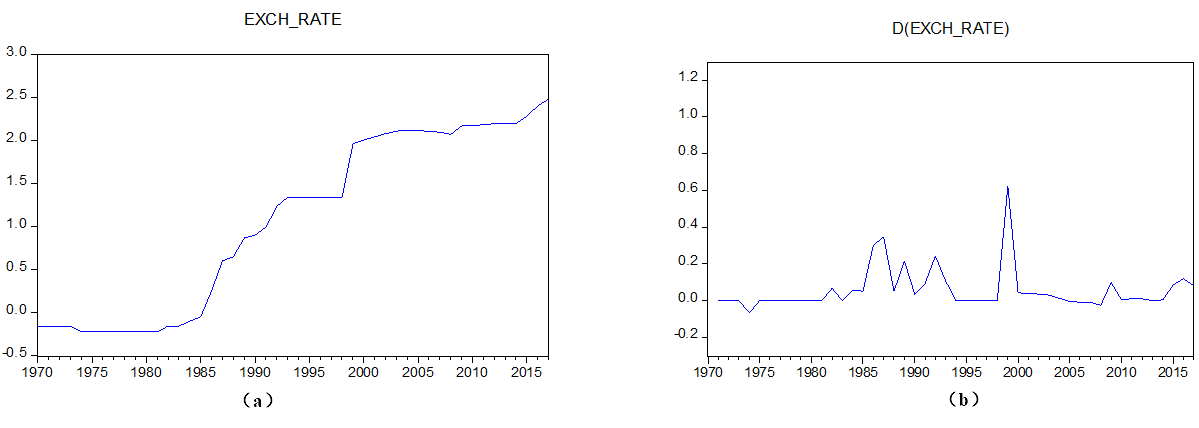
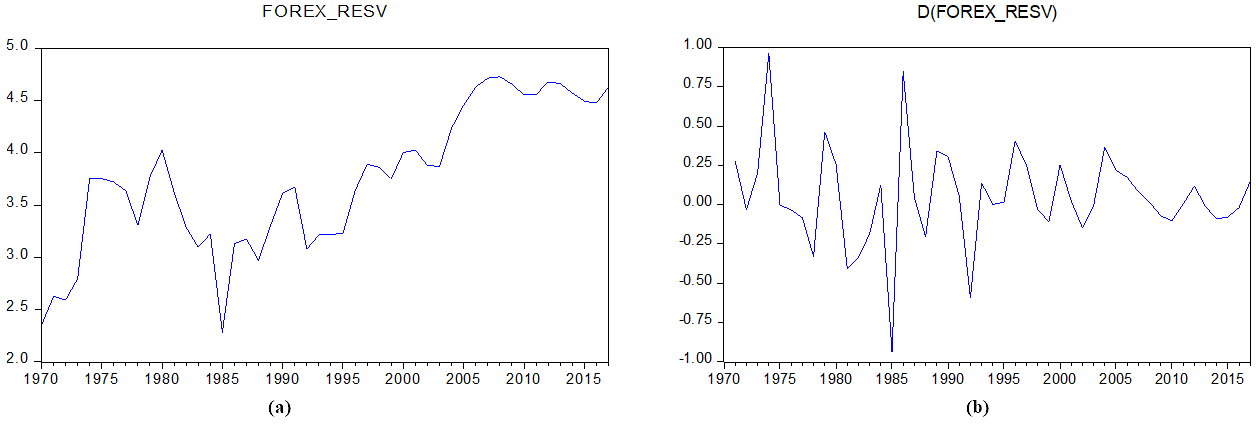
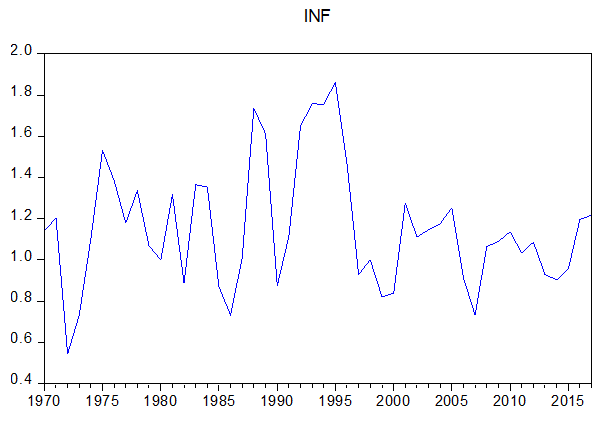
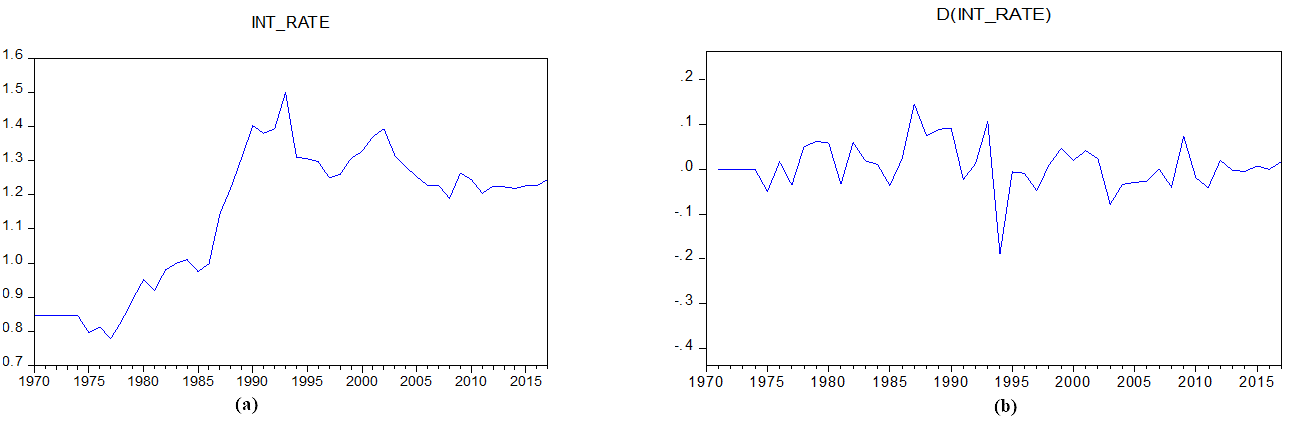
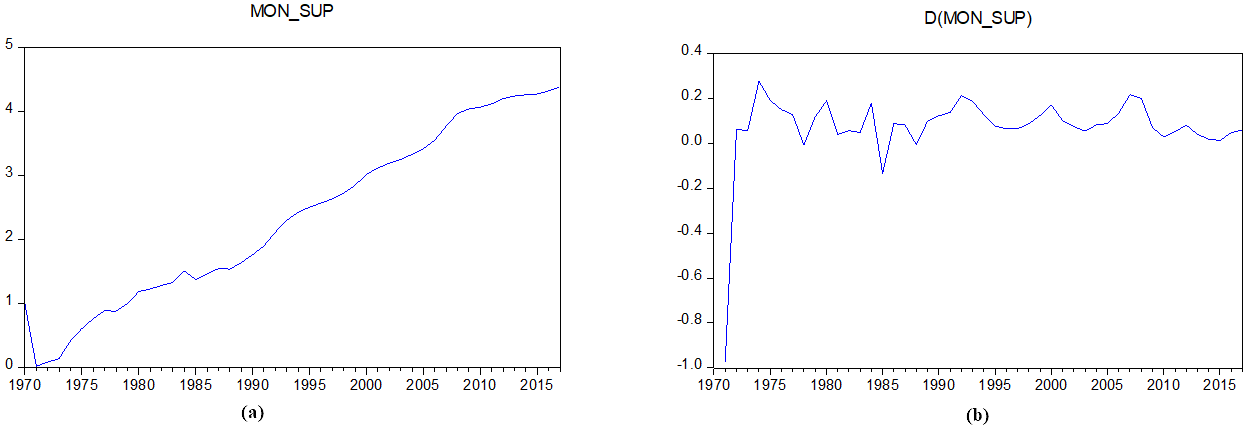
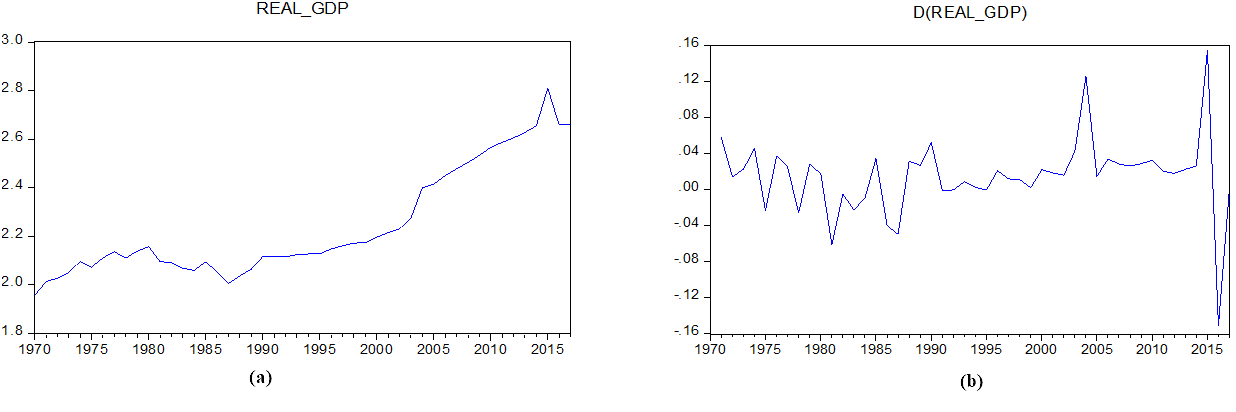
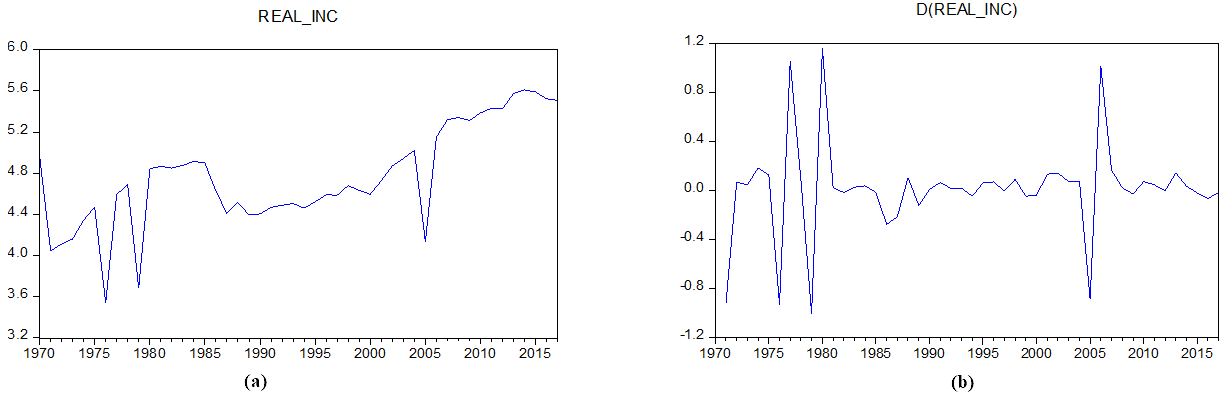
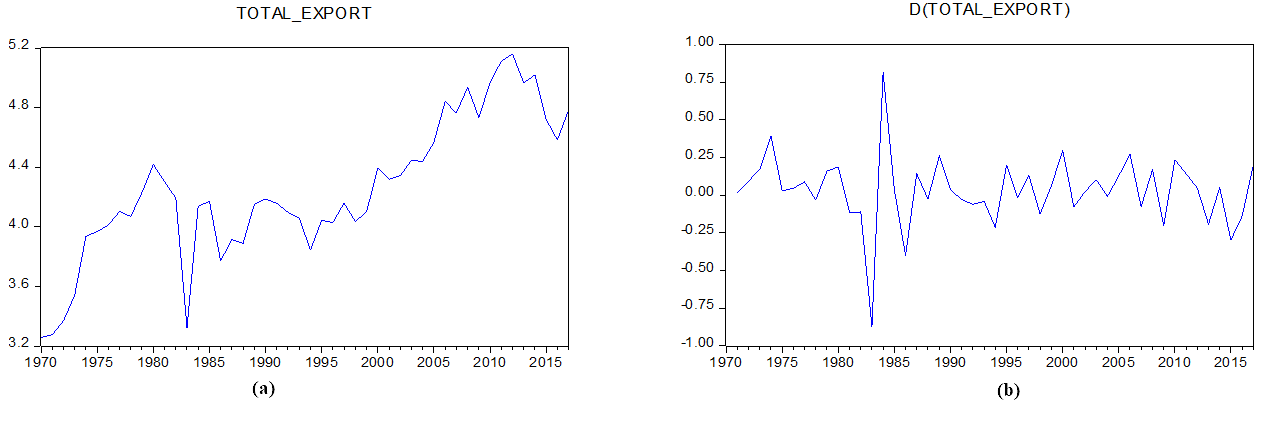
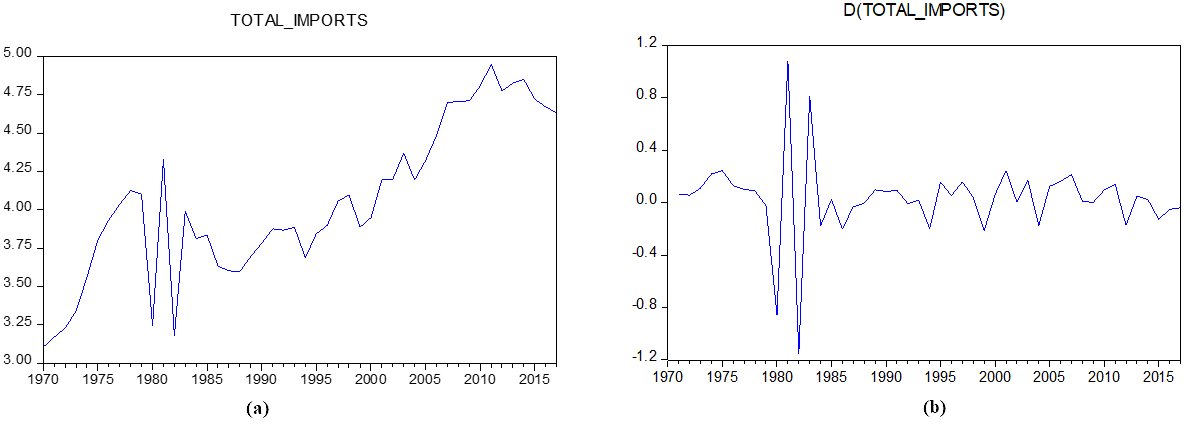
This section of this research contains the test for stationarity for all variables involved. The time plot for all the variables is presented to examine the trend of the variables and subsequently, to check if the series is stationary and also differencing the series when found not stationary. The formal test was also conducted to corroborate the graphical analyses already displayed. The results are summarized in Figures 1 to 9 and Table 1.
From the result above, Figure 1a shows that Exchange Rate is non-stationary at the level. (The probability statistic also shows not significant with value 0.9426), while Figure 1b shows that Exchange Rate is stationary at 1st difference. The probability statistic also shows significance with a value of 0.0000.
Table 4.5 produce an absolute value of the test statistic (2.0495) which is less than the absolute value of the 1% critical value (3.5777), 5% (2.9252) and 10% critical value (2.6007). Therefore, we do not reject the null hypothesis and conclude that Forex Reserve is non-stationary at the level. (The probability statistic also shows not significant with value 0.2655), while Table 4.6 shows the absolute value of the test statistic (7.5796) which is greater than the absolute value of the 1%, 5% and 10% critical values (3.5812, 2.9266 and 2.9014). Therefore, we do not accept the null hypothesis and conclude that Forex Reserve is stationary at 1st difference. The probability statistic also shows significance with a value of 0.0000. Figure 2a shows that Forex Reserve at level is non-stationary or has unit root while Figure 2b indicates that Forex Reserve has no unit root or it’s stationary at First Difference. Figure 3a shows that the inflation rate is stationary at a level. The probability statistic also shows significance with a value of 0.0006. Figure 4a show that Interest Rate is non-stationary at the level. (The probability statistic also shows not significant with value 0.2655) while Figure 4b shows that Interest Rate met stationary at 1st difference. The probability statistic also shows significance with a value of 0.0000. Table 4.10 produce an absolute value of the test statistic (1.5703) which is less than the absolute value of the 1% critical value (3.5812), 5% (2.9266) and 10% critical value (2.6014). Therefore, we do not reject the null hypothesis and conclude that Money Supply is non-stationary at level. (The probability statistic also shows not significant with value 0.4894), while Table 4.11 shows the absolute value of the test statistic (14.9873) which is greater than the absolute value of the 1%, 5% and 10% critical values (3.5812, 2.9266 and 2.9014). Therefore, we do not accept the null hypothesis and conclude that Money Supply is stationary at 1st difference. The probability statistic also shows significance with a value of 0.0000.
Figure 5a shows that Money Supply at level is non-stationary or has unit root while Figure 5b indicates that Money Supply has no unit root or it’s stationary at First Difference. Figure 6a shows that Real GDP is non-stationary at level. (The probability statistic also shows not significant with value 0.9587) While Figure 6b shows that Real GDP met stationary at 1st difference. The probability statistic also shows significance with a value of 0.0000. Figure 7a shows that Real Income is non-stationary at level. (The probability statistic also shows not significant with value 0.8576), while Figure 7b shows that real Income met stationary at 1st difference. The probability statistic also shows significance with a value of 0.0000. Figure 8a shows that Total Export is non-stationary at level. (The probability statistic also shows not significant with value 0.2445), while Figure 8b shows that Total Export is stationary at 1st difference. The probability statistic also shows significance with a value of 0.0000. Figure 9a shows that Total Import is non-stationary at level. (The probability statistic also shows not significant with value 0.4976), while Figure 9b shows that Total Import met stationary at 1st difference. The probability statistic also shows significance with a value of 0.0000.
4.1.2. Test for Autocorrelation using Breusch-Godfrey LM Test
The Breush-Godfrey LM test for autocorrelation presented in Table 2 ascertains that serial correlation is absent in the model with a chi-square probability value of 0.0851 which is greater than (0.05) the level of significance.
4.1.3. Test for Heteroskedasticity
From the chi-square result in Table 3 produce as a result of testing for heteroskedasticity, we could note that chi-square prob. (0.7133) is greater than 0.5 level of significance. Therefore, we do not reject the null hypothesis and conclude that the model is not suffering from heteroskedasticity.
4.1.4. Test for Normality
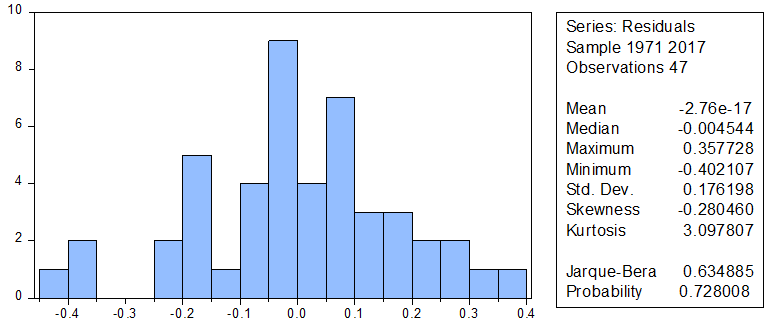
The null hypothesis is that the residuals are normally distributed. Considering the chi-squared result of the test for normality presented in Figure 10, we could note that the probability value 0.7280 is greater than the critical value (0.05). Therefore, we cannot reject the null hypothesis and conclude that the residuals are normally distributed. Hence, the OLS used for this study is appropriate.
4.2. Correlation Matrix
Table 4 shows that there exist a positive association between CPI and Inflation Rate, Exchange Rate and CPI, Interest Rate and Exchange Rate, Interest Rate and Forex Reserve, Money Supply and Inflation Rate, Money Supply and CPI, Money Supply and Exchange Rate, Money Supply and Forex Reserve, Money Supply and Interest Rate, RGDP and CPI, RGDP and RGDP and Forex Reserve, RGDP Interest Rate, RGDP and Money Supply, Real Income and CPI, Real Income and Money Supply, Real Income and RGDP, Export and CPI, Export and Forex reserve, Export and Interest Rate, Export and Money Supply, Export and RGDP, Export and Real Income, Import and Inflation Rate, Import and CPI and between Import and RGDP while the other are negative association. The probability result in the table shows that there exists a correlation between Interest Rate and Exchange Rate (0.0064), Money Supply and Forex Reserve (0.0007), RGDP and CPI (0.0000) and between Export and Money Supply (0.0405) since their probability value is less than 0.05 level of significance. While the rest are not correlated as their probability result values are greater than then level of significance (0.05).
4.3. Ordinary Least Square Test
From the Table 5, R-squared = 0.6613, which shows that 66.13% of the total variation in the inflation rate can be explained by the explanatory variables.
The coefficient column on the table above shows the values by which the inflation rate was influenced by the independent variable, which could either be positive or negative. When it’s positive, it means the inflation rate and the variable move in the same direction and is inversely related when it’s negative. For example: For every unit change in interest rate, the inflation rate increases by 0.46. A unit change in CPI will increase inflation by 3.52. If the money supply changes by 1 unit, the inflation rate will decrease by 0.15. A unit change in the exchange rate will decrease inflation by 0.18. The Parameters of the model was estimated using the student T-test where only the CPI was found to be statistically significant (P<0.05). The F-test (0.000) shows that the explanatory variables have a significant effect on the inflation rate. The OLS model is thus given as:
Infl Rate = 0.9395 + 3.5208(CPI) – 0.3792(Ex Rate) – 0.1227(ForexRes) + 0.4619(IntRate) – 0.1499(MonSup) -0.1898(RGDP)- 0.1125(RInc) +0.1510(Export) – 0.0390(Import).
4.4. Granger Causality Test
The results presented in Table 6 shows unidirectional causality between Exchange Rate and Inflation Rate, Total Import and Inflation Rate, Money Supply and Forex Reserve, Total Export and Forex Reserve, Forex Reserve and Total Import, Total Export and Money Supply, Real Income and Total Import and between Total Import and Total Export. The result shows bi-directional causality between Real GDP and CPI.
5. Discussion and Conclusion
The purpose of this study is to build a statistical model for Nigerian inflation and its determinants. The problems of inflation are undoubtedly surmountable if only the constituted authorities would demonstrate their dexterity in the implementations of the necessary policies to curb the menace. Since one of the components that are relatively under the control of the monetary authority in Nigeria is the nominal effective interest rate, efforts must be made to ensure interest rate stability to stem inflationary tendencies. Also, the government must put in place measures that will reduce the impact of total imports on domestic inflation. This can be achieved by reducing the dependence of the economy on imported goods and find means of appreciating our local products. Government should reduce the money supply though it has been one-sided as the rich become richer and the poor becoming poorer which is not fair. Government should also stimulate the productive capacity of the economy, especially the agricultural sector to increase the aggregate supply of food products so that prices will come down and consequently reduce the rate of inflation.
This research work shows that the series does not suffer from serial correlation, heteroskedasticity and its residuals are normality distributed. It was also discovered that only the Inflation rate was stationary at level while CPI, Exchange Rate, Forex Reserve, Interest Rate, Money Supply RGDP, Real Income Export and Import attains stationarity at the first difference.
The correlation result shows that there exists a correlation between Interest Rate and Exchange Rate, Money Supply and Forex Reserve, RGDP and CPI and between Export and Money Supply since their probability value is less than 0.05 level of significance. While the rest are not correlated as their probability result values are greater than the level of significance (0.05).
We found out that 66.13% of the total variation in the inflation rate can be explained by the explanatory variables. It was also observed from the result that CPI, Interest Rate and Export has a positive relationship with the inflation rate but only CPI has a significant effect on the inflation rate with a probability value less than 0.05.
The result shows unidirectional causality between Exchange Rate and Inflation Rate, Total Import and Inflation Rate, Money Supply and Forex Reserve, Total Export and Forex Reserve, Forex Reserve and Total Import, Total Export and Money Supply, Real Income and Total Import and between Total Import and Total Export. The result shows bi-directional causality between Real GDP and CPI.
Based on the findings of the study, it was recommended that interest rates should be given attention and the government should create policies that will eliminate fluctuations in the interest rate. The Nigerian Government should improve the local product to meet international demands to reduce total imports. Lastly, the policy that will check the money supply in the country and its utilization should be formulated.
Author Contributions: “Conceptualization SOA and MAZ; Methodolody, SOA; Software, MAZ and KSA; Validation, SOA and KSA; Formal Analysis, KSA; Investigation, MAZ; Resources, SOA and MAZ; Data Curation, KSA; Writing-Original Draft Presentation, SOA; Writing-Review and Editing, SOA and MAZ; Visualization, SOA; Supervision, SOA and MAZ.
All Authors have read and agreed to the published version of the manuscripts”
Funding: This study received no funding from any source.
Conflicts of Interest: The authors declare no conflict of interest
Reference
- Abdul, Syed and Qazi, (2008). Political instability and inflation volatility. Public Choice, 135(3), 207-223.[CrossRef]
- Metwally and Al-Sowaidi, (2004). Inflation, output growth, volatility and causality: Evidence from panel data and the G7 Countries. Economic Letters, 83(2), 185-191.[CrossRef]
- Udu, & Paesani, P. (1989). Inflation and inflation uncertainty in the Euro Area. European Central Bank Working Paper Series, No.1229.
- Agba M., David (1991). Conditioning Diagnostics: Collinearity and Weak Data in Regression. New York: Wiley. ISBN 978-0-471-52889-0.
- Pinto (1990) Modelling Inflation Volatility. CAMA Working Paper, No.68
- Canetti and Greene (1991). Regression Analysis by Example (Third ed.). John Wiley and Sons. ISBN 978-0-471-31946-7.
- Egwakhide (1994) Political instability and inflation volatility. Public Choice, 135(3), 207-223.[CrossRef]
- Iyabode, Oyaromade, R. (2008). Modelling the inflation process in Nigeria. AERC Research Paper, 182, 1-37. [9] Odusola and
- Akinlo (2001) Exchange rate volatility, inflation uncertainty and foreign direct investment in Nigeria. Botswana Journal of Economics, 5(7), 14-31.
- Busari Abdullahi, I.S., & Ibrahim, A. (2007). Analysis of inflation dynamics in Nigeria (1981 – 2015). CBN Journal of Applied Statistics, 7 (1b), 255-275
- Odusanya, I.A. and Atanda, A.A. (2010). Analysis of Inflation and its Determinants in Nigeria. Pakistan Journal of Social Science, 7(2), 97-100.[CrossRef]
- Bakare (2011) A package for R is available: "perturb: Tools for evaluating collinearity". R Project.
- Imimole and Enoma (2011), Fiscal policy and inflation volatility. European Central Bank Working Paper Series, 317.
- Anfofum Abraham, Alexander et el (2012). A Caution Regarding Rules of Thumb for Variance Inflation Factors".Quality & Quantity. 41(5): 673–690.doi:10.1007 / s11135 - 006 - 9018 - 6.[CrossRef]
- Sani Bawa, Ismaila S. Abdullahi and Adamu (2016) Another perspective on the effects of inflation uncertainty. Journal of Money, Credit and Banking, 36(5), 911- 928.[CrossRef]
- Farrar, Donald E.; Glauber, Robert R. (1967). "Multicollinearity in Regression Analysis: The Problem Revisited". Review of Economics and Statistics. 49 (1): 92–107. doi:10.2307/1937887. JSTOR[CrossRef]