
Abstract
Akuapem has received a great deal of discussion in Akan phonology. This paper examines a comparative analysis of final-nasal and associative construction in the Akuapem Twi in Ghana. This study adopted a qualitative approach. The study was carried out in the two main districts namely Akuapem North (Okuapeman) and Asuogyaman in the Eastern Region of Ghana. This study focused on the views of the respondents on morpheme-final nasals in Akan and associative construction in Akuapem Twi dialect. The population of the study consisted of speakers of Akuapem Twi in the Eastern Region. The target population therefore was the thirty (30) Akuapem Twi speakers in Akuapem North (Okuapeman) and Asuogyaman. The two districts and the respondents were purposively and conveniently used for the study. The study concluded that, the alveolar nasal consonant /n/ can occur as a final nasal consonant in Akuapem. The study also concluded that, in possessive construction, the associative floating H which floats between the possessor pronoun and the possessed noun (NP2) is realized differently in all the three sub-dialect of Akuapem with the H docking to the toneless nominal prefix in Ofie and Akwamu and to the initial TBU in Kamena while the default assignment assign L to the possessor pronoun in Ofie and Kamena with nouns that has a [+Low] toneless vocalic nominal as it’s prefix. The study recommended that, final-nasal and associative construction in the Akuapem Twi should be emphasized in Ghanaian language curriculum in basic schools in Ghana.
1. Introduction
This paper examines the process of final nasal consonant and associative construction in Akuapem Twi, a dialect of Akan, a member of Kwa, Niger-Congo language. Final nasal consonant and associative construction has received some appreciable body of research in the field of phonology in Akan. Akan has three main dialects namely, Fante, Akuapem and Asante. Other dialects of the Akan include Akwamu, Akyem, Bono, Kwahu, Assin, Denkyira and others. The Akuapem dialect as studied by Akan phonologist perceives the language as consisting of only one language. But this is not the case in this current paper. The Akuapem dialect consist of sub-dialect of which attention of researchers have not been drawn to. Therefore, this paper presents a comparative study of the Akuapem sub-dialect of Akan. It is observed that final nasal consonant /n/ in Akuapem becomes the velar nasal consonant /ŋ/ at word final and in associative construction, the floating H which floats between the possessor pronoun (NP1) and the possessor noun (NP2) is realized differently with nouns that has [+Low] vocalic as its prefix. With the former case, we account that the alveolar nasal consonant /n/ do not always yield a velar /ŋ/ as a final consonant at the phonetic level i.e. in rapid speech when /nʊ/ occurs at the sentence or clause final in the language.
This paper therefore aims to contribute, in a way, to our knowledge of the subject in particular and phonology in general. Akan is a member of the Niger-Congo (Kwa group) languages. It is spoken mainly in Ghana and some parts of Cotê d'lviore both in West Africa. The three major dialects which have received scholarly works and are taught in both private and government schools are Akuapem Twi, Asante Twi and Fante. The Akuapem and Asante dialects together constitute the Twi group of Akan. This paper focuses on the Akuapem dialect of Akan only. On its vocalic inventory, Akan has ten (10) phonemic vowels as follows /a, ɪ, e, i, o, ʊ, ɔ, æ, ɛ, u/. Akan operates the following as its basic syllable structures; V, CV, and C where the C is always [+Sonorant]. A researcher opined that, the syllable in Akan can also be described in terms of the tone on which the consonant and or vowel which makes up the syllable is uttered [1]. Akan does not have a syllable that ends in a consonant; therefore, there is no VC or CVC syllable type in Akan. She continued that every final consonant constitutes a separate syllable with a tone of its own [1]. This means that syllabic consonants such as /m, n, w, r/ are tone bearing unit in Akan as in the example below.
1.1. The Akuapem People and the Language
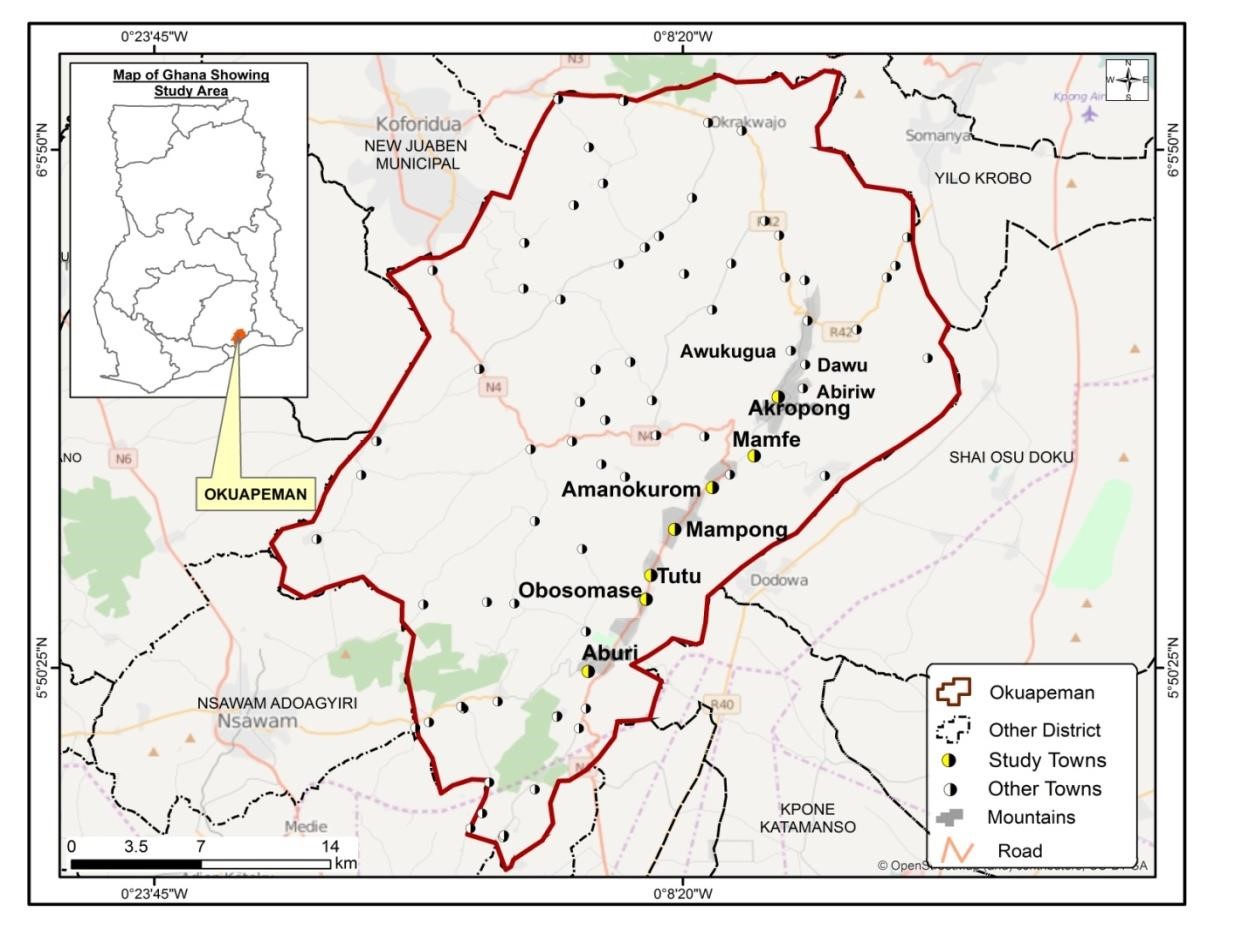
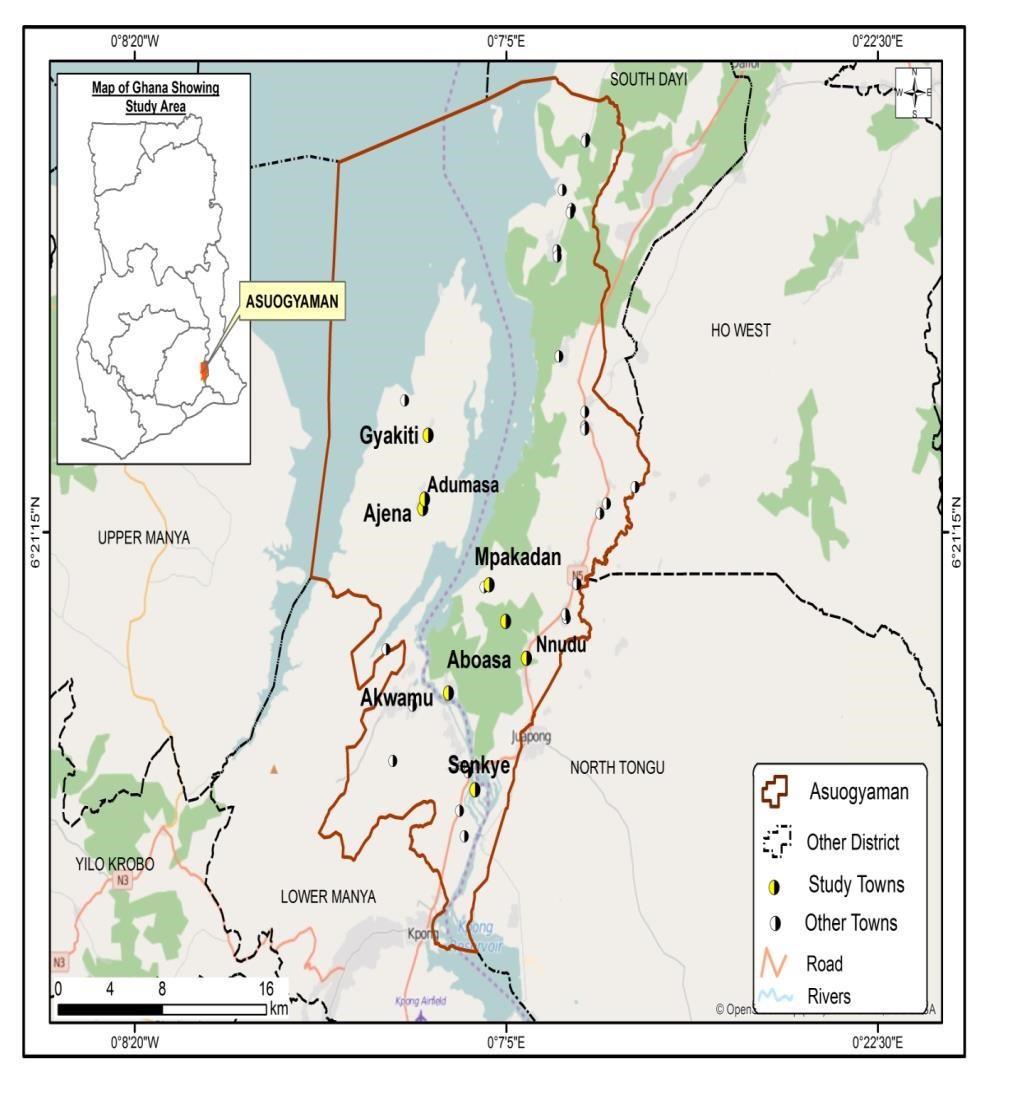
Akuapem also belongs to the Kwa family of languages. It‟s a dialect of Akan spoken in the Eastern Region of Ghana. The Akuapems also known as Akuapemfo (Akuapem people) occupy the Akuapem Ridge. The district capital is Akropong. Akuapem share boundaries with Yilo Krobo to the Northeast, with New Juaben to the North, with Dangme West to the Southeast with Akuapem South and the West Suhum Kraboa-Coltar district to the Southwest. (See map 1). There are two ethnic groups in the Akuapem Ridge. These are the Guans and the Akan. The Guans occupy the North (from Akropong) and Eastern part. Those in the Northern part speak “Kyerepong” as their L1 and Akuapem Twi as L2 while those in the Eastern speak Latɛ1 (Larteh). The Guans and the Akans in the Asuogyaman district are the Anums and they speak Anum with the Akans, speaking Akuapem Twi and Akyem/Asante Twi (see map 2).

1.2. Theoritical Framework: Autosegmental Phonology
The theory of Autosegmental phonology was developed within the tradition of classical Generative Phonological theory [2]. It was followed by the works done by a researchr on tone system in West African languages such as Igbo and Mende [3]. But the eminent and principal innovations of autosegmental phonology are exemplified [4]. Autosegmental phonology is a Non-linear version of phonological analyses of Generative phonology while Chomsky and Halle‟s Sound Pattern of English (SPE) is a linear version of phonological analyses [5]. The difference between the SPE and Autosegmental theory is the “the development of a multi-linear phonological analysis in which different features may be placed on separate tiers and which the various tiers are organized by “association lines” [6]. The researcher opined further that, autosegmental phonology is a “theory of how the various components of the articulatory apparatus i.e the tongue, the lips, the larynx and the velum are coordinated” in the process of sound production. In this idea therefore, autosegmental phonology places segments and supragementals i.e. tone and other prosodic features on different tiers parallel to each other with the supragementals being linked to the segments by lines called the “association lines”. Every segment on each tier is specified for a set of features, specific and unique to that tier, and segments on each tier are associated with segments on the other tiers by association lines [6].
2. Materials and Methods
This study adopted a qualitative approach. The study was carried out in the two main districts Akuapem North (Okuapeman) and Asuogyaman in the Eastern Region of Ghana. This case study focused on the views of the respondents on final-nasal and associative construction in Akuapem Twi dialect. The population of the study consisted of speakers of Akuapem Twi in the Eastern Region. The target population therefore was thirty (30) Akuapem Twi speakers in Akuapem North (Okuapeman) and Asuogyaman. The two districts and the respondents were purposively and conveniently used for the study. These two districts are mainly known for speaking the Akuapem Twi language. The sub-dialects namely; Ofie, Akwamu and Kamena refer to towns in the Akuapem North (Okuapeman) (Ofie) and Asuogyaman (Akwamu and Kamena) district were classified based on phonological and lexicography point of view [12]. The purposively sampling procedure was adopted because the two districts were the only ones involved in the speaking of Akuapem Twi dialect in the Eastern Region of Ghana. The thirty (30) respondents were conveniently sampled in cars, lorry stations, market places and funeral grounds because they were the available or nearest units within the reach of the researchers. The data was collected using a VN-702PC Olympus Digital Voice recorder. Data analysis was done by the use of both descriptive and interpretative techniques based on the themes arrived at in the data collection. We recorded them using both a recorder and a notebook. We later analyzed the data that were recorded.
3. Results and Discussions
Feature geometry is a phonological theory which represents distinctive features as a structured hierarchy. It grew out of autosegmental phonology which emphasizes the autonomous nature of distinctive features. Feature geometry recognizes that some sets of features often pattern together in phonological generalizations, while others rarely interact. Feature geometry thus formally encodes groups of features under nodes in a tree. Features that commonly pattern together share a common parent node. The researchers employ the Unified Feature Theory (UFT) for this paper. This theory employs a single set of PLACE feature for both Consonants and Vowels [7]. The PLACE feature node is parent to three articulator privative nodes: [LABIAL], [CORONAL], [DORSAL] and [PHARYNGEAL]. The researchers employ the three Place feature [LABIAL], [CORONAL] and [DORSAL] in this paper. The [LABIAL] is privative node mother to the labial consonants and rounded or labialized vowels, [CORONAL] to the coronal consonants (dental, alveolar, palatal and alveo-palatal) and front vowels and [DORSAL] to the dorsal consonants and back vowels respectively. The only difference is that, the C-Place node dominates consonantal place features while the V-Place node dominates vocalic place features.
3.1. Morpheme-Final Nasals in Akan
Researchers argue that, there can never be a word in Akan with final consonant (obstruent) [8, 9]. Therefore, there is no morpheme that is consonant-final at the systematic phonemic level. They further argue that, it is only [+Sonorant] consonants which are nasals, liquids and labio-velar glides that can occur word-finally in Akan [8, 9]. This means that there cannot be a syllable of C1V1C2V2 in Akan whereby C2 is specified as [-Sonorant] at the phonetic level. A researcher continues to argue that, the archiphoneme /N/ has two realizations in Akan. The underlying alveolar nasal becomes [n] in Fante, [ŋ] in Akuapem but is replaced with a high vowel in the Asante dialect depending on the roundness of the vowel system, while the underlying bilabial nasal stop surfaces as [m] in all the dialects of Akan [8]. The study posited the alveolar nasal /n/ as an underlying penultimate consonant in spite of the fact that each of the dialect of Akan realizes it differently at the surface level. Thus they are realized as non-final in the Underlying Representation (UR) but becomes word-final in the surface representation when preceded by [+High] vowels which deletes in the surface representations in Fante and Akuapem. Data (2) is adapted from [9].
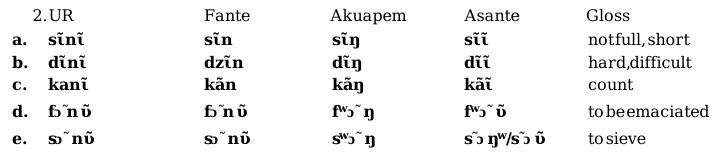
Since this paper focuses on the Akuapem dialect of Akan only, I will present the P-level on a feature geometry diagram for a clear understanding.
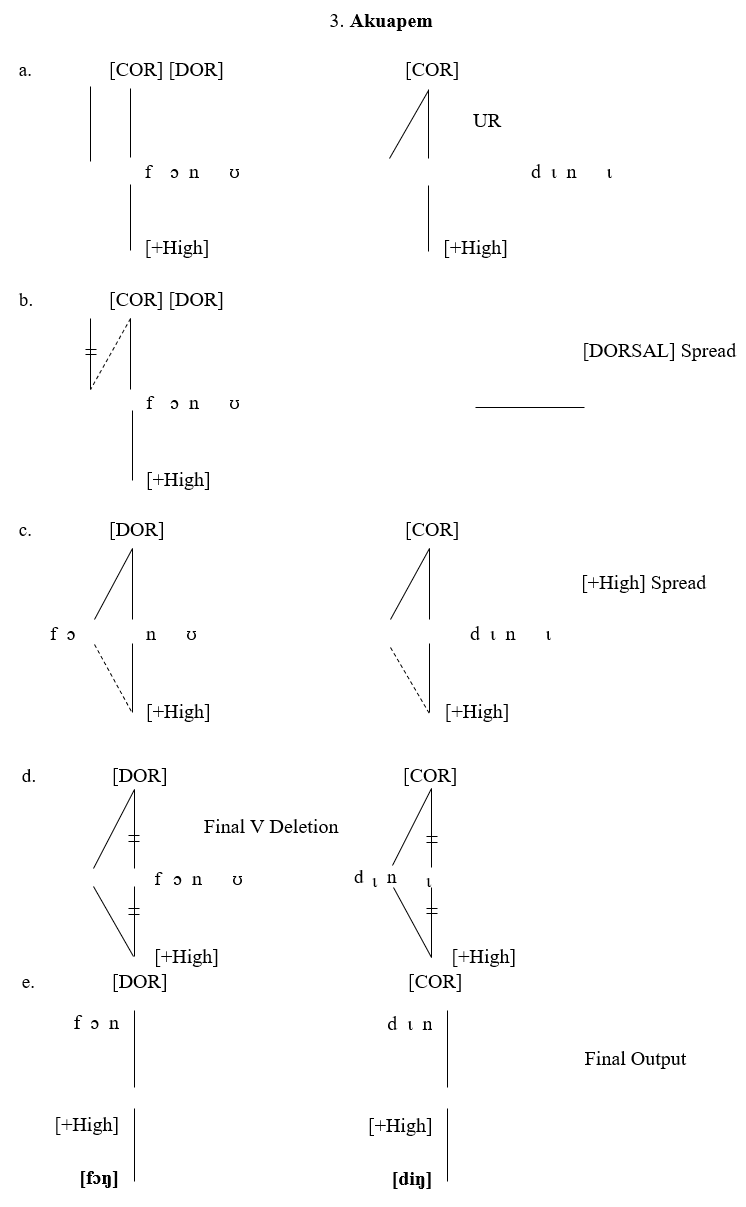
3.2. Dorsalization in Akan
Dorsalization is one of the assimilatory processes exhibited in Akan especially in the Akuapem dialect. Dorsalization as a phonological process that is associated with only consonants in Akan [8]. He explained that the process occurs whereby a nondorsal consonant specifically an anterior coronal nasal occurs before a word-final V-Place [DORSAL] that has also a labial component. The anterior coronal nasal losses it’s C-Place [CORONAL] feature in favour of a C-Place [DORSAL] articulator feature. A study further explains the process that, in Akan the trigger vowels is specified in its feature matrix as [+High] whether coronal or dorsal [8]. The Akuapem data in (3) exhibit this process perfectly. It can be seen that the trigger vowel being specified in its V-Place as [DORSAL] and [CORONAL] which are redundantly [+High] spread to the preceding anterior coronal nasal to be dorsal nasal at the output level.
3.3. Dorsalization in Akuapem Formalized
It is discernible in (2) above that the Akuapem dialect exhibits the dorsalization process more than any of the Akan dialects. As it has been stated that, in Akuapem when an anterior coronal nasal occurs before a word-final that is specified as [+High] in it feature matrix and a V-Place [DORSAL], it spreads to the preceding anterior coronal nasal and conditions it to be dorsal nasal [10]. I therefore argue that this is not always the case with the dialect under study. I provide data 4, 5, 6 and 7 to show that when /nʊ/ which functions in Akan as pronominal, determiner and subordinate clause maker or adverbial particle occurs at a clause or sentence final in Akuapem, the trigger V-Place [DORSAL] which is specified as [+High] do not spread it’s feature to the penult/preceding anterior coronal nasal to yield a dorsal nasal at the phonetic level in the Akuapem dialect.
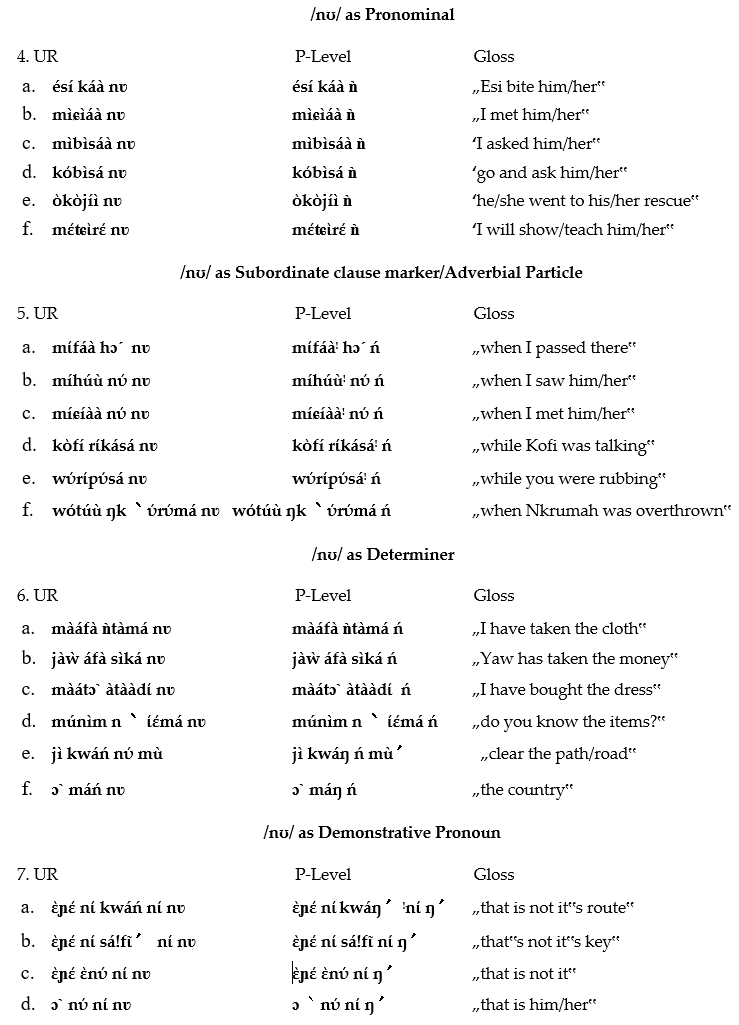
The data above demonstrate that, even when the dorsalization environment is created in /nʊ/ at the underlying level in 4, 5 and 6 it does not yield the process. It is seen at the phonetic level that the V-Place [DORSAL] in /nʊ/ is deleted not causing the anterior coronal nasal to surface as dorsal nasal at the prepausal position/clause final or sentence final. Tonally, it is toneless therefore the tone of the final syllable of the penult word spread to it. When the vowel deletes, its tone floats and settles on the final nasal consonant. Looking at the phonetic level in 6 (e) and (f), the determiner /nʊ/ is preceded by a word-final dorsal nasal. In Akuapem, when /nʊ/ is preceded by words like; [ɔkwaŋ] ‟road/path‟, [ɔmaŋ] „country‟, [ŋkwaŋ] „soup‟, [daŋ] „building‟, [diŋ] „name‟, [naŋ] „leg‟ etc. which has dorsal nasal as its word-final consonant, a speaker of this language in a fast speech will only articulate the anterior coronal nasal /n/ and can never articulate it as dorsal nasal /ŋ/ in succession with such words when it occurs at the sentence or clause final. Data (7) is exception to data (4), (5) and (6) in that the anterior coronal nasal consonant in /nʊ/ becomes dorsal nasal /ŋ/ at the phonetic level. This occur in Akuapem when /nʊ/ functions as a demonstrative pronoun and is preceded by the verb /nί/ „is‟. At the phonetic level, the V-Place [DORSAL] spread it feature to the preceding anterior coronal nasal to surface as dorsal nasal at the sentence final. This is captured graphically below as (8).
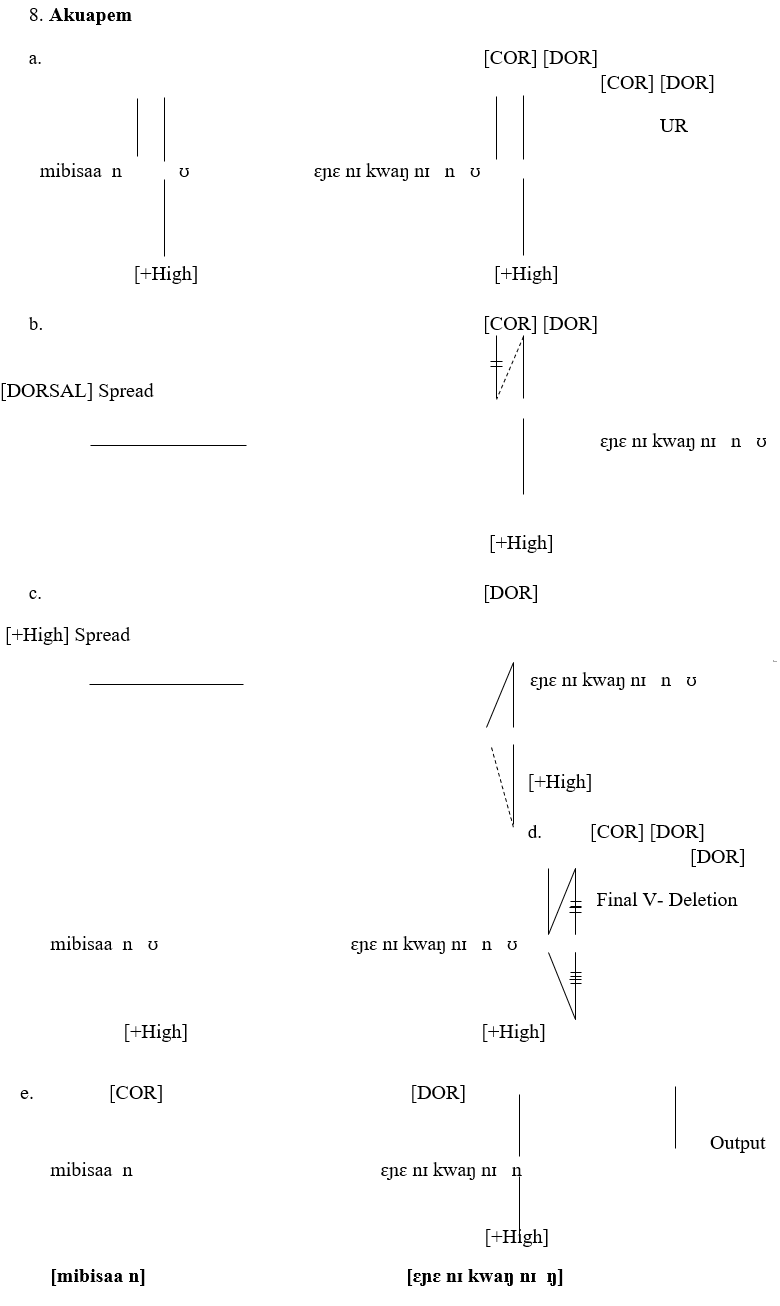
(8a) presents the underlying representation. In (8b), the V-Place [DORSAL] spreads its feature to the anterior coronal nasal. In (8c), the final vowel which is specified as [+High] in its feature matrix spreads to the preceding anterior coronal nasal. In (8d), the vowels delete when /nʊ/ functions as the pronominal and demonstrative pronoun. (8e) is the output.
3.4. The Associative Construction in Akuapem
The associative construction in Akan is used to show possession. The formation of the associative construction involves the association of two nouns to form a complex noun or compound [11]. These two nouns are linked together in a sequence. But this paper focuses on the association of the possessive pronoun (NP1) and the noun (NP2) whereby the NP1 is a possessor pronoun and NP2 is a noun. A study examined the associative morpheme in Akan under Diachronic I and II and Synchronic theory [11]. According to the diachronic theory I, he explained or pointed out that Akan did not lose its segmental melody in the Proto-Akan but the association line linking the tone and the associative morpheme was disengaged leaving the segmental melody toneless and the tonal melody segmentless [11]. He further explained under the diachronic theory II that Proto-Akan lost completely its segmental melody of the associative morpheme leaving behind it tone melody intact. This therefore means that, the tone melody of the associative H morpheme then floats between the possessor pronoun (NP1) and the possessed noun (NP2) at the Underlying level. Synchronically, Abakah pointed out that the associative morpheme is a copy of the personal pronoun to which the floating H associates [11]. (The synchronic data in (9) is adapted from [11].
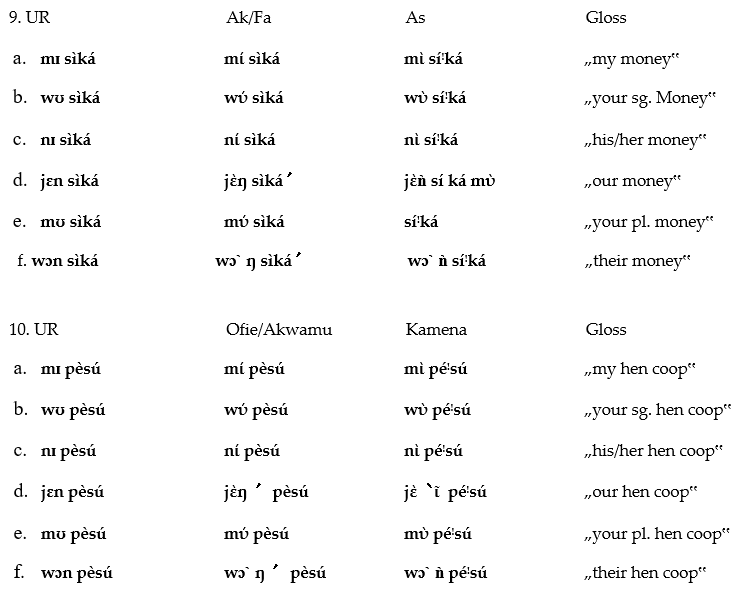
Looking at the data at our disposal, it can be seen that, the Akuapem example in (9) correspond to the Ofie and Akwamu data whiles that of the Asante Twi also to the Kamena. It is seen that at the Underlying Representation, the associative morpheme is toneless. In (10), the associative floating H docks to the possessor pronominal in Ofie and Akwamu while its docks to the initial Tone Bearing Unit (TBU) of the possessed noun root in Kamena resulting in a downstep. The possessor pronominal received L by default in Kamena only. The Kamena data conforms to that of the Asante data in (9). This is captured graphically below as (11).
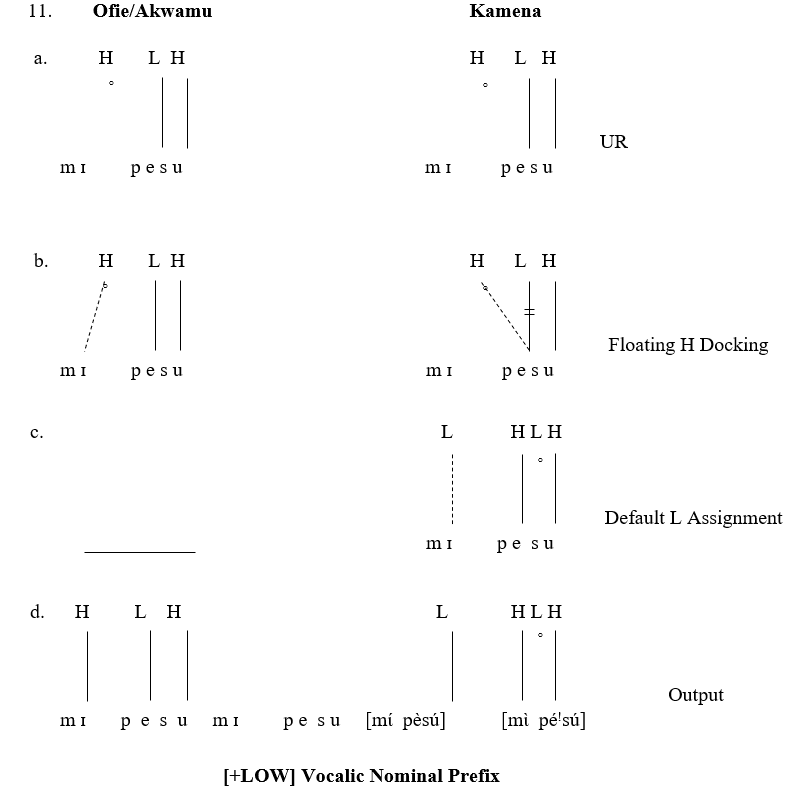
3.4.1. [+LOW] Vocalic Nominal Prefix
In a situation whereby the possessed noun (NP2) begins with a vocalic nominal prefix that is specified as [+Low] the associative floating H is realized differently in all the three sub-dialect of the Akuapem language. Let’s examine the data below from [11].
Looking at the Akuapem data below, it is detectible at the P-level that, the associative floating H lands on the vocalic nominal prefix while the segmental melody of the associative morpheme receives L by default. In Asante, the associative floating H lands on the initial TBU of the possessed noun root while the receive L by default. I will provide data (13) for the three sub-dialects of Akuapem to make a stand that not all the Akuapem examples in (12) occur in the language.
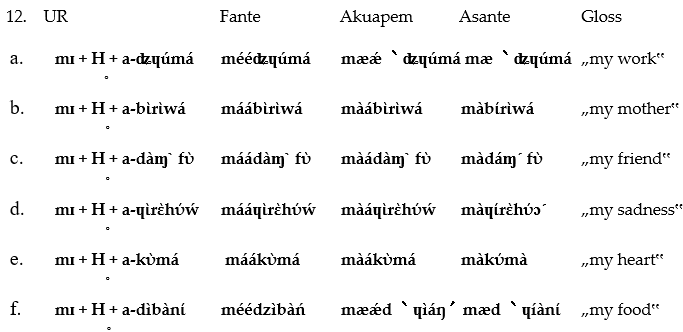
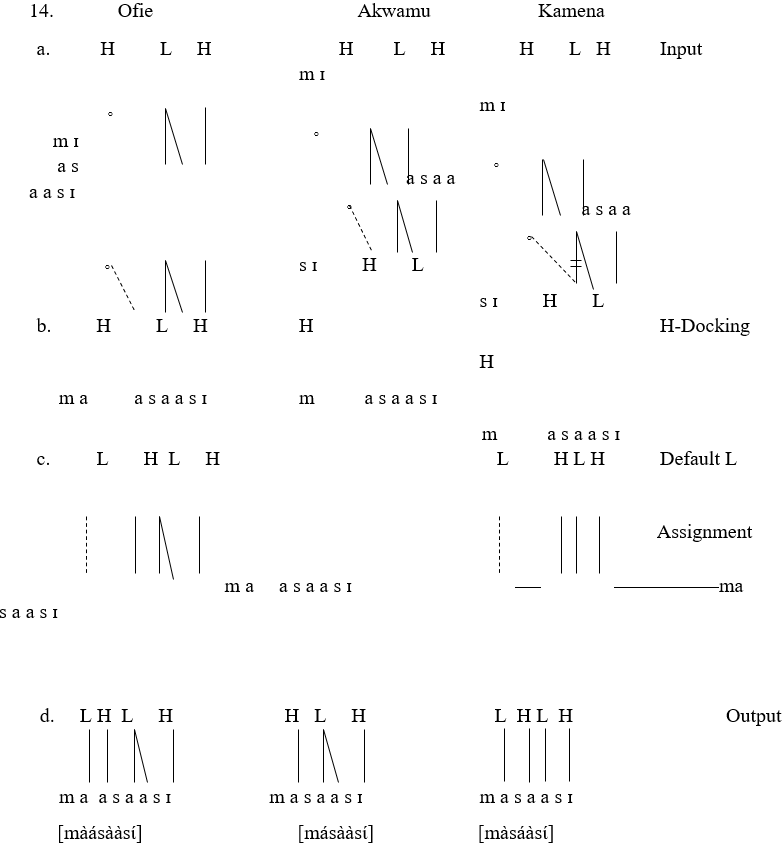
It is discernible from the Akuapem data below that the three sub-dialects show different realization for the associative floating H. The associative H lands on the vocalic nominal prefix in Ofie and Akwamu whiles the initial TBU of the possessed noun root in Kamena becomes the landing site for the associative floating H. The toneless possessor pronoun in Ofie and Kamena receives L by default at the phonetic level. The double vowels in Ofie are subjected to vowel lengthening as compared to that of Akwamu and Kamena. Let us capture the above graphically as (14).
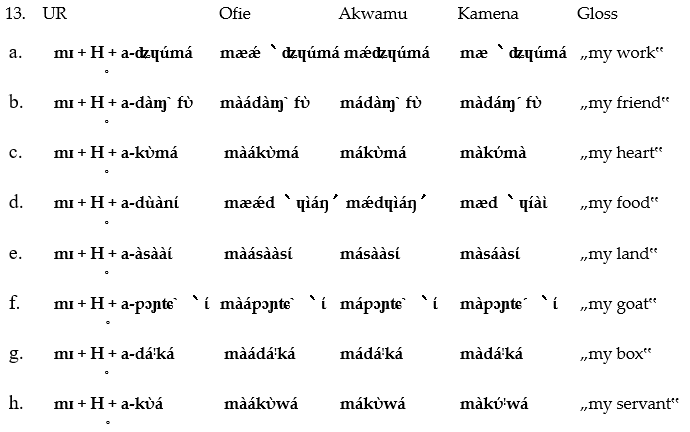
In the above derivation, (14a) is the input with the underlying tone melodies. In (14b), the associative floating H docks to the toneless nominal prefix in Ofie and Akwamu while it docks to the initial TBU of the possessed noun root in Kamena. In (14c), the toneless possessor pronoun receives L by default in Ofie and Kamena only while (14d) is the derived output.
4. Conclusion
In conclusion, this paper has investigated and discussed some of the assimilatory and tonal processes in Akuapem within the theoretical frameworks of Autosegmental Phonology and Feature Geometry. It has also been demonstrated in this paper that a coronal nasal consonant does lose its coronality in favour of absolute dorsality upon the phonetic environment in which it is sited in the Akuapem dialect of Akan. With the issue of word-final consonant in Akan, this paper has discussed an exceptional case in the Akuapem dialect of Akan. It has been pointed out in this paper that, the alveolar nasal consonant /n/ can occur as a final nasal consonant in Akuapem. This, we have identified and analyzed in this paper that when /nʊ/ functions as pronominal, determiner, subordinate clause marker or adverbial particle occurs at a sentence or clause final/prepausal position, the V-place [DORSAL] /ʊ/ surfaces at the Underlying Level but deletes at the P-level. Upon it deletion, it does not spread its underlying V-place [DORSAL] feature to the penult anterior coronal nasal to yield dorsal nasal at the P-level in all the sub-dialect of Akuapem but the vowel deletes and leaves it tone behind which later settles on the anterior coronal nasal.
It has also been demonstrated in this paper that, in possessive construction, the associative floating H which floats between the possessor pronoun and the possessed noun (NP2) is realized differently in all the three sub-dialects of Akuapem with the H docking to the toneless nominal prefix in Ofie and Akwamu and to the initial TBU in Kamena while the default assignment assign L to the possessor pronoun in Ofie and Kamena with nouns that has a [+Low] toneless vocalic nominal as it’s prefix.
Author Contributions: Conceptualization EAA; methodology, EAA; validation, EAA, JKT, WB A, and VOS; formal analysis, EAA; investigation, EAA, JKT, WB A, and VOS; resources. EAA, JKT, WB A, and VOS.; data curation, EAA, JKT, WB A, and VOS; writing—original draft preparation, EAA; writing—review and editing, EAA, JKT, WB A, and VOS.; visualization, EAA, JKT, WB A, and VOS; supervision, EAA; project administration, EAA, JKT, WB A, and VOS. All authors have read and agreed to the published version of the manuscript.
Funding: “This research received no external funding”
Data Availability Statement: Data is available on request from the corresponding author.
Acknowledgments: we acknowledge the Dr. Anthony Bordoh for his input and suggestions
Conflicts of Interest: “The authors declare no conflict of interest.” “No funders had any role in the design of the study; in the collection, analyses, or interpretation of data; in the writing of the manuscript, or in the decision to publish the results”.
Appendix 1
Source: Geography Department; Remote Sensing and GIS Laboratory, University of Ghana, legon.
Appendix 2
Source: Geography Department; Remote Sensing and GIS Laboratory, University of Ghana, legon.
References
- Dolphyne, F. A. (2006). The Akan (Twi-Fante) Language: Its Sound System and Tonal Structure. Ghana Universities Press, Accra.
- Chomsky, N. & Halle, M. (1968). The Sound Pattern of English. Cambridge, Massachusetts London: MIT Press
- Leben, W. R. (1973). Suprasegmental Phonology On. Doctoral Dissertation. Massachusetts: Massachusetts Institute of Technology.
- Goldsmith, J. A. (1976). Autosegmental Phonology. Doctoral Dissertation. MIT: New York.
- Nerius, K. (2013). An Autosegmental Analysis of Phonological Processes in Dagara. M.Phil. Thesis, University of Ghana.
- Goldsmith, J. A. (1976). (1979). The Aims of Autosegmental Phonology. In: D. Dinnsen (ed.) Current Approaches to Phonological Theory. (pp. 202-222) Bloomington: Indiana University Press.
- Halle, M., Vaux, B., & Andrew, W. (2000). On Feature Spreading and the Represenation of Place of Articulation. Linguistic Inquiry, 31(3), 387-444.[CrossRef]
- Abakah, E. N. (2005). Phonological Analysis of word-final Consonant in Akan. African and Asian Languages and Literatures 5, 47-65.
- Adomako, K. (2015). Final-Nasal Deletion in Akan (Asante Twi) Reduplication. The Buckingham Journal of Language and Linguistics. Volume 8, pp 1-20[CrossRef]
- Abakah E. N. (2012) Some Assimilatory Processes in Akan. Journal of West African Languages 39(2), 47-82.
- Abakah, E. N. (2010). Tone and the Associative Contruction in Akan. Journal of West African Languages 37(2), 57-80.
- Akoto, A. E. (2016). Aspect of Akuapem Phonology. Unpublished Mphil Thesis. University of Education, Winneba.