

The purpose of this study was to examine the influence of new religious movements’ televangelism on women in Dunkwa-on-Offin in the central region of Ghana. The study adopted the sequential explanatory mixed-methods approach. The study population was important because they make up a bigger share of individuals who attend mainline churches and are constantly exposed to televangelism in their daily lives. A multi-stage sampling technique (purposive and simple random sampling techniques) was used to select two hundred (200) women for the study. Krejcie and Morgan's table determined the two women population of 400 (for both churches). The main instruments for data collection were questionnaires and interview guides. Quantitative data was analysed with the use of the IBM SPSS statistics software version 23, to compute frequency distributions, percentages, tables and cross-tabulation. Descriptive statistics and inferential analysis were employed in the analysis of the data. Qualitative data was analyzed thematically by identifying relevant information, coding, classification and summaries. The study revealed that televangelism has influenced women to follow televangelists rather than the teachings of their churches. Also, the activity has influenced the youth and women to follow false teachings, prosperity and vain promises of travelling. The findings of the study revealed that televangelists’ messages are geared towards obtaining money and raising unrealistic hopes. It is recommended that the government should also establish and enforce policies and regulations that encourage genuine televangelism programming and deter televangelists who are driven by fraud and self-gain by registering all the churches and holding them accountable for their actions.
Influence of Televangelism on Ghanaian Women
October 20, 2023
December 25, 2023
February 12, 2024
February 15, 2024
This is an Open Access article, distributed under the terms of the Creative Commons Attribution 4.0 International License (http://creativecommons.org/licenses/by/4.0/), which permits unrestricted use, distribution and reproduction in any medium or format, provided the original work is properly cited.
Abstract
1. Introduction
1.1. Influence of new religious movements’ televangelism on women
The New Religious Movements (NRMs) have a negative influence on women [1]. These NRMs foster social isolation both from family and mainline religious fronts. Leaders of these churches forge a strong bond with the women and can readily mobilize them to violence. Skrumedi’s study underpins the proposed study because it shows that NRMs can have a negative influence on women [1]. However, a writer asserts that “NRMs have had a positive influence on women. She showed that it helped them fulfil their desire to be involved in church leadership. NRMs emancipate them from men’s domination to the point that several women now own a church where they serve as the main officiating minister or prophetess. NRMs, by their miracles and prophetism, have helped several women out of barrenness and ailment. The findings of Barker (2013) underpin the present study because it shows that women are positively influenced by listening to NRM televangelism [2]. However, Barker's findings contradict Skrumedi's findings, necessitating the need to address this gap and substantiate the true stance of televangelism on women in the Dunkwa-on-Offin area. Whether these women have been influenced positively or negatively. The purpose of this study was to examine the influence of new religious movements’ televangelism on women in Dunkwa-on-Offin in the central region of Ghana. The study was guided by this research question - What is the influence of new religious movements’ televangelism on women in the locale?
1.2. The Theory Underpinning the Study
The Social Exchange Theory (SET), underpins the study. It was first created by George Homans and then developed by [3]. Blau's explanation of the theory was studied extensively for the study. Blau said that “social relations are dictated by an exchange of activity, physical or intangible, more or less rewarding or costly, involving at least two persons” [3]. As a result, his theory's thesis is that "an individual who provides rewarding services to another is obligated to fulfil this commitment, the second must, in turn, provide benefits to the first”. This applies to religious interaction as well. Some authors claimed that religious interaction is a form of social relation between televangelists and their audience of which the postulation by Blau applies [4, 5].
Blau's postulation serves as the foundation for this proposed study, as televangelists offer prophetic utterances that assist infertile women in conceiving, restoring sight to the blind, and alleviating various ailments. Blau suggests that individuals facing these challenges are attracted to these religious institutions and are required to make financial contributions (sow seeds) in exchange for blessings or relief from their afflictions. Therefore, the act of sowing seeds represents a transaction for the services provided by televangelists. Considering these points, this study critically examines this theoretical framework to emphasize how the religious ideology of televangelists can impact their audience, particularly women [3]. The theory also sheds light on the nature of religious services offered by new religious movements that could be construed as a threat to mainline churches and women in society.
2. Materials and methods
The study adopted the sequential explanatory mixed-methods approach. It was used to gather and analyze follow-up qualitative data to explain and understand quantitative results. The approach was ideal for the study since it allowed the researcher to obtain quantitative data via survey first, and then investigate the results qualitatively via semi-structured interviews [6, 7, 8, 9]. Because the researcher is not restricted to a particular method or approach, mixed methods design can answer a broader range of research issues. Convergence, triangulation, and corroborations of findings provide better proof for a study's conclusion. The population of the study was Women who attended mainline churches Dunkwa - On-Offin in Ghana's Central Region. The study population was important because they make up a bigger share of individuals who attend mainline churches and are constantly exposed to televangelism in their daily lives. a multi-stage sampling technique (purposive and simple random sampling techniques) was used to select two hundred (200) women for the study. Krejcie and Morgan's table was used to determine the two women population of 400 (for both churches) [10]. Random sampling technique was used to select the 200 women House of Power Ministry International with 3 assemblies in the Dunkwa-on-Offin Municipal contributed 230 congregants for the sample size while GILGAL Pentecostal Prayer Ministry International with 2 assemblies in the Dunkwa-on-Offin Municipal area contributed 170 congregants to make up for the sample size. a purposive sample technique was used to pick twenty (20) participants for an interview, including clergy, lay leaders, and other worshippers. The main instruments for data collection were questionnaires and interview guides. Quantitative data was analysed with the use of the IBM SPSS statistics software version 23, to compute frequency distributions, percentages, tables and cross-tabulation. Descriptive statistics and inferential analysis were employed in the analysis of the data. Qualitative data was analyzed thematically by identifying relevant information, coding, classification and summaries.
3. Results
3.1. Influence of New Religious Movements’ Televangelism
This section presents the findings on the impact of televangelism by New Religious Movements (NRMs) on individuals' beliefs. As shown in Table 1, a majority of respondents (84.0%) expressed their belief in televangelists' preaching, while only a minority (16.0%) replied negatively. Among those who believed in televangelists' messages, an overwhelming majority (85.5%) stated that they preached about the word of God, whereas those who did not believe indicated that their sermons focused solely on materialistic aspects. As to whether the preaching of televangelists encouraged respondents to seek prosperity and more wealth, more than half (56.0%) of the respondents responded that “Yes”, the preaching of televangelists encouraged them to seek after prosperity and more wealth while the rest (44.0%) of the participants responded “No”. Again, the majority (64.5%) of the respondents indicated that they sought wealth and prosperity because the televangelists preached and talked about wealth and those who indicated that they did not seek wealth pointed out that the televangelists preached “fake” messages. Concerning televangelism encouraging women to develop virtues useful in cementing families together, the majority (81.5%) of the respondents responded that televangelism did encourage women to develop virtues while the least (18.5%) of the respondents otherwise responded “No”. From the study, the majority (71.5%) of the respondents pointed out that televangelists did seek popularity at the expense of espousing Christian teachings and the least (28.5%) of the participants opined that the situation was not like that. About the type of influence, televangelists exert on youth and women, the majority (67.0%) of the respondents asserted that it makes them follow false teachings, 31.5% of the respondents also opined that it influenced them to put their trust in God and following Gods’ word and the least (1.5%) identified that televangelists influenced both youth and women on prosperity, money and travelling. From the study, the majority (91.0%) of the respondents believed that televangelists only used television and other mediums as a means of promoting themselves and their ideology instead of Christian values and the least (9.0%) of the participants on the other hand responded “No”. With regards to the funds that televangelists acquire through their preaching on television, 52.5% of the respondents opined that televangelists used those funds to promote their ministry and 47.5% indicated that televangelists used those funds for buying luxurious cars and building mansions. The results showed that 57.0% of the respondents had indicated that income, age, education, marital status or socio-economic factors foster televangelism while 43.0% of the participants responded that the above factors did not foster televangelism. Regarding the future of televangelism for Christian worship in Ghana, the majority (79.5%) of the respondents indicated that yes, televangelism had a future for Christian worship in Ghana whereas the least (20.5%) of the respondents showed that the activity did not have any future as far as Christian worship is concerned in Ghana. Regarding the government’s involvement in the regulation of televangelism in Ghana, the majority (80.0%) of the respondents identified that the government should be involved in the regulation process but 20.0% of the participants indicated that the government should not be part of the regulation of televangelism. The majority (62.0%) of the participants thought that women follow televangelism more than the teachings of their churches and the least (6.9%) of the respondents also added that, televangelism has destroyed and broken down the extended family while 28.5% indicated that televangelism had influenced many other things on women in Dunkwa-On-Offin.
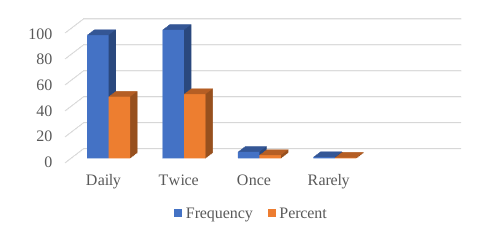
About how many times respondents viewed a new religious movement's programme on TV in a week, 49.5% of the respondents indicated that they watched the programme twice in a week, 47.5% showed that they watched the programme daily, 2.5% of the respondents identified that they watched the programme once and the least (0.5%) also asserted that they rarely viewed new religious movement's programme on TV. Moreover, during the interview, participants were quizzed on the Influence of New Religious Movements’ Televangelism and the following feedback was received.
3.1.1. Participant’s Understanding of Televangelism in the Ghanaian Context
The respondents were interviewed on their understanding of televangelism in Ghana within the Ghanaian context and the following feedbacks were received. The Head Pastor indicated: “…. that televangelism is a tool for winning souls through the medium of television. In terms of Ghana it has a larger coverage and captures a larger number of viewers or people”. (Personal communication with Head Pastor Francis Affrinie at his residence, June 2023).
Besides, a Superintendent Minister postulated and asserted that: “……… televangelism is an activity where an evangelical preacher appears regularly on television to promote beliefs and in some cases appeal for funds. The person can be an official that is working for a particular church or self-proclaimed”. Moreover, Women’s Ministry (Deaconess)indicated that “…. televangelism is about trying to propagate the word of God to those who have not yet accepted Christ, especially those who are workaholics and always going about their business and do not have time for church service. An opportunity to listen to the word of God in their comfort zone”. (Personal communication with Rev. Micheal Oppong at his office, June 2023).
According to a Student Leader, “Televangelism is the preaching and teaching of the word of God on the television. It is also the organisation of church services on television. Again, a Male Student Leader defined televangelism as preaching the gospel of the Lord Jesus Christ on television whereby quite a good number of people listen at the same time.
Moreover, according to a General Secretary/Deaconess,
“Televangelism is the process of appearing regularly on television to try to persuade people to become Christians and often also ask people to give money”. Male, Parish Priest asserted that “televangelism is evangelism through media, specifically through radio and television or a Ministry done through television and also asking them for money for the ministry”. (Personal communication with a male and a female student, George Attisu and Sarah Ababio respectively and General Secretary Deconness Dora Nketia in the church after church service, June 2023).
Besides, an Assistant Cathedral Administrator reported that “televangelism in the Ghanaian context is the use of television for evangelistic activities in Ghana whereby televangelists proclaim and project the message of prosperity, miracles and fast-track method of getting wealth as against the message of Truth, Jesus Christ”. (Personal communication with Assistant Cathedral Administrator; John Ayisi Mensah, at the Cathedral’s Office, June 2020). A report by a male Elder defined “televangelism as the use of media specifically radio and television, to communicate Christianity by Christian Ministers, whether official or self-proclaimed”. A Male Welfare Secretary indicated that “televangelism is Christian gospel message on television that transforms the life of a person”. (Personal communication with Elder Robert Brafi and a male Welfare Secretary, Mr Samuel Adarkwah, July 2023 respectively)
3.1.2. Extent to which televangelism has taken over attendance at local church
A male, Head Pastor airing his view said: “Televangelism has not taken over attendance at local churches but rather complemented it, but cannot guarantee true conversion in Christ”. Besides, a male Superintendent Minister indicated that “realistically, one cannot conclude that televangelism is the cause of low attendance to church services. However, it is also true that some church members have favourite preachers they love to listen to even if it co-modes with their church activities”. (Personal communication with Head Pastor, Gideon Donkor at the Mission House, September 2019).
Again, a Deaconess asserted that “to a very large extent most people prefer to stay at home and view church programmes on the television than to attend church service. It reduces money for transport and offers. No payment of tithe; etc”. Moreover, a male Pastor indicated that to some extent it has because he had visited church members who did not come to church but were watching Christian channels in their homes. (Personal communication with Deaconess Diana Twum at her house in July 2023).
Besides, a General Secretary/Deaconess postulated that “a very minimal number in her view, perhaps thirty (30) per cent i.e. 30% of local church members may decide to watch preaching on television instead of attending church service, especially in the urban setting. To a large extent that most people (Christians) now believe that staying out of church and being in the comfort of their homes to listen to the good news or all kinds of people who profess to be prophets etc. is equally worthwhile”. (Personal communication with Yaw Adanse-Bona at the Mission House, July 2023).
A Parish Priest asserted that:
“to some extent because of their persuasive words and destructive ways, a lot of Christians have followed them instead of attending their local churches. This turn of events is very detrimental to a very large extent because most Christians nowadays think that worshipping God is not all about going to sit at the church premises or even attending their parent church. People prefer watching the supposed miracles performed by television pastors. Others have placed their complete trust in television evangelists to the extent that they equate they are going to sit at the feet of Jesus in the church to touching television sets for hopeful miracles. This has infused the minds of many and inculcated the character of laziness and spiritual and ecclesiastical pomposity in Christians of today, especially Ghanaians”. (Personal communication with Rev. Addo Amankwah at the Parish, July 2023).
A Welfare Secretary indicated that ….
“Attendance in many local churches today has declined due to the “health and wealth” messages by the televangelists and by the signs and wonders they wrought, they win many members of the local churches. A lot of the televangelism programmes have been scheduled during local church hours and due to that many people watch without going to church. Televangelism has taken over attendance at local churches because television has become the most important source of news and information. Thereby, people use that opportunity to watch Christian programmes on television”. (Personal communication with John Atongo at the church after church service, July 2023).
3.1.3. Televangelism having a positive influence on family and societal values
A male Head Pastor claimed that:
“yes, it does; televangelism has a positive influence on family and societal values On one hand, he said, televangelism makes a case for Christianity and secondly, it gives hope to developing societal values such as modesty, humility, honesty, communalism, care and the like. It has made family and societal bonds stronger. Some televangelists give good and sound doctrine thereby impacting positively on the society. Notwithstanding, there are people whose messages pollute and destroy the very fibre of our families and society” (Personal communication with Pastor Emmanuel Saah, in the church after church service, July 2023).
On the contrary, another male Pastor said:
“No, I do not think so. Rather, televangelism has had a negative influence on family and societal values. There have been segregation, mistrust and disunity which fight against family and societal values. In the olden days when there was no such medium as it is now, family and societal values, that is, faithfulness, honesty, commitment, patriotism, holiness, etc. were highly esteemed and the impact was greatly felt everywhere. Besides, it’s because, in the Ghanaian context of televangelism, it is all about miracles, a penchant for money and fame without really preaching the true gospel for people to come to repentance and follow Christ's footsteps have accounted for the stillness in family and societal values. He further opined that most of these televangelists intimate to their adherents that their problems are a result of orchestrations of another family member leading to enmity among family members.” (Personal communication with James Offei in the church after church service, July 2023).
An Assistant Cathedral Administrator narrated that…
there has been some level of positive influence but largely negative. This stems from the fact that what most televangelists preach is most often very little or not linked to the exact instructions, admonishment from the bible for effective moral training and value impartment. Some instil Christian values and owners’ parochial interests; meant to satisfy interests of individual churches and pastors”. (Personal communication with Mr. Kojo Sedefia at the Cathedral Administrator Office, July 2023).
A male Parish Priest said …
it has rather had a negative influence especially on societal values because considering the Ghanaian context of televangelism, it is all about money, witches that are destroying someone, and the use of magic and other biblical items as solutions to human problems, especially women. Instead of adherents having faith in Jesus Christ, they turn to have faith in those items and the so-called televangelist. (Personal communication with Rev. Thomas Baako at the Parish, July 2023).
A Church Leader indicated that
“…...the youth of our time have refused to stand up for hard work. This is because; there is always the message of prosperity which replaces hard work with idleness. Family members have lost family bonds because some members are accused of witchcraft in societies concerning finding solutions to supposed predicaments. Televangelists leave no models or examples for posterity but miracles, lies, hypocrisy and laziness. It has brought about enmity among some families because they tell their members who go for counselling that their mother, brother or uncle is the reason for their failure in life. People are deceived, robbed and hurt”. (Personal communication with John Adu Bediako at his residence, August 2023).
Female, General Secretary indicated that …
“some of the preachers on television have shaped some people’s minds on sexual issues and spiritual matters. An example is Rev Dr Mensah Otabil’s daily broadcast on television dubbed ‘The Living Word’ which has helped influence people to be generational thinkers and problem solvers. Besides, I can confidently say that those who have truly centred their strength on the propagation of the word of God or the ‘Good news’ have a positive influence on family and society because many people are also very careful about false prophecies. Bible says that by their fruit they shall be known” (Personal communication with Ms. Felicia Adorkor at her office, August 2023).
3.1.4. Televangelism Messages and Christian Values
A Head Pastor indicated that….
“Some are exerting positive values on the family and society and some are not. Some are bible based, they unite and bond society, and others on the other hand are divisive, meant to enrich the individuals involved and impoverish the followers. Furthermore, some are completely occultist, fetish, demonic and barbaric. Some also hide their true intentions, to deceive, cheat and prey on the innocence of the masses. On the whole, one can say that the majority of these preachers lack the fundamentals or basic knowledge of theology, hence their messages always bring about chaos and confusion. There is too much division in Christendom because of bad doctrines preached by these people”. (Personal communication with Johnson Attobrah at his office, September 2023).
A Female, General Secretary asserted that …
“Some of the televangelist’s activities are very realistic and good for building Christian values, but others are not good at all. They rather cause fear and panic in society, they are dubious and underrate Christian values. Most of the channels I watch like HSM TV and Pent TV teach to build Christian values. I do not listen to them so, I cannot say much as regards my stand”. (Personal communication with Rev. Mercy Dumbah at her office, September 2023).
A Parish Priest indicated that ………
“Christian values are values preached and provided by the bible – love for neighbours, respect for everyone, respect for life and sex as the preserve of a married man and woman. However, some preachers or evangelists defile these values preaching divisiveness to the extent that some Christians may belong to the same church but have varying thoughts and beliefs which do not ensure love and unity. This they can do because they don’t care about what one knows, believes and where one is”. (Personal communication with Rev. Samuel Tandoh at the Parish, September 2023).
A Welfare Secretary asserted that…..
“Because their messages are not Christ-centered and they don’t even practice these Christian values, how can their members follow suit and thereby build Christian values? Christians now have faith in the sale of their items to solve spiritual problems like the worldly people do and even believe those televangelists than the Lord Jesus. Some of them too their messages and programmes are not biblical to build Christian values”. (Personal communication with Gideon Ankrah, September 2023).
An Assistant Cathedral Administrator indicated that…….
“While some have good messages to promote Christianity, the masses communicate messages far from the Christian context and are out of the dictionary of circumspection. Televangelists use platforms and pulpits to chastise each other on the grounds of fame. Others claim to be God and Lions appearing in dreams meanwhile the son of the man himself did not count equality with God (Philippians 2:6-11). This teaches nothing to Christians but pride, arrogance and lack of reverence for the Divine Being. Some of the evangelists preach substance. It has also helped those with bad behaviours to put on a Christ-like life”. (Personal communication with Kwesi Owusu at his office, September 2023).
A Pastor indicated that……
“Some of the messages are worthwhile and good for Christian values because the messages that are telecasted daily have shaped some non-believers’ lives on the need to accept the principles of Christ. It is emphatically true that the messages of televangelists in their programmes are not worthwhile except for those whose principles, teachings and perceptions barrel on the word of God (Good news) that is good for building Christian values. On the contrary, others whose messages are geared towards prosperity, giving lotto numbers, etc. are not good for building Christian values. Their messages are not the true Gospel of Jesus Christ. They are health and wealth preachers whose messages do not centre on Holy living, bearing fruit of the Holy Spirit and infilling of the Holy Ghost”. (Personal communication with Gideon Ankrah at the Mission House, September 2023).
Paul of the few male participants insinuated that,…
“There is nothing that happens on television that does not happen in the church so if there is any change in the moral fibre of people, it might not necessarily be attributed to televangelism. There was a division among the interviewees on the implication of televangelism services on traditional Christian values and societal values at large and that televangelism had contributed to eroding the values once held by the traditional church while others said it had not. (Personal communication with Paul in the church after church service, September 2023).
Moreover, Female Church Leader, who identified herself as a singer corroborated as follows:
“The Traditional Christian values have been affected. The warm close fellowship is no longer there. Societal values are now influenced by media. People want to acquire what they watch on media even though it is not the best. Televangelism has not replaced traditional Christian values because not everyone has a television. The values being affected depend on the level of commitment one has to those values. Those that are strongly grounded don’t need a televangelist to change them”. (Personal communication with Josephine Esi Dede, September 2023 in the church after church service).
On the contrary, other participants were of the view that Christians copy worship habits from the West through the media, and societal values have not changed because not all people own television sets as one interviewee noted.
4. Discussion on the Influence of New Religious Movements’ Televangelism
The present study discovered that the introduction of televangelism has influenced the lives of many Christians in Ghana though negatively. For example, respondents opined that televangelism has influenced women to follow televangelists rather than the teachings of their churches. Also, the activity has influenced the youth and women to follow false teachings, prosperity and travelling. These results relate to previous studies to a significant extent. For instance, a writer revealed that certain NRMs have a negative influence on women [1]. These NRMs foster social isolation both from family and mainline religious fronts. Leaders of these churches forge a strong bond with the women and can readily mobilize them to violence. Skrumedi’s study underpins this study because it shows that NRMs can have a negative influence on women.
On the contrary, a similar study asserted that NRMs have had a positive influence on women. She showed that it helped them fulfil their desire to be involved in church leadership [2]. NRMs emancipate them from men’s domination to the point that several women now own churches where they serve as the main officiating minister or prophetess. NRMs, by their miracles and prophetism, have helped several women out of barrenness and ailment. The findings of a previous study underpin the present study because it shows that women are positively influenced by listening to NRM televangelism [2].
5. Conclusion and Recommendation
The study revealed that televangelism has influenced women to follow televangelists rather than the teachings of their churches. Also, the activity has influenced the youth and women to follow false teachings, prosperity and vain promises of travelling. These imply that televangelism has had a great impact on the lives of many people, especially Christian women and the youth. The study also indicated that televangelism has profound effects on societal values through the type of messages delivered and how they are delivered. This has resulted in a lack of trust. The worshippers don’t trust the preachers enough to donate money to them because there is a lack of transparency on how the money will be spent. Most worshippers feel that the preachers might use the money for their prosperity and not for the church. The findings of the study revealed that televangelists’ messages are geared towards obtaining money and raising unrealistic hopes. That is why the majority of Ghana worshippers do watch televangelist messages but minorities give donations. Further, the few that do give donations, most of them do so because they want to give to God and not the individual. It is recommended that the government should also establish and enforce policies and regulations that encourage genuine televangelism programming and deter televangelists who are driven by fraud and self-gain by registering all the churches and holding them accountable for their actions.
Author’s Contributions: Conceptualization; methodology; validation; formal analysis; investigation; resources; data curation; writing—original draft preparation; writing—review and editing; visualization; supervision; project administration. All authors have read and agreed to the published version of the manuscript.
Funding: “This research received no external funding”
Data Availability Statement: Data is available on request from the corresponding author.
Acknowledgements: I acknowledge the respondents for their time and patience.
Conflicts of Interest: “The author declares no conflict of interest.” “No funders had any role in the design of the study; in the collection, analyses, or interpretation of data; in the writing of the manuscript, or in the decision to publish the results”.
References
- Skrumedi, C (2017). The Question of Violence in New Religious Movements: A Meta-Analysis of Aggregates. Unpublished Doctor of Philosophy in Religious Studies Thesis Presented to the University of Ottawa
- Barker, E. (2014). The not-so-new religious movements: Changes in ‘the cult scene’ over the past forty years. Temenos-Nordic Journal of Comparative Religion, 50(2), 235-256.[CrossRef]
- Blau, P. M. (1977). A macro-sociological theory of social structure. American journal of sociology, 83(1), 26-54.[CrossRef]
- Mokaya, E. N. (2015). Televangelism and the changing habits of worshippers In Nairobi County. Unpublished Master's Thesis submitted to the University of Nairobi, Kenya.
- Crossman, J. E. (2018). Celebrating interconnectedness as a spiritual paradigm for teaching, learning, and the internationalization of higher education. The Palgrave handbook of workplace spirituality and fulfillment, 1013-1031.[CrossRef]
- Kusi, H. (2012). Doing Qualitative Research: A Guide for Researchers. Accra-New Town: Emmpong Press
- Plano Clark, V. L. (2017). Mixed methods research. The Journal of Positive Psychology, 12(3), 305-306.[CrossRef]
- Cresswell, J. W. (2008) (2 ed). Research design: qualitative, quantitative and mixed methods. Boston: McGraw Hill Co.
- Cresswell, J.W., & Clark, F. (2007). Research design: principles and Methods. Education Services Publication.
- Krejcie, R. V., & Morgan, D. W. (1970). Determining sample size for research activities. Educational and psychological measurement, 30(3), 607-610.[CrossRef]