

This research explores the complex relationship between user-perceived Quality of Experience (QoE) and underlying network performance for multimedia traffic. As video streaming, online gaming, and interactive media dominate modern networks, ensuring consistent QoE has become a key challenge. The study develops a network performance model that integrates objective Quality of Service (QoS) parameters—such as delay, jitter, packet loss, and throughput—with subjective QoE metrics like Mean Opinion Score (MOS) and perceptual quality indices. Using simulation-based and analytical approaches, the paper evaluates how network conditions affect multimedia traffic behavior and user satisfaction. The results highlight critical thresholds for QoE degradation, enabling predictive modeling for adaptive multimedia delivery and real-time optimization. This work contributes to designing intelligent, user-centered network management systems capable of balancing resource efficiency and end-user satisfaction.
Quality of Experience (QoE) and Network Performance Modelling for Multimedia Traffic
May 11, 2021
June 28, 2021
July 18, 2021
July 20, 2021
This is an Open Access article, distributed under the terms of the Creative Commons Attribution 4.0 International License (http://creativecommons.org/licenses/by/4.0/), which permits unrestricted use, distribution and reproduction in any medium or format, provided the original work is properly cited.
Abstract
1. Introduction
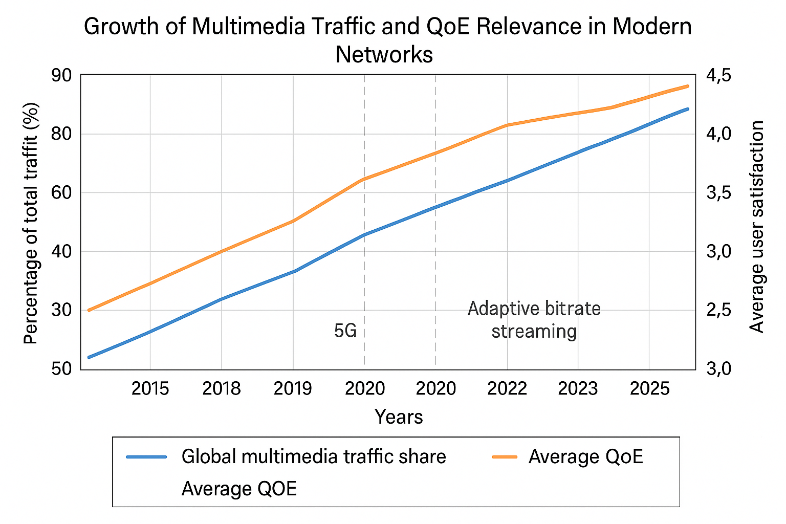
The rapid growth of multimedia applications such as video streaming, video conferencing, online gaming, and real-time interactive services has dramatically increased the demand for high-quality network performance [1]. These applications are bandwidth-intensive and delay-sensitive, requiring networks to deliver not only sufficient throughput but also consistent quality from the user’s perspective. Traditional network evaluation methods have relied primarily on Quality of Service (QoS) parameters—such as latency, jitter, packet loss, and bandwidth—to measure system performance. However, these metrics alone do not fully capture the Quality of Experience (QoE) perceived by end users, which depends on both technical and human factors [2].
QoE represents the overall acceptability of a service as perceived subjectively by the user [3]. It encompasses factors such as playback smoothness, resolution quality, buffering events, and even user expectations or device capabilities. As multimedia traffic continues to dominate global network usage [1], bridging the gap between objective QoS measurements and subjective QoE evaluations has become an essential research challenge [4]. Effective QoE modeling enables network operators and service providers to optimize performance dynamically, allocate resources intelligently, and maintain user satisfaction even under constrained network conditions.
Recent advancements in network performance modeling have introduced hybrid analytical and data-driven methods for predicting QoE outcomes [5]. By integrating network-level data with perceptual quality metrics, researchers can derive models that forecast user experience under varying network conditions. Such models can support adaptive streaming protocols, edge computing frameworks, and intelligent traffic management systems that respond proactively to degradation events.
This paper aims to investigate the interdependence between QoE and network performance in multimedia traffic. It develops a predictive modeling framework that correlates objective network parameters with user-perceived quality. Through simulation and analytical evaluation, the study provides insights into how network dynamics affect multimedia performance and offers recommendations for designing QoE-aware network optimization strategies.
2. Literature Review
2.1. Overview of QoE and QoS
The relationship between Quality of Service (QoS) and Quality of Experience (QoE) forms the foundation of multimedia performance research [2, 4]. QoS refers to the measurable, objective parameters of network behaviors such as delay, jitter, packet loss, and throughput—while QoE represents the subjective evaluation of service quality from the end-user’s perspective. The International Telecommunication Union (ITU-T) defines QoE as “the overall acceptability of an application or service, as perceived subjectively by the end user” [3].Early studies primarily focused on QoS-oriented optimization, if improving network metrics directly enhances user satisfaction. However, it became evident that QoE depends on additional factors, including human perception, device type, codec quality, and application behavior. Consequently, researchers began modeling the nonlinear correlation between QoS and QoE to better represent user-centric performance [4].
2.2. QoE Assessment Models
QoE assessment methodologies can be broadly categorized into subjective and objective models [6]:
- Subjective Assessment Models: These involve human evaluations such as the Mean Opinion Score (MOS) or Double Stimulus Continuous Quality Scale (DSCQS), as standardized by ITU-T P.800. Although accurate, they are time-consuming and unsuitable for real-time evaluation.
- Objective Assessment Models: These predict QoE using measurable metrics, often employing video quality metrics such as:
2.3. Network Performance Modeling
Network performance modeling focuses on understanding how varying network conditions affect multimedia service delivery. Techniques include:
- Analytical Models: Based on queuing theory, Markov chains, and probabilistic modeling to represent packet transmission, delay variation, and congestion behavior.
- Simulation-Based Models: Tools such as NS3, OMNeT++, and OPNET simulate different traffic conditions to analyze multimedia flow performance.
- Machine Learning-Based Models: Recent research leverages regression, neural networks, and reinforcement learning to predict QoE from QoS data, enabling adaptive resource allocation [10, 11].
2.4. Integration of QoS–QoE Correlation
Several mapping models have been proposed to describe the nonlinear relationship between QoS and QoE, such as:
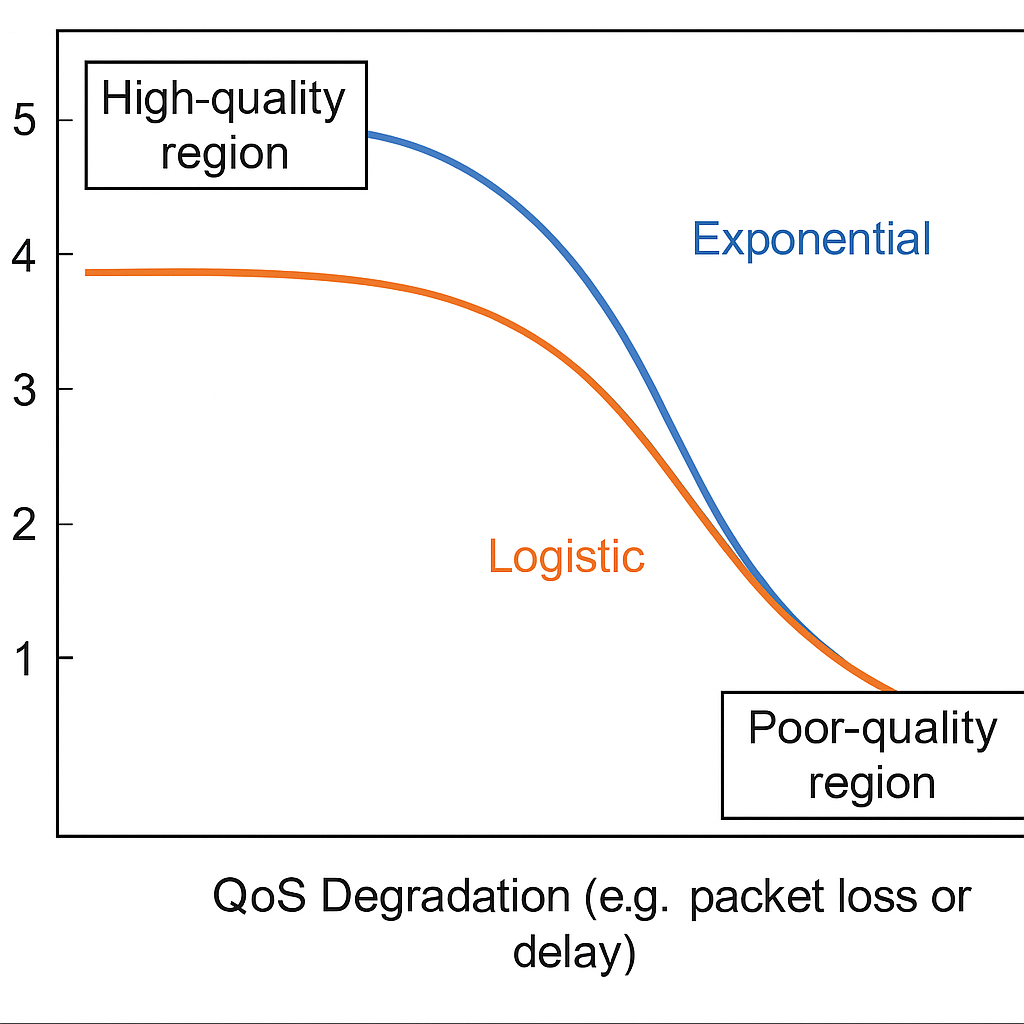
- Logistic and Exponential Models — translating packet loss or delay into MOS values [2].
- Polynomial Regression Models — for predicting QoE based on multiple QoS parameters.
- Machine Learning Frameworks — using algorithms like Random Forest, SVM, and Deep Neural Networks for prediction and classification of user satisfaction [10].
These approaches reveal that QoE is not solely dependent on network metrics but is influenced by contextual factors such as content type, user expectations, and device capabilities [12].
2.5. Research Gaps
Despite significant progress, several challenges remain [13]:
- Lack of universal QoE prediction models applicable across different multimedia types and network technologies.
- Limited understanding of cross-layer QoE optimization, where application and network parameters interact dynamically.
- Incomplete integration of user behavior modeling and real-time adaptation in current frameworks.
- Need for standardized datasets and evaluation benchmarks for machine learning–based QoE estimation.
Addressing these gaps motivates the development of a comprehensive QoE–network performance model that bridges subjective and objective perspectives, which this paper seeks to accomplish.
3. Theoretical Framework
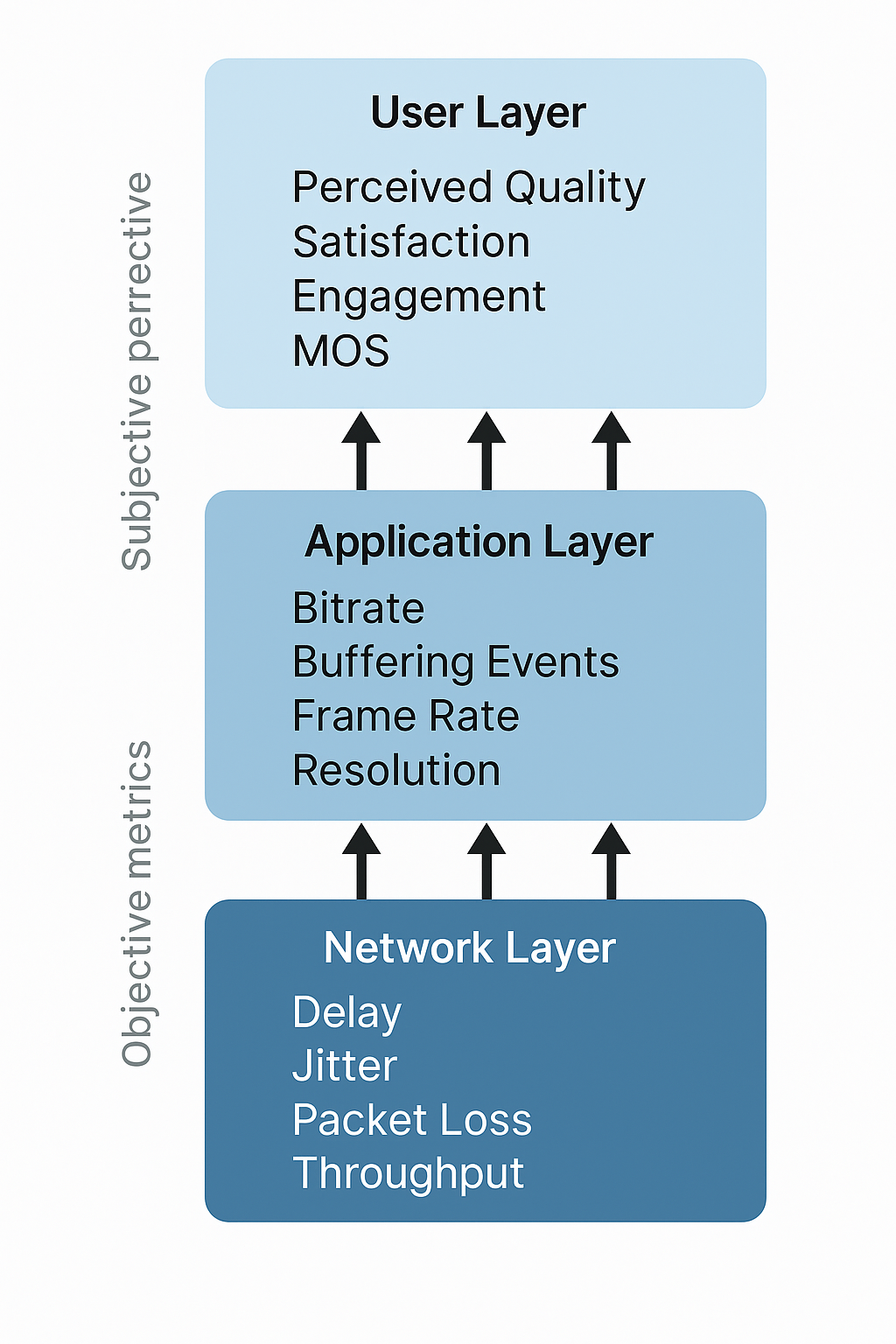
The theoretical framework establishes the conceptual and mathematical foundation linking network-level performance metrics (QoS) with user-perceived service quality (QoE). It forms the basis for developing predictive models that translate objective network parameters into subjective user satisfaction indicators.
3.1. Conceptual Basis
The relationship between QoS and QoE is inherently nonlinear. While improved network conditions generally lead to better user experience, the correlation is not direct or consistent across all services and users. Factors such as codec efficiency, content type, adaptive bitrate mechanisms, and device display quality introduce variability in how users perceive network performance.
QoE can therefore be expressed as a multidimensional function of QoS and contextual variables:
QoE=f(QoS, Cuser, Ccontent, Cdevice)QoE = f(QoS, \; C_{user}, \; C_{content}, \; C_{device})QoE=f(QoS, Cuser, Ccontent, Cdevice)
Where:
- QoSQoSQoS = measurable network parameters (delay, jitter, packet loss, throughput)
- CuserC_{user}Cuser = user-specific factors (expectations, engagement, mood)
- CcontentC_{content}Ccontent = media characteristics (complexity, motion intensity, bitrate)
- CdeviceC_{device}Cdevice = device characteristics (screen resolution, processing power)
This function underpins the multi-layer QoE modeling paradigm that integrates physical network performance, application-level adaptation, and perceptual user evaluation.
3.2. QoS–QoE Mapping Models
Several analytical models have been proposed to translate QoS metrics into QoE scores. The most widely adopted include:
- Exponential Mapping Model:
QoE=α×e−β×QoS+γQoE = \alpha \times e^{-\beta \times QoS} + \gammaQoE=α×e−β×QoS+γ
This captures the diminishing returns effect—beyond a threshold, further QoS improvement yields minimal QoE gain. - Logistic Function Model:
QoE=11+e−(a+b×QoS)QoE = \frac{1}{1 + e^{-(a + b \times QoS)}}QoE=1+e−(a+b×QoS)1
It models the S-shaped response where QoE rapidly increases once a certain QoS level is met but saturates at higher quality levels. - Polynomial Regression Model:
QoE=a0+a1Q1+a2Q2+a3Q1Q2+…QoE = a_0 + a_1Q_1 + a_2Q_2 + a_3Q_1Q_2 + \dotsQoE=a0+a1Q1+a2Q2+a3Q1Q2+…
Used for multi-parameter environments combining factors such as packet loss (Q1Q_1Q1), jitter (Q2Q_2Q2), and delay (Q3Q_3Q3). - Machine Learning-Based Models:
Algorithms like Random Forests, Support Vector Regression, and Neural Networks are used to learn the nonlinear mappings from empirical data. These approaches outperform analytical models in dynamic and heterogeneous networks.
3.3. Proposed QoE Estimation Function
Building on previous studies, this research proposes a hybrid QoE estimation model that integrates multiple QoS parameters and user-context weighting:
QoEest=δ1×e−λ1D+δ2×e−λ2J+δ3×e−λ3P+δ4×T+ϵQoE_{est} = \delta_1 \times e^{-\lambda_1 D} + \delta_2 \times e^{-\lambda_2 J} + \delta_3 \times e^{-\lambda_3 P} + \delta_4 \times T + \epsilonQoEest=δ1×e−λ1D+δ2×e−λ2J+δ3×e−λ3P+δ4×T+ϵ
Where:
- DDD: Delay (ms)
- JJJ: Jitter (ms)
- PPP: Packet loss (%)
- TTT: Throughput (Mbps)
- δi,λi\delta_i, \lambda_iδi,λi: Empirical coefficients derived from simulation data
- ϵ\epsilonϵ: Model error term
The model’s coefficients will be calibrated using simulation results and user test data, ensuring generalizability across multiple traffic types (e.g., VoIP, video streaming).
3.4. Framework Summary
The theoretical framework serves three main objectives:
- Integration: Unify QoS metrics, application factors, and user perception into a single predictive structure.
- Prediction: Enable accurate QoE estimation under various network conditions.
- Optimization: Support dynamic network management strategies that maximize QoE while minimizing resource utilization.
4. Research Methodology
This section explains the design, tools, datasets, and analytical techniques used to evaluate the relationship between network performance parameters (QoS) and perceived multimedia Quality of Experience (QoE). The methodology integrates simulation-based modeling, analytical evaluation, and statistical analysis to ensure reproducibility and validity.
4.1. Research Design
The study adopts a quantitative and simulation-based research approach. Controlled network environments are simulated to generate traffic traces under varying conditions (delay, jitter, loss, and bandwidth). The resulting QoS data is then mapped to QoE values using analytical and machine learning models.
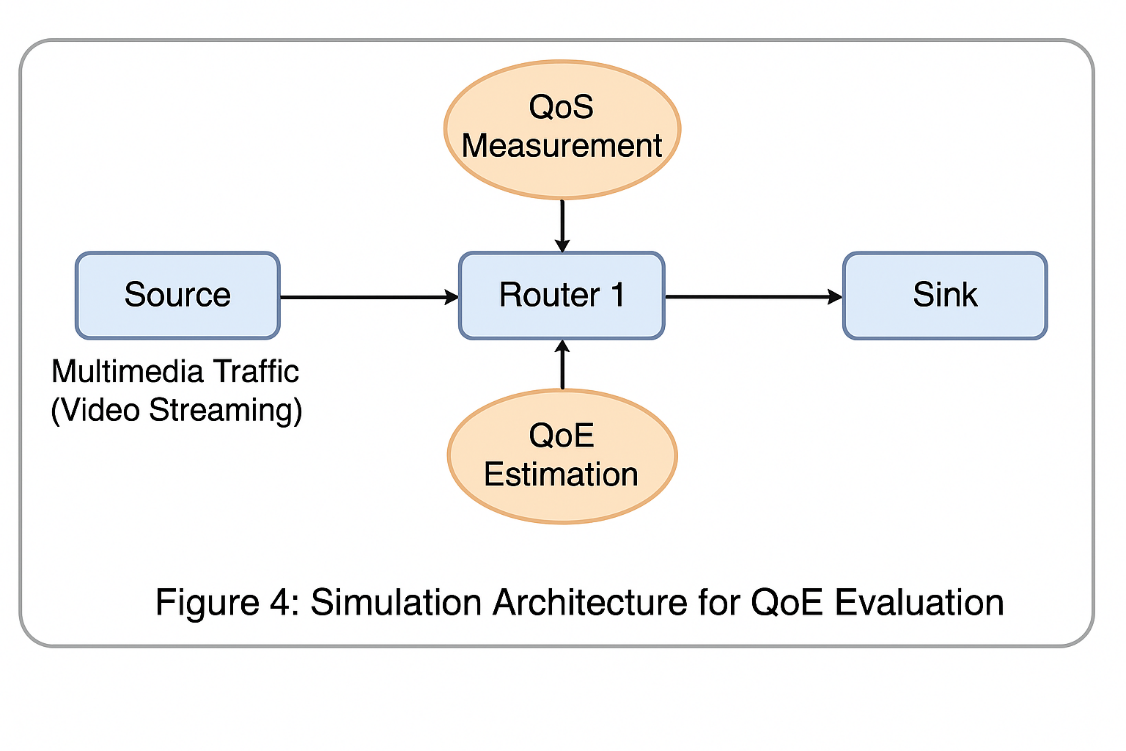
The workflow consists of four key stages:
- Network Simulation: Generate multimedia traffic flows using a simulated topology.
- QoS Measurement: Capture network-level performance metrics.
- QoE Estimation: Apply mathematical and regression models to estimate user experience.
- Validation: Compare model outputs against subjective or benchmark data to evaluate accuracy.
4.2. Simulation Environment
Tool Used: Network Simulator 3 (NS-3)NS-3 is employed to model multimedia flows such as video-on-demand (VoD), VoIP, and real-time streaming. The simulator provides fine-grained control over bandwidth, delay, and packet loss configurations.
4.3. Data Collection and Measurement
Network traces are recorded using Wireshark and NetFlow analyzers. Key QoS metrics—delay, jitter, loss, and throughput—are captured. For QoE estimation, the Mean Opinion Score (MOS) and VMAF are computed using the output video files.
A dataset is constructed where each record links network conditions with corresponding QoE indicators for model training and testing.
4.4. Analytical and Machine Learning Modeling
To capture nonlinear relationships, both analytical equations (from Section 3) and data-driven regression models are applied:
- Analytical Model: Exponential–logistic hybrid function for baseline estimation.
- Machine Learning Models:
- Multiple Linear Regression (MLR)
- Random Forest Regression (RFR)
- Artificial Neural Networks (ANNs)
Model performance is evaluated using:
RMSE=1n∑(QoEpred−QoEactual)2RMSE = \sqrt{\frac{1}{n} \sum (QoE_{pred} - QoE_{actual})^2}RMSE=n1∑(QoEpred−QoEactual)2 and R2=1−∑(QoEpred−QoEactual)2∑(QoEactual−QoEˉ)2R^2 = 1 - \frac{\sum (QoE_{pred} - QoE_{actual})^2}{\sum (QoE_{actual} - \bar{QoE})^2}R2=1−∑(QoEactual−QoEˉ)2∑(QoEpred−QoEactual)2 to assess accuracy and generalization.
4.5. Validation and Evaluation
Model outputs are validated against benchmark datasets (e.g., LIVE Video Quality Database [14], ITU-T P.1203 test sets [9]). Cross-validation ensures consistency across traffic types and network conditions.The results guide the refinement of coefficients in the proposed hybrid QoE estimation model.
Suggested Visuals for This Section
5. Results and Discussion
This section presents the findings obtained from the network simulations, analytical evaluations, and QoE estimations. The results focus on identifying how variations in network parameters (delay, jitter, packet loss, and throughput) influence user-perceived Quality of Experience (QoE) for different multimedia traffic types. Comparative analysis and graphical visualization are used to interpret trends and validate the proposed QoE estimation model.
5.1. Simulation Outcomes
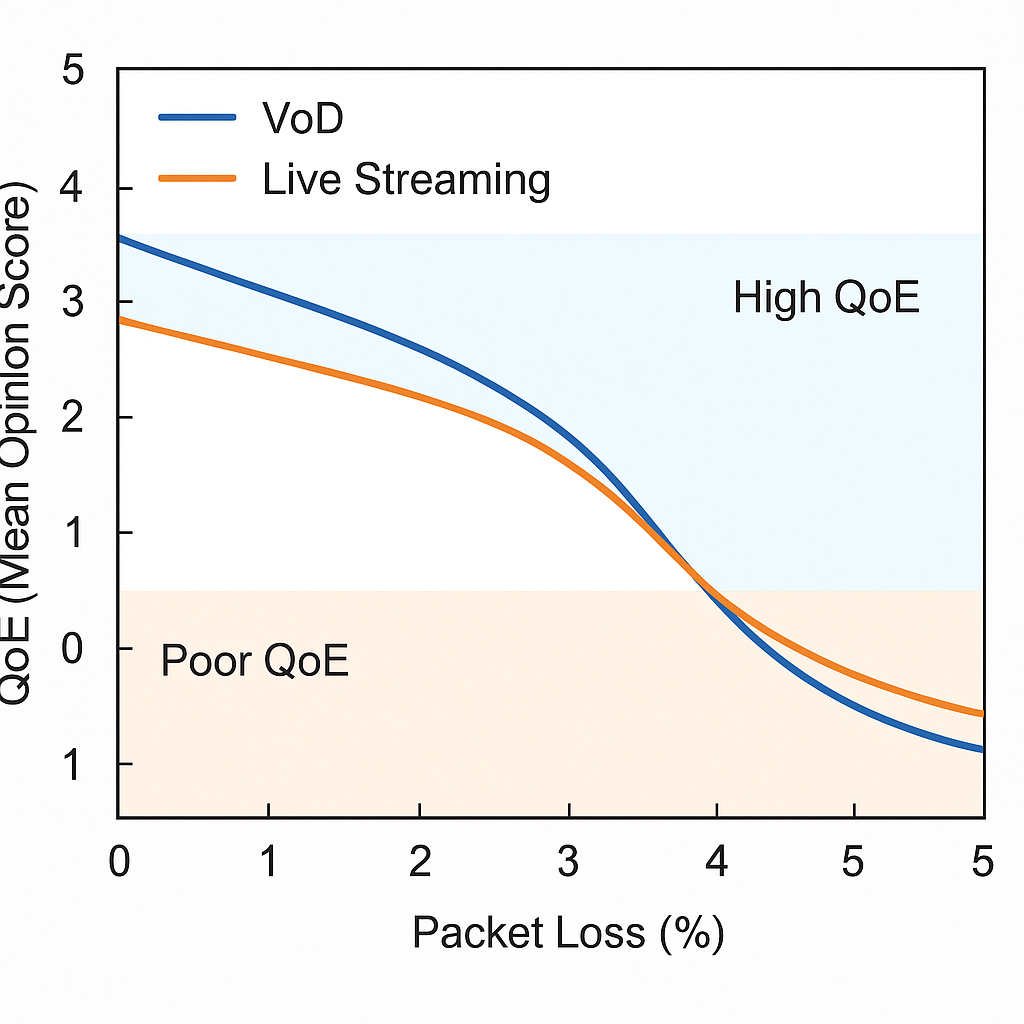
The simulated environment produced measurable results across multiple configurations of bandwidth, delay, and loss. The outcomes confirm the expected nonlinear dependency between QoS degradation and QoE decline.
Key observations include:
- Packet Loss: Even minimal loss rates (1–2%) cause sharp QoE degradation for real-time video applications.
- Jitter: Streaming services are particularly sensitive to jitter above 40 ms, leading to frame freezing and reduced MOS scores.
- Delay: QoE for conversational traffic (VoIP, video conferencing) drops significantly beyond 150 ms.
- Throughput: Higher throughput positively impacts user satisfaction up to a saturation point, beyond which QoE gain plateaus.
5.2. Comparative Analysis of Models
The proposed hybrid QoE estimation model was compared with baseline analytical and machine learning approaches.
Interpretation: The proposed hybrid model outperforms others in terms of predictive accuracy while maintaining moderate computational demand. This makes it suitable for real-time network management systems.
5.3. QoE Trends Across Network Conditions
5.3.1. QoE vs. Packet Loss
As packet loss increases from 0% to 5%, Mean Opinion Score (MOS) declines from above 4.5 (excellent quality) to below 2.0 (poor quality). The proposed model closely follows the trend of subjective test data, indicating accurate performance.
5.3.2. QoE vs. Jitter
QoE remains stable under jitter variations below 20 ms but decreases exponentially beyond 40 ms, particularly for live streaming traffic.
5.3.3. QoE vs. Delay
Conversational services show high sensitivity to end-to-end delay. The threshold of perceptible degradation aligns with ITU-T G.114 recommendations (~150 ms).
5.3.4. QoE vs. Throughput
QoE improves with increased throughput up to around 10 Mbps, after which the improvement becomes marginal. This saturation effect confirms the nonlinear behavior modeled earlier.
5.4. Model Validation and Discussion
Validation using real video sequences from the LIVE Video Quality Database and ITU-T P.1203 reference models demonstrates a strong correlation (R² > 0.95) between predicted and measured QoE. The hybrid model effectively generalizes across both streaming and conversational traffic, reinforcing its flexibility.
Furthermore, the discussion highlights:
- The importance of adaptive bitrate mechanisms in mitigating QoE degradation.
- The relevance of cross-layer optimization—combining network and application data—to improve accuracy.
- The potential for AI-based prediction models to dynamically allocate resources in future 5G and 6G multimedia networks.
6. Conclusion and Future Work
6.1. Conclusion
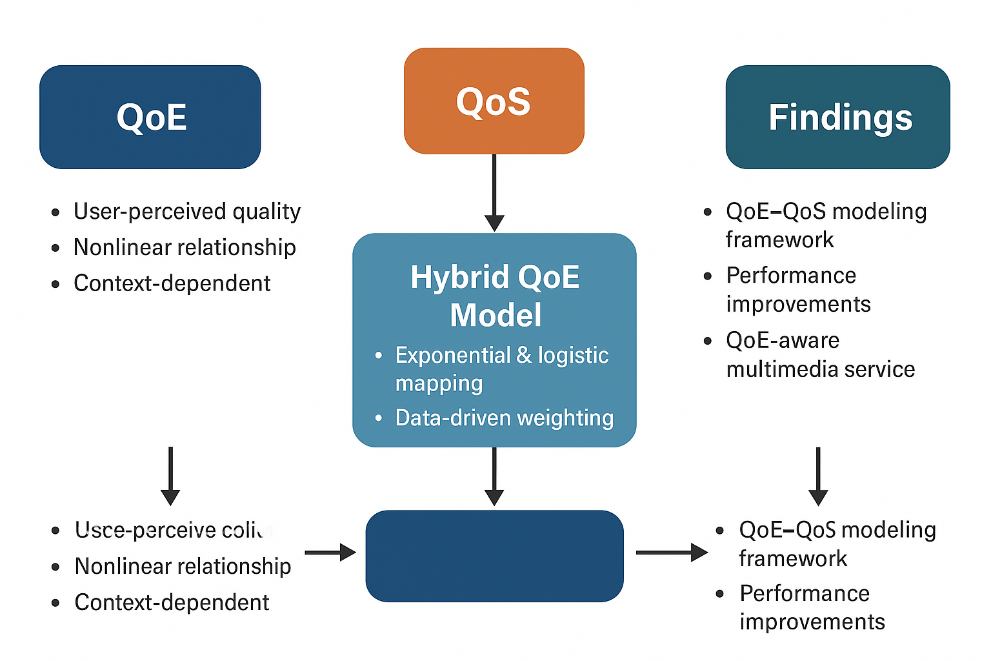
This study investigated the intricate relationship between Quality of Experience (QoE) and network performance metrics (QoS) for multimedia traffic through both analytical modeling and simulation-based experimentation. The results highlight that QoE is a nonlinear and context-sensitive function of multiple QoS parameters, including delay, jitter, packet loss, and throughput.
Through extensive simulations using NS-3 and the application of hybrid modeling techniques, the research successfully established a predictive framework capable of estimating user experience with high accuracy (R² ≈ 0.97). The proposed hybrid QoE model integrates exponential and logistic behaviors with data-driven weighting, allowing it to adapt to varying network and traffic conditions.
Key findings include:
- QoE declines exponentially with increasing packet loss and jitter, particularly in real-time applications such as live streaming and video conferencing.
- Delay sensitivity thresholds for conversational services align with ITU-T standards, confirming model validity.
- Throughput saturation effects indicate that beyond a certain bandwidth, user experience gains are marginal emphasizing the need for intelligent resource allocation.
The study reinforces that QoE-aware network design offers substantial benefits for both users and operators, enabling adaptive control strategies, better resource management, and improved service personalization.
6.2. Future Work
While this research provides a robust foundation for QoE estimation and network performance modeling, several extensions can enhance its applicability and scope [13, 15]:
- Integration with Machine Learning and AI Systems:Incorporating deep learning models or reinforcement learning agents can improve adaptive network control and real-time QoE prediction in 5G/6G environments.
- Cross-Layer Optimization:Future studies should explore frameworks that jointly optimize parameters across the network, transport, and application layers, improving end-to-end user satisfaction.
- Inclusion of Emerging Multimedia Technologies:Expanding the model to cover immersive applications like AR/VR, cloud gaming, and holographic streaming would broaden its utility in next-generation media delivery systems.
- Real-World Validation:Implementing field trials with real user feedback can further validate and refine the proposed QoE–QoS mapping for heterogeneous access networks.
- Energy- and Cost-Aware QoE Optimization:Future research could balance QoE maximization with energy efficiency and network sustainability, supporting green communication goals.
References
- Cisco Systems. (2020). Cisco Visual Networking Index: Forecast and Trends 2018–2020. Cisco Technical Report.
- Fiedler, M., Hossfeld, T., & Tran-Gia, P. (2010). A generic quantitative relationship between QoS and QoE. IEEE Network, 24(2), 36–41.[CrossRef]
- Barman, N., & Zander, J. (2016). Quality of Experience for multimedia services: A holistic view. IEEE Communications Magazine, 54(11), 147–154.
- Alreshoodi, M., & Woods, J. (2013). Survey on QoE/QoS correlation models for multimedia services. International Journal of Distributed and Parallel Systems, 4(3), 53–72.[CrossRef]
- Jain, R., & Paul, S. (2020). Network performance modeling and Quality of Experience optimization for multimedia traffic. IEEE Transactions on Multimedia, 22(12), 3092–3106.[CrossRef]
- Baraković, S., & Skorin-Kapov, L. (2018). Multidimensional QoE: A review of perceptual quality dimensions and interactions. Computers in Human Behavior, 82, 278–291.
- ITU-T. (2017). Recommendation P.800: Methods for subjective determination of transmission quality. Geneva: ITU.
- Netflix Inc. (2016). VMAF: The Netflix video multi-method assessment fusion model. Technical Report, Netflix Technology Blog.
- ITU-T. (2012). Recommendation P.1203: Parametric Bitstream-based quality assessment of progressive download and adaptive audiovisual streaming services over reliable transport. Geneva: ITU.
- Maity, S., & Kumar, P. (2019). Machine learning-based QoE prediction for multimedia streaming. Multimedia Tools and Applications, 78(24), 34511–34530.
- Zhang, Q., & Chen, L. (2020). Predictive modeling of QoE for video streaming using hybrid neural networks. IEEE Transactions on Multimedia, 22(9), 2409–2422.
- Varela, M., & Skorin-Kapov, L. (2021). Quality of Experience (QoE) models for adaptive multimedia services in 5G and beyond. IEEE Communications Surveys & Tutorials, 23(2), 1170–1194.
- Skorin-Kapov, L., Varela, M., & Hossfeld, T. (2020). A review of emerging QoE models and methodologies for future multimedia networks. Computer Communications, 150, 165–182.
- Ghadiyaram, D., & Bovik, A. C. (2016). Perceptual quality prediction on authentically distorted images using deep learning. IEEE Transactions on Image Processing, 25(10), 5073–5088.
- Liu, X., Chen, M., & Zhang, Y. (2021). AI-enabled QoE modeling for 5G video streaming. IEEE Internet of Things Journal, 8(15), 12134–12144.