

Monitoring and supervision in schools is a very important aspect in the educational process. The purpose of the study was to examine monitoring and supervision of curriculum delivery in the Junior High Schools in Ejisu-Juaben Municipality of Ghana. Mixed method research approach was adopted for the study. The population f or this study was made up of teachers, head-teachers and the deputy director in charge of supervision in the Ejisu-Juaben Municipality. Purp osive and convenient sampling techniques were employed to select the one-hundred and eighty-four respondents for the study. The main instruments for data collection were questionnaire and observation. The study revealed that monitoring and supervision was more or less just conformance to stipulated regulations and that teachers and head-teachers must comply without necessarily ensuring staff development to reduce limitations. The study also indicated that there is high level of impact of monitoring and supervision on Junior High Schools’ curriculum implementation in Ejisu-Juaben Municipality over the past years. It is recommended that, f or good performance, appraisal should be done at least by the end of every school term to ascertain staff performance on their j ob. It is also recommended that, for improvement of curriculum implementation, school heads should improve on; frequency coordination of all departments of the organization of visiting less on sessions, checking teachers’ less on notes, inviting teachers to observe him/her teach and checking students’ assignments, class exercises and pupils project work to ensure regular marking of exercise takes place.
An evaluation of Monitoring and Supervision in the Junior High Schools Curriculum Delivery in Ghana
April 24, 2022
July 08, 2022
July 28, 2022
November 21, 2022
This is an Open Access article, distributed under the terms of the Creative Commons Attribution 4.0 International License (http://creativecommons.org/licenses/by/4.0/), which permits unrestricted use, distribution and reproduction in any medium or format, provided the original work is properly cited.
Abstract
1. Introduction
Monitoring is an ongoing process by which all stakeholders are able to obtain regular feedback on the progress being made towards goals and objectives of a process. It is an important source of information f or programme evaluation [1]. Monitoring is a systematic process of observing, tracking, and recording activities of a process f or the purpose of measuring a programme or project implementation and its progress towards achieving objectives. Information gathered through monitoring is used to analyse and evaluate the components of the project or programme in order to measure its effectiveness and adjust inputs where necessary [2]. Monitoring is a process of tracking changes in a programme, project or policy outcomes over time [3]. It is the systematic and routine collection of information from policies, projects and programmes f or the purpose of learning from experiences and making necessary changes; make outcome assessment regarding inputs and outputs to provide internal and external accountability of the resources used and the results obtained; provide a basis to take informed decisions on the future of the policy, project or programme; To fine tune outcomes to meet intended benefits f or beneficiaries of the policy, project or programme [3].
Educational supervision is the set of activities designed to attain educational objectives, to bring about effective teaching and learning methods, to attain and develop the curriculum, to help teachers to find out their teaching problems and come up with the solution by themselves and to develop professional growth [4]. Educational supervision is also seen as a planned programme to stimulate, c o ordinate, and guide continued growth of teachers in schools, both individually and collectively f or the improvement of instruction, assistance in the development of better and satisfying teaching-learning situation, a means of maintaining existing programmes of instruction as well as improving them to the level of satisfying both the needs of the teachers and of the school together [4]. Educational supervision is concerned with the total improvement of teaching and learning situations in the school. In line with this idea, educational supervision has the following principles: there should be short-term, medium-term and long-term planning f or supervision; supervision is a sub-system of school organisation, all teachers have a right and the need f or supervision; supervision should be conducted regularly to meet the individual needs of the teachers and other personnel; supervision should help to clarify educational objectives and goals f or head teachers and the teachers; supervision should assist in the organisation and implementation of curriculum programmes f or the learners; and supervision from within and outside the school complement each other and are both necessary [5].
1.1. Impact of Monitoring and Supervision on Teacher Performance
The impact of monitoring on the instructional process cannot be overlooked. supervision is viewed as the motivation of professional growth and development of teachers, a collection and amendment of educational objectives, resources of instruction, approaches of teaching, and the assessment of instruction. Contemporary educational supervision is categorised amid others as a practical procedure which aims at bettering teaching and learning through the maintenance, direction and replication of sustained growth f or teachers and other persons who have an impact on the educational context [6].
Monitoring of the teaching and learning process enables teachers to develop their skill in the delivery of instruction which brings improvement in teaching and learning [7]. Also, it is a process which is aimed at assisting teachers to achieve the value from their instructional process. Instructional supervision aims at identifying a domain in the instructional process that requires improvement. Instructional supervision is important because of many factors, supervisees acquire knowledge during the process of supervision because the supervisor has more knowledge than the supervisee and this is realized through constructive communication. Apart from that, it enhances the proficient skill of the instructor [7]. The purpose of supervision of instruction is to assist instructors to gain knowledge in their field of work so that their teaching skills will be enhanced which will in turn improve their output [7]. In a nut shell, supervision of instruction addresses issues like enhancing the worth of teaching and learning, helping students increase their performance in spite of the nature of the curriculum or staff development [7, 8]. The most significant aims of educational supervision is seeing each teacher carry out the responsibilities given to him or her and also better the productiveness of teachers to equip them give their maximum ration to achieve the aims of a school [6].
Also, the aim of supervision of instruction is to bring enhancement to teachers. This enhancement may be in areas like enhancement of teaching skills, together with the teachers’ skill to make proficient choices. [6]. Supervision of instruction is an important instrument that helps in developing effectual teacher proficiency. It can also be said as a managerial task that aims at development of teachers and enhancement in instructional process and better pupil achievement [6, 9]. Each career or vocation needs constant development in approaches and abilities essential f or employee performance. This simply implies that teacher professional enhancement is important f or the effective performance of employees. This implies that teacher proficiency improvement is needed f or every school to be successful [6, 10, 11]. The several methods of supervision of instruction like clinical supervision, peer coaching, cognitive coaching, mentoring helps to improve the professional development of teachers. Supervision of instruction propose that there is an important connection between supervision of instruction and professional development [6, 9, 10, 11, 12].
1.2. Impact of Monitoring and Supervision on Students Performance
Instructional process and supervision assists in enhancing the educational achievement of students. This is so because, supervision of instruction focuses on improving teaching and l earning through appropriate direction and organisation, and inventing methods of enhancing instructors skillfully and assisting them to deliver their innovative skills in order that the instructional process will be improved through them. Supervision assists instructors to be conversant with sources of help to solve educational challenges [7]. Supervision improves instructors’ knowledge of the educational process and helps them in the usage of scholarly writing, periodicals, available and affordable instructional resources, audio visual aid and educational tools which goes a long way to improve students l earning [7]. Supervision of teaching assists in enhancing education. The author explained that instruction refers to the c olla oration among people, resources, philosophies, presentations and objects of the artificial curriculum atmosphere. This simply means the collaboration of various actions among the teacher and the student as fragments of the school setting. During collaboration, the supervisor finds out challenges the instructor fac es and helps to address them. This goes a long way to affect the l earning positively [7]. Educational supervision helps to alert the teacher m or e in classroom management. The way a teacher manages his class is often seen as an index of his teaching effectiveness. L earning is an activity which takes place in an atmosphere free from disturbances and distractions. A teacher cannot therefor e be said to be facilitating l earning when conducting his class in a disorderly environment like when students are sleeping in the class, when students are inattentive or engaging in disruptive activity while lesson is on [7]
A good teacher should watch these behaviours and put them to control and supervision helps to intimate teachers in this way [7]. Classroom visits constitute an important aspect of the responsibilities of the instructional supervisor. The researcher further explains that during such visitations, supervisors examine how favourable the l earning environment is and devices strategies to enhance the classroom setting to obtain the anticipated objectives. Educational procedures and supervision work hand in hand to enhance the educational output of pupils since without supervision, instructional managers will flop in their duty of perpetuating excellent and high quality education [7].
Supervision is basically the practice of monitoring the performance of school staff, noting the merits and demerits and using befitting and amicable techniques to improve the flaws or negatives while still improving on the merits, thereby increasing the standard of schools and achieving educational goals [13, 14]. The effective monitoring and supervision in education helps to give the governing body, a picture of performance, and helps facilitate decision-making in order to improve the educational process. Monitoring and supervision in education is therefore a very vital process that can help to effectively implement the school curriculum. Knowing the value and the importance of monitoring and supervision, the Ghana Education Service provides monitoring and supervision services for basic schools in Ghana. This research seeks to investigate the role of monitoring and supervision that the Ghana Education Service offers in the delivery of Ghana’s Basic school curriculum.
A five – year personal experience of the researcher as a circuit supervisor of basic schools revealed that there is a gap between what circuit supervisors do during monitoring and supervision of the schools they are assigned to and what is actually required of them by Ghana Education Service. Also, reports written by circuit supervisors to the district and municipal education directorate are shelved so the problems identified on the field are not addressed as anticipated by both teachers and supervisors as indicated by the circuit supervisor for Tikrom circuit Mr. Dwumfuor in November 2017 (personal communication). As a result, the curricular which are the planned activities that are expected to transform the lives of pupils in the basic schools are not achieved adequately. Considerable attention has been placed on monitoring and supervision of the Junior High School curriculum by researchers however, not much scholarly work has been done on its delivery. This study therefore seeks to find out the role of monitoring and supervision in the delivery of the JHS curriculum in the Ejisu-Juaben Municipality in Ghana.
As such, the general question this study seeks to find answer to is, to what extent is monitoring and supervision done to ensure the effective delivery of the JHS curriculum in Ghana? Is there a monitoring and supervision policy available in the Ghana Education Service and if it is in existence, how effective have they been to ensure delivery of the JHS curriculum in Ghana? There have not been much empirical studies in this area especially in Ghana Education Service. It is for this gap that this work is being conducted to study monitoring and supervision practices that are employed by the Ghana Education Service to ensure delivery of the JHS curriculum in Ghana with special reference to Ejisu-Juaben Municipality. The study sought to answer the research question - What is the impact of monitoring and supervision of curriculum delivery on Junior High Schools in Ejisu-Juaben Municipality?
2. Materials and Methods
Mixed method research approach was adopted for the study. The population f or this study was made up of teachers, head-teachers and the deputy director in charge of supervision in the Ejisu-Juaben Municipality. Purp osive and convenient sampling techniques were employed to select one hundred and eighty f our (184) was selected f or the study. (180 teachers, 3 head-teachers and the deputy director in charge of supervision in the Ejisu-Juaben Municipality). The purposive sampling technique was used to select the teachers who participated whereas the convenience technique was used to select the Deputy Director of Education in charge of supervision and head-teachers which the researcher assumes that, they have in-depth knowledge of the monitoring and supervision activities in delivering the JHS curriculum. The convenience sampling method was also used to select respondents who were willing and able to participate in the study. The main instruments for data collection were questionnaire, semi-structured interview and observation.
The quantitative data entry and analysis was done by using the SPSS software package. The data was edited, coded and analysed into frequencies, percentages with interpretations. The qualitative data was analysed by the use of the interpretative method based on the themes arrived at during the data collection. The themes were related to the research question and interpreted on the number of issues raised by respondents. These were based on question on the semi-structured interviews and observation.
3. Results and Discussion on Impact of Monitoring and Supervision on Curriculum Delivery in Junior High Schools in Ejisu-Juaben Municipality
The objective study was to examine the impact of monitoring and supervision on curriculum implementation in Junior High Schools in Ejisu-Juaben Municipality over the years. In order to achieve this, questionnaire was administered to teachers and head-teachers in the Ejisu-Juaben Municipality which had some questions to express their level of agreement. A 5-point scale was employed, measuring “1=strongly disagree” through to “3=neither agree n or disagree” to “5=strongly agree”. The results obtained from this evaluation are shown in Tables 1 and Figure 1 bel ow:
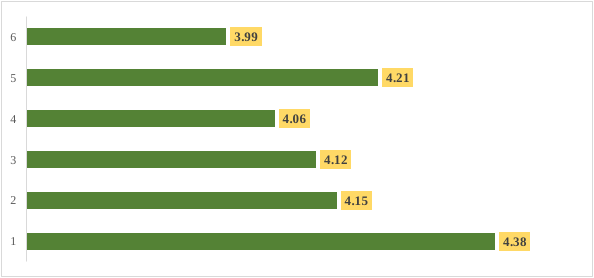
In Table 1 and Figure 1, the respondents indicated the extent to which they agree or otherwise with the impactof monitoring and supervision on curriculum implementation in Junior High Schools in Ejisu-Juaben Municipality over the years. The overall mean score was 4.15 representing a high degree of agreementof the impact of monitoring and supervision on curriculum implementation. The result shows more than average rank of respondents agreeing to all of these impact factors. The result shows that at Ejisu-Juaben municipality, Monitoring and supervision helps in effective instructional delivery (Mean= 4.38, SD-=1.104). Similar responses were given to assertions such as monitoring and supervision helps to improve up on pupils' performance; monitoring and supervision helps teachers upgrade themselves in their subject areas; monitoring and supervision helps with the judicious use of instructional time; monitoring and supervision helps teachers to prepare appropriate lesson plans; and to improve on teaching and learning materials. The findings revealed that there is high level of impact of monitoring and supervision on Junior High Schools’ curriculum implementation in Ejisu-Juaben Municipality over the past years.
These roles of supervisors agree with previous study that supervision has direct effect on employees’ performance, since they assign tasks and clear responsibilities f or performing activities. Providing feedback check employee performance through the right direction [16]. Furthermore, interview sessions were conducted with three head teachers in the Municipality from Asaman M/A JHS, Ejisu Presby JHS and Tinkr om JHS and there were varied responses. The study revealed that there were varied responses from the head-teachers interviewed. Using content analysis, it was necessary to compare their responses. The first question posed to them was about how often the circuit supervisor visits their respective schools in a term. The Asaman M/A JHS Head-teacher indicated that, “the circuit supervisor visits the school twice in a term; first visit in the first week of re opening and the second visit in the last week of re opening”. F or, Ejisu Presby JHS, the response indicated that, the circuit supervisor visits the school at least five times in a school term whereas the Tikrom head-teacher iterated that “the circuit supervisor visits their school three times in a term. First visit is during the re- opening week, another one in the middle of the term and the last one in the last week of school term”. Therefore, comparatively, Ejisu Presby JHS enjoy more visits from the circuit supervisor with the reason been that they are situated in the municipal capital and accessibility is very easy as compared to the other school.
Secondly, they were asked the r ole that the circuit supervisor plays in the implementation of the curriculum in their respective schools. According to the Asaman M/A JHS Head-teacher, the circuit supervisor only inspects scheme of work that teachers will be using to teach in the term but does not sit in the classroom to observe teachers teaching. Ejisu Presby JHS head-teacher indicated that the circuit supervisor inspects teachers’ attendance, less on plans of teachers, pupils’ exercises b o oks to see if the kind of exercises teachers give to the pupils corresponds with what is in the syllabus and textbook and also inspects if the school compound is safe f or teaching and learning. Tikrom JHS head-teacher also added that the circuit supervisor inspects less on notes of teachers and the class exercises teachers have given to pupils. These reveal that much supervision and monitoring is done at the Ejisu Presby JHS as they receive more visits from the circuit supervisor.
The interviewees were further asked how often the circuit supervisor sits in classrooms to observe teaching and learning. Apart from the Head teacher of Ejisu Presby JHS who affirmed that the circuit supervisor sits in the classroom to observe each of the subjects studied in the JHS at least once a term, both head teachers of Asaman D/A JHS and Tikrom JHS indicated that he does not sit in classroom sessions. The reason was that most of the visits were at the beginning of the term and latter part of the term. This implies that the major purposes of curriculum supervision include monitoring performance, sharing information and solving problems in the classroom situation [17].
The head teachers were again asked about which interventions the circuit supervisor put in place to help teachers limit the challenges they have with less on preparation and delivery. The Asaman M/A JHS Head-teacher indicated that the circuit supervisor does not give any feedback to teachers after looking at the scheme of work they have prepared to use to teach in the term. This assertion was affirmed by the head teacher of Tikrom JHS who indicated that “the circuit supervisor does not give any feedback to teachers after he has inspected the lesson plan of teachers but sanctions those who have not prepared any less on plan.” An earlier study on Perception of Curriculum Leaders and Teachers on Feedback and Conditions Essential for Effective Supervision in Senior High Schools posits that effective curriculum supervision thrives on both supervisors and supervisees keeping records of all formal, as well as informal supervision sessions and providing immediate feedback [16]. This implies that effective feedback should be given space in educational supervision. On the other hand, Ejisu Presby JHS headteacher iterated:
“That after the lesson is taught, the circuit supervisor engages the teacher and encourages him/her about the strengths and discusses possible ways one can limit his/her weaknesses in less on preparations and delivery. He sometimes organizes in-service training f or the teachers in the school and other times f or all the teachers in the circuit”.
The head-teachers interviewed were asked about the general conduct of teachers when the circuit supervisor is around f or monitoring and supervision:
They all iterated that the teachers go about doing their work and there is generally discipline and comportment from both the teachers and pupils. They also use instructional time appropriately and use teaching and learning materials to teach. The pupils al so comp ort themselves and are disciplined. They acknowledged that there is a cordial relationship between teachers and the circuit supervisor.
They were asked about the relationship between circuit supervisors and teachers and all head-teachers interviewed unanimously agreed that there is a cordial relationship. Furthermore, the head-teachers were asked that apart from classroom work, what else does the circuit supervisor does when he visits your school? They further revealed that the circuit supervisor helps in the organization of c o-curricular activities and visits the school during such events and sometimes attends other c o-curricular activities like sports and culture activities organized in the schools. Previous study supported the findings of this current research that the scope of curriculum supervision should not only be limited to the classroom but to the activities outside the classroom which have influence on the teaching and learning interaction [14].
Again, the head-teachers were asked about the sanctions that the circuit supervisors give to teachers who do not prepare lesson plans, teach, and gives pupils appropriate class exercises based on the syllabus and recommended textbooks. They all indicated that:
“When the circuit supervisor identifies any unscrupulous behaviour by teachers, on the first occasion, he gives a verbal warning; the second times, he gives a query letter and if such behaviours are repeated, the person is made to face a disciplinary committee. Also, if teachers fail to prepare less on plan, he gives them a verbal warning and continues with a query letter if the teacher repeats such actions”.
Finally, the respondents were asked about the impact circuit supervisors have on teachers and Pupils. There were varied responses but they all they were very similar. With the impact on teachers, the responses revealed that:
the visits make sure that teachers go to class to teach and do what is expected of them; they give the pupils appropriate class exercises based on the syllabus and textbook; they comport themselves and use teaching and learning materials to teach; they prepare their lesson plan and teach appropriately; they give the pupils adequate exercises based on the syllabus and they use appropriate teaching and learning materials to teach; the visits generally helps to improve the skills of teachers in less on preparation and delivery. Overall, the impact of the visits is evident in the fact that the teachers comp ort themselves better than when the circuit supervisor is not around.
With regards to the pupils, the impact of the circuit supervisor’s visits to the schools helps them to comport themselves and to improve their performance. They are taught the right lessons based on what is stipulated in the syllabus and textbook. The pupils are more disciplined than when the circuit supervisors are not around. Finally, it helps them to understand concepts better since the teachers use teaching and learning materials and also, they employ several methods of teaching.
These were all varied responses of head-teachers of Asaman M/A JHS, Ejisu Presby JHS and Tikrom JHS. Overall, it can be said that the impact of monitoring and supervision on Curriculum Implementation of Junior High Schools in the Ejisu-Juaben Municipality especially among schools in the municipal capital than schools in the hinterlands.
3. Conclusions and Recommendations
The study revealed that monitoring and supervision was more or less just conformance to stipulated regulations and that teachers and head-teachers must comply without necessarily ensuring staff development to reduce limitations. The study also indicated that there is high level of impact of monitoring and supervision on Junior High Schools’ curriculum implementation in Ejisu-Juaben Municipality over the past years. It is recommended that, f or good performance, appraisal should be done at least by the end of every school term to ascertain staff performance on their j ob. It is also recommended that, for improvement of curriculum implementation, school heads should improve on; frequency coordination of all departments of the organization of visiting less on sessions, checking teachers’ less on notes, inviting teachers to observe him/her teach and checking students’ assignments, class exercises and pupils project work to ensure regular marking takes place.
Author Contributions: Conceptualization; methodology; formal analysis; investigation; Resources; data curation; writing-original draft preparation; writing-review and editing; visualisation; supervision; project administration; Author has read and agreed to the published version of the manuscript.
Funding: “This research received no external funding”
Data Availability Statement: Data is available on request from the corresponding author.
Acknowledgments: I acknowledge respondents for their time with us.
Conflicts of Interest: “The author has declared no conflict of interest.” “No funders had any role in the design of the study; in the collection, analyses, or interpretation of data; in the writing of the manuscript, or in the decision to publish the results”.
References
- Ajayi, I. A. and Oguntoye, H. O. (2003). Motivation as correlate of teachers’ job performance in Ogun State Secondary Schools. UNAD Journal of Education. (3):155—162.
- OECD (2015a). OECD Business and Finance Outlook 2015, OECD Publishing, Paris, http://dx.doi.org/10.1787/9789264234291-en[CrossRef]
- Mtetesha, N (2018) Planning and evaluating special education serv ices, retrieved fr om: .
- Kassahun, N. (2014). Pract ices and challenges of educat ional superv ision on profess i onal devel opment of teachers in g overnment preparatory schools of Add is Ababa. Retr ieved March 8, 2021, fr om http://etd.aau.edu.et/b itstream/123456789/7323/1/3.NETSANET%20KASSAHUN.pdf
- Ekyaw, B. A. (2014). The practices and challenges of instructional supervision in As ossa z one primary schools. Retr ieved March 8, 2022, fr om
- Esia-D onk oh, K & of osu-Dwamena, E. (2014) Effects of Educational Superv ision on Professional Development: Perception of Public Basic School Teachers at Winneba, Ghana, European-American Journals, 2 (6), 63-82
- Okendu, J. N. (2012). The influence of instruct ional pr ocess and superv ision on academic performance of Sec ondary School Standards of R ivers State. N iger ia. Academ ic Journal of Research Internat ional, 2(3), 23-60
- Palandra, M (2010) The r ole of instruct ional superv ision in district-w ide ref orm, Internat ional Journal of leadership in Education, 3(2), pp. 221-234
- Tesfaw T.A., & Hofman R.H (2012). Instructional Supervision and Its Relationship with Professional Development: Percept i on of pr ivate and government secondary school teachers in Add is Ababa
- Carter, S. C. (2001). No Excuses: Less ons from 21 high-performing, h igh-poverty schools. Washington D.C.: The Heritage Foundation.
- Zepeda, S. J. (2002). L inking portfolio development to clinical supervision: A case study. Journal of Curriculum and Supervision, 18(1), 83-102.
- Burant, S. E. (2009). The relat ionship of instructi onal supervision and professional learning c communities as catalysts f or authent ic professional growth: A study of one school d iv is i on (Master’s thes is). Saskatoon: Un ivers ity of Saskatchewan. Retr ieved fr om on 07/08/2018
- Onasanya, S. A. (2008). The concept and practices of supervision/ inspection in Kwara state public primary schools. Retr ieved March 8, 2021, from DPSC/ reference/107.pdf
- Eshun. I., Bordoh, A., & Kofie, S. (2015). Perceived Scope and Approaches of Curriculum Supervision. American Journal of Psychology of Behavioural Sciences, 2(4), 146-151.
- Mills, J. E., Francis, K. L., & Bonner, A. (2005). Mentoring, clinical supervision and preceptoring: clarifying the conceptual definitions for Australian rural nurses. A review of the literature. Rural and remote health, 5(3), 1-10.[CrossRef]
- Cobbold, C., Kofie, S., Bordoh, A., & Eshun. I. (2015a). Perception of Curriculum Leaders and Teachers on Feedback and Conditions Essential for Effective Supervision in Senior High Schools. International Journal of Educational Research and Information Science. 2(2), 21-26.
- Cobbold, C., Kofie, S., Bordoh, B., & Eshun. I. (2015b). Functions and Practices of Curriculum Supervision in Senior High Schools in the Assin North Municipality of Ghana. American Journal of Social Sciences. 3(4), 120-128.