

The healthcare access is fundamental rights for every human being. It is Governments responsibility to provide good healthcare services and infrastructure to its citizen. Since last few decades, Government and healthcare industries are struggling to minimize the adverse events impacting people health due to fake medicine. The world health organization also predicted that 4 out of 10 medicines in developing and poor countries are either fake or potentially adulterated. Counterfeit drugs cost billions of dollars deficit to world economy and reduce research and development (R&D) funds allocation from organizations. Stopping counterfeit medicine into supply chain is main challenge for Government and regulatory authorities. The Government and regulatory authorities are now making stringent guidelines to prohibit criminals and counterfeiters to supply fake medicine in markets. Healthcare industry need stringent regulations and secure technologies provide sage and authentic drugs to patients. The FDA has published the 10 years roadmap to implement the drug traceability in United States. The Healthcare Distribution Alliance (HDA) has also mandated to print several barcodes and human readable data in product packaging hierarchy. The FDA is participating in pilot project with leading pharmaceutical drug manufacturer and wholesales to use blockchain technology in interoperable digital network for securing digital traceability data transfer between authorized trading partners.
Dynamics of Pharmaceutical Drugs Serialization
July 02, 2022
August 22, 2022
August 30, 2022
September 01, 2022
This is an Open Access article, distributed under the terms of the Creative Commons Attribution 4.0 International License (http://creativecommons.org/licenses/by/4.0/), which permits unrestricted use, distribution and reproduction in any medium or format, provided the original work is properly cited.
Abstract
1. Introduction
Pharmaceutical drug serialization is a critical concept of tracking and tracing drugs digitally in supply chain. Digital drug serialization is based on What, why, When and Where concept which ensure that any activities happened to drug is recorded digitally for future audit and traceable in supply chain.[1] Digital drug traceability in supply chain involves many complexities. This process contains many continues changes in brand ownership of drug between manufacturer and buyer. The absence of stringent regulations and secure technology in supply chain threats to all stake holders including patients’ life. Any error or adverse events in manufacturing, supply chain process, material sourcing, ideal storage and temperature can affect to drugs potency which can cause to people health.[2]
Pharmaceutical business always attracts to criminals and drug trafficker to produce mass quantities of fake medicine and distribute them through illicit network and online selling through dark web. Covid-19 also played a crucial role for illicit drug trade which increased counterfeit drug production due to the disruption lack of skilled resources, low business resilience, and the rapid misuse of technologies.[3] Adverse economic impacts faced by the healthcare sector due counterfeit and illicit drugs cost huge amount of revenue to supply chain partners. The counterfeit drug trade decreases the health sector’s profitability and capacity to invest on pharmaceutical research and innovation for economic expansions. To assess the precise size of counterfeit drug market, four potential scenarios are evaluated that are associated with an estimated global counterfeit drug market of $100 billion, $200 billion, $300 billion, and $431 billion, respectively. (Henry I. Miller & Waye Winegarden, 2020) [4]. Some blockchain based applications with advanced manufacturing technologies being applied to the digital drug traceability, continuous processes of improvements at the forefront of innovations. Some traceability scope that is critical and desirable to be systematically tracked and investigated is material traceability in continuous manufacturing systems [5]. The current competitive economic environment in pharmaceutical industries is playing the potential role of traceability as a main differentiator, enhancing wastage reduction, counterfeit prevention and minimize targeted recalls to improve supply chain process, synchronization, adaptability, visibility, resilience and security [6].
2. Impact of Barcodes in digital drug traceability
Most countries have already adopted pharmaceutical serialization regulatory compliance and processing drug manufacturing as per regulations. Many manufacturers are facing challenges to implement serialization such as noncompliant due to bar incompatible codes. Noncompliance and incompatible barcodes can cause potential for lost productivity on production lines, the need for major human and capital investment for new processes of data management and inventory complications raise uncontrolled tracking of return serialized medicine. Implementing digital drug serialization regulation had a major impact on drug packaging such as label redesigning, alignments and incorporating serialization product data, product graphic elements, and pharmaceutical barcodes as per HDA guidelines. Pharmaceutical industry must to apply correct barcodes in drug packages to avoid confusion in supply chain to consider potential suspected drugs and delay further distribution in market. Implementing serialization regulation is an urgency for market to mitigate the risk of counterfeit and illicit drugs in the supply chain, it will require a sizable capital investment to cover start-up expenses for packaging serialized drugs. Manufacturer have to invest in infrastructure, equipment and digital devices including establishing new packaging line, barcode printers, Optic vision devices, barcode label grading and validating system, Global Traceability system etc. Additionally implementing blockchain can be used for resilient end-to-end digital tracking systems through the supply chain. It can be significantly useful by assigning GS1 standard barcodes in all levels of packaging units to consider it as the digital identity of the product. Industry also needs to train and educate their resources to validate label data on packages as it is part of the GMP process. Any misprint or overlooked error may create trust deficit in the market and can potentially risk drug recall by agencies [7].
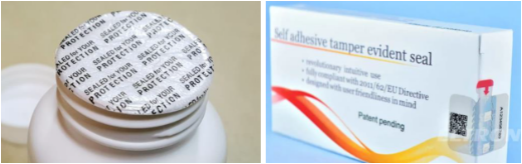
Tamper evident seals on drug pack to mitigate risk of drug adulteration.
Patra, S. (2022) explains that “Pharmaceutical Barcode is very mandatory for serialization process in pharmaceutical industries. It is very critical that barcode should contain accurate encoded information which must be scannable, readable and should decoded in any location. Manufacturer must ensure that right barcode printed as per regulatory compliance product packaging. Healthcare Distribution Alliance (HDA) recommends to encode all fixed length data element first then variable length elements. It is also significantly noticed that encoding GTIN/NDC + unique serial number first will avoid the practical limit of length of some data scanning devices.
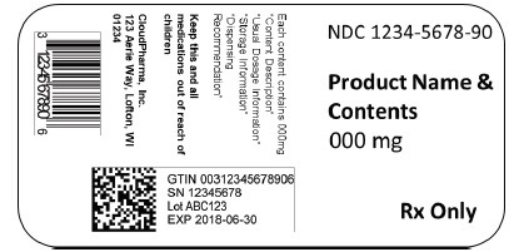
Healthcare Distribution Alliance (HDA) recommended to use barcode attribute on medicine packages. Drug name to be printed minimum 0.5 inch or larger on packages. Label should also state the temperature for storage, drug potency, strength, NDC number in three segment, information of manufacturer and distributor, Global Trade Item number, Unique serial number (if product is serialized), Lot number and expiry date. Logistic item in trade must affix GS1-28 Databar Linear barcode for serialization. GS1-128 barcode for homogenous pallet can have product information including Pallet level GTIN (DGFT regulation for India). Manufacturer can encode additional data but it must have word printed “Internal Use Only” so that it does not create complexity and confusion in supply chain which can cause costly delay in medicine distribution (pp-355-356) [8]. Adopting latest barcode technologies play critical roles for improving patient safety and health. It administrates and ensure safe and accurate medicine is given to patient based on 5 mechanism – the correct drug, dose, time, route, and patient.[9] (Naidu & Alicia, 2019)
Homogenous, Heterogenous serialized labels with GS1 2D Datamatrix and GS1-Databar (Linear) Barcodes
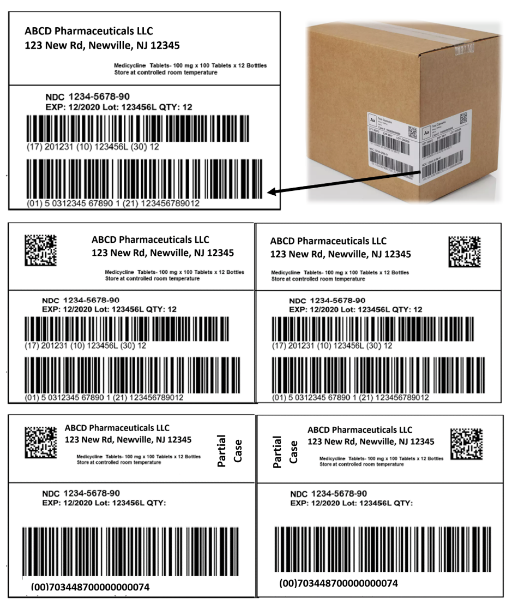
Pharmaceutical products generally packed into three level of packaging hierarchy. The pallet (Tertiary) level is a logistics unit also called as SSCC (Serial Shipping container code). SSCC is considered as final unit of packaging for transportation in supply chain. Secondary packaging hierarchy considered as Shipper Case in pharmaceutical supply chain terminology, mostly used for managing stock at warehouse level [10].
3. Online Drug Sales – Risk of Potential Counterfeiting
Technological evolution and increased globalization of pharmaceuticals trade benefited global healthcare industries and eased drug accessibility to needful patients. Now people have greater accessibility of critical medicine and can buy them from trusted sources. Unfortunately, it is also exposing the loopholes of supply chain due to lack of government control on illicit drug sales on dark web. Counterfeiters and illegal drug traders sell medicine through social media platforms and dark-web sites. There are multiple factors which attract people towards online medicine purchase such as geographical limitations, lower cost, fast go-to-market time, target direct customers, and wider reachability to customers [11]. Government and regulatory agencies must investigate the reason behind purchasing medication online (education level, awareness, age, economic conditions etc.). Investigations from this work would be useful to determine the solutions for consumers and stopping them for making questionable purchases or inform them of the risks available. Future research could also focus on examining how new and existing technologies can be utilized to help protect patients from online [12]. In 2011 the World Economic Forum has published a report which shows that online sales represent 7 – 10% of the global economy. Counterfeit drugs are products deliberately and fraudulently produced and/or mislabeled with respect to identity and/or source to make it appear to be a genuine product [13, 14, 15].
4. Challenges in Digital Drug Traceability
Drug traceability is mandatory regulatory compliance for mitigating the risk of counterfeit drug in supply chain.
Unfortunately, poor and developing countries are facing key challenges such as insufficient grants for infrastructure improvement, skillful resources, unavailability of secure technology and incapability of local pharmaceutical manufacturers to adopt and invest on drug traceability system. Small manufacturer face some critical challenges on geo-political and economic disparities, civil wars and political unrest, trust deficit on government, impact of climate change and nature’s fragility [16]. Implementing and sustaining serialization system for drug traceability required skillful resources. Any human, mechanical and technical error can cause adversely to human life [17]. In India, DGFT’ s requirement that manufacturers upload “dummy” or fake serial numbers for primary packages (i.e., individual vials, blister cards, or bottles) that are not serialized is possibly the most confusing requirement. In India, regulatory authority of DGFT mandated to upload serial numbers in DAVA portal. DGFT advised to upload dummy serial numbers which are not serialized and it can cause potential chance of counterfeiting [18]. To compliant with serialization regulations, small manufacturer has to invest significant amount in computers, vision systems, barcode grading system, effective quality control to regulate country compliance. Some processes like detecting and discarding misprinted drug package in packaging line required AI based applications to optimize and improve manufacturing defects and reduce to minimum human interventions [19]. Digital pharmaceutical products traceability provisions require additional space in manufacturing units for specialized packaging equipment’s to print the unique identifier in all packaging levels, label grading systems, barcode printer and vision systems. This setup needs huge financial investment for manufacturers and might be a good portion of their financial capabilities [20]. Investing on serialization equipment’s, label software, and digital traceability system make completely unbalance financial status of small pharmaceutical manufacturer. The cost basically involves the configuring of traceability system, various testing, validation and [21]. In many cases, big pharmaceutical manufacturer come into an agreement with hospitals to dispense their own branded medicine. Despite of heavy investment in infrastructure to adopt serialization compliance, these arrangements and agreements force small manufacturers to look into other segment of market and resulted reduction of earned revenue [22]. Technology is evolving rapidly and pharmaceutical industries using variety of IT platforms were available to assist in the planning and conduct of clinical trials [23].
5. Future Approach in Digital Drug Traceability
Drug serialization and traceability is becoming a global compliance as more countries are adopting and standardizing their drug traceability regulation. As we are approaching to 2023, It will be final phase of 10 yearlong implementation of Drug Supply Chain Security Act (DSCSA) since compliance enacted in 2013.
Currently FDA is conducting a pilot project for feasibility of adoption blockchain technology in interoperable network. Under the 2023 DSCSA Act, drug manufacturer has to transfer drug traceability data digitally to wholesaler and distributor in supply chain. Furthermore, dispenser and pharmacy also need to receive drug traceability data in electronic product code information services (EPICS) format through shared and secured interoperable network.
Finally, all stakeholders in pharmaceutical supply chain should be integrate to each other through digital interoperable network [24]. Healthcare Distribution Alliance (HDA) also published guidelines for manufacturer to print different levels of barcode in drug packages to make supply chain secure and mitigate drug counterfeiting. Nonconformance with Healthcare Distribution Alliance barcode guidelines can decrease supply chain efficiency, resulting in increased costs, product delays, and potential drug shortages [25]. It was clearly observed that world need effective solution to detect counterfeit medicine to improve supply chain visibility and patient safety [26]. Blockchain is a innovative technology which can be leverage for drug traceability. Blockchain technology can be significantly useful when GS1 compliant barcode is used in drug packages and then unique drug identifier stored digitally for drug traceability. Drugs serialized data will be available for all stakeholders (wholesaler, distributors, dispenser, pharmacy, and hospitals) in the supply chain and they can digitally verify the product identifier authenticity. The Blockchain technology is originated from the famous Bitcoin virtual currency and now it is widely adopted in different industry sectors. It has been distinguished from Bitcoin and famed as most stringent and secure technology. In essence, it is based on distributed ledger database maintained by multiple participants, which combines technical features such as cryptography, consensus mechanism, and smart contracts and has decentralized credibility, immutability, transparent data traceability, etc. features [27]. Blockchain is based on complex network which can be used for digital drugs traceability through the supply chain. Digital data encoding in GS1 compatible barcodes will be useful by assigning barcodes in all levels of packaging units to the digital identity of the product [28]
6. Conclusions
Drug counterfeiting is a serious issue which compromise public health and poised great threat to patient life. Since few decades, World Health Organization (WHO) made numerous efforts to mitigate the risk of counterfeit drugs. As per an estimate the majority of fake and illicit drugs are supplied in developing or poor countries like south Asia and Africa, this proportion can rise to 70 percent []. Drug Supply Chain Security Act (DSCSA) made 10-year long roadmap to implement serialization compliance in United States. DSCSA 2023 Act require manufacturer and distributor/wholesalers to transfer serialized data digitally through interoperable network. FDA is also working on pilot project to adopt blockchain technology in interoperable network to validate “Authorized Trading Partner”. DSCSA 2023 Act also mandate to transfer serialization data electronically between all supply chain partner for unit level traceability. By adopting secure, stringent and innovative technology and encoding product attributes in barcodes mitigate the risk of counterfeiting in supply chain. Future of serialization adoptability among countries is visible sign of its success and soon most of countries will make it regulatory mandate to serialized prescribed drugs.
Funding: This research received no external funding.
Conflicts of Interest: The authors declare no conflict of interest
References
- Chan, K. K. (2022). Supply chain traceability systems—robust approaches for the digital age. In The Digital Supply Chain (pp. 163-179). Elsevier.[CrossRef]
- Haji, M., Kerbache, L., Sheriff, K. M., & Al-Ansari, T. (2021). Critical Success Factors and Traceability Technologies for Establishing a Safe Pharmaceutical Supply Chain. Methods and Protocols, 4(4), 85.[CrossRef] [PubMed]
- Sarkar, S. (2022). Digital Traceability of pharmaceutical drugs in supply chain. International Journal of Advance Research in Computer Science and Management Studies, 10(2), 39–44. www.ijarcsms.com
- Billups, M., & Singh, R. (2020). Systematic framework for implementation of material traceability into continuous pharmaceutical tablet manufacturing process. Journal of pharmaceutical innovation, 15(1), 51-65.
- Benedetti, M., Bellman, A., Rotunno, R., Introna, V., & Cesarotti, V. (2014). Impact of track and trace integration on pharmaceutical production systems. International Journal of Engineering Business Management, 6(Godište 2014), 6-25.[CrossRef]
- Sarkar, S. (2022). Pharmaceutical serialization: Impact on drug packaging. International Journal of Advance Research in Computer Science and Management Studies, 10(3), 21–26. www.ijarcsms.com[CrossRef]
- Patra, S. (2022). Healthcare Distribution Alliance - Barcoding Requirement for Serialized Product. International Journal of Engineering Research & Technology, 11(7), 353-358.
- Alli, S. M. A. (2021). Barcoding an automatic identification and data capture system in healthcare settings.
- Klein, K., & Stolk, P. (2018). Challenges and opportunities for the traceability of (biological) medicinal products. Drug Safety, 41(10), 911-918.
- Sarkar, S. (2022). Online Drug trade a threat to pharmaceutical industry. International Journal of Advance Research in Computer Science and Management Studies, 10(5), 15–20. www.ijarcsms.com[CrossRef] [PubMed]
- J. Ahmed, Laura, Mackey (2022). A critical review on the availability of falsified medicines online: Incidence, challenges and perspectives https://journals.sagepub.com/doi/full/10.1177/23992026221074548.
- Van der Elst K, Davies N. Global Risks 2011. World Economic Forum; 2011. 1–60. http://reports.weforum.org/wp-content/blogs.dir/1/mp/uploads/pages/files/global-risks-2011.pdf[CrossRef]
- W. G. Chambliss, W. A. Carroll, D. Kennedy, D. Levine, M. A. Moné, L. D. Ried, et al., "Role of the pharmacist in preventing distribution of counterfeit medications", J. Amer. Pharmacists Assoc., vol. 52, no. 2, pp. 195-199, Mar. 2012.
- Z. RJ, "Roles for pharmacy in combating counterfeit drugs", J. Amer. Pharmacists Assoc., vol. 48, pp. e71-e88, Jul. 2008.[CrossRef] [PubMed]
- Sarkar, S. (2022). Challenges for Implementing Digital Drug Traceability in Developing Countries. International Journal of Research Publications, 103(1), 760–766. https://doi.org/10.47119/IJRP1001031620223477[CrossRef] [PubMed]
- Goldhammer A, Scott ML. Pharmaceutical Supply Chain Security: a view from the pharmaceutical research and manufacturers of America. J Pharm Pract 2006; 19: 239–243. http://dx.doi.org/10.1177/0897190006293514[CrossRef]
- Government of India. Directorate of Foreign Trade. “Implementation of the Track and Trace System for Export of Pharmaceutical and Drug Consignments. http://dava.gov.in/davahq/files/DGFT_Drug_Track_N_Trace_Implementation_Manual.pdf[CrossRef]
- Sarkar, S. (2022). Pharmaceutical Serialization: A Challenge for Small Manufacturers. International Journal of Scientific Research in Computer Science, Engineering and Information Technology, 8(4), 174-181. https://ijsrcseit.com/CSEIT228428
- Arden, N. S., Fisher, A. C., Tyner, K., Yu, L. X., Lee, S. L., & Kopcha, M. (2021). Industry 4.0 for pharmaceutical manufacturing: Preparing for the smart factories of the future. International Journal of Pharmaceutics, 602, 120554. https://doi.org/10.1016/J.IJPHARM.2021.120554
- Chitra, M., and Nandan Kumar. “Pharmaceutical Market Structure in India & Competition Concerns.” Shanlax International Journal of Arts, Science and Humanities, vol. 8, no. 1, 2020, pp. 233–241. https://doi.org/10.34293/ sijash.v8i1.3295[CrossRef] [PubMed]
- Shanley, A. (2018). Serialization: Scaling Down for the Final Stretch. PharmTech.com, 38.[CrossRef]
- Rajora, N. (2022). Pharmaceutical drug launch and its readiness in enterprise systems.International Journal of Advance Research in Computer Science and Management Studies, 10(5), 9–14. www.ijarcsms.com
- Sarkar, S. (2022). Drug Supply Chain Security Act 2023: Interoperable Data Exchange for Drug Traceability. International Journal of Scientific Research in Computer Science, Engineering and Information Technology, 8(3), 471–477. https://doi.org/10.32628/CSEIT228390
- Pisa, M., & McCurdy, D. (2019). Improving global health supply chains through traceability. Center for Global Development.[CrossRef]
- S. Bhunia and S. Mandal, "Countering counterfeit drugs: A technique used for detecting explosives can also verify the integrity of medicines," in IEEE Spectrum, vol. 56, no. 09, pp. 38-43, Sept. 2019, doi: 10.1109/MSPEC.2019.8818590.
- Evaluating Feasibility of Blockchain Application for DSCSA Compliance. https://scholar.smu.edu/datasciencereview/vol1/iss2/4/[CrossRef]
- Rajora, N. (2022). Blockchain technology – A basic need of the pharmaceutical industry. International Journal of Advance Research in Computer Science and Management Studies, 10(4), 26–31. www.ijarcsms.com
- Rajora, N. (2022). Counterfeit and illicit drugs trade: A quantitative data on how counterfeit drugs impact globally. International Journal of Advance Research in Computer Science and Management Studies, 10(2), 32–38. www.ijarcsms.com