

Astronomic azimuths had been used for orienting old surveys in Ghana. With technological advancement and the development of simpler but accurate equipment and techniques for measurement, this has been replaced by the use of the Global Navigational Satellite System (GNSS) techniques such as the Global Positioning System(GPS). However, the use of these for azimuth determinations results in a different type of azimuth as opposed to astronomic azimuths previously used. For retracing some of those old surveys based on Astronomical coordinates, the relationship and convertibility between the different azimuths is imperative. In this exploration, the relationship and precision of both techniques were tested on various baselines located in different parts of the country. This involved the computation of Astronomic, Geodetic and Grid Azimuths between pairs of points to form several baselines. These baselines span from the Southern to the Middle belt portions of the Country where triangulations have been done, as some of these triangulation stations were Laplace stations that have both astronomic and geodetic coordinates determined for them. The results were investigated in terms of effect of using the convergence and t-T correction to convert between the set of azimuths. The results show that Geodetic Azimuths could be converted to grid coordinates and vice versa to accuracies of mean 0° 0ʹ 0.56ʺ and standard deviation ± 5.6 seconds. However, for Astronomic to Grid Azimuths, without correcting for Deflection of vertical, the conversion is accurate only to mean differences of 0° 1ʹ 25.3ʺ with standard deviation ± 0° 8ʹ 21.5ʺ. The results show the necessity of the Laplace correction for vertical deflection in astronomic azimuths in addition to the convergence and t-T correction and recommends the provision of country-wide deflection corrections.
Grid, Geodetic and Astronomical Azimuth Conversions in Ghana
May 03, 2022
June 14, 2022
June 22, 2022
June 24, 2022
This is an Open Access article, distributed under the terms of the Creative Commons Attribution 4.0 International License (http://creativecommons.org/licenses/by/4.0/), which permits unrestricted use, distribution and reproduction in any medium or format, provided the original work is properly cited.
Abstract
1. Introduction
1.1. Background
The Azimuth of a line is the horizontal angle measured clockwise from the true north baseline to the direction of the line. It is often derived from astronomical observations that may also result in astronomical coordinates (,) at the two ends of the line. On the other hand, the geodetic bearing (azimuth) is obtained from the geodetic coordinates ( at the ends of the line as determined using GNSS techniques. Such geodetic coordinates are defined based on a mathematically defined best-fit ellipsoid such as the WGS84 ellipsoid or the specific ellipsoid defined and used for the country. By definition, the latitude is obtained as the angle the normal to the ellipsoid surface through a point makes with the equatorial axis, and longitude as the angle between the Meridian through a point and that of Greenwich. Grid Azimuths result from the projection of Geodetic coordinates onto the plane using an accepted projection methodology and then measuring the clockwise angle between an accepted reference meridian and a straight line to the azimuth point.
Very often, different countries assume and use ellipsoids different from the WGS84 definition used in GNSS calculations, and hence the geodetic coordinates defined based on these chosen ellipsoids could be different from those defined on the WGS84 ellipsoid, as well as the astronomic ones. Astronomic coordinates on the other hand are not referenced to an ellipsoid surface but to the geoid surface. This makes it obvious that, the values of the three quantities (Geodetic coordinates from GNSS observations based on WGS84 ellipsoid, Geodetic coordinates based on the country’s chosen ellipsoid, and the Astronomical coordinates) may not coincide.
Directions of lines (bearings or azimuths) are based upon the size of an angular arc from a reference meridian or North. The Geodetic North is defined by the mean rotational axis of the earth and hence geodetic bearings are defined referenced to this true north. The Grid North is a based upon a map projection system that has adopted a meridian usually the country’s central meridian as its reference. Bearings based on this north are the Grid bearings. The Astronomical (Celestial) North is based upon a projection of the earth’s polar axis onto a celestial horizon and bearings based on these constitute the Astronomic bearings or Azimuths. Therefore, bearings or azimuths would show differences based on the choice of referencing North Meridians. Astronomic North would coincide with the geodetic north only when it is corrected for the deflection of the vertical. Pierre Simon, Marquis de Laplace (1749-1827), has defined a mathematical relationship between Astronomic and geodetic azimuths known as the “Laplace correction” [1]. This correction is often overlooked because it is deemed not significant.
Before the introduction of electronic surveying instruments, azimuths were conventionally obtained from observation of different celestial bodies leading to Astronomical azimuths. This method was widely used in the establishment of old geodetic control networks. Therefore, most old surveys have been based on a series of astronomic observations, whereas newer ones are based on National Grid coordinates developed later and most recently on Geodetic coordinates from GNSS measurements. Thus some old boundary retracement projects could involve re-establishing those that have been based purely on conventional astronomic coordinates. The use of newer equipment for such retracement is possible only if there are some verifiable conversion between the various types of azimuths.
Astronomic Azimuths in Ghana has been traditionally converted into Grid Bearings for short lines by applying Grid convergence corrections. For longer lines it is recommended to modify this formula slightly to include additionally an arc to chord correction factor (so called T-t correction). This work investigates the appropriateness of this formula and hence find a tie evidence between Grid Azimuths, Geodetic Azimuths and Astronomic azimuths and coordinates in Ghana for the applicability and resulting consequences of using newer techniques for retracement of old works that were based purely on astronomical observations.
2. Theoretical Relationship between azimuths
The azimuth of a line is the direction given by the angle between a reference meridian and the line measured in a clockwise direction [2]. Based on the referencing Meridian, we may define Astronomical Azimuths with reference to the Celestial North based upon a projection of the earth’s polar axis onto a celestial horizon. For the Geodetic Azimuth, the referencing North is the Geodetic North defined by the mean rotational axis of the ellipsoid considered to coincide with the mean axis of the earth. For the Grid azimuth, the referencing Meridian is the Meridian adopted by a country as reference meridian, usually the country’s central meridian [3, 4].
The coordinate system used to define and determine astronomic quantities (azimuth, Latitude and longitude) is related to the physical earth, or the geoid as opposed to the ellipsoid used for geodetic coordinates and Grid coordinates [5, 15].
Grid north refers to the direction northwards along the grid lines which have been projected as parallel straight lines instead of true meridian lines that converge at the poles. Thus there is a variation between the True North and the Grid North. This variation which is the Grid convergence is slightest along the central meridian of the map and greatest towards the edges of the map. Figure 1 shows this difference between the Grid north and Geodetic North or Astronomic North corrected for vertical deflection (DOV).
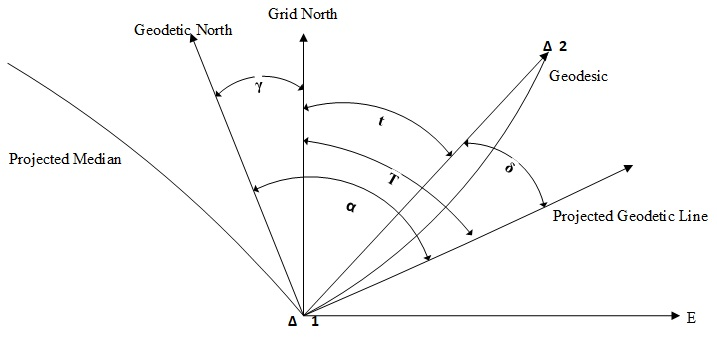
In Figure 1, is the geodetic azimuth reckoned from the Geodetic North, T is the Projected Geodetic Azimuth, t is the Grid Azimuth reckoned from the Grid North, is the Grid convergence angle and is a term called the (t-T) or the arc-to-chord correction term.
From the above, it is shown that:
The commonest conversion adopted for determining convergence is the Gauss-Bomford convention. In this convention, positions to the East of the Central Meridian would have positive convergence angles and positions west of the Central Meridian have negative angles [7].
The Convergence correction is determined from [8] as:
where
= convergence correction, is the longitude of the station and is the central meridian and is the geodetic latitude of the station.
The Arc-to-Chord correction (t-T) is due to the fact that the measured direction between two points is actually a curved line, on the surface of the ellipsoid. When projected onto a plane, the geodetic direction looks like an arc, rather than a straight line. Thus, the computed angle differs slightly from the plane angle (figure 1). This difference is expressed by (t-T) correction for the Transverse Mercator (Gauss-Kruger) type projection and is given by [9] as:
seconds where N1, E1, N2, E2 are the Northing and Easting of Points 1 and 2 respectively (in meters) and E0 is the false Easting of the CM (in meters).
2.1. Relationship between the Astronomic and Geodetic Azimuths
The “deflection of the vertical” is the difference between the astronomic meridian and the geodetic/ellipsoidal meridian [10]. This may also be regarded as the angle between the directions of the plumb line and the ellipsoidal normal at the same point. The deflection has two components ξ and η which depend directly on the shape of the geoid in the region.
These components are expressed as:
(North-South Component)
(East-West Component)
where φ, λ are the geodetic coordinates and Φ, Λ the corresponding astronomical coordinates [11, 14].
The difference between the astronomic and geodetic azimuths is given by in [12, 13]) as:
But
Therefore, on substitution, we have:
and since , we may write that
This result is the Laplace's equation for azimuths.
3. Methodology
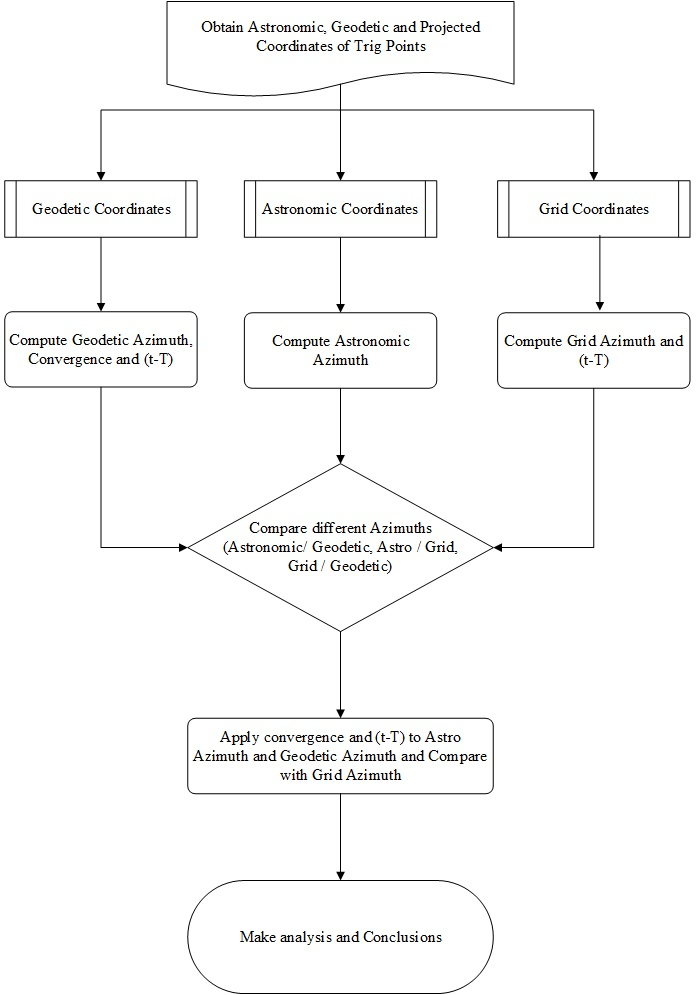
Eight key stations distributed within the triangulation framework of Ghana had Astronomic, geodetic and Projected Grid coordinates determined for them (Table 1). The Geodetic coordinates in this definition were both assumed for the adopted Ghana National Ellipsoid known as the Ghana War Office (GWO) and also for the World Geodetic System 1984 definition (WGS84) ellipsoid as obtained with GPS observations.These values were used to compute the Astronomic, Geodetic and Grid Azimuths for each conjugate point pairs forming different baselines. So also were the convergence at each station (eq. 3) and the arc-to-chord correction for each baseline (eq. 4) computed and the results given in Table 3. Figure 2 gives a summary of the complete methodology in a flow diagram.
4. Results
Table 2 and Table 3 shows the results of the calculation of Grid bearing, Geodetic azimuth, Astronomic Azimuth, convergence and the arc-chord corrections for each baseline. The convergence and arc to length correction are applied as corrections to the Astronomic and the geodetic Azimuths and the resulting corrected azimuths are compared to the corresponding Grid Azimuths.
4.1. Investigating Convergence and t-T Correction on Astronomic, Geodetic and Grid Azimuths
In order to investigate the adequacy of using convergence to convert Astronomic Azimuths to Grid Azimuths in Ghana, convergence values computed for each of the stations is applied to the Astronomic Azimuths. This is expected in theory, if deflection of the vertical is considered negligible, to convert the Astronomic Azimuths into their respective grid Azimuths. The results are presented in Table 3.
4.2. Analysis of Results
It was expected that the astronomic azimuths corrected for convergence and arc to chord would be comparable to the Grid azimuths. However, as shown in table 3, a mean difference of 0° 1ʹ 55.92ʺ with variations of from 0° 0ʹ 6.23ʺ to 1° 32ʹ 30.12ʺ was noticed. These obtained differences are the result of the fact that, the deflection of the vertical values is not negligible as has been assumed, so the astronomic azimuths do not adequately approximate to geodetic azimuths. Therefore, the application of convergence and arc to chord corrections alone is not sufficient to convert them into grid azimuths. This limitation is also revealed in the differences observed between the Astronomic and the geodetic azimuths shown in Table 3. An examination of the Astronomic and Geodetic coordinates based on the adopted GWO ellipsoid shows that at Accra-Gov.Lodge, the two values were closest differing only due to the adjustment done to the initial triangulation network involving this point, and Legon that is (Astro= Lat. 005° 34 ʹ 37.43 ʺ Long. 000° 10 ʹ 27.45 ʺ W; GWO=Lat. 005° 34ʹ 37.46 ʺ Long. 000° 10 ʹ 29.13 ʺ W). This is understandable as this was also the point whose initial astronomic coordinates was accepted as base coordinates for building the framework. There were however differences between the two at other stations.
With the geodetic azimuths, it is noticed that when they are corrected using the convergence and t-T correction, they exactly modelled the grid azimuths with mean residuals of 0° 0ʹ 0.95ʺ with variations of 0° 0ʹ 00ʺ up to 0° 0ʹ 20.09ʺ for the Ghana ellipsoid and mean residual of 0° 0ʹ 0.56ʺ with variations from 0° 0ʹ 00ʺ up to 0° 0ʹ 17.72ʺ when the ITRF geodetic values are used. These results show that the Ghana National ellipsoid has its rotational axis well aligned with the ITRF ellipsoid.
5. Conclusions and Recommendation
It is concluded that whereas, the difference between the geodetic azimuths and the grid azimuths is exactly modelled through the convergence and arc to chord correction, the astronomic azimuths directly do not represent true geodetic azimuths unless they have been corrected for the deflection of the vertical. The validity of the conversion method that is used in Ghana for converting astronomic azimuths directly into Grid bearings need to be re-examined to include application of the vertical deflections. Thus for retracement of old surveys, GPS survey and traditional astronomic observations may not be used interchangeably without the necessary corrections of vertical deflections in addition to convergence and arc to chord appropriately applied.
This work has established the efficacy of Laplace equation in the reversibility between Astronomic and geodetic coordinates in Ghana. It is recommended to add the deflection of vertical (DOV) values to coordinates for the purpose of direct conversion of Astronomic and geodetic azimuths and coordinates.
References
- Nievergelt, Y. (2000). A tutorial history of least squares with applications to astronomy and geodesy. Journal of Computational and Applied Mathematics, 121(1-2), 37-72.[CrossRef]
- Anderson, J. M.; Mikhail, E. M.;. (2015). Surveying, Theory and Practice. McGraw Hill, 2001.
- Bugayevskiy, L. M., & Snyder, J. (2013). Map projections: A reference manual. CRC Press.[CrossRef]
- Engle, D. P.; Metzger, J.; Schott, J.; Hinchcliff, J.; Kuckenbecker, C.; & Schanfish, C. . (2006). Solar and Celestial Observations for Position and Azimuth Determination: Artillery Surveying in Vietnam. Surveying and Land Information Science, 66(3), 217-22.
- Ardalan, A. A., & Safari, A. (2005). Global height datum unification: a new approach in gravity potential space. Journal of Geodesy, 79(9), 512-523.[CrossRef]
- Soler, T.; Fury, R. J.;. (2000). GPS alignment surveys and meridian convergence. Journal of surveying engineering, 126(3), 69-82.[CrossRef]
- Malan, J; Telukdarie, A; & Grobler, H.. (2019). Meridian convergence: An alternate methodology. Journal of Applied Geodesy, 13(1), 17-26.[CrossRef]
- Bermejo-Solera, M; Otero, J.;. (2009). Simple and highly accurate formulas for the computation of Transverse Mercator coordinates from longitude and isometric latitude. Journal of Geodesy, 83(1), 1-12.[CrossRef]
- Janssen, V. (2009). Understanding coordinate reference systems, datums and transformations. International Journal of Geoinformatics, 5(4), 41-53.
- Šugar, D.; Brkić, M; & Špoljarić, D.. (2013). Comparison of the reference mark azimuth determination methods. Annals of Geophysics, 55(6).[CrossRef]
- Torge, W.; Müller, J.;. (2012). Geodesy. Geodesy. de Gruyter.[CrossRef]
- Jekeli, C. (2006). Geometric Reference Systems in Geodesy. Ohio: Ohio State University.
- Leick, A. (2004). GPS and Satellite Surveying. Hoboken.
- Yilmaz, N & Karaali, C . (2006). Positioning with Astronomic and Geodetic Method. In XXIII international FIG congress.
- Chang, C., & Tsai, W. (2006). Evaluation of a GPS-Based Approach for Rapid and Precise Determination of Geodetic/Astronomical Azimuth. Journal of Surveying Engineering, 149-154.[CrossRef]