

Scrub typhus is a common disease caused by Orientia tsutsugamushi in the tropical/ temperate zone. It usually shows the skin lesions, including eschar, but erythema multiforme is rare.
Commentary
Open Access
July 06, 2024
A severe scrub typhus case with erythema multiforme caused by Orientia tsutsugamushi
1
Department of Infectious Diseases and Infection Control, Saitama Medical University International Medical Center, Hidaka City, Saitama, Japan
Page(s):
14-15
Received
May 12, 2024
May 12, 2024
Revised
July 01, 2024
July 01, 2024
Accepted
July 05, 2024
July 05, 2024
Published
July 06, 2024
July 06, 2024
Keywords
Creative Commons
This is an Open Access article, distributed under the terms of the Creative Commons Attribution 4.0 International License (http://creativecommons.org/licenses/by/4.0/), which permits unrestricted use, distribution and reproduction in any medium or format, provided the original work is properly cited.
Copyright: Copyright © The Author(s), 2024. Published by Scientific Publications
Abstract
1. Commentary
Scrub typhus is a disease caused by a rickettsia, Orientia tsutsugamushi, and patients usually show a specific eschar, papules, and erythema ranging in size from rice grains to beans, with treatment being antibiotics for mild cases [1, 2].
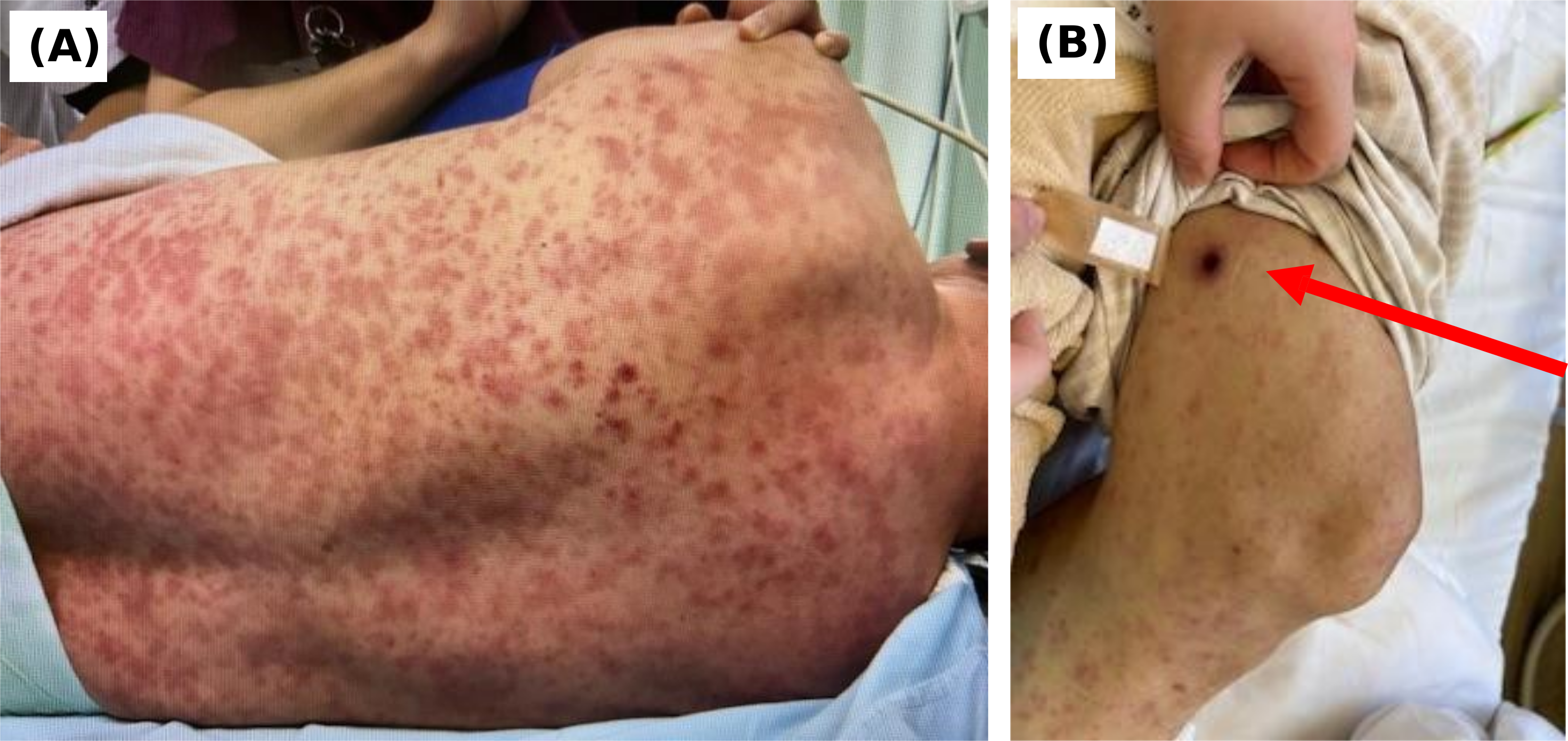
However, severe cases can occur. A 72-year-old man who was taking oral amoxicillin 500 mg three times/day following tooth extraction 10 days earlier presented with general malaise and erythema multiforme with target lesion, and a drug eruption was diagnosed (Figure 1A). No medications were given, and antibiotic treatment was withdrawn, but he lost consciousness half a day later and was transported to the Emergency Department.
The characteristic eschar from a tick bite was found (Figure 1B), and scrub typhus, such as tsutsugamushi disease, was diagnosed. We found anti-Tsutsugamushi IgG and IgM were also increased significantly. Intravenous minocycline 100 mg twice/day was started immediately, and his fever decreased the day after admission and finally improved two weeks later.
Erythema multiforme is a very rare skin lesion in tsutsugamushi disease and is often misdiagnosed as a drug eruption [3, 4], but severe rickettsial diseases should be considered, and efforts should be made to identify the characteristic eschar caused by the tick bite.
Conflict of Interest: The author has no competing interests to disclose.
Funding: This research received no specific grant from any funding agency in the public, commercial, or not-for-profit sectors.
References
- Taylor AJ, Paris DH, Newton PN. A Systematic Review of the Mortality from Untreated Leptospirosis. PLoS Negl Trop Dis 2015; 9(6): e0003866.[CrossRef] [PubMed]
- Pradhan RR. Eschar of scrub typhus. IDCases 2022; 30: e01630.[CrossRef] [PubMed]
- Grünwald P, Mockenhaupt M, Panzer R, Emmert S. Erythema multiforme, Stevens-Johnson syndrome/toxic epidermal necrolysis - diagnosis and treatment. J Dtsch Dermatol Ges 2020; 18(6): 547-53.[CrossRef]
- Hu YQ, Mu ZL, Zhang JZ. Erythema multiforme-like drug eruption in a patient with systemic lupus erythematosus treated with leflunomide. Dermatol Ther 2020; 33(3): e13382.[CrossRef] [PubMed]