

The current financial services sector is realising considerable changes in its operations due to development in technology and embracing of digital platforms. This evolution is changing the established concepts of business, consumers and channels of delivery of services. Financial services firms are changing the way they work through digital transformation due to developments in technology, changes in customer needs, and an increase in emphasis on sustainability. Understanding the opportunities, risks, and new trends in digital transformation is the focus of this paper. Opportunities include efficient real-time decision-making processes, increased transparency and better process controls, which are balanced by the threats of change management, dubious organization-technology fit, and high implementation costs. The study also examines recent advancements, including the application of machine learning and artificial intelligence, developments in mobile and online banking, integration of blockchain, and increasing focus on security and personalised banking. A literature review yields some findings from different studies on rural financial services, the evolution of the blockchain, drivers of digital transformation, cloud-based learning approaches, and emerging sustainability practices. All of these results suggest that more strategic planning, analytics, and more focus on ensuring that organisational objectives are met with transformations should be pursued. Hence, this research findings add to the existing literature in determining how innovative and digital technologies are likely to transform the financial services sector and advance sustainability.
Understanding the Fundamentals of Digital Transformation in Financial Services: Drivers and Strategic Insights
July 19, 2023
October 22, 2023
December 25, 2023
December 27, 2023
This is an Open Access article, distributed under the terms of the Creative Commons Attribution 4.0 International License (http://creativecommons.org/licenses/by/4.0/), which permits unrestricted use, distribution and reproduction in any medium or format, provided the original work is properly cited.
Abstract
1. Introduction
In the modern world, which is characterised by constant globalisation and the acceleration of technological progress, the topic of digitalisation has become widespread in different industries, as it has become an indicator of a new breakthrough in traditional lines of business and changes the pace of people’s daily lives [1]. New media technology has a great potential for providing radical increases in productivity, creativity and customer satisfaction for organisations. Such is the constant shift not only to the use of the latest technology or new pertinent applications but also to redefining the process and thinking out of the box to design new business models and continuously deliver better value [2]. As such, industries are beginning to change and being an essential part of any modern economy, the financial sector is at the vanguard of this change.
The financial services sector has long been acknowledged for its strategic position in supporting unchanging economic growth. This sector involves millions of people and contributes to the gross domestic product of most economies all over the world, it is a major support to individuals and other forms of businesses [3]. However, as customers demand more engagement with digital solutions and businesses embrace the latest trends, including AI, big data, and blockchain, the traditional forms of the business model are shifting. The digital revolution has become a reality in the financial services industry addressing the way firms interact with customers, the operational model subscribed, and competition strategies adopted [4].
Several forces are driving the digitisation of the financial service industry [5]. Innovation in technology like cloud computing & artificial intelligence gives remarkable opportunities for massive data analysis & automation of processes and an opportunity to deliver a highly customised service. Consumer behaviour and the latter involves consumers wanting convenient, transparent and secure interactions [6]. Also, drivers such as start-ups FinTechs, InsurTechs and BigTechs, and the regulatory environment compel incumbent institutions to seek new sources of income.
Financial transformation transforms the capability level of financial service providers, improves efficiency, promotes cost minimisation, and nurtures unique financial service solutions that address emerging customer needs. It also supports efficiency in financial sector through the provision of services through digital platforms which target otherwise unserved consumers [7]. Though, these advancements come with some issues like cybersecurity risk, legal requirements or questions of getting the workforce ready for unprecedented engineering technologies.
1.1. Organization of This Paper
This paper is structured as follows: This is followed by Section II in exploring the concept of Digital Transformation. Section III describes the dynamics, including the Aspect of Technological Development. Division IV is about the actions for financial services. Section V: Literature Review provides a synthesis of earlier studies and points out the deficiencies. Section six: conclusion and recommendation for future study.
2. Understand Digital Transformation in Financial Services
Business communication is changing with the onset and with increased use of digital transformation across organisations. In all industries, there is increasing use of modern technologies that seek to enhance organisation’s competitiveness and clients’ satisfaction [8]. Take retail, for example. Thus, the transition to e-commerce has forced retailers to use technologies like AI, big data and IoT to preserve a unique approach to m-Consumers and optimise their logistic processes. Sixty percent of healthcare is taking ehealth records, telemedicine and wearable technologies, making it individualised and convenient [9]. At the core of the transformation is the shift of the doing good attributes to the transportation industry, where now they come across novelties like ride-sharing and the functionalisation of electric cars, including battery swapping and vehicle-to-grid systems. Lastly, it remains clear that digital transformation is in the process of opening new opportunities, enhancing productivity, and enhancing client benefits [10]. With the development of several years and the rise of customer expectations, its role will remain progressive in industries such as the financial sector. The industry within the financial sector is changing drastically as is fueled by digital efforts. Blockchain and smart contacts are the most beautiful examples of how modern technologies are challenging the banking systems and offering new solutions [11]. These new tools provide efficiency gains, security and convenience far beyond what was provided by traditional and, in some cases, outdated systems.
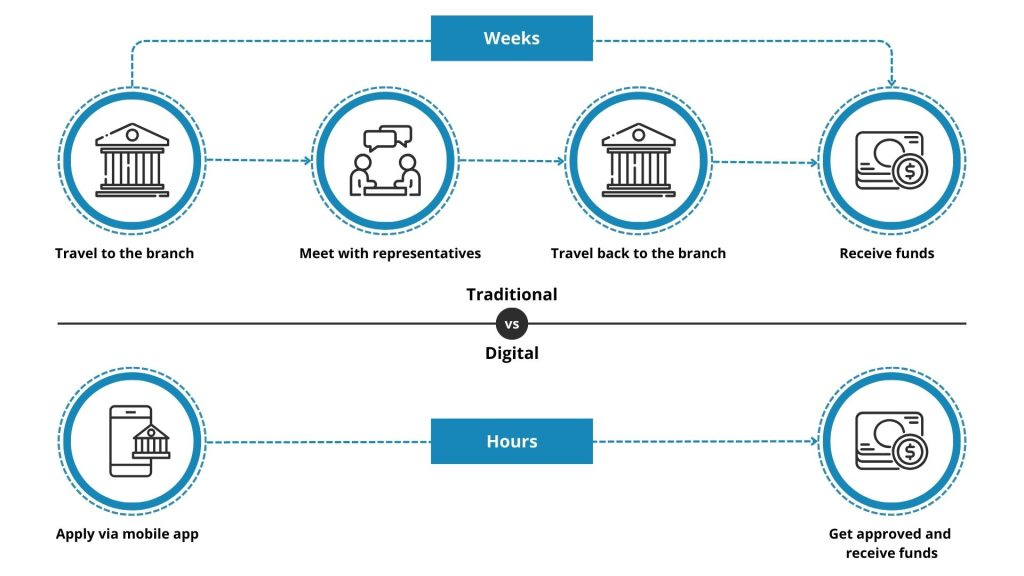
Thus, the processes of the financial industry transition started with the appearance of new alternative financial services, including centralised and decentralised exchange platforms for cryptocurrencies [12], NFT marketplaces, as well as others [13]. Next is that the conventional financial institutions have realised the full potential of these new technologies and the high demand and got what they needed to incorporate the new technologies to be able to compete. This digital transformation is bringing the financial industry at the center of technology revolution and changing even the traditional stakeholders.
2.1. Benefits of Digital Transformation for Traditional Banks
Thus, while significantly transferring services to the digital environment, the current generation of purely digital IFs has significant advantages that classic banks can fully use to intensify their digitalisation. Let me talk how these advantages will help them succeed in today’s digital economy:
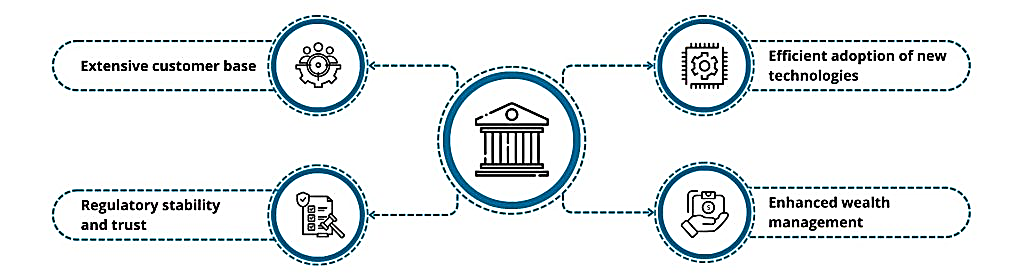
- Extensive customer base: For many years, incumbent banks have been growing their clientele and earning their confidence as well as access to insurance and personal information. One of the established conventional banks' main advantages when they go digital is this data, together with the reputation they earn.
- Regulatory stability and trust: Traditional banks have been in business forming part of widely accepted legal frameworks when it comes to determination of appropriate methods of data gathering and evaluation [14]. Their reputation and regulatory compliance afford a solid bedrock comforting clients to engage in transformational IT adoption that is still secure, trusted, and reliable.
- Efficient adoption of new technologies: Many traditional banks may possess the financial capital to attract the best talent, as well as refine their system over time and integrate the new technologies at their inception. This makes it easier to integrate with third-party and governmental systems, guaranteeing a seamless and legal experience for clients.
- Enhanced wealth management: These are some of the main obstacles to digital transformation that your company or organisation may encounter [15]. This improves the entire client experience by enabling them to provide reasonable rates, waived fees, and guaranteed returns [16].
2.2. Key Digital Transformation Challenges
Although the prospect of increased productivity and creativity is enticing, there are obstacles in the way. Implementing, there are issues with the digital transformation that need to be addressed, such as overcoming resistance to change and acclimating to new technologies [17]. These are some of the main obstacles to digital transformation that your company or organisation may encounter:
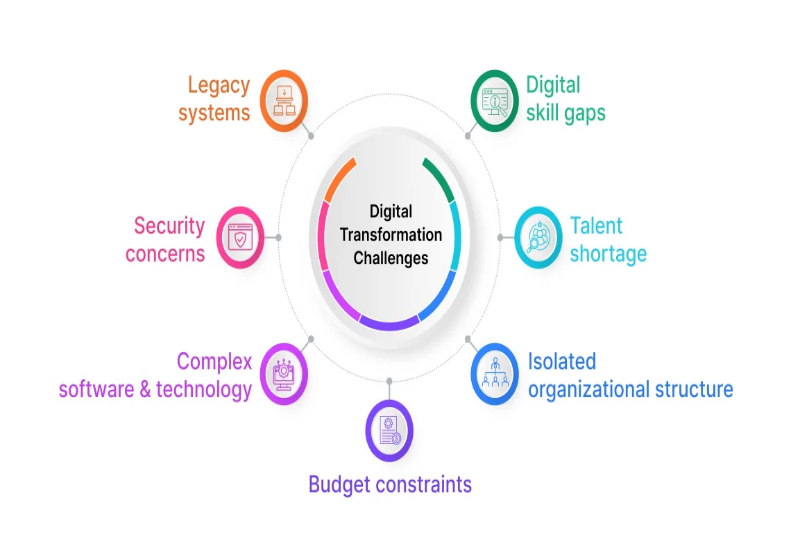
2.2.1. Legacy Systems
Despite the availability of advanced, high-tech, and effective digital solutions, businesses still appear to be stuck with their outdated systems [18]. Over the years, many businesses have been devotedly supported by their outdated technological infrastructure.
2.2.2. Security concerns
The problem goes beyond conventional cybersecurity measures and includes problems like data breaches, illegal access, and the constant danger of cyberattacks. The companies find it difficult to reconcile innovation with defending against changing security risks.
2.2.3. Isolated organisational structure
Each department operates alone in this situation, frequently oblivious to the objectives and actions of other departments. The organisation is unable to fully utilise its aggregate potential because of these compartmentalised arrangements, which create an atmosphere where important ideas, resources, and insights are restricted inside certain departments [19].
2.2.4. Digital skill gaps
The inability to use sophisticated software and comprehend intricate data analytics tools is what causes the skill gap.
2.2.5. Complex software and technology
Unlike antiquated tech infrastructure, incorporating state-of-the-art technological solutions into pre-existing frameworks occasionally calls for meticulous planning and execution. This entails negotiating complex software requirements and adjusting to rapidly changing technical environments.
2.2.6. Budget constraints
Projects involving digital transformation, such as the purchase of cutting-edge equipment, employee training, and infrastructure upgrades, require a coordinated allocation of financial resources [20]. These financial limitations provide a major obstacle as they limit the amount of money that can be allocated for the purchase of necessary equipment and the implementation of all-encompassing transformation projects.
3. Drivers of Digital Transformation In Financial Services
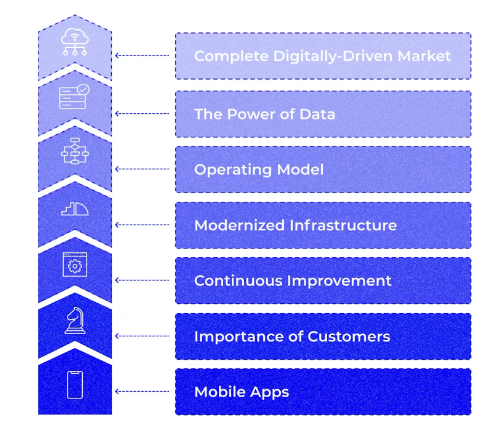
Drivers are either internal or external factors that motivate businesses to undergo digital transformation. Businesses say they must stay up to date with the digital changes taking place in their sector. The banking industry is in the middle of a revolutionary shift that is taken by advancing technology and shifting customer trends. Banks can use technology to drive a new level of digital change and generate value for people through data in this new twenty-teens digital milieu [21]. Some of the main factors that have led to such a change are stated as follows:
3.1. Mobile apps
Additionally, one of the major developments of digitalisation in the banking industry is mobile banking. Customers' usage of smartphones has made it simpler and quicker to locate resources and information for obtaining financial data [22]. In terms of data, fast results, and usability, mobile banking provides all of this and more.
3.2. Importance of customers
The client must be at the centre of banks' efforts to implement digital transformation. They will be in a better position to make sure that they are providing their consumers with services that will be beneficial to them if they comprehend and satisfy their demands and desires.
3.3. Continuous improvement
Here, digital transformation in banking is a continual process of advancement rather than a one-time event. Banks need to be ready to adapt to changing customer needs and technology developments in order to remain competitive [23]. This means regularly assessing their digital strategy and making necessary adjustments to their technology stack and operational approach.
3.4. The power of data
Data is one of the primary drivers of the digital revolution in the banking industry. By using client data, banks may improve their decision-making processes, offer more relevant and customised services, and get valuable insights into the behaviour and preferences of their customers.
3.5. Complete digitally-driven market
The banking industry is undergoing a transition due to the emergence of a completely digitally driven market where customers want immediate access to financial services and solutions from their own devices. Banks must embrace digital transformation if they want to remain competitive and meet the evolving needs of their customers.
3.6. Operating model
The digital revolution of the banking industry requires a shift in the traditional operating paradigm. This might mean rearranging the organisational structure, incorporating new technology, and streamlining processes to align with the bank's digital strategy. Additionally, banks need to make sure that their staff members have the abilities needed to thrive in a digital world.
3.7. Modernized Infrastructure
In order to facilitate digital transformation, banks need to make investments in updating their infrastructure. This entails modernising networks, software, and hardware to facilitate digital processes and offer a flawless client experience.
3.7.1. Advantages and Challenges in Digital Transformation of Financial Services
The financial system will see significant changes in how it provides services, which will initially provide difficulties for market participants and service providers since end consumers are unaware of the recently introduced digitally changed business processes [24]. Financial services firms may reach a wider market by educating investors about digitally altered business processes and their proportional benefits through effective awareness campaigns and activities. Below are the advantages and difficulties of digital transformation in the financial services sector:
These services, which are primarily referred to as FinTech solutions, are concentrating on taking the lead role as major partners to existing businesses and offering those organisations extensive support in financing and investment decision-making processes, despite the fact that financial services providers face numerous challenges in providing the services in a digitally transformed manner.
4. Digital Transformation Strategies for Financial Services Providers
While digital transformation is a short-term plan, it is actually a long-term one. Because digitisation should not disrupt the entire process but rather help both investors and service providers, service providers will need to properly plan and carry out this process. [2] contends that businesses may employ a methodical approach to digitalising corporate operations rather than adhering to strict guidelines [25]. It is advised that the financial services industry implement the following stages in order to digitally transform their offerings:
- Choosing contemporary technology that satisfies certain requirements.
- Knowing what current consumers anticipate in order to better understand and interact with them.
- Putting an emphasis on personalisation to strengthen the bonds between clients and their financial advisers in order to establish credibility and trust over time.
- Utilising data and analytics to monitor progress and directly interact with clients to enhance their experience.
4.1. Top Emerging Trends in Financial Services
The transformation of the sector is being driven by regulated reforms, fintech startup growth, personalised banking, and improved consumer experiences [26]. Top emerging technologies are provided below:
- Adoption of AI and ML: Transforming financial services with data analysis, process automation, fraud detection, personalised advice, and improved decision-making [27].
- Expansion of Digital Banking: Offering convenient, 24/7 access to financial services through user-friendly platforms, driving global adoption.
- Growth of Contactless Payments: Mobile payment methods such as Google Pay and Apple Pay Wallet dominate, enabling fast, secure, and hygienic transactions.
- Rise of Blockchain Technology: Revolutionizing transactions with decentralised, secure systems for cryptocurrency, smart contracts, and cross-border payments.
- Increasing Focus on Cybersecurity: Protecting sensitive data with encryption, multi-factor authentication, and proactive monitoring against rising cyber threats.
- Shift Towards Personalized Banking: Leveraging data analytics to deliver tailored financial solutions, enhancing customer satisfaction and loyalty [28].
- Enhancing Customer Experience: Streamlining processes and utilising AI, chatbots, and apps for seamless and responsive services.
- Rise of Fintech Startups: Disrupting traditional methods with agile, customer-centric solutions in Digital wallets, robo-advisors, and peer-to-peer loans [29].
- Regulatory Changes: Ensuring stability, transparency, and compliance with evolving rules while driving innovation in operations [30].
- Embracing Sustainability: Promoting green finance and ESG-driven investments to address climate and social challenges for sustainable growth.
5. Literature of Review
This section provides background information on the many domains of digital transformation in financial services. Key research on innovation, sustainability, and Table II compiles the digital revolution of financial services. It outlines the focus, benefits, challenges, and future contributions of each study, providing insights into how digital technologies like blockchain, cloud services, and sustainability efforts are reshaping the financial sector.
This study, Wensheng, (2020) creates the research model for the smart financial environment's platform for providing financial information services in remote areas. It looks at the basic situation of a rural financial information service platform's development in China from three angles: functional scope, service mode, and operation mode. Based on the platform's present construction and usage, it makes recommendations for improvement. The findings indicate that implementing the enhanced approach presented in this research resulted in a 20% improvement in the efficiency of rural financial information services, which has some practical utility [31].
The study, Li et al. (2020) indicates that after 2015, ideas outside "Bitcoin" begins to surface and elevate relevant topics to a new plane. Instead than focussing on technology or theory, they often cover practical subjects in the conventional business domain. Despite their similarities, the terms "blockchain," "bitcoin," and "cryptocurrency" belong to distinct clusters, with the red blockchain cluster having the most potential to redefine financial services using digital resources. These observations will make it easier for future academics to comprehend how blockchain technology is developing and to react more successfully to the trend of digital transformation [32].
In this study, Hrustek, Tomicic Furjan and Pihir, (2019) Explain, assess, and look into the DT drivers' impact on the development of new business models. Ideas for organisational innovations are defined by the drivers of DT and can originate from either within organisation innovation ideas or from trends in the organisational environment. In either case, the desire to change can be categorised as corporate development driven, when the need for digital work improvement is a strategic objective that must be met, technology-driven, when a new technology has become the norm in the industry the company operates in, or customer-driven, when the change is the consequence of adoption to new customer needs [33].
In this study, Sánchez et al. (2019) A conceptual model based on cloud services is proposed, as well as a method for the automatic evaluation of skills applied to the field of software engineering. The concept relies on using multiple-choice tests as a means of assessment and establishing a link between learning goals, competences, and the assessment rubrics' evaluation criteria. Students can determine the academic preparation required to submit an application for a specific position on the job market by connecting competencies to learning outcomes. This technique serves as an educational service and is applied to an actual subject that is outlined in an e-learning portal [34].
This research, Pan (2016) employs a using a text mining approach to find sustainability trends in the financial services sector by analysing corporate sustainability reports. This study has demonstrated that the European and North American financial services industries are concerned with sustainability concerns related to customer centricity, strong governance, financial crime control, sustainable mortgage and lending regulations, and training and education. Such information can assist financial institutions in defining directions to enhance their sustainability programmes as per comparing with the general tendencies that are reveal in the financial services segment [35].
6. Conclusion
Today, changing paradigms within the financial services industry have shaped significant changes in the business landscape by improving processing methodologies, developing new customer focus, and enriching the culture of providing services. The financial services industry can derive many advantages from digital transformation, such as increased process efficiency and productivity and better information and decision-making to create the proper new business models to fulfil changing customer needs. Blockchain, Artificial Intelligence and machine learning are key technologies that help financial institutions improve their value delivery mechanisms and increase security and customer-centricity. But this kind of transformation process does have problems. It is quite common for change initiatives to receive resistance from both employees and customers, implementation costs are high, and there is the challenge of compatibility across new technologies and existing infrastructure. However, integrating digital change initiatives with company goals and determining the range of technology application are two significant challenges. There are still some restrictions in the growth of digital solutions in the financial industry; however, the above solutions have shown that they have the potential to be utilised in those environmental facilities that are not so highly developed as to afford the use of new technologies. Environmental sustainability in the financial services industry has also been described as a work in progress, with the firms therein differing significantly in the level of green financial and ESG-integrated investment. Further research should be descriptive in nature to capture details of implementation of DT and the challenges experienced in small and medium-sized institutions.
References
- R. Goyal, “THE ROLE OF BUSINESS ANALYSTS IN INFORMATION MANAGEMENT PROJECTS,” Int. J. Core Eng. Manag., vol. 6, no. 9, pp. 76–86, 2020.
- O. Werth, C. Schwarzbach, D. Rodríguez Cardona, M. H. Breitner, and J. M. Graf von der Schulenburg, “Influencing factors for the digital transformation in the financial services sector,” Zeitschrift fur die gesamte Versicherungswiss., 2020, doi: 10.1007/s12297-020-00486-6.[CrossRef]
- P. Setia, V. Venkatesh, and S. Joglekar, “Leveraging digital technologies: How information quality leads to localised capabilities and customer service performance,” MIS Q. Manag. Inf. Syst., 2013, doi: 10.25300/MISQ/2013/37.2.11.[CrossRef]
- M. Z. Hasan, R. Fink, M. R. Suyambu, and M. K. Baskaran, “Assessment and improvement of intelligent controllers for elevator energy efficiency,” in IEEE International Conference on Electro Information Technology, 2012. doi: 10.1109/EIT.2012.6220727.[CrossRef]
- E. Piccinini, A. Hanelt, R. W. Gregory, and L. M. Kolbe, “Transforming industrial business: The impact of digital transformation on automotive organizations,” in 2015 International Conference on Information Systems: Exploring the Information Frontier, ICIS 2015, 2015.
- V. Kumar and F. T. S. Chan, “A superiority search and optimisation algorithm to solve RFID and an environmental factor embedded closed loop logistics model,” Int. J. Prod. Res., vol. 49, no. 16, 2011, doi: 10.1080/00207543.2010.503201.[CrossRef]
- G. Vial, “Understanding digital transformation: A review and a research agenda,” Journal of Strategic Information Systems. 2019. doi: 10.1016/j.jsis.2019.01.003.[CrossRef]
- M. Z. Hasan, R. Fink, M. R. Suyambu, M. K. Baskaran, D. James, and J. Gamboa, “Performance evaluation of energy efficient intelligent elevator controllers,” in IEEE International Conference on Electro Information Technology, 2015. doi: 10.1109/EIT.2015.7293320.[CrossRef] [PubMed]
- C. F. Breidbach, B. W. Keating, and C. Lim, “Fintech: research directions to explore the digital transformation of financial service systems,” J. Serv. Theory Pract., 2020, doi: 10.1108/JSTP-08-2018-0185.[CrossRef]
- V. V. Kumar, F. W. Liou, S. N. Balakrishnan, and V. Kumar, “Economical impact of RFID implementation in remanufacturing: a Chaos-based Interactive Artificial Bee Colony approach,” J. Intell. Manuf., 2015, doi: 10.1007/s10845-013-0836-9.[CrossRef]
- B. Boddu, “Serverless Databases Are the Future of Database Management,” https://jsaer.com/download/vol-6-iss-1-2019/JSAER2019-6-1-277-282.pdf, vol. 6, no. 1, p. 5, 2020.
- M. A. Shajahan, N. Richardson, N. Dhameliya, B. Patel, S. K. R. Anumandla, and V. K. Yarlagadda, “AUTOSAR Classic vs. AUTOSAR Adaptive: A Comparative Analysis in Stack Development,” Eng. Int., vol. 7, no. 2, pp. 161–178, Dec. 2019, doi: 10.18034/ei.v7i2.711.[CrossRef]
- C. Scardovi, Digital transformation in financial services. 2017. doi: 10.1007/978-3-319-66945-8.[CrossRef]
- B. Boddu, “DevOps for Database Administration: Best Practices and Case Studies,” https://jsaer.com/download/vol-7-iss-3-2020/JSAER2020-7-3-337-342.pdf, vol. 7, no. 3, p. 5, 2020.
- M. Zachariadis and P. Ozcan, “The API Economy and Digital Transformation in Financial Services: The Case of Open Banking,” SSRN Electron. J., 2017, doi: 10.2139/ssrn.2975199.[CrossRef]
- V. V. Kumar, M. K. Pandey, M. K. Tiwari, and D. Ben-Arieh, “Simultaneous optimization of parts and operations sequences in SSMS: A chaos embedded Taguchi particle swarm optimization approach,” J. Intell. Manuf., 2010, doi: 10.1007/s10845-008-0175-4.[CrossRef]
- D. A. Patil, “Digital Transformation in Financial Services and Challenges and Opportunities,” Int. J. Trend Sci. Res. Dev., 2018, doi: 10.31142/ijtsrd18661.[CrossRef]
- M. Dehnert, “Sustaining the current or pursuing the new: incumbent digital transformation strategies in the financial service industry: A configurational perspective on firm performance,” Bus. Res., 2020, doi: 10.1007/s40685-020-00136-8.[CrossRef]
- S. C. R. Vennapusa, T. Fadziso, D. K. Sachani, V. K. Yarlagadda, and S. K. R. Anumandla, “Cryptocurrency-Based Loyalty Programs for Enhanced Customer Engagement,” Technol. \& Manag. Rev., vol. 3, pp. 46–62, 2018.
- V. V. Kumar, S. R. Yadav, F. W. Liou, and S. N. Balakrishnan, “A digital interface for the part designers and the fixture designers for a reconfigurable assembly system,” Math. Probl. Eng., 2013, doi: 10.1155/2013/943702.[CrossRef]
- J. Siderska, “Robotic Process Automation-a driver of digital transformation?,” Eng. Manag. Prod. Serv., 2020, doi: 10.2478/emj-2020-0009.[CrossRef]
- V. V Kumar, M. Tripathi, M. K. Pandey, and M. K. Tiwari, “Physical programming and conjoint analysis-based redundancy allocation in multistate systems: A Taguchi embedded algorithm selection and control (TAS&C) approach,” Proc. Inst. Mech. Eng. Part O J. Risk Reliab., vol. 223, no. 3, pp. 215–232, Sep. 2009, doi: 10.1243/1748006XJRR210.[CrossRef]
- B. Boddu, “Best Practices for In-Memory Database Administration in Real-Time Environments,” https://www.ijirmps.org/research-paper.php?id=231463, vol. 8, no. 6, p. 8, 2020.
- V. V. Kumar, F. T. S. Chan, N. Mishra, and V. Kumar, “Environmental integrated closed loop logistics model: An artificial bee colony approach,” in SCMIS 2010 - Proceedings of 2010 8th International Conference on Supply Chain Management and Information Systems: Logistics Systems and Engineering, 2010.
- I. Mavlutova, T. Volkova, A. Natrins, A. Spilbergs, I. Arefjevs, and I. Miahkykh, “Financial sector transformation in the era of digitalization,” Estud. Econ. Apl., 2020, doi: 10.25115/EEA.V38I4.4055.[CrossRef]
- V. V Kumar, “An interactive product development model in remanufacturing environment : a chaos-based artificial bee colony approach,” Missouri University of Science and Technology, 2014. [Online]. Available: https://scholarsmine.mst.edu/cgi/viewcontent.cgi?article=8243&context=masters_theses
- S. K. R. Anumandla, V. K. Yarlagadda, S. C. R. Vennapusa, and K. R. V Kothapalli, “Unveiling the Influence of Artificial Intelligence on Resource Management and Sustainable Development: A Comprehensive Investigation,” Technol. \& Manag. Rev., vol. 5, no. 1, pp. 45–65, 2020.
- J. Camarate and S. Brinckmann, “The future of banking : A South African perspective,” PwC South Africa A Marketpl. without boundaries, 2017.
- M. R. Kishore Mullangi, Vamsi Krishna Yarlagadda, Niravkumar Dhameliya, “Integrating AI and Reciprocal Symmetry in Financial Management: A Pathway to Enhanced Decision-Making,” Int. J. Reciprocal Symmetry Theor. Phys., vol. 5, no. 1, pp. 42–52, 2018.
- S. Stein Smith, “Emerging Technologies and the Accounting Profession: Trends and Topics for Practitioners to Consider,” Asian J. Financ. Account., 2019, doi: 10.5296/ajfa.v11i1.14627.[CrossRef]
- D. Wensheng, “Rural financial information service platform under smart financial environment,” IEEE Access, 2020, doi: 10.1109/ACCESS.2020.3033279.[CrossRef]
- J. Li et al., “How can blockchain shape digital transformation: A scientometric analysis and review for financial services,” in Proceedings - 2020 Management Science Informatization and Economic Innovation Development Conference, MSIEID 2020, 2020. doi: 10.1109/MSIEID52046.2020.00054.[CrossRef]
- L. Hrustek, M. Tomicic Furjan, and I. Pihir, “Influence of digital transformation drivers on business model creation,” in 2019 42nd International Convention on Information and Communication Technology, Electronics and Microelectronics, MIPRO 2019 - Proceedings, 2019. doi: 10.23919/MIPRO.2019.8756666.[CrossRef]
- J. A. Sánchez et al., “Cloud service as the driver for university’s software engineering programs digital transformation,” in Procedia Computer Science, 2019. doi: 10.1016/j.procs.2019.01.126.[CrossRef]
- Y. Pan, “Sustainability trends in financial services sector: Evidence from Europe and North America,” in 2016 13th International Conference on Service Systems and Service Management, ICSSSM 2016, 2016. doi: 10.1109/ICSSSM.2016.7538549.[CrossRef]
- Patra, G. K., Rajaram, S. K., Boddapati, V. N., Kuraku, C., & Gollangi, H. K. (2022). Advancing Digital Payment Systems: Combining AI, Big Data, and Biometric Authentication for Enhanced Security. International Journal of Engineering and Computer Science, 11(08), 25618–25631. https://doi.org/10.18535/ijecs/v11i08.4698.[CrossRef]
- Shravan Kumar Rajaram, Eswar Prasad Galla, Gagan Kumar Patra, Chandrakanth Rao Madhavaram, & Janardhana Rao. (2022). AI-Driven Threat Detection: Leveraging Big Data For Advanced Cybersecurity Compliance. Educational Administration: Theory and Practice, 28(4), 285–296. https://doi.org/10.53555/kuey.v28i4.7529[CrossRef]
- Gagan Kumar Patra, Shravan Kumar Rajaram, & Venkata Nagesh Boddapati. (2019). Ai And Big Data In Digital Payments: A Comprehensive Model For Secure Biometric Authentication. Educational Administration: Theory and Practice, 25(4), 773–781. https://doi.org/10.53555/kuey.v25i4.7591[CrossRef]
- Chandrababu Kuraku, Hemanth Kumar Gollangi, & Janardhana Rao Sunkara. (2020). Biometric Authentication In Digital Payments: Utilizing AI And Big Data For Real-Time Security And Efficiency. Educational Administration: Theory and Practice, 26(4), 954–964. https://doi.org/10.53555/kuey.v26i4.7590[CrossRef]
- Eswar Prasad Galla.et.al. (2021). Big Data And AI Innovations In Biometric Authentication For Secure Digital Transactions Educational Administration: Theory and Practice, 27(4), 1228 –1236Doi: 10.53555/kuey.v27i4.7592[CrossRef]
- Janardhana Rao Sunkara, Sanjay Ramdas Bauskar, Chandrakanth Rao Madhavaram, Eswar Prasad Galla, Hemanth Kumar Gollangi, Data-Driven Management: The Impact of Visualization Tools on Business Performance, International Journal of Management (IJM), 12(3), 2021, pp. 1290-1298. https://iaeme.com/Home/issue/IJM?Volume=12&Issue=3.
- V. N. Boddapati et al., “Data migration in the cloud database: A review of vendor solutions and challenges,” Int. J. Comput. Artif. Intell., vol. 3, no. 2, pp. 96–101, Jul. 2022, doi: 10.33545/27076571.2022.v3.i2a.110.[CrossRef]
- Mohit Surender Reddy, Manikanth Sarisa, Siddharth Konkimalla, Sanjay Ramdas Bauskar, Hemanth Kumar Gollangi, Eswar Prasad Galla, Shravan Kumar Rajaram, 2021. "Predicting tomorrow’s Ailments: How AI/ML Is Transforming Disease Forecasting", ESP Journal of Engineering & Technology Advancements, 1(2): 188-200.
- K. Gollangi, S. R. Bauskar, C. R. Madhavaram, P. Galla, J. R. Sunkara, and M. S. Reddy, “ECHOES IN PIXELS: THE INTERSECTION OF IMAGE PROCESSING AND SOUND OPEN ACCESS ECHOES IN PIXELS: THE INTERSECTION OF IMAGE PROCESSING AND SOUND DETECTION,” Int. J. Dev. Res., vol. 10, no. 08, pp. 39735–39743, 2020, doi: 10.37118/ijdr.28839.28.2020.
- Gollangi, H. K., Bauskar, S. R., Madhavaram, C. R., Galla, E. P., Sunkara, J. R., & Reddy, M. S. (2020). Unveiling the Hidden Patterns: AI-Driven Innovations in Image Processing and Acoustic Signal Detection. (2020). JOURNAL OF RECENT TRENDS IN COMPUTER SCIENCE AND ENGINEERING (JRTCSE), 8(1), 25- 45. https://doi.org/10.70589/JRTCSE.2020.1.3.[CrossRef]
- Gollangi, H. K., Bauskar, S. R., Madhavaram, C. R., Galla, E. P., Sunkara, J. R., & Reddy, M. S. (2020). Exploring AI Algorithms for Cancer Classification and Prediction Using Electronic Health Records. Journal of Artificial Intelligence and Big Data, 1(1), 65–74. Retrieved from https://www.scipublications.com/journal/index.php/jaibd/article/view/1109[CrossRef]
- Bauskar, Sanjay and Boddapati, Venkata Nagesh and Sarisa, Manikanth and Reddy, Mohit Surender and Sunkara, Janardhana Rao and Rajaram, Shravan Kumar and Polimetla, Kiran, Data Migration in the Cloud Database: A Review of Vendor Solutions and Challenges (July 22, 2022). Available at SSRN: https://ssrn.com/abstract=4988789 or http://dx.doi.org/10.2139/ssrn.4988789[CrossRef]
- Chandrakanth R. M., Eswar P. G., Mohit S. R., Manikanth S., Venkata N. B., & Siddharth K. (2021). Predicting Diabetes Mellitus in Healthcare: A Comparative Analysis of Machine Learning Algorithms on Big Dataset. In Global Journal of Research in Engineering & Computer Sciences (Vol. 1, Number 1, pp. 1–11). https://doi.org/10.5281/zenodo.14010835
- Krutthika, H. K. (2019). Modelling of data delivery modes of next-generation SOC-NOC router. 2019 IEEE Global Conference for Advancement in Technology (GCAT). Bangalore, India. https://doi.org/10.1109/GCAT47503.2019.8978290.[CrossRef]
- Pavitha US, Nikhila S, Krutthika HK. design and implementation of image dithering engine on a spartan 3AN FPGA. Intern J Future Compt Comm. 2012;1(4):361.[CrossRef]
- S Nikhila, U. S. Pavitha and H. K. Krutthika, "Face recognition using wavelet transforms", International Journal of Advanced Research in Electrical Electronics and Instrumentation Engineering, vol. 3, no. 1, pp. 6740-6746, 2014.
- H. K. Krutthika and Rajashekhara, "Modeling of Data Delivery Modes of Next Generation SOC-NOC Router," 2019 Global Conference for Advancement in Technology (GCAT), Bangalore, India, 2019, pp. 1-6, doi: 10.1109/GCAT47503.2019.8978290.[CrossRef]