

In this study, oil was extracted from Moringa seed using mechanical and solvent methods. To transesterify the oil into biodiesel, factorial design of experiment of 24 was used to obtain different combination factors at different level of reaction temperature, catalyst amount, reaction time and alcohol to oil ratio, giving rise to 48 experimental runs. The oil sample was transesterified in 48 experimental runs, in each case the biodiesel yield was recorded in percentage. The biodiesel was then characterized according to ASTM test protocol. Factorial design model was developed using Design Expert 7.0, the model generated R of 0.987 and Mean Square Error (MSE) of 5.0453 and was used to predict and optimize biodiesel yield. Artificial Neural Network (ANN) model from MATLAB R2016a was developed using 4 input variables and 30 runs, the remaining 18 runs were tested with the ANN model to predict and compare the biodiesel yield with the experimental biodiesel yield, the model generated R value of 0.99687 and MSE of 3.50804. It was found that solvent method yielded more oil than mechanical method, the biodiesel has good thermo-physical property, optimum biodiesel yield of 91.45 % was obtained at 5:1 alcohol/ oil molar ratio, 18.89 wt% catalyst amounts, 45 minutes reaction time and at 45 reaction temperature. The experimental validation yielded 88.33 % biodiesel. The ANN model adequately predicted the remaining 18 runs with R2 value of 0.99649 and MSE of 4.914243. Both models proved adequate enough to predict biodiesel yield but ANN model proved more adequate.
Optimization and Prediction of Biodiesel Yield from Moringa Seed Oil and Characterization
July 02, 2021
August 01, 2021
August 08, 2021
August 09, 2021
This is an Open Access article, distributed under the terms of the Creative Commons Attribution 4.0 International License (http://creativecommons.org/licenses/by/4.0/), which permits unrestricted use, distribution and reproduction in any medium or format, provided the original work is properly cited.
Abstract
1. Introduction
The growing concern over fast depletion of the worlds’ crude oil reserve, fuel price volatility and stringent pollution regulation has placed the future of fossil fuels under serious threat; this has generated research interest in production of supplementary and surrogate fuels. Biodiesels have been found to be promising substitute fuels and supplementary fuels in internal combustion engines [1, 2]. Biodiesel is a preferable fuel option because it is renewable, biodegradable and non-toxic, with high flash point and reduces green house gas emission [3]. Biodiesel can be produced from plant oils or animal fat via transesterification of triglyceride using short chain alcohol mostly methanol and ethanol as solvents in the presence of catalyst [4], however, Verma, et al. [5] reported that the choice of the solvent that gives the highest yield depends on the feedstock used thus it is necessary to identify the best solvent for each feedstock.
In relation to petro diesel, the cost of production and commercialization of biodiesel is relatively higher at pilot scale [6] thus the idea of increasing the yield with relatively lower input has become a worthwhile endeavour to minimize cost. Several researchers adopted factorial design in optimizing biodiesel yield with maximum success, this approach has become widely used because it allows the influence of a factor to be predicted at different interaction level of other factors, that is, it allows three, four or more input variables to be studied simultaneously [7].
Production of biodiesel from plant oil should be in such a way that it does not pose threat to food security, the oil derived from Moringa seed is classified as non-edible oil [8, 9, 10] and its oil has been identified as a potential biodiesel resources in some countries [8, 9, 11]. Abdulkareem [11] optimized oil yield of Moringa seed using factorial design, he employed n-hexane and bio-ethanol as solvents, this work attempts to find the optimal yield of biodiesel from moringa seed oil using methanol as solvent.
In scientific studies, larger sample size helps researchers to efficiently avoid error from testing and effectively determine the average values of their data [12], thus during experimental design, many experimental runs may be desirable as this gives larger sample size to the data. In solvent extraction of biodiesel from oils, catalyst such as KOH, NaOH and CH3ONa are cheap and available, however, consequent higher energy consumption may cause increase in capital cost for equipment and safety concern [13, 14] this limitation may increase with increasing data size in addition to making it tedious, thus it is necessary to develop and test a model that can efficiently predict biodiesel yield using previous experimental data.
2. Experimental Method
2.1. Factorial Experimental Design and Plan of the Experiment
Factorial design formulates the interaction of the dependent and independent variables prior to experiment. If the combinations of three independent variables (factors, k) are to be investigated at two different levels, the factorial design will be in the form of 2k giving rise to 12 experimental runs. The lower level of these factors are represented by minus (-1) and the upper level by plus (+1), that is, all the variables are normalized to fall between -1 and +1. After experimental runs have been carried out, the obtained response variables at different combination and interaction level of the input variables are used to generate regression model that describe the relationship between them and this model is used to optimize the independent variable. The input variables may be constrained within the experimental range, minimized or maximized depending on what it is intended for [15]. The regression model equation will take the form of y is the dependent variable (biodiesel yield), and are the independent variables, and , and are the intercepts and coefficients of linear and quadratic terms respectively.
Design Expert 7.0 was used to carry out the factorial design, 24 factorial design of four (4) factors namely alcohol to oil ratio, catalyst amount, reaction temperature and reaction time was used. The factors were varied at two levels; low and high level to determine the interactive factors for highest biodiesel yield. The varied parameters are presented in Table 1.
2.2. Extraction and transesterification of Moringa seed oil
Two methods of oil extractions were used to determine the oil yield; mechanical and solvent extraction approaches were employed.
2.2.1. Oil extraction by mechanical method
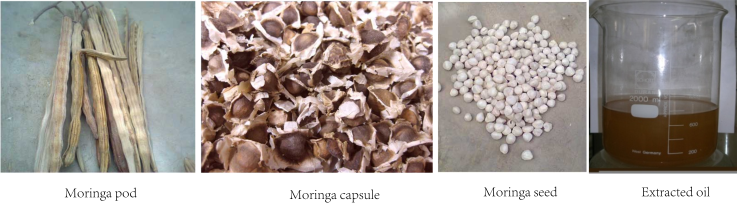
The seeds were extracted from the pod and dried under open sun, the weight of the seeds were continually measured until no further weight change was observed. 1000g of moringa seeds were grinded into powder, hot water at approximately 105 was poured on the powder and thoroughly mixed with a homogenizer to form paste, the paste was then tied in a filter material and pressed gradually using hydraulic press to drain the oil, the drained oil was collected in a beaker. The oil collected was then heated in an open container to allow water present in the oil to evaporate; the oil was weighed continuously until no further change in weight was observed. The final volume of the oil which represents the percent oil yield was measured and recorded.
2.2.1.1. Oil extraction by solvent method
The method of Shivani et al. [16] was used. 1000g of Moringa seeds were grinded into powder and the fat was removed using soxhlet apparatus, n-hexane was utilized as the solvent. The process was allowed for 6 hours and the solvent was removed via drying at oven temperature of 50 utilizing vacuum evaporation. The quantity of the oil extracted was presented as percentage of oil extracted from moringa seed.
2.2.2. Transesterification of moringa seed oil
A quantity of Moringa seed oil was poured into a flat bottom conical flask, a water bath apparatus connected to a thermostat was used to preheat the oil to a temperature of 50. 10g of KOH and 5g of methanol were mixed together and dissolved; the mixture was then poured into the oil and heated on a hot plate magnetic stirrer to a temperature of 60 according to the experimental design. The reaction was allowed a period of 50 minutes and the process was stopped. The mixture was allowed to stand for 14 hours to stratify and form separate layer of glycerol and biodiesel, the mixture were then separated using burette.
60 mL of distil water was poured on the biodiesel and stirred gently to remove impurities that may be present in the diesel, the mixture was then allowed to stay for 14 hrs to form two phases of the liquid, the mixture was separated using burette, the process was repeated twice and the decanted biodiesel was then heated at 90 to dry it, the weight was continually measured till no weight change was observed. The process was replicated for 47 more runs, in each case the biodiesel yield was calculated and recorded using equation 2.
Where:
Vb=Volume of biodiesel recover (g)
Vs= Volume of the oil used (cm3)
2.3. Determination of moisture content
Moisture content of the biodiesel was determined in accordance with ASTM D6304 test protocol. Empty crucible was weighed and recorded as W1; 1g of the fuel sample was poured into the crucible and weighed as W2. The fuel sample was heated to 100 for 1hour then the temperature was increased to 105 for 1 hour to rid off the water in the fuel sample. The fuel sample was reweighed after every 15 minutes until no further change in weight was recorded, the final weight was recorded as W3. The percentage water loss was obtained using equation 3.
Where:
W1- Initial weight of empty crucible
W2- weight of crucible + Sample before drying
W3- Final weight of sample + Sample after drying
2.4. Determination of specific gravity
The specific gravity of the biodiesel was determined according to ASTM D1298 test protocol. An empty bottle was weighed on electronic weighing scale and its weight was read and recorded as W0. The bottle was filled with fuel sample and weighed as W1. Equal volume of water was poured into another empty bottle and weighed as W2. The specific gravity of the fuel sample was determined using equation 4.
Where:
W0 = Weight of empty bottle
W1 = Weight of oil + empty bottle
W2 = Weight of water + empty bottle
2.5. Determination of kinematic viscosity
The viscosity was determined in accordance with ASTM D-2983 test protocol. The fuel sample was poured into an insulated glass tube and kept at temperature of 50, and allowed for approximately 10 minutes for the sample to come to the bath temperature of 40. Rotary viscometer was used to determine the absolute viscosity of the fuel.
Kinematic viscosity of the oil was calculated using equation 5
Where:
ν = kinematic viscosity (m2/s)
μ = absolute or dynamic viscosity (N s/m2)
ρ = density (kg/m3)
2.6. Determination of acid value
A given quantity of moringa biodiesel was weighed and poured into a 250-mL conical flask, 50 mL of ethanol-ether solution was added to the fuel sample and the mixture was stirred rigorously until it completely dissolved. The solution was titrated with sodium hydroxide as titrant and phenolphthalein as the indicator until pink colouration was observed. The volume of sodium hydroxide titrant used was measured and recorded. The acid value was computed using equation 6.
2.7. Determination of cloud point
The cloud point was determined in accordance with ASTM D-2500 test protocol. The cloud point was determined by visual observation of cloudiness of the fuel in a glass tube. Sample of the biodiesel was poured into a test tube to a particular marked point and then placed inside a cooling water bath. The temperature at the bottom of the test tube is the temperature at which the biodiesel starts to form cloud was read and recorded as the cloud point.
2.8. Determination of flash point
The flash point was determined according to ASTM D-92 test protocol; 10 ml of the fuel sample were poured into an evaporating dish and heated over a Bunsen burner flame at the rate of 100C per minute. A thermometer was placed inside the fuel, but not allowed to touch the bottom of the dish. The temperature was gradually increased until the oil started flashing when flame was applied without supporting combustion, that temperature was recorded as the flash point.
2.9. Determination of pour point
The pour point was determined according to ASTM D-92 test protocol. The fuel sample was poured into a test tube and cooled using a refrigerator. This test tube was checked on hourly basis by tilting to check oil movement. When no movement was observed when the test tube was tilted horizontally for 5 seconds, the lowest temperature at which no movement of the biodiesel was observed was recorded as the pour point.
2.10. Determination of cetane number
The cetane number was determined using a Waukesha Code of Federal Regulations (CFR) F-5 engine as described in ASTM 613.
3. Results and Discussion
3.1. Oil yield from moringa seed
The oil yield obtained from mechanical and solvent method of oil extraction is presented in Table 2.
The oil yield obtained from the two extraction methods shows that the solvent extraction approach yielded 55% more oil than the mechanical method. The results obtained are in agreement with that of Anwar and Bhanger [17] and Abiola and Atoo [18].
3.2. Properties of the transesterified moringa oil (biodiesel)
The results of preliminary study of the properties of moringa methylesther carried out according to ASTM standard are presented in Table 3.
As it could be seen, the moisture content of the biodiesel falls above the minimum recommended value, this could be attributed to the fact that biodiesels are hygroscopic in nature, and fatty acid methyl esters absorbs humidity during storage [19, 20], thus the biodiesel of moringa seed oil is hydrophilic as from other feedstock, such elevated moisture content could present potential microbial growth media in transport equipment and fuel tank. A further study may be required to determine the level of moisture absorption of the biodiesel under different storage medium and through a longer storage period. The specific gravity of the fuel falls within the bracket of suitable biodiesel fuel standard; this inferred that the fuel contains favourable energy content which can consequently increase engine power [8, 21]. The kinematic viscosity of the fuel falls within the low-normal limit, this implies that the fuel will atomize into fine spay without resistance and burn efficiently in engines [22]. The acid value of the fuel falls below the minimum benchmark, this demonstrate that the fuel has no tendency of forming solid deposits in fuel injectors and will rarely present corrosion effect in fuel tank due to acidity [23]. Both flash point and pour point also falls within the bracket, this infer that the fuel is suitable for use in temperate regions with no challenges of gelling. The Cetane value was also found to fall above the minimum value, this indicates that the fuel will not present any challenge during ignition.
3.3. Regression Model Evaluation
The forty eight (48) experimental runs carried out for each combinations of independent variables obtained from the design to obtain the biodiesel yield, the experimental data was regressed to obtained models that explains the relationship or the effect of all the independent variables on the yield of biodiesel, the summary of the design and yield of the biodiesel is presented in Table 4.
The statistical analysis explains the fitness of the model to predict biodiesel yield after transesterification. From Table 5, it could be seen that the model generated R2 value of 0.974, which demonstrates that 97.4 % changes in the biodiesel yield can be explained by changes in the independent variables. Larger F-statistics of 806.70 and sum of square of regression of 31764 indicate that the model accounts for most of the changes in the biodiesel yield. It can be inferred that the model significantly predicts the independent variable, since the significance level is 0.0001 which is below 0.05 at 95% level of confidence. Adequate precision or signal to noise ratio of 83.486 is far above the benchmark of 4 which indicates very minimal noise in the model; the variation inflation factor (VIF) of 1 is below the benchmark of 10, this negates the possibility of collinearity or multi collinearity among the independent variables thus the model can be declared adequate enough to estimate the relationship between the independent variables and the biodiesel yield. Correlation between predicted and experimental biodiesel yield (y) = 0.974x + 0.174 and R² = 0.974 as shown in Figure 1.
The model generated is a factorial model of 4FI order at 95% level of confidence; the model equation was modified to eliminate all independent variables that are insignificant in terms of actual factor and is given as;
While the equation in terms of coded factor is given as;
Where A-Alcohol/molar ratio; B-catalyst amount; C-Reaction time; D-Reaction temperature

3.4. Optimization and Validation of Biodiesel Yield
Having substatiated the adequacy of the regression model, the generated model was utilized by to maximize biodiesel yield, the goal of the optmization is to keep alcohol/ oil molar ratio, catalyst amount and reaction time within the experimental domain and then minimize reaction temperature to save energy cost. The algorithm randomly chooses starting values for all the independent variables for 30 cycles per optimization at simplex fraction of 0.1. Maximum biodiesel yield of 91.45 % was obtained at 5:1 alcohol/ oil molar ratio, 18.89 wt% catalyst amount, 45 minutes reaction time and 45 reaction temperature. The optimized value was validated experimentally using the optimized values of the independent variables; the experimental biodiesel yield obtained was 88.33 %. The optimized and the validated biodiesel yield show close agreement, with deviation of 3.12%, according to Ali and Hanna [24], residual of less than 10% is the minimum allowable error, thus our finding is valid.
3.5. Artificial Neural Network Modeling
Thirty (30) of the forty eight (48) experimental run’s input variables (alcohol/oil ratio, catalyst amount, reaction time and reaction temperature) and output variable (biodiesel yield) (Table 4) were used to train and develop artificial neural network (ANN) model using MATLAB R2016a. Back propagation algorithm base on Levenberg-Marquardt algorithm was used to train the network, the data was divided into 70, 15 and 15% for training validation and testing respectively, the weight and biases were randomly initialized to adjust their value during each training session. Mean Square Error (MSE) and Correlation Coefficient (R) were used to evaluate the performance of the model. After training for different network structures and re-initializing their weight and biases severally, a model with 4-10-1-1 (4 inputs, 10 hidden layers, 1 output layer and 1 output) topography was adopted base on highest R value and lowest MSE value. The hidden layer and output layer transfer functions used were Tansig and purelin respectively, the general neural network model formulation is given as [25].
= Output variable
=Output transfer function
=Output layer bias
=Weight connecting the kth hidden neuron and the single output neuron
=Hidden layer transfer function
=Bias of the kth hidden neuron
=ith input variable and kth hidden neuron connecting weight
=input variable
The two transfer functions used in this model can be expressed as:
Tansig(n) =
= Purelin =n
The matrices of input weight and biases into and out of each layer is presented below:
Layer 1 (Hidden layers)
Layer 2 (Output layer)

3.6. ANN Model validation
Figure 2 shows Correlation between ANN predicted biodiesel yield and experimental biodiesel yield for 30 runs and Figure 3 shows the Correlation between ANN predicted biodiesel yield and experimental biodiesel yield for 18 runs
The generated model (Network) was saved as MATLAB file, the remaining eighteen (18) input experimental data were then used as input variables to the generated ANN model to test its ability to predict biodiesel yield beyond 30 experimental data. After the model has been used to simulate the biodiesel yield, the ANN model predicted biodiesel yield for the 18 remaining runs were then compared with the experimental biodiesel yield. R value of 0.99649 and MSE of 4.914243 were obtained as the performance function of the ANN model’s predicted biodiesel yield.

On the overall performance of the model as shown in Figure 4, the model satisfactorily predicts biodiesel yield with high level of accuracy. Comparatively, the ANN model generated higher R value of 0.99649 and lowest MSE of 3.50804 when compared to R of 0.983 and MSE of 5.0453 of factorial design model, thus it can be adjudged that ANN model outperforms factorial design model, however both models showed excellent capability of predicting biodiesel yield from Moringa seed oil.

4. Conclusion
Extraction, transesterification of moringa seed oil and characterization, optimization and prediction of biodiesel yield has been carried out; the work draws the following conclusions:
- Solvent extraction method yielded more moringa seed oil than mechanical method.
- The biodiesel from moringa seed oil shows good properties suitable for use as diesel engine fuel.
- The maximum biodiesel yield of 91.45 % was obtained at 5:1 alcohol/ oil molar ratio, 18.89 wt% catalyst amounts, 45 minutes reaction time and at 45 reaction temperature.
- Artificial neural network model satisfactorily predicts biodiesel yield with higher accuracy than factorial design model
- The neural network model proves efficient to predict biodiesel yield beyond the experimental run.
References
- R. Moshin, Z. A. Majid, A. H. Shinan, N. S. Nasri, Z. Sharer, Effect of Biodiesel Blend on Engine Performance and Exhaust Emission for Diesel Dual Fuel Engine, Energy Conversion and Management. 88 (2014) 821-828.[CrossRef]
- A. Chiavo, E. Recco, Emission Performance of a Diesel Engine Fuelled with Petro Diesel, Green Diesel and Waste Cooking Oil Blends, Journal of Combustion. Volume 2018 (2018).[CrossRef]
- A. Demirbas, Biodiesel: A Realistic Fuel Alternative for Diesel Engines. Springer; London, UK. (2008).[CrossRef]
- S. T. Keera, A. R. Taman, Transesterification of Vegetable Oil to Biodiesel Fuel using Alkaline Catalyst, Fuel. 90 (1) (2011) 42- 47.[CrossRef]
- P. Verman, M. P. Sharma, G. Dwivedi, Impact of Alcohol on Biodiesel Production and Properties, Renewable and Sustainable Energy Reviews. 56 (2016) 319–333.[CrossRef]
- S. Jong, R. Hoefnagels, E. Watterlud, K. Petterson, A. Faaij, M. Junginger, Cost Optimization of Biofuel Production- The Impact of Scale, Integration, Transport and Supply Chain Configurations, Applied Energy. 195, (2017) 1055-1070.[CrossRef]
- A. A. Montgomery, T. J. Peters, P. Little, Design Analysis and Presentation of Factorial Randomized Controlled Trials, Biomed, Central Medical Research Methodology. 3:26 (2003).[CrossRef]
- J. D. Amine, S. C. Owhor, B. S. Luka, Engine Performance Characteristics of Biodesiel from Oils of Sandbox and Moringa as Feedstock. Journal of Multidisciplinary Engineering Science and Technology (JMEST) 12 (2018) 9144-9147.
- A. K. Azad, M. G. Rasul, M. M. K. Khan, S. C. Sharma, R. Islam, Prospect of Moringa Seed Oil as a Sustainable Biodiesel Fuel in Australia: A Review, Procedia Eng. 105 (2015) 601-606.[CrossRef]
- T. Kivevele, Z. Huan, Influence of Metal Contaminants and Antioxidant Additives on Storage Stability of Biodiesel Produced from Non-Edible Oils of Eastern Africa Origin (Croton Megalorcapus and Moringa Oleifera Oils), Fuel. 158 (2015) 530-537.[CrossRef]
- A. S. Abdulkareem, H. Uthman, A. S. Afolabi, O. L. Awenebe, Extraction and Optimization of Oil from Moringa Oleifera Seed as an Alternative Feedstock for the Production of Biodiesel, Sustainable Growth and Applications in Renewable Energy Sources, Dr. Majid Nayeripour (Ed.), ISBN: 978-953-307-408-5, InTech, retrieved 15th May, 2019 from: http://www.intechopen.com/books/sustainable-growth-and-applications-in-renewable-energysources/extraction-and-optimization-of-oil-from-moringa-oleifera-seed-as-an-alternative-feedstock-for-the-pr, (2011).[CrossRef]
- A. Zamboni, The advantages of a large sample size, retrieved 16th June, 2009 from: https://sciencing.com (2018).
- K. S. Liu, Preparation of Fatty Methyl Esters for Gas Chromatographic Analysis of Lipids in Biological Materials. J. Am. Oil Chem. Soc. 71 (1994) 1-15.[CrossRef]
- H. N. Basu, M. E. Norris, Process for Production of Esters for Use as a Diesel Fuel Substitute Using Non-Alkaline Catalyst, US Patent 5525126, (1996).
- T. Lundstedt, E. Seifert, L. Abramo, B. Thelin, A. Nystrom, J. Petterson, R. Bergman, Experimental Design and Optimization. Chemometrics and Intelligent Laboratory System, 42 (1998) 3-40.[CrossRef]
- P. Shivani, P. Khushbu, N. Faldu, V. Thakkar, R. B. Shubramanian, Extraction Analysis of Jatropha Curcas L. Seed Oil, African Journal of Biotechnology. 10 (79) (2011) 18210-18213.[CrossRef]
- F. Anwar, M. I. Bhanger, Analytical Characterization of Moringa oleifera Seed Oil Grown in Temperate Regions of Pakistan, Journal of Agricultural and Food Chemistry. 51 (2003) 6558-6563.[CrossRef]
- O. F. Abiola, E., A. Atoo, Process Optimization of Mechanical Oil Expression from Moringa (Moringa Oleifera) Seed, Industrial Crops and Products. 90 (2016) 142-151.[CrossRef]
- P. B. L. Fregolente, , L. V. Fregolente, M. R. W. Maciel, R. Maciel, Water Content in Biodiesel, Diesel, and Biodiesel-Diesel Blends, Journal of Chemical Engineering Data. 57 (2012) 1817-1821.[CrossRef]
- M. B. Oliveira, F. R. Varanda, I. M. Marrucho, A. J. Queimada, P. Coutinho, Prediction of Water Solubility in Biodiesel with CPA Equation of State, Ind. Eng. Chem. Res. 47 (2008) 4278-4285.[CrossRef]
- D. T. Rick, Make Biodiesel, Specific Gravity and Biodiesel. Retrieved from www.Make-biodiesel.org/Biodiesel-Chemistry/specific-gravity-and-biodisel.html (2019).
- I. R. Ejilah, K. Dahuwa, B. A. Gambo, Influence of Marula Oil Methyl Ester–Diesel Fuel Mixtures on the Performance of a Variable Load Compression Ignition Engine, European Journal of Advances in Engineering and Technology. 4 (6) (2017) 457-465.
- M. Tubino, J. A. Aricetti, A Green Method for Determination of Acid Number of Biodiesel, J. Braz. Chem. Soc. 22 (6) (2011) 1073-1081.[CrossRef]
- Y. Ali, M. A. Hanna, Physical Properties of Tallow Ester and Diesel Fuel Blends, Bioresource Technol. 47 (2010) 31-40.
- A. T. C. Goh, F. H. Kulhawy, C. G. Chua, Bayesian Neural Network Analysis of Undrained Side Resistance of Drilled Shafts, J. Geotech. Geoenviron. Eng. 131(1) (2005) 84-93.[CrossRef]