

The purpose of this study was to examine the effects of Subject Conception and Efficacy Beliefs on the Teaching Effectiveness of Social Studies teachers. The study focused on how teachers’ conception of Social Studies affect their sense of efficacy and ultimately their teaching effectiveness. The study adopted a non-experimental descriptive design to achieve its objective. The population for the study comprised of fifty-two (52) JHS Social Studies teachers. In this study the accessible population was the same as the target population. All the fifty-two (52) teachers teaching Social Studies in the Tano South district were used for the study. Purposive sampling technique was used to sample the respondents for the study. The data for the study was collected using the observation guide, questionnaire and teacher sense of efficacy scale adapted from Tschannen-Moran and Hoy, (2001). Mean, percentages, ranges and correlation were used to analyse the data using SPSS. The findings of the study showed that majority of the Social Studies teachers conceived the subject as citizenship education. Teachers’ also rated their sense of efficacy very high. However, the study revealed that most of the Social Studies teachers teaching effectiveness was low. The low teaching effectiveness would affect the realisation of the objectives of Social Studies. Also, there exist low correlation between teacher efficacy and teaching effectiveness as well as subject conception and teaching effectiveness. The correlation between teacher efficacy and effectiveness was weak and as such it is recommended that there should be a concerted effort to update and upgrade teachers’ knowledge with strong pedagogical skills and better understanding of the task of the Social Studies teacher through workshops and short courses.
Appraisal of Social Studies Teachers’ Conceptions and Efficacy Beliefs in Ghana: Teaching Effectiveness
December 01, 2021
February 28, 2022
March 09, 2022
March 11, 2022
This is an Open Access article, distributed under the terms of the Creative Commons Attribution 4.0 International License (http://creativecommons.org/licenses/by/4.0/), which permits unrestricted use, distribution and reproduction in any medium or format, provided the original work is properly cited.
Abstract
1. Introduction
Social Studies teachers’ general performance in all these thematic areas - planning and preparation, instructional skills, classroom management, communication skills and assessment skills indicate that, they are optimum in terms of teaching effectiveness [1]. This implies that Social Studies teachers generally perceive their ability to execute the teaching of the subject [2]. Good teaching demands that teachers know a lot of other things outside their field of expertise, for instance, about learning, about their students, and about the cultural, social, and political contexts within which they work. That teachers may hold such goals for student learning that grow out of their study of subject matter, but nonetheless dictate a particular pedagogy. In helping students develop such understandings, teachers may play a variety of roles and draw on a variety of knowledge and skills. Teaching styles and the manner in which teachers organise their classrooms may also vary [3].
Various commissions and authors have come out with numerous definitions and criteria regarding effective teachers, yet, a single definition has not been resolutely established on what teaching effectiveness means. Teaching effectiveness is mostly defined with regards to fostering students’ affective and personal development as well as curriculum mastery [4]. In terms of the components of effective teaching, Norphy outlined: time management, active teaching through discussions, follow-up assignments, and effective classroom management skills as the major components of teaching effectiveness [5].On the other hand, asserts that all the instructor behaviours that help students learn constitute effective teaching, and college teaching encompasses several areas as follows: subject matter mastery, curriculum development, course design, delivery of instruction, assessment of instruction and making availability to students, as well as administrative requirements. These aspects should be addressed while assessing teaching effectiveness [5]. Researchers identified the most common five characteristics related to effective teaching, these are: “enthusiasm, clarity, preparation/organization, stimulation, and love of knowledge”. They concluded that experience might be a crucial ingredient for excellence in teaching provided that it is supplemented with the aforementioned features [6].
Effective teaching fosters student learning” the author argued that “efficiency without effectiveness such as efficiently teaching a class in which students do not learn is hollow. Effectiveness without efficiency means that the profession and often the students waste time. In his argument, Wankat emphasized the co-dependence of efficiency and effectiveness in good teaching [7]. A study found out that exemplary teachers are highly organized, plan their lessons carefully, set unambiguous goals, and have high expectations of their students. They give students regular feedback regarding their progress in the course of study, make specific remediation, recommendations and assume a major responsibility for student outcomes [8]. Consistent with the aforementioned characteristics of teaching effectiveness, researchers emphasized clarity, stimulating students’ interest, engaging and motivating students, enthusiasm, establishing rapport with students, and maintaining positive classroom environment as effective practices of teaching [8]. A study conducted on “Profiles of effective college and university teachers. The Journal of Higher Education” revealed that value of interest, motivating students to do their best, comfortable learning atmosphere, course organisation, effective communication, concern for student learning, and genuine respect for students were highly related to the criterion of teacher effectiveness. The major finding of this research was that the value of the course for the university students was regarded as the most important predictor of teacher effectiveness [9].
In the same way, upon examining pre-service teachers’ perceptions of effective teaching, a study proposed seven characteristics such as being student-centred, competent, enthusiastic about teaching, ethical, knowledgeable on the subject matter, professional and effective in terms of classroom and behaviour management, which reflect effectiveness in teaching [10]. Similarly, other researchers identified nine characteristics that students consider as effective teaching. These include: being student-centred, knowledgeable about subject matter, professional, enthusiastic about teaching, effective at communication, accessible, competent at instruction, fair and respectful, and provider of adequate performance feedback [11].
Another study on “effective teachers- professional and personal skills” concluded that effective teachers need to have good professional and personal skills. Content knowledge, together with good planning, clear goals and communication, good classroom management and organization, and consistently high and realistic expectations with the students are essential factors to be effective teachers. Besides, they need to feel responsible for the students learning process, regardless the students’ aptitude to learn. Moreover, the effective teacher will combine professionalism with care, understanding, fairness, and kindness. They also have to be passionate, enthusiastic, motivated about teaching and learning. They have to create a warm classroom environment where students feel comfortable, and have a sense of belonging, as the environment is conductive to learn. Effective teachers are innovative, invite students to approach and interactions, and also values diversity [12].
Effective teachers therefore demonstrate a high sense of commitment to the attainment of their subject goals and objectives, demonstrate competence in handling the subject, are prepared to help struggling students, inspire learners, communicate effectively, and demonstrate willingness to try out new approaches and best practices. This posit that those who have the capacity to inspire students to reach their fullest potential on learning through their qualities, professional and personal skills are effective teachers [3]. Subject knowledge of teachers is one of the central issues raised which is the efficacy beliefs of teachers. teacher efficacy is to organize and execute courses of action required to successfully accomplish a specific teaching task in a particular context. The purpose of this study was to assess Social Studies teachers’ conceptions and efficacy Beliefs in teaching effectiveness. The study was guided by this research question - what extent does Social Studies teachers’ conceptions and efficacy belief correlate with their teaching effectiveness?
2. Materials and Methods
The study adopted the descriptive survey design using quantitative approach. The population consisted of all Social Studies teachers in the Junior High Schools (JHS) in the Tano South District. There were fifty-two (52) Social Studies teachers at the JHS level in the district. Purposive and convenient sampling techniques were used for the study. Purposive sampling technique was used to select all the fifty-two (52) teachers, teaching Social Studies during their teaching practice period. While Tano South District and forty-one (41) schools were conveniently sampled for the study.
The two main instruments (questionnaires and an observation guide) were used to for the study. There are twenty- four (24) items on teacher efficacy scale. The respondents were to assess their own sense of efficacy beliefs in Student Engagement, Classroom Management and Instructional Strategies. A twenty-four (24) item Teacher Sense of Efficacy Scale was adapted extracting three variables, each with eight (8) items, namely, Student Engagement, Classroom Management and Instructional Strategies. A Teacher Sense of Efficacy scale was selected for this study because it is a self-report measure which guarantees confidentiality and therefore more likely to elicit more openness in response, with regard to the kind of information required from respondents. Data obtained through the questionnaire was measured on the Likert scale. To each statement on the instrument respondents’ responses ranged from 1-Nothing, 2-Very Little, 3-Some influence, 4-Quite a bit of influence, 5- A great deal of influence.
On how effective are the Social Studies teachers in the Tano South District in the teaching of the subject, the lesson observation guide made up of twenty-seven (27) structured items was used to observe twenty Social Studies teachers lessons twice. Each of the observation lasted for 70 minutes. The observation guide was used to observe teachers planning and preparation prior to lessons, instructional skills, classroom management and communication skill and assessment respectively. The observation guide was an adaptation of the University of Education, Winneba teaching practice lesson observation and evaluation format. The researchers studied and modified to suit the study. The reason for the adaptation of the instrument was to provide standard assessment results and instrument for measuring teacher competency. It also, afforded the researchers the opportunity to see the teaching of Social Studies in schools selected for the study. The items that were used to answer the questions were scored using the Likert scale. Data were analysed with the use of cross tabulation.
3. Results and Discussions
3.1. Teacher Efficacy Beliefs and Teaching Effectiveness
This section of the study presents results and discussions on the research question “what extent does Social Studies teachers’ efficacy beliefs correlate with their teaching effectiveness?”, the data for teacher self-efficacy ratings and the results of the teaching observation were cross tabulated to establish the correlation or association between the two variables and their subscales. The results are presented on the table below.
As presented in Table 1, it is noted that teacher efficacy and teaching effectiveness is significant per the chi square it shows that the two are not independent from each other. From the table, Social Studies teachers’ efficacy and their teaching effectiveness produced a results of (χ2 = 193, df =165, sig=0.067, n=20, P<0.10) showing that there is low association between Social Studies teachers efficacy and their teaching effectiveness. This implies that the two variables can work together to improve teaching and learning outcomes. However, the finding shows that the claim of high efficacy by the teachers is not supported by the observation outcome
In a similar study determined if there existed a statistically significant relationship between the subscales of teacher efficacy belief (engagement, instruction and management) and of teachers’ perception of their effectiveness in assisting students to re-engage behaviourally by teaching assignments [14]. The results indicated that teacher perception of re-engaging the student behaviourally was significant and positively correlated with the scores on all the three subscales of teacher efficacy. In another scenario a study on the teacher efficacy and its effects on the academic achievement of African American students concluded that efficacious teachers are dedicated to student learning [15]. These findings somewhat contradict the results of the current study where the existing relationship is rather low and does apply to all the three subscales.
The result shows that there exists low correlation between the two variables because teachers’ perception of their self-capability to educate students is not all that significantly and positively related to teacher behaviours that promote students’ achievements. In relation to the Communication skill and Teacher Efficacy the results show that there is low association between the variables (χ2 = 6.593, df =3, sig=.086, n=20, P<0.10). Result on assessment skills and teacher efficacy was not different (χ2 = 8.000, df =2, n=20, p=0.10 P>0.10). With respect to the assessment skills and instructional strategy, the results show that there is strong association between the assessment skills and Social Studies instructional strategy (χ2 = 5.714, df =2, sig=0.057, n=20, P<0.10). The above results show that the variables had a marginal significant impact on each other and therefore the teachers rating of their sense of efficacy marginally correlate with their teaching effectiveness.
However, on the student engagement and assessment, the result was insignificant (χ2 = 1.818, df =2, p=.403, n=20, P<0.10) showing that most student engagement do not necessary associate with assessment. Similarly, the results of the cross tabulation of the following subscales did not produce any significant results. For instance, the result of instructional strategy and instructional skills was insignificant (χ2 = .726, df =1, sig=.394, n=20, P<0.10). The result above is contrary to the teachers claim of very high efficacy beliefs of their instructional strategy (66%) as against the low ratings (70%) of the observation. This implies that the teachers over rated themselves or lack understanding of the competences the Social Studies teacher must be endowed with in order to teach effectively. Other factors that could hinder the attainment of teaching effectiveness of the teacher may include inadequate supply to teaching and learning aids such as the syllabus, textbooks, the teachers’ manual among others. Also, the school environment could be a contributory factor in that most of the schools lack the necessary infrastructure such as furniture. It is therefore pertinent for all stakeholders especially the Ministry of Education and Ghana Education Service to ensure that the necessary facilities and teaching aids that will help teachers to prepare are provided and liaise with the institutions that trains Social Studies professionals to map up plans to upgrade JHS Social Studies teachers’ knowledge about the nature and philosophy of Social Studies and the necessary competences needed in order for them to teach the subject effectively.
3.2. Conception of Social Studies and Teaching effectiveness
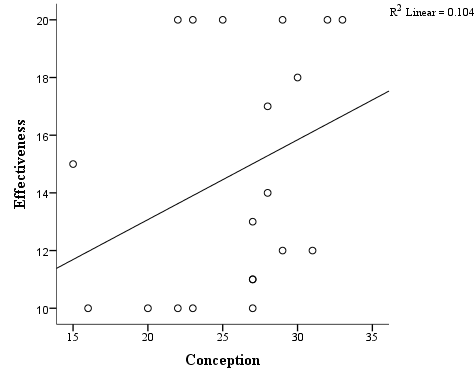
The percentage of the variation in y (effectiveness) due to a linear relationship with x (conception) is 10.4% using the R2=0.104. This means that, very little of the variance in y can be explained by the changes in x as shown in Figure 1.
A correlation was computed among social studies teachers’ conceptions and their teaching effectiveness as shown in table 2 above. From a statistical view, it was indicated that social studies teachers’ conceptions and their teaching effectiveness are not significantly correlated, r (18) = .32, p = .17. With the value of r be positive implies that there is a positive linear relationship between the data (i.e. when the teachers’ conceptions increase teaching effectiveness also increases and vice versa). However, the magnitude or strength of the relationship between social studies teachers’ conceptions and their teaching effectiveness is small or weak (< | r |<.3) with r = .32.
4. Conclusions and Recommendations
The study revealed that, here exists low correlation between teacher efficacy beliefs and teaching effectiveness irrespective of subject conception. The teachers’ claim of high sense of efficacy with regards to the teaching of Social Studies could not be true. This was as a result of the outcomes of the ratings of the two variables. That is, whiles the ratings by the teachers gave high efficacy; the analysis of the scores of their teaching was very low, indicating that they are not at their best when it comes to the teaching of Social Studies, irrespective of the good conception teachers hold about the subject Social Studies. It is recommended that, the universities and colleges of education training Social Studies teachers for the basic and pre-tertiary institutions in Ghana should collaborate with National Teaching Council (NTC) and National Social Studies Association to organise seminars and workshop to orientate teachers’ conception on efficacy beliefs and teaching effectiveness. It is also recommended that there should be a concerted effort to update and upgrade teachers’ knowledge with strong pedagogical skills and better understanding of the task of the Social Studies teacher and effective methods of teaching the subject through workshops and short courses.
References
- Bordoh, A., Nyantakyi, F., Otoo, A. K., Boakyewa, A., Owusu-Ansah, P., & Eshun, I. (2021). Effective Teaching of Social Studies Concepts in Basic Schools in Ghana. Universal Journal of Social Sciences and Humanities, 1(1), 46–53.[CrossRef]
- Nyantakyi, F., Bordoh, A., Anim, C., & Brew, E. (2020). Social Studies Curriculum: Teachers’ Conception and Efficacy Beliefs in Junior High Schools in Ghana. Journal of Social Sciences and Humanities, 6(4), 297-308[CrossRef]
- Nyantakyi, F. (2017). Subject conception, efficacy beliefs and teaching effectiveness: a study of junior high school Social Studies teachers in the Tano South District. Unpublished Master of Philosophy Thesis in Social Studies, University of Education, Winneba[CrossRef]
- Brophy, J., Good, T. L. (1986). Teacher behavior and student achievement. In Wittrock, M. C. (Ed.), Handbook of research on teaching (3rd ed., pp. 328–375). New York, NY: Macmillan.[CrossRef]
- Cashin, W. E. (1989). Student ratings of teaching: Recommendations for use. IDEA Paper No. 22. Manhattan, KS: Kansas State University, Center for Faculty Evaluation and Development.[CrossRef]
- Sherman, T., Armistead, L. P., Fowler, F., Barksdale, M. A., & Reif, G. (1987). The quest for excellence in university teaching. Journal of Higher Education, 58(1), 66–84.[CrossRef]
- Wankat P. C. (2013). Integrating the Use of Commercial Simulators into Lecture Courses. https://doi.org/10.1002/j.2168-9830.2002.tb00668.x[CrossRef]
- Hativa, N., Barak, R., & Simhi, E. (2001). Exemplary university teachers: Knowledge and beliefs regarding effective teaching dimensions and strategies. The Journal of Higher Education, 72(6), 699–729.[CrossRef]
- Young, S., & Shaw, D. G. (1999). Profiles of effective college and university teachers. The Journal of Higher Education, 72(6): 699–729.[CrossRef]
- Minor, L. C., Onwuegbuzie, A. J., Witcher, A. E., & James, T. L. (2002). Preservice teachers’ educational beliefs and their perceptions of characteristics of effective teachers. The Journal of Educational Research, 96(2), 116–127.[CrossRef]
- Witcher, A.E., Onwuegbuzie, A. J., Collins, K. M. T., Filer, J. D., Wiedmaier, C.D., & Moore, C. (2003). Students’ perceptions of characteristics of effective college teachers. (ERIC Document Reproduction Service No. ED482517).[CrossRef]
- Rubio, M C. (2009) “Effective teachers –Professional and personal skills”, en ENSAYOS, Revista de la Facultad de Educación de Albacete, Nº 24, 35-46 2009. (Enlace web: http://www.uclm.es/ab/educacion/ensayos[CrossRef]
- Tschannen-Moran, M., & Woolfolk Hoy, A. (2001). Teacher efficacy: Capturing an elusive construct. Teaching and Teacher Education, 17, 783-805.[CrossRef]
- Guillory, J. (2012). Is there a correlation between teacher efficacy and effectiveness to re-engage at risk students and graduate on time? Retrieved May 14, 2021, from The University of Southern Mississippi http://aquila.usm.edu[CrossRef]
- Richardson, J. (2005). Students’ approaches to learning and teachers’ approaches to teaching in higher education. Educational Psychology 25(6,) 673-680.[CrossRef]