

The savant syndrome is a syndrome that is associated with certain cognitive disorders and is as-sociated with limitations but also with individual significant abilities. The nature and expression of the syndrome is very heterogeneous, which means that many facets of the syndrome have not yet been researched. The object of the study described below was to approach the research gap on the topic of work and employment in particular with initial results, since up to now both topics have only been adequately researched in isolation. In doing so, the influence of the profit orienta-tion of organisations on the employability of savants was investigated. Correlations between non-profit organisations and companies with other parameters such as the implementation of a company health management or the general employment of severely disabled people could al-ready be proven in previously conducted studies. The method used was a quantitative survey of 465 dependent employees. The ability to integrate was expressed by a total score, which was an additive index consisting of the dimensions strengths, weaknesses and framework conditions. Although the proportion of severely disabled employees is higher in the public sector and compa-ny health management is also partly obligatory, no significant differences in the employability of island gifted people could be found compared to the free economy.
Correlation of non-profit organisations to the occupational integrability of savants
April 26, 2022
May 26, 2022
June 07, 2022
June 09, 2022
This is an Open Access article, distributed under the terms of the Creative Commons Attribution 4.0 International License (http://creativecommons.org/licenses/by/4.0/), which permits unrestricted use, distribution and reproduction in any medium or format, provided the original work is properly cited.
Abstract
1. Introduction
The research on insularity, which has now lasted 130 years, began with the English neurologist J. Langdon Down. During his clinical work he observed patients who suffered from severe disorders on the one hand, but showed extraordinary abilities on the other hand [1]. To date, research has provided only limited further insight into the syndrome of insular giftedness. The diversity of theories corresponds to the heterogeneity of the phenomena and significantly complicates research [2]. For a long time, therefore, insular giftedness has been the subject of all sorts of speculation, misunderstanding, and, unfortunately, exploitation [3]. However, it is well known that the impairments of insular gifted individuals can be multifaceted and vary in nature and expression depending on the particular condition [4]. Insular giftedness is not a classified disorder, but a syndrome defined by the fact that the complexity of the various pathogenic factors and manifested symptoms can no longer be differentiated from each other [5]. However, a common identifying feature of insular giftedness, in addition to the limitations, is always an above-average ability in at least one dimension. Insular giftedness is difficult to study in isolation from the particular clinical picture. Every second insular gifted person belongs to the autism spectrum disorder. The second half of the insular gifted suffer from other cognitive disorders [6]. The disabilities have an impact on social inclusion. People with disabilities generally have less access to the labor market [7]; these trends can also be seen in general among people with mental illness [8]. Without robust unemployment rates for the insularly gifted existing, higher than average unemployment rates can be found among autistic individuals [9]. The transfer to insular gifted people is obvious.
At the same time, in Germany as in many other countries, a demographic change is emerging that will result in a shortage of skilled workers in the next 20 to 30 years [10]. This will be accompanied by an aging of the labor force potential [11]. The inevitable existence of a shortage of skilled workers as a result of demographic change is viewed quite critically [12]. Nevertheless, it appears to be a paradox that an increased rate of unemployment can be assumed among island gifted people, although they have above-average skills and at the same time there is a shortage of skilled workers on the labor market. The shortage of skilled workers and the further development to be expected require companies even more than before to nurture and promote their employees, who are the most important resource for the company's success, in order to maintain their health and thus their workforce for as long as possible and to retain their employees [13].
Occupational health management (OHM) lends its conceptual framework to the focus on employee health. Particularly in the introduction of a BGM, clear differences and dependencies on the profit orientation of the organizational unit can be observed. In the public service of the state of North Rhine-Westphalia, the introduction of a BGM is mandatory. The fact that organizational size is related to the existence of an OHM can also become relevant, since organizational units in the public sector are rarely comparable to the sizes of micro and small enterprises [14]. In addition, the general numbers of severely disabled persons in the public sector also show higher rates, suggesting that a successful inclusion policy would be pursued here and that there would thus also be better employability for island gifted persons.
Insofar as the BGM is shown to be conducive to insular giftedness or general severely disabled numbers are synonymous with an ability to integrate insular gifted people, it can be assumed that the profit orientation of an organizational unit also correlates with the ability to integrate insular gifted people. This constituted the hypothesis to be tested. The object of the study was therefore to examine the dependence of an organization's profit orientation on the integration ability of insularly gifted individuals by comparing free enterprise with public service on the basis of existing jobs.
2. Method
The following analysis aimed to survey the subjectively perceived employability of island gifted individuals in German for-profit and non-profit organizations from the perspective of the respective job holders. For this purpose, a survey of dependent employees was conducted by means of random selection. Persons in dependent employment were eligible to participate. There were no further requirements for participation. The synonym of public service was used to determine the non-profit organizational affiliation. It had to be expected that the question about profit orientation could not be answered correctly by many employees, due to the large number of mixed forms under company law (registered associations, gGmbH, etc.) The question about affiliation with the public service, on the other hand, is known to job holders and could therefore be asked as a mandatory item. The data collection instrument chosen was a questionnaire with 29 closed-ended items and final response options. The employability of island gifted individuals is a latent variable that can only be measured indirectly and for which appropriate characteristics must be constructed to make the corresponding facts measurable. For this purpose, the operationalization was based on the theory of Seiler [15] that the integration of insular gifted persons requires a consideration of the special abilities and limitations, but also suitable framework conditions must be given in the company. Indicators were formed for these three dimensions (strengths, weaknesses, framework conditions) on the basis of relevant literature (numerical comprehension, flexibility, communication requirements, etc.). From the indicators, items were derived for which a few items could be taken from established questionnaires on occupational health management (OHM). Other items were developed in-house.
The items were ordinal and nominal scaled. The response specifications corresponded to the Likert method. To avoid forced choice, five response options were provided. To prevent the respondent from recognizing a response structure, some items were asked inversively and then reversed. The quality of the designed study sample was determined in the pretest by an explorative factor analysis and a check for internal consistency with the help of the statistical software SPSS, version 25. The survey was conducted via an online platform. The survey was conducted in March 2020. After three weeks, the minimum number of participants was reached and the survey (n=465) was closed. All subsequent tests were two-sided with a significance level of 5%.
Nonparametric tests were used in the subsequent analysis of the results after the Kruskall-Wallis test failed to confirm a normal distribution. The characteristic values were summarized as mean (M) and standard deviation (SD). A total value or total score was calculated by summing the individual dimensions.
3. Results
A total of 465 volunteers participated in the survey, 6 participants did not complete the survey and dropped out early, leaving 459 records available for analysis. Overall, 133 of the respondents (28.98%) reported being employed in the public sector. In contrast, 326 of the respondents (71.02%) indicated that they were not employed in public service. The item on employment was coded as a mandatory question with no neutral response option offered. Thus, a value for assignment was available for all data sets. The overall scale of all 30 items, with a range of values from -60 to 60, had a mean of -1.60 (SD = 12.05). With respect to kurtosis, the Weaknesses scale exceeded the cutoffs for the presence of a normal distribution elaborated by Miles and Shevlin [16]. The Kolmogorov-Smirnov test revealed a significant deviation of all scales from the normal distribution with p < 0.05.
For the investigation of the hypothesis on the correlation between profit orientation of the organization and employment or integration ability of island gifted people, the scale values of respondents from the public sector were compared with those from the free economy. A listing of the characteristic variables as well as the test results is shown in Table 1. Overall, negative values indicate unfavorable conditions, while positive mean values indicate favorable conditions.
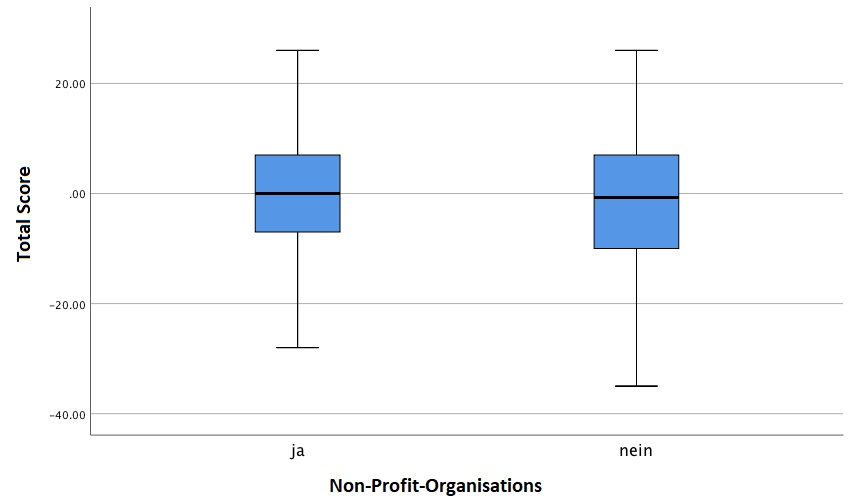
No differences can be demonstrated depending on the profit orientation of the organization. The mean values of the scales of employees from the public sector and from the private sector differ only slightly from one another. Thus, a mean value of 3.23 (SD = 2.78) can be observed for the scale "Strengths" in the public service, and 2.87 (SD = 3.10) in the non-public service, which leads to an effect size of d = -0.120, i.e. a low effect. The difference is not significant (Z = -0.905; p = 0.365). For the "Weaknesses" scale, the means differ by less than one score point (-6.96 +/- 4.70 vs. -6.01 +/- 4.69), indicating a weak effect of 0.202. The differences are not significant at p = 0.123 (Z = -1.541). For "general conditions," a mean score of 2.66 (SD = 8.76) in the public sector contrasts with a score of 1.32 (SD = 9.99) in the private sector (Z = -1.200; p = 0.230) with d = -0.139. This results from a total score in the public sector of -1.08 (SD = 11.41) compared with non-public sector of -1.82 (SD = 12.31) with a weak effect (d = 0.061). Group differences are not significant (Z = -0.434; p = 0.664).
The graphical representation of the scales as a function of profit orientation is given in Figure 1 in the form of boxplots and is limited to the scale on the total score.
4. Discussion
Schrapper [17] already described several years ago that the public service (as a proxy for non-profit organizations - well aware that the two terms are not fully synonymous) has long recognized the instrument of BGM to take measures against the above-average sickness rates, which in turn result from the aging workforce. With the passing of the Dienstrechtsmodernisierungsgesetz (DRModG NRW) in June 2016, the state of North Rhine-Westphalia even obliged every department to draw up a framework concept for health management in accordance with Section 76 (2) LBG NRW and to develop this on a regular basis [18].
In the private sector, however, the implementation of structured health management cannot be described as comprehensive. Due to differentiated objectives, many companies are tempted to reduce health management solely to its effect as a recruitment and retention tool [19]. The benefits that are not guaranteed with the investment in OHM could deter a for-profit organization from introducing OHM more than a non-profit organization. In this case, lower employability of insular talent would have to be assumed.
In testing the hypothesis formulated at the outset, the employability of island gifted individuals in the public sector and outside the public sector was consequently compared. No differences were found or demonstrated in the empirical survey. The assessments of all scales individually as well as overall did not differ between public service and non-public service respondents.
Again, the findings on the integration of insular gifted persons do not coincide with the absolute and general statistics on severe disabilities. This is because, although no differences between the public sector and the private sector can be seen in the integration of island gifted persons, there are definitely differences in the statistics on severely disabled persons. If the employment figures of the Federal Employment Agency [20] are taken into account, the rate of people with disabilities is lower among private employers at 4.1% than among public employers at 6.5%. The employment statistics include figures for all types of severe disability. Thus, it does not depict transferability for people with insular disabilities. The difficulty in using the numbers is also due to the fact that many people with insular disabilities do not appear as such to their supervisors. Although there is a legally prescribed compensation for disadvantages, many insularly gifted persons avoid "outing" themselves to colleagues and superiors, since professional disadvantages are feared and a perception as a person with a disability is to be prevented [21].
For the comparison of public employers and private employers, it is further important to consider that hiring conditions differ in many cases. In the public sector, for example, rationally comprehensible, objective selection criteria are often used (e.g. grades, medical examination, etc.), while private employers often select applicants in personal interviews or via assessment centers. If companies do not actively choose to integrate individuals with insular talents, they often fail in the applicant selection process. Companies, such as SAP, that decide to actively hire people on the autism spectrum will also optimize the working conditions necessary to do so. Contact points for the placement of autistic professionals for private as well as public employers represent a competent point of contact for both sides in this regard [22].
Affected persons often do not complain in personal conversations about the employment skills provided by the company. In this context, the behavior of colleagues or direct superiors to maintain social contacts, small talks, joint lunch breaks or celebrations is often perceived as disruptive and untenable [23]. This encroachment, perceived as coercion, is found in both private and public employers. The reason is often ignorance regarding the needs and desires of the insular gifted person. This can only be remedied by an open, understanding and appreciative exchange with the parties involved, possibly involving external mediators. These basic requirements with regard to public service and private employers in terms of promotion of strengths, consideration of weaknesses and provision of framework conditions are comparable in the public service and private employers. The empirically tested hypothesis shows that there is no correlation between the absolute number of severely disabled persons employed and the ability to integrate gifted islanders.
5. Conclusion
Legislators are promoting an inclusive employment policy and setting a good example. This is supported by higher employment rates of severely disabled employees in the public sector. However, the conclusion that the public service thus also offers better employment and integration opportunities for island gifted people is wrong. The study was able to prove that the public service does not differ from the free economy with regard to the use of skills, consideration of limitations and the offer of special framework conditions.
At the same time, it follows from this that the absolute case figures on the number of severely disabled employees do not allow a judgment on the integration ability of island gifted people.
The investigation of the causes could be the subject of further research, in which in particular the interaction of other instruments for the employment promotion of severely disabled people in the context of the integration ability of island gifted people should be explored.
References
- Down JL. On some of the Mental Affections of Childhood and Youth: Being the Lettsomian Lectures Delivered before the Medical Society of London in 1887. Nachdruck der Auflage aus 1887 in 2018. Norderstedt: Hansebooks GmbH; 1887/2018.
- Stegemeyer-Senst E. Das Savant-Syndrom. Schnittpunkt zwischen Neurowissenschaften und Sozialer Arbeit, Sozialpädagogik / Sozialarbeit, GRIN. München: Grin Verlag; 2017.
- Tammet D, Klostermann M. Wolkenspringer: Von einem genialen Autisten lernen. Düsseldorf: Patmos; 2009.
- Neumann FAO. Sind Savants die Zukunft der menschlichen Evolution? Eine neurobiologische Betrachtung des Savant-Syndroms. 1. Auflage. München: Grin Verlag; 2015.
- Uhle T, Treier M. Betriebliches Gesundheitsmanagement: Gesundheitsförderung in der Arbeitswelt - Mitarbeiter einbinden, Prozesse gestalten, Erfolge messen. 4., vollst. ak. u. erw. Auflage 2019. Wiesbaden: Springer Fachmedien Wiesbaden GmbH; Springer; 2019.[CrossRef]
- Treffert DA. Extraordinary people: Redefining the "idiot savant". 1st ed. New York: Harper & Row; 1989.
- Pfaff H. Lebenslagen der behinderten Menschen. Ergebnis des Mikrozensus 2009. In: Statistisches Bundesamt, Hrsg. Wirtschaft und Statistik. Wiesbaden; 2018. S. 232–43 (03).
- Ulich E, Wülser M. Gesundheitsmanagement in Unternehmen: Arbeitspsychologische Perspektiven. 7. Aufl. 2018. Wiesbaden: Springer Gabler; 2018. (Uniscope. Publikationen der SGO Stiftung).
- Lever M. The autism employment gap. The National Autistic Society 2016.
- Brandenburg U, Domschke J-P. Die Zukunft sieht alt aus: Herausforderungen des demografischen Wandels für das Personalmanagement. 1. Aufl. Wiesbaden: Gabler; 2007. Verfügbar unter: http://dx.doi.org/10.1007/978-3-8349-9532-2.[CrossRef]
- Bellmann L, Kistler E, Wahse J. Demographischer Wandel: Betriebe müssen sich auf alternde Belegschaften einstellen. IAB-Kurzbericht 2007; (21). Verfügbar unter: http://doku.iab.de/kurzber/2007/kb2107.pdf.
- Domroese K-F. Den Fachkräftemangel durch die Personalentwicklung vermeiden. Saarbrücken: VDM Verl. Dr. Müller; 2008.
- Huber S. Betriebliches Gesundheitsmanagement und Personalmanagement. In: Esslinger AS, Emmert M, Schöffski O, Hrsg. Betriebliches Gesundheitsmanagement: Mit gesunden Mitarbeitern zu unternehmerischem Erfolg. 1. Aufl. Wiesbaden: Gabler Verlag / Springer Fachmedien Wiesbaden GmbH, Wiesbaden; 2010. S. 67–87.[CrossRef]
- Faller G. Umsetzung Betrieblicher Gesundheitsförderung/Betrieblichen Gesundheitsmanagements in Deutschland: Stand und Entwicklungsbedarfe der einschlägigen Forschung. Gesundheitswesen 2018; 80(3):278–85. doi: 10.1055/s-0042-100624.[CrossRef] [PubMed]
- Seiler K. Beschäftigungsfähigkeit als Indikator für unternehmerische Flexibilität. In: Badura B, Schröder H, Vetter C, Hrsg. Betriebliches Gesundheitsmanagement: Kosten und Nutzen. Berlin, Heidelberg: Springer-Verlag Berlin Heidelberg; 2009. S. 3–14 (Fehlzeiten-Report; Bd. 2008).[CrossRef]
- Miles J, Shevlin M. Applying regression & correlation: A guide for students and researchers. Reprinted. London: SAGE Publ; 2001.
- Schrapper L. Der Öffentliche Dienst im Demografischen Wandel. Die Verwaltung 2013; 46(3):441–55.[CrossRef]
- Möltgen-Sicking K, Winter T. Verwaltung und Verwaltungswissenschaft: Eine praxisorientierte Einführung. Wiesbaden: Springer VS; 2018. (Lehrbuch). Verfügbar unter: http://dx.doi.org/10.1007/978-3-658-19085-9.[CrossRef]
- Nürnberg V, Braun M, Vischer A. Von schönen Zähnen zum BGM. Personalmagazin 2016; (06):52–4.
- Bundesagentur für Arbeit. Schwerbehinderte Menschen in Beschäftigung: Gebietsstand 2017; 2017 [Stand: 28.03.2020]. Verfügbar unter: https://statistik.arbeitsagentur.de/nn_31958/SiteGlobals/Forms/Rubrikensuche/Rubrikensuche_Suchergebnis_Form.html?view=processForm&resourceId=210358&input_=&pageLocale=de&topicId=17388®ion=&year_month=201712&year_month.GROUP=1&search=Suchen.
- Eisenreich R. Autismus; 2019. Verfügbar unter: https://www.zeit.de/arbeit/2019-11/autismus-berufsleben-vorurteile-outing/komplettansicht.
- Jablonski HW. Diversity Management: Chancen für deutsche Unternehmen. In: Genkova P, Ringeisen T, Hrsg. Handbuch Diversity Kompetenz: Band 1: Perspektiven und Anwendungsfelder : mit 83 Abbildungen und 24 Tabellen. Wiesbaden: Springer; 2016. S. 307–19 (Springer Reference Psychologie).[CrossRef]
- Aspergerforum Selbsthilfe; 2015 [Stand: 31.03.2020]. Verfügbar unter: https://aspies.de/selbsthilfeforum/index.php?thread/2202-asperger-in-der-verwaltung-öffentlicher-dienst/