

The digital drug traceability systems ensure the patient-centric dose, dosage form, and strength delivered to the patient as intended in the supply chain. It helps the digital healthcare platforms securely establish drug information supplied to patients for potential treatments. Therefore, it is important for the global supply chain to explore the number of high-end digital health solutions and drug traceability to create an interactive loop on drug security for patients. This article provides an overview of advanced technologies for digital drug traceability, such as blockchain, that would establish a secure pharmaceutical supply chain for the digital world.
Review Article
Open Access
March 05, 2024
The Future of Digital Drug Traceability in the Global Supply Chain
1
Pharmaceutical Serialization/Information Technology, Pennsylvania, USA
Page(s):
1-6
Received
January 10, 2024
January 10, 2024
Revised
February 28, 2024
February 28, 2024
Accepted
March 04, 2024
March 04, 2024
Published
March 05, 2024
March 05, 2024
Creative Commons
This is an Open Access article, distributed under the terms of the Creative Commons Attribution 4.0 International License (http://creativecommons.org/licenses/by/4.0/), which permits unrestricted use, distribution and reproduction in any medium or format, provided the original work is properly cited.
Copyright: Copyright © The Author(s), 2024. Published by Scientific Publications
Abstract
1. Introduction
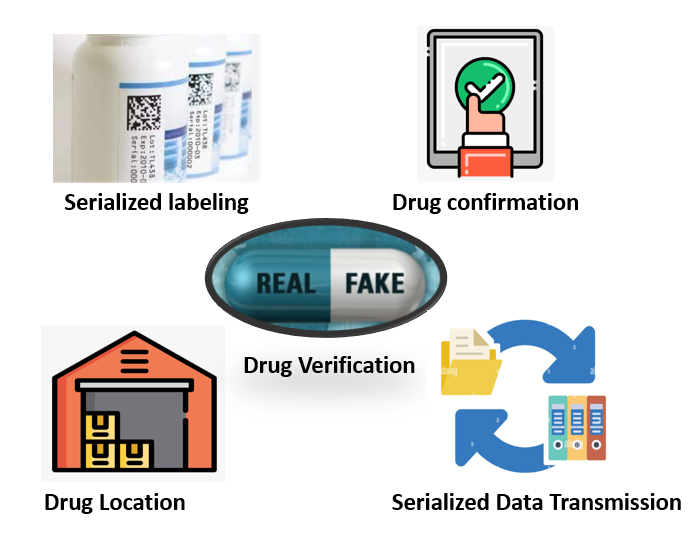
The pharmaceutical supply chain is more intricate than that of other products. The primary cause of this complexity is the frequent transfers of ownership between pharmaceutical drug suppliers and patients. Businesses are at risk when manufacturers and distributors are unable to provide a sufficient supply in the market. Errors in the pharmaceutical manufacturing process, medicinal ingredients, storage, distribution, and temperature control, are a few examples, can lead to drug ineffectiveness, unfavourable side effects, or even death. The counterfeited drugs may contain hazardous or substandard substances that can become dangerous for humans. Due to this negligence, consumers end up paying for drugs that have little to no medicinal benefit, which leads to a host of other problems [1]. The network that ships genuine APIs to manufacturers for use in manufacturing and delivers completed medications to patients is known as the pharmaceutical supply chain. As a result of drug security, a pharmaceutical supply chain must meet safety and quality requirements, deliver the necessary amount of medication at the required time, and keep costs down for the greatest number of patients. Recent advancements in the field of digital drug traceability have made it possible to secure the authenticity of the drug in the supply chain. Another revolution we have witnessed in the early 21st century is the advent of digitalization. Modern society is becoming increasingly digitized and dependent on the virtual world and enormous amounts of data. The distribution of pharmaceutical drugs in the global supply chain has emerged as a significant global concern in recent times, alongside other supply chain issues. Digital drug traceability should be ensured while at the same time delivering solutions allowing for medicine security, combating falsified and counterfeit drugs, and reducing the environmental footprint of related manufacturing. In this way, a manual drug database might be transformed into secure digitalized drug information. This would enable simultaneous secure distribution, more accurate and timely dosage of an active ingredient and tracking of each consumed dose by patients. A more effective pharmaceutical supply chain can only be possible with the traceability feature of digitalized medications. This will open up new avenues for decreasing pharmaceutical waste, creating more sustainable drugs, and ultimately creating a supply chain that incorporates parts of the circular economy. Additionally, the digitalized medication goods ought to be functional, accessible, and reasonably priced so that they can be utilized in middle-class and lower-class countries worldwide. In this digital age, the pharmaceutical product is the weakest link in the supply chain. This is due to the restricted alternatives available for its traceability, on-step verification, and interaction with the current digital health platforms. Technologies known as track and trace have made it possible to track the locations of pharmaceutical medication goods both in the present and the past along the whole supply chain [2]. Figure 1 shows the characteristics of the digital drug traceability system.
The FDA has been enforcing the DSCSA's mandate that prescription medication packaging bears a product identifier since 2018. By 2023, the supply chain set of regulations aims to establish unit-level traceability, where a unit is characterized as a single sealable entity. A primary package with several dosage units, such as a blister package containing tablets or capsules, or a primary package with a single dose unit, such as an oral film, can both be sealable units. Technological advancements in information technology (IT) have made it possible to establish networks between organizations that provide real-time information processing and sharing, enabling various controls, such as supply chain traceability [3]. There are several possible advantages that digital technologies can offer supply chain management. The location and properties of all the drugs and its packaging in the supply chain can be determined at any time by using the Internet of Things to make the chain transparent and give visibility to individual items [4]. Digital solutions include the integration of information and communication technologies, such as mobile phones, software, apps, and the internet, to carry out specific tasks, enhance work performance, offer better services, deliver healthcare services, and encourage self-management of patients [5]. Furthermore, a stringent digital drug traceability system is required in the supply chain to be effective, efficient, and meet all security parameter needs [6].
2. Internet of Things
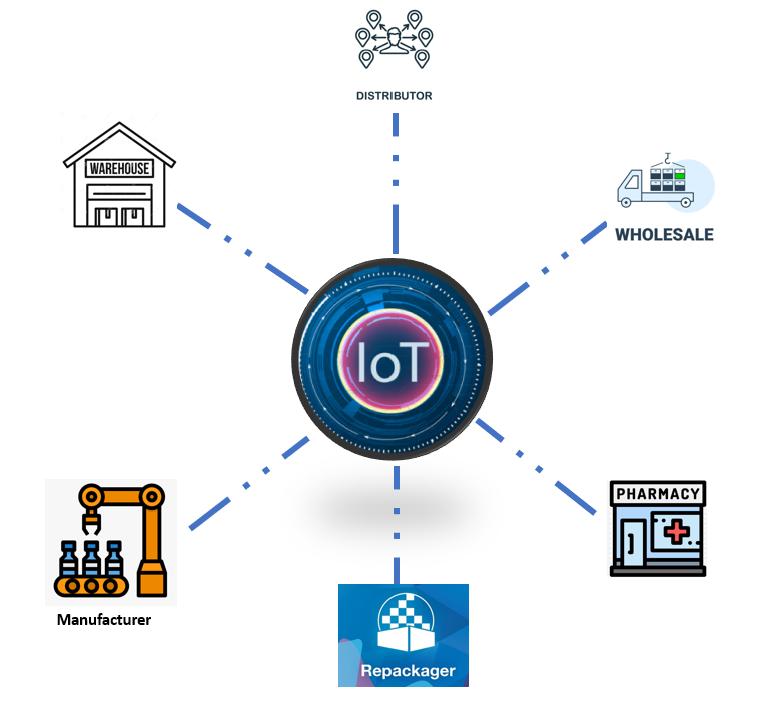
These days, the Internet of Things (IoT) consists of wearable and personal mobile sensors that can detect a variety of things, including breathing, heart rate, biomarkers from perspiration, and even an individual's mental condition. The Internet of Things (IoT) is a concept that represents a networked collection of anybody, anything, anywhere, at any time, with any service [7]. The Internet of Things (IoT) makes it feasible to integrate human society and matter organically while also analyzing and optimizing goods and living more thoroughly and dynamically [8]. Improved pharmaceutical global supply chain management, product counterfeit detection, manufacturing automation, smart homes and appliances, e-government (electronic official documents and currency), enhanced integrated vehicle health management, and e-health (patient monitoring and patient records) are a few of the most promising applications. The Internet of Things (IoT) allows a typical smartphone to scan serialized barcodes, measure, interpret the serialized data that are transmitted by the Internet of Things [9]. In the healthcare industry, these technological possibilities allow for a completely novel type of human-machine interaction. The pharmaceutical supply chain is undergoing a continuous transformation that involves integrating the Internet of Things (IoT) into all relevant components, such as manufacturing facilities, analytical tools, drugs tracking, temperature monitoring during transportation, and so on. This is being done to facilitate digital connectivity and ultimately enhance the PSC as a whole. Devices that transmit digital drug scan data to digital platforms, such as drugs movement in the supply chain, digital temperature tracking, and relative humidity meters, are considered the Internet of Things (IoT) in this context. These devices allow for continuous and real-time signal monitoring as well as automatic adjustment of crucial parameters during the storage and transportation of drug products. Figure 2 shows how the IoT will improve digital drug traceability in the supply chain.
3. Blockchain Technology
To address the issue of counterfeit drugs, a multinational pharmaceutical company submitted a patent application in December 2016 to trace products moving through the supply chain using blockchain technology. The patent describes how to use blockchain technology to store data on an object (in this case, a single drug), update that data as the product moves away from its point of origin, and store data on a distributed network to confirm the drug's expiry. Put differently, the patent application centres around the prevention of counterfeiting [10]. This technology prevents data loss or harm from unintentional or intentional deletion and guarantees safe and trustworthy drug security. Blockchain technology is more suited for exchanging private data. A blockchain, to put it simply, is a time-stamped collection of immutable and unchangeable data that is not owned by a single entity and is recorded and managed by a collection of decentralized computers. Blockchain technology has already shown benefits in the healthcare industry, but before utilizing its applications, one must first embrace blockchain technology [11]. Information can be shared on a blockchain in a way that makes information tampering difficult. This technological feature can assist in overcoming the shortcomings and difficulties of different systems, such as information accessibility, consistency, and safety. Since all parties involved in a pharmaceutical supply chain share this information, the structure of blockchain technology makes it difficult to make modifications to the data without being detected [12]. As a result, data exchanged between authorized parties is protected within the supply chain. Furthermore, a blockchain can guarantee the accuracy and consistency of the data in a PSC management system. The fact that information on blockchain is instantly accessible from anywhere on the globe is another important feature. It does not, however, imply that information is readily accessible to all. Blockchain security is strong enough that access to it is restricted to approved parties only. The dissemination of counterfeit drugs can be stopped with the use of blockchain technology. Digital signatures and cryptographic hash functions are the two primary cryptographic techniques that blockchain uses. The blockchain's immutability creates a decentralized database that is impossible to alter or falsify, and its decentralized functioning significantly boosts efficiency, security, and transparency [13]. The blockchain, being a decentralized database, keeps track of every transaction from the block of creation to the present block [14]. The blockchain is auditable, non-receivable, anonymous, and decentralized, in contrast to traditional databases [15]. The pharmaceutical drug production, distribution, and research and developments are no longer entirely within the purview of one or a small group of producers due to the rapid growth of the pharmaceutical sector and international trade. These days, blockchain technology is extensively utilized in the supply chain to achieve digital tracking and verification of drugs, and other features. The drug manufacturer and the supplier of medicinal API will agree on the supply through smart contracts. The drug manufacturer and the distributor of drug distribution will also agree on the distribution and sale of drugs through smart contracts if blockchain technology is integrated into the design and production of drugs [16]. To achieve the effect of drug anti-counterfeiting, the entire history of drug manufacture and distribution may be tracked, and a third party can verify the drug at any moment [17].
4. Need for an Innovative Traceability and Reporting System
Current research has been done with the intention of combating counterfeit drugs. The goal of smart digital drug traceability is to guarantee improved supply chain security, performance, and so forth; however, no study has specifically focused on reporting any incidents to the local government. If a pharmaceutical supply chain stakeholder finds out that a medication is fake or forged, they can, at most, refuse to take it. A patient only option upon discovering a fake or fabricated medication is to not take it. Therefore, until the consumer or pharmacy alerts them, nobody—not even the manufacturer or the local government—knows about this problem. By doing so, the manufacturer can raise awareness of the situation and encourage greater caution on their part. Notifying the local authorities right away about the incident and providing them with the necessary evidence and data may aid in identifying the offending party, deterring others from taking further action and preventing the falsification and counterfeiting of the medication. Future innovations might concentrate on creating a secure reporting system (mobile app or web portal) that makes it easier to report any occurrence involving fake or fraudulent medications and on pursuing the necessary legal action to lower the use of these drugs.
5. Conclusion
The rapid expansion of the social economy and our unawareness have resulted in an increase in counterfeit drugs in our lives. The general population's attitude toward inexpensive drugs through an illegal supply chain has encouraged counterfeit manufacturers to take advantage of the opportunity to offer low-cost counterfeit drugs, suppress the profits of genuine manufacturers, and compromise public trust in the quality of the drug being sold. The rise in drug counterfeiting highlights the urgent need for additional technological innovations in this field, with an emphasis on testing the effects of traceability technologies and important success factors in overcoming the various barriers to creating a safe pharmaceutical supply chain through qualitative research.
6. Abbreviations
IoT – Internet of Things
PSC – Pharmaceutical Supply chain
TnT – Track and Trace
IT – Information Technology
References
- Singh, R., Dwivedi, A. D., & Srivastava, G. (2020). Internet of things based blockchain for temperature monitoring and counterfeit pharmaceutical prevention. Sensors, 20(14), 3951.[CrossRef] [PubMed]
- T.K. Mackey, G. Nayyar, A review of existing and emerging digital technologies to combat the global trade in fake medicines, Expert. Opin. Drug. Saf. 16 (2017) 587–602.[CrossRef] [PubMed]
- Singh, S. K., & Goh, M. (2019). Multi-objective mixed integer programming and an application in a pharmaceutical supply chain. International Journal of Production Research, 57(4), 1214-1237.[CrossRef]
- Settanni, E., Harrington, T. S., & Srai, J. S. (2017). Pharmaceutical supply chain models: A synthesis from a systems view of operations research. Operations research perspectives, 4, 74-95.[CrossRef]
- Islam, M. N., & Inan, T. T. (2021). Exploring the fundamental factors of digital inequality in Bangladesh. SAGE Open, 11(2), 21582440211021407.[CrossRef]
- Islam, M. N., & Inan, T. T. (2021). Exploring the fundamental factors of digital inequality in Bangladesh. SAGE Open, 11(2), 21582440211021407.[CrossRef]
- Al-Fuqaha, A., Guizani, M., Mohammadi, M., Aledhari, M., & Ayyash, M. (2015). Internet of things: A survey on enabling technologies, protocols, and applications. IEEE communications surveys & tutorials, 17(4), 2347-2376.[CrossRef]
- Sánchez López, T., Ranasinghe, D. C., Harrison, M., & McFarlane, D. (2012). Adding sense to the Internet of Things: An architecture framework for Smart Object systems. Personal and Ubiquitous Computing, 16, 291-308.[CrossRef]
- Paik, M., Chen, J., & Subramanian, L. (2009, August). Epothecary: cost-effective drug pedigree tracking and authentication using mobile phones. In Proceedings of the 1st ACM workshop on Networking, systems, and applications for mobile handhelds (pp. 13-18).[CrossRef]
- Modgil, S., & Sonwaney, V. (2019). Planning the application of blockchain technology in identification of counterfeit products: Sectorial prioritization. IFAC-PapersOnLine, 52(13), 1-5.[CrossRef]
- Salim, M. R., Widodo, R. T., & Noordin, M. I. (2021). Proof-of-concept of detection of counterfeit medicine through polymeric materials analysis of plastics packaging. Polymers, 13(13), 2185.[CrossRef] [PubMed]
- Tseng, J.-H., Liao, Y.-C., Chong, B., Liao, S.-W., 2018. Governance on the drug supply chain via gcoin blockchain. Int. J. Environ. Res. Public Health 15 (6), 1055–1062.[CrossRef] [PubMed]
- Chen, L., Lee, W. K., Chang, C. C., Choo, K. K. R., & Zhang, N. (2019). Blockchain based searchable encryption for electronic health record sharing. Future generation computer systems, 95, 420-429.[CrossRef]
- Lin, B., Guo, W., Xiong, N., Chen, G., Vasilakos, A. V., & Zhang, H. (2016). A pretreatment workflow scheduling approach for big data applications in multicloud environments. IEEE Transactions on Network and Service Management, 13(3), 581-594.[CrossRef]
- Tanwar, S., Parekh, K., & Evans, R. (2020). Blockchain-based electronic healthcare record system for healthcare 4.0 applications. Journal of Information Security and Applications, 50, 102407.[CrossRef]
- Haq, I., & Esuka, O. M. (2018). Blockchain technology in pharmaceutical industry to prevent counterfeit drugs. International Journal of Computer Applications, 180(25), 8-12.[CrossRef]
- Sahoo, M., Singhar, S. S., & Sahoo, S. S. (2020). A blockchain based model to eliminate drug counterfeiting. In Machine Learning and Information Processing: Proceedings of ICMLIP 2019 (pp. 213-222). Springer Singapore.[CrossRef]