
Abstract
Background: Morris syndrome, also known as androgen insensitivity syndrome (AIS), is a disorder of sex development caused by mutations in the androgen receptor gene in individuals with a 46,XY karyotype. The syndrome is typically diagnosed during adolescence due to primary amenorrhea, and early detection in childhood is uncommon. Prompt recognition is clinically important to guide multidisciplinary management and reduce the risk of gonadal malignancy. Case Description: We report the case of a one-year-old phenotypic female presenting with an irreducible, painful right inguinal hernia. Ultrasound suggested bilateral inguinal hernias containing ovary-like structures. During emergency surgical exploration, bilateral testes were unexpectedly identified within the inguinal canals. The testes were reduced into the abdominal cavity, and herniotomy with anterior wall repair was performed bilaterally. External genital examination revealed normally developed labia but absence of the hymenal ring and vaginal opening. The postoperative course was uneventful. Despite referral for karyotype analysis and multidisciplinary follow-up, the parents did not return for further evaluation. Conclusion: This case highlights the rare intraoperative diagnosis of Morris syndrome in early childhood. Awareness of AIS is essential for pediatric surgeons managing inguinal hernias in phenotypic females. Early detection allows timely planning of gonadectomy and long-term multidisciplinary management, minimizing the risk of malignant transformation of undescended testes and optimizing patient outcomes.
1. Introduction
Morris syndrome, also known as Androgen Insensitivity Syndrome (AIS), is one of the most frequent disorders of sexual differentiation in individuals with a 46XY karyotype. The syndrome was first described in 1953 by Dr. John Morris, who reported its clinical, histological, and anatomical features. It is a genetic, X-linked condition caused by abnormalities in the androgen receptor (AR) gene [1]. The estimated prevalence of AIS ranges from 1 in 20,000 to 1 in 99,000 genetic males. Among phenotypic females presenting with inguinal hernias, the reported prevalence is noted to be 0.8% to 2.4% [2].
Numerous variants of mutations in the AR gene have been described, leading to varying degrees of impairment of receptor function, androgen sensitivity, and phenotypic expression. AIS can be classified into 3 forms: complete androgen insensitivity syndrome (CAIS), partial androgen insensitivity syndrome (PAIS), and mild androgen insensitivity syndrome (MAIS).
In cases of complete androgen insensitivity, intrauterine development results in female-typical external genitalia. In partial androgen insensitivity, the phenotype ranges from mildly androgenized female genitalia to discrete abnormalities of the external male genitalia with underdeveloped internal male reproductive structures. Due to the secretion of anti-Müllerian hormone, the development of internal female reproductive organs is inhibited [3]. The most common reason for diagnosing a male genotype is primary amenorrhea. The risk of malignancy in the undescended gonads increases with age, with an estimated cumulative risk of approximately 3.6% by 25 years and up to 33% by 50 years of age [4]. We present an early diagnosis of AIS in a patient presenting with an incarcerated inguinal hernia.
2. Case report
A one-year-old girl, born from a first, uncomplicated pregnancy via operative delivery, with a birth weight of 3,350 g and good cardiopulmonary adaptation, was admitted to the emergency surgical unit due to inconsolable crying and the presence of a painful, irreducible mass in the right inguinal region. The patient had no episodes of vomiting.
On physical examination, the child was in good general condition, afebrile. The skin and visible mucous membranes were pale pink, with no rashes. The abdomen was soft and non-tender. Local examination of the right inguinal region revealed a firm, markedly tender mass with hyperemic overlying skin, irreducible to manual manipulation. In the left inguinal region, a freely reducible inguinal hernia was present.
Ultrasound examination revealed bilateral inguinal hernias containing oval, homogeneous structures consistent with ovaries.
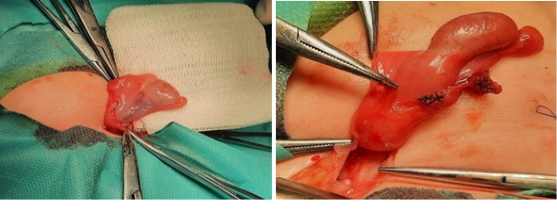
Surgical management was undertaken. During exploration of the right inguinal canal, a hernial sac was identified, containing a testis-like structure, measuring approximately 2 cm. (Figure 1). The structure was reduced into the abdominal cavity, followed by herniotomy and anterior inguinal wall repair. Because of the intraoperative findings, a decision was made to proceed with surgical repair of the left-sided hernia. Exploration of the left inguinal canal revealed, in its distal third, a similar testis-like structure. (Figure 1). The structure was reduced within the abdominal cavity, and herniotomy with anterior inguinal canal wall repair was subsequently performed.
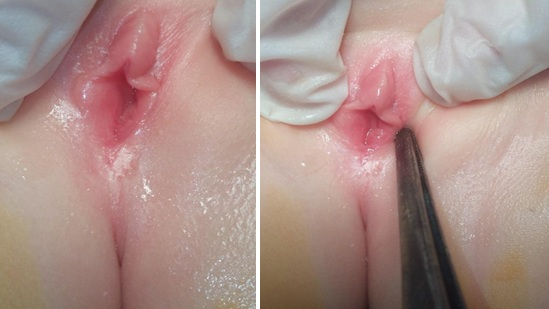
Examination of the external genitalia revealed age-appropriate labia majora and labia minora. (Figure 2) The hymenal ring and vaginal opening were absent. The postoperative period was uneventful. Following discharge, the patient was referred for karyotype analysis and multidisciplinary consultation; however, despite careful explanation of the child’s condition and detailed guidance regarding further diagnostic evaluation, the parents did not present the patient for subsequent follow-up.
3. Conclusion
This case illustrates the rare intraoperative diagnosis of Morris syndrome in early childhood during emergency repair of an incarcerated inguinal hernia. Awareness of androgen insensitivity syndrome is essential for pediatric surgeons, particularly when managing inguinal hernias in phenotypic females. Early recognition enables timely multidisciplinary management, informed discussions with the family, and appropriate planning of gonadectomy, thereby reducing the risk of malignant transformation of undescended testes. Reporting such cases contributes to the broader understanding of the variable presentations of AIS and underscores the importance of vigilance in atypical pediatric surgical presentations.
4. Discussion
This case underscores that Morris syndrome may present unexpectedly in early childhood, even during routine pediatric surgical procedures such as inguinal hernia repair. Phenotypic females with inguinal hernias should prompt consideration of disorders of sex development, including AIS, especially when imaging suggests ovarian structures. Intraoperative recognition allows surgeons to initiate appropriate multidisciplinary evaluation, guide parental counseling, and plan timely management of undescended testes to reduce malignancy risk. Reporting such rare early presentations expands awareness of the variable manifestations of AIS and reinforces the importance of vigilance in atypical pediatric surgical cases.
References
- Conn J, Gillam L, Conway GS. Revealing the diagnosis of androgen insensitivity syndrome in adulthood. BMJ. 2005 Sep 17;331(7517):628-30. doi: 10.1136/bmj.331.7517.628. PMID: 16166136; PMCID: PMC1215563.[CrossRef] [PubMed]
- Oakes MB, Eyvazzadeh AD, Quint E, Smith YR. Complete androgen insensitivity syndrome--a review. J Pediatr Adolesc Gynecol. 2008 Dec;21(6):305-10. doi: 10.1016/j.jpag.2007.09.006. PMID: 19064222.[CrossRef] [PubMed]
- Delli Paoli E, Di Chiano S, Paoli D, Lenzi A, Lombardo F, Pallotti F. Androgen insensitivity syndrome: a review. J Endocrinol Invest. 2023 Nov;46(11):2237-2245. doi: 10.1007/s40618-023-02127-y. Epub 2023 Jun 10. PMID: 37300628[CrossRef] [PubMed]
- Kravarusic D, Seguier-Lipszyc E, Feigin E, Nimri R, Nagelberg N, Freud E. Androgen insensitivity syndrome: risk of malignancy and timing of surgery in a paediatric and adolescent population. Afr J Paediatr Surg. 2011 May-Aug;8(2):194-8. doi: 10.4103/0189-6725.86061. PMID: 22005364.[CrossRef] [PubMed]