
Abstract
Managing supply chains efficiently has become a major concern for organizations. One of the important factors to optimize in supply chain management is logistics. The advent of technology and the increase in data availability allow for the enhancement of the efficiency of logistics in a supply chain. This discussion focuses on the blending of analytics with innovation in logistics to improve the operations of a supply chain. An approach is presented on how predictive analytics can be used to improve logistics operations. In order to analyze big data in logistics effectively, an artificial intelligence computational technique, specifically deep learning, is employed. Two case studies are illustrated to demonstrate the practical employability of the proposed technique. This reveals the power and potential of using predictive analytics in logistics to project various KPI values ahead in the future based on the contemporary data from the logistics operations; sheds light on the innovative technique of employing deep learning through deep learning-based predictive analytics in logistics; suggests incorporating innovative techniques like deep learning with predictive analytics to develop an accurate forecasting technique in logistics and optimize operations and prevent disruption in the supply chain. The network of supply chains has become more complex, necessitating the need for the latest technological advancements. The sectors that have gained a fair amount of attention for the application of technology to optimize their operations are manufacturing, healthcare, aerospace, and the automotive industry. A little attention has been diverted to the logistics sector; many describe how analytics and artificial intelligence can be used in the logistics sector to achieve higher optimization. Currently, significant research has been done in optimizing logistics operations. Nevertheless, with the explosive volume of historical data being produced by the logistics operations of an organization, there is a great opportunity to learn valuable insights from the data accumulated over time for more long-term strategic planning. To develop the logistics operations in an organization, the use of historical data is essential to understand the trends in the operations. For example, regular maintenance planning and resource allocation based on trends are long-term activities that will not affect logistics operations immediately but can affect the business’s strategic planning in the long run. A predictive analysis technique employed on historical data of logistics can narrow down conclusions based on the future trends of logistics operations. Thus, the technique can be used to prevent the disruption of the supply chain.
1. Introduction
Supply chain management (SCM) and logistics are facing different challenges due to globalization, which gives rise to growing supply chain complexity and management issues. As a result, logistic processes are becoming more complex, leading to the necessity of managing the supply chain processes in a more efficient and streamlined way by multimodal and intermodal transport solutions, with sophisticated and advanced real-time planning and scheduling methodologies. The ability to leverage predictive analytical insights within the supply chain can lead to new strategies for direct improvement. Different predictive models such as time series, artificial neural networks, or combined methods are employed in the supply chain management literature. However, one of the key challenges in the world of logistics is the ability to keep up with the sheer amount of data being reported. Integrating the potential capabilities of big data with the advanced predictive computational techniques of deep learning in logistics for real-time decisions is still in its infancy. Therefore, in this paper, we are seeking logistic network solutions for connecting real-time data with deep learning, beyond prescriptive analytics in logistics.
Clear evidence of this application of deep learning to logistics and supply chain management is almost non-existent in the literature. That said, already at this stage, it is worth pointing out the most striking gap observed in the current research with regard to the above discussion: comprehensive coverage of deep learning capabilities within logistics is still missing. There are some recent papers in this field. However, it needs to be noted that a comprehensive overview that integrates possible contributions of predictive analytics in the context of supply chain and logistics optimization, and the deep learning potentials on the other side, and tries to propose a roadmap for future research of such systems is even harder to detect in the current state of the research [1].
1.1. Background and Significance
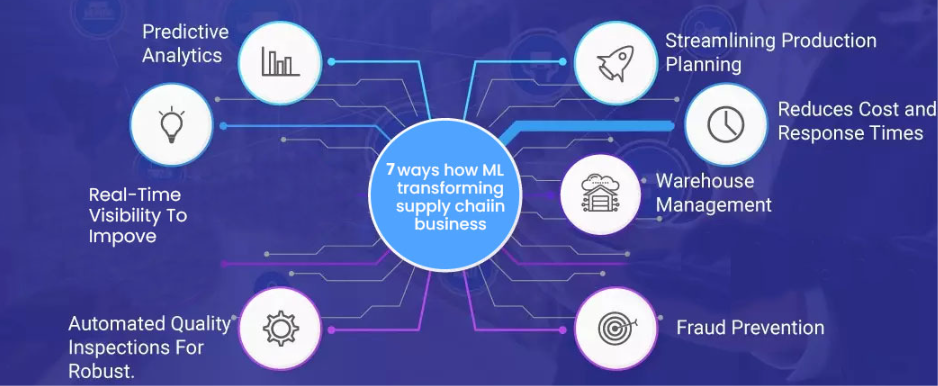
Supply chain management (SCM) involves logistics and logistics optimization and is an important area of study in artificial intelligence (AI). Logistic optimization aims to facilitate better decision-making for the distribution of goods from source to consumer effectively and efficiently. With the advent of digitization, distinct technologies have been developed, such as predictive modeling and analytics, more vehicles, and more convenient routes; automatic supply chain correction and automated kitting solutions have been put into use, and so on. Traditional logistics can no longer meet the demands of quickly getting shipments from point A to point B. It is imperative to use predictive analytics and deep learning to improve the efficiency of the pick-to-people process, for example.
Predictive modeling helps forecast when and where an order will come in and in what quantity. It might be that a pattern in the order has been recognized and products suggested to the person reading the purchase order information. Demand prediction from the distribution center to the store improved by using deep learning. Deep learning is also useful when patterns are multilayered characteristics that are identified. Deep neural networks are quite good at recognizing cat photos, for instance, with a high accuracy. There are many subfields in deep learning, the application of which in some paragraphs above indicates the technologies that are of importance.
1.2. Research Objectives
This study aims to explore predictive analytics and deep learning for logistics optimization. It generates two research questions: (1) How does deep learning integrate with predictive analytics in order to optimize logistics, and (2) In what future research areas could these two technologies be further integrated into real-world logistics optimization? To identify objectives, we turn our focus to sought-after research outcomes by summarizing the requirements and complexities in contemporary supply chain management. More specifically, logistics plays a significant role in allowing efficient management of the sales and distribution of industrial goods and consumer products. The task of logistics management is to lower the expenses of the system. This study attempts to hash out methodological aspects of, and practical suggestions for, a framework that integrates predictive analytics with deep learning in logistics optimization [2].
The key to solving the aforementioned question lies in a study of integrated prediction methods. There are several possibilities for integrating predictive analytics with deep learning, including the possibility of integrating them with technologies traditionally used at the beginning of the optimization process. This research will use supply chain and logistics predictive models to identify potential requirements for the articulation of interesting integrated predictive techniques aligned with deep learning in real system operations. After identifying these requirements, we draw a roadmap for future research areas. The study’s significant contributions are: the revelation of objectives; insight into the business side; results of delivered performance; guidance in smart investment policies; and justification for adopting and further upgrading the AI-enabled tool.
2. Predictive Analytics in Supply Chain Management
Predictive analytics has become pivotal in health checks, logistics, and supply chain management for improving operational excellence. In logistics and supply chain management applications, collecting data from diverse sources and processing such data optimally are still major challenges. Accessing and accurately analyzing this big data is essential for making operational improvements by logistics and supply chain managers. Predictive analytics, a data analysis concept that involves forecasting future events using big data, typically allows algorithms to forecast future trends and events and facilitate core systems reacting proactively to such forecasts. Predictive analytics are based on the idea that data can be collected from a variety of data sources, analyzed, and used to predict trends and behavior, which typically allows organizations to operationalize and improve their decision-making processes. Predictive analytics is the present trend of demand forecasting and inventory management in supply chain logistics and transportation. Supply chain decisions can be made with high confidence using predictive analytics-based future forecasts. Many methodologies and methods such as time series analysis, association rules, classification and regression trees, the Random Forest method, and deep learning tools are being used in predictive analytics. Predictive analytics focus on forecasts of future events. These forecasts enable the logistics operations manager to receive intimation in advance of impending disruptions, customer demands, shortages, and machine or process failures, indicating what could occur in the future. Sharing cargo forecasts with carriers will help distribution centers to pre-plan the storage and movement of cargo. Similar logistics and warehousing managing agencies rely on continuous reduction in transportation costs through predictive tools that forecast the off-peak timings for the cheapest truck charges.
Equation 1: Deep Learning for Demand Forecasting (using Neural Networks)
2.1. Definition and Concepts
Predictive analytics is a technique of predictive modeling that is based on finding relationships between different independent variables inside a database. It is used to make predictions on a particular result of a dependent variable. Predictive analytics is commonly used in supply chain planning and logistics optimization. In demand forecasting, a subset of supply chain management, predictive analytics can be used to help managers predict successive scenarios of items and products in the supply chain from several market and high-dimensional data. Analytics is generally organized into three types: descriptive analytics, predictive analytics, and prescriptive analytics. Descriptive analytics is used to describe data from various observations made. The purpose of predictive analytics is to predict or estimate certain conditions from historical data. Prescriptive analytics is used to recommend the best actions in a particular scenario. In conclusion, predictive and descriptive analytics are used to analyze historical data and summarize certain historical data. In the business world, predictive analytics is often applied to estimate demand and is usually used in sales and operations planning. Predictive analytics or predictive modeling makes judgments or future predictions based on historical or present data. Although company data from CRM and ERP systems can be arbitrarily large, its nature can be noise-prone, incomplete, varying, and unstructured. One of the most important aspects of predictive analytics is indeed the quality of the data. The collected data would ensure the efficiency and effectiveness of its predictions. Companies mainly undertake noise reduction, missing data correction, and data standardization. There are several techniques for predictive analysis, specifically time-series seasonal decomposition, regression analysis, statistical hypothesis testing, and machine learning methods. Techniques for machine learning, particularly deep learning, have been broadly used in making predictions in large-scale datasets with various prediction types such as regression or classification. Since the current condition of data is vast and rapidly growing, the way managers create tools or channels to gain insights for operational strategies should be relevant to it. We primarily focus on predictive analytics in transportation and logistics planning for demand forecasting, using the concept of recurrent neural networks as the predictive technique. Functional features are also called characteristics or attributes. Functional features have a significant impact on activities that can affect risk and operational performance. Regarding this, we briefly review the main functional features in terms of predictive analytics used in supply chain management [3].
2.2. Applications in Logistics Optimization
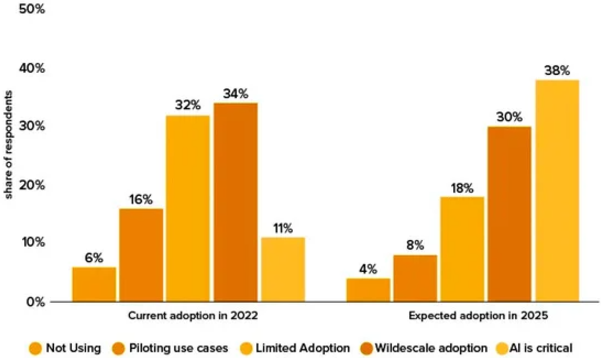
Logistics management is a key field of application of predictive analytics, as decisions need to be made continuously in supply chain operations that have a direct influence on cost and service provision. Predictive models are employed in nearly any planning module of logistics services in today's supply chain management IT systems. With modern data science methods like deep learning, predictive models penetrate deeper into the operational level within warehouse management systems and transport management systems. This trend is also enforced by the further falling costs in the IT domain. This shift calls for considerably more data-driven decision-making based on predictive insights enabling improved decision-making with respect to the supply chain operations of an organization, the basis of finding cost savings and efficiency improvements [4].
The applications of predictive analytics are manifold. Some of the domains in logistics that can be supported by predictive analytics include demand forecasting, route optimization, inventory optimization, procurement, predictive pricing in transport, predictive maintenance, and production planning. The field of demand forecasting is intensively researched, and successful applications have been made in various industries. Other fields also show a practical applicability in logistics. For example, a company saves 5 million US dollars per year using route optimization. Another company uses predictive analytics to save 25% of its previous spending on maintenance. A logistics provider was able to cut down 8% of the miles driven using predictive analytics in due-time delivery.
3. Deep Learning in Supply Chain Management
Deep learning is a subdivision of artificial intelligence, which is a transition from traditional artificial algorithms and is motivated by the structure and function of the human brain, called an artificial neuron. Deep learning can use unsupervised learning to discover features from raw data. This can be very useful if the task is simpler to combine features from raw data than it is to generate new instances of features that can be detected. This is one of the reasons the application of deep learning and generative modeling has transformed predictive analytics. Thus, deep learning is not a specific algorithm but a general concept in machine learning. Deep learning copes with the volume, velocities, and varieties of big data, with patterns characterized by its depth and breadth. These are the main reasons deep learning is preferred for predictive analytics [5].
A lot of transformations have taken place in deep learning, especially after 2012, because of its application in big data architecture. For this, deep learning provides logistics and supply chain management the ability to have a better predictive capability, be a trusted adviser, uncover patterns, and better predict customer orders. Logistics and supply chain management have very high opportunities in the application of deep learning, particularly in predictive analytics for inventory management and logistics operations. This is because logistics operations are constantly in touch with the various big data sources. That area can be developed if deep learning techniques are used at various levels of supply chain management. However, in recent years, only a few studies on the application of deep learning in supply chain management have been published, rather than the application of deep learning to predict complex patterns.
Equation 2: Route Optimization in Logistics
3.1. Introduction to Deep Learning
This subsection introduces the concept of deep learning, aiming to provide a foundational understanding of its mechanisms and relevance. It differentiates deep learning from other machine learning methods, clarifying its uniquely expansive approach to data analysis through neural networks. By detailing how these networks operate on both the input and the output side, the overall architecture of deep learning models is addressed, including individual layers and neurons. Importantly, this subsection acknowledges the necessity of large and diverse datasets for training deep learning models, consequently discussing some of the methodologies employed for optimization. It emphasizes real-world applications of deep learning in various industries, demonstrating the method’s multifaceted utility, before considering some of the implications of recent advancements in logistics. Overall, this part represents a surface-level understanding of deep learning, directing the reader toward considerations of predictive analytics in a more detailed light [6].
Deep learning should not be confused with regular machine learning or traditional statistics. Machine learning is already a broadening field within statistics. It becomes very complex. Also, deep learning is the only machine learning approach that proposes and creates a model that is focused and constructed in the form of a network. This network consists of a chain of layers. Each layer consists of some neurons. Modern deep learning often involves tens or hundreds of layers. These models are trained to understand data well when the scale of the data is enlarged. For deep learning, if the number of input features is curved, a greater number of hidden layers can be set. Data-driven models in deep learning can learn from a very large number of input parameters and can generate optimal solutions. However, the more data that are used to make the model more complex, the greater the possibility of overfitting will occur.
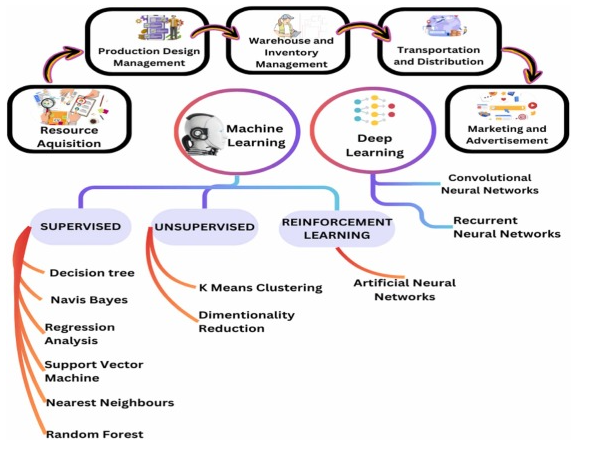
Deep learning has been applied in various fields including finance and banking, social media, e-commerce, education and e-learning, weather, and climate directly. In transportation and logistics, it has been used for predicting congestion in urban traffic. Deep learning technology is moving very fast. New applications or algorithms keep emerging; they can have profound implications for various decision-support problems in supply chain management, particularly in logistics. Deep learning represents a distinct approach within the broader field of machine learning, leveraging neural networks to model complex relationships within large datasets. Unlike traditional machine learning methods that often rely on hand-crafted features, deep learning automatically discovers patterns through its multi-layered architecture, where each layer consists of interconnected neurons that process data at increasing levels of abstraction. This network structure allows deep learning models to handle vast amounts of input features, making them particularly effective for tasks with high-dimensional data, such as image recognition, natural language processing, and predictive analytics. However, as models grow more complex, they become susceptible to overfitting, especially when trained on smaller or less diverse datasets. Despite these challenges, deep learning has found widespread application across industries, from finance and e-commerce to transportation and logistics. In logistics, for example, deep learning is used to predict traffic congestion, optimize delivery routes, and improve supply chain efficiency. As research in deep learning accelerates, the technology continues to drive innovations that have significant implications for decision-making and problem-solving in sectors like logistics and supply chain management [7].
3.2. Applications in Logistics Optimization
Supply chain management is an integral aspect of business operations. With the growing complexity of global market dynamics, logistics optimization is of particular interest to researchers and industry practitioners alike. The application of predictive analytics for logistics optimization, particularly deep learning models, has the potential to bring significant improvements and have a large-scale transformative effect on the industry. In practice, deep learning models are implemented across different levels of the logistics operation. Testing deep learning models for demand forecasting in logistics operations has shown significant improvements over classical time-series methods. Moreover, it is argued that deep learning models are more efficient for demand forecasting in e-commerce supply chain networks. Predictive maintenance of rail infrastructure has significant potential in terms of cost reduction, and modeling train partitioning for asset buffering through predictive maintenance is also explored.
Developing a multi-horizon model for routing optimization is another area of focus. Routing optimization with multiple destinations differs from demand forecasting and predictive maintenance in that dynamic routing optimizes during the logistics operation for a time-sensitive objective at each point in time. Nonetheless, all of the above-mentioned applications contribute to a general increase in efficiency in logistics operations, leading to cost savings and providing better in-time service quality to the end customers. Deep learning models are capable of handling unstructured and semi-structured data, which aligns with the research questions aiming to consider a holistic approach. Demonstrations of how deep learning models can analyze data on multiple levels are also present. The integration of data between infrastructure and train systems, which requires large computational modeling efforts, is a crucial obstacle for predictive maintenance concepts to overcome prior to implementation. Hence, deep learning techniques can be efficient in logistics operations, as they are expected to directly optimize a logistics Key Performance Indicator by leveraging operational data processed in real-time.
Deep learning models have been shown to have significant advantages in capturing complex patterns in data by applying a complex decision-making process in a progressive manner. Operational data in the logistics context is particularly affected by a demand-side aspect and several network attributes, including delivery lead time and route constraints. It is argued that deep learning models are more effective at capturing those complex interactions as compared to integer linear programming or rule-based systems. In general, deep learning models are more efficient in the optimization of ever-changing systems. The computational time required for each operation is relevant for a real-time analysis and decision process. In the case of optimization models for a system with multiple decision variables, a small computational time is essential for informing data-driven decisions. The analysis above indicates that deep learning models can contribute to a new technological generation, aligned with real-time analysis, for the investigation of value generation in the logistics industry. It is a disruptive trend, as it allows us to consider a move away from traditional ways of analysis characterized by partially structured linear models to a completely unstructured data learning approach while maintaining higher accuracy in the forecast of logistics operations [7].
4. Integration of Predictive Analytics and Deep Learning
To examine the effectiveness of the synergy of predictive analytics and deep learning, the ability to use both advanced predictive analytics systems and advanced deep learning technologies to analyze various operational data in a logistics management context is reviewed. Predictive analytics and deep learning are highly complementary technologies that, when integrated, provide deeper insight and more accurate predictions for logistics optimization. While traditional predictive analytics methods can generate forecasts, they are unable to uncover previously hidden patterns in data. Additionally, deep learning methods are capable of learning from unstructured and extensive data, efficiently filling the gap generated by traditional predictive analytics methods. The integration of predictive analytics and deep learning may help to improve forecasting accuracy, which can lead to greater operational efficiency and cost savings [8].
However, the integration of predictive analytics and deep learning faces several challenges, such as performance trade-offs and compatibility with operational data. As a result, many companies are still relying on traditional heuristics to guide their logistics operations. Next, an example of predictive analytics integration and deep learning is supplied to better reflect the current logistics situation. In predictive analysis with deep learning, the focus is on predicting visitors traveling from a diversity of origins. This example shows the closeness of the predictive modeling field and the benefits of employing techniques for complementary predictions. There is currently little research that integrates predictive analytics and machine learning. Systematically examining the advanced modeling approaches within and across distinct modeling domains improves solution quality in supply chain management. The results suggest that both data analytics and deep learning need to be challenged to significantly advance current transport systems.
4.1. Benefits and Challenges
In recent literature and online discussions, there are several benefits associated with the integration of predictive analytics and deep learning in logistics. Predictive analytics together with unsupervised or semi-supervised deep learning techniques can achieve better results in computer vision and language translation than using only predictive models on historical data. Key benefits that technology market experts and consultants see when logistic service providers or others integrate predictive analytics and deep learning are: 1) enhanced decision-making, 2) real-time insights, and 3) helping to drive automation of basic, yet time-consuming, data management functions. The mention of automation can also imply that questions on how to actually implement this integration are not just about using the best technology for decision-making, but more for strategy purposes: there needs to be an implementation that allows for automated insights to enable different business behaviors faster and cheaper.
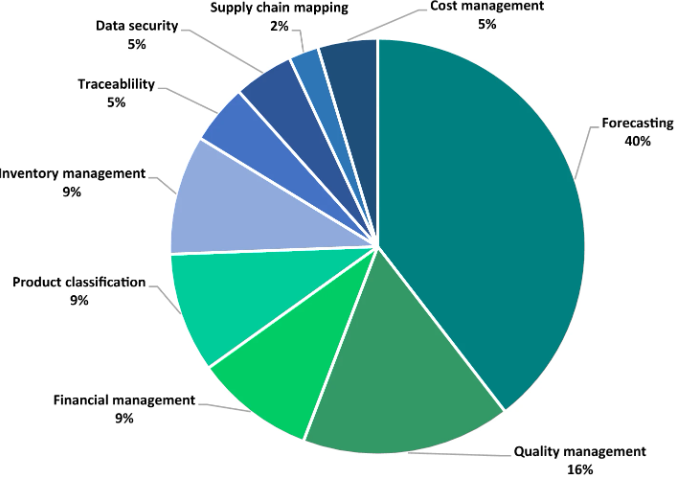
Overall, several sources, software vendors, technology consultants, and training resources also suggest possible capital and operational cost savings from logistics and supply chain optimization when deep learning and predictive analytics are integrated. There are, however, a number of challenges when applying deeper predictive analytics to logistics. In the supply chain logistics and pharma logistics area, only about one-third or lower of respondents in two recent respective surveys either provide or use software or spreadsheets for predictive analytics. Where they do not, significant disadvantages are perceived. Key challenges involve, inter alia: 1) the need to continuously manage and update relevant and complex freight, environmental monitoring, and delivery time data, 2) upskilling some logistics human resources, and 3) evaluating the business case for investment in deep learning and predictive analytics computing power and training when operational, financial, and strategic inputs and outputs are sometimes inconclusive. This can also depend on the level of maturity with other complementary technologies, including for data collection and analysis, as well as driver algorithmic acceptance and willingness by organizational change managers to continuously train staff to regularly up their game [9].
Equation 3: Demand Satisfaction
5. Case Studies and Success Stories
The stories below provide insight into how organizations can use predictive analytics and deep learning to optimize logistics and supply chain operations. Not only do they discuss goals, methods, and outcomes, but they also consider the factors that helped each initiative succeed. They all highlight the value of a supportive leadership team and an environment that values ongoing learning and innovation.
Using machine learning has not only produced a more efficient and comprehensive allocation plan but has also enabled ERIKS to react more rapidly to a turning point. The last two years have demonstrated how important it is to have the agility and speed to adapt our supply chain. NLMK is using predictive analytics built on a dedicated high-performance computing platform to tackle the complexity in every step of its logistics and supply chain. Overseeing the import of half a million tonnes of iron ore between Sweden and Belgium is just the beginning of a complex supply chain. Around 10% of our transported ore was value-added through process and quality innovation. Running fully automatically over dedicated high-performance computing began in 2020.
We aim to gain agility and our logistic providers an upper hand in our balancing and providing shipping. We use a forecast rate for a week every day, and every hour, over an optimization window as narrow as just a couple of hours. Their prediction provides up to a 200% better prediction for shipping rates compared with a three-week vista and is already finding 20% better potential shipping, even inside that narrow optimization window on the complex route between the Port of Oxelösund in Sweden and the coastal location of NLMK La Louviere in Belgium [10].
6. Conclusion
This research discusses that predictive analytics and deep learning extend the trajectory of past knowledge by investigating demographic trends as well as logistics and supply chain decisions in an integrated environment. This trajectory investigates the impact of predictive models and deep learning capabilities on logistics operations in the end. It is concluded that the advances in predictive and deep learning logistics operations have the potential to transform the constrained operations of logistics, moving and sorting, into an unconstrained wave that adapts and reacts to the circumstances. Supply chains of the future will take advantage of these advanced technologies by blending the digital and physical worlds to investigate how deep learning models can predict the behavior of digital twins and deliver actionable insights for effective decision-making. From a technology management perspective, we see predictive analytics as an operating platform and an integration layer. The future supply chain management system needs systems that help one organization see how their operation is being impacted by other organizations in the supply chain and see this information in real time.
As a practical recommendation for logistics optimization in a supply chain, the integrated use of deep learning and predictive analytics definitely offers the increased efficiency required for competitive advantage realization. Following the technology-push nature of advanced technology research, practitioners need to be proactive learners and integrators in the area of deep learning; that is, a rapidly evolving technology that might become strategic in the end. In terms of research contribution, the integration of predictive analytics and deep learning for logistics optimization in a supply chain is not widely known. Moreover, practitioners need critical thinking evaluations about the challenges for a better appreciation of potential returns. Non-expert practitioners will benefit from understanding the management gap and lead time to realize the potential benefits of this integration.
To be critical, however, the application of deep learning might seem premature given the availability of datasets or the amount of information that could be input. Despite the data streaming potential, there is therefore a need for further theoretical development. This paper shows the urgency to use the two technologies in an integrated way. Supply chain integrators are recommended to make efficient investments in this area. However, they should first and foremost be proactive and conduct critical experiments to understand the challenges and returns of an integrated use of the two. Consequently, some restrictions or behaviors might cause changes in specific operations or decision areas. Once the benefits of using deep learning for production or logistics operation decision-making have been realized, continuous real-time data streaming can be very useful in practice. The industry will no longer be an unidentified territory. The huge datasets and digital twins will call for praxis in this regard [11].
6.1. Future Trends
The digitalization of logistics operations in the field of supply chain management is rapidly shaping and influencing the logistics landscape. It is predicted that future operations will not only see the importance of a high level of visibility in logistics, thanks to technologies adopted and developed but will also increase the stability of logistics operations. Research and practice predict that predictive analytics will integrate lessons from past events in their modeling and processing, adopting deep learning, and thus employing experimental knowledge in their models. Artificial intelligence (AI) will, in turn, take this to processing, initiatives, and solutions not previously used. Organizations and companies will increase the ways that they can analyze, visualize, and simulate realistic outcomes of managerial decisions at various levels to allow managers to make better-informed decisions. Currently, the understanding of future trends related to predictive analytics and deep learning for logistics optimization and monitoring in supply chain management shows the changing operations landscape.
In addition, a number of changes in technology and methodologies that practitioners in logistics and supply chain management should take into account right now. At the forefront of some of the more curious trends are the synthesis methods and trends in predictive analytics allowing insights into future logistics operations. It has been explicitly identified that machine learning is considered a form of predictive analytics, and it extends the horizons of interacting with AI. Algorithms considered predictive analytics examine concrete past data to identify what occurred in various stages of the value chain, and to what degree, and to store this knowledge in a mathematical or computational model, where it is distilled to facilitate the predictions. Machine learning can also learn the patterns by facilitating event interrelations that are not well understood causally. Further, it was also claimed that supply chains are more amenable to machine learning and use case analysis in terms of explaining how to perform an action leading to a desired outcome. Decreasing the distance, time, and thinking from the processing system is also under the magnifying glass, offering organizations incredible capabilities to push solutions to clients before they ask and increasing the speed of operations by adopting real-time decision-making tools and techniques. The importance of learning will be a process that must be conducted continuously. Additionally, it explicitly mentions that the person or agent who does not invest in skills development cannot be deemed an interlocutor by AI. Furthermore, new methods that have been largely unexplored will come within reach, such as quantum optimization. In closing, the sustainability of the environment can also be optimized through the increasingly greening of the logistics operational processes. The possibility of green logistics is offered by the potential to promote this concept and, through the withdrawal or further emissions reduction, to simplify supply chain logistics constraints. This, along with the logistics needs, will enhance the capacity of people to adopt more sensible, merciful operations. It is estimated that at least in the fifth position for logistics trends, a coalition will invest in new real-time indicators of logistic risks and the internet of data to produce, synthesize, and monitor predictive analytics of the capacity. The third and last real-time analytics systems are also valued. Enhanced real-time and estimated risk models adopting deep reinforcement learning are another trend. Using reinforcement learning in artificial intelligence/machine learning models is an emerging trend [12].
References
- Danda, R. R. (2021). Sustainability in Construction: Exploring the Development of Eco-Friendly Equipment. In Journal of Artificial Intelligence and Big Data (Vol. 1, Issue 1, pp. 100–110). Science Publications (SCIPUB). https://doi.org/10.31586/jaibd.2021.1153[CrossRef]
- Nampalli, R. C. R. (2021). Leveraging AI in Urban Traffic Management: Addressing Congestion and Traffic Flow with Intelligent Systems. In Journal of Artificial Intelligence and Big Data (Vol. 1, Issue 1, pp. 86–99). Science Publications (SCIPUB). https://doi.org/10.31586/jaibd.2021.1151[CrossRef]
- Syed, S. (2021). Financial Implications of Predictive Analytics in Vehicle Manufacturing: Insights for Budget Optimization and Resource Allocation. Journal of Artificial Intelligence and Big Data, 1(1), 111–125. Retrieved from https://www.scipublications.com/journal/index.php/jaibd/article/view/1154[CrossRef]
- Eswar Prasad Galla.et.al. (2021). Big Data And AI Innovations In Biometric Authentication For Secure Digital Transactions Educational Administration: Theory and Practice, 27(4), 1228 –1236Doi: 10.53555/kuey.v27i4.7592[CrossRef]
- Danda, R. R. (2020). Predictive Modeling with AI and ML for Small Business Health Plans: Improving Employee Health Outcomes and Reducing Costs. In International Journal of Engineering and Computer Science (Vol. 9, Issue 12, pp. 25275–25288). Valley International. https://doi.org/10.18535/ijecs/v9i12.4572[CrossRef]
- Syed, S., & Nampalli, R. C. R. (2021). Empowering Users: The Role Of AI In Enhancing Self-Service BI For Data-Driven Decision Making. In Educational Administration: Theory and Practice. Green Publication. https://doi.org/10.53555/kuey.v27i4.8105[CrossRef]
- Syed, S. (2019). Roadmap for Enterprise Information Management: Strategies and Approaches in 2019. International Journal of Engineering and Computer Science, 8(12), 24907–24917. https://doi.org/10.18535/ijecs/v8i12.4415[CrossRef]
- Janardhana Rao Sunkara, Sanjay Ramdas Bauskar, Chandrakanth Rao Madhavaram, Eswar Prasad Galla, Hemanth Kumar Gollangi, Data-Driven Management: The Impact of Visualization Tools on Business Performance, International Journal of Management (IJM), 12(3), 2021, pp. 1290-1298. https://iaeme.com/Home/issue/IJM?Volume=12&Issue=3
- Syed, S., & Nampalli, R. C. R. (2020). Data Lineage Strategies – A Modernized View. In Educational Administration: Theory and Practice. Green Publication. https://doi.org/10.53555/kuey.v26i4.8104[CrossRef]
- Gagan Kumar Patra, Chandrababu Kuraku, Siddharth Konkimalla, Venkata Nagesh Boddapati, Manikanth Sarisa, An Analysis and Prediction of Health Insurance Costs Using Machine Learning-Based Regressor Techniques, International Journal of Computer Engineering and Technology (IJCET) 12(3), 2021, pp. 102-113. https://iaeme.com/Home/issue/IJCET?Volume=12&Issue=3
- Venkata Nagesh Boddapati, Eswar Prasad Galla, Janardhana Rao Sunkara, Sanjay Ramdas Bauskar, Gagan Kumar Patra, Chandrababu Kuraku, Chandrakanth Rao Madhavaram, 2021. "Harnessing the Power of Big Data: The Evolution of AI and Machine Learning in Modern Times", ESP Journal of Engineering & Technology Advancements, 1(2): 134-146.
- Mohit Surender Reddy, Manikanth Sarisa, Siddharth Konkimalla, Sanjay Ramdas Bauskar, Hemanth Kumar Gollangi, Eswar Prasad Galla, Shravan Kumar Rajaram, 2021. "Predicting tomorrow’s Ailments: How AI/ML Is Transforming Disease Forecasting", ESP Journal