

This study aimed to evaluate the Social Studies Curriculum for Senior High Schools in Ghana to determine whether the subject has attained its goal(s) or not, using Stake’s Countenance Evaluation Model. The study took place in the Asante Akim North District. The population for study were all Social Studies teachers and students in the district. The multi-stage sampling technique was adopted for the study and the sample size was 120, made up of 100 students and 20 teachers. The concurrent mixed method approach was adopted. The main instruments used for collecting data were questionnaires, interviews (focus group and unstructured interview), observation and documentary analysis. Quantitative data were tabulated, organised, analysed and interpreted to draw sound conclusions and generalisations. The data were presented in the form of tables and percentages. Words were used to interpret the tables and percentages for easy understanding. The qualitative data responses were described and explained in the form of themes. Sometimes responses were quoted verbatim to authenticate claims made. The study looked at the congruence between what was intended to occur and what was observed before and during the implementation of the curriculum in the Asante Akim North District. On the transactions, it was revealed that teachers in the district communicate the problem the topic seeks to address and the specific objectives to the learners during instruction. Also, teachers varied their teaching methods, techniques and strategies. However, teachers failed to take students out on field trips. Also, they failed to use video documentaries to deliver their lessons inhibiting students’ creativity as they are denied the opportunity to explore and get first-hand information to build up knowledge and develop the needed attitudes and values. From the findings, it is therefore recommended that the National Council for Curriculum and Assessment should increase the time allotted to the teaching of Social Studies at the SHS level from 3-periods of 40 minutes a week to 5-periods of 40 minutes a week to give teachers and learners ample time to discuss, debate, digest and solve problems during instructional hours to enable the goal of the subject attained.
Congruence Between Intended and Observed Transactions in the Implementation of the Senior High School (SHS) Social Studies Curriculum in Ghana
December 17, 2023
February 25, 2024
March 18, 2024
May 03, 2024
This is an Open Access article, distributed under the terms of the Creative Commons Attribution 4.0 International License (http://creativecommons.org/licenses/by/4.0/), which permits unrestricted use, distribution and reproduction in any medium or format, provided the original work is properly cited.
Abstract
1. Introduction
The primary purpose or goal of Social Studies is to produce well-informed, concerned, participatory, responsible and problem-solving citizens who are willing to contribute to societal development and nation-building [1, 2, 3]. However, whether this goal has been achieved or not, since the introduction of the Social Studies curriculum in the country and more specifically in the Asante Akim North District is what this study seeks to find. Studies have also shown that “the successful implementation of the Social Studies curriculum resides in the bosom of the teachers and that teachers’ conception of a subject or a curriculum would shape their perceived curriculum and therefore their implemented curriculum” [4, 5, 6]. But as to whether teachers who teach Social Studies in the Senior High Schools have conceptualized the curriculum content and possess the right pedagogical skills and whether they use the knowledge and skills acquired from their training to ensure the realization of the subject goal, is the gap this study seeks to fill.
It is quite argued that Social Studies lessons have been tagged as boring and less important by the majority of students [4, 7] due to poor instruction or monotonous way of handling the subject by teachers through the use of textbooks [8, 9] instead of the problem-solving method which has been proven by studies to be the best method for teaching social studies [10, 11] and the existence of out-of-field teachers in Social Studies Classroom [12, 13]. The researchers agree with this but want to go a step further with its impact on the learners who are the recipients of the programme through evaluation.
The issue stemmed from the fact that some headmasters/mistresses think every teacher can teach the subject so several untrained Social Studies teachers are handling the subject in almost all Senior High Schools in the country which confirms Eshun, Zuure, Brew, and Bordoh assertion that “there are several out-of-field teachers Social Studies in the country.” This has resulted in the poor teaching of the subject at the SHS level which has killed students’ interest in the subject [12]. This has often led to poor teaching and learning of Social Studies in our Ghanaian schools, especially at the Senior High School level due to inadequate knowledge [2, 14, 15, 16]. This is supported by Kumari when he bemoaned that, the teaching of Social Studies has suffered very much from poor teaching, especially at the elementary stage. He went on further to say that “it is in general held that anyone could teach Social Studies” [17]. All that is needed is a textbook and the ability to read, and truly this is the case in our Senior High Schools. The teaching of Social Studies has been restricted to the four walls of the classroom with most teachers teaching without any aid of teaching and learning materials which is in sharp contradiction to what Social Studies stands for.
In 1987 and 1998 educational reforms, the teaching of Social Studies was fully rolled out and implemented in the Junior High School (JHS) and Senior High School (SHS) curricula in Ghana. However, when the subject was incorporated into the Ghanaian school curricula, one thought our problems as a country were over, but contrary, social problems like armed robbery, sexual violence, drug abuse, corruption, poor sanitation, greed, political intolerance, examination leakages, indiscipline, indecent dressing and destruction of water bodies especially through galamsey activities have skyrocketed. The question then is, has Social Studies failed to achieve its goal or the subject has underachieved or is achieving its goal? This question can best be answered if empirical evidence is provided through an evaluation of the implementation of the Social Studies curriculum. Hence, this study sought to present empirical evidence on the attainment of Social Studies goals by involving some Senior High School students in the Asante Akim North District of Ghana.
Kirman argued that “Social Studies is not about the accumulation of selected facts for later recall but should aim to: produce a responsible person able to cope with change, capable of making reasonable decisions, who is an intelligent consumer and controller of science and technology, able to live with and appreciate human diversity, and support and defend human dignity.” [18]. Given this, the subject aimed at equipping the learner with the relevant knowledge, skills, positive attitudes and values to deal with personal and societal problems. The rationale for teaching the subject at the SHS level is to prepare the individual to fit into society by equipping him/her with knowledge about the culture and ways of life of their society, its problems, its values and its hopes for the future. To achieve this rationale, the general objectives of teaching the subject as spelt out in the 2010 Social Studies Teaching Syllabus are to: “Develop the ability to adapt to the developing and ever-changing Ghanaian society; Acquire positive attitudes and values towards individual and societal issues; Develop critical and analytical skills in assessing issues for objective decision-making; Develop national consciousness and unity; Use enquiry and problem-solving skills for solving personal and societal problems; and Become responsible citizens capable and willing to contribute to societal advancement” [19].
This implies that the teaching of Social Studies at Senior High Schools should be geared towards the attainment of these objectives and thus, it is envisaged that, students who passed through the Social Studies programme at the Senior High School level should develop and internalize the relevant knowledge, positive attitudes, values and skills to solve their problems and that of their communities to make the goal of Social Studies (producing informed, reasoned and participatory citizens) realized. However, there seems to be an upsurge in social problems such as indiscipline among the youth who are mostly products of Social Studies as well as the rife of corruption, greed, apathy, and disloyalty among others in the country which raise questions about whether the subject is achieving its goal or is failing to achieve its goal.
However, since the introduction of Social Studies as a school subject in Basic Schools in Ghana and subsequently the Senior High schools in 1998, not many studies have been conducted on the impact it is making on learners. The researcher has not sighted any study about the evaluation of the implementation of the subject in Ghana; as to whether it is achieving its intended goals and objectives. It is therefore important for a study that will focus on the attainment of the subject’s goals and objectives to be conducted to fill the gap in the literature as to whether the implementation of the Social Studies curriculum in Ghana is leading to the attainment of its objectives and goals.
The study was guided by this objective: assess the congruence between the transactions involved in the implementation of the Social Studies curriculum, as captured in the intents of the curriculum (syllabus) and as practised by teachers in the Asante Akim North District. The role of evaluation cannot be underestimated in the success of a programme, product or process. Therefore, a programme like Social Studies has to be evaluated to see its worth or otherwise in our educational system. This will contribute to knowledge by filling the gap created as a result of the paucity of evaluation of the implementation of the subject. The findings will also serve as valuable material to other researchers who will embark on similar studies within the country and outside the country as well as letting our leaders be aware of the indispensable role of evaluation in the development of education.
2. Literature Review and Theoretical Perspective
2.1. Stake’s Countenance Model
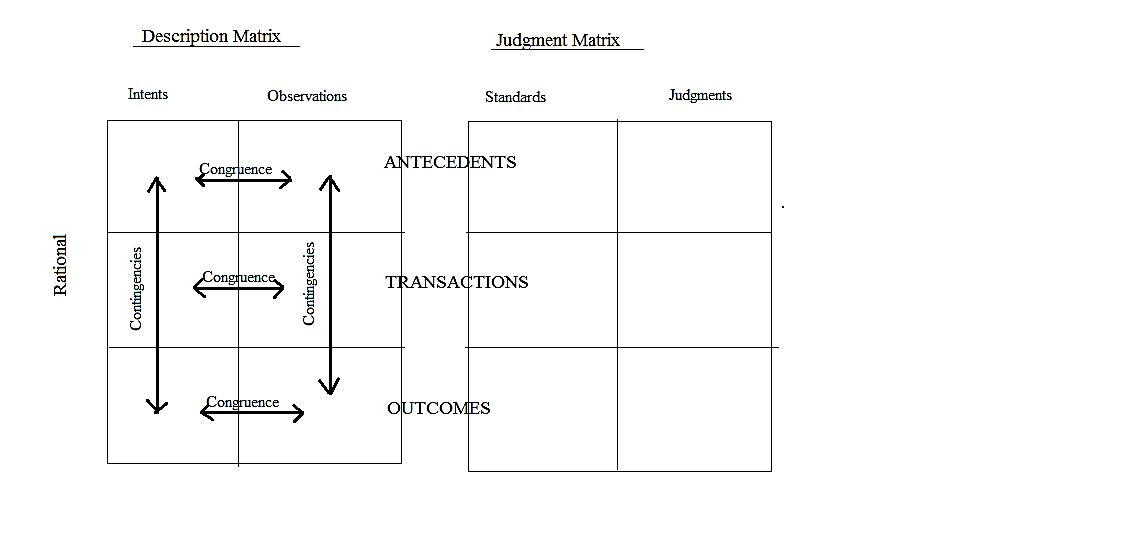
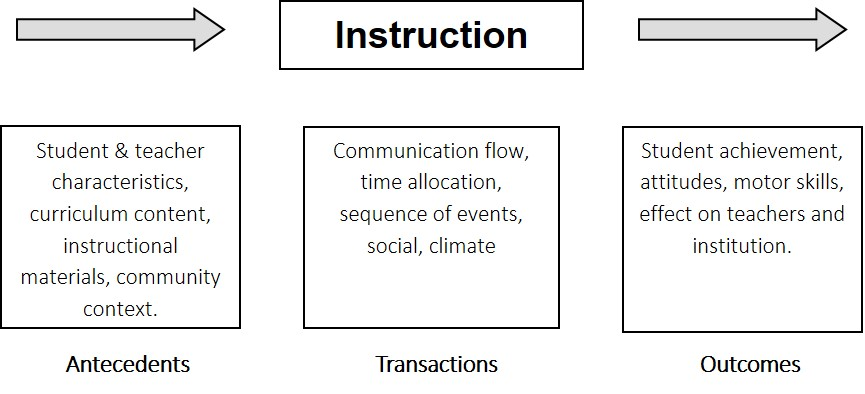
Concerning the research problem, the purpose and the research question, Stake’s Countenance Model of curriculum evaluation (1967) was adopted. The model suggests three phases of curriculum evaluation which are the antecedent phase, the transactions phase and the outcome phase. The antecedent phase talks about the existing conditions before the implementation of the curriculum, such as teachers' and students’ characteristics, curriculum content and instructional materials which relate to the outcomes. [20, 21]. The transactions phase constitutes the process of construction such as communication flow, time allocation, sequence of events and social climate which relate to the effects of the programme or the curriculum. Finally, the outcome phase is the effect of the programme or the curricula such as students’ achievements, attitudes and exhibited skills [20, 21]. Stake emphasises “two operations which are descriptions and judgments. Descriptions are divided according to whether they refer to what was intended or what was observed. Judgments are separated according to whether they refer to standards used in arriving at the judgments or the actual judgments.”
This is shown in Figures 1 and 2.
Stake’s model is useful for this study because it will provide the researcher with enough reliable evidence as to whether the Social Studies curriculum is achieving its goal or not. This is supported by Leong and Rethinasamy who opine that Stake’s Countenance Model “provides extensive evidence to support the success of a course by documenting plausible links between all components of the course programme” [22].
With this model, “the evaluator begins by looking at intents. Intents are planned-for conditions and behaviours, anticipated, and feared effects. The evaluator will next analyse information in the descriptive matrix by looking at congruence between intents and observations. Observations are descriptions of environmental events and consequences” [23]. Similarly “moving across the chart, the evaluator will then apply standards to the descriptive data to form judgments. The evaluator, however, also studies the relationships, or contingencies, between antecedents, transactions, and outcome variables. Outcomes are dependent on transactions and on antecedent conditions” [23, 24]
The study adopted this model to make good and accurate judgements of a curriculum like Social Studies. Bharvad asserts that “this model recognizes that multiple standards operate depending on the educational setting, instructor and student” [25]. “The recognition of logical contingency between the antecedents, transactions and outcomes is an important feature of this model. The evaluator makes judgements regarding the programme based on the congruency between the intended and the observed aspects of the curriculum” [25]
Stake's Countenance model of 1967 proposed by Stake, is further presented in Figure 2. Stake suggested “three phases of curriculum evaluation: the antecedent phase, the transaction phase and the outcome phase. The antecedent phase includes conditions existing before instruction that may relate to outcomes” [21]. The transaction phase constitutes the process of instruction while the outcome phase relates to the effects of the programme. This is indicated in Figure 2 which is an elaboration of Figure 1.
On this, Stake emphasises “the settings where learning occurs; teaching transactions, judgement data, holistic reporting, and assisting educators.” With the standards-based and responsive evaluation, Stake “emphasises two operations; descriptions and judgements” [26]. To him, “descriptions are divided according to whether they refer to what was intended or what was observed. Judgements are separated according to whether they refer to standards used in arriving at the judgements or to the actual judgements” [26].
It is therefore assumed that “unless structures are established to facilitate interaction and free-flowing discussions throughout the evaluation exercise: there is a danger that the benefits of evaluation will be eroded by unresolved conflict” [26]. “The implication is that there is no simple way of ensuring that such an agreement will be reached. Several experts have proposed different models describing how and what should be involved in evaluating a curriculum” [27]. That is the reason why “There does exist, however, a range of curriculum evaluation models, which can provide a useful structure for teachers wishing to make more effective their role as curriculum implementers and act as evaluators” [27]. Evaluating curriculum will help curriculum designers and implementers to form a common conception to work along the needs of society and how learners can be taught to realise societal aspirations. This is imperative because conception will shape the art of teaching practice in either a positive or negative manner. This process calls for effective teaching approaches, techniques and strategies in Social Studies.
2.2. Effective Methods and Techniques of Teaching Social Studies
On the effective teaching and learning of Social Studies, Schmidt suggested “three aspects of instruction - content, learning and outcomes - that need to be reconnected with the fundamental humanity of this discipline” [28]. This means that “aside from content, teachers need to learn methodology before going to class to teach. Techniques of teaching and assessment need to be taken seriously to reflect the subject objective of building positive attitudes. This can be acquired through observation, initiation and practice” [27].
“This implies that imbuing of appropriate skills should be given priority in pre-service preparation and in-service training as a support for the transition into full professional teacher status and survival of a novice teacher” [27].
“The way Social Studies is taught needs to get a makeover. So many Social Studies teachers only teach by lecturing and expect rote memorisation from their students “[27]. According to Vogler and Virtue, “This happens often because of the overwhelming amount of material contained in a typical Social Studies curriculum framework” (p. 55) [29]. The authors further stressed that “The teachers have so much information they are required to cover that they have trouble getting beyond the “just the facts” content coverage and into higher-level, critical thinking, especially because of the limited class time available” (p. 55) [29].
On this premise, Ayaaba et al assert that “It is commonplace in Ghana to see people from all walks of life and varied disciplines teaching Social Studies. This is due to the erroneous impression that social studies is a reading subject, and as such any teacher can read the Social Studies textbook and teach. This is most unfortunate. For social studies to engender effective citizenship, there is the need for competent, well-trained and qualified teachers to teach the subject at all levels of education, particularly at the SHS level which prepares the minds of the learners for advanced work at the tertiary level” [30].
The successful implementation of every curriculum including Social Studies relies heavily on the methods and techniques used by teachers who are agents of curriculum implementation. [31]. Aligning the goals and the general objectives of teaching Social Studies has been an issue in implementing the curriculum issues. According to Eshun, Bordoh and Opoku-Afriyie, “Most of the teachers who are the curriculum implementers have forgotten the subject's general objectives. Therefore, they teach the subject without any cognizance of the attainment of these objectives. Again, the absence of the needed teaching and learning resources for effective teaching and learning is another cause” (p. 399) [31]. As there is no distinct correct method to teach Social Studies, cognizance should be taken in aligning the objectives, content and ideal method of teaching to realise the reason for the subject introduction into the school curriculum. [31]. This indicates that techniques and strategies which fail with one group of students may be very helpful to another. Shaughnessy and Haladyna concluded that “it is the teacher who is key to what Social Studies will be for the student (p. 694)” [32]. The implication here is that there are varieties of methods and, techniques at the disposal of the Social Studies teacher however the selection of appropriate and suitable methods and techniques to enable the subject to realise its goal or purpose rests in the bosom of the teacher. Aggarwal supported this by quoting the Secondary Education Commission “Every teacher and educationist of experience knows that even the best curriculum and the most perfect syllabus remain dead unless quickened into life by the right methods of teaching and the right kind of teachers” (p. 91) [11]. He further went on to say that, even an unsatisfactory and unimaginative syllabus can be made interesting and significant sometimes by the gifted teacher who does not focus his mind on the subject matter to be taught or the information to be imparted but on his student's interest, aptitudes, reactions and response. This implies that the Social Studies teacher should acquire professional knowledge in the discipline to ensure effective teaching. It is against this background that “social studies teachers use more authentic forms of profile dimension assessment techniques such as portfolio and peer and self-assessment techniques during lesson delivery, to lay a strong foundation for the knowledge base for teaching and assessing the learners' learning outcomes” [13].
According to Ayaaba and Odumah, “a method of teaching refers to everything that a teacher does in the classroom during a lesson delivery. Thus, a teacher’s method of teaching refers to his or her overall approach to a lesson” [33]. On their part, Lawal and Oyeleye defined “method as an orderly arrangement of activities and systematic procedure of doing things” [34]. They further argue that “the method sets guidelines for the patterns of behaviour the teacher expects from the learners in class. The method is, therefore, a teacher’s approach to instruction on facts, concepts and generalizations, that is, a systematic way in which teachers approach their teaching.” However, Muyanda-Mutebi and Yiga-Matovu observed that “the term method or method of teaching is often used as a general term to cover everything a teacher does” [35]. This they “believe cannot be taken as one best way of describing the concept. Hence, a method was defined as “the way a teacher decides on what the students will learn.” They “perceive the method as a general choice between what learners will mainly be told and what they will largely find out by themselves.” This posits that “Social Studies teachers should hold it a duty to help students have better, more realistic ideas about the multiple realities of what constitutes Social Studies in the real world since they (teachers) influence what is taught” [36, 37]
Awoyemi also defines “a method of teaching Social Studies as the kind of exposure that the teacher subjects the students to achieve the goals of teaching” (p. 65) [38]. The author further sees a method of teaching Social Studies as the broad or general ways in which knowledge, content, skills, competencies, values and attitudes are inculcated in a teaching-learning setting [38]. Aggarwal opines that “a method is not merely a device adopted for communicating certain items of information to students and exclusively the concern of the teacher who is supposed to be at the giving end” (p. 92) [11]. He argued that “any method good or bad, links up the teacher and his pupils into an organic relationship with constant mutual interaction.”
Generally, there are two methods of teaching namely the “transmission or presentation method and the discovery, inquiry or problem-solving method” [33, 34]. The transmission or presentation method according to Ayaaba and Oduma is where the teacher tells the students what they need to know about the topic. The implication here is that learners are seen as recipients of pre-packaged information from the teacher. The teacher controls the instructional process, the content is delivered to the entire class and the teacher tends to emphasize factual knowledge.
“The problem-solving method on the other hand emphasizes situations where learners are challenged to examine, investigate, and explore subject matter. Here, the teacher or a teaching resource demands that the students think about questions or problems and try to work out the answers or solutions to the problems” [34]. In support Ayaaba and Oduma assert that “in the problem-solving method, the teacher does not tell the students what they need to know rather, students are challenged to examine investigate and explore an issue or a problem” [33]. They continued to say that the role of the teacher in this method is to serve as a guide, facilitator, resource person and consultant. Writers recommended that Social Studies teachers should have a structured plan of activities to be incorporated into their teaching to enable students to deal with problem-solving activities [39]. This implies that “for teachers making the purpose of teaching for improving the use of formative assessment real is to give their learners the capacity to assess themselves more often and effectively” [40, 41].
Based on the nature and the goal of Social Studies the researchers believe this method of teaching is consistent with the nature of Social Studies hence, the preferred method for the teaching and learning of Social Studies at the SHS level of education if only we want the subject to achieve its goal of producing concerned, reflective and participatory citizens. “To achieve functional education, the learner needs to be exposed to practical tasks and provided with ample opportunities to think reflectively, scientifically, and creatively” [10]. Van Sledright clarified “The common preoccupation with having students commit one fact after another to memory based on textbook recitations and lectures does little to build the student's capacity to think” [42].
At this time, “many institutions are moving towards problem-based learning as a solution to producing graduates who are creative and can think critically, and analytically, and solve problems. Since knowledge is no longer an end but a means to creating better problem solvers and encouraging lifelong learning. Problem-based learning is becoming increasingly popular in educational institutions as a tool to address the inadequacies of traditional teaching. These traditional approaches do not encourage students to question what they have learnt or to associate with previously acquired knowledge” [43]. “The Social Studies programme should provide learners with the opportunity to engage in reflective thinking and discussion as they listen carefully and respond to each other’s views to find solutions to problems” [44].
Cuban is of the view that “several educational researchers have provided a theoretical framework and research to support methods that facilitate the development of attitudes and values, and the ability to consider multiple perspectives. If we return to our original mandate, the development of a productive citizen, it is clear that value development and consideration of multiple perspectives are requisite to both the political and economic roles which a student will eventually play” [45]. Debate, Socratic inquiry, role-playing, and individual research are teaching strategies which encourage the development of values and multiple perspectives. Cuban further opines that other frequently employed methods such as lectures, text reading, and worksheets may be necessary for some fact gathering, but as relatively passive types of learning, they may be inadequate for the development of ideas, values, and perspectives. Aggarwal argues that “the effect of recent developments in educational philosophy and educational psychology upon the methods of teaching has been given to the student” (p. 90) [11]. Finally, he went further to say that “any process that is not based on the ‘student activity’ is not in accord with recent educational theories. Instructional strategies which rely on investigation and promotion of ideas, however, require resources which may not be available or familiar to the classroom teacher.”
Teaching techniques, on the other hand, are the specific activities and actions required in class to implement the selected method, either transmission or problem-solving. Teaching techniques are seen as a planned specific sequence of a method of action which is applied in a given Social Studies teaching-learning process to make a method workable or operational [10]. Ayaaba and Oduma shared this opinion and defined techniques of teaching as all the activities performed to achieve a method [33]. Writers posit that “teaching technique is an activity which the teacher gets the learners to perform in/out of the classroom” [46, 47].
On his part, Awoyemi sees a technique as the activities employed by the teacher to achieve the goals of teaching [38]. Formative techniques ensure effective learning and provide immediate feedback in the classroom situation [48, 49]. This implies that Social Studies teachers should use varied formative techniques in lesson delivery for effective classroom engagement. Ayaaba and Oduma define a technique of teaching as any activity teachers ask their students to perform during a lesson delivery [33]. They continue to opine that the “techniques that teachers employ during lesson delivery depend on their method of teaching.” “Some of the teaching techniques that can be drawn from, by that teacher using the transmission method would include, recitation, lecturing, and workbook exercises. The Employing problem-solving method would require choosing from techniques such as inquiry, field trips, case studies, projects, discussion role play and values clarification” [3]. The African Social and Environmental Studies Programme (ASESP) lists as many as 150 techniques of teaching social studies which include discussion, role play, project work brainstorming and field trips [50]. Given the lofty goals of citizenry and productivity, what are the best practices in Social Studies teaching? All teachers, including those in Social Studies, can now look to a wide array of standards to guide their instructional practices. Five main elements of best teaching practice emerge from several sources which are: “(1) multiple representations or perspectives, (2) appropriate methodologies, (3) critical use of appropriate source materials, (4) interdisciplinary methods, and (5) ability to construct new knowledge or sound interpretations.” This idea of learning Social Studies “using an array of methods and techniques corresponds with the views of Russell and Byford” [51].
The researchers believe that the general goal of Social Studies can be met when teachers employ a variety of suitable techniques. “Using various teaching techniques is considered by many as the best practice, and numerous studies conclude positive results about the use of various instructional methods. It is concluded that direct observation, data gathering, reading, role-playing, constructing projects, and watching films are all excellent ways to provide students with new information” [52]. “Using film to enhance Social Studies instruction is an effective instructional method” [53]. In 2006 researchers concluded that using simulations heightened student interest and increased understanding [51]. As well, researchers have found that the discussion method is a valuable method for teaching Social Studies [51]. This made Dynesson and Gross conclude that “in one form or another discussion is the most preferred technique in most Social Studies classrooms” [54]. However, the authors disagree since successful discussion lessons are dependent on students who are intelligent, attentive and good communicators which most less endowed Senior High Schools in the country are lacking.
In education, “the engagement of pupils is becoming increasingly significant in understanding effective pedagogy and in securing more personalized approaches to learning” [55]. Stenhouse claimed that “pupils would do better at school if they were treated with respect as learners and (their) ideas listened to and taken seriously” [56]. This implies that methods and techniques that take into account the views of the learner can result in classroom participation and better learning than those which do not.
Rudduck and Flutter suggest that strengthening students ‘engagement is a route to strengthening their commitment and their progress in learning [57]. Hoagland observed that teachers need to connect the content to the individual interests of the students, thus increasing student interest in the content and actively engaging students in the learning process [58]. This involves the use of a variety of teaching techniques that help engage students in the learning process. Some examples of engaging instructional techniques include cooperative learning, role-playing, and technology [59].
The teaching of Social Studies must adopt methods that promote creativity, aesthetics, and critical perspectives, and enable children to draw relationships between past and present, to understand changes taking place in society. Problem-solving, dramatization and role play are some hither-to under-explored strategies that could be employed. Teaching should utilize greater resources of audio-visual materials, including photographs, charts maps, and replicas of archaeological and material cultures. The presentation of new material can take many interesting and amusing turns. An interactive lecture, well-illustrated with slides or images from authentic sources, is a good teaching strategy. To make the process of learning participative there is a need to shift from mere imparting of information to debate and discussion. This approach to learning will keep both the learner and teacher alive to social realities [60].
Lawal and Oyeleye describe a teaching strategy as the sequencing or ordering of the techniques that have been selected by a teacher to teach a particular lesson [34]. It is simply the sequencing or organization of a given selection of techniques to achieve a particular method. Ogunyemi also describes a teaching strategy as the overall plan developed by a teacher to satisfy his/her instructional objectives. It is thus a laid out specific plan which is characterized by systematic presentation [61]. The process of sequencing techniques of teaching by a teacher in terms of which one comes first and which one follows is also a reflection of what teaching strategy means.
Ayaaba and Odumah see the strategy of teaching as the ordering or sequencing of the techniques that a teacher selects to teach a particular lesson [33]. It is well-accepted that strategies of teaching as ways of sequencing or organizing a given selection of techniques. The implication is that a teacher may decide to use storytelling to introduce a lesson, follow it up with a discussion and conclude with questions and answers. The authors believe that the goal of Social Studies can be achieved if teachers use appropriate teaching strategies, that’s why Dynneson and Gross, note that a teaching strategy is a delivery system intended to establish, clarify, and expand students’ ability to understand and interact with the subject matter [54]. Hence the success or otherwise of Social Studies instruction relies heavily on the strategies teachers use.
“The question of adopting appropriate strategies for providing learning experiences and organizing teacher-pupil activities is crucial for effective use of curricular content and achievement of curricular objectives. While dealing with curriculum organization, the curriculum designer should treat teaching-learning strategies as an essential component of the curricular cycle and while transacting the curriculum the curriculum practitioner should be consistently conscious of the careful selection of appropriate strategies” [11]. The implication is that no matter the extent of a teacher’s mastery over the subject matter the teacher should be abreast with the various teaching strategies to ensure effective instruction and learning.
Finally, Awoyemi believes that learning Social Studies needs to involve certain elements which the students must acquire. These include ideas, materials, skills, or attitudes. It is also assumed that the teacher understands the pupils’ needs to acquire certain objectives and gives the desire to effect learning on the part of the learner in addition so that the teacher can reach a result [38]. Thus, teaching involves intervention and deliberate and purposeful guidance in the learning process. The possibilities of the teacher wanting to effect a change in the classroom through communication include talking, questioning, picturing, demonstrating, writing, reading and directing [38].
3. Methodology
This study was carried out in the Asante Akim North District of the Ashanti Region. The district capital is located at Agogo. The Asante Akim North District which was created from the Asante Akim Central has three public Senior High schools, one College of Education, one Nursing Training and a University. Two of the senior high schools namely Agogo State College and Collins Senior High are located in the capital while the other one, Owerriman Senior High is located at Domeabra two kilometres from the capital Agogo. However, all the Tertiary Institutions namely, the Presbyterian College of Education, Presbyterian Nursing Training and the Presbyterian University College are located in the district capital Agogo. Due to the creation of new districts that occurred during the studies, the researcher included Wesley Senior High School which is closer to the district but fell in Asante Akim Central in the research. The population for the study was all SHS Social Studies Teachers and SHS final-year students in the selected Senior High schools in the Asante Akim District of the Ashanti Region. Below is the breakdown of the schools that formed the study’s population.
The sample for the study was composed of one hundred and twenty (120) participants. Out of this number, one hundred (100) were students and twenty (20) were teachers. The 100 students were made up of 54 females and 46 males. These students were selected from four major programmes offered at the SHS namely: General Arts, Home Economics, Visual Arts and General Science. The multi-stage sampling technique was adopted for the study. The convenience sampling technique was used to select the district. Convenience or Accidental sampling involves choosing the nearest individuals to serve as respondents and continuing that process until the required sample has been obtained and accessible at the time [64]. This was to provide researchers easy access to required information and also to make their work relatively easy and faster.
The teachers and students who constitute the population for the study were selected on purpose. Purposive sampling is a sampling technique where the researcher handpicks the cases to be included in the sample based on their judgment of their typicality or possession of the particular characteristics being sought [64]. This was to enable the researchers to obtain the correct and accurate information for the studies. The stratified sampling technique was also used to select the sample for the study after which the simple random technique was used to select the sample for each stratum before the questionnaires were administered. This was also done to ensure a fair representation of collected data.
The instruments used for the study were questionnaires, interviews (focus group and semi-structured interview) guide, observation checklist and documentary analysis. The use of these four instruments was to ensure triangulation. This was collaborated by Eshun when he posited “Triangulation in research is to test for consistency of findings obtained through different instruments” [65]. Therefore, these instruments were necessary to validate the information gathered.
With the quantitative data analysis, the completed questionnaires were numbered and coded. Data gathered from the questionnaires were then fed into Statistical Product and Service Solutions (SPSS). With the help of this statistical package, descriptive statistics, especially, percentages, frequencies, means and standard deviations that were indicators of the perception of the Social Studies teachers and students about the antecedents of the Social Studies curriculum emerged. Simple words were used to interpret the tables and percentages for easy understanding. The qualitative data responses were described and explained in the form of themes based on the research questions. Sometimes responses were quoted verbatim to authenticate claims made. This was important for a particular reason. Koul on this issue expresses the view that “responses from participants in the form of direct quotations reveal the level of emotions of respondents, how they have organized their world, their thoughts and experiences about certain happenings, and their perceptions [66].
The study considered certain ethical issues. First, all participants signed a consent form to indicate their willingness and acceptance to participate in the study. Again,
participants were asked to sign a debriefing and withdrawal letter. These letters were signed to give assurance to participants that, their participation in the research was purely voluntary and that, they have the freedom to withdraw from it anytime they wish to. In furtherance, the objectives of the study were communicated to the participants. Finally, participants were reassured that their responses would be used only for academic purposes and that the confidentiality of the responses was guaranteed.
4. Findings and Discussion
This section deals with the presentation of findings, resulting from the analyses of data collected for the study and the discussion of the findings within the context of the literature. Data analysed has been presented in the form of tables and interpretations given. Some of the issues discussed are the socio-demographic characteristics of the respondents, and the congruence between the intended and observed transactions in the implementation of the SHS Social Studies curriculum in the Asante Akim North District of Ghana.
4.1. Background Characteristics of the Respondents
This section deals mainly with the distribution of the respondents by sex, and age. The data on the background characteristics of the respondents were analysed using frequency and percentage distributions. It was revealed that out of 100 students, 54 (54%) were females while 46 (46%) were males. This implies that the majority of the respondents selected for the study were female students. Also, it was depicted that, the majority of 86 (86%) of the students selected for the study were between the ages of 15 to 19 years. Again, it was revealed that 13 (13%) of the students were within 20 to 24 years whilst, 1 (1%) student was below 15 years. In addition, all the students 100 (100%) reported that they are in Form 3. This connotes that all the students sampled for the study were final-year students. The implication is they might have gotten a fair knowledge of the concepts in Social Studies to help them contribute to the research.
4.2. Congruence between Intended and Observed Transactions in the Implementation of the SHS Social Studies Curriculum in the Asante Akim North District
This section is dedicated to the presentation of findings in respect of the second research question, which guided the conduct of the study.
Research Question Two: What transactions are involved in the implementation of the Social Studies Curriculum in the Asante Akim North District as compared to the intents in the syllabus? This research question sought to identify the transactions involved in implementing the Social Studies Curriculum in the Asante Akim North District compared to the intents in the syllabus.
The documentary analysis revealed that the intended time allocated for the teaching of Social Studies over the three years at Senior High School according to the curriculum developers was 3 periods a week, for Years 1, 2 and 3. Teachers should give students reading assignments ahead of time before the start of a topic to enable students to acquire relevant knowledge. Also, the content to be studied has been grouped under sections and units with specific objectives to be achieved under each unit.
More so the documentary analysis revealed that teachers should use a variety of methods, techniques and strategies to ensure effective implementation of the subject. Again, it was revealed that the three profile dimensions that have been specified for teaching, learning and testing are: Knowledge and Understanding 35%; Use of Knowledge; 40% Attitudes and Values 25%. Each of the dimensions has been given a percentage weight that should be reflected in teaching, learning and testing. The weights indicated on the right of the dimensions, show the relative emphasis that the teacher should give in the teaching, learning and testing processes. Combining the three dimensions in the teaching and learning process will ensure that Social Studies is taught and studied not only at the cognitive level but will also lead to the acquisition of positive attitudes and values that can be applied in solving personal and societal problems [19].
Finally, it was revealed that students should be assessed based on the profile dimensions of the subject and teachers should consider the specific objective in the syllabus as a criterion to be achieved by the student. Also, there are two forms of assessment which are: the external examination consisting of two papers. Paper 1, Paper 2 and School-Based Assessment (SBA). Paper 1 according to the curriculum developers will usually be an objective-type paper while Paper 2 will consist of structured questions or essay questions essentially testing the “use of Knowledge” but also consisting of some questions on “Knowledge and Understanding”. The SBA will essentially focus on “Attitudes and Values” and will also consist of some “Use of Knowledge” assignments.
To find out the actual transactions ten closed-ended items were used to collect data. A four-point Likert scale was used to measure the extent to which students describe how their teacher handles Social Studies lessons with the scales, Again, eight closed-ended items were used to collect data on how teachers implement the Social Studies curriculum using the same Likert scale. These are presented in Tables 6 and 7 respectively.
Table 6 indicates the transactions that take place during Social Studies instruction. About item 1, which was to find out from the respondents (students) whether they go out on local studies/field trips during Social Studies lessons, 92 student respondents said “never” to the statement while 3 of the respondents said “always” to the statement (SD =44.6992). This implies that quite a large number of the respondents confirmed that they do not go on local studies/field trips during Social Studies lessons which is in contradiction to what Social Studies stands for. The results from the focus group discussions confirmed the above findings when all 11 (100%) participants said they had never embarked on any field trip. This result indicates that teachers have restricted the teaching and learning of Social Studies education to the four walls of the classroom which denies students from getting first-hand information. Once students are restricted to classroom learning, it is anticipated that students are given mere facts to memorise to pass examinations without exposing them to problems affecting their communities as well as affecting their attitudes but Van Sledright explained that the common preoccupation with having students commit one fact after another to memory based on textbook recitations and lectures does little to build the students capacity to think [42]. However, Dow was of the view that direct observation, data gathering, reading, role-playing, constructing projects, and watching films are all excellent ways to provide students with new information during Social Studies instruction” [52].
Concerning item 2 which sought to find out from respondents (students) whether the problem of the topic is communicated to them before a new lesson begins, the findings reveal that 42 respondents agreed with the statement that the problem of the topic is “always” communicated to them before a new lesson begins while 14 respondents indicated it is “never” communicated to them. This is an indication that the majority of the respondents established the fact that the problem of the topic is communicated to them before a new lesson begins (SD = 14.4683). From the focus group discussions, it was also revealed that the problem of the topic is communicated to students before the start of a new topic. The observation made also confirmed the above findings as in all the six lessons the researcher observed the problems were communicated. This again confirmed that the majority of the teachers communicate the problem to the students in the Asante Akim North District which is in line with the nature of Social Studies
Also, concerning item 3 which required soliciting respondents’ (students) views as to whether their teacher relates his or her teaching to real-life situations, 60 respondents agreed with the statement that teachers always relate their teaching to real-life situations while 7 respondents view that teachers rarely relate, their teaching to real-life situations (SD=23.9304). This portrays that teachers relate most of their teaching to real-life situations. Findings from the focus group discussion also confirmed the above, as the participants gave various scenarios where their teachers relate their teaching to real-life situations. For instance, one of them said: “We sometimes solve real-life problems during Social Studies lessons.” This conforms with what Kirman argued, “Social Studies is not about the accumulation of selected facts for later recall but should aim to: produce a responsible person able to cope with change, capable of making reasonable decisions, who is an intelligent consumer and controller of science and technology, able to live with and appreciate human diversity, and support and defend human dignity” [18].
About items 4, 7 and 8 of the students' questionnaire which sought to find out the level at which students are involved in Social Studies lessons 69 of the respondents said they actively participated in lessons, 39 said they read from the textbooks always whilst 36 said they copy notes which indicates that students are involved mostly during Social Studies instruction. The findings from the observation and the focus group discussion confirmed this. Out of the six lessons only one teacher failed to involve the students. During the lesson, he tried involving the students but since it was unusual of him the students sat quietly unconcerned when he asked questions. Out of frustration, he exclaimed: “Eiiii! Nkwadaa wei paa, mogu nipa animuase!” which means: “These students are a disgrace to me.” This confirms what Siler explained “Teachers tend to use only one teaching style day after day, which denies students the opportunity of a variety of teaching techniques” [67]. Ellis, Fouts, and Glenn stated that “teachers often rely solely on text, lecturing, worksheets and traditional tests as methods of learning” [68]. Apart from this teacher, all the rest involved the students either in whole class or group discussion. With the focus group discussion, the entire 11 (100%) participants recounted how their teachers involved them during instructions using questions and answers, discussions and at times debates. One of them said: “Our teachers put us in groups and give us group assignments to present”. When asked whether they liked it they all said “yes”. One other participant (S3) said: “It helps us to share ideas”. One (W2) also said: that when we group ourselves one may have an idea that s/he would not share in the whole class but would share in the group. Finally, one concluded: “Sometimes they even use the mother tongue to contribute”. The above findings support the argument made by researchers that the discussion method is a valuable method for teaching Social Studies [51]. This made Dynneson and Gross conclude that in one form or another discussion is the most preferred technique in most Social Studies classrooms [54]. This means that the choice of discussion by most teachers during Social Studies lessons is in tandem with the attainment of the Social Studies goal. This is in sync with Cuban when he stressed that “debate, Socratic inquiry, role-playing, and individual research are teaching strategies which encourage the development of values and multiple perspectives” [45].
Consequently, the statement concerning Social Studies class is lively and interesting as we discuss and debate on controversial issues, 52 respondents responded positively to the statement. This finding indicates that the teachers go about their teaching in a lively and interesting manner to encourage students to study Social Studies. This confirms what Ayaaba and Oduma asserted “The discussion of controversial issues is necessary because it promotes ‘reflective dialogue’ among people who otherwise might be adversaries” (p. 16) [33]. They further suggested that any discussion of controversial issues in the Social Studies classroom leads to better preparation of the youth, and results in the development of critical thinking skills as posited by the National Council for Social Studies that, “the Social Studies classroom is a place where all students can be successful practising the democratic process, participating in role-plays and classroom discourse, demonstrating special skills and unique talents, and developing their identities through learning about the experiences of others” [4].
However, about item 9 which sought to find out from respondents (Students), whether they watch videos and short documentaries during Social Studies lessons, the majority of the respondents thus 69 said they “never” watch videos and short documentaries while only 4 respondents agreed that they always watch videos and short documentaries during Social Studies lessons.
Table 7 indicates the transactions that take place during Social Studies instruction. About item 1 which sought to find out whether Social Studies teachers communicate the problem the topic seeks to address to learners before the beginning of a new topic, findings from the teachers’ responses show that 12 (60%) respondents “always “communicate the problem to the students whilst 4 (20%) often communicate the problem to the students before the beginning of a new topic. For instance, from the interview, 3 out of the 4 respondents said they communicate the problem to their students whilst 1 said he has stopped communicating the problem to his students. This is what the one who has stopped said: “At first, l used to communicate the problem to my students but now l have stopped” When asked why he stopped he said “Time factor” he went on to say “You know we are in hurry to complete the syllabus to enable our students to pass their exams, so communicating these problems is a waste of time” This indicates that this teacher aims to coach his students to pass exams and nothing else leaving the core function of Social Studies which is attitudinal change. With this outcome, Eshun and Mensah asserted that “Social Studies should be taught as a holistic subject, which should reflect behavioural change in students and not facts from other social sciences” (p. 183) [69]. They went on to say that, “the main role of the Social Studies teacher is to emphasize the development of relevant knowledge, positive attitudes, values and problem-solving skills of students hence it would be wrong for teachers to dwell solely on mere facts during Social Studies instruction.” With this, it indicates that the arts of teaching to test will not essentially help to realise the ultimate goal of the subject which is the inculcation of positive attitudes to righting the wrongs in society.
Concerning the 3 respondents who always communicated the problem, this is what they said when asked how they communicate the problem to their students. One of them said, “l make a student read the problem to the class for discussion before l conclude that it is the solution to this problem that is why we are learning this topic.” Another also said, “l discuss the problem with the student to let them know the need for learning that topic.” Whilst, the last said, “l make students read the problem for class discussion.” The researchers believe that, since the nature of the subject is problem-solving communicating the problem to the students before treating a topic will go a long way to help the goals of the subject be realized.
Concerning item 2, which sought to find how teachers relate their lessons to real-life situations, 15 (75%) of the respondents (teachers) were of the view that they inculcate in the learner’s positive attitudes and values during Social Studies lessons (SD = 23.9304). This was confirmed by the students, as 69 respondents agreed to the statement that their teachers inculcate in them some values, positive attitudes and skills during Social Studies lessons while 2 respondents said their teachers never do. This means that the majority of the respondents sampled for the study vehemently support the views that their teachers inculcate in them values, positive attitudes and skills during Social Studies lessons which succinctly fit in with what King said “The Social Studies teacher after teaching should develop attitudes, values, skills and knowledge so that learners will be reflective, concerned, responsible and participatory citizens for the individual’s survival” [70]. Similarly, Martorella opined that “the enduring goal of Social Studies is to produce reflective, competent, concerned and participatory citizens who are both willing and capable of contributing positively toward the progress of democratic life in their societies” [1]. Hence the purpose of the subjects is likely to be met if students are inculcated with positive attitudes and values during Social Studies lessons. The results from the interview confirmed the above findings as all four teachers said they inculcated in their students’ positive attitudes, and values using scenarios, real-life examples and advice when asked this question: How do you inculcate in students’ positive attitudes and values during Social Studies lessons? For instance, one respondent said “l uses real-life cases in the community to advise them. When l was teaching them adolescent irresponsible behaviours l asked them: what happened to those boys who were caught smoking weed? Do you want to be like them? Another said, “l picked current issues which relate to the topic lam teaching and advice students to refrain from it.”
Concerning item 3 which sought to find out whether teachers go on field trips /excursions, 16 (80%) teacher respondents, said they have “never” taken their learners out on local studies or field trips (SD = 30.5109). This finding connotes that, teachers do not expose their students to natural environments to observe things for themselves. Due to this, most students are restricted to what they learn in the classroom. Again, from the interview, all 4 (100%) teachers confirmed that they have never taken their students out on field trips citing reasons of time constraints and financial problems. For instance, one of them said “You see my brother, the authorities are unwilling to fuel the bus for such trips” Another said: “our school does not have a road-worthy bus and our students too don’t have money to pay since most of them are owing fees”.
The third respondent said “We are been constrained with finances and other things. We have been taking them around the school but as for long distances we have not due to financial problems but if the authorities will help us we can budget for that and go.”
The last respondent said, “Due to pressure on them to complete the topics and time constraints there is no way we can embark on field trips”.
Consequently, 14 (70%) of the respondents (Teachers) sampled for this study denied the fact that they used videos and short documentaries to deliver their lessons (SD = 9.6264). This confirms what the students said, and implies that teachers were unable to use visual manipulatives or visual aids in teaching Social Studies to enhance better understanding and visualization skills of students. The above findings are in clear contradiction to what Russell said “Using film to enhance Social Studies instruction is an effective instructional method” [53]. The authors think this situation looks gloomy since the main aim of Social Studies is to change student’s attitudes and one of the powerful means to do that is the usage of video documentaries. Hence teachers should be encouraged to use video documentaries during Social Studies instruction.
On the issue of the teacher's questionnaire, which sought to find whether teachers assess learners to cover the three domains of learning Social Studies, all 4 (100%) respondents admitted that although they were aware of the profile dimension which confirms the findings from Eshun, Zuure, Brew, and Bordoh on “Implications of teachers’ knowledge of social studies profile dimensions in teaching and learning in senior high schools” [12]. The outcome indicates that they were unable to teach and assess their students to cover all three domains of learning which confirms the findings of Eshun and Mensah's research on the “Domain of educational objectives social studies teachers’ questions emphasise in senior high schools in Ghana” [71]. The findings from the interview were not different and confirmed the above, when teachers fail to even indicate the weights attached to the various dimensions as stated in the Social Studies Syllabus let alone assessing their students to cover the domains especially the affective. Again, the observation made on the assessment items from the four schools revealed that about 80% of the questions fell under knowledge and understanding and 20% under application of knowledge with no question falling under the affective domain. When asked about the reason(s) behind this, they all said the demands of WASSCE. For example, one of the respondents (c1) said:
“You know if your students don’t pass well in the exams you are called to answer questions, at times at the Board Meeting. So, to save your face you teach and assess your students to help them pass the WASSCE that’s all”
The above findings confirmed what Bekoe, Eshun and Bordoh said “Due to the hasty nature in formulating formative assessment and scoring, tutors emphasize cognitive domain to the neglect of affective and psychomotor domains which are also of paramount importance” (p. 28) [40]. The researchers bemoan this development and assert that if this trend continues, then the achievement of the goal of Social Studies which is the preparation of concerned and participatory citizens will be a mirage.
As regards question 5, which sought to find out some of the challenges teachers are facing in implementing the Social Studies curriculum, all 4 respondents representing 100% mentioned lack of instructional materials, and inadequate time during the interview.
One of the respondents (O1) said:
“One major challenge is lack of instructional materials like books syllabus, projector, computers, charts and cars. So, boss, you see this is the reason why we have not been using video documentaries during instruction is not our fault.”
Another said (W1):
“We are lacking a lot of things in my school. We don’t have a syllabus, textbooks, and other audio-visual materials even though we don’t have conducive classrooms and the ones we have are not connected with electricity.”
The observations made also confirmed the above findings, especially with the nature of classrooms and their connection with electricity. This is an indication that teachers teach the subject with what they have which will eventually affect the realization of the subject goal. The findings above confirm the assertion made by Ivowi that curriculum is effectively implemented if the infrastructural facilities, equipment, tools and materials are provided in adequate quantities [72]. This again confirms Overbaugh's assertion when he said that, the physical environment or facilities affect teachers in their performance [73]. She mentioned further that the most important environmental features which affect teachers’ performance are classrooms, furniture and class equipment. Ivowi and Overbaugh were of the view that the presence of the needed resources affects the implementation of a curriculum like Social Studies likewise its absence [72, 73].
Finally, about item 8 which sought to find out whether teachers introduce controversial issues during instruction, 12 teacher respondents said they introduce controversial issues to the students to make their class lively always and often. (SD = 12.99872). A challenge revealed from the interview was inadequate time. All four respondents complained of time. To them, the 3-periods per week with 40 minutes as stated in the syllabus concerning the goal and objectives tied to the demands of WASSCE are wholly inadequate. However, the observation made revealed additions of periods by some schools by a period while other schools have stuck to what the curriculum developers say. A case was witnessed during the observation where students were caught in a heated debate on a controversial issue ‘whether the would-be couple should have sex before marriage or after marriage” when the siren sounded. You hear the students shouting “Aaaah”! to incur their displeasure. The above indicates that students need ample time to digest and debate on issues.
5. Conclusions and Recommendations
On the transactions, it was revealed that teachers in the district communicate the problem the topic seeks to address and the specific objectives to the learners during instruction. Also, teachers varied their teaching methods, techniques and strategies. However, teachers failed to take students out on field trips. Also, they failed to use video documentaries to deliver their lessons inhibiting students’ creativity as they are denied the opportunity to explore and get first-hand information to build up knowledge and develop the needed attitudes and values.
Again, it was revealed that inadequate teaching and learning resources, demands of WASSCE and time constraints are challenges impeding the successful implementation of the Social Studies Curriculum in the Asante Akim North District. However, the study revealed that learners are involved during Social Studies lessons as learners participated fully and made meaningful contributions during lessons.
Furthermore, the time allotted to the teaching of the subject which is 3-periods of 40 minutes a week is not enough for the realization of the subject’s general objectives and the goal or purpose so for the goal of Social Studies to be realized, the time allotted to the teaching of the subject should be increased.
Moreover, it was realised that the affective domain which is central to Social Studies is overlooked during instruction and assessment. This becomes worrisome since this will not allow the learners to internalise fully the values and positive attitudes needed for good citizenship. Hence will hamper the realization of the subject goal or purpose.
We therefore concluded that the demands of WASSCE results and the time allotted to the teaching of the subject have made teachers glued to the concentration of knowledge at the expense of developing learners’ attitudes, values and skills contributing to the failure of the subject to achieve its goal.
From the findings, it is therefore recommended that the National Council for Curriculum and Assessment should increase the time allotted to the teaching of Social Studies at the SHS level from 3-periods of 40 minutes a week to 5-periods of 40 minutes a week to give teachers and learners ample time to discuss debate, digest and solve problems during instructional hours to enable the goal of the subject attained. It is further recommended that the government should support the cost of educational trips in all Senior High Schools at least once a year to enable learners to explore, experience, appreciate and get first-hand information on some of the concepts they learn in the classroom to aid learners understanding.
References
- Martorella, P. H. (1994). Social studies for elementary school children. Englewood Cliffs, New Jersey: Prentice-Hall Inc.
- Bordoh, A., Eshun, I., Brew, E., Osman, S., Kofie, S., & Kwarteng, P. (2019). Evaluation of attitudes and factors toward practising of concepts in social studies curriculum in senior high schools in Ghana. International Journal of Multidisciplinary Research and Studies, 1(3), 34-47.
- Bordoh, A., Eshun, I., Kofie, S., Bassaw, T. K., & Kwarteng, P. (2015). Social studies teachers’ content knowledge in senior high schools in the Sekondi-Takoradi Metropolis in the Western Region of Ghana. American Journal of Social Science Research, 1(3), 169-177.
- Koomson, E., & Eshun, I. (2021). Knowledge and perception of senior high school social studies teachers on the teaching and learning for nation building. British Journal of Education, 9(9), 1-18.
- National Council for Social Studies (NCSS) (2015). Outstanding social studies teacher of the year. Retrieved from www.socialstudies.org
- Quashigah, A. Y., Eshun, I., & Mensah, M. F. (2013). Influences of the pedagogical content knowledge of graduate social studies teachers on questions they set in senior high schools in Ghana. Research on Humanities and Social Sciences, 3(6), 76-86.
- Bekoe, S. O., & Eshun, I. (2013). Curriculum feuding and implementation challenges: The case of Senior High School (SHS) social studies in Ghana. Journal of Education and Practice, 4(5), 39-45.
- Amoah, E. A. (1998). An investigation into the implementation of the social studies curriculum in junior secondary schools: The case of some selected districts in the Central Region. (M.Phil Thesis), University of Cape Coast.
- Ukadike, J. O., & Iyamu, E. O. S. (2007). Effects of Cooperative Learning Methods and sex of students on social studies achievement in selected secondary schools in south central Nigeria. African Journal of Studies in Education, 3(1), 74-83.
- Meziobi, D. I., Oyeoku, E. K., & Ezegbe, B. N. (2012). The challenges of social studies educators for effective teacher preparation and implementation of the universal basic education programme in Nigerian Junior Secondary Schools. University of Nigeria, Nsukka, Nigeria Milton Keynes: Open University Press.
- Aggarwal, J. C. (2006). Teaching of social studies: A practical approach. New Delhi: Vikas Publishing House.
- Eshun, I., Zuure, D. N., Brew, E., & Bordoh, A. (2019). Implications of teachers’ knowledge of social studies profile dimensions in teaching and learning in senior high schools. Journal of Social Sciences and Humanities, 5(3), 209-221.
- Bordoh, A., Brew, E., Otoo, Owusu-Ansah, P., & Yaw, E. O. (2021). Use of teacher’s profile dimensions to assess social studies student’s learning outcomes at the senior high schools in Ghana. Innovare Journal of Education, 9(4), 14-21.[CrossRef]
- Bordoh, A., Eshun, I., Kwarteng, P., Osman, S., Brew, E., & Bakar, A. (2018). Professional qualification of teachers in teaching and learning of social studies concepts in the senior high schools in Ghana. American Journal of Social Sciences, 6(2), 25-28.
- Bordoh, A., Eshun, I., Quarshie, A. M., Bassaw, T. K., & Kwarteng, P. (2015). Social studies teachers’ knowledge base in authentic assessment in selected senior high schools in the Central Region of Ghana. Journal of Social Sciences and Humanities, 1(3), 249-257.
- Quashigah, A. Y., Dake, Y. G., Bekoe, S. O., Eshun, I., & Bordoh, A. (2014). Evaluation of colleges of education (CoE) social studies curriculum vis-à-vis the junior high school (JHS) social studies curriculum in Ghana. European Journal of Training and Development Studies, 1(2), 1-13.
- Kumari, B. V. (2004). Methods of teaching social studies. London: Discovery Publishing House.
- Kirman, J. M. (1991). Elementary social studies. Scarborough: Prentice Hall.
- Curriculum Research and Development Division [CRDD] (2010). Social Studies syllabus for senior high schools. Accra: Ministry of Education.
- Popham, W. J. (1993). Educational evaluation. Boston: Allyn and Bacon.
- Stake, R. E. (1967). Toward technology for the evaluation of educational programmes. In R. W. Tyler, R. M. Gagne, & M. Scriven (Eds.), Perspectives of curriculum evaluation (pp. 1-12). Chicago: Rand McNally.
- Leong, J. L. & Rethinasamy, S. (2020) Narratives of English Language teachers on the implementation of School-Based Assessment (SBA) in Sarawak, Malaysia. Pertanika J. Soc. Sci. & Hum. 28 (S2), 35-52.
- Stake, R. E. (1977). The countenance of educational evaluation. In A. A. Bellack & H. M. Kliebard (Eds.), Curriculum and evaluation (pp.372-390). Berkeley, CA: McCutchan.
- Eshun, I. (2010). Influence of the difference in social studies teachers’ curriculum conception on classroom practices in senior high schools in Central Region of Ghana. Unpublished MPhil Thesis, University of Education, Winneba, Ghana
- Bharvad, A. J. (2010). Curriculum evaluation. International Research Journal, I (1), 75-86.
- Stake, R. E. (2024) Stake, R. E. (2004). Standards-based and responsive evaluation. Thousand Oaks, California: Sage Publications.[CrossRef]
- Eshun, I. (2015). Final year teacher-trainees' ideas and sense of efficacy in implementing the basic school social studies curriculum in Ghana. Unpublished PhD Thesis. University of Education, Winneba, Ghana
- Schmidt, L. (2007). Social Studies that stick: How to bring content and concepts to life. Portsmouth: Heinemann.
- Vogler, K. E., & Virtue, D. (2007). "Just the facts, ma'am": Teaching social studies in the era of standards and high-stakes testing. Social Studies, 98(2), 54-58.[CrossRef]
- Ayaaba, D. A. Eshun, I. Bordoh, A. (2014). Achieving the citizenship education goal of the social studies curriculum in Ghanaian senior high schools: Challenges and the way forward. Open Science Journal of Education, 2(6), 61-65.
- Eshun, I., Bordoh, A., & Opoku-Afriyie, P. (2024). An evaluation of the implementation of the social studies curriculum in Ghana: A case study of the Asante Akim North District. Asian Journal of Education and Social Studies, 50(5), 381–402. https://doi.org/10.9734/ajess/2024/v50i51369[CrossRef]
- Shaughnessy, J. M., & Haladyna, T.M. (1985). Research on student attitude toward social studies. Social Education, 49, 692-695.
- Ayaaba, D. A., & Odumah, L. K. (2007). Skills and techniques of teaching social studies. Cape Coast: YACI Publications.
- Lawal, M. B., & Oyeleye, A. S. (2004). A pedagogy handbook for social studies pre-service and in-service teachers. Lagos: Tunbans Publishers.
- Muyanda-Mutebi, P., & Yiga-Matovu, M. (1994). Social studies curriculum and teaching resource book for Africa. Nairobi: ASESP Secretariat
- Quashigah, A. Y., Kankam, B., Bekoe, S. O., Eshun. I., & Bordoh, A. (2015). Mentees’ social studies curriculum conceptions and their classroom practices in the junior high schools (JHSs) in Ghana. American Journal of Educational Research, 1(3), 69-78.
- Bekoe, S. O., Quashigah, A. Y., Kankam, B., Eshun. I. & Bordoh, A. (2014). Sense of efficacy in implementing the basic school social studies curriculum in Ghana. International Journal of Educational Research and Information Science, 1(4), 53-61.
- Awoyemi, O. M. (2001). Fundamentals of social studies. Accra: K “NAB” Agencies Ltd.
- Otoo, A. K., Kwarteng, P. Eshun, I., Bordoh, A. (2021). Social Studies teacher-trainees competencies in supported teaching in schools in the Central Region of Ghana. Journal of Social Sciences and Humanities, 7, (3), 187-195.
- Bekoe, S. O., Eshun, I., & Bordoh, A. (2013). Formative assessment techniques tutors use to assess teacher-trainee in social studies in colleges of education in Ghana. Research on Humanities and Social Sciences, 3(4), 20-30.
- Kankam, B., Bordoh, A., Eshun, I., Bassaw, T. K., & Korang. F. Y. (2014). An investigation into authentic assessment practices of social studies teachers in the senior high schools (SHSs) in Ghana. American Journal of Social Sciences, 2 (6), 166-172.
- Van Sledright, B. (2004). What does it mean to think historically ... and how do you teach it? Social Education, 68(3), 230-233.
- Teo, R., & Wong, A. (2000). Does problem-based learning create a better student: a reflection? Paper presented at the 2nd Asia Pacific Conference on Problem–Based Learning: Education Across Disciplines, December 4-7, 2000, Singapore.
- Bariham, I., Yirbekyaa, K. E., & Bordoh, A. (2022). Teachers’ perspective on redesigning social studies curriculum for student-centred and constructivist learning: Empirical study of secondary schools, Northern Region. Social Education Research, 3(2), 307- 321.[CrossRef]
- Cuban, L. (1993). History of teaching social studies. In P. Shaver (Ed.), Handbook of research on social studies teaching and learning: A project of the National Council for the Social Studies, (pp. 197-209), New York: Macmillan.
- Bordoh, A. (2023). Efficacy of formative assessment practices in social studies instructions: A case study of Holy Child College of Education in Ghana. Asian Journal of Education and Social Studies, 49(4), 409-419.[CrossRef]
- Eshun, I. (2023). A multiple case study of teacher-trainees practice of Formative Assessment Classroom Techniques and Strategies (FACTS). Education Journal, 6(5), 84-107.
- Kankam, B., Bordoh, A., Eshun, I., Bassaw, T. K., & Andoh-Mensah, C. (2014). Social Studies teachers’ content knowledge impact on students in the senior high schools in Ghana. Open Science Journal of Education, 2 (6), 73-82.
- Eshun, I. (2020). Social studies curriculum through time and space: The Ghanaian conceptual perspectives of appraised scholarly works. Education Journal, 3(3), 81-104.[CrossRef]
- African Social and Environmental Studies Programme (1992). Curriculum and teaching resource book for Africa. Nairobi: ASESP.
- Russell, W., & Byford, J. (2006). The evolution of man and his tools: A simulation from the MACOS project. The Journal for the Liberal Arts and Sciences, 10(3), 17-21.
- Dow, P. (1979). MACOS: Social studies in crisis. Educational Leadership, 43(1), 35-39.
- Russell, W. (2008). Civil War films for teachers and historians. Lanham, MD: University Press of America.
- Dynneson, T. L., & Gross, R. E. (1999). Designing effective instruction for secondary social studies (2nd ed.). Upper Saddle River, New Jersey: Prentice Hall Inc.
- Hopkins, E. (2010). Classroom conditions for effective learning: Hearing the voice of key stage 3 pupils. Improving Schools, 13(1), 39-53.[CrossRef]
- Stenhouse, L.A. (1975). An introduction to curriculum research and development. London: HMSO.
- Rudduck, J., & Flutter, J. (2004). Improving schools, involving pupils. London: Continuum.[CrossRef] [PubMed]
- Hoagland, M. (2000). Utilizing constructivism in the history classroom. Bloomington: ERIC Clearinghouse for Social Studies / Social Science Education. (ERIC Document Reproduction No. ED 482436).
- Driscoll, M. P. (2005). Psychology of learning for instruction (3rd ed.). Boston, MA: Pearson.
- Rather, Z. A. (2017). Effective use of social science textbooks: A neglected aspect of education in Jammu and Kashmir. Research on Humanities and Social Sciences, 7 (5), 16-21.
- Ogunyemi, S. (2000). Strategies for teaching social studies. Ibadan: OACE Pub.
- Patton, Q. M. (2002). Qualitative research and evaluation. London: Sage Publications.
- Ornstein, A. C., & Hunkins, F. P. (2009). Curriculum, foundations, principles, and issues. (5th ed.). Singapore: Pearson.
- Cohen, L., Manion, L., & Morrison, K. (2007). Research methods in education (6th ed.). London and New York, NY: Routledge Falmer.[CrossRef]
- Eshun, I. (2015). Final year teacher-trainees' ideas and sense of efficacy in implementing the basic school social studies curriculum in Ghana. Unpublished PhD Thesis University of Education, Winneba.
- Koul, L. (2000). Methodology of educational research. New Delhi: Vikas Publishing House Pvt Ltd.
- Siler, C. R. (1998). Spatial dynamic: An alternative teaching tool in the social studies. Bloomington: ERIC Clearinghouse for Social Studies / Social Science Education. (ERIC Reproduction No. ED415179).
- Ellis, A., Fouts, J., & Glenn, A. (1992). Teaching and learning social studies. New York: Harper-Collins Press.
- Eshun, I., & Mensah, M. F. (2013a). Investigation of pedagogical content knowledge of graduate social studies teachers in senior high schools in the Western Region of Ghana. Journal of Education and Practice, 4(4), 176-184.
- King, M. B. (2007). Pedagogical content knowledge of social studies teachers. Social Education, 73(1), 43-49.
- Eshun, I., & Mensah, M. F. (2013b). The domain of educational objectives social studies teachers’ questions emphasise in Senior High Schools in Ghana. Journal of Education and Practice, 4(4), 185-196.
- Ivowi, U. M. O. (2004). Curriculum implementation: Implication for school administration. In Noah, A. O. K, Shonibare, D. O, Ojo, A. A and Olujuwon, T. (eds), Curriculum implementation and professionalizing teaching in Nigeria. Lagos: Untral Educational Services.
- Overbaugh, B. L (2010). The relationship of the physical environment to teachers’ professionalism. Unpublished doctoral dissertation. Texas A& M University