
Abstract
Traffic congestion across the globe is a multimodal problem, intertwining vehicular, pedestrian, and bicycle traffic. The relationship between the multimodal traffic flow is a key factor in understanding urban traffic dynamics. The impact of excessive congestion extends to the excessive cost spent on traffic maintenance, as well as the inherent transportation inefficiency and delayed travel times. From an urban transportation standpoint, an immediate consideration on one hand is monitoring traffic conditions and demand cycles, while on the other hand inducing flow modifications that benefit the traffic network and mitigate congestion. Embedded and centralized control systems that characterize modern traffic management systems extract traffic conditions specific to their regions but lack communication between networks. Moreover, innovative methods are required to provide more accurate up-to-date traffic forecasts that characterize real-world traffic dynamics and facilitate optimal traffic management decisions. In this chapter, we briefly outline the main difficulties and complexities in modeling, managing, and forecasting traffic dynamics. We also compare various conventional and modern Intelligent Transportation Strategies in terms of accuracy and applicability, their performance, and potential opportunities for optimization of multimodal traffic flow and congestion reduction. This chapter introduces various proposed data-driven models and tools employed for traffic flow prediction and management, investigating specific strategies' strengths, weaknesses, and benefits in addressing various real-world traffic management problems. We describe that the design phase of dependable Intelligent Transportation Systems bears unique requirements in terms of the robustness, safety, and response times of their components and the encompassing system model. Furthermore, this architectural blueprint shares similarities with distributed coordinate searching and collective adaptive systems. Town size-independent models induce systemic performance improvements through reconfigurable embedded functionality. These AI techniques feature elaborate anytime planner-engagers ensuring near-optimal performances in an unbiased behavior when the model complexity is varied. Sustainable models minimize congestion during peaks, flooding, and emergency occurrences as they adhere to area-specific regulations. Security-aware and fail-safe traffic management systems relinquish reasonable assurances of persistent operation under various environmental settings, to acknowledge metropolis and complex traffic junctions. The chapter concludes by outlining challenges, research questions, and future research paths in the field of transportation management.
1. Introduction
Urban traffic is a notable issue in modern society. Traffic congestion is described as a condition in which automobile movement at standard operating speeds and capacities is constrained or arrested. Traffic congestion is a typical and substantial source of annoyance in urban districts, adding to unreliability, lost time, increased fuel usage, raised emissions, and reduced productivity of urban centers. It boosts waiting times, lengthens congestion, and decreases the efficiency of urban surface streets and thus hinders traffic flow more explicitly. Although the influence of any one of these indicators might fluctuate with time and location, congestion is regularly linked with a drop in overall trip effectiveness. Managing congestion and enhancing traffic flow is mandated by urban traffic management [1].
In recent years, privately built traffic applications exploiting historical and real-time community-generated information from transported vehicles and semantic-based urban data have been developed. The extensive use of smartphones and ride-hailing platforms has made it possible to collect enormous amounts of GPS-tracked transportation data that can be further used to investigate the movement of road vehicles within restricted and aggregated temporal resolutions and for varying urban territorial extents. Along with this, urban traffic management has been expanding towards information-rich and data-driven approaches. In addition to the conventional detection-based methods, traffic data can be abridged into numerous new categories and at an enhanced accuracy using artificial intelligence, which leverages the breakthroughs that have been obtained by deep learning. This paper is a review of the main contributions that have assisted, and will likely continue to benefit, artificial intelligence in alleviating congestion and enhancing traffic flow in urban areas. Urban traffic congestion remains a significant challenge, characterized by reduced vehicle movement speeds and increased delays, leading to frustration, wasted time, higher fuel consumption, and elevated emissions. The rise of smartphones and ride-hailing services has enabled the collection of vast amounts of GPS-tracked transportation data, facilitating a deeper understanding of traffic patterns across different urban environments. Recent advancements in artificial intelligence, particularly through deep learning, have enhanced traffic management by transforming traditional detection methods into sophisticated, data-driven approaches. These innovations allow for more accurate analysis and categorization of traffic data, providing valuable insights that can optimize traffic flow and reduce congestion. This paper reviews the key contributions of AI in addressing these urban traffic challenges, highlighting its potential to significantly improve the efficiency of urban transportation systems [2].
1.1. Background and Significance
The present times are marked by rapid urbanization and associated urban challenges. They lead to increasing demand for human mobility and public transportation, and massive investments in transportation infrastructure. Road traffic is regarded as the core part of the urban areas' infrastructure, which not only helps drive economic growth but also has crucial social and environmental impacts on the quality of life. It triggers significant social and environmental challenges, such as air quality, social inclusion, land use, noise, climate change, road safety, and others. Moreover, transportation's energy consumption is projected to increase significantly by 2030. This dramatic surge in the demand for urban mobility is the primary cause of traffic congestion, which has been swiftly becoming a significant feature of almost every urban economic hub.
Developing cities all over the world are facing problems like increasing levels of congestion in urban areas, an increase in road crash fatalities, difficulty in finding parking spaces, especially in urban areas without a structured parking system, inadequate public transportation, air pollution, especially from vehicles, and delays in traffic management systems. There are various strategies in urban areas for improving traffic operations, such as infrastructure or public transport improvements. However, we understand that an alternative combination of these measures will be necessary to meet the transport needs of everyone without a major increase in motorized traffic. Hence, it has become the priority of smart city planning to reduce the number of vehicles on urban roads. But can this be implemented? The answer is yes. From parking management technologies to advanced traffic management systems, various intelligent transportation technologies have emerged. Moreover, traffic management departments can use artificial intelligence-based solutions to manage traffic flow. This paper discusses the potential of these solutions and how they can help [3].
1.2. Research Aim and Objectives
Traffic congestion in urban areas has become a major source of problems, such as environmental pollution, worry for drivers on the road, and the economy. However, in reality, the amount of construction required to expand transportation can no longer satisfy the massive number of motor vehicles, which not only consumes a large land area but also leads to a larger amount of air pollution. The transportation congestion industry has become the main challenge for many government transportation agencies, decision-makers, and researchers. Scholars have put forward many solutions to form an extensive collection of topics. The use of statistical models or machine learning techniques helps identify the factors that increase the probability of congestion, increase travel time, and reduce road speed. Information is captured based on real-time data compared with the background pattern; however, due to the advent of the big data era, some statistical models or machines might not be able to handle the large volume and fast speed of big data [4].
To address urban smart transportation, this study aims to investigate the use of deep learning algorithms to predict traffic congestion and reduce the probability of congestion. Major traffic theories and congestion caused by traffic are used as knowledge to develop a model in this study. The network structure is established by deep learning-based neurons or feature pyramid networks to predict the possibility of traffic congestion on the road. In addition, deep learning models are used to predict and classify the different positions of congestion, such as the front, middle, and back of each vehicle in urban traffic. Meanwhile, we use the apply-case method to validate the effect of the proposed model, and the results show that the accuracy and resiliency of congestion prediction on test data offer robustness for practical traffic monitoring [5].
Equation 1: Queue Length
2. Understanding Urban Traffic Management
Urban traffic management strategies seamlessly use advanced technologies, engineering practices, and management tools to enhance urban traffic flow. They aim to effectively deal with the ever-increasing traffic congestion issues faced in most urban areas today. AI-based traffic signal control systems, traffic signal adaptive control systems, traffic control centers, intelligent traffic management systems, ramp metering, urban traffic micro-simulation models, and others are integral parts of urban traffic management. Leveraging these AI-based systems guarantees improved traffic flow, lower congestion, reduced fuel consumption, and lower pollution.
Urban traffic management is a specialized study area of transportation engineering. It addresses the problem of congestion, which continues to worsen in most highly urbanized areas due to the increasing population of cars. With the presence of more cars on crowded city roads, traffic conditions have become a growing concern. Traditionally, this problem is handled through traffic signals, signs, pavement markings, and the enforcement of traffic rules. Advances in technology have led to increased use of new intelligent traffic control systems and other management tools to address issues related to urban traffic congestion. These infrastructural developments are highly regarded for improving urban traffic flow, reducing traffic jams, increasing the efficient use of urban road space, and reducing traffic travel times. The ultimate aim is to ensure safer, faster, and more reliable movement of passenger and freight traffic [6].
2.1. Challenges in Urban Traffic Management
Urban traffic management has been an enduring pain point throughout human history. This phenomenon was once considered the epitome of the booming urban civilization and thus a symbol of civility. The problem has worsened over the years as city shapes have transcended from linear or single-core structures to plane-like complex shapes with multiple cores. Nowadays, metropolises have expanded to form a complex multi-center mega-urban agglomeration featuring one main center, several sub-centers, and an inestimable myriad of commercial, administrative, political, residential, service, and industrial centers. The problem of urban traffic congestion has inevitably come to the attention of urban management decision-makers at different levels [7].
Nevertheless, the difficulty and complexity of this problem have also increased owing to the more complicated and convoluted structures of megacities. The previous goal of resolving traffic problems to improve traffic efficiency for comfort and convenience is no longer sufficient. The main challenge lies in the achievement of harmonious coexistence and symbiotic collaborations between different factors and stakeholders, as well as the impact of transport on environmental problems. The emerging technologies in transport, such as vehicle electrification, autonomous cars, and shared mobility services, exacerbate the complexity of the issue, while traditional traffic management technologies that rely predominantly on pavement facilities to optimize signal timings are no longer sufficient. They are no longer able to meet the burgeoning and changing needs [8].
2.2. Traditional Approaches vs. AI Solutions
The conventional methodologies employed to alleviate congestion and control the flow of traffic necessary due to increased urbanization is a car-centric approach. The traditional mitigation measures include increasing the existing road networks, constructing new roads, highways, and expressways, imposing restrictions such as speed limits, no-parking zones, and one-way roads, devising traffic signaling systems, paratransit systems, and intelligent transportation systems, as well as price mechanisms by imposing tolls and fees or limiting the number of cars. Traffic monitoring and management are centralized in traffic judging centers through conventional surveillance cameras, manual video and image feeds, and historical methods. They all tend to generally look at the road network and road users from a car-centric perspective.
High maintenance costs, privacy issues, security aspects, misinterpretation of data, unavailability of data when needed, inaccurate information dissemination of congestion to curb the problem, and an inability to generalize for other problems and provide a generic solution in a constrained time frame are some of the inherent weaknesses associated with traditional management approaches [9].
Performance-wise, traditional methods typically have two considerable weaknesses in their ability to optimize the asset: the ability to track performance and the ability to act in a structured way. However, these inequities prevail, especially in large complex transport systems like expanding urban areas. The reinforcing feedback loop between supply and demand for road space manifests a weakened system that shapes our future transport system [10].
3. AI Techniques for Traffic Management
Efficient traffic management is critical for any smart city. Bad traffic flow can raise vehicles' emissions, waste fuel, and increase urban noise. Typically, this situation worsens during peak hours. Urban traffic management systems are designed to minimize these problems by improving traffic flow. Fortunately, technological advances are helping current systems provide a faster, more precisely targeted response. Up to now, many different artificial intelligence and data analysis approaches have been utilized in traffic management processes. This chapter explains such AI technologies in detail [11].
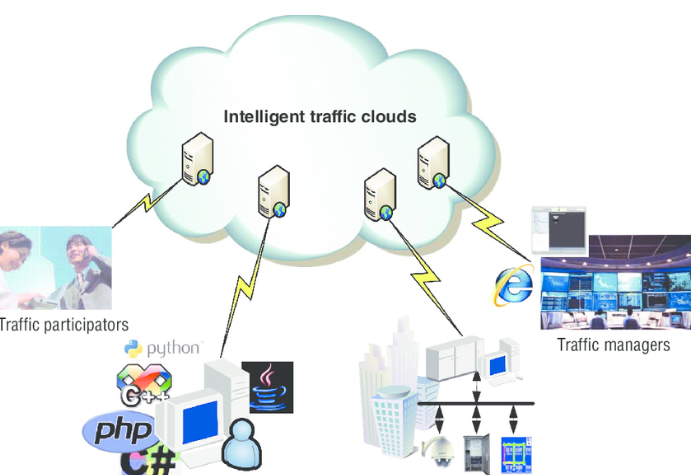
UMTS Architecture: A Brief Introduction In the last decades, urban traffic management systems have become one of the most important systems of a smart city, used to address urban challenges and as a field of extensive research. The ultimate objective of these systems is to enhance traffic flow, thus diminishing the trip and travel times of their users, promoting energy savings, and reducing pollutant emissions. To fulfill these objectives, the main function of these systems is to provide information about road and traffic conditions to users and authorities, thus enabling users to prepare their trips before starting them and authorities to achieve their goals. This is accomplished by monitoring traffic networks and surrounding sensors [12].
3.1. Machine Learning Algorithms
Machine learning models derive patterns from historical data, allowing traffic conditions and their evolutionary behaviors to be approximated from more available labeled data. This means that the data should be correctly categorized; for example, a sequence of cars should be accurately labeled as orderly or disorderly, together with other relevant information such as speed and headway.
Four major types of machine learning algorithms have been employed in intelligent transportation systems research to model traffic conditions: supervised, unsupervised, semi-supervised, and reinforcement learning. In the context of last-mile delivery, supervised learning algorithms are widely used. They can automate the effort required to process substantial traffic data. Once trained, new data may be immediately classified accordingly. The main disadvantage is the need for a lot of labeled data from the past to train the model properly. Logistic regression is a simple example of supervised learning used in the last-mile delivery context for estimating travel time.
Physical and practical implementations commonly use unsupervised learning approaches, including clustering, self-organizing maps, and principal component analysis to model and explore data. Semi-supervised machine learning algorithms typically combine supervised and unsupervised learning. In general, labeling traffic data is a hard and expensive effort. Relaxed rules or constraints in supervised learning allow the use of both labeled and unlabeled traffic data to handle semi-supervised learning. Reinforcement learning algorithms take actions in a given environment to maximize a reward. The algorithms make sequential decisions based on long-term goals, conflicting with short-term benefits, learn by trial and error, and require an environment interactive with an agent. Reinforcement learning is generally used for control parameter selection, such as the rule of the traffic light at a signalized intersection [14].
Equation 2: Given the GM5 model below with m 1 n 2
3.2. Computer Vision Applications
Computer vision has applications in various domains such as biometrics, surveillance, automotive, aerial photography, and medicine. These applications, along with new ones, have been the subject of intense research over the years. To address problems commonly found in cities today, several computer vision-based solutions in urban traffic include the detection of incidents, traffic signs, pedestrian crossing control, traffic light control, vehicle tracking, and counting, incident detection in the transport of dangerous goods, stop-line violation detection, and vehicle detection for the automatic collection of data in road inspection using structured light. Computer vision-based urban traffic management systems are used in different components of traffic operations such as transportation planning, management, control, and maintenance activities.
The detection of incidents, such as accidents and traffic congestion from different origins, has a direct impact on urban traffic and on the people who use the traffic system. Thus, the development of computer vision-based algorithms that allow for the detection of accidents, day or night, is very important and useful for the urban environment. Normally, a traffic incident can be detected, and thus traffic flow is affected, by a change in the visual information features. Recent works use vision systems for intelligent traffic control. Other computer vision-based city technologies include the use of visual sensors for pedestrian crossing control and traffic light control in different scenarios. AI constantly empowers new features to improve the road environment, such as audio enhancements to guide blind citizens using intelligent traffic lights. A traffic light system based on computer vision and artificial intelligence, which is capable of detecting pedestrians in the traffic flow and accordingly managing the traffic lights, ensures a safer environment on the road, and there is frequently necessary research on this topic.
4. Case Studies and Applications
In this section, we describe several case studies and large-scale traffic management systems that incorporate state-of-the-art and industrial solutions.
Arizona Regional Optimization Model and Optimization Results: Implementation and Deployment of SCOOT Adaptive Traffic Signal Systems SCOOT is an urban traffic control system that optimizes signal operations and adjusts the duration of red, amber, and green signal lights based on real-time traffic flow measurements at intersections. Following the deployments of SCOOT adaptive traffic signal control systems in several Arizona metropolitan areas, including the City of Phoenix, the City of Mesa, and the City of Chandler, a significant portion of each agency’s signal resources are now operated in adaptive mode. We present an innovative application of the SCOOT adaptive signal optimization model, termed the Arizona Regional Optimization Model, to proactively coordinate SCOOT signal plans distributed among different signal agencies in the Valley and to optimize the total regional transportation system. The results of this transit-friendly approach are presented and discussed, and its impact on bus travel time reliability is highlighted.
Singapore has deployed an Intelligent Traffic Management System for all the traffic junctions in its district. The system includes traffic junction signal control, central traffic management, traffic monitoring and management, and digital map and location-related services. The design, implementation, and operation of this real-time traffic management system over the Urban Wireless testbed are described [13].
The Philippines has an unprecedented use of sensors and wireless communication infrastructure for real-time traffic monitoring and analysis. The sensors used come in the form of cameras and radio-frequency identification. We present some preliminary results of sensor-based real-life data in Quezon City, Philippines, and techniques for proactive traffic management.
One of China’s first city-wide real-time traffic flow systems has been deployed in Guangzhou, covering approximately 400 traffic-lit intersections under a gradually expanding police wireless network with more than 60 monitor cameras and intelligent traffic controllers. We present general design issues, a case study on the effectiveness, and an overview of the current security functionality provided by the system.
This section examines several innovative traffic management systems that leverage advanced technologies for real-time optimization and efficiency. The Arizona Regional Optimization Model integrates SCOOT adaptive traffic signal systems across multiple metropolitan areas, allowing for dynamic adjustments to signal timings based on current traffic conditions, significantly enhancing bus travel time reliability. In Singapore, a comprehensive Intelligent Traffic Management System oversees all traffic junctions, utilizing centralized control and monitoring to improve traffic flow across the district. The Philippines showcases an ambitious use of sensors and wireless communication for real-time traffic monitoring in Quezon City, employing cameras and RFID technology for proactive traffic management. Meanwhile, Guangzhou, China, has implemented one of the country's first city-wide real-time traffic flow systems, covering around 400 intersections with a network of cameras and intelligent controllers, highlighting its design challenges and effectiveness in enhancing traffic security. Collectively, these case studies illustrate the transformative impact of technology on urban traffic systems, aiming for improved efficiency and safety [15].
4.1. Smart Traffic Lights
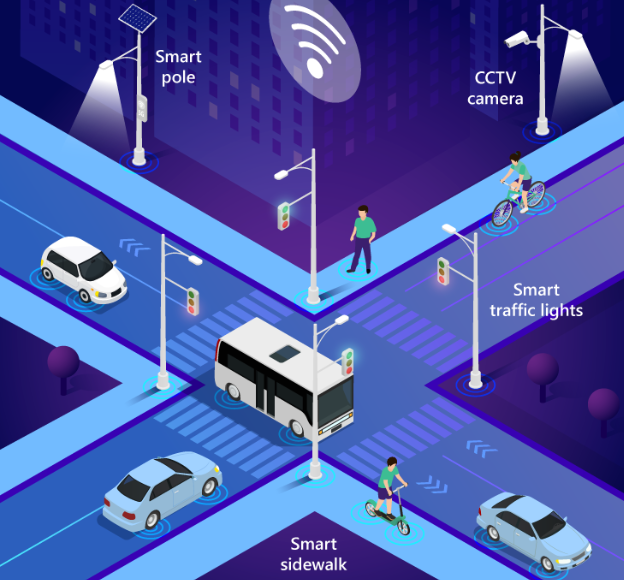
Traffic lights are crucial elements of an urban traffic system, which consists of various components such as vehicles, drivers, traffic vans, traffic signals, pedestrians, buses, complex traffic environments, and road conditions. A shortened duration of red light can certainly restrict the passage of pedestrians through the crosswalks, causing an increased potential for accidents for inhabitants, and their movement comfort would be significantly affected. This traffic project introduces an advanced intelligent system, which is a microcontroller-based traffic light duration controller aimed at reducing delays in pedestrian movement. We cannot construct subways on each street to solve traffic problems due to the extremely high costs of subway systems. Thus, traditional traffic light control systems must be replaced by more intelligent traffic light control systems to improve traffic flow for all types of vehicles and passengers.
The intelligent system, named the shorter traffic light duration controller, described in this study aims to provide ticketless travel through a suburban network and is being designed as an automated, flexible, reliable, and cost-effective system. These features make our system an ideal solution for handling transportation, as well as supporting urban development when convenient cities are dedicated to efficiently facilitating low problems resulting from their geographical and social impacts. The system developed through the implementation of micrometric control promotes the reduction of excessive delay distribution caused by long signal durations and decreases disturbances in subsequent links. Ultimately, traffic flow is improved by reducing the number of stops, detecting the presence of cars at a signalized intersection, and significantly reducing the duration of green and red intervals based on this presence [16].
4.2. Dynamic Route Planning Systems
Dynamically updated route-planning applications suggest the best route a vehicle can take based on real-time traffic updates provided by surveillance systems. The route recommendations are provided to drivers in advance, so they can set their destination and use the real-time advice to guide them through the urban traffic system. The updated possibilities also indicate the faster routes that can be taken in case of accidents, road closures, and other incidents. The system monitors and utilizes the dynamic times for the links within itself to generate the shortest paths. Based on new data, these times can be rebalanced, aiming to achieve optimization. When the link-time estimates between two specific nodes are high, the system tries to offer new alternatives to mitigate traffic congestion. This can be achieved by rerouting vehicles to the best possible position, as this can have system-wide benefits.
The routing system can also assist traffic managers as it can consider the actions they can take in the case of urban traffic, for example, signal-based traffic management strategies and rerouting existing vehicles. Additionally, signaling timing plans can be taken into account to find the best sequence of traffic signals for future travel times. The real-time traffic updates directly affect the benefits of each traffic signal—individually, at adjacent traffic signals, or even at the entire transportation network that holds the individual signals.Dynamically updated route-planning applications leverage real-time traffic data from surveillance systems to optimize urban mobility for drivers. By providing advanced route recommendations, these applications help users navigate through congested areas, offering alternatives in response to accidents, road closures, or heavy traffic. The system continuously monitors link-time estimates between nodes, adjusting routes to alleviate congestion and improve travel efficiency. Furthermore, the application supports traffic managers by incorporating signal-based management strategies, allowing for coordinated traffic signal timings that enhance flow across the entire transportation network. By analyzing the collective impact of traffic signals, the system can propose optimal sequences, ultimately leading to reduced travel times and enhanced urban traffic management. This comprehensive approach ensures that both individual drivers and the broader traffic ecosystem benefit from improved routing and signal optimization [17].
5. Future Directions and Challenges
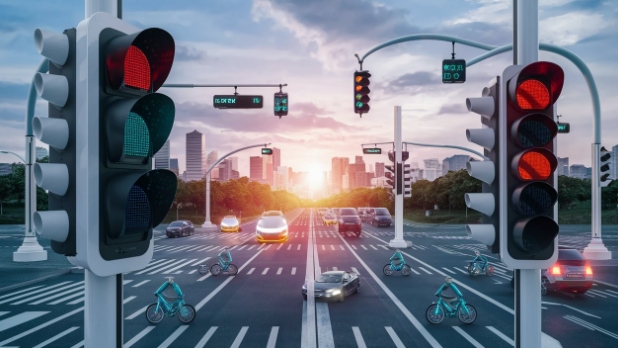
The widespread usage of autonomous vehicles and the availability of socially driven services such as ride-hailing and ride-sharing, possibly containing multiple users with similar itineraries that move efficiently along the same routes, will significantly impact urban traffic management. Consequently, the current demand for infrastructure built and maintained by public funds will decrease. Technological progress in electric propulsion, as well as in the field of batteries, will likely lead to a replacement of vehicle fleets used in urban public transport with fleets of zero- or low-emission vehicles. To convey the mentioned changes in their entirety, an intelligent exchange of data should be enabled between the vehicles and the city infrastructure, which will permit efficient operation and support services managed by AI. The creation of a data-sharing system based on standards-based protocols for secure and reliable data exchange that promotes valuable insights derived from the data should be encouraged. Moreover, the use of distributed intelligence and novel privacy-preserving strategies should be studied and developed. The progressive transition from vehicle ownership to more flexible and versatile mobility services will raise new challenges related to traffic management and the allocation of road resources. The on-minute layer and the on-demand layer will populate the mobility scenario, currently managed mainly by services operating on a weekly to hourly basis. A reorientation of local rules is required for the creation of a market that resists protectionist attitudes and generates innovation. Local rules should be conceived to stimulate operators to offer multiple and complementary contracts with solutions that meet customers' needs. Intelligent systems should then help to coordinate these different services at the city level and to build infrastructures that protect the best long-term interests of the people. Finally, it is worth considering that increasing the availability of optimized, scheduled, and predictable services will also allow a more suitable design of the physical urban environments.
5.1. Integration of AI with IoT for Traffic Management
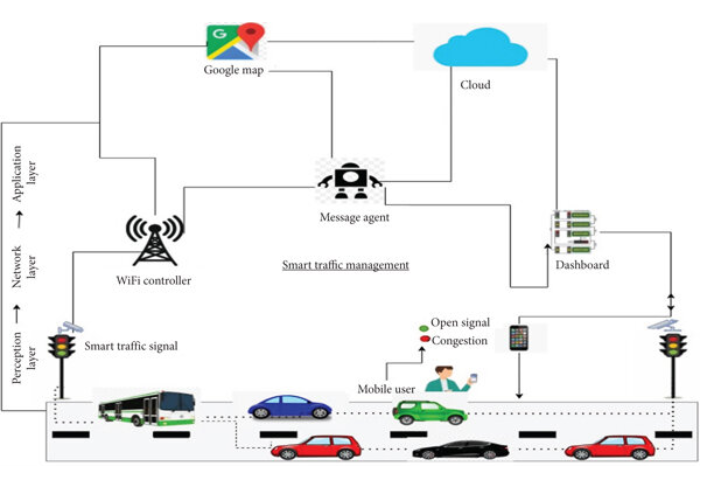
IoT is a major connectivity model in the current era, with increasing applications in several fields including smart traffic. The concept of traffic in a smart city is to improve traffic mobility by mitigating traffic congestion and reducing vehicle emissions, noise, and other harmful environmental effects. An interconnection of smart vehicles with smart infrastructure, which provides real-time analytics and the ability to autonomously control efficiency, can also largely help traffic management and road safety. This connects not only vehicles on the road but also the road infrastructure, providing real-time traffic information and driver advisories in direct support of drivers, who should be involved in driving and making the final decision regarding route selection and traffic light handling. Since most smart systems are applied in urban areas, the term smart cities is often used interchangeably with the term intelligent transportation system. Variables such as metro network usage, city area, available commuting travel time, trip distance, vehicle ownership, modal choice, and travel demand can be correlated with the state of the art and research in the field of smart transportation solutions.
Smart technologies—fully aligned with the smart city concepts—can enable efficient mobility in various traffic conditions by implementing cooperative collision avoidance or cooperative adaptive cruise control. In such circumstances, advanced driver-assistance systems and connected or cooperative automated driving can become the bridge between tolerable traffic states instead of progressive grid-like consequences. While current governments and major companies have been investing in technologies for the development of smart vehicle classes and autonomous driving systems, the general public is open to these features but does not appreciate the added cost of such features because of a decreased investment return. They remain suspicious of the underlying change that smart systems might bring about in privacy and security aspects. Current car-sharing solutions are seen by the general public as expensive, inconsistent, unsafe, and even less comfortable than using one’s bike, car, or motorbike. Smart cities can offer augmentable public services to encourage users to utilize public transportation and approve traffic telematics as integrated services. This context suggests interesting market scenarios, such as the integration of these services—favoring urban smart mobility with travel empowerment methods, such as car sharing, ride-hailing, and performance engineering. These features can operate with on-demand travel services to provide efficient access to the shared freeway management right of way.
5.2. Ethical and Privacy Concerns in AI-driven Traffic Systems
Ensuring the ethical use and responsible deployment of AI technologies in urban traffic management is critical for user acceptance and regulatory clarity. Several serious concerns for an ethical and equitable outcome regarding the development and deployment of AI-driven traffic systems remain for both short and long terms. Privacy and cybersecurity concerns are of paramount importance. There is a need for a data protection plan, and the anonymization and de-identification of sensitive data are necessary. Allowing AI systems to access user data is considered a violation of privacy. The systems should help ensure traveler privacy. The rationale for demarcating certain travel data as personal must be understandable. It encompasses a structured response to potential data breaches.
The participants should have a right to withdraw from data collection. AI systems should be transparent in providing a clear view of the operational status of the system and an understanding of the parameters that are used in making decisions. AI assets that assist in the collection of sensitive travel data should be used appropriately and should only retain and preserve the personal data for the time essential to reach the goals. Justify that new data uses do not expect a disproportionate effect. All the factors contained in the AI engine before setting up the operational status of the system should mainly be addressed to preserve the right to explain the decisions and concerns. Efficient security includes the application of standard security best practices for secure data handling. Classic security threats are changing rapidly. It is currently imperative to constantly update security best practices.
Equation 3: A non-continuum lumped-parameter dynamic model applied to Indian traffic
6. Conclusion
In this chapter, we presented four different ways that AI systems have the potential to transform urban traffic management: (1) with predictive models of traffic flow dynamics at a variety of spatial scales; (2) with intervention activities at either long or short temporal scales using several variants of the notion of "control," of which signal light control is the most traditional; (3) with convenient search and information gathering that can provide significant value to drivers through congestion reduction and fuel economy; and (4) by taking over driving tasks using various kinds of automated driving technology. Each of these leverages big data and big computation to various degrees; most require significant learning from experience that has the potential to either greatly enhance human efforts or replace them entirely. In conclusion, we have described examples of how AI, machine learning, and big data technologies are used in major application areas related to urban transportation, including traffic modeling and simulation, traffic management and control, travel forecasting, transit operation and rider support, and routing and navigation for pedestrians, individual drivers, and autonomous vehicles. There are now many opportunities to leverage these new technologies to significantly improve transportation systems.
6.1. Future Trends
Future cities will be characterized by several factors, including exponential growth in population and economy, scarce resources, and increasing mega challenges in the transport sector. Urban traffic will face several challenges such as safety, increasing emissions, and energy consumption, as well as parking, user fleet mix management, equity and control, and management for efficiency. The control, management, and operation of activities related to each transportation system must be addressed at a level of service to mitigate transport externalities. Smart, intelligent systems have proven to be among the best candidates to satisfy the current and future needs of these multi-actor systems. The employment of this technology will help reduce negative impacts produced by transportation, as well as make cities more efficient, people more integrated, and transportation and logistics systems function in an opaque way. In recent years, we have seen advances in ICT, networks, and in general computing regarding formulation, decision support, and sound quantitative building information. These advances are typically real-time control in the transport system, availability in vehicle fleets, geographic information systems, and a variety of communication technologies. The future incorporates more ideas that are based on models of operations, advanced applications, and personal transportation and integrated services. Additionally, artificial intelligence, such as predictive algorithms and machine learning, contributes to the changing needs in the management and control of transportation systems, thus improving the current restrictions and allowing for expanding services and mitigating social and environmental externalities.
References
- Pamulaparthyvenkata, S., & Avacharmal, R. (2021). Leveraging Machine Learning for Proactive Financial Risk Mitigation and Revenue Stream Optimization in the Transition Towards Value-Based Care Delivery Models. African Journal of Artificial Intelligence and Sustainable Development, 1(2), 86-126.
- Avacharmal, R. (2021). Leveraging Supervised Machine Learning Algorithms for Enhanced Anomaly Detection in Anti-Money Laundering (AML) Transaction Monitoring Systems: A Comparative Analysis of Performance and Explainability. African Journal of Artificial Intelligence and Sustainable Development, 1(2), 68-85.
- Chintale, P. (2020). Designing a secure self-onboarding system for internet customers using Google cloud SaaS framework. IJAR, 6(5), 482-487.
- Korada, L. (2021). Unlocking Urban Futures: The Role Of Big Data Analytics And AI In Urban Planning–A Systematic Literature Review And Bibliometric Insight. Migration Letters, 18(6), 775-795.
- Vaka, D. K. “Artificial intelligence enabled Demand Sensing: Enhancing Supply Chain Responsiveness.
- Bansal, A. (2021). OPTIMIZING WITHDRAWAL RISK ASSESSMENT FOR GUARANTEED MINIMUM WITHDRAWAL BENEFITS IN INSURANCE USING ARTIFICIAL INTELLIGENCE TECHNIQUES. INTERNATIONAL JOURNAL OF INFORMATION TECHNOLOGY AND MANAGEMENT INFORMATION SYSTEMS (IJITMIS), 12(1), 97-107.
- Mandala, V., & Surabhi, S. N. R. D. (2021). Leveraging AI and ML for Enhanced Efficiency and Innovation in Manufacturing: A Comparative Analysis.
- Bansal, A. (2021). INTRODUCTION AND APPLICATION OF CHANGE POINT ANALYSIS IN ANALYTICS SPACE. INTERNATIONAL JOURNAL OF DATA SCIENCE RESEARCH AND DEVELOPMENT (IJDSRD), 1(2), 9-16.
- Vaka, D. K. " Integrated Excellence: PM-EWM Integration Solution for S/4HANA 2020/2021.
- Chintale, P., Korada, L., WA, L., Mahida, A., Ranjan, P., & Desaboyina, G. RISK MANAGEMENT STRATEGIES FOR CLOUD-NATIVE FINTECH APPLICATIONS DURING THE PANDEMIC.
- MULUKUNTLA, S., & VENKATA, S. P. (2020). AI-Driven Personalized Medicine: Assessing the Impact of Federal Policies on Advancing Patient-Centric Care. EPH-International Journal of Medical and Health Science, 6(2), 20-26.
- Mandala, V. (2021). The Role of Artificial Intelligence in Predicting and Preventing Automotive Failures in High-Stakes Environments. Indian Journal of Artificial Intelligence Research (INDJAIR), 1(1).
- Bansal, A. (2020). An effective system for Sentiment Analysis and classification of Twitter Data based on Artificial Intelligence (AI) Techniques. International Journal of Computer Science and Information Technology Research, 1(1), 32-47.
- Vaka, D. K. (2020). Navigating Uncertainty: The Power of ‘Just in Time SAP for Supply Chain Dynamics. Journal of Technological Innovations, 1(2).
- Mulukuntla, S., & VENKATA, S. P. (2020). Digital Transformation in Healthcare: Assessing the Impact on Patient Care and Safety. EPH-International Journal of Medical and Health Science, 6(3), 27-33.
- Dilip Kumar Vaka. (2019). Cloud-Driven Excellence: A Comprehensive Evaluation of SAP S/4HANA ERP. Journal of Scientific and Engineering Research. https://doi.org/10.5281/ZENODO.11219959
- Chintale, P., Korada, L., Ranjan, P., & Malviya, R. K. ADOPTING INFRASTRUCTURE AS CODE (IAC) FOR EFFICIENT FINANCIAL CLOUD MANAGEMENT.