
Abstract
Regardless of their traditional ERP Systems, it is essential for every business to acquire a universal advantage in the contemporary international market. When everything is considered, end users in these kinds of businesses have to deal with poorly designed interfaces and unusable technologies. Despite the claims of significant benefits from using S4 Hana cloud ERP software, the possibility of achieving maximum productivity is not fully utilized. One of the causes of this reality is the underfunding of ergonomic measures and the newest technologies. Through the design of S4 Hana cloud ERP software applications, we will demonstrate how important and highly recommended ergonomic research is in order to minimize the financial and human costs that enterprises are currently facing.
1. Introduction
SAP S/4 HANA is a commercial software package that, under the assumption that every module is acquired and used, claims to fully integrate all information flow through a particular stand-alone business or a collection of subsidiaries inside an organization. The use of SAP S4 Hana ERP aims to combine all departmental functions into a single system that can meet all of those departments' unique requirements [1]. SAP HANA is a database management system that is primarily designed to be used in memory, offering users quick access, querying, and processing. SAP HANA boasts a substantial customer base. Over the past ten years, there has been a notable rise in both the quantity and variety of information [2]. The worldwide markets of today, referred to as Industry 4.0 and the Internet of Things (IOT), are characterized by increased rates of complexity and a progressively faster rate of dynamism due to global supply chain networks. This necessitates the seamless interconnectedness of processes. It is comparatively crucial to solve the complexity issue in a field like supply chain logistics networks. The internal logistics frame, which represents the flow within the four walls of the organization, and the external logistics frame, which represents the flow among suppliers, factories, and distribution centres of the organization and their interactions with one another, will both be used to consider different logistics network nodes. We must first comprehend the basic architecture of ERP systems. These systems have a three-tier architecture, which divides applications into three levels of physical and logical computing. This design is typically used for modern applications rather than more conventional ones. These layers are the application tier, which processes the data, the data tier, which manages and stores the data according to how it connects with the application, and the presentation tier, which is the user interface. The primary advantage of this three-tier architecture is that each layer functions on its own owned infrastructure, allows for multiple development teams to work on it concurrently, and allows for scalability and updating without affecting the other levels. These ERP system installations struggle because they are excessively expensive, take too long in comparison, and typically fall short of the promises made regarding cost savings and competitive advantage [3]. According to a study looking into the efficacy of implementation in companies with sales over $500 million, there was a staggering 59 percent shortfall in average slide through functional improvements, an average scheduled overrun of 230 percent, and an average cost overrun of 175 percent [4]. We all know deep down that ERP systems never malfunction, miscalculate, or wear out. They only act in accordance with their programming. Relatively poor project management, misconceptions about the chosen ERP capabilities and embedded features, a lack of executive buy-in—a subset of organizational change management—technical complexity, the inability to create strong business cases and appropriate business process reengineering, and the absence of important stakeholders in the decision-making process are the reasons behind what is referred to as a failure [5]. With its newfound use of in-memory tables, embedded analytics, and streamlined data structures, SAP S/4HANA runs on top of HANA. Period-end closing is one of the time-consuming tasks that can now be completed quickly. It gets rid of the need for reconciliation between departments like finance, procurement, sales, and production. It provides you with Embedded Analytics-based real-time analytical reports.
SAP HANA Cloud, the company's highly scalable cloud version of SAP HANA, is presently offered by Microsoft Azure and Amazon Web Services (AWS). An example of a SAP HANA Cloud landscape is shown below. A HANA instance offers the user a wide range of configuration options that may be adjusted to meet the demands of clients with various specifications [6]. The customer and the user may be the same individual. It's important to keep track of the overall configuration of each instance and group of instances when managing a landscape that has a large number of these highly changeable instances. A temporary workaround for an issue could be to modify the configuration of a HANA instance. For instance, this might prevent an outage. A bug would typically impact several HANA instances. As a result, configuration would be required for a collection of several instances. Gardener, a SAP product, manages the Kubernetes clusters in which HANA instances are operating. Gardener5 generates, updates, scales, and destroys Kubernetes clusters on demand. This makes these Kubernetes clusters SAP HANA Cloud landscapes. We should quickly discuss containerization in order to comprehend the goal of Kubernetes. Based on cloud computing, SAP S/4HANA Cloud provides apps in databases with data models, eliminates redundancies, offers better competitiveness, automates key business processes across the entire company, boosts productivity, and assists employees in their work [7].
SAP S/4HANA Cloud, public edition/essential edition is a subscription-based Software as a Service (SaaS) on multi-tenant cloud infrastructure. The pre-configured "core ERP" is the extent of the capabilities. It is not permissible to add to or modify the current code. Public cloud: a conventional multi-tenant system provided as software as a service [8]. It provides constrained configuration options and limited functionality. Programming customization is not feasible because the system is shared by several clients on a technical level. The system just needs minimal configuration to be operational because it is already pre-configured. A single-tenant cloud system provided on an Infrastructure as a Service (IaaS) or Platform as a Service (PaaS) basis is known as a private cloud or on-premise in the cloud [9]. The customer rents from the cloud provider either a portion of the infrastructure (IaaS) or a portion of the infrastructure combined with a vanilla system (PaaS). One customer has exclusive use of the system, and that client is in charge of keeping the system functionally maintained as well as modifying and customizing it to suit their needs (sometimes with the help of an outside ES consultant). A cloud provider is in charge of upkeep of the system's technical aspects as well as its infrastructure (in certain cases).
2. Usability
User-friendly online interfaces are not included in this criterion because it is assumed that all SAP cloud users are at least experienced with using a command-line tool. The degree to which the service's launch shortens and streamlines the development and operations teams' burden in relation to HANA configuration assistance can be used to assess the usefulness.
2. Performance
The performance of the S4 Hana is its primary benefit. It is not necessary to use the Hana cloud for real-time applications. Nevertheless, if HANAs need to be reconfigured in order to prevent them from becoming non-functional, the process of doing so should not take too long. The criteria explain the scenario in which the handler is intended to accomplish its goals with the least amount of API calls and computations. This will prevent the waste of valuable CPU resources.
3. Security
Every ERP Software product should always have some level of security. The handler will eventually be incorporated into production landscapes, if all goes well. The handler, operating in a production environment, has the ability to modify the settings of HANAs that actually process client data. As a result, the handler's security level ought to be fairly high compared to, say, a monitoring service that just keeps an eye on resources that are operational in the landscape. Permissions should only be granted to the handler when absolutely necessary. Among other things, decisions about the concepts that are utilized in the handler's implementation should be dependent on the required permissions. This implies, if at all feasible, staying away from ideas that require important permits [10].
4. Scalability
The landscapes may dynamically grow up and down in size because they are distributed systems made up of S4 Hana cloud clusters. Most services that operate on these kinds of systems place a high importance on scalability. While it is not anticipated that the handler will be used heavily or continuously, it would be ideal if it could adjust its functionality based on the number of HANAs or usage density. This is a feature of cloud-native programming.
5. Design and Implementation
The S4 Hana's implemented features are completely described, along with the design strategies that were applied in various global contexts. Other potential solutions will be listed for each feature, along with an explanation of why they weren't selected. The created artifacts and documentation are then listed. For the handler to function, there are two prerequisites. First off, since the release of Cloud S4 Hana, no HANA is manually configured anymore. Second, after the HANA has been fully supplied, no configuration changes are made by other services.
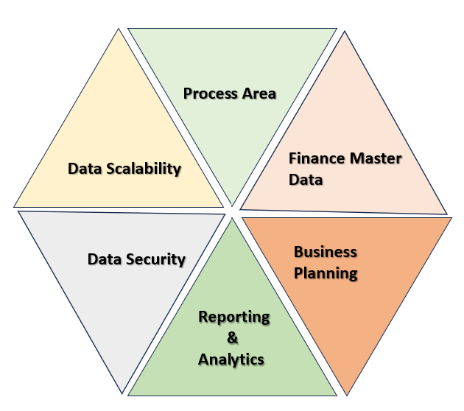
SAP S4 Hana Cloud ERP's innovative features and adaptability make it an essential tool for success in the digital era. ERP systems have historically brought businesses a great deal of value by helping them become more knowledgeable and productive (Figure 1). But everything has changed as a result of digitization, including the degree of competition [11]. Locally installed ERP solutions are just unable to keep up. It is difficult for them to adjust to sustained change. Because they were designed for simpler environments, the majority of traditional ERP systems are unable to give businesses the speed, flexibility, and insight they need to operate in new, more flexible ways. Consumers of today want more dependability, lower costs, faster delivery of goods and services, and ongoing product and service improvement. Businesses frequently need to venture outside of their boundaries in order to give clients the best value [12]. They work digitally with a variety of partners for production, product distribution, sales management, service, support, and even basic business operations. As a result, they need software that supports both managing their increasingly complex internal procedures and managing international business networks. That would not be feasible without cloud ERP. It makes sense to question the security of cloud ERP. Taking into account the latest news regarding infections and data breaches. No system is impregnable, but how secure it is will rely on who is in charge of it and how it was put into place. SAP HANA Security ensures that the company's adopted security criteria are followed and safeguards sensitive data from unauthorized access. Multiple databases can be created on a single SAP HANA system thanks to a technology called multitenant databases. It's called a multitenant database container. Consequently, SAP HANA provides full security-related functionality for all multitenant databases. Since database security is a difficult task that requires a thorough, all-encompassing approach, SAP HANA and SAP HANA Cloud come pre-configured with an extensive, potent, and robust security framework. It assists businesses in complying with security-related regulations and policies and seeks to protect data's accessibility, integrity, and confidentiality from common threats like improper access, misplaced privileges, and a lack of control guidelines.
6. Conclusion
In this article, a service that automates the configuration management of HANAs operating in an established Kubernetes environment was designed and put into operation. However, the project's instructional component is more valuable than the handler's implementation or design. With more people using cloud technology for data storage, there is little doubt that improving cloud data storage techniques is becoming more popular. Data kept in the cloud could be vulnerable if it is not adequately secured. This essay addressed three distinct security challenges, as well as the risks and dangers to the protection of cloud-based data. Virtualization is examined to ascertain the hazards that the hypervisor presents. There have been discussions about similar issues raised by multitenancy and public clouds. The primary subjects of this study were cloud computing data security, including its hazards and possible solutions. How to securely encrypt data in the cloud using different kinds of data and encryption techniques has been discussed.
Reference
- Davenport, T. H. (1998). Putting the enterprise into the enterprise system. In Harvard Business Review 76 (4),121-131.
- A. Edmunds and A. Morris, “Problem of information overload in business organizations: A review of the literature,” International Journal of Information Management, vol. 20, no. 1, pp. 17–28.[CrossRef]
- D. Simchi-Levi, P. Kaminsky, and E. Simchi-Levi, Designing and Managing the Supply Chain: Concepts, Strategies, Case Studies, 2003.
- Buckhout, S., Frey, E., and Nemee, J. (1999). Making ERP succeed: Turning fear into promise, IEEE Engineering Management Review, Fall 1999, 116-123.
- Juturi, V. P. K. (2023). Role of Enterprise Applications for Pharmaceutical Drug Traceability. Universal Journal of Pharmacy and Pharmacology, 41-46.[CrossRef]
- VARMA, K. M., CHOWDARY, N. D., CHANDRA, P. P., & KUMAR, G. P. (2023). Cloud based ERP systems and Data Security for Cloud based ERP Applications-SAP S/4HANA.
- Mandava, H. (2024). Critical Success Factors of Cloud ERP in the Enterprise Business. Universal Journal of Computer Sciences and Communications, 1-5.[CrossRef]
- Harale, N. D., & Meshram, D. B. B. (2016). Data mining techniques for network intrusion detection and Prevention Systems. International Journal of Innovative Research in Computer Science & Technology.[CrossRef]
- Morawiec, P.; Sołtysik-Piorunkiewicz, A. Cloud Computing, Big Data, and Blockchain Technology Adoption in ERP Implementation Methodology. Sustainability 2022, 14, 3714.[CrossRef]
- Juturi, V. P. K. (2023). Success Factors of Adopting Cloud Enterprise Resource Planning. Universal Journal of Computer Sciences and Communications, 9-14.[CrossRef]
- A. Pattanayak, “SAP S/4HANA Embedded Analytics: An Overview,” Journal of Computer and Communications, vol. 05, no. 09, pp. 1–7, 2017,[CrossRef]
- Mandava, H. (2023). How Digital Technologies Improving Business Enterprise Applications. Universal Journal of Computer Sciences and Communications, 15-19.[CrossRef]