
Abstract
The theme of the study that catches our attention is the initial conceptions of learners in Science and school performance; this theme is based on the competency-based approach in force in Cameroon, which is implemented in several African countries. Insofar as learning is not the accumulation of new knowledge but a cognitive reorganization of old knowledge experienced, it is therefore a question of knowing what is the influence of initial conceptions on the academic performance of learners in science. The objective of this research was to show that taking into account the initial conceptions of learners, Biology “SVT” has a lasting influence on learning and thus on the academic performance of learners. To achieve this objective, the study uses the mixed and quasi-experimental method, where two groups of learners were used: a control group and an experimental group. The experimental group was subjected to the teaching-learning system designed for this purpose, and in which the initial conceptions of the learners were taken into account according to do with or go against. In the light of the different hypotheses adopted and the different results of this study, it can be observed that the didactic consideration of the learners' initial conceptions improves their academic performance through the data of the experimental group. In relation to the field of education, this study shows that in order to enable learners to learn and build knowledge in the long term, their initial conceptions must be taken into account in concrete didactics; Otherwise, learning will be sporadic, learners' conceptions will be significant, which will lead to a learning defect perceptible by school failure.
1. Introduction
Cameroon's education system is compartmentalized into two subsystems, Anglophone and Francophone. It is regulated by Law No. 98/004 of 14 April 1998 on the School Orientation Law in Cameroon. Science education in general aims to train learners in the scientific mind. In Cameroon, the modalities for the implementation of science teaching in secondary schools are defined by the Ministry of Education. This is how MINESEC [1] defines a set of objectives inherent to science education. Among these objectives, we have learning objectives that express and announce an expected result, a change in the student's action or conduct; Teaching objectives, which are written by the teachers, help them to plan their training. In addition, there are evaluation criteria that will focus on the abilities developed in learners based on previously defined objectives. To achieve these objectives, it is recommended to study through observation, the analyses of the mechanisms of life through the scientific approach to arrive at biological concepts and practical applications in SVTEEHB. For an efficient acquisition of technical knowledge (skills and competences), MINESEC ask teachers to learn to children how to observe objects meticulously and to initiate them in a progressive movement for experimentation. Therefore, any SVTEEHB teacher will have to start from an observable, audible or malleable didactic support, from which the teacher will ask an adequate question in order to make the students actively participate in the construction of knowledge and/or targeted expertise. Concerning the pedocentric approach, which is part of the new pedagogy, and which is one of the characteristics of the based competency approach in Cameroon since August 2014, which entails the teacher to use an active and participatory pedagogy where, he plays the role of facilitator, and the learner being at the center of learning will have to do his best to acquire knowledge, master experimental techniques and develop skills. The implementation of this new approach was enshrined in Order No. 263/14/MINESEC/IGE of 13 August 2014. In this context, the teaching and learning models take place according to the scientific approach of DiPHTHERIC investigation (Initial Data, Problem, Hypotheses, Testing Hypothesis, Results, Interpretation and Conclusion). After all, the teaching session begins with a problem situation, contextualized or not, which hides a scientific problem; the student engages in his or her studies by collecting course materials from his or her surrounding environment, by observing living things or any other sample, by formulating hypotheses or provisional answers to the problem, by proposing protocols for experiments or testing hypothesis, by carrying out experiments, by interpreting and highlighting their limitations on the based documents (textbooks or other studying materials), by representing what he observes (sample drawings, photographs, graphs), by drawing right conclusions and exposing what he has understood to his classmates. During teacher’s actions, the student is at the heart of education. The focus of the teaching and learning process on the student requires that, his initial conceptions should be taken into account, and that they should be optimally used, according to Giordan's allosteric model [2], so that they are the starting point of all tuition; insofar as "learning" is not the accumulation of new knowledge, but a cognitive reorganization of old knowledge experienced. The study focuses on learners' initial conceptions on the origin of chromosomal abnormalities, in teaching and learning situations, and on school performance.
The academic failures for example proves that, official exams in Cameroon reflects a learning defect, which could be explained by the trespass of the knowledge received from the teacher during teaching and learning sessions, the lack of motivation that can be observed in transmissive approaches widely used by Cameroonian teachers and which do not take into account the initial conceptions of learners in the process of knowledge construction because the practices of these teachers are focused on themselves and not on the learners, that is the student. It is therefore a question of knowing what is the impact of the learners' to knowledge or to "studies" on learners' performance in science?
The findings made after a pre-survey on the study sites shows that certain concepts studied in the third year of secondary school, such as "the study of karyotypes and chromosomal abnormalities", are used in the first year of secondary school. By evaluating the prerequisites on these notions in a class of first literature at the Marie-Albert II College by a collection of initial conceptions, it was observed that out of 60 learners, only 11 could give an appropriate definition of the expressions karyotype, chromosomal formula, and chromosomal disease, that is 18.33%. Regarding the question on the explanation of the origins and consequences of chromosomal abnormalities, no learner was able to answer this question, that is, 0%. Following these results, the question that arises is to know what is the initial influence of the learners' conceptions concerning their academic performances in science?
Our interest on this work is to show that teaching based on the consideration of learners' conceptions would improve their academic performances, by improving their disciplinary competence, as in the case of the science discipline relating to the level of study. This is one of the solutions to the problem of school failure by focusing on the child who is the one to learn.
2. Materials and Methods
2.1. Definition of Concepts
The different concepts related to the theme of this study are : initial conceptions, performances, school performances.
2.1.1. Learners' initial designs
According to the dictionary of key concepts [3], learner design refers to the concepts or pseudo-concepts used during cognitive mobilization to apprehend new knowledge and construct knowledge.
One conception [4] is:
"An underlying thought structure that is at the origin of the student's actions. The student understands the world through it. It is not what the student thinks, says or writes, it is the result of his previous experience, his grid for reading and interpreting reality. It is a personal process by which a learner structures the knowledge he or she integrates as he or she goes along."
Conceptions are generally considered knowledge systems that a subject spontaneously mobilizes in the face of a question or problem, whether or not they have been the subject of learning [5]. They refer to particular ways of reasoning that refer to an explanatory model that pre-exists formal learning. For lack of anything better, they prove to be alternatives to canonical and scientific models [6].
The student's conceptions are common sense knowledge resulting from the internalization by each person of socially constructed and shared experiences, practices, models of conduct and thought.
An analysis of its different definitions shows that they converge on the fact that learners' initial conceptions are individual and allow the learner in a particular context to apprehend teaching or life situations. However, Dénis.M highlights the precarious character of a conception in the sense that it is dynamic, which obviously shows that a conception is likely to be transformed into a teaching and learning situation.
In the context of this study, the initial conceptions of learners represent a set of coordinated ideas, knowledge and coherent mental images that each individual has constructed for himself and that he or she mobilizes at a given time, in a given situation, to explain the world he sees, that he feels, or to solve a task.
2.1.2. Performances
Performance is a polysemic concept whose meaning depends on the frame of reference used. In a general framework, according to the dictionary of key concepts in pedagogy [3], performance is the actualization of competence. In the 1989 Petit Larousse showed that, performance is the result obtained in the execution of a task.
Sillamy [7] defines performance as the "implementation of an aptitude and the result of this action from which the possibilities of a subject in a particular field can be deduced". At the level of evaluation, he distinguishes between sports performance, psychological test performance and academic performance.
The various authors agree on the individual aspect of the performance and on its circumstantial character. However, the definitions proposed by Françoise Raynal and Alain Rieunier, and De Landshere seem to be more framed knowing that we are in the field of teaching and learning. Thus, in our study, performance will be considered as the individual result that a student obtains in a school subject during a sequential assessment.
2.1.3. Academic performance
Following the definition of performance, academic performance is assimilated to a result obtained by a pupil in a given school subject. Academic performance can also be defined as the degree of academic success, day after day, based on a student's progress in three dimensions that are taught in school: the subjects taught constructive attitudes, behaviours and understanding of the world [8]. Of the two definitions, the second seems more complete insofar as it goes beyond knowledge, to integrate knowledge and being. However, in the context of this study, given the determination of school performance, we will consider numerical grades; So, we define academic performance as the grade obtained at a given time by a student in a subject at the end of an assessment.
2.2. Explanatory theory
It is a question of presenting the theory on which the study finds its theoretical anchoring. The theory used specifically is the theory of educational intervention.
Inspired by the work NOT by Yves Lenoir [9], which refers to the notion of educational intervention, it highlights the fact that the teacher acts toward others with the aim of improving a situation considered problematic in a socially normative framework, and that his actions are oriented in an interactive relationship towards one or more learning subjects based on the establishment of the most appropriate conditions possible to promote the implementation by students with an appropriate learning process allowing them to have access to knowledge, in a transitional and transactional space of negotiation.
In the school environment, educational intervention therefore includes all the actions of planning (pre-active phase: identification of the problem situation; establishment of a value judgement justifying the action; structuring of the action within a system), updating in the classroom (interactive phase: acting in a situation), and evaluation of the actualization (post-active phase). Considering that knowledge is not transmitted, but rather is the product of the work of the learner; It is important to note, however, that its construction by the learner requires external mediation on the part of the teacher who puts in place the most favourable conditions for its construction. Learning is therefore a cognitive relationship of concretization established between the subject and the object through a system of regulation (mediation) based on speech as discourse, and on human action as a process of social production. In this perspective, the teacher, by creating optimal conditions for learning, will guide the student during the didactic process to allow him to reorganize his cognitive structures.
Educational intervention presents four main profiles of teaching practices, also known as educational intervention models (EIMs). Among these four models, MIE4 is the one adapted to our research because it integrates a social dimension in the construction of knowledge by learners, who are more middle way with the teaching and learning process, also with a teacher so that the action becomes less preponderant and is relegated to the rank of facilitator. Indeed, this model of MIE4 emphasizes the interactions and dynamics of learner / knowledge / teacher. Implementing this model requires three essential steps. The first refers to a spontaneous investigation, which makes it possible to pose and construct a problem situation through periods of simulation and exploration. The second step, the structured investigation, which solves the problem situation through planning and data collection. The third step finally corresponds to the regulated structuring during which the data collected are processed, in order to achieve a synthesis. Presented this way, this path makes it possible to guarantee the efficiency and success of a learning sequence.
2.3. Research Caracteristics
This part will be to clarify the type of research, determining the characteristics of the study population, delineating the sample and determining the sampling method.
2.3.1. Type of Research
As part of this study, we carried out a quasi-experimental research that is both qualitative and quantitative. During a teaching and learning session, the facilitator who is the teacher deploys a set of strategies whose aim are to promote more of the learners' comprehension, and who by themselves achieve this knowledge, because they are the main architects of its construction. Starting from the postulates of Meirieu [10] and Saint-Germain, like everything else, knowledge is a good that works to allows us obtain results that must be earned. Knowing therefore that learning manifests itself, and does not take place, the acquirement of information cannot be a simple operation of reception but a complex story in which the subject assimilates the unknown in an active and rarely spontaneous way. Appropriation cannot therefore refer to simple repetition: it requires mental operations that are rarely spontaneous [11]. The choice of a quasi-experimental research will therefore allow us, to use a control group and an experimental group, in order to evaluate the impact of taking into account learners' conceptions during didacticism in learning.
2.3.2. Study population
The study population for this research is located in two secondary schools, namely the Marie-Albert II College in Yaoundé and the Ndelle-Ayos High school, both located in the Centre region. However, the Marie-Albert College II is located in an urban area, while the Ndelle-ayos High School is located in a non-electrified rural area. This study population was made up by learners of both sexes with age ranges between 16 and 20 years old, enrolled in the first class of literature. The table 1 below shows the sampling criteria:
2.3.3. Study sample
The sample is a fraction of the population that has been studied. The sample is therefore a group of individuals chosen from a population with the aim of studying some characteristics concerning the population from which the group is taken. At the end of the sampling, the results obtained must be a representation of the population. It is the representation of the sample that makes the results reliable and possible. In this study, to make no errors, we used a probability sampling method, namely random sampling. Unlike the empirical method, probability sampling is more precise because it allows the construction of illustratives that are close to the population. Its choice was more motivated by the fact that, being the simplest of the probabilistic method, it is more adapted to the size of the population, which was not large, but also does not allow any bias during the draw because each individual of the population can be chosen.
We decided to conduct our study in two secondary schools as mentioned above, because of certain problems related to the availability of teachers, but also because of infrastructural problems. The study sample will consist of two groups of learners made of 20 learners each: an experimental group made of 20 students, and a control group made of 20 learners, for 40 learners. The experimental group will follow courses based on a pedagogical method, which, in the construction of knowledge, starts from the initial conceptions of the learners; and the control group will receive lessons in an approach that does not take into account the learners' conceptions in the construction of knowledge.
2.4. Methodological Framework
2.4.1. Data Collection Methods
In the framework of this quasi-experimental research, based on the construction of an evidence (or justification), requiring a description made by multiple cases or several studies.
Data collection is therefore done during pre-tests and post-tests mixed because it is both qualitative and quantitative.
Data collection instruments are the samples used for the various tests and questionnaires given to learners to determine the influence of learners' initial conceptions on academic performances.
The pre-test test (Appendix 1)
The pre-test test made it possible not only to collect the initial conceptions of the learners before the teaching of scientific concepts, chosen in this study in the form of a diagnostic evaluation, but also to evaluate the homogeneity of the two groups of the experiment from the use of marks that the learners of the two groups obtained. It is a questionnaire marked out of 10 points, although this information was not indicated. It consists key words to be defined and questions related to the origin and consequences of chromosomal abnormalities. The definitions correspond in a way the evaluation of resources, and the other questions to the evaluation of knowledge in the form of explanations of scientific phenomena. This test focuses on module 1 of the official program and more specifically on sequence 3 of the said module, entitled human genetics and heredity.
The post-test test (Appendix 2)
The post-test test made it possible to evaluate the conceptual evolution of the learners and the impact of a teaching method based on the consideration of the learners' initial conceptions on the sustainable construction of knowledge over time, which is seen through their performance in this test. This test was submitted to the learners two months after the teaching of the chosen scientific concepts, and is identical to the pre-test, in content and not in form.
These two tests allowed the collection of quantitative data.
Interviews (Appendix 3)
The interviews used in this study are of two types:
- The interview relating to the pre-test and the collection of learners' conceptions during the experimental period.
Administered throughout the teaching and learning session, the aim is to collect the learners' conceptions before the start of the teaching and learning of chosen concepts, but also to collect the conceptual evolution of the learners at different periods of teaching, between the beginning and the end of the test or experiment.
- The mixed interview.
This interview has questionnaires and consists of both open-ended and closed-ended questions. The administration of this questionnaire made it possible to collect information on the influence of teaching based on the consideration of learners' initial conceptions (doing with it to go against) on their conceptual evolution, motivation to learn, their relationship to knowledge and their academic performance in Science.
These interviews made it possible to collect qualitative data.
The data collection procedure
In order to ensure that data collection was made through out the study in a clear way, we previously had to send written consent forms to all selected learners and their parents or tutors in order to have their approval for the participation in this research (Appendix 4), in accord with the ethical considerations of the research. In this study, data collection was carried out in several phases over a period of six months:
- The first phase: lasting three months, it ran from November 2023 to January 2024 and was used to collect the designs of learners from the two control and experimental groups and to carry out the experiment;
- The second phase of data collection took place in April and May 2024.
Regarding the phase of collecting learners' conceptions in the field of human heredity and genetics, this collection of learners' conceptions was done in several stages, from the same questionnaire (identical form and content), before and after the beginning of teaching, depending on the progress of the study of concepts chosen in the teaching programs. This can be explained by the fact that each of the concepts is divided into several lessons. For each of the concepts studied, the articulations of the study were as follows:
- The first stage: the collection of initial conceptions before the beginning of courses on the definition of key words in the study, and on the origin and consequences of chromosomal abnormalities.
At the end of the illustration of a life situation triggering the appearance of individuals with new characteristics within families, the aim of this collection was to identify the level of learners' achievements in order to determine the origin of these conceptions for each of the concepts studied, but also to see whether learners at the First level, who had already studied the notion relating to chromosomal diseases, in the third grade, had kept something of their past studies (highlighting the prerequisites).
- The second collection took place after the beginning of the studies.
- The third collection was done after the last lesson.
The second and third collections of designs had two major objectives:
- Ampilation of the knowledge acquired,
- Identify learners' abilities to reinvest the knowledge acquired so as to explain the causes and consequences of chromosomal abnormalities.
- Assess learners' conceptual evolution in understanding study concepts.
As for the second phase of data collection from learners, it took place during the months of April and May, depending on the availability of learners. It made it possible to take the post-test, and to collect data relating to the learner's living environment, the nature of their knowledge (relationship to learning), their motivation to learn and the impact of considering conceptions on the sustainable development of knowledge and school performance.
During the phase of giving the questionnaires to the learners, the questionnaires were completed accepted by the learners during the face-to-face interviews, which resulted in a high response rate; the advantage in this case is that credibility of the questionnaire was reinforced.
Considering the experimental group made up of learners from Ndelle-Ayos High school, the purpose of our study was to remain in line and was aimed to add the impact of taking into account initial conceptions in learning and consequently on learners' performance, the structuring of the teaching and learning sequences remained faithful to the experimental pedagogical approach. This pedagogical approach is generally structured around three types of activities:
- Functional activities for the collection of conceptions and questions in relation to the triggering activity presented.
- Problem-solving activities that allow the confrontation and verification of the hypotheses put forward by the learners from the analysis of documents illustrating scientific concepts and phenomena (Appendix 5). These activities also allow learners to revisit their conceptions, which leads to new questions.
- Structuring or synthesis activities that make it possible to keep in stock the various verifications and to conclude on the investigation.
Assessment is the last step in this teaching and learning sequence. However, for conveniences related to this experiment, it was carried out two months after the synthesis session by administering a post-test (Appendix 2). The aim was to verify the conceptual evolution and sustainable development of the knowledge of the learners in the experimental group. It lasted 1 hour and it made possible to verify the definition and learning of the concepts that were taught. To do this, two exercises were offered to learners in the experimental group and those in the control group. Furthermore; Taking into consideration the protocol of this research, after the summative assessment, the learners in the experimental group received their copies of the pre-test and those of the post-test, in order to become aware of their progress by going back to their initial conceptions. This allowed them to develop reflective thinking about the teaching and learning sequences.
2.4.2. Data analysis methods
In this study, the data collected was analysed by the Student's statistical test for the analysis of quantitative data and by content analysis for the analysis of qualitative data.
Student's statistical test (t-test)
In the case of our study, we chose the t-test. It is a statistical test that compares the means of two groups of samples, the objective is to determine any statistical difference that may exist between the two groups, under well-defined conditions. This test is used to determine the influence of one variable X on another variable Y. Before proceeding with the test, two hypotheses are formulated (H0 and H1). The first "null hypothesis or H0" is an assumption that indicates that, there is no significant difference between the means of the two groups or measures, which would correspond to Group 1= Group 2 or Measure 1= Measure 2. The second "alternative hypothesis or H1" refers to the research hypothesis denoted Group 1≠ Group 2 or Measure 1≠ Measure 2, with ≠ meaning different.
Unlike the null hypothesis, the alternative hypothesis indicates that, there is a significant difference between the means of the two groups. It should be noted that, the existence of this difference implies the rejection of the null hypothesis and the validation of the alternative hypothesis, thus allowing a link to be established between the two variables.
When it comes to the Student's test, there are several types:
- Student's t-test for single sample,
- The Student's t-test comparing two independent samples or the unmatched Student test,
- The Student's t-test comparing two dependent samples or paired Student's test.
In this study, we used the unmatched Student's test.
Qualitative analysis of the data
Qualitative data analysis can be done through either content analysis or thematic analysis. In this study, the data analysis will be done through a type of content analysis, namely qualitative content analysis. Qualitative content analysis refers to the meaning of the participant's choice of words. Here, it is important to take into account the context, and it is a logical-deductive process tinged with subjectivity. Thus, the analysis of the words used by the participant makes it possible to objectify the idea or feeling that drives him or her according to a context. This qualitative content analysis is done based on the analysis grids of the questionnaires and the copies made for this purpose.
3. Results
3.1. Verification of the homogeneity of the two groups at the beginning of the experiment
The aim is to show that at the beginning of the experiment, the two groups have the same characteristics, so any differences that is observed between them are attributable to the experiment. This verification of the homogeneity of the experimental group (GE) and the control group (GT) is done on the basis of the analysis of the grades of the learners of the two groups in the pre-test (Appendices 6 and 7).
The table below shows the scores obtained by learners during the pre-test.
Based on its results, we have calculated the statistical parameters recorded in the following table.

From the analysis of this table, it appears that the average score of the learners in the control group is 0.2667; while that of the experimental group is 0.2333; which shows that the experimental group is advanced by 0.0334. In addition, the grade table indicates that no student in either group has a grade of 4 out of 10 or higher.
The P-value of the levene’s variance equality test is (Sig = 0.648). This value is higher than the significance threshold (alpha= 5%), so we cannot reject the null hypothesis HO and the variances of the groups are equal. In this case, we will consider the first row of the second table (equal variance assumed). This table shows that the P-value of the student test (sig (2-tailed) = 0.839). This value is higher than the alpha threshold, so we cannot reject the null hypothesis HO. Therefore, at the 5% threshold, the averages obtained by the two groups are equal. The two groups are therefore homogeneous.
Null Hypothesis (HO): The difference between the means is equal to 0.
Alternative Assumption (Ha): The difference between the means is non-0.
3.2. Highlighting the impact of taking into account the learners' initial conceptions on performance
Here, we want to show that the consideration of the initial designs during an experiment influenced the learning of the learners in the experimental group and consequently their performance. To do this, we will use a comparative approach to the learners' post-test grades (Appendices 8 and 9). The following table illustrates the scores of the learners of the two groups at the post-test.
According to this table, it appears that, in the control group, only one learner out of the 20 was able to obtain a mark greater than or equal to 5 out of 10, i.e. a rate of 5%. On the other hand, in the experimental group, out of the 20 learners, 18 learners obtained a score of 5 out of 10 or higher, i.e. a rate of 90%. In order to demonstrate that the consideration of the designs influenced the experimental group, we calculated the parameters illustrated in the following tables.

From this table, it appears that the mean of the experimental group is 6.2500 while that of the control group is 2.3500; the mean of the control group is therefore 3.90 times higher than that of the experimental group. Since the P-value of the Levene’s variance equality test (sig = 0.249) is greater than the significance threshold (alpha = 5%), the null hypothesis cannot be rejected, and the group variances are therefore equal. In this case, we consider the first row of the second table (equal variances assumed). Only the P-value of the student's test (sig. (2-tailed) = 0.00), and this value is below the alpha threshold. We cannot therefore keep the null hypothesis HO. Therefore, at the 5% threshold, the averages obtained by the two groups are different. Thus, the experimental group is superior to the control group.
Although the two groups were homogeneous at the beginning of the experiment, this result sufficiently shows that taking into account the learners' conceptions during the experiment improved the performance of the learners in the experimental group. This attitude influences the performance of the learners in the experimental group, which is more observed from the results of the learners' averages in the pre- and post-tests illustrated by the following figure 1.
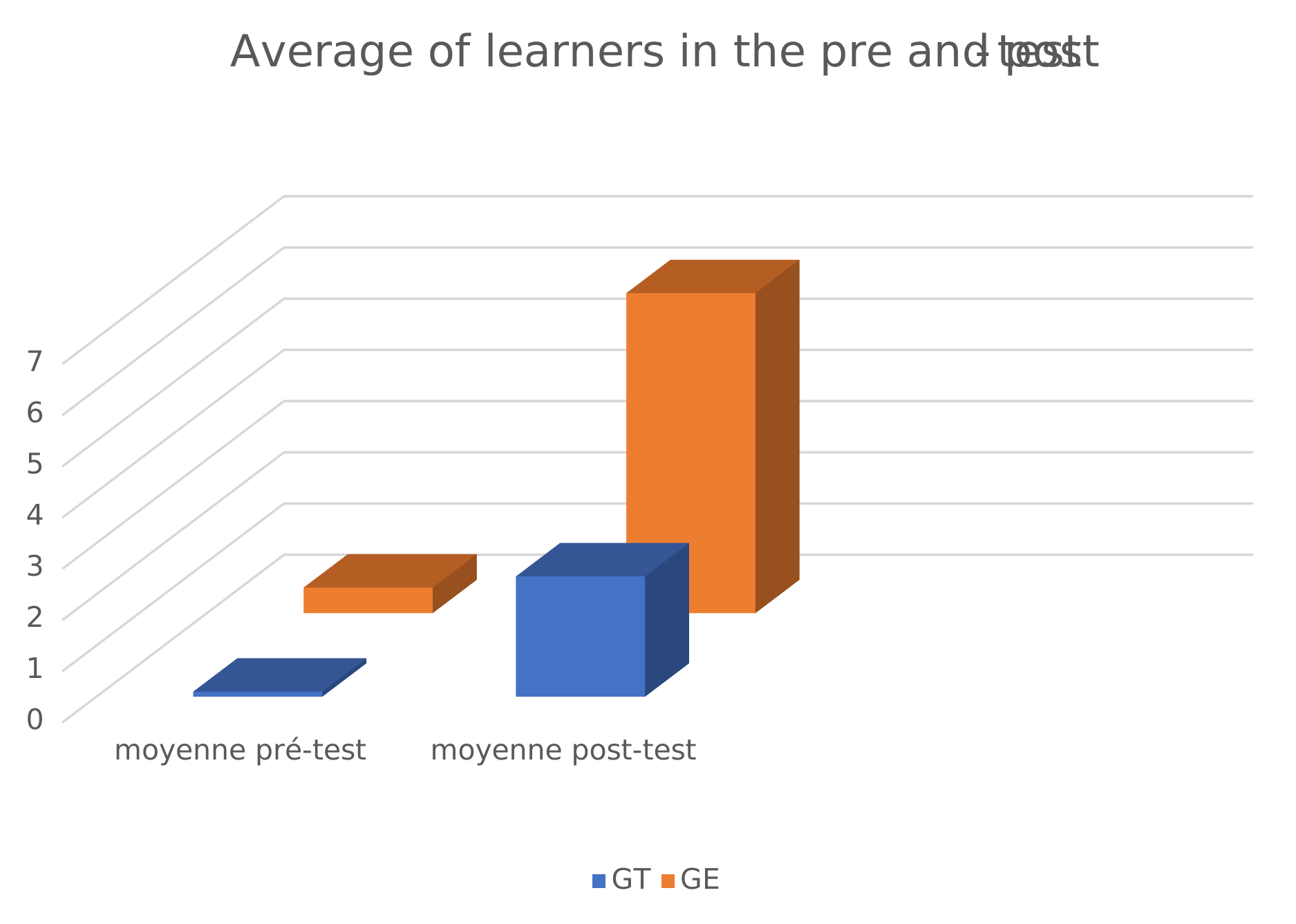
From the analysis of this figure, it is seen that the averages of the learners of the two groups have increased. However, the average of the experimental group is much higher than that of the group; therefore, the experimental group performs better than the control group. This result would attest that taking into account learners' conceptions in the construction of their knowledge improves their academic or disciplinary performance.
Considering that the improvement of learners' performance would depend on the quality of their production, which would denote a conceptual evolution, we will qualitatively analyze the productions of the students of the two groups in pre- and post-tests.
3.3. Presentation of the students' productions
As a general observation, the analysis of the content of the outputs of the learners in the experimental group shows that the latter have undergone a significant conceptual evolution, which has resulted in an improvement in the quality of their proposals at the post-test, compared to the proposals of the learners in the control group. To illustrate this, we have chosen the productions of five learners in each group.
In the experimental group, if we consider the notion of karyotype, the definitions proposed during the pre-test (collection of conceptions) do not indicate that the karyotype corresponds to a schematic representation of chromosomes. However, during the post-test, the learners indicate that this notion refers to a schematic representation of chromosomes and that these can be classified in pairs or not. This increase in growth is not observed in the control group, where the learners' proposals at the post-test do not bring out these two essential aspects of the notion of karyotype. Nevertheless, although they arestructured males, the proposals of the learners in the control group show a rapprochement between the karyotype and the chromosomes. Apart from the fact that their proposals were wrong at the post-test and therefore did not evolve, in some participants they remained identical to those of the pre-test; for example, we can cite the case of Claire.
Regarding the second notion which refers to the chromosomal abnormality, it can be observed that, the participants in the experimental group made a conceptual evolution, because at the post-test, they were able to indicate that whatever its nature, a chromosomal abnormality is the consequence of the modification of the number of chromosomes of an individual, as indicated respectively by Hermann and Leslie: "A chromosomal abnormality is a disease due to the change in the number of chromosomes of an individual" or "A chromosomal abnormality is the change in the number of chromosomes in an individual's karyotype". In the control group, based on the analysis of the learners' productions at the post-test, there was no improvement in their initial conceptions. Despite the lessons learned, the learners' conceptions have not evolved, but have rather been reinforced although they are erroneous, which reflects their resonance. This can be seen in the pre- and post-test productions of Rosa, Pierre, Joseph and many others. In Rosa's case, for example, in the pre-test we have: "a chromosomal abnormality is the deformation of chromosomes in the karyotype", and in the post-test, we have: "a chromosomal abnormality is a disease due to the malformation of chromosomes in the blood". These two propositions indicate that for Rosa, a chromosomal abnormality would be the consequence of a modification of the structure of the chromosomes, hence the resonance of her initial conception, in this regard. This reinforcement of conceptions is also observed in other learners in the same control group.
Regarding the question of the origin of chromosomal abnormalities and their consequences, the analysis of the learners' outputs in the two groups in the pre-test are similar, and they present a chromosomal abnormality as consequences of chromosomes structure modifications. However, at the post-test, there is a conceptual evolution of the learners in the experimental group. This is reflected in the fact that these learners were able to indicate that a chromosomal abnormality originated on the one hand in the production of gametes with an abnormal number of chromosomes, and on the other hand in the participation of these abnormal gametes in fertilization. For example, this can be illustrated by the propositions of Venus, who indicates in the pre-test that: "the origin of a chromosomal abnormality is due to the deformation of the gene in the genetic information", and in the post-test that: "chromosomal abnormalities are due to the fertilization of normal gametes with abnormal gametes obtained during abnormal meiosis".
In the control group, the analysis of the post-test productions shows an absence of conceptual evolution, but rather a pervasiveness of the initial erroneous conceptions, as is the case with Claire or Rosa. Moreover, for other learners, the absence of conceptual evolution results in the production of new conceptions, but which remains erroneous; this can be observed with the proposals of Joseph, who in the pre-test indicates: "a chromosomal abnormality can come from a malformation of the chromosomes", and in the post-test: "the chromosomal abnormality is genetic. It comes from the association of two individuals, namely male and female, whose blood groups are not compatible." This comparative analysis of the learners' productions at the pre- and post-tests shows that the learners in the experimental group have achieved a conceptual evolution, unlike the learners in the control group who have experienced a resonance of their conceptions; which would explain the improvement in their performance. In an end, the analysis of the post-test productions indicates that the learners in the experimental group improved not only their declarative knowledge (definition of expressions), but also their conditional knowledge by explaining the scientific processes relating to the origin of chromosomal abnormalities; This was not the case for the learners in the control group, who only slightly improved their declarative knowledge.
In order to understand the origins of the improvement in the performance of learners in the experimental group, we will present in turn the factors of the act of teaching and learning that are responsible for it.
3.4. Factors in improving learners' performance
3.4.1. Socio-cognitive conflicts and learners' performance
In order to establish a cause and effect relationship between the socio-cognitive conflicts inherent in taking in considering learners' conceptions and learners' performance, we will use the answers of learners in the experimental group to questions (Q): Q10, Q11, Q12, Q13.
From the analysis of the content of answers proposed by the learners, it emerges that socio-cognitive conflicts between learners improve learning and school performance, thanks to the lasting conceptual evolution that it induces. This is justified by their recurrent use of certain expressions that show that this pedagogical style promotes learning. In an end, we can quote: "we don't forget easily, knowledge remains automatically, it flows like crystal water". The results of this qualitative analysis of the responses of the learners in the experimental group are supported by the results of the quantitative analysis at the post-test in Figure 1, which shows that the experimental group at the end of the experiment works better than the control group.
3.4.2. The relationship to knowledge and performance
To highlight a possible influence of the knowledge on learners' performance, the answers to the questions: Q4, Q5, Q6, Q7, Q8, of the questionnaire administered to the experimental group will be used.
From the analysis of the answer’s content, it can be observed that at the beginning of the year, some learners have a negative relationship with the Science discipline related to SVT, due to the bad experiences they encountered with the latter. However, at the end of the experiment, it is observed that their relationship with Science has improved, to the point of being favourable to learning, because of the consideration of their initial conceptions by socio-cognitive conflicts initiated in a pedagogy group for this purpose. This would have allowed a greater involvement of the learners of the experimental group in the construction of their knowledge, all thanks to the perception of the importance of this discipline in the resolution of their daily problems, or the continuation of their studies. It turns out that personal research, pedagogy group, and the various debates illustrating socio-cognitive shocks motivated the learners in the experimental group to take ownership of the act of learning, which in return improved their ability to reason, their ability to defend a point of view with confidence and their self-esteem. This evolution of the relationship with science, which is nowfavourable, can be justified by expressions such as: "I can reason better, I am able to express myself in public, to avoid diseases and to fight against diseases".
From the analysis of the answer’s content proposed by these learners in the experimental group, it appears that the consideration of their conceptions of science in the act of teaching and learning has aroused in them a motivation to learn this discipline. It can be observed that this motivation would be the consequence of the gratifying aspect of taking into account their conceptions of their ability to reason, to understand the concepts easily because they are constructed through exchanges between students within a group or within opposing groups; and this possibility of transferring skills in writing or speaking, in other disciplines.
4. Discussion
In this part, it is a question of providing an interpretation of the results of this work by taking into account previous similar studies. Knowing that the aim of this research work is to show the influence of taking into account learners' conceptions on their academic performance, this discussion of the results is structured, around two essential aspects inherent to our study theme, as follows:
- Influence of socio-cognitive shocks on learners' academic performance;
- Influence of the type of relationship to knowledge on learners' academic performance.
Subsequently, the professional implications of this study will be presented with a view to highlighting its contribution to the improvement of the teaching-learning process and, in turn, to the improvement of teachers' professional skills and students' academic performance. To close this part, the limitations of this study is also presented, followed by suggestions.
4.1. Influence of socio-cognitive shocks on learners' academic performance
At the end of this study, the analysis of the results obtained showed that taking into account the initial conceptions of the learners of the experimental group in the teaching and learning process, by the establishment of socio-cognitive conflicts between the learners in a pedagogy group, improved their performance; results were observed at the end of the post-test. These results were in line with the work of Maëlia Morin [12], in which she indicates that, considering learners’ conceptions promotes learning and an extension in the achievement of good academic performances; which is in alliance with several other studies. About this, taking into consideration the learners' conceptions promotes their conceptual evolution in a sustainable way. Indeed, his work has shown that in a teaching and learning model where there is a didactic use of conceptions, the conditional knowledge of learners is improved and their initial conceptions do not come back at the end of the school year in most cases; observations made with the experimental group. Similarly, Christine Partoune [13] states that "true scientific learning is defined at least by the conceptual transformations it produces in the individual through the acquisition of information and knowledge". In accordance with our theoretical framework, this improvement in performance is dependent on the socio-cognitive shocks thanks to which, at the end of the confrontation of opinions, the learners of the experimental group were able to experience a conceptual evolution. Various authors highlight this influence of socio-cognitive shocks on learning by extension on performance. Ernestine Rouvière and Zoulayka Mhoumadi [14] have observed in their work that peer confrontation has a positive influence on learning insofar as it leads to a questioning of representations, which promotes the appearance of new knowledge. Surely, this is because, sociocognitive shocks lead the learner to cognitively integrate new information that will allow the development of new cognitive structures. Similarly, Sinclair Parfait Dasse, in his thesis on "the management of sociocognitive conflict and school performance" [15], indicates that the use of sociocognitive conflicts in learning encourage learners' to learn and perform. These results are also in agreement with the work of Dalzon [16] who also observed in his work that sociocognitive conflict improves learning and therefore learners' performances. For this researcher, socio-cognitive conflict leads to a cognitive conflict and a social conflict that disposes each learner to internalize the inter-individual coordinations that are responsible for subsequent individual progress.
4.2. Influence of the type of relationship to knowledge on learners' academic performance
In agreement with the Tramp [17], introducing the learning mobilities at the same time as the relationship to knowledge, to be in a relationship with the world, to others and to oneself. In his opinion, like those of the other researchers, the guarantee of good academic performance is an entry into education. The results of this study revealed that, considering the learners' conceptions allowed them to have a different appreciation of the discipline of study and to be open to learning, thanks to the improvement of their relationship to knowledge, because the pedagogical model used, highlighted the importance of science in their lives or in their school ambitions. The consequence of this favourable relationship to knowledge is learning which allows them to give meaning to this discipline, which also allows the help of other factors to improve learners' performances, as observed at the post-test. This result is explained by the work of Séverine [18] who has shown that the perception that students have of their academic level as well as the relationship they have with the disciplines significantly influence, in the statistical sense of the term, their academic results. Similarly, Charlot [19] indicates that an enthusiastic relationship with knowledge contributes to giving more meaning to learning, which further promotes academic success. Other researchers such as Geneviève Therriault and her collaborators have also shown that a positive relationship with knowledge (enthusiastic or favourable) leads to motivation and real commitment to academic learning, the result is an improvement in students' academic success. The favourable relationship to knowledge is learning, that has been developed among students and has led to a conceptual evolution of learners; which would further justify the improvement in performances that has been observed. Laurence Catel [20] and her collaborators, who have shown that, when a student has a favourable relationship to knowledge, the later achieves an important conceptual evolution that improves his or her academic performances, corroborate the influence of the type of relationship to knowledge on conceptual evolution. This influence of the relationship to knowledge on conceptual evolution is also demonstrated by Chartrain and Caillot [21], and by Emmanuella Di Scala et al. [22].
4.3. Study Suggestions or Recommendations
The suggestions of this study are directed at teacher training schools, textbook designers, but also supervisors of the educational chain which are inspectors.
In agreement with the pioneers of the new education and many didacticians, a sustainable construction of knowledge is only possible if the learner, who is not devoid of knowledge, is placed at the heart of the teaching and learning process. This is in line with the APC that is in force in Cameroon. However, putting the learner at the heart of teaching and learning refers to taking into account his initial conceptions and their proper use, even if they are wrong. To do this, the initial training of future teachers in the “École Normale de l'Enseignement” should give them these professional skills so that, when the time comes, they will use pedagogical styles that allow them to make better use of the learners' initial conceptions.
In this regard, knowing that once teachers leave the training schools, they regularly participate in pedagogical days, supervised by regional and national educational inspectors, for the strengthening of their capacities, the latter can only receive quality continuous training, a guarantee of the improvement of their professional skills, if their supervisors themselves are equipped. It is on the strength of this that it will be possible for educational inspectors to be trained beforehand in these new teaching and learning methods for better popularization.
For textbook designers, they should design activities that incorporate the teaching method considering learners' designs and making their best use in the classroom.
4.4. Professional implications
Speaking of professional implications, they must highlight the impact of the results of this study in improving teachers' didactic practices for an efficient improvement of learners' learning and academic performances.
Pedagogical implications
In a context where the teaching paradigm is the Competency-Based Approach or Integration Pedagogy, as is the case in Cameroon, the pedagogical style indicated must be interactive, with a focus on the learner because he is the one who learns; and not transmissive as observed in the field. To this end, this study revealed that the appropriate pedagogical style for sustainable learning and performance improvement is the one that promotes and considers learners' conceptions, socio-cognitive shocks through a good application of group pedagogy, a good use of learners' errors for the amelioration of knowledge by themselves. The socio-cognitive shocks that take place through the confrontation of initial conceptions allow the teacher to promote the development of learners' language skills, but also allows the latter to reconsider the status of their conceptions in order to access an evolved consensual conception that tends towards scientific knowledge, which is conductive to sustainable amelioration of knowledge and learning.
Didactic implications
In relation to the notions of benevolence and empathy in relation to educational intervention, the teacher must create optimal conditions for learning, from the pre-active phase to the post-active phase. This study showed that improving learners' learning and performance in classroom situations requires the design of teaching devices that are based on the DiPHTERIC approach, which requires, at the beginning of any teaching and learning sequence or a course session, the collection of learners' initial designs for their optimal use according to Giordan's allosteric model. Taking into account designs, as observed in this study, allows the teacher to situate the level of learners' prerequisites, to determine the obstacles of learning, this in order to help them overcome, but also to motivate them to engage in studying activities for successful learning. In addition, knowing that professional skills influence classroom practices, this study also highlights the interest of good initial teacher training, since many teachers practice isomorphism in their classroom practices.
4.5. Prospects
The fundamental problem of school seems to be that of academic failure, which is dependent on the lack of lasting learning. In the context of this study, thanks to the results obtained, it is observed that the sustainable development of knowledge and effective learning are only observed in teaching-learning situations where in an interactive pedagogical approach the initial conceptions of learners are considered. This shows that one of the solutions to the problem of school failure is the improvement of the professional skills of SVTEEHB teachers, even in the new paradigm of popularized teaching in Cameroon, namely APC. Knowing that the vast majority of teachers remain non- professionals, initial teacher training does not already provide an effective response in this regard so it is necessary that the service training should be of quality and that it responds to this problem. In relation to the didactic concept of the master effect on learning and school performance, future research may focus on the relationship between the professional competences of SVTEEHB teachers and the sustainable learning and academic performance of learners.
In short, it is remembered that the didactic consideration of learners' initial conceptions in the teaching and learning process allows for a conceptual evolution, a favourable relationship to knowledge to sustain learning; and consequently improve learners' academic performances. In an end, teachers must abandon transmissive pedagogical methods for interactive methods in the APC, in which the child being placed at the core of the teaching and learning process, they consider his initial conceptions didactic for the amelioration of their knowledge. In the opinion of didacticisms, the core of the teaching and learning process of the learner is essential and even indispensable for a sustainable amelioration of knowledge because it is up to the child to declutter these conceptions for a greater reconstruction through socio-cognitive shocks. It is therefore illusory to think that a child learns because a teacher devoted to his task transmits knowledge to him, under the pretext that he is devoid of knowledge. This is why Charpak [] states that: "it is not because the teacher has treated his entire program and conducted his course seriously that the student has acquired knowledge. The latter is not integrated by simple passive transmission from a person who knows to a student."
This prerequisite therefore raises the problem of the professional skills of SVTEEHB teachers in Cameroon, and therefore implies a questioning of the quality of initial teacher training, but also of the quality of in-service training within the framework of teaching councils led by pedagogical facilitators within the disciplinary departments and within the framework of pedagogical days organized by the Pedagogy Inspectorate. It is on the basis of this that a research avenue for this study may give rise to an interest in the relationship that would exist between the professional competences of SVTEEHB teachers and the sustainable learning and academic performance of learners.
References
- NGONO (2010). Didactics of SVT teaching in Cameroon. Online.
- GIORDAN, A. (1998). Learn. Paris :Bélin, P.153-163.[CrossRef]
- Reynal, F et Rieunier, A. daire de pédagogie
- GIORDAN, A. and DE VEictionnCCHI, G. (2010). The origins of knowledge - The method for learning. Nice: Editions Ovadia. PP. 31-138.
- DUPLESSIS, P. (2008). Students' conceptions at the center of information didactics. IUFM of the Pays de la Loire. GRCDI seminar "context and challenges of information literacy, approaches and questions of information didactics". P. 3-18.
- Joshua and duppin 1999
- SILLAMY, N. (1999). Dictionary of Psychology. Paris: Larousse.
- WWW. Seeds of Peace. Org. (2019).
- LENOIR, Y. (2004). Educational intervention: from its conceptualization to its actualization. Meirieu 1987
- ASTOLFI, J-P. and DEVELAY, M. (2002). The Didactics of Science. Paris, PUF, "Que sais – je?", 6th edition.
- MAËLIA, M. (2016). The importance of taking into account the initial conceptions to build a scientific concept. Memory. University of Orleans and Tours.
- CHRISTINE, P. (2012). Representations and conceptions. University of Liège, Laboratory of Geography Methodology.
- ERNESTINE, R. and ZOULAYKA, M. (2018). Learning and motivation, freedom and performance of students in group situations. Memory. University of Aix-Marseille.
- SINCLAIR, P.D.B. (2021). Management of socio-cognitive conflict and academic performance: the case of learners in some general education high schools in the Far North region. Memory. Department of Educational Sciences. “Ecole Normale Supérieure”. University of Maroua.
- DALZON, C. (1990). Interactions between peers and construction of the right-left notion in children aged 7-8 years. Ph.D. thesis, University of Provence, Aix en Provence.
- CHARLOT, B. (2000). The problem of the relationship to knowledge. In relation to the knowledge and learning of science, In Proceedings of the fifth International Colloquium on Didactics and Epistemology of Science. P.13-25.
- SEVERINE,L, B-L. (2005). The subjective experience of students in the second grade: influence on academic results and career wishes. Educational and vocational guidance, 34/2. P.143-164.
- CHARLOT, B. (2001). The relationship to knowledge in the working class. Paris: Anthropos.
- LAURENCE, C., MARYLINE, C., MAGALI, G. (2002). Relationship to knowledge and differentiated learning of scientific knowledge of middle and high school students: what questions. ASTER NO 35, Paris Cedex 05.
- CHARTRAIN, J. L. et CAILLOT, M. (2001) Relationship to knowledge and scientific learning: what methodology to analyze the type of relationship to knowledge of students? IUFM Marseille. SKHOLE, Special Issue, PP. 153-168..
- EMMANUELLA, D. S., PHILIPE, R., NATHALIE, P., ROBERT, A., et SAMUEL, R. (2016). The impact of the relationship to learning on the evolution of scientific conceptions. Research and Education, 15, p.153-170.
- CHARPAK, G. (2011). The hand in the dough. Science in primary school. Paris: Flammarion. PP. 34-48.