
Abstract
This study developed a co-design model for integrating children’s drawings into textile design and production within Ghana’s Creative Arts and Design (CAD) curriculum. Using a qualitative research design informed by Design-Based Research, the study involved 24 teachers and 120 visual artworks produced by pre-school and primary school learners from the northern, central, and southern zones of Ghana. Through co-design sessions, learners engaged in establishing narratives, contextual reflection, ideation, and low-tech prototyping to transform their artworks into textile designs and products. The findings informed the development of a context-specific model comprising three iterative phases and six textile design stages: motif, trace, transfer, arrange, colour, and texture. The model provided opportunities for learners to develop creativity, critical thinking, problem-solving, collaboration, decision-making, and practical design skills while expressing their cultural identities and everyday experiences. The study concluded that integrating co-design into the CAD curriculum can promote child-centred, culturally responsive, and inclusive learning while positioning children as active design partners. The study recommended incorporating the model into pre-school and primary school teaching practices to strengthen creative learning and practical textile design education in Ghana.
1. Introduction
The early years of education are critical for developing children’s cognitive, creative, social, emotional and psychomotor capacities. Consequently, contemporary early childhood education emphasises learning environments in which children actively construct knowledge through exploration, interaction, experimentation and creative expression. In Ghana, this orientation is reflected in the Kindergarten and Creative Arts Curriculum (2019), which promotes play-based and child-centred learning and provides opportunities for learners to self-explore, self-express, develop mental focus, use their hands skilfully, and cultivate creativity, critical thinking, problem-solving and collaboration (NaCCA, 2019) [1]. The curriculum further advocates holistic learning experiences that encourage participation, brainstorming, decision-making and inclusive collaboration.
These curriculum aspirations provide a strong basis for involving children as active participants in the design of learning experiences and products. Co-design extends child-centred pedagogy by positioning learners as contributors to the generation, development and evaluation of ideas rather than merely recipients of predetermined designs (Sanders & Stappers, 2008) [2]. In this process, children's experiences, preferences, imagination and creative expressions become valuable sources of design knowledge. Evidence from Ghana supports this perspective. Jaasma (2015) [3], in a co-design activity with primary school learners in Abetifi, found that engaging children in transforming readily available waste and natural materials into useful or aesthetically appealing objects provided opportunities to develop leadership, ingenuity, creativity and confidence.
Children's drawing activities are particularly relevant to co-design because drawings can communicate children's experiences, ideas and meanings and provide evidence of their thinking and learning (Coates & Coates, 2016) [4]. In textile design, such visual expressions can serve as initial design resources from which patterns, colour combinations and surface designs can be developed. The transformation of children's drawings into textile products therefore creates an opportunity to connect creative expression with practical designing and production, while allowing learners to see their ideas translated into tangible products.
Despite the emphasis on creativity, collaboration, practical activity and learner participation in Ghana's Creative Arts curriculum, there remains a need for a systematic pedagogical model that guides teachers in involving young learners in authentic textile design processes. Existing curriculum provisions establish desired competencies but provide limited guidance on how children's visual expressions can be systematically developed into textile patterns and products through co-design processes.
This gap is particularly important because learners differ in age, cognitive development, motor abilities, cultural experiences and creative capabilities. Again, Ghana's curriculum promotes creativity and participation, but there is a lack of a structured, context-specific model showing how children's drawings can be collaboratively transformed into textile designs and products. A contextually appropriate co-design model could therefore provide a structured pathway from observation and reflection, through idea generation and experimentation, to textile pattern development and production.
Against this background, this study seeks to develop a co-design model for supporting the Creative Arts and Design (CAD) curriculum in textile designing and production. The model is intended to position children as active design partners and harness their visual artworks as sources of textile design ideas, thereby connecting creativity, collaboration, practical skills, cultural expression and learner-centred pedagogy within Ghanaian basic education.
2. Literature Review
2.1. Co-Design in Creative Arts and Design
Co-design is an approach that involves users and other stakeholders directly in generating, developing and evaluating solutions rather than designing solely for them (Sanders & Stappers, 2008) [2]. It recognises participants as contributors whose experiences, knowledge and creativity can inform the design process (Moll et al., 2020) [5]. In Creative Arts and Design (CAD), co-design provides opportunities for learners to explore, generate and refine ideas through drawing, experimentation, material manipulation and collaborative decision-making. It therefore shifts the learner from a passive recipient to an active contributor to the design process. The approach is particularly relevant to textile design, where children's visual ideas can be collaboratively transformed into patterns and products.
2.2. Children as Co-Designers
Children's participation in co-design reflects their capacity to communicate experiences, express preferences and contribute ideas about issues that affect them. Mutch (2016) [6] positions child-centred research as involving children as partners in research design, implementation and interpretation, while Clark (2005) [7] emphasises viewing children as active social actors rather than passive recipients of adult decisions. Co-design can therefore provide children with accessible ways of expressing ideas through drawing, storytelling, play, colour, materials and other visual or practical activities. Druin (2002) [8] argues that appropriate participatory methods can reduce barriers associated with children's limited verbal expression and enable them to contribute more meaningfully to design processes. In CAD, positioning children as co-designers can consequently make their creative abilities, experiences and preferences integral to the development of textile designs.
2.3. Educational Benefits of Co-Design
Co-design can support both creative outcomes and learners' intellectual, social and practical development. Through active participation, learners develop opportunities to generate ideas, experiment, reflect, collaborate and make decisions (Lam & Pitsaki, 2019) [9]. The process can also enhance creativity, empathy, confidence and interaction among participants (Sanders & Simons, 2009) [10]. In educational settings, co-design enables learners to see how their ideas contribute to tangible outcomes, thereby supporting critical thinking, problem-solving and metacognitive awareness. Importantly, its value extends beyond the final product because the process itself can develop learners' confidence and capacity to apply creative thinking to new problems (Lam & Pitsaki, 2019) [9]. For CAD and textile education, these benefits make co-design a potentially effective approach for transforming children's creative expressions into meaningful textile design and production experiences.
2.4. Co-Design Methods with Children
Co-design with children employs a range of participatory methods that enable them to express ideas, observe contexts, generate concepts and develop design solutions. Common approaches include narrative-based, observation-based, documentation-based and art-based methods. Narrative methods such as Embodied Narratives and Mission from Mars facilitate children's expression through play, storytelling and performance, while observation-based methods such as Contextual Inquiry help researchers understand children's activities in their natural environments. Documentation-based methods engage children in collecting and recording information through photographs, interviews and written accounts. Art-based methods, including Comic Boarding, Mixing Ideas and Layered Elaboration, use drawing, low-tech materials and iterative activities to support idea generation and collaborative problem-solving.
2.5. Co-Design Models and Frameworks
Several models provide structured approaches for involving children throughout the design process. Druin's Cooperative Inquiry integrates contextual inquiry, low-tech prototyping and technology immersion, enabling children to participate in identifying needs, generating ideas, developing prototypes and evaluating solutions. Sanders and Stappers' framework further organises co-design into pre-design, generative, evaluative and post-design phases, emphasising a shift from designing for users to designing with users. Clark's Mosaic Approach similarly recognises children as competent participants and combines observation, interviews, photography, mapping, reflection and joint decision-making to capture children's diverse ways of expressing their experiences. These models demonstrate the importance of providing children with developmentally appropriate tools and opportunities to contribute meaningfully to design decisions.
2.6. Relevance of Co-Design Methods to Children's Textile Design
The reviewed approaches provide useful principles for developing a co-design model for children's textile designing and production. In particular, observation and reflection can help children identify visual forms and meanings from their environment; drawing, brainstorming and mixing ideas can support the generation of textile motifs and patterns; while low-tech prototyping and iterative development can enable children to experiment with pattern arrangement, colour and repeat. The use of accessible materials such as paper, crayons, clay and other low-cost resources is particularly relevant to school-based Creative Arts and Design contexts. Thus, rather than adopting one existing model wholesale, the present study can synthesise appropriate elements from established co-design approaches into a context-specific model that connects children's visual expressions with textile design and production.
2.7. Empirical Supports of Co-Design
Empirical studies demonstrate the potential of co-design to support children's creativity, participation, collaboration and learning. Jaasma and Lu (2015) [3], working within a Ghanaian community, showed that co-design based on local knowledge, skills and resources can create opportunities for experiential learning, creativity, confidence and problem-solving. Their Discover Area initiative also demonstrated the value of waste and natural materials in supporting practical learning and community participation. This finding is particularly relevant to Ghanaian Creative Arts and Design (CAD), where locally available and low-cost materials can be incorporated into children's design activities.
Alisha et al. (2020) [11] further found that children's perceptions of learning spaces differ from those of adults and that children's interactions with objects, places and peers contribute to knowledge construction. Using observation, narrative, documentation, art and game-based methods, the study demonstrated the importance of involving children directly as design partners in developing sustainable learning environments. The findings suggest that co-design can create collaborative learning experiences in which children actively contribute their perspectives and ideas.
Similarly, Alhumaidan (2017) [12] developed the Experience, Learn and Use (ELU) framework for co-designing augmented-reality textbooks with children. Building on Read's Play, Learn and Use model and Druin's cooperative inquiry, the study illustrates how children's participation can be incorporated into both the development and evaluation of educational products. The study provides support for structuring co-design processes around children's experiences, learning and use of designed outcomes.
Shruthi and Gray (2022) [13] identified four dimensions that influence effective co-design experiences: rhythms of engagement, material engagement, ludic engagement and conceptual achievement. They also identified the roles of the designer, researcher and facilitator. These dimensions emphasise the importance of carefully organising time, materials, playful experiences and intended outcomes when working with participants. For children's textile designing, these considerations are useful for planning age-appropriate activities, selecting accessible materials and maintaining active engagement throughout the design process.
Kerr et al. (2022) [14] further proposed an Integrated Co-Design Model that supports collaboration among multiple stakeholder groups across the different stages of a project, from initial scoping and ideation to implementation and post-project development. The model demonstrates the value of sustained stakeholder participation and provides practical guidance for managing complex co-design projects. Collectively, these studies indicate that effective co-design requires active participation, appropriate materials, structured facilitation, iterative development and opportunities for reflection and evaluation. However, the reviewed studies do not specifically provide a model that connects children's visual artworks with textile pattern development and production within the Ghanaian CAD curriculum. This gap provides a basis for developing a context-specific co-design model for the present study.
2.8. Textile Design Activities and Products
Textile design activities include creating motifs, colour ways, and layouts for textiles. The products of textile design include clothing, home furnishings, and art. Textile design activities and products typically include information on various textile design techniques like weaving, printing, dyeing, embroidery, and their applications in creating a wide range of products like clothing, home furnishings (curtains, bedding), accessories (scarves, bags), upholstery fabrics, and even art pieces, while also covering aspects like design development, colour theory, pattern creation, and material selection, with potential activities like sketching design ideas, experimenting with different dyeing methods, creating fabric samples, and exploring sustainable textile practices.
2.9. Theories Supporting the Study
2.9.1. Ecological Model of Bronfenbrenner
Bronfenbrenner's Ecological Model explains development as a result of continuous interaction between the learner and the surrounding social and physical environment. (Crawford, 2020) [15]. The theory supports the co-design model by recognising that children's textile design ideas are influenced by their home, school, community, culture, peers, teachers and available materials. Therefore, the model provides opportunities for learners to draw inspiration from their immediate environments and collaboratively transform their experiences, observations and cultural expressions into textile motifs and surface-print designs. The interaction between learners, facilitators, materials and the learning environment can consequently influence the development of both the designs and the learners' creative and practical skills.
2.9.2. Experiential Learning Theory
Kolb's Experiential Learning Theory explains learning as a continuous cycle of Concrete Experience, Reflective Observation, Abstract Conceptualisation and Active Experimentation (Kolb, 1984) [16]. The theory supports the co-design model by enabling learners to learn textile design through direct participation. Learners first experience visual artworks, textile patterns and printing activities; reflect on what they observe; conceptualise their observations into motifs, colours and pattern ideas; and experiment by developing and printing textile designs. The cycle allows learners to learn through doing and continuously improve their designs based on reflection and experimentation.
2.9.3. Constructivist Theory
Constructivism views learners as active participants who construct knowledge from their experiences and prior understanding (Piaget, 1967; Vygotsky, 1978) [17, 18]. The theory supports the co-design model by allowing children to use their existing artworks, experiences, observations and ideas as starting points for creating textile designs rather than simply receiving predetermined designs from the teacher. Through drawing, discussion, experimentation, collaboration and manipulation of materials, learners construct new knowledge about motifs, colour, composition, pattern repetition and surface printing. The teacher or researcher provides scaffolding and guidance, while learners progressively gain greater independence in developing and refining their textile designs.
3. Methodology
3.1. Study Design and Participants
Qualitative research design which involves Design-Based Research approach was used to answer the research question “What co-design model can be developed for textile product design activities among pre-school and primary school learners with varied cognitive developments? This was done to develop a co-design model for textile product design activities among pre-school and primary school learners with varied cognitive developments. This study was conducted among pre-school and primary school learners and teachers from northern, central and southern parts of Ghana. These schools/zones were selected because the researcher wants fair representation of learners across different cultures in Ghana. 24 teachers from Pre-School and Primary Schools and 120 visual art works from learners of three zones were purposely chosen and 49 were eventually converted into textile designs and products.
3.2. Measures
Studio-based designing involves co-designing sessions (co-design session brief) of developed model based on literature review was employed for textile product activities among pre-school and primary school learners:
- Co-Design Session Brief
- Equipment: Laptop, Phone with camera
- Materials and tools: Low-tech prototyping materials and tools for idea generation e.g. bond paper, crayon, colour pencil, etc.
Co-designing consisted of three phases:
- Establishing the narrative: Here learners were told that they were going to design a textile pattern to be used in the classroom for learning and the learners were divided into groups of ten (Duration: 10 min).
- Context and reflection: Children were shown a video of existing textile pattern and made to answer question “what did you see in the video that you watched?” Learners in their groups were given the art works produced by them and reflected to relate it to textile design patterns. (Duration: 15-20 min)
- Ideation: Low-tech prototyping materials and tools for idea generation were issued to the various groups and with facilitators and researcher guidance, learners designed textile patterns out of their existing visual artworks (Duration: 40 min). Pictures were taken whiles learners’ work.
- The same process described above was repeated for the other artworks collected from learners.
3.3. Procedure
The respondents were educated on the need to respond to the instrument (Co-design session/brief). Effort was made to establish good rapport with respondents which yielded accurate responses willingly by learners and teachers.
3.4. Data analysis
Thematic analysis was employed for data collection. With thematic analysis various themes were developed by the researcher and the respondents for the co-design session which resulted in the co-design.
3.5. Ethical Consideration
Individual participants of the study were provided with sufficient information on the significance of the study and as such an informed decision was made by the participant that ensured an agreement of trust between the researcher and the participants.
4. Discussion of Results
In order to draw a holistic view, models (Narrative-based Methods, Observation-based Methods, Art-based Methods, formative method, Sanders and Stappers’ Co-Design framework and Reads’ Play, Learn, Use Model) as well as the creative arts curriculum for pre-school and primary school were analysed in terms of relevant considerations and features including the main purpose of the method/technique, the activities included, the age of the participants, the skills required, the design field in which these methods and techniques were utilized, and pros and cons as portrayed in the literature review.
According to Shruthi and Gray (2022) [13], four multi-dimensional facets (Rhythms of Engagement, Material Engagement, Ludic Engagement, and Conceptual Achievement) and three roles (designer, researcher, and facilitator) need to be considered when creating co-design experiences. Rhythms of Engagement considers designing over time and space in a co-design. Material engagement considers designing of physical co-design material and logistics. Ludic engagement considers designing aesthetics experiences aspect of co-design. Conceptual achievement considers designing for goals to be achieved through co-design. All these were factored in the designed co-design model.
4.1. Co-Design Model Development
Based on the data collected and analysed from the teachers and the children’s works, a co-design model was developed (Figure 1). In developing the co-design model, literature on co-designing in conjunction with studio-based designing were reviewed to gain knowledge about the co-design approach, and methods and techniques for co-designing with children. This knowledge constitutes the basis for developing the co-design method. However, the review of existing co-design methods and techniques integrating children into design process requires an analysis on a different level before it can be utilized for the development of a co-design model. The steps such as establishing the narrative, context and reflection as well as ideation and low-tech prototyping resulted from the reviewed literature and CAD Curriculum for the development of the model. The textile design process (motif, trace, transfer, arrange, colour and texture) was also simplified for easy use by the learners and the teachers.
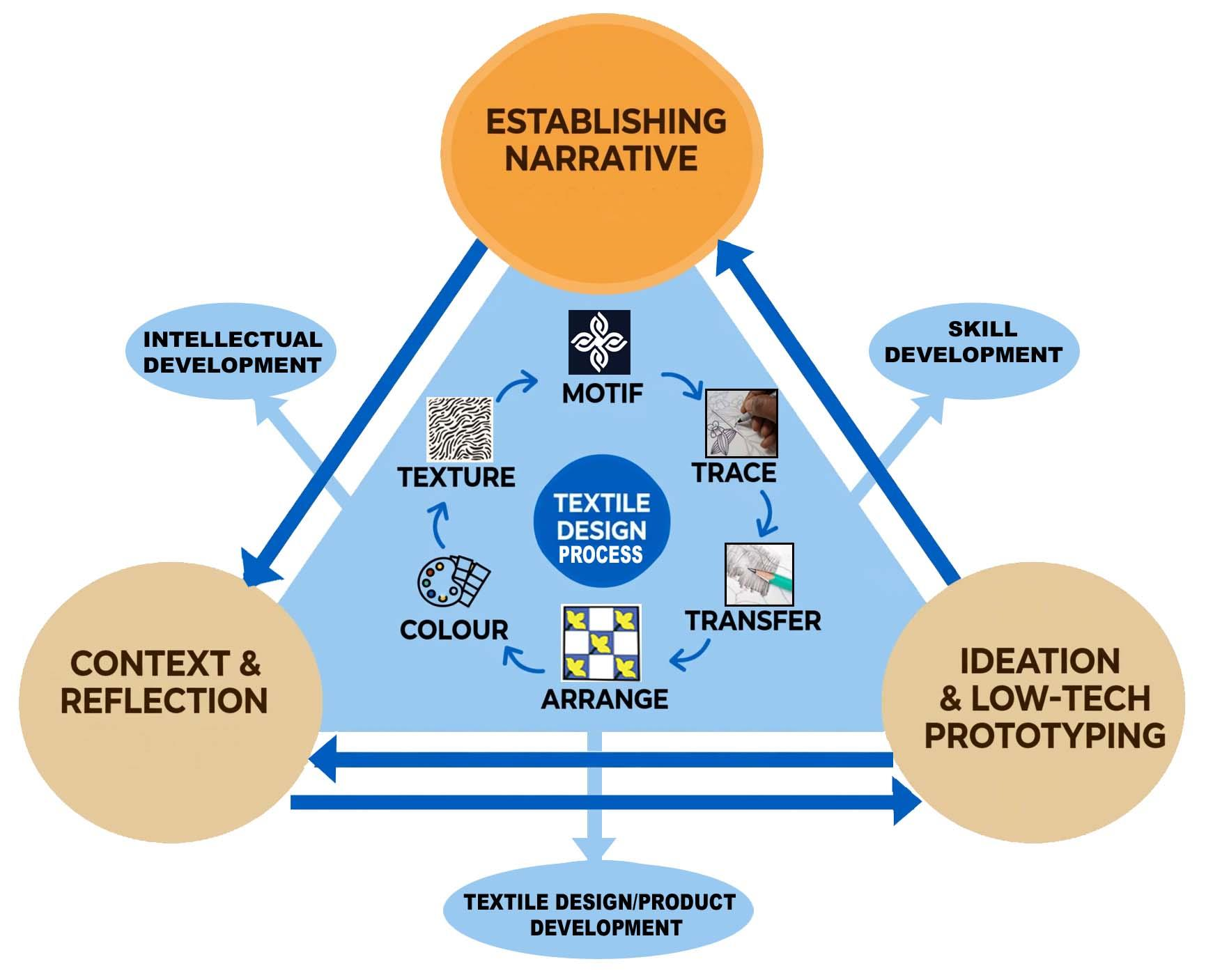
The model as illustrated (Figure 1) operates on three iterative phases and six stages of textile design process flow for learners’ textile design activities. The first phase, (Establishing the Narrative), involved co-constructing meanings into creation of textile designs, and curriculum requirements with learners and teachers. At this stage learners were shown samples of textile designs related to children. This ensured that the designs were not researcher-imposed but rooted in the Ghanaian child’s lived day-to-day experience, aligning with the culturally responsive pedagogy advocated in the Standards Based Curriculum (NaCCA, 2019) [19]. The second phase, (Context and Reflection), situated prototypes within the realities of Ghanaian basic school classrooms to evaluate feasibility and suitability in the use of elements and principles of textile designing. Children were shown videos of existing textile designs so as to familiarise with the textile design tradition. The double arrow between phases two and three emphasizes iteration and reflective observation, consistent with Vygotsky’s (1978) [18] social constructivism which posits that children construct knowledge through social interaction with more knowledgeable others (NaCCA, 2019) [20].
The third phase, (Ideation and Low-Tech Prototyping), constituted the core making phase where children used accessible, low-cost materials such as coloured pencils, cartridge papers, pencils, tracing papers to create textile designs in the classroom environment.
While the outer triangle outlines the participatory research approach, the inner six-stage cycle details the actual textile design production flow. The cycle begins with Motif, which develops creativity and sense of aesthetics and symbolism; Trace, which builds concentration and fine motor control; Transfer, which introduces tool and material handling; Arrange, which develops mathematical thinking through symmetry and pattern counting (Hutson et al., 2023) [21]; Colour, which teaches colour theory and basic skill of combining colours; and Texture, which enhances sensory evaluation. This integration demonstrates that when textile design is positioned not merely as product-making but as a pedagogical tool, which directly supports the Creative Arts and Design competencies outlined by NaCCA (2019) [20] for intellectual and psychomotor growth. The model indicates intellectual development, skill development as well as textile design and product development as important outcomes of the co-design process. The various design activities require children to observe, analyse, compare, make decisions, solve problems, experiment, evaluate alternatives, think creatively and reflect on their choices.
Therefore, textile co-design is presented not simply as an artistic activity but as an intellectual and cognitive learning process. For example, deciding how many times a motif should be repeated requires planning and reasoning. Choosing appropriate colours requires comparison and evaluation. Modifying a prototype requires problem-solving.
The model emphasises skill development in the sense that participation in textile co-design enables children to acquire practical and creative skills. These may include drawing skills, tracing, transferring, pattern arrangement, colouring, manipulation of materials, hand-eye coordination, communication, collaboration, experimentation and problem-solving. This model also indicates textile design and product development which is the eventual transformation of the children's design ideas into a tangible textile designs and eventual conversion into products including bags, cushions, wall hangings, tablecloths, clothing, textile panels, classroom decorations and other textile-based products.
The downward arrow from the central design process indicates that the outcomes of the design cycle can be translated into actual designs and products. It is important to note that the products are not simply produced for the children; it is developed through their participation in the design process.
5. Conclusion
The developed co-design model provides an effective and culturally responsive framework for engaging pre-school and primary school learners with varied cognitive abilities in textile design and textile product development. The model, which incorporated narratives, context and reflection, and ideation processes, successfully aligned with the Creative Art and Design curriculum and reflected established principles of effective co-design practice. Furthermore, the model demonstrated essential qualities of successful co-design engagement, including active participation, material interaction, playful learning experiences, and conceptual understanding. The findings therefore establish that co-design approaches can enhance inclusive participation, collaborative learning, and creative problem-solving among young learners from diverse cultural settings.
6. Recommendations
The developed co-design model should be integrated into the Creative Art and Design curriculum at the pre-school and primary school levels to enhance collaborative learning, creativity, and inclusive classroom practices. Teachers should adopt learner-centred, culturally responsive, and participatory teaching approaches that promote creativity, communication, collaboration, problem-solving, and self-expression among learners. The developed co-design model should be integrated into the Creative Art and Design curriculum at the pre-school and primary school levels to enhance collaborative learning, creativity, and inclusive classroom practices. Curriculum developers and teachers should incorporate culturally relevant narratives, practical activities, reflective exercises, and ideation processes that support learners from diverse cultural and cognitive backgrounds.
References
- NaCCA, (2019). Creative Arts Curriculum for Primary Schools (Basic 1 – 3), 2019. Ministry of Education.
- Sanders, E. and Stappers, P. (2008). Co-creation and the New Landscapes of Design. CoDesign: International Journal of Co-Creation in Design and the Arts, 4(1), 5–18. https://doi.org/10.1080/15710880701875068[CrossRef]
- Jaasma P. and Lu Y. (2015). Discover area: co-designing for situated learning within a Ghanaian community. 11th International Conference of the European Academy of Design (EAD 11), April 22-24, 2015, Paris, France - Université Paris Descartes, Paris, France. http://thevalueofdesignresearch.com/think-research-think-design-2/[CrossRef] [PubMed]
- Coates, E., & Coates, A. (2006). Young children talking and drawing. International Journal of Early Years Education, 14(3), 221–241. https://doi.org/10.1080/09669760600879961[CrossRef]
- Moll, S., Wyndham-West, M., Mulvale, G., Park, S., Buettgen, A., Phoenix, M., Fleisig, R. & Bruce, E. (2020). Are you really doing ‘codesign’? Critical reflections when working with vulnerable populations. BMJ Open. 2020; 10(11) doi: 10.1136/bmjopen-2020-038339.[CrossRef] [PubMed]
- Mutch, C. (2016). Engaging children in participatory research in sensitive contexts. SAGE Research Methods Cases Part 2. https://doi.org/10.4135/9781526403698[CrossRef]
- Clark, A. (2005). Ways of seeing: using the Mosaic approach to listen to young children's perspective. In: Clark, Alison; Kjørholt, Anne Trine and Moss, Peter eds. Beyond listening: Children's Perspectives on Early Childhood Services. Bristol: Policy Press, pp. 29–49. URL: https://www.policypress.org.uk/catalog/product_inf.[CrossRef]
- Druin, A. (2002). The role of children in the design of new technology. (2002). Behaviour & Information Technology, 21(1), 1–25. https://doi.org/10.1080/01449290110108659[CrossRef]
- Lam, B. & Pitsaki, I. (2019). Co-design for the development of new knowledge and practices in not-for-profit organizations. Design Management Journal, 13(1), 70-82. Advance online publication. https://doi.org/10.1111/dmj.12044[CrossRef]
- Sanders, L. and Simons, G. (2009). A Social Vision for Value Co-Creation in Design. Technology Information Management Review, December, 1-5.
- Alisha, S. and Martina, M. K. (2020). Co-Design with Children to Create a Sustainable Learning Space. Proceedings of 8th IOE Graduate Conference Peer Reviewed ISSN: 2350-8914 (Online), 2350-8906 (Print) Year: 2020 Month: June Volume: 8.
- Alhumaidan, H. (2017). Co-design of augmented reality textbook for children’s collaborative learning experience in primary schools (Doctoral dissertation, Loughborough University).
- Shruthi, S. C. and Gray, C.M. (2022). What Do I Need to Design for Co-Design? Supporting Co-design as a Designerly Practice. 1, 1 (October 2022), 34 pages.
- Kerr, J., Whelan M., Zelenko O., Harper-Hill K, and Villalba, C. (2022). Integrated Co-design: A Model for Co-designing with Multiple Stakeholder Groups from the ‘Fuzzy’ Front-end to Beyond Project Delivery. International Journal of Design. ISSN: 1994-036X (online); 1991-3761. Home > Vol 16, No 2 (2022).
- Crawford, M. (2020). Ecological Systems Theory: Exploring the Development of the Theoretical Framework as Conceived by Bronfenbrenner. Journal of Public Health Issues and Practices 4(2):170. DOI:10.33790/jphip1100170 85[CrossRef]
- Kolb, D. A. (1984). Experiential learning: Experience as the source of learning and development. Englewood Cliffs, NJ: Prentice-Hall.
- Piaget, J. (1997). The Principles of Genetic Epistemology. London, New York: Routledge.
- Vygotsky, L. S. (1978). Mind in society: The development of higher psychological processes. Cambridge, MA: Harvard University Press.
- NaCCA, (2019). Creative Arts Curriculum for Primary Schools (Basic 4 – 6), 2019. Ministry of Education.
- NaCCA, (2019). Kindergarten curriculum for preschools (KG 1 & 2). Accra, Ghana: Ministry of Education. Available at: https://nacca.gov.gh/wp-content/uploads/2019/06/KG-Curriculum.pdf
- Hutson, J., Robertson, B., & Trent, B. (2023). The integration of mathematics in textile design education: Pattern, symmetry and cognition. Journal of Textile Design Research and Practice, 11(1), 45-62.