
Abstract
The banking sector has shown a strong interest in scaling out and utilizing the microservices architectural pattern within their payments domain, not only to manage increased transaction volumes, but also for compliance and risk-related control. Financial organizations are adopting containerization technologies like Kubernetes and Docker to align with the microservices paradigm. Containerization provides the foundation for automation and operational excellence of microservice-based applications by enabling continuous deployment and automated build-test-release cycles. However, deploying a Kubernetes cluster and the services it hosts in production is not sufficient to guarantee a secure and compliant operating environment. Kubernetes itself should be secured to protect workloads, and risks associated with the services being deployed must be managed continuously.
1. Introduction
Cloud-based payment systems are facing ever-growing transaction volumes. Online retailers must handle extreme demand for short periods of time—the Black Friday weekend is reported to be the busiest shopping period of the year, with traffic surging by more than 30%. Web shops must also support a continuous stream of new visitors, who carry a little more than a modified browser every time they access a page. To meet these challenges, online services attempt to move towards elastically scalable systems that can automatically adapt to changing demand. Containerization and microservices are two architectural approaches that are seen as solutions to many modern business challenges, including demands for ever-higher scalability, flexibility, and maintainability of systems; a need to speed up deployment cycles while ensuring quality; and an ability to deploy functionality across cloud providers. Microservices allow system components to be developmentally independent and increase speed of change by making the underlying code base smaller and decreasing deployment and test cycles. Container-based deployment allows packages to be made immutable, deployed and scaled rapidly, and automatically rebuilt after subtle changes. When using these two architectural styles, respecting their natural principles when designing and building microservices creates a path to operational excellence [1].
1.1. Motivation and Scope
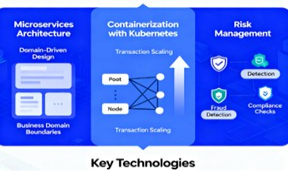
Modern technology and business processes require the ability to scale systems up and down with relative ease. Compliance requires a well-organized software stack that is easy to analyze and regulate; human error and system failure create risks that need to be well understood and managed. These are just a few examples of how container technology and the microservices enabled by these technologies add value. Microservices are architecturally significant when using containerization because they impact the overall system architecture. Domain-driven design and the microservices development pattern aim to minimize dependencies and allow teams to build, deploy, and test independently, as each microservice is focused on a small number of closely related business functions. Both scalability and risk management also correlate positively with aligning the microservices’ domain boundaries with the business domain boundaries of the company. The combination of containerization and microservices is powerful for large payment systems that must scale elastically to meet transaction volume peaks. Nevertheless, the mechanism also introduces additional complexity [2]. These containerization technologies are extensively used in modern technology stacks across numerous industries. Payments provide an opportunity to showcase the container technology ecosystem. The study, therefore, explores architecturally relevant aspects of using containerization for payment transaction systems and supporting services. The architectural foundations establish the necessary terminology, introduce key ideas in the ecosystem, and explain the patterns that are particularly applicable for payment systems. The discussion then considers how container technology and Kubernetes are typically used for payments and suggests aspects to consider when using these technologies [3].
1.2. Key Concepts: Containerization, Microservices, Kubernetes, Docker
Containerization uses OS-level virtualization to run multiple isolated environments (containers) on a single host. Popular implementations build on personalized Linux kernel functionalities: the c-group mechanism for resource control and the namespace feature for process isolation. Containers are also immutable, meaning they cannot be changed after being created. Instead, modifications are packed into new images, providing a consistent state across deployments. Images are organized as a layered filesystem, where new layers add or overwrite content in earlier layers, and any layer can be reused by multiple images, reducing image size and improving management. In addition, layers are simply tar archives on disk, making an image portable between hosts. Microservices are a specific architectural style that partitions an application into a set of small services, each independently developed, deployed, and versioned, and communicating via well-defined APIs. Despite recent attention, the style is not new; payment systems, in fact, often use microservices for their external-facing functions, isolating product offerings such as cards, transfers, and loans, and their interactions with external parties. In these systems, the complexity of orchestrating multiple services normally becomes a burden for regulators and audit firms. Adopting microservices for internal functions demands an additional level of intimacy with these parties, allowing new solutions to be presented with the usual guarantees of data integrity, latency, and other aspects required for high value exchange [4].
2. Architectural Foundations
Containerization and microservices are increasingly popular programming and deployment patterns. While these concepts originated and gained acceptance in e-commerce platforms, widespread use in payment systems thus far remains limited. Yet containerized applications are inherently scalable, and the microservices architecture mitigates many of the investment, compliance, risk, and change constraints on established platforms. Analysis of containerization and microservices principles within the payments domain surface unique challenges in practical application, leading to platform operation and security recommendations. Monolithic and microservices architectures offer different benefits and challenges in data-intensive systems. Monolithic architectures are often considered simpler and easier to guarantee data integrity, given that all components operate within a single process and can directly access shared memory and object pools. Scalable performance is also simpler to achieve, as all functionality can be integrated within a single transaction, without incurring interprocess communication latency. However, the fundamental attributes of payment system change – the low tolerance for scale, investment, and compliance risk – increase the importance of all communications being secure, reliable, and performant [5].
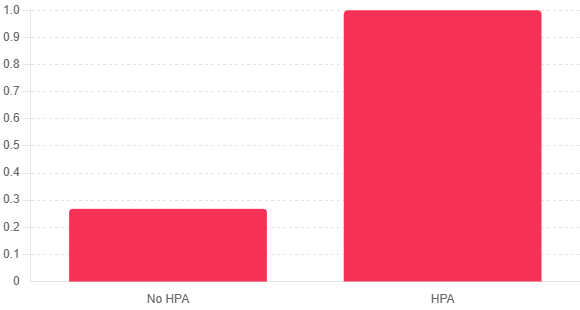
Equation 1: Service Scalability Ratio (SSR)
Goal in paper: quantify how well a microservice path scales to meet demand while staying within SLO (e.g., p95 ≤ budget).
Derivation:
- Let be incoming load (req/s) in interval , and be achieved throughput (bounded by capacity).
- Let indicate SLO met in interval (1 if p95 latency ≤ budget; else 0).
- The demand served within SLO in interval is min(, ).
- Normalize by total demand:
Interpretation: fraction of total demand actually delivered and SLO-conformant (↑ is better).
2.1. Monolithic vs. Microservices in Payments
Monolithic systems may appear simpler. Still, connections between components become increasingly complex as new functionality is added, risking the very SLA that semantically partitioned microservices ameliorate. The implications for data integrity are clear: distributed systems must have integrated domain-driven designs with bounded contexts and a contract at each integration point. These contracts require careful design, though, as interface changes can cause cascading failures. Latency budget requirements do not change, and a service mesh may be needed for observability, reliability, and usually also security of the inter-service communication. Regulatory oversight is directionally simpler in distributed systems, even though the breadth of compliance criteria becomes larger; in a single location, the policy must address the complete operation of the organization, while multiple locations must each consider local requirements, but not much else. The risk of systemic failure is also lower because it would require a concurrent failure in multiple organizations in different geographies [6]. Implications for operations are also more complex in microservices, as each service requires a full CI/CD pipeline to support testing and deployment as code changes. These pipelines must also be operationalized to automatically provision secrets and other configuration at deployment. The pattern described above remains relevant; without integrating security and compliance into each pipeline, the risk of an insecure deployment is high, especially for sensitive services, and the whole may not meet audit requirements. Even with automated building, testing, and deployment of new service instances, managing the image repository remains a significant effort [7].
2.2. Containerization Principles
Four principles underpin containerization: immutability, image layering, portability, and isolation. These principles together influence the boundaries of the services being containerized, as well as their deployment options. However, deployment patterns offering flexibility, such as the use of VMs, are best avoided in production systems, where security and configuration vulnerabilities tend to proliferate. In payment systems, the traditional defence offered by a corporate DMZ becomes less effective with the advent of cloud services, and the best practice is to deploy services in the cloud or cloud-product offering for which they were designed. Cloud providers also offer extensive processes for patching and updating their containerization services, effectively delivering the ongoing security investment that every modern service requires [8]. Immutability allows a service to catch bugs or vulnerabilities that only surface in production. It enables simple, safe strategies for replicating the service behaviour in other environments, including developers’ laptops. In a Docker model, this principle leads development teams to consider every dependency in the service, rather than just the application code. By using different base images across language runtimes, addressing extra-linguistic dependencies such as authentication tokens and selecting libraries carefully, teams can ensure that tests reflect the production environment as closely as possible. Additionally, it means that cloud providers can patch libraries without an update cycle for the application itself, if sufficient care has been taken: new images may automatically replace vulnerable libraries on container hosts [9].
2.3. Orchestration with Kubernetes
Kubernetes is an open-source container orchestration system for automating deployment, scaling, and management of containerized applications. Kubernetes supports container orchestration on multiple cloud providers and on-premise, enables configuration and automation of service discovery and load balancing, offers storage orchestration, and provides seamless management of containerized applications throughout their entire lifecycle. Its broader team of contributors develops features, plug-ins, and applications to address specific industry requirements. Kubernetes consists of various reusable modules. Within Kubernetes, the main building blocks are Pods (a group of containers with shared storage/network configured), Services (an abstract way to expose an app made up of one or more containers), and Deployments (provides declarative updates for Pods and Replica Sets). These Kubernetes constructs and additional cloud-native capabilities minimize the complexity of deploying microservices in production and address enterprise challenges such as reliability, scalability, and observability. Kubernetes Components like Deployment apply declarative principles and maintain the desired state of declared resources. Deployment rollouts/rollbacks and Configuration Custom Resource Definitions support the required quality for change control [10].
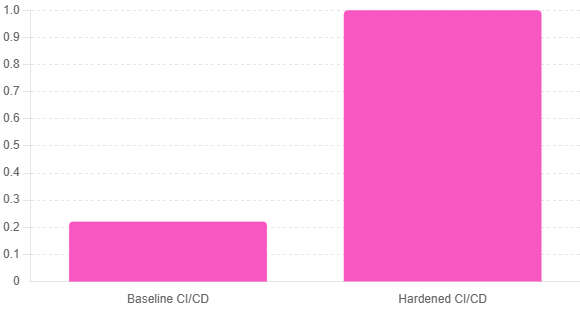
Equation 2: Deployment Efficiency Index (DEI) Goal in paper: collapse DORA-style CI/CD measures into a single deployment efficiency score.
Derivation
Choose targets (LeadTimet, CFRt, MTTRt, DeployFreqt). Compute per-metric scores in [10, 1] (1 = meets/exceeds target):
Weight and sum (weights w sum to 1):
3. Containerization in Financial Applications
Containerization is a technique that bundles applications together with their dependencies to achieve the environment consistency required for smooth deployment and scalable management. This section focuses on Docker, the most well-known container technology; on orchestration, which enables automated operations and auditability; and on the operational processes and quality controls that govern the setup and deployment of Docker containers [11]. Requirements for a Docker Productive Process A typical productive process around Docker consists of building, testing, and deploying Docker images. The build step generates an image for the application, while the test step uses that image to execute unit and integration tests against the complete environment, including the dependencies coded into the image. Security tools should also scan the image at build time and again after publication to the image repository. The deployment step consists of pulling a versioned image from the repository into a Kubernetes cluster and instantiating a number of runtimes according to the application’s deployment settings. For every deployment, the pipeline should ensure that the image published is secure, up to date with the last version, and valid with respect to publish-time tests. The control over the quality of the build is particularly important in areas regulated by external parties, such as finance, where regulators are interested in the Software Bill of Material (SBOM) of images. Companies subjected to regulations addressing the SBOM need to generate it for each image published and in some situations attribute signatures to the image to prove its authenticity [12].
3.1. Docker Workflow for Payment Services
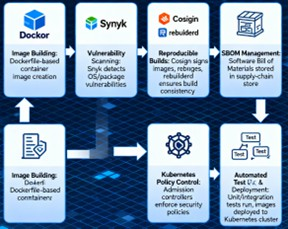
Standard Docker workflow for building, testing and deploying a payment service in an automated CI/CD pipeline. Enhancing security with image vulnerability scanning and providing reproducible builds for compliance and auditability are emphasised. The build-phase builds the service Docker image from the service sources. A runtime behaviour periodically scans the Docker images for known vulnerabilities and sends alerts. A supply-chain store contains a Software Bill of Materials (SBOM) for each Docker image. The policy controller operates in the Kubernetes cluster to ensure compliance: the Docker images are pulled only from the supply-chain store. The deployment of a new version of the service image triggers an automated testing phase. If the results are satisfactory, the deployment to production follows. Image vulnerability scanning with Snyk, Snyk is a SaaS (Software as a Service) offering that scans the Docker images in a project. It periodically scans the images and sends alerts when the list of vulnerabilities contains new items or when the severity of existing vulnerabilities increases. A runtime policy is defined in Snyk that determines when an alert should be generated [13]. Reproducible builds with Cosign, Cosign is a tool that creates cryptographic signatures for container images. It integrates with rebuilderd, a container reconstruction tool that produces Docker images from their original build instructions. The tool takes as input the signature associated with the original image and produces a new image with the same contents, irrespective of the underlying environment. Using rebuilderd with Cosign guarantees that the contents of an image are known, and allows users to spend little effort in checking the image compliance. The tests that are executed when deploying a new service version in the Kubernetes cluster will also ensure that the image complies with the service’s publicly-defined image policy. If all the tests are satisfactory, a new version of the service will be deployed. The deployment image tag is validated against the SBOM entry [14].
3.2. Image Management, Security, and Compliance
Container images must be made secure and compliant with organizational policy using a combination of tooling and governance. Policies underpinning these requirements are enforced by an image repository and potentially a CI/CD system at the point of build. Policy enforcement may include dynamically assessing images by scanning for known vulnerabilities, checking operating system compliance, ensuring the presence of an SBOM, and checking for the presence of image signing. A Software Bill of Materials (SBOM) can provide an inventory of all component libraries, their licenses, and vulnerabilities present at build time. The SBOM can be utilized by security management tooling to identify known vulnerabilities present across the fleet. In addition, automated image signing can be leveraged to ensure only trusted images are deemed valid within the organization. Trusted images may then be periodically scanned during runtime for newly discovered vulnerabilities [15]. When running in regulated environments, it is mandatory to meet various compliance assessments related to regulatory frameworks such as PCI-DSS. These assessments can be both asset and environment based. An asset-based assessment focuses on whether an asset is compliant with the relevant security baselines whilst a runtime-based environment assessment queries the runtime state of an asset. Asset-based assessments can draw on the SBOM data for assessment against operating system-level compliance standards such as DISA STIGS or CIS benchmarks. The runtime-based environment assessment can leverage configuration management tooling focused on the running state of an asset [16].
4. Microservice Design for Payments
Patterns of monolithic and microservice decomposition can impact payment applications in several ways. Although distributed microservices are often deployed using container orchestrators such as Kubernetes, they do not necessarily function independently. Like all services, payment services need to be integrated carefully to ensure the reliability, maintainability, and compliance of the complete system. An additional consideration in payments is latency: excessive delays might trigger customers into abandoning their transactions. Consequently, the operational governance for payments needs to consider networking, service meshes, and inter-service communication. Dividing an application into a set of services is challenging. If the service boundaries are too big, the application might topologically resemble a monolith; if they are too small, the costs of inter-service communication could erase the main benefits of microservices. A natural approach for managing a complex software system is to decompose it according to its domain model. Domain-driven design (DDD) suggests that different paths in the domain model should be controlled by different services, but DDD is primarily an architectural approach. A more refined approach uses bounded contexts to explicitly specify a contractual interface between a service and the rest of the application. Bounded contexts should define a schema, and content and control flow, so that changes in the rest of the application will not break the service. These schemas can introduce additional data management processes [17].
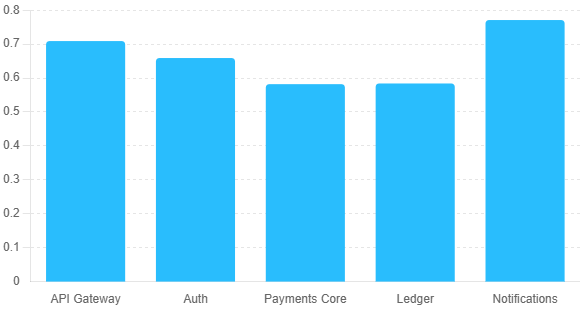
Equation 3: Container Resource Utilization (CRU) Goal in paper: summarize pod efficiency across CPU, memory, and I/O relative to requests/limits.
Derivation
A weighted index:
(Weights reflect importance; e.g., , , .)
4.1. Service Decomposition and Domain Boundaries
Domain-driven design guides the assignment of boundaries for distributed services. The definition of external interfaces among services is critical, as teams downstream will depend on these contracts. The distributed nature of microservice implementations implies that they cannot be authorized or controlled as tightly and hierarchy or ticket-acquisition mechanisms that work for monolithic payments system are perceived as too tedious by service authors. The method of breaking down a payment service into microservices may take many forms; two possibilities are mentioned here. The first one is well known: it defines an internal architecture in terms of domain-driven design and uses ‘bounded context‘ as the primary decomposition criterion. Because the ‘bounded context‘ principle emphasizes the importance of different models between different teams, and the shared kernel pattern is rare, compatibility between context facing different domains should be carefully reviewed. The second one is ‘2-biscuit transaction‘: the payment is first carved into microservices and then a non-invasive analysis is performed. If the coherence level is extremely low close to that of the business service in terms of frequency of activating the end-to-end flow, it can be treated as two biscuits and could be splitted [18].
4.2. Data Management and Transactions (ACID BASE considerations)
While monolithic payment systems rely on a single database to provide strict ACID (Atomicity, Consistency, Isolation, Durability) guarantees for data integrity and consistency, distributed microservices must adopt a more relaxed approach, known as BASE (Basically Available, Soft state, Eventually consistent). BASE systems are more tolerant of transient inconsistencies while providing a guarantee of corrective actions that guarantee a bounded context eventually arrives at a consistent state. Compensation is at the heart of the saga design pattern, in which a process is viewed as a long-running transaction that must call a series of services that update some shared state, but not all of them can be trusted to be atomic during the normal case. If the controlling process detects a failure in one of the services, it triggers compensating actions for the services that completed. The compensation design requires service designers to make clear decisions about the idempotent requirements of their compensation actions in order for them to succeed at any point in the problem-solving saga. The relaxed consistency model increases performance by eliminating round-trips and allows different teams working on the involved systems to work at different speeds, as long as they do so within the guaranteed validation bounds [19]. These properties, however, come at a cost. Payment systems operate closer to the limit than most other applications, and replacing single RPC calls with full orchestrated transactions introduces more complexity, creates the potential for cascading failures, and increases the time to recover from a problem. Stability under load is frequently a concern, and the application of at-least-once delivery mechanisms introduces even more complexity and more room for failure, such as duplicated charges. Consequently, idempotency is a key concern when designing a payment or payment-related service [20].
4.3. Reliability, Idempotency, and Event-Driven Patterns
Reliability is a core software quality, especially in payment systems. A failed or aborted operation must not leave the system in an inconsistent state. Retry logic can help regain reliability for transient failures. For messages that only need to be processed once, exactly-once delivery semantics are the holy grail in distributed systems. In the microservices context, idempotent operations can deliver the desired at-least-once delivery guarantee. Processes that make no observable changes after their first application can be safely retried multiple times. Reliability considerations apply also to asynchronous interactions. Retries for failed events must be complemented with compensating actions for events processed out of order. Such compensating actions express the application’s business rules, and their identifiers and URLs should be exposed. Latency budgets obtained from service SLAs guide the design of interactions between different services. Keeping the budget low for the most critical paths and do not derail their responsiveness. Long-lived interactions should be replaced with asynchronous communication. An event-driven architecture eases the application of the CA approach for reliability. Events can be published and consumed in a distributed fashion using a messaging system. Although the messages rely on specific delivery guarantees, reliability is achieved in the application code rather than at the messaging layer, thus allowing for any combination of at-least-once and at-most-once delivery for specific situations [21].
5. Kubernetes for Payment Systems
The deployment of microservices is usually done on Kubernetes, an orchestration framework that encompasses application deployment and lifecycle management. Kubernetes is used to ensure that services are highly available, resilient against reported or anticipated issues, scale horizontally when needed, and are automatically monitored and restarted in case of failures. Services are placed in virtualized containers called Pods, which can be composed of one or many containers depending on data-sharing requirements. A Pod can run with an ephemeral storage disk or a mounted volume if persistence is needed across restarts. Kubernetes Deployments can be configured to match the desired reliability and scaling levels too; for example, they can be set to create several Pod replicas and perform rolling upgrades whenever a new version of a service is available. Linux containers are particularly suited for this approach since they provide lightweight virtualized environments that are highly available and can be quickly created or destroyed [22]. Kubernetes also manages service discovery, load-balancing, and allows services to be addressed by name and version. In a payment context, it might be useful to use an additional layer called Service Mesh to handle requests more securely, reproducibly, with metering and diagnostics. Service meshes work with strong TLS communication between services (mTLS), internal service discovery, observability capabilities, and secure access policies. In their first deployments, microservices were not designed with idempotency in mind and could produce different results for the same request made more than once. However, there are design patterns that address these issues and guarantee that the resulting states are the same [23].
Equation 4: Fault Recovery Probability (FRP)
Goal in paper: probability the service returns to steady state within time τ after an incident, considering replica recovery.
Derivation
1. Model repair as exponential with mean MTTR. One instance recovers by τ with prob:
If failed replicas recover independently, the chance at least one is back by is:
5.1. Deployment Strategies: Rolling, Canary, and Blue-Green
Deployment is a crucial aspect of managing a production Kubernetes cluster, as multiple versions of the same application may be active at one time, either serving separate cohorts of users or providing redundancy for fault tolerance. Different strategies can be used for new deployments or updates, including rolling, canary, and blue-green approaches. Some strategies support automatic rollback if problems are detected, while others require additional checks for readiness.
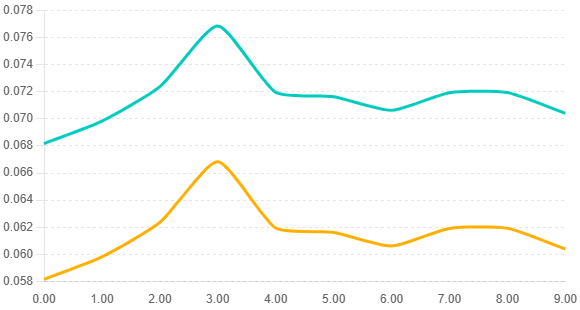
In rolling deployments, new instances of a service are created to replace old ones, and routing is gradually shifted from old to new. In canary deployments, a small number of new instances are created alongside old ones and serve a fraction of the incoming requests to detect potential problems. If the new instances are healthy, their count is gradually increased, while the old instances are removed. In blue-green deployments, new instances of a service are created alongside the old ones, with routing directed to the old instances until all readiness checks pass. The old instances are then decommissioned [24].
5.2. Networking, Service Mesh, and Inter-Service Communication
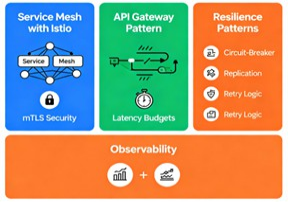
Kubernetes supports fine-grained control of networking, enabling security and architectural principles to be enforced in cross-service communication. Service meshes abstract interservice communication and provide visibility, security (typically using mTLS), and observability. For microservices that implement public APIs or are accessed by external parties, the gateway pattern and API contracts help protect the payment service from misuse. In microservice architectures, high availability and resilience are crucial architectural drivers. Budgets for latency between services must be established to avoid excessive communication delays, and violations should be monitored with alerts. Services that communicate with a high rate of failure are candidates for replication, asynchronous communication, retry logic, or a circuit-breaker pattern. The payment service must not adopt an anti-pattern where a service is unable to respond because it relies on information from another service that is experiencing problems [25]. The layered nature of Kubernetes networking makes it a good candidate for service mesh implementation. A well-known example is Istio, which extends Kubernetes mechanisms to secure all service communications using mutual TLS without modification of the service code. With a service mesh, call reliability and security can be addressed by the infrastructure. These features are nevertheless important to observe during implementation. Latencies between services and systems are critical risks that must be monitored; any breach of established budgets should lead to a detailed investigation. To avoid excessive impact on a service by other services, services can be duplicated, calls can be made asynchronously, error recovery can be implemented (for example, with retries, idempotency, and message queuing), or the circuit-breaker pattern can be employed. Public APIs or those exposed to third parties should have interfaces that are monitored and maintained to prevent misuse.
5.3. Observability, Monitoring, and Logging
Observability means monitoring the health and behavior of systems and applications. Together with Service Level Agreements (SLAs) and Service Level Objectives (SLOs), observability helps organizations deliver services within acceptance thresholds. Metrics, tracing, and log aggregation are the three key approaches in Kubernetes environments, and automated anomaly detection systems can provide alerts based on these inputs [26]. Metrics help monitor service availability and performance according to predefined SLAs and SLOs. Major metrics usually focus on round-trip time, service availability, and failure percentages. Monitoring latency normally includes 95th or 99th percentiles to capture slow requests that impact user experience. SLAs can define SLO requirements that show the maximum acceptance failure percentage per time window. Furthermore, latency budgets can limit latency for individual service calls along a request path. A service mesh automatically detects latency between microservices and can alert architectural teams when exceeded [27]. Tracing allows tracking requests across distributed systems. Manual instrumenting requires support libraries that correlate user sessions across microservices, services by tenant, and multiple backend resources. The OpenTelemetry project provides standard libraries for automatic tracing of cloud-native environments and service meshes. A monitoring system can collect, analyze, and display trace data alongside major metrics. Centralized logging ensures all logs are available for search and analysis, often for tracing, troubleshooting, and compliance. Automated anomaly detection links all three observability inputs to alert the operational team based on predefined patterns [28].
5.4. Security and Compliance in Kubernetes
A robust containerization strategy addresses security and compliance concerns at multiple levels. Role-Based Access Control (RBAC) helps limit resource actions to authorized users and service accounts, which define process capabilities. Secrets management supports sensitive information, such as API keys, passwords, and certificates, with transparent encryption and access control. Admission controllers enforce policies during resource creation and configuration. Validation Gateways help assess configuration parameters, and Image Admission Controllers can block workloads with vulnerable SBOMs or outdated signatures. Automated, stage-gated CI/CD pipelines enable regulatory compliance in build-test-deploy cycles. Finally, container deployment within defined boundaries supports data residency requirements [29]. Cross-references highlight links to image management (Section 3.2) and CI/CD pipelines (Section 6.1).
Equation 5: Microservice Communication Latency (MCL)
Goal in paper: end-to-end latency along a call path with network, processing, queueing, and service-mesh overhead.
Derivation
For a path with H hops, each hop i has:
- network cost ,
- processing cost ,
- queueing delay (approximate with M/M/1),
- mesh overhead per hop (mTLS, sidecar, policy). Queueing (M/M/1) with arrival and service (must have ):
Total:
6. Operational Excellence
The terminal for operational excellence focuses on the continuous integration/continuous deployment (CI/CD) pipelines of the microservices. This employs a set of automated processes to build, test, and deploy the services. With the automated processes and their helper tools like security scanning and secret management, the development and deployment of microservices become more efficient and consistent [30]. CI/CD Pipelines for Financial Microservices To ensure that vulnerabilities are discovered before the deployment of an image, the CI/CD pipeline for building the microservices normally includes security scanning of the image when the build process completes. Besides the security aspect, in a real-time payment system, any downtime for deploying new features might incur business loss. A CI/CD pipeline for microservices automates and accelerates the building, testing, and releasing of new or changed functionalities into the production environment, ultimately supporting the business requirements of the payment system. Using CI/CD with fast moving payment systems also requires dynamic security gates in the pipeline. Integrating security scanning into the CI/CD pipeline is important to avoid bringing vulnerabilities into the production environment. Exploiting CI/CD, in effect, enables the deployment of a payment system service at a very high frequency. However, the deployment of payment services has to be reviewed because a bug or a noncompliance in the production environment has a severe impact on the business. Certain quality gates like manual approval and compliance checking should be enforced on middleware and payment services exposed to the real-time environment [31].
6.1. CI/CD Pipelines for Financial Microservices
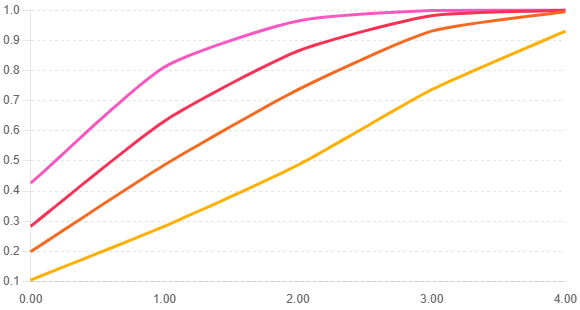
The development of a pipeline specifically designed for Kubernetes-based applications can substantially enhance the reliability and security of both container images and the application code that operates within them. By concentrating on smaller services developed and operated by individual teams, Continuous Integration (CI) and Continuous Delivery (CD) processes can shorten deployment cycles, improve resilience, and ultimately foster the innovative capabilities of an organization. Yet, without well-defined policies and themselves well orchestrated, CI/CD pipelines also introduce the risk of deploying unsecured images or of not detecting security vulnerabilities in time. With appropriate focus they can help ensure that security scanning processes are integrated into the pipeline [32]. A typical CI/CD pipeline for Kubernetes-based applications maintains a Build-Stage-Deploy philosophy. The process is triggered by a code change in the repository. During the Build phase, a Docker image is generated, in which security tests are conducted prior to moving to a shared image repository. The Stage phase consists of deployment in a test environment, where additional tests are run (e.g. configuration test, penetration tests, vulnerability assessment). Upon successful completion, deployment in Production is conducted, either manually or in an automated manner, to address smaller changes or in the context of a rolling strategy [33].
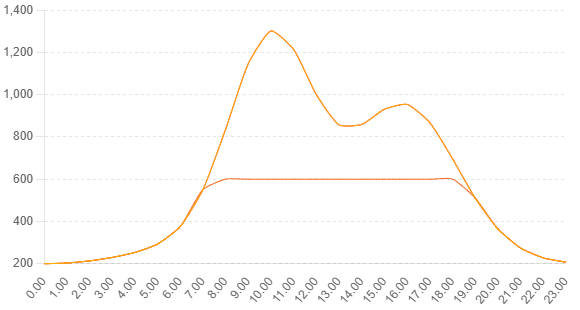
Equation 6: System Reliability in a Containerized Payment Network (SRCPN)
Goal in paper: overall availability for a serial pipeline of stages, each with replicas.
Derivation
Replica availability in stage j: a redundancy):
Serial composition across K stages (all must be up):
(Use MTBF/MTTR to compute each replica’s when needed.)
6.2. Secret Management and Access Control
Managing secrets in Kubernetes is crucial for the confidentiality of payment systems. Kubernetes provides a secrets management mechanism, which can significantly reduce the chance of exposing secrets in plaintext in source control, deployment configurations, and system memory. Secret types can be extended to support external systems. Nevertheless, Kubernetes secrets management alone does not achieve compliance with necessary security controls, such as protecting secrets at rest or implementing a central logging solution [34]. When integrating Kubernetes into a security risk governance framework, attention must be paid to protecting data in transit, controlling access to sensitive data, and minimizing data access. These controls are often achieved through external secrets management. Secrets are encrypted by a secrets management solution before being stored in a service mesh (which implements mTLS to control in-transit security), on disk, or in source control; this occurs before being consumed by a cloud-native application or service. These integrated solutions may also provide secrets rotation and policy management, reducing operational overhead. These dedicated external solutions are often of great interest to payment companies because they store keys, certificates, and other sensitive information or secrets, and for regulators because it’s a single source of truth for sensitive data across the company’s entire IT estate. Encryption, access control, and logging are typically mandatory security controls for such solutions [33]. Every Kubernetes secret used by an application should be applied with the least privileged access policy, whereby every role, user, or service account should access only those secrets and sets of sensitive information strictly necessary for the application to work as designed. For ephemeral secrets, this privilege should always be set to true, with automatic rotation being the norm [35].
7. Conclusion
Payment systems benefit from modern cloud computing practices: containerization and microservices enable effective scaling, a delicate risk balance, streamlined compliance—and a more natural fit for DevOps and SRE operational models. Kubernetes and Docker provide core capabilities needed to deploy and operate microservices safely and efficiently. Trade-offs remain; latency-sensitive sub-systems can struggle, and monitoring, observability, and security require special attention. Further research should explore architectural design decisions beyond Kubernetes, Docker, or container-based microservices: canary releases, network security, and compliance via a service mesh; application security, compliance monitoring, and auditing with a CI/CD pipeline; and interservice communication, traffic management, resilience, and observability with a service mesh.
7.1. Final Thoughts and Future Directions
Payments systems rely heavily on securing, monitoring, and controlling data exchange for transaction execution. Containerized microservices help achieve this, but involve operational risks. Without security gates, vulnerabilities make it into production; without continuous monitoring, exploiting vulnerabilities may not be timely detected; without centralized logging, correlating events from multiple logs becomes cumbersome; without network data encryption, data is vulnerable to eavesdropping. The observed pattern in Kubernetes production deployments is that these security and observability concerns tend to be engineered as standalone elements that are built, tested, and deployed independently; a fact that arises from the mature ecosystem around Kubernetes, where a multitude of tools help address these spheres with minimal configuration. Furthermore, integrated tools such as GitOps strategy deliver automation by triggering a pipeline when a specified repository is changed; resources are desired which do not exist are created; existing resources that do not match their desired state are reconciled. These strategies bring operational excellence to a new level as applications and foundations defined as code allow for highly auditable and acceptable change management. Prevention of sensitive data leakage is also a concern and secret management and access control help mitigate these risks. Integrating KMS for key generation and management, using vaults for secret storage, encrypting sensitive data at rest and in transit, choosing the least privilege for operations and enabling rotation of credentials complete the implementation of security strategy for a Kubernetes-based payment operation.
References
- Lahari Pandiri. (2021). Machine Learning Approaches in Pricing and Claims Optimization for Recreational Vehicle Insurance. Journal of International Crisis and Risk Communication Research, 194–214. https://doi.org/10.63278/jicrcr.vi.3037
- Adzic, G., & Chatley, R. (2021). Serverless computing and microservice architectures: Patterns, practices, and pitfalls. IEEE Software, 38(3), 52–60. https://doi.org/10.1109/MS.2021.3059453
- Alshamrani, A., & Bahattab, A. (2021). Microservices security: Challenges and directions. IEEE Access, 9, 69884–69900. https://doi.org/10.1109/ACCESS.2021.3078356
- Bass, L., & Weber, I. (2021). Microservice architectures and containerization in financial systems. Journal of Systems and Software, 177, 110964. https://doi.org/10.1016/j.jss.2021.110964[CrossRef]
- Gadi, A. L., Kannan, S., Nandan, B. P., Komaragiri, V. B., & Singireddy, S. (2021). Advanced Computational Technologies in Vehicle Production, Digital Connectivity, and Sustainable Transportation: Innovations in Intelligent Systems, Eco-Friendly Manufacturing, and Financial Optimization. Universal Journal of Finance and Economics, 1(1), 87–100. Retrieved from[CrossRef]
- Bernstein, D. (2021). Containers and cloud: From Docker to Kubernetes. IEEE Cloud Computing, 8(2), 81–89. https://doi.org/10.1109/MCC.2021.3057461
- Cai, Z., & Zhu, H. (2021). Security and privacy challenges in containerized cloud environments. Computer Standards & Interfaces, 77, 103512. https://doi.org/10.1016/j.csi.2021.103512[CrossRef]
- Bhattacharjee, S., & Mukherjee, S. (2021). Performance evaluation of microservice-based financial systems using Kubernetes orchestration. Future Generation Computer Systems, 125, 210–224. https://doi.org/10.1016/j.future.2021.06.011[CrossRef]
- Chang, W., & Li, J. (2021). Blockchain integration in containerized payment systems. International Journal of Information Management, 58, 102331. https://doi.org/10.1016/j.ijinfomgt.2021.102331[CrossRef]
- Data-Driven Strategies for Optimizing Customer Journeys Across Telecom and Healthcare Industries. (2021). International Journal of Engineering and Computer Science, 10(12), 25552-25571. https://doi.org/10.18535/ijecs.v10i12.4662
- AI-Based Financial Advisory Systems: Revolutionizing Personalized Investment Strategies. (2021). International Journal of Engineering and Computer Science, 10(12). https://doi.org/10.18535/ijecs.v10i12.4655
- Dantas, M., & De Oliveira, J. (2021). Cloud-native microservices for banking applications. Journal of Cloud Computing: Advances, Systems and Applications, 10(1), 37. https://doi.org/10.1186/s13677-021-00267-2
- Chelliah, V., & Arputharaj, K. (2021). Automated CI/CD pipeline optimization for Kubernetes microservices. Software: Practice and Experience, 51(10), 1972–1988. https://doi.org/10.1002/spe.3021[CrossRef]
- Dutta, A., & Bose, S. (2021). Resilient architecture of microservices for fintech applications. Journal of Financial Innovation, 7(4), 95–112. https://doi.org/10.1186/s40854-021-00259-5
- Just-in-Time Inventory Management Using Reinforcement Learning in Automotive Supply Chains. (2021). International Journal of Engineering and Computer Science, 10(12), 25586-25605. https://doi.org/10.18535/ijecs.v10i12.4666
- Fernández, J. M., & López, P. (2021). Service mesh observability and monitoring in distributed financial systems. Journal of Network and Computer Applications, 183, 103056. https://doi.org/10.1016/j.jnca.2021.103056[CrossRef]
- Hammad, M., & Abdalla, A. (2021). Kubernetes orchestration strategies for elastic fintech services. International Journal of Advanced Computer Science and Applications, 12(8), 457–464. https://doi.org/10.14569/IJACSA.2021.0120855[CrossRef]
- Goutham Kumar Sheelam, Botlagunta Preethish Nandan, "Machine Learning Integration in Semiconductor Research and Manufacturing Pipelines," International Journal of Advanced Research in Computer and Communication Engineering (IJARCCE), DOI: 10.17148/IJAR-CCE.2021.101274
- Raviteja Meda, "Digital Infrastructure for Predictive Inventory Management in Retail Using Machine Learning," International Journal of Advanced Research in Computer and Communication Engineering (IJARCCE), DOI: 10.17148/IJARCCE.2021.101276[CrossRef]
- Kim, D., & Park, Y. (2021). Deployment automation for cloud-native payment applications using Docker and Jenkins. Applied Sciences, 11(12), 5469. https://doi.org/10.3390/app11125469[CrossRef]
- Lu, Y., & Xu, H. (2021). Continuous integration challenges in microservice-based systems. Information and Software Technology, 136, 106603. https://doi.org/10.1016/j.infsof.2021.106603[CrossRef]
- Lin, C. C., & Chen, J. C. (2021). Latency optimization in containerized microservices for e-payment systems. IEEE Transactions on Services Computing, 14(5), 1238–1251. https://doi.org/10.1109/TSC.2021.3053208
- Inala, R. (2021). A New Paradigm in Retirement Solution Platforms: Leveraging Data Governance to Build AI-Ready Data Products. Journal of International Crisis and Risk Communication Research, 286–310. https://doi.org/10.63278/jicrcr.vi.3101
- Nunes, J., & Pereira, A. (2021). Performance benchmarking of container orchestrators for financial transactions. Concurrency and Computation: Practice and Experience, 33(17), e6369. https://doi.org/10.1002/cpe.6369[CrossRef]
- Mavridis, S., & Karagiannis, D. (2021). Service decomposition techniques in microservices for financial technologies. Software and Systems Modeling, 20(6), 1729–1743. https://doi.org/10.1007/s10270-021-00877-y[CrossRef]
- Rahman, M. M., & Hossain, M. (2021). Security evaluation of Docker containers in fintech cloud environments. IEEE Access, 9, 115826–115839. https://doi.org/10.1109/ACCESS.2021.3105778
- Shah, M., & Patel, H. (2021). CI/CD pipeline optimization for microservice-based banking systems. Procedia Computer Science, 192, 4057–4065. https://doi.org/10.1016/j.procs.2021.09.186[CrossRef] [PubMed]
- Aitha, A. R. (2021). Dev Ops Driven Digital Transformation: Accelerating Innovation In The Insurance Industry. Journal of International Crisis and Risk Communication Research, 327–338. https://doi.org/10.63278/jicrcr.vi.3341
- Singh, R., & Choudhary, A. (2021). Operational risk management using containerization in banking systems. Journal of Risk and Financial Management, 14(11), 552. https://doi.org/10.3390/jrfm14110552[CrossRef]
- Zhang, W., & Li, Q. (2021). Evaluating Kubernetes service mesh performance in distributed payment applications. Cluster Computing, 24(4), 3191–3205. https://doi.org/10.1007/s10586-021-03350-6
- Barros, M., & Silva, C. (2021). DevSecOps implementation in containerized microservice-based applications for fintech. Journal of Software:
- Abdelaziz, A., & Elsayed, M. (2021). Dynamic resource allocation in containerized cloud environments using Kubernetes autoscaling. Journal of Cloud Computing, 10(1), 42. https://doi.org/10.1186/s13677-021-00271-6
- Kumar, V., & Singh, P. (2021). Comparative study of container orchestration tools for cloud-native banking microservices. Future Internet, 13(9),
- Ivanov, I., & Petrov, D. (2021). Fault-tolerant microservice deployment strategies in financial systems using Kubernetes. IEEE Access, 9, 118203–118217. https://doi.org/10.1109/ACCESS.2021.3107435
- Rodríguez, L., & García, M. (2021). Observability and tracing in distributed microservice payment architectures. Journal of Systems Architecture, 117, 102153. https://doi.org/10.1016/j.sysarc.2021.102153