
Abstract
This paper includes the impacts of the Internet of Things (IoT), Big Data, and other emerging technologies in the vehicle production sector, digital connectivity, and sustainable transport system. Automated and intelligent transportation for safe, efficient, and sustainable transport systems will be stressed. Key factors to promote automated or connected vehicles including connected environment, integration of all transport modes, advanced cooperative systems, and policy enforcement will be discussed. This paper contains the Axiomatic Categorisation Framework (AFS) for the dynamic alignment in a collection of disparate functions in cyber-physical systems (CPS). Developed system is enhanced for breaking the rules within autonomous vehicles (AV). It means the human personal injury is inevitable while the vehicle does not do any rules. Especially in complicated traffic situations, many of the constraints are mutually exclusive, and there is no way to obey all of them at a time. Also, there is no way to ensure that the self-driving vehicle has priority in all situations [1]. Public distrust in AV systems has to be increased and the investment in this technology has to slow down. Instead, a human driver should be partially responsible for operation. The development of a driver-behavior assistant (DBA) system is proposed, which should be able to break the rules for the distances of such slow development. It is intended to be effective in non-deterministic situations while maintaining the safety of the AV and those involved in the event. A driver's actions would not only be acceptable as a driving strategy but also would be predictable, and therefore other road users could unambiguously react.
1. Introduction
Since the invention of the wheel, advances in transportation technology have played a crucial role in shaping modern society. The way people move around has shifted from horseback, walking, and sailing to using trains, cars, airplanes, and motorcycles. Each technological innovation has had an impact on the way goods are produced, distributed, and consumed. Some of these impacts have been direct; for example, the introduction of assembly lines was a direct consequence of mechanization, as the high demand for automobiles meant that they had to be produced in large quantities at a low cost. Others have been indirect; for example, the rise of the suburbs and the decline in the use of public transport in the United States were triggered by the extensive motorization of the country. However, advances in transportation technologies are not always kept up-to-date with the needs of society, which leads to negative economic and environmental consequences.
The analysis of the impact of transportation technologies on the production and consumption of goods has traditionally been focused on mobility solutions. It has mainly taken a Quantitative Life Cycle Assessment approach to greenhouse gas emissions, energy costs, and is typically limited to the vehicle and the route. However, recent advances in computational technologies are changing the way these impacts can be analyzed. This Special Issue brings together papers from different fields that demonstrate the potential of utilizing advanced computational techniques to tackle complex issues of transportation and sustainability.
So, this new vision of a network becomes relevant in order to reduce the communication problem due to an anticipated soon future of widespread 5G communication tools. Today’s transportation issues take on another meaning. Moreover, cars now introduce hundreds of new software condition products each year, in which aspects related to Intelligent Transportation are not a section, leaving untouched their societal impact unaddressed. A realistic viewpoint considers that 5G networks deployment is too expensive, e.g., in rural areas.
1.1. Background and Significance
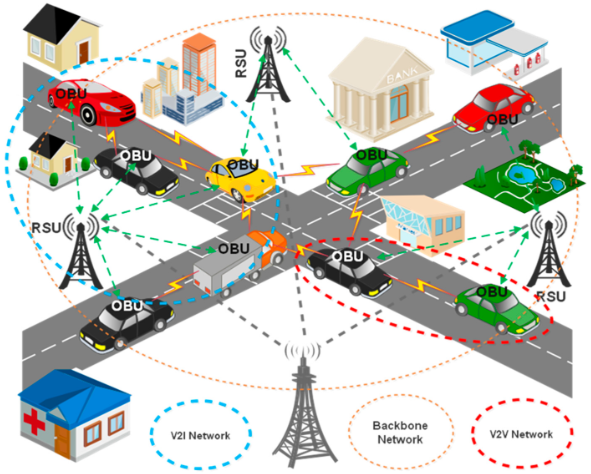
Imagine a world where traffic lights not only react to density or traffic events, but where the road itself communicates with self-driving cars. With connected vehicles, transportation is much more than a chain of items moving passengers. Today, an oil company can refine better fuel only with data from sensors in new cars. This explores how computational technologies foster a new vision and era for transportation.
Current challenges of car manufacturers are to make roads safer, to achieve free flowing traffic with few congestions, and to reduce pollution by an effective fuel use. Many improvements are performed in-car, but more and more approaches rely on communication capabilities between cars, with an infrastructure, or with IoT devices left on a road for instance. One possible interest of monitoring and coordinating vehicles is to compute an intelligent way of transportation, like vehicles automatically convoying to do mutual gains. From an operational point of view, automated driving promotes new tools for advanced agency of fleets. From an economic point of view, a shared fleet of vehicles would reduce the cost and environmental impact of road transits. Therefore, the transportation chain is better seen as a Complex Multi-Level System. The previous needs imply to monitor and coordinate vehicles or road-charging devices. A new opportunity is tackled with the concept of Programmable Matter, a technology that aims to blur the frontier between manufactured objects and the electronic system. It is based on small, smart, and communicative micro-objects that can perform a collective task. An example could be a road device with this technology that can raise poles cutting a path between two sides or road lamps changing their height [3].
Equation 1: Intelligent Systems for Vehicle Production
Where:
- = Total number of vehicle models in production
- = Production time for vehicle model
- = Cost per unit produced for vehicle model
- = Total time spent in the production cycle for vehicle model
- = Maintenance cost of machinery used for vehicle model
2. Overview of Advanced Computational Technologies
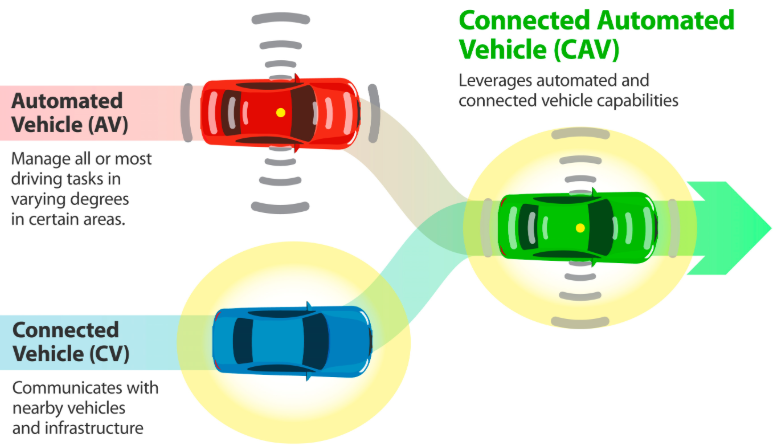
The proposed integrated model is potentially beneficial for ITSs as it indicates the potential adaptation of external resources for connected vehicles (CVs) and vehicle-based computational technologies (VBCTs). ITSs are required to support the evolution of advanced technologies, methodologies, and infrastructures to effectively promote advancements and ensure the sustainability of future personalized mobility. CVs are envisioned to fundamentally constitute a connected Internet of vehicles (IoVs) over time and generate numerous sets of heterogeneous data. As the backbone of future ITSs, CVs can play an active role by implementing the driving environment, road users, and traffic conditions, and making use of VBCT, which would undertake the high-performance computational operations of this data. Also, CVs can co-transmit the processed data with the accumulated knowledge to ground facilities, boosting the situation awareness and reaction capacity [4]. At the crossroads of the connected vehicle industry and recent technologies, the current study addresses the combination of VCC and eSports betting markets. eSports refers to video game competitions on a professional level and driving simulators to develop and train the player's skills who compete in tournaments to win significant prize purses. To enable real-time complex computing operations in the vehicle-based free zone, novel VBCT systems are proposed. At the same time, a distributed fog module is designed that can adaptively allocate computational tasks to built-in equipment in vehicles. obj: Toward the growth of ITSs, a novel integrated planning framework and model are proposed to form and deploy a network of CVs that efficiently undertake time-critical and high-performance computational tasks. The proposed planning model strategically determines the technology, location, and deployment scale of two different computational modules, namely vehicle-based computational technologies (VBCTs) and vehicle-based communications since such networks could be prone to congestion. To the best of our knowledge, the proposed model represents the first attempt to investigate the strategic combined deployment of vehicle-based computational and communicative resources. As vehicle-based IoT and related technologies are boosted, vehicle-based computational technologies (VBCTs) have come into play by leveraging the computational power of onboard computer systems considerably amplifying the VCC capacity. In addition to connected transportation technologies, over the next three decades, environmentally friendlier cars will provide the biggest potential of many more technological solutions. Throughout developed cities and emerging megacities with traffic congestion problems, strictly regulated environmental issues, the continuously increasing use of alternative and electrified powertrains, and a strong use of the V2X communication technology, a combination of safe, efficient and green urban multimodal transportation is expected. Calculating millions to billions of safety-critical vehicle information extensively via cloud storage and cloud-side data processing could induce a data overload to the road side and backhaul network by the cloud-vehicle communications.
2.1. Research Design
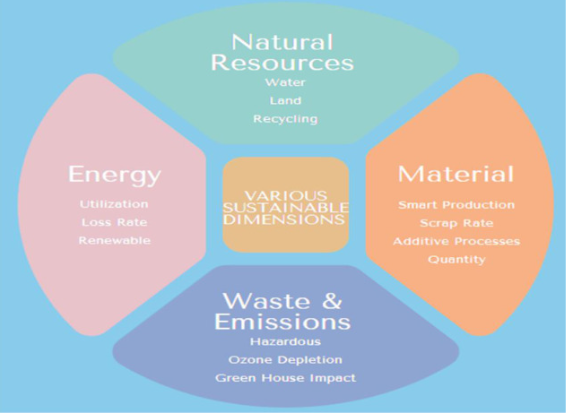
When signing the Paris Accord, the automotive industry assumed a commitment to produce a reduced number of internal combustion engine vehicles. Recent propositions have approached this problem, depicting advanced computational technologies embedded on key industry hotspots, and have strategized on developing digital connectivity co-evolution between synthetic and real-flows in the commercial vehicle sector. However, there is still a large gap on digital technologies proficient exploitation with the intent to investigate its implications on the production, what creates an instance of gap analysis. This study sought to understand how the digital transformations in the vehicle sector could influence current production systems, and to uptake real-world data on the automotive industry by conducting a case study on modelling the system dynamics of an automotive manufacturing network using data-driven methodologies [5]. To answer the mapped research questions, this poses a step-by-step strategy. First, an encompassing system dynamics (SD) structure on the digital transformations in the vehicle production sector and its influences on the market environment is developed. To verify the theoretical model and with the intent to filling a knowledge gap on the illustrative system of the automotive industry, a production service-level SD model is developed using data-driven methodologies based on robustness assessments. To ease the setup of the endeavoured production SD model, a simulation-aided modeling approach is established which accounts for data preparation, model development, benchmarking policy testing, and robustness evaluations. This study supports the development of computational systems for industrial applications. To focus, an SD model of the responsive capacity of wide-bandgap semiconductor production is pursued by the U.S. Department of Energy as part of a national network of manufacturers. The methodology developed here is leveraged to construct the DakotaSD platform which uses commercial and open source tools for sensitivity analysis, model calibration, and policy optimization.
3. Intelligent Systems in Vehicle Production
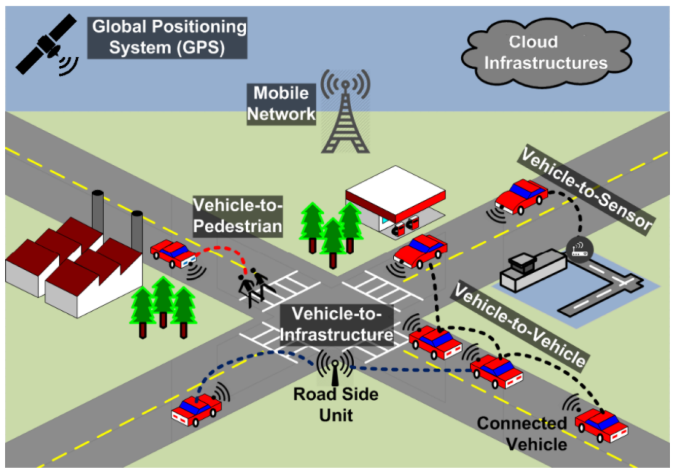
The adoption of Advanced Computational Technologies in modern vehicle production is still immature and fragmented. Industry actors need to acquire new competences and develop new organizational behaviors to take full advantage of the potential benefits of these technologies that will progressively become mainstream. A dominant vision about digital connectivity is currently shaping a new production concept of future Global Networks of Vehicle Production. The next phase toward the future industry framework will consist of extending automatic decision making to all inter-factory connections. Such a framework is a novel paradigm for a global vehicle production system in which each site works as an intelligent agent interacting with all the other agents in a global network [6]. An extensive mapping of the main factors which will influence the development of Global Networks of Vehicle Production in the near future is provided, describing the agricultural, the background environmental analysis and a concentration about a specific case study. A new framework which can be used by industry practitioners to enact the fourth industrial revolution in global networks of vehicle production is put forth. By acquiring new cognitive capacities in terms of a) universally exchanging big data in an across-factory network, b) processing these data by means of intelligent systems and informational algorithms and c) separately defining, imitating, reverting, estimating and planning the whole production philosophy by autonomous decision making, vehicle manufacturers will have the opportunity to overhaul all the paradigms of current vehicle production systems and find a possible safe harbor where shifting. Such a framework, likely to become professionally mainstream within the next decade, can be introduced here as an important and perhaps the first step towards broad digitalization in the domain of vehicle production.
3.1. Artificial Intelligence in Manufacturing
The traditional production model, featuring mass production and centralized manufacturing, does not have the flexibility to meet individual customer demands. To satisfy market demands, a new era of smart factories, the so-called customized smart factories, has emerged, which have the flexibility to support small-batch, customized manufacturing. In a customized smart factory, a new concept of a production system, that is, flexible cell manufacturing, is employed in the shop floor to cope with increasingly diversified, low-standardized items. To guarantee the production efficiency and quality of the shop floor, an adaptive multi-objective scheduling model is proposed. In this model, four typical goals in modern manufacturing, that is, the makespan, the total energy consumption, the total workload fluctuation, and the load balancing, are considered together. To solve this model, an intelligent multilayer control strategy is designed by combining simulation-based optimization, gray relational analysis, and artificial bee colony optimization. The method can not only generate the optimal schedule with the tradeoff among the above goals but can also adapt the scheduling policy with the changes of shop floor. A shop-floor experiment was conducted on an intelligent workshop platform, and a comparative analysis was performed between the intelligent scheduling method and the traditional sequence scheduling strategy. The experimental results validate the superiority of the proposed method on reducing the throughput time and the starting time, as well as the flexibility in response to the scheduling policy switch [7].
In the meantime, the domestic paradigm of centralized manufacturing should transform into the distributed production mode emphasizing the balance between city industrial development and city life. A series of industrial transfer behaviors among cities in Fujian province were analyzed. Combined with the characteristics of distributed logistics centers (DLC) in urban agglomerations, a Hub–DLC location problem considering minimum facilities idling and waiting time is described, which has not been researched before. The model aims at minimizing the total weighted facilities waiting time and fixed investment cost. A multi-objective tabu search algorithm with the Pareto neighborhood is proposed to solve this model. The effectiveness and practicability of the proposed model and algorithm are shown by numerical experiments. The results show that an enterprise should choose a DLC location statically based on the 5-year industrial transfer direction. The processing order of considering static DLC location scheduling and DLC location simultaneously is proposed. The Pareto-optimal solutions provide more alternatives for planners under different developmental objectives, and the decision-making results can offer a more comprehensive consideration of static DLC location problems for different cities [8].
3.2. Machine Learning Applications
Digitization and the use of digital data are growing in many industries, and the ongoing digital transformation is shaping the future. In the automotive domain, rapidly increasing digital connectivity will transform the way vehicles are produced and used. Together with digital factories, the Industry 4.0 framework includes advanced manufacturing technologies, such as robotics and machine learning systems. These computational technologies will enable new manufacturing paradigms, such as smart factories, that are characterized by flexibility and reconfigurability. Decentralized vehicle repair and fleet-based vehicle ownership created a need for new business models and services that are in alignment with the principles of servitization. Embedding digital factories in a broader digital and service system comprising entities from various industrial sectors will foster sustainable transportation, and hence, reduce environmental harm and social costs during vehicle production and operation. After an overview is provided, the digital, service, and environmental implications of the future interconnected mobility system are discussed, and recommendations for research and development in the field are provided. Reduced air pollution will help to extend human lives. Transportation contributed to 14% of the GHG emissions in 2004, and this share is projected to increase to 21% in 2035 across the European Union. Vehicle production is a key contributor to environmental harm along with transportation, and the automotive industry is the one third biggest contributor. The environmental and social costs include the exhaustion of non-renewable resources, air and water pollution, noise, human rights and labor violations, and health issues [9].
Equation 2: Digital Connectivity for Vehicle Systems
Where:
- = Efficiency of data transmission
- = Bandwidth available for transmission
- = Total data transferred
- = Power required for transmitting the data
- = Distance between vehicle and communication node
4. Digital Connectivity in Modern Vehicles
Connected cars are a comprehensive concept uniting modern vehicles, several digital systems concerned with vehicle-to-vehicle (V2V) and vehicle-to-infra (V2I) communication. Several technologies, such as VANET, have been developed for the use of vehicular communication. Along what concerns technologies, connected cars domiciliate heterogeneous services and gadgets in numerous scientific fields. An offering of navigation service, live upkeep information, cyber entertainment, internet browsing, purchase on-the-move or compensation on-the-move are only a few instances of information and communication technologies to be observed in connected cars. Automobiles and infrastructure will authenticate each other; and car navigations, immobilizers and sound systems will avail internet-based services. Othello finds a wise way to encircle. Strategy: Connected cars. From the outset, brick phones were bulky equipment. As time advanced, miniaturization became conceivable. In the next stages vehicles of the gregarious order were equipped with telephones. With the telephone, the telephone equipment was evolved in a manner that the vehicle's speaker could be utilized for telephone discussions. Amplified to high-time the image of vehicles turned into telephone stovepipes. Smart phones broke in and became widespread. Phone manufacturers commenced to equip vehicles with bluetooth, which somehow rendered modern devices to talk to each other. Smartphones stepped forwards to the vehicle's sound system and users could glide over the playlists, make calls or even write an email exactly analogous to gesticulation on the device. And now, the future closes the circle; a mobile device holds a superior role. Vehicular standards for digital communication have been established and industry has taken action. The way has now been paved for an august fall in the vehicle dracontius spreading like wildfire [10]. Transforming ages have triggered the vehicles to turn into sophisticated systems. Early in the electric harness distribution of the vehicle, a self-proclaimed bus mercantile player would put forward bundles of wires confirmed by heat-shrink bands and tape. Later, efforts to digitize automobiles ensued. From model year 1996 vehicles were obliged to have OBD II capability and thereafter on-board systems started to possess digital components. The current standing is a plethora of ECUs folded in a single vehicle. This transformation can be accredited to ameliorate safety and plod; even to betterment hikes in fuel depletion, making excuse for the creation of powertrains with much greater decampment efficiencies. Like a scirocco to the earlier developed applications, M2M communications have penetrated into the vehicle field. Implementations on a vehicular scale proposed for two major spheres: inside the vehicle; and in the span of vehicle to vehicle and vehicle to kiosk applications [11].
4.1. Vehicle-to-Everything (V2X) Communication
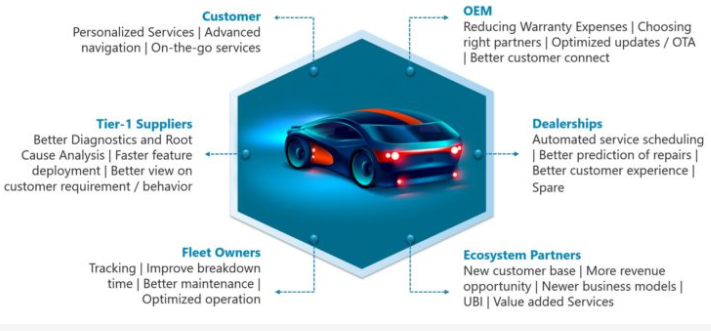
Modern transportation and vehicle production are based on various new technologies which play an important role in energy saving, digitization, and socio-economic development. Among them, digital connectivity as a dominant factor in 4th Industrial Revolution fuels the production and smooth operation of vehicles through smart vehicle parts, secure vehicle-to-everything (V2X), and vehicle-to-vehicle (V2V) communications. Digital connectivity and advanced computational technologies support the initiation of autonomous vehicles and Next Generation Vehicles (NGV). In addition, next-generation ICT provides sensors, computing services, smart AI, and next-generation networking technologies that increase intelligent transport systems as an improvement from vehicle production to road safety reduction.
An investigation about the role of advanced computational technologies in vehicle production, digital connectivity, and smart transport was performed. Initially, a general examination of the impact of information and communication technology (ICT) development in the vehicle's production process separately examined the South Korean vehicle production system, which is currently the 4th largest vehicle manufacturer worldwide. The impact of next-generation ICT technologies on vehicle production and the possibility to switch it to NGV's production is discussed through the change in the vehicle part and in the CAVp. Secondly, the current use of smart vehicle parts with IoT and AI accelerates vehicle-to-everything (V2X) communication and supports the direct operation of vehicles through vehicle-to-everywhere (V2X) cloud technologies. Smart vehicle parts are a critical factor in ensuring smooth vehicle operation with minimal risks. Thirdly, the advanced computational technology of CU and CCU's ITS support the initiative of autonomous vehicles and improve road safety.
4.2. Telematics and Data Management
Today’s vehicles are increasingly embedded with computers and sensors which produce huge amounts of data. The data are exploited for internal purposes and with the development of connected infrastructures and smart cities. The vehicles interact with each other as well as with road users generating other types of data. The access to these data and in-vehicle resources and their monetisation faces many challenges. In this Marketplace, the vehicle data is considered as new gold by all the entities in the ecosystem. Therefore, the access to this data and its monetization can lead to fierce competition between some entities in the ecosystem but the data should benefit all the actors. In this document, it is shown that an open, interoperable and secure vehicular platform seems the most appropriate solution for the monetization and the access to in-vehicle data and resources. Such a platform poses many challenges on the legal and technical aspects which results in different solutions. The vehicle data and resources are at the core of a not yet fully explored competition between various actors: car manufacturers, telematic operators, car dealers, insurance companies, consumers, etc. Several technologies are used to access vehicle data and store them in the cloud/edge of the network, among them the most important are: i) The CAN bus that is the de-facto standard used by OEMs to exchange data and connect sensors inside the vehicle. ii) The On-board Diagnostic II (ODB II) is a standard that provides access to emission and other data exchanged on the CAN bus and allows professional repairers to assess the status of the vehicle. Many products on the market exploit the OBD II interface to create remote access to these data. iii) The Fleet Monitoring Standard allows the access to trucks and buses data exchanged on the CAN bus. The data can be wirelessly retrieved but just the subset related to safety and pollution. As an example the mileage and the location of the vehicle. Further pieces of information can be remotely requested afterwards within a specified time window. Given the huge amount of data produced by the vehicle and the necessary respect of privacy, the access to the other vehicle data and resources faces many technical challenges (latency, quality of service, etc.). A vehicular platform preferred by the DG Move evaluation should as a minimum: a) allow the same operating conditions to all aftermarket operators; b) be secure guaranteeing confidentiality and authenticity of the data; c) be interoperable providing the possibility to access the data by third-party applications developed by any entity; d) enable a fair remuneration of the vehicle owner and simplify the interchangeability of the vehicle data and resources. Several solutions are developed by the industry and the research on these topics, among them: SmartG, the GDPR and the Privacy Guarantees, the secure approach for the OBU, the Rahal, Smart Data Access, Fleet Monitor and Service, an Integration and Verification platform, the Secure SCMS approach [12].
5. Sustainable Transportation Initiatives
The vehicle production sector in developing countries continues to grow relatively rapidly. Consequently, emissions from the transport sector are also projected to rapidly increase globally, on the back of strong motorisation growth, particularly in medium income countries. Current technological changes have the potential to increase the rate of production, and indeed this has already begun to happen. There is also the prospect of a potential radical change in emerging production. Factors leading to this include the rapid development of advanced computational technologies, new materials processes, integration of digital connectivity systems, and a general new paradigm for production, which is characterised by responsive, reconfigurable systems that can rapidly adjust to changes in the product. These changes feed through into new configurations of supply chain organisations in production, which can have profound implications for the path of industrial development in countries of varying levels of industrialisation.
Countries of vastly differing levels of development have the potential to either win or lose out as production is restructured to take advantage of these new changes. However, in general it would seem that the potential for countries to miss out is likely to be particularly acute in the least developed countries. These changes revolve around general-purpose technologies that can be widely diffused but are also flexible in their application and can be used as part of reconfigurable systems, particularly the rapid increase in use of robots, 3D printing, and a new generation of digital connectivity (ICT) systems.
5.1. Electric Vehicles and Hybrid Technologies
The first EV created in the '70s had a lead-acid pack-based architecture with voltages well below 100 V. From a power-electronic point-of-view, it was a basic device composed mainly of unidirectional semiconductors, resistive based machine control and a gearbox as needed for ICEs. This concept, due to the technology ready in the '70s, was also the starting point for hybrid vehicles, but HVs still have ICE and automatic gearbox, so they represent an “evolution” of the powertrain. With power bus voltages over 300 V, new electronic issues and functionalities, based on controlled switches, were introduced. A new electrical machine appeared, without rotor-based excitations, and the control is based on a proper choice of power semiconductor switches. Reliability of these systems is ensured through a deep collaboration between component manufacturers and car manufacturers to reach further Safety Integrity Levels. Considering such a timely adoption of electrical innovations in the already “consolidate” architecture, the effort will be mainly oriented toward the understanding of transition steps from the well-structured ICE-control to a comparable, but less established, E-control.
On the other hand, the requested path lies in the definition and development of new tools and methodologies to be adopted for an “orderly open” electrified environment where manufacturers, system and component suppliers will share “standard” interfaces or design procedures. Probably, together with the increased connectivity of the car with the smart grid, the cars of the future can be envisaged as electrified, connected, shared and autonomous. The last can boost E-mobility, considering that the management of the electrical vehicle-to-grid interface can be more easily handled by an intelligent infrastructure. It is well known that full EVs are expensive, mainly due to the Energy Storage System.
5.2. Alternative Fuels and Energy Sources
There have been many factors converging in the last decade on the economic and political front that are driving the consideration of new materials, powertrains, and technologies. In North America three main events initiated the process. In reaction to California’s Zero Emission Mandate (ZEV) a federal law was passed in the early 1990s requiring 2% of production to be “clean” vehicles. In response to the first fuel crisis in the late 1970s, the 27.5-mpg corporate average fuel efficiency (CAFE) ruling was put in place. Finally, the price of oil shot up and stayed high beginning in 2004 and the World Trade Organization removed quotas on Chinese goods in 2009 causing a shift in the source of low-cost components supporting the focus on vehicle weight savings. Looking at the broader picture and longer-term objectives, most companies are considering new materials for decreasing the weight of vehicles. Vehicle mass is a key factor that controls fuel consumption. This simple fact explains why hybrids are so efficient in the city since a significant part of energy is dissipated when driving at low speeds. One Kwh of energy to move the vehicle generates about two additional Kwh in the form of HEAT [13].
Equation 3: Integrated System for Autonomous Vehicle Operation and Fleet Management
Where:
- = Total number of vehicles in the fleet
- = Distance traveled by vehicle
- = Fuel consumption cost per distance unit
- = Number of maintenance events for vehicle
- = Maintenance cost per event
- = Time spent on travel or in operation for vehicle
- = Cost per unit time for operating vehicle
6. Eco-Friendly Manufacturing Processes
University Topic - Eco-friendly variants of the manufacturing processes and smart toolings used in vehicle production have become a research interest in parallel to the intensified interest in eco-friendly materials and increased regulation pressure. We extended this overlap to investigate the deposition of hard ceramic coatings via an eco-friendly physical vapour deposition process. The PVD metallization is done by means of controlled plasma on multiple different parts geometries via material recovered smart tooling. Additionally, tailoring the properties of the ceramic layer via laser post-treatment technology is presented. The proof of concept was completed via a comprehensive computational approach consisting of free-form deformation analysis, heat transfer modelling and residual stress analysis. An integrated methodology for the material and production process selection of advanced steels is proposed. The framework is based on the comparison of processing induced damage to material properties and it is intended for the upfront capture of bonded stacking sequence potential. The proposed methodology assesses the sensitivity of damage formation to the material and process properties. Four representative PID metrics are proposed covering a wide set of production processes. Subsequently, through a strategic use of simulation tools, the methodology enables the study of the effects of a large number of production variables and the identification of critical values for the application. The application of the methodology is demonstrated for a hybrid aerostructural component showing its added value.

6.1. Lean Manufacturing Principles
The implementation of lean manufacturing principles in an organization is primarily for the reduction in variances and/or wastes to improve manufacturing performance or enhance flexibility configurations in a production environment. The need for this implementation becomes eminent when small and medium enterprise (SME) vehicle manufacturers struggle to meet market demand and market variety, with mass-produced models in low volume operations, facing increase in fuel prices and customer needs for sustainable transportation. Actually, Lean manufacturing is a systematic method for waste minimization within a manufacturing system without sacrificing productivity [14]. Lean Manufacturing provides principles adopted by the Japanese automotive sector and, since its transfer to general manufacturing, has increased competitiveness by enhancing operational efficiency in the areas of inventory control, supplier relationships, performance monitoring and manpower utilization.
The methodological design methodology in Lean Process Model, Lean Implementation Platform, Lean Implementation Model, and Lean KBS Prototypes is presented. Lean processes cover a range of distinctive processes detailing Best Practice (BP), lean potential benefits, lean rules for evolution, evaluation, performance measures, Lean key for business, Lean key for KBS and best document support. It is generally seen that the Lean Implementation Factors primarily affect the automation level and dispatch of the product in the CFT process. It becomes imperative to be lean, understand and synchronize within the low volume automotive manufacturing process model for a systematic and structured lean implementation strategy. The extent case study is taken from the interior heat isolation of the car body Isuzu Panther low volume model at PT. ASTRA MANUFACTURING, in translating knowledge rules, rules that manage resources as well as the know-how such as best practices, lean tools and granulated knowledge, are using the Lean Knowledge-Based Systems (KBS) [15].
6.2. Circular Economy in Automotive Production
Automotive production is a hallmark of the circular economy with its bog energy and resource intensity, and the closed-loop recycling process can form the basis for a full circular economy in the automotive sector. At the same time digitalization offers opportunities to match supply and demand and thus achieve the optimal use of the installed base of passenger cars and, finally, to decelerate the car output cycles and life extension strategies beyond pure material considerations. Vehicle composition in a future circular economy provides a brief summary of policies and business models that will likely foster a transition from the current automotive economy towards a circular automobile production system.
While private cars in high-income regions spent most of their existence in parking lots or congested roads in the future, active digital connectivity of vehicles may increase their usability, e.g. making them more transposable goods. The vision is to match supply and demand by identifying individuals searching to satisfy certain transportation needs. This may happen with different business models ranging from partly to fully decentralized services with different markets conveying with traditional ride-sharing, P2P, or some other service implying the driverless property. Physical continuity of vehicle ownership may occur without digital connectivity and widen categories of the transport sharing. In developing countries, existing business models for an enhanced second-hand market might evolve enhancing leasing options, for example by attaching automatic driving packages to the personal vehicles. Business models fostering a longer use of the car may include different services set up at the end-of-life, extending the use up to a specific age or number of kilometers. Automakers may push for less intensified product specs on the vehicles, namely, e.g., point use of materials or embedded systems, in order to make the re-manufacture or refurbishment easier. Curtailment of the car alluding cycles may imply OEMs to anticipate the design of their future models and automated OEMs to converge their production standards.
As a production system, automotive production encompasses a wide variety of activities that go beyond the mere assembly of the vehicle and that are typical of a linear economy, such as the acquisition of raw materials and components, the use of energy for the transformation and assembly of parts, or the need for different resources along the life of the car. Automotive companies around the world have developed to some extent their recycling strategies, as become evident with the growing rate of reuse and recycling of passenger cars and light trucks in Europe, North America and Japan, and much slower traffic stations as the Latin American countries or the Middle East. More recently, light weighting of the vehicles has become the most distinctive feature in March of these strategies. From a standardized approach to the post-use phase, visualization is mainly focused on the design phase of the product; but end-of-life options are also taken into account in consideration of a more circular approach to product design.
7. Conclusion
Digital transformation is now reshaping the automotive industry. The integrated use of advanced manufacturing and digital technologies such as Big Data analysis, Geographical Information System, Internet of Things, digitized knowledge management, and cloud computing generates the current paradigm, denoted as Industry 4.0. Advanced computational technologies lead to more automated, efficient, and sustainable processes. The automotive industry is the second largest industrial sector in the European manufacturing market. In consequence, the application of these new technologies in vehicle production is drawing an increasing amount of attention. Particular interest is in systems to directly affect the communication and travel within the factory doors, such as AGVS and automatic guiding vehicles. Advanced computational technologies targeting digital connectivity are expected to play a crucial role in the next decade to increase the efficiency of industrial processes.
However, the use of these technologies is not being extended at the same rate as it evolves. Currently, most of the applications remain in simple models and simulations aimed at improving the layout design. The machine and robot industry is the most common consumer of AGVS. Car manufacturers employ AGVs in limited process steps of transportation, where trains still prevail for bulk and long distances. It is an indicative peripheral tool within the car manufacturing layout since problems related to open yards and lacking natural paths. On the other hand, the AGVS are used exclusively indoors, requiring the re-engineering of the facades of existing plants .
7.1. Future Trends
Growing the sustainability in mobility is a strategic objective for vehicles manufacturers, for citizens, and for local and regional authorities and affects regions, economies, climate change, social problems, and health issues. Today, it is estimated that own cars represent around 600 million vehicles in Europe only. Such an amount and number of trips produces foreseen and unforeseen load and traffic in urban, suburban, extra-urban areas, and motorways, and affects the road infrastructure functionality and the environment with air and acoustic pollution. New markets are orientated towards the development and commercialization of clean and fuel-efficient vehicles. Innovative ship approach analyses, in addition to vehicles and fuels problems, the possibility of using new communication, territorial, and logistic strategies to increase the actual mobility effectiveness and to improve transport's negative effects on the road system. It advocates the possibility of enhancing the existing effectiveness of intelligent transport systems developing new simulation, prediction, and decision methodologies. These novel technologies allow an understanding of stationary and non-stationary properties of traffic flow, and at the same time, a modeling of the load and dynamics of traffic network users and a possible assessment of its impact on the macroscopic traffic system. In the vision, future transport systems are noise-free, congestion-free, safety-full, and respect the environment. Thus, vehicle dynamics are seen as the base of the control design because it allows modeling and defining desired control performances directly in terms of vehicle behavior. By making vehicle dynamics low level tasks, smart sensors and actuators are required. High level tasks adopt information and decision technology, ensuring coordination and cooperation to diverse tasks through wireless communication. Products like trucks are dynamically comparable and easy-to-model. By putting a bipartite network invariant to the road topology, it performs real time motion generation with impact prediction, allowing smoother, time-efficient, and fuel-efficient driving even without offset information. Finally, vehicle detection and relative positioning are introduced. Neural networks are used in target recognition, trading between computation and robustness, while a stochastic predictive rule leads to quasi-optimal and efficient overtakings. Road ahead information gives traditional and connected vehicles the possibility to generate intelligent time-efficient driving. However, dangerous traffic conditions might be predicted, affecting enricher control strategy with anticipation capabilities. Distributed linear quadratic control and model predictive control are presented in this context as tools for coordinating neighboring vehicles acting online. Onboard units rely on a camera system, capturing the distance to the vehicle ahead together with road markers, for tracking vehicle lateral position. The radio module, working in the unlicensed band, is responsible for the exchange of position, velocity, and acceleration. On the other side, a communication scheme is also being developed, able to broadcast periodic control actions to surrounding vehicles.
References
- Kalisetty, S., & Ganti, V. K. A. T. (2019). Transforming the Retail Landscape: Srinivas’s Vision for Integrating Advanced Technologies in Supply Chain Efficiency and Customer Experience. Online Journal of Materials Science, 1, 1254.[CrossRef]
- Sikha, V. K. (2020). Ease of Building Omni-Channel Customer Care Services with Cloud-Based Telephony Services & AI. Zenodo. https://doi.org/10.5281/ZENODO.14662553[CrossRef]
- Siramgari, D., & Korada, L. (2019). Privacy and Anonymity. Zenodo. https://doi.org/10.5281/ZENODO.14567952[CrossRef]
- Maguluri, K. K., & Ganti, V. K. A. T. (2019). Predictive Analytics in Biologics: Improving Production Outcomes Using Big Data.[CrossRef]
- Sondinti, K., & Reddy, L. (2019). Data-Driven Innovation in Finance: Crafting Intelligent Solutions for Customer-Centric Service Delivery and Competitive Advantage. Available at SSRN 5111781.[CrossRef]
- Siramgari, D., & Korada, L. (2019). Privacy and Anonymity. Zenodo. https://doi.org/10.5281/ZENODO.14567952[CrossRef]
- Polineni, T. N. S., & Ganti, V. K. A. T. (2019). Revolutionizing Patient Care and Digital Infrastructure: Integrating Cloud Computing and Advanced Data Engineering for Industry Innovation. World, 1, 1252.[CrossRef]
- Somepalli, S. (2019). Navigating the Cloudscape: Tailoring SaaS, IaaS, and PaaS Solutions to Optimize Water, Electricity, and Gas Utility Operations. Zenodo. https://doi.org/10.5281/ZENODO.14933534[CrossRef]
- Ganti, V. K. A. T. (2019). Data Engineering Frameworks for Optimizing Community Health Surveillance Systems. Global Journal of Medical Case Reports, 1, 1255.[CrossRef]
- Somepalli, S., & Siramgari, D. (2020). Unveiling the Power of Granular Data: Enhancing Holistic Analysis in Utility Management. Zenodo. https://doi.org/10.5281/ZENODO.14436211
- Pandugula, C., & Yasmeen, Z. (2019). A Comprehensive Study of Proactive Cybersecurity Models in Cloud-Driven Retail Technology Architectures. Universal Journal of Computer Sciences and Communications, 1(1), 1253. Retrieved from https://www.scipublications.com/journal/index.php/ujcsc/article/view/1253[CrossRef]
- Vankayalapati, R. K. (2020). AI-Driven Decision Support Systems: The Role Of High-Speed Storage And Cloud Integration In Business Insights. Available at SSRN 5103815.
- Somepalli, S. (2021). Dynamic Pricing and its Impact on the Utility Industry: Adoption and Benefits. Zenodo. https://doi.org/10.5281/ZENODO.14933981[CrossRef]
- Yasmeen, Z. (2019). The Role of Neural Networks in Advancing Wearable Healthcare Technology Analytics[CrossRef]
- Satyaveda Somepalli. (2020). Modernizing Utility Metering Infrastructure: Exploring Cost-Effective Solutions for Enhanced Efficiency. European Journal of Advances in Engineering and Technology. https://doi.org/10.5281/ZENODO.13837482[CrossRef]