
Abstract
This research work is about the propagation of electromagnetic waves on coaxial cables such that its resistive losses are minimized, and signal quality is improved. The resistive loss of a coaxial cable is caused by several things; impedance of the conductor, and the type of dielectric material used and the skin effect and causes the signal to be attenuated. In this research, various comparison was made on different coaxial cables in other to test their resistivity per length of the conductor and measure the losses per meter of the coaxial cables. The various properties of the conductor, the impedance, capacitance, and the velocity of propagations was taken into consideration. Measurements were carried out to derive our data, and MATLAB was used in analyzing the results and the behaviour of the LMR series, RG8, RG6A, Davis RF, and CQ110 coaxial cables. Based on the findings, it is concluded that for a better and improved signal quality and to reduce resistive losses in coaxial cables, the characteristic impedance of the cable should be 80 ohms as this will reduce the coaxial cable resistive losses.
1. Introduction
A big advancement has been made over time in the transmission of radio frequencies, microwaves, and millimetre waves. However, despite the emergence of the fibre optics cables for big bandwidth and very rapid transmission of data, the coaxial cable has performed a great role in telecommunication and remains part of the industry. The coaxial cable is a kind of low loss transmission line that transports electric signals of very large frequencies [1]. The coaxial cable transmission line is utilized in cell phone trunk lines, wideband internet networking, Global system of mobile communications (GSM), cable TV etc. The coaxial cable has an internal conductor enclosed by a dielectric insulator. Above the dielectric material is a conducting shield that is concentric. Spread over this shield is an outer insulating sheath which protects it. The term coaxial pertains to the inside conductor and the outer shield having a geometric axis. Figure 1 shows a coaxial cable.
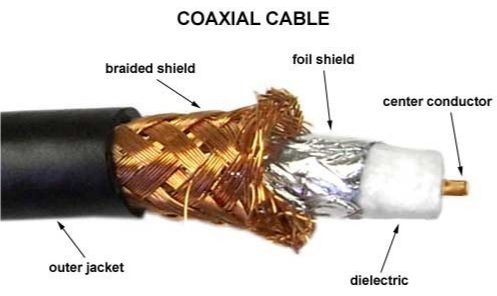
The concept of electromagnetic waves arose in the nineteenth century because of the rapid evolution of electrodynamics, and it has become as a unique type of electromagnetic field. Hans Cristian Oersted (1777-1851), a Danish physicist in conjunction with the Michael Faraday (1791-1867), an English physicist, at the start of the nineteenth century, came up with the concept of the indivisibility of the magnetic and electric fields. James Clerk Maxwell (1831- 1879), an English scientist expounded in 1846 the basics of magnetic and electrical phenomena in its entirety, and also produced a full thesis of the electromagnetic field. He exhibited mathematically the concept of the electromagnetic field in the form later referred to as the Maxwell's equations. [3]. These equations may be expressed in phrases in the following sentences: The field force lines of electric fields begin and ends in electric charges. The field force lines of the magnetic field are closed curves. Varying magnetic fields produce electric fields, while varying electric fields and chargnour. Hertz in his experiment was able to transmit electrical charge from one cable to another which were a few meters away from one another. [3].
Electromagnetic waves are oscillating electric and magnetic fields which propagate in free space at the speed of light (c) which is approximately 300,000,000 m/s. The electric and magnetic fields are oriented at right angles to each other. Energy is carried through space by electromagnetic waves, and their wavelengths vary, with each wavelength corresponding to a different kind of wave. The different types of the waves on the electromagnetic spectrum have different kinds of waves which move from longest to shortest wavelength and include radio, microwave, infrared, visible light, ultraviolet, X-Rays, and Gamma rays. Its wavelength is inversely proportional to its, frequency. Equation (1) illustrates this mathematically:
Where: λ is wavelength in meters, f is frequency in Megahertz.
The energy of the wave increases with increase in frequency and is shown in Equation (2).
Where: E is energy of wave, f is the frequency and h is the Planck's constant.
Electromagnetic waves find wide use in many applications. For communication, Radio waves are used. Microwaves are used in heating and cooking food using the microwave oven. They are used also for communications, to extend the TV signals range to greater distances. Used in remote controls are Infrared and for night vision cameras which are heat-sensitive among many numerous applications. Ultraviolet (UV) waves are very useful in destroying viruses, bacteria, and moulds in water, the air, and on surfaces. Used in imaging are X Rays, while Gamma rays are used to treat cancers and for geological applications.
A transmission line is a system of conductors, such as coaxial cables, waveguides, or wires that conduct electric power or signals efficiently between two terminals or more.” [4].
2. The Transmission Line
A transmission line is a cable or other structure specially designed to conduct electromagnetic waves between two or more terminals. When the conductors are long enough, it is called a transmission line and the wave nature of the transmission must be considered. A transmission line applies to a large range of power levels, frequencies, lengths of line, and construction modes.
The Telegraph was the earliest device that used transmission lines. It was built of mechanical parts, required little power to work, and its frequency spectrum was less than 100Hz. The first public message was sent in 1844 By Morse. Currently, there are several devices that use transmission lines. Many of these are more complex, requires wider frequency band, and have higher quality of sending and receiving end instruments.
In 1918 carrier frequency transmission was commercially introduced. This resulted in a great increase in the rate that any transmission line handles messages. In carrier frequency transmission, a sinusoidal wave of higher frequency is combined with a signal through the process of modulation. As a result, a band of frequencies that is close to the carrier is transmitted. At the receiving end through the process of demodulation, the signal is recovered.
The basic transmission line consists of two parallel conductors. These include the open wire line made up of two identical wires with air as the surrounding medium and a spacing of about 75 times the diameter of the conductor; the cabled pair having two twisted identical wires with solid insulation and a centre to centre spacing of twice the diameter of the conductor and encased; and the coaxial cable (Figure 2).
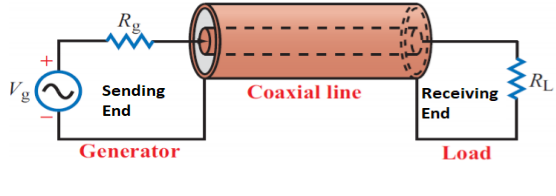
To explain the signal on any line using Electric field intensity (E) and Magnetic field intensity (H) requires that the field distributions of E and H in transverse plane should be explained. The circuit state at any position can be fully explained using the current and voltage flowing in the circuit along a quasi-TEM (Transverse Electromagnetic) or TEM line [6]. This approximation should be understood and an awareness of the situations where it breaks down should be known. Transmission line models can be developed once the transmission line issues have been reduced to its resistance (R), Capacitance (C), Inductance (L), current, and voltage. Several models for transmission line are in use depending on the frequency of operation and accuracy needed.
Figure 3 can be used as a model for a segment of transmission line that is uniform, with steady cross-section along its length, regardless of the actual structure. The main constants of this transmission line are “R = resistance/unit length; L = inductance/unit length; C = capacitance/unit length; and G = conductance/unit length” [7]. A good approximation which is useful is the lossless concept. However, when the resistance is large for example in the narrow on-chip interconnections, the lossless approximation is not valid.
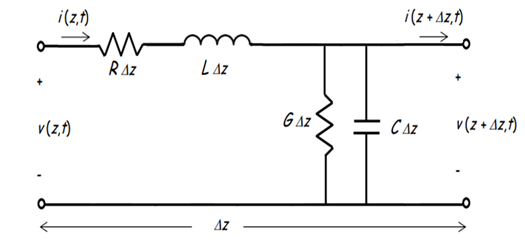
When Kirchhoff’s laws applied to Figure 3 and the limit as ∆z → 0 is taken, the Equations of the transmission line are obtained.
These Equations (3) and (4) are referred to as the Telegrapher’s Equations. Solving further, the Characteristic impedance is obtained as:
3. Properties of a Coaxial Cable
Coaxial cables have many characteristics or properties. These include Resistance of the Coaxial Cable, Resistance Per Unit Length, Coaxial cable capacitance, Inductance, Characteristic Impedance, Cutoff frequency, Velocity of Propagation, Skin Effect, and Attenuation. Several of these properties are calculated using the inner and outer conductor diameters illustration of a coaxial cable in Figure 4.
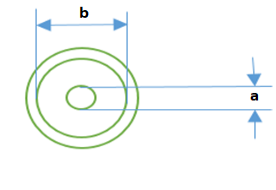
The coaxial cable has a shunt capacitance because of the space between inner and outer conductor of the cable. This capacitance per unit length C' in Farads per meter (F/m) is defined as [9, 10]:
As a result of the magnetic field that exists around the inner conductor as electromagnetic waves are propagated, the coaxial cable contains some inductance. The inductance per unit length L' (Henries per meter (H/m)) [9, 10] is:
For a lossy coaxial cable, the characteristics impedance is defined by Equation 5 as:
When the cable is lossless, line resistance (R'= 0) dielectric loss (G' = 0), this Equation becomes [6, 10]:
Substituting the values of and in Equations 6 and 7 we have:
But
Substituting we have:
Where: is the permittivity of vacuum,
= relative permittivity of the dielectric,
is the speed of light
outer diameter, and inner diameter of the coaxial cable.
is the permeability of vacuum or free space permeability.
ln (x) = 2.30259 (x)
The expression for attenuation in a coaxial cable [11] is below:
The general Equation for attenuation loss in Coaxial cables is the combination of the Resistivity loss and the dielectric loss which is equation (13).
Where: diameter of the outer conductor
The resistivity of the centre of conductor material relative to copper = the resistivity of the shield material relatively to copper.
4. Experimentation
To measure the amount of electromagnetic field in a coaxial cable, the PCE electromagnetic (EM) field meter was employed. Also used is the EMF clamp meter. In order to take an accurate measurement of the resistance of an LMR 400 coaxial cable and electromagnetic field present in the coaxial cable, the Airtel mast at AP filling Station Olu-Obasanjo Road and the Airtel mast at Air force base Port Harcourt Rivers State were used to carry out our measurements on an interval of 4 days. Several measurements were obtained at a Global System for Mobile Communications (GSM) Base Transceiver Station as illustrated in Figures 5 and 6.
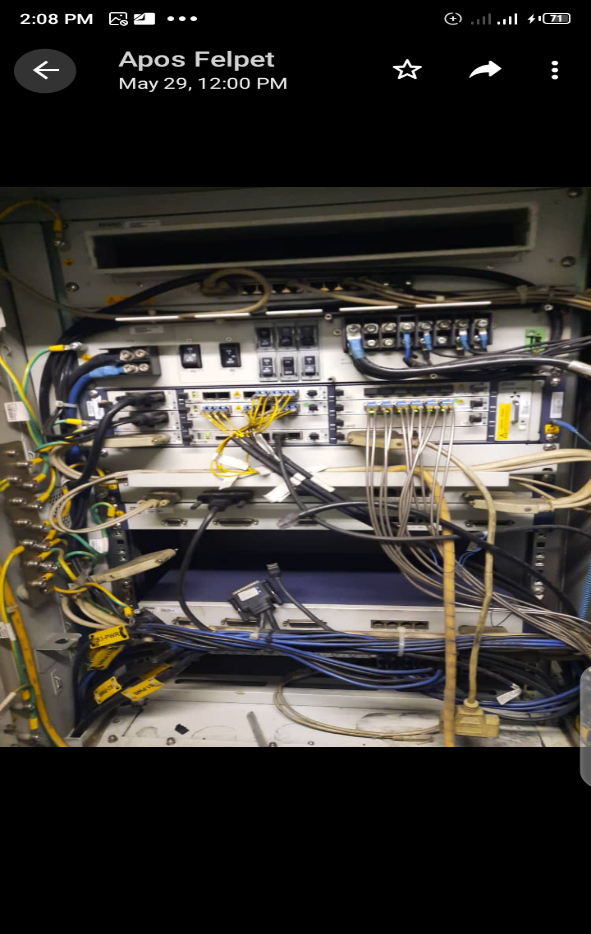
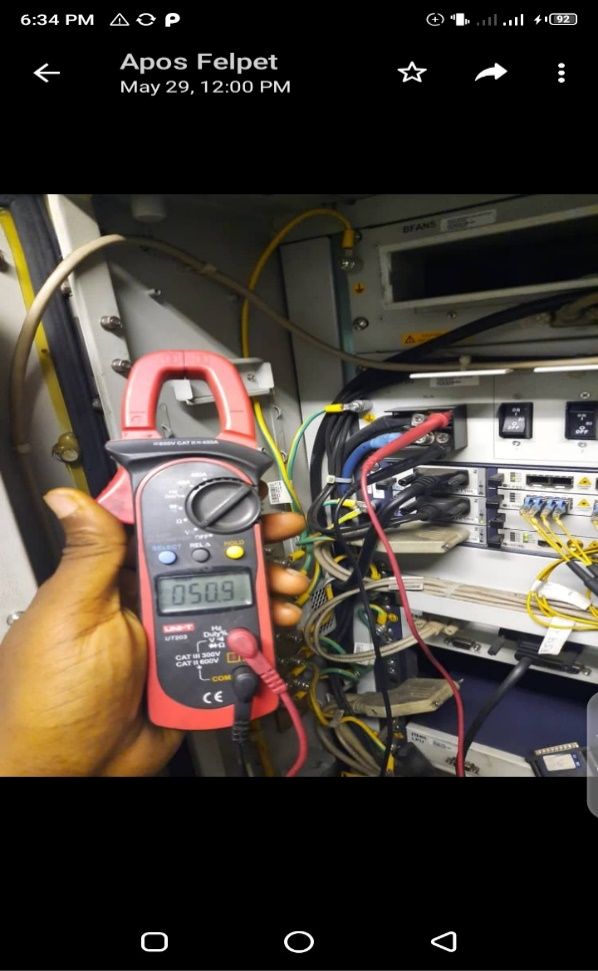
On this experiment we measured the level of attenuated GSM (Global System for Mobile Communications) signal from an LMR 400 coaxial cable connected to a Huawei base transceiver station. Also measured is the comparative characteristics of LMR400 Microwave cable, attenuation data for LMR series Microwave coaxial cables, and tests on other coaxial cables for Microwave Propagation. GSM attenuation measurement are shown in Table 1, while Table 2 shows the LMR=400 resistive loss data.
With a 1900 MHz GSM signal propagated at an input power of 100 watts, the graph in Figure 7 illustrates the percentage of power loss and the output signal at different lengths of the coaxial cable. Figure 7 was plotted using data from Table 1.
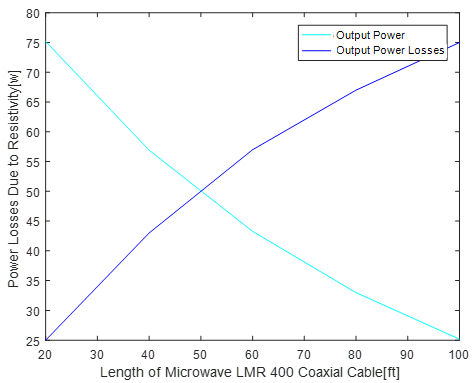
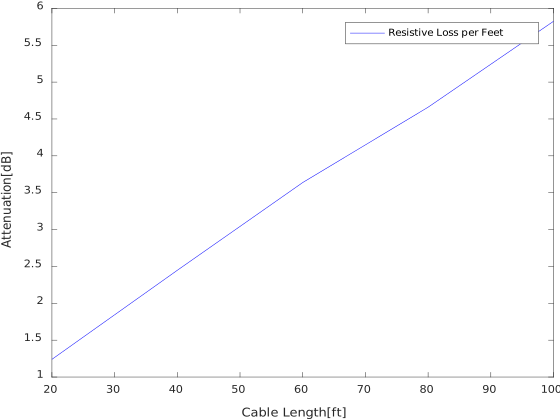
Figure 2 shows the resistive loss per feet when a 1900 MHz GSM signal is propagated through the cable. Figure 8 was plotted using data from Table 2.
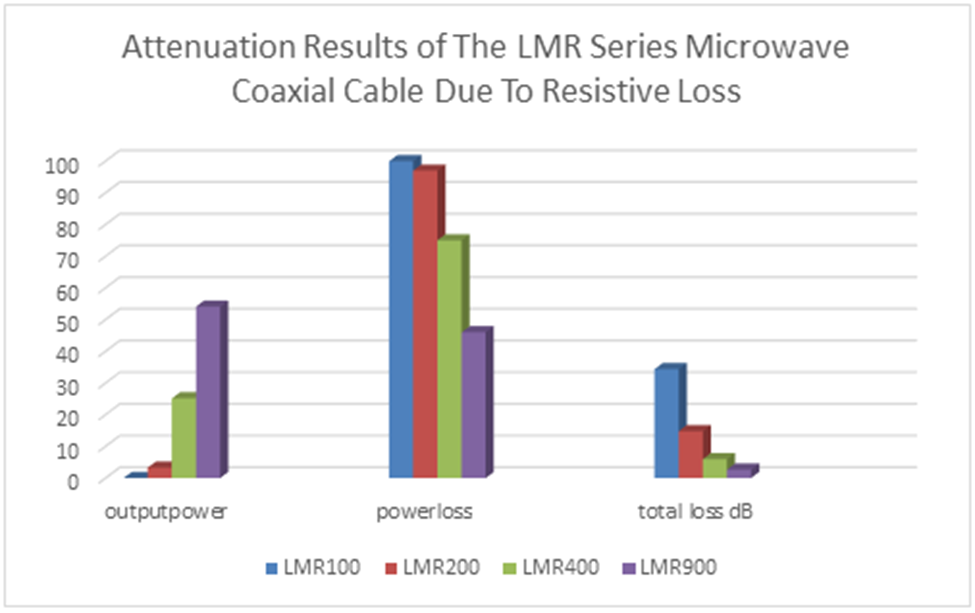
LMR series coaxial cables were tested. The results in Table 3 shows the LMR 900 to be the best in the series because it has higher output power compared to others, lowest attenuation, and lowest power percentage loss at 30GHz. The next in line to be chosen after LMR900 is the LMR400 cable.
Figure 9 was plotted using data from Table 3.
Getting the best results during microwave propagation depends on the type of coaxial cable with its dielectric constant and how the resistance of the cable reacts to high frequency propagation through it. The results in Table 4 shows the various types of coaxial cables tested with their respective losses in decibels.
Figure 10 was plotted using data from Table 4.
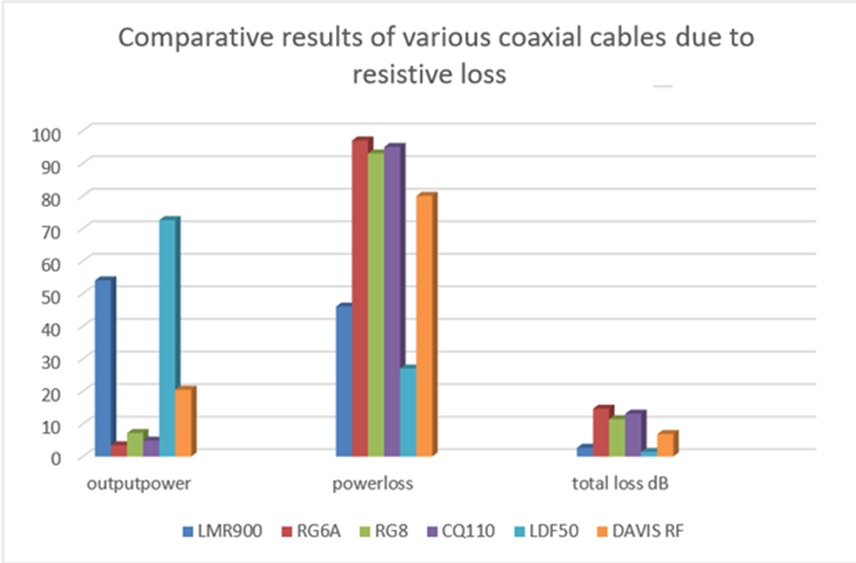
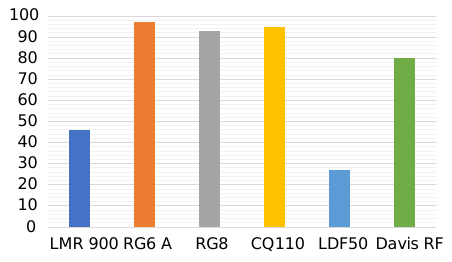
Figure 11 illustrates the percentage power losses in each coaxial cable and was plotted from data in Table 5.
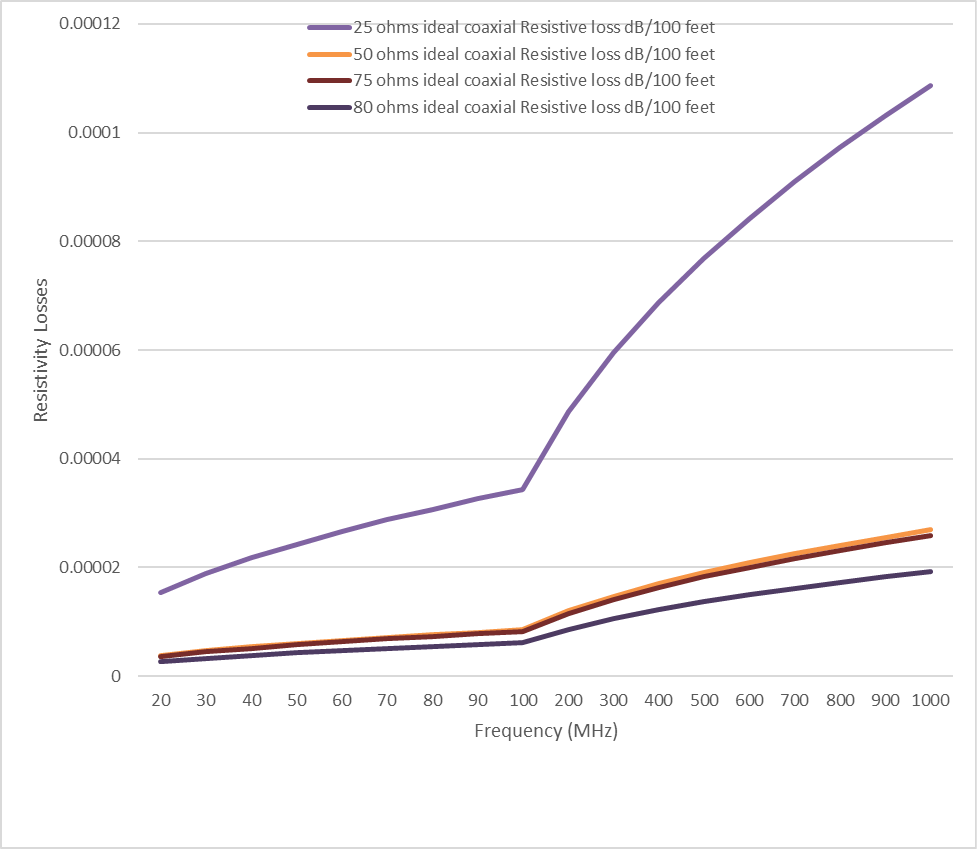
Equations 10 and 11 were used in calculating the Resistive loss of Coaxial cables as a factor of their characteristic impedance and frequency in MHz. With the dielectric of the Coaxial Cable chosen to be Polyethylene Solid (PE) with relative dielectric constant of 2.3 and Power Factor (PF) of 0.0003 [12], characteristics impedance chosen to be either 25Ω, 50Ω, 75Ω, or 80Ω, the inner and outer diameters of the coaxial cable was calculated using Equation 10. These values where then used in Equation 11 to calculate the resistivity loss for the various characteristic impedance of the Coaxial Cable. Since both the inner and outer conductors are both made of copper, the resistivity of the centre of conductor material relative to copper and the resistivity of the shield material relatively to copper are the same and have the value of [13]. The results are in Table 6.
5. Conclusion
One of the fastest ways to transmit electromagnetic signals after the fibre optics medium, is the use of the Coaxial Cable. However, the issue with the coaxial cable is the attenuation loss on the cable particularly, the resistive losses which is the focus of this research.
Based on the findings, it is concluded that for a better and improved signal quality and to reduce resistive losses in coaxial cables, the characteristic impedance of the cable should be 80 ohms as this will reduce the coaxial cable resistive losses.
References
- Wikipedia. (2021). Coaxial Cable. Retrieved from https://en.wikipedia.org/wiki/Coaxial_cable
- Indiamart.com. (2021). Finolex Coaxial Cable. Retrieved from indiamart.com: https://www.indiamart.com/proddetail/finolex-coaxial-cable-13401967188.html
- Dervić, K., Šinik, V., & Despotović, Z. (2019). Basics of electromagnetic radiation. IX International Conference Industrial Engineering and Environmental Protection 2019 (IIZS 2019) (p. 10). Zrenjanin, Serbia: Dr Zeljko V Despotovic.
- Magnusson, et. al. (2001). Transmission Lines and Wave Propagation, Fourth Edition. New York: CRC Press.
- Farahmand, F. (2012). Sonoma. Retrieved from Sonoma: https://web.sonoma.edu/users/f/farahman/sonoma/General_Lectures/TransmissionLines/TransLine/TransmissionLinesPart_I.pdf
- Steer, M. (2010). Microwave and RF Design A Systems Approach. Raleigh, NC.: SciTech Publishing, Inc.
- Stiles, J. (2005). 2.1 The Lumped Element Circuit. Retrieved from The University of Kansas: http://www.ittc.ku.edu/~jstiles/723/handouts/2_1_Lumped_Element_Circuit_Model_package.pdf
- Pozar, D. (2011). Microwave Engineering Fourth Edition. Hoboken, NJ: John Wiley & Sons, Inc.
- Ellingson, S. (2020). Electromagnetics, Vol. 2. Blacksburg, VA: Virginia Tech Publishing.[CrossRef]
- Zolotkov, A. (2020). Coaxial Cable Calculator. Retrieved from translatorscafe.com: https://www.translatorscafe.com/unit-converter/uz-Latn-UZ/calculator/coaxial-cable/
- Large, D., &. Farmer, J. (2009). Broadband Cable Access Networks. Burlington, MA: Morgan Kaufmann Publishers.[CrossRef]
- Standard Wire & Cable Co. (2021). Coax Cable Theory and Application. Retrieved from Standard Wire & Cable Co.: www.standard-wire.com/coax_cable_theory_and_application.html
- Georgia State University. (2021). Table of Resistivity. Retrieved from HyperPhysics: http://hyperphysics.phy-astr.gsu.edu/hbase/Tables/rstiv.html