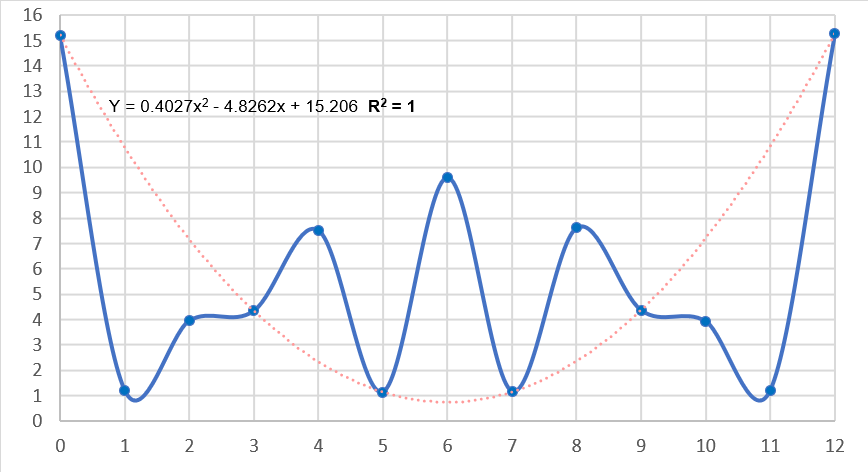
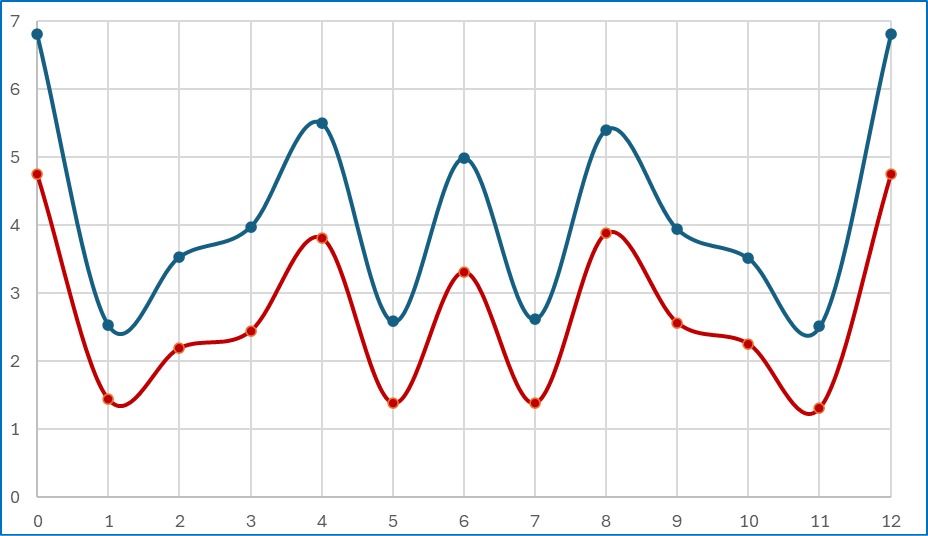
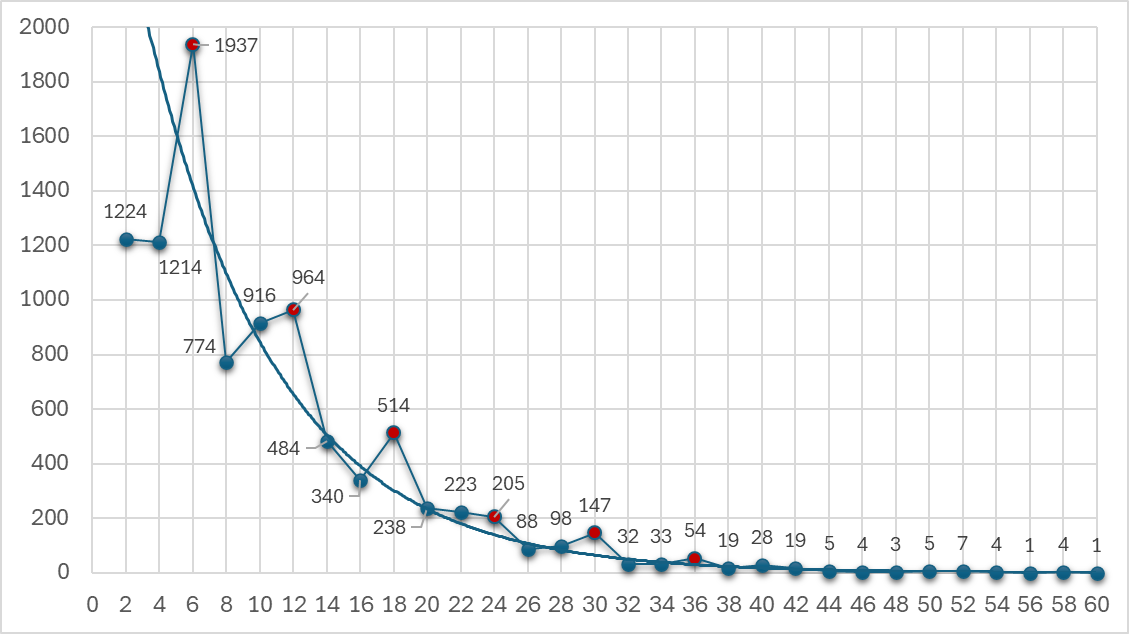
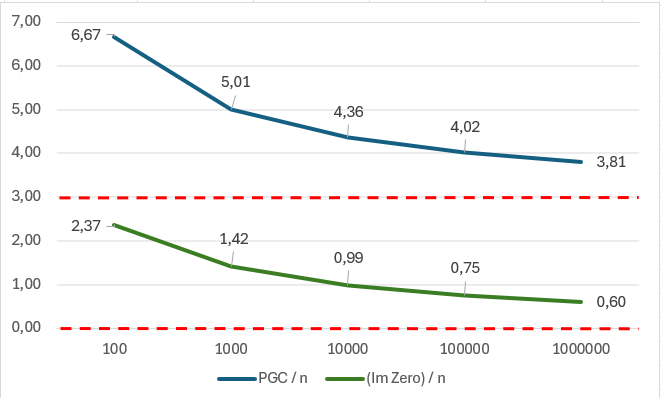
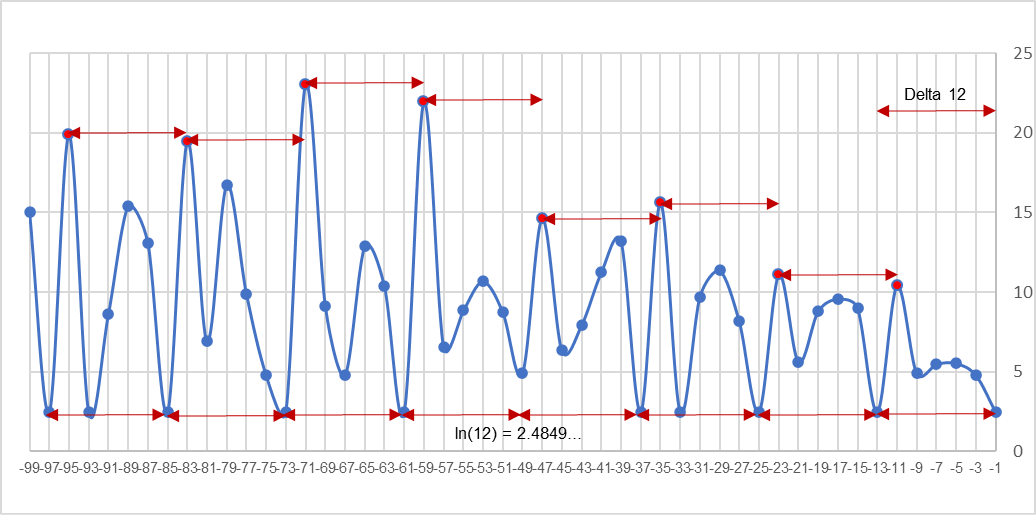
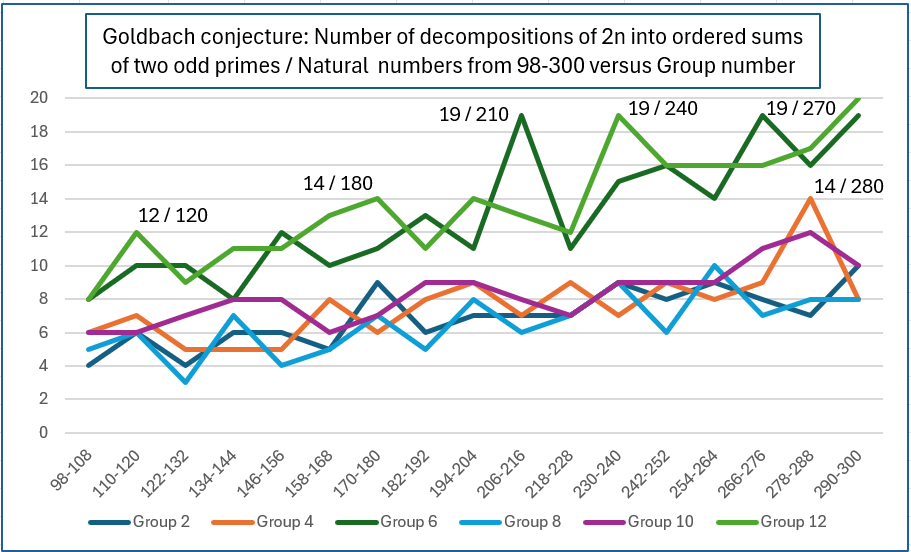
A residual-set framework is introduced for analyzing additive prime conjectures, with particular emphasis on the Strong Goldbach Conjecture (SGC). For each even integer <math><semantics><mrow><msub><mi>E</mi><mi>n</mi></msub><mo>≥</mo><mn>4</mn></mrow></semantics></math>, the residual set <math><semantics><mrow><mi>ℛ</mi><mrow><mo>(</mo><mrow><msub><mi>E</mi><mi>n</mi></msub></mrow><mo>)</mo></mrow><mo>=</mo><mo>{</mo><msub><mi>E</mi><mi>n</mi></msub><mo>−</mo><mi>p</mi><mo>∣</mo></mrow></semantics></math> <math><semantics><mrow><mi>p</mi><mo><</mo><msub><mi>E</mi><mi>n</mi></msub><mo>,</mo><mi>p</mi><mo>∈</mo><mi>ℙ</mi><mo>}</mo></mrow></semantics></math> is defined, and the universal residual set <math><semantics><mrow><msub><mi>ℛ</mi><mi mathvariant='double-struck'>E</mi></msub><mo>=</mo><msub><mrow><msup><mstyle mathsize='140%' displaystyle='true'><mo>∪</mo></mstyle><mtext>​</mtext></msup></mrow><mrow><msub><mi>E</mi><mi>n</mi></msub></mrow></msub><mi>ℛ</mi><mrow><mo>(</mo><mrow><msub><mi>E</mi><mi>n</mi></msub></mrow><mo>)</mo></mrow></mrow></semantics></math> is constructed. It is shown that <math><semantics><mrow><msub><mi>ℛ</mi><mi mathvariant='double-struck'>E</mi></msub></mrow></semantics></math> contains infinitely many primes. A nontrivial constructive lower bound is derived, establishing that the number of Goldbach partitions satisfies <math><semantics><mrow><mi>G</mi><mrow><mo>(</mo><mi>E</mi><mo>)</mo></mrow><mo>≥</mo><mn>2</mn></mrow></semantics></math> for all <math><semantics><mrow><mi>E</mi><mo>≥</mo><mn>8</mn></mrow></semantics></math>, and that the cumulative partition count satisfies <math><semantics><mrow><munder><mstyle mathsize='140%' displaystyle='true'><mo>∑</mo></mstyle><mrow><mi>E</mi><mo>≤</mo><mi>N</mi></mrow></munder><mi>G</mi><mrow><mo>(</mo><mi>E</mi><mo>)</mo></mrow><mo>≫</mo><mfrac><mrow><msup><mi>N</mi><mn>2</mn></msup></mrow><mrow><msup><mrow><mtext>log</mtext></mrow><mn>4</mn></msup><mi>N</mi></mrow></mfrac></mrow></semantics></math>. An optimized deterministic algorithm is implemented to verify the SGC for even integers up to 16,000 digits. Each computed partition <math><semantics><mrow><msub><mi>E</mi><mi>n</mi></msub><mo>=</mo><mi>p</mi><mo>+</mo><mi>q</mi></mrow></semantics></math> is validated using elliptic curve primality testing, and no exceptions are observed. Runtime variability observed in the empirical tests corresponds with known fluctuations in prime density and modular residue distribution. A recursive construction is formulated for generating Goldbach partitions, using residual descent and leveraging properties of the residual sets. The method extends naturally to Lemoine's Conjecture, asserting that every odd integer <math><semantics><mrow><mi>n</mi><mo>≥</mo><mn>7</mn></mrow></semantics></math> can be expressed as <math><semantics><mrow><mi>n</mi><mo>=</mo><mi>p</mi><mo>+</mo><mn>2</mn><mi>q</mi></mrow></semantics></math>, where <math><semantics><mrow><mi>p</mi><mo>,</mo><mi>q</mi><mo>∈</mo><mi>ℙ</mi></mrow></semantics></math>. A corresponding residual formulation is developed, and it is proven that at least two valid partitions exist for all <math><semantics><mrow><mi>n</mi><mo>≥</mo><mn>9</mn></mrow></semantics></math>. Comparative analysis with the Hardy-Littlewood and Chen estimates is provided to contextualize the cumulative growth rate. The residual-set methodology offers a deterministic, scalable, and structurally grounded approach to additive problems in prime number theory, supported by both theoretical results and large-scale computational evidence.