

The study accessed the critical risk factors in public-private partnership (PPP)-procured mass housing project (MHP) delivery in Nigeria. The research design adopts a quantitative approach, using well-structured questionnaires distributed to stakeholders involved in PPP-MHPs i.e. consultants, in-house professionals, contractors, and the organized private sector (OPS) registered with PPP departments in the Federal Capital Territory Development Authority (FCDA) Abuja, Nigeria. The instrument relates to the background information of respondents and the risk peculiar to PPP-MHP. Sixty-three (63) risk factors were submitted for the respondents to rank using Mean Item score (MIS) for risk occurrence and its severity, while risk significance index (RI) was used to determine the risk impact. Fuzzy Synthetic Evaluation (FSE) method was subsequently applied to determine the risk criticality groups and the overall risk level in the sector. The fuzzy set theory deals with ambiguous, subjective and imprecise judgments peculiar to decision making in construction project risk assessment. It aims to provide a synthetic evaluation of an object relative to a fuzzy decision environment with multiple criteria that requires qualitative linguistic terms. The findings show that thirty-one (31) risk factors were critical in the sector while financial and micro-economic risk group is contributing most significantly to the overall risk level in PPP-MHPs in Nigeria. The top 10 risk factors in the sector include availability of finance, high finance cost, the unstable value of the local currency, lack of creditworthiness, influential economic events (boom/recession), high bidding cost, poor financial market, financial attraction to project investors, interest rate volatility, inflation rate volatility, corruption and lack of respect for the law, non-involvement of the host community and poor execution of housing policies. The implication for practice is that having known the risk group contributing most significantly to the overall risk level in PPP-MHPs, adequate financial and budgetary allocation should be made available before embarking on such venture so as to sustain the scheme in the country. The study is one of the recent researches conducted on housing, since the procurement option is novel in the sector. The study is of immense value to PPP actors in providing necessary information required to formulate risk response methods in minimize the identified risk impact sector.
Evaluation of the Critical risk factors in PPP - procured Mass Housing Projects in Abuja Nigeria - A fuzzy synthetic evaluation (FSE) approach
January 29, 2023
March 20, 2023
April 26, 2023
April 27, 2023
This is an Open Access article, distributed under the terms of the Creative Commons Attribution 4.0 International License (http://creativecommons.org/licenses/by/4.0/), which permits unrestricted use, distribution and reproduction in any medium or format, provided the original work is properly cited.
Abstract
1. Introduction
The need to manage risks in construction project delivery is relevant to all professionals and other stakeholders in the sector such as the client group, design team, project management team, and contractors, with concern for cost, time, quality and health and safety, most especially in the housing sector [1]. Although risk management is still a developing field of knowledge and expertise in Nigeria [2], but much had been done in the area of risk identification and assessment, there is still a great need for research that provides an objective assessment of risk management most especially in PPP mass housing project (PPP-MHP) delivery. Ibem [3] and Ahmed and Sipan [4] observed that PPP is gaining currency in housing provision in Nigeria based on the premise that it promotes multi-stakeholders participation thereby enhances the productivity of the public-sector housing and reduces housing shortage. The Federal Government adopted a market-oriented approach to housing delivery and infrastructure development in Nigeria in the year 2000 stressing its role as that of enabler and regulator, rather than a provide which had been hitherto the role of the Federal Government [5]. This approach allows the organized private sector (OPS) to be fully involved in the provision of housing in the country. The mass housing scheme was initiated to utilize the PPP strategy, with the main objective to provide adequate and affordable housing accommodation for the growing population most especially the middle and low-income earners. PPP in housing provision thereby becomes prominent in Lagos and Abuja, the Federal Capital Territory of Nigeria. As novel as this initiative is in the sector, it was observed that the programmes has not performed to expectation due to some inherent risk factors involved and the objectives of the PPP-MHP had been defeated [6]. Hence there is need for a study that examines the critical risk and response strategy to ensure the sustainability of PPP-MHP scheme.
1.1. The Performance of Abuja PPP Mass Housing Scheme
The FCTA guideline allows for large parcels of land to be granted to private sector real estate developers at low prices. The developers will then construct estates of affordable housing with tertiary infrastructure linking these mass houses to the government provided primary infrastructure. The private developers were made to sign a Development Lease Agreement (DLA) and an undertaken to mobilize to the site within six months and complete development within three years from the date of signing of the agreement. It also requires the developers to comply with the city’s regulations, standards and specifications in the course of the construction of the housing units. The Mass Housing Scheme (MHS) is meant to do three things; allocation of land to the OPS, production of affordable housing units and development of primary and tertiary infrastructure. These are to be accomplished through the partnership between the private developers and the FCTA. Ukoje and Kanu [5] opined that this partnership did not achieve the much-desired objectives of the program as the outcomes have not been produced to any reasonable level. Ukoje and Kanu [5] stated that the FCTA started to allocate the approved land across the 22 districts of the FCT to estate developers to construct houses to fulfil its part of the agreement in the MHS. The allocations were made in three phases between 2000-2003, 2004-2007 and 2008-2011 under varying terms and conditions. In the first phase of the program, the development lease term was three years within which the developer was expected to complete and sell the houses to individual beneficiaries. 184 developers were granted allocation with a combined area of 2610 hectares in six different districts of the FCT. Umoh [6] opined that the second and third phases of 2004-2007 and 2008-2011 comprised of large volume of land with a combined area of 10,081.7 hectares that was allocated to 176 developers which were fast-tracked to 18 months under the Accelerated Development Program from the date of signing the agreement. Rufai [7] opined that FCTA did not adhere to the rule for land allocation as they were made in defiance of the specification of the agreement. Ukoje and Kanu [5] were also of the opinion that the majority of developers received very generous allocation well above the policy requirement. The poor implementation of the MHS has turned it into a land program rather than a housing program. Under this scheme, developers had more land than they could develop and resorted to land subdivision into single plots which were sold to individuals running to about ₦3 to ₦6 million for plots of 400-450sqm [5, 6]. These buyers posing as ‘sub-contractors’ then built, using a prototype design obtained from the ‘Developer’. This situation has diverted the attention of developers from the intent and purpose of the PPP's objectives as land sales were found more lucrative than a housing development. As of 2012, only 4158 units were delivered by 29 developers. This represents 11.66% of the total units of housing proposed. The remaining 31,700 units (86.62%) are at different stages of completion and about 2,704 units and 8,884 units are at Finishing and Roofing stages respectively while Over 19,913 units are at DPC level. The houses produced by the MHS are unaffordable to most of the population in Abuja. The MHS is framed as an affordable housing program targeting low and medium-income earners as beneficiaries; however, an estimated 35,659 housing units of different typologies proposed by the sampled developers on-site were high-end housing [8, 9].
1.2. PPP Risk Management Framework/Process
Risk can either be managed, minimized, shared, transferred, or accepted, but cannot be ignored [10, 11, 12]. Project risk management is an important discipline that consists of three phases irrespective of the procurement route. The three phases include; (a) risk identification which is dealing with the documentation of possible risks; (b) risk assessment which is the close examination and evaluation of the identified risks’ probabilities and possible impact and (c) risk response which is the selection and implementation of actions that could lower those risks’ likelihood and impact [10, 13]. Risk management is a system that aims to identify and quantify all risks to which the business or construction project is exposed by minimizing unforeseen costs accruable from such risks so that a conscious decision can be taken on how to manage it [14, 15]. Ameyaw [16] defines the risk management process (RMP) as a logically consistent and structured approach to enumerating and understanding potential risk factors and assessing the consequences and uncertainties associated with the identified risk factors. Renault and Agumba [17] opined that risk management in the construction industry is the assessment and response to risks that are inevitably attached to construction projects. Therefore, risk management is the approach and activities that are put in place to lessen the disturbances that may occur during the action of a project. Risk management is one of the nine core knowledge areas as identified in the PMBOK which described the term as the process that concerns conducting risk management planning, identification, analysis, responses, monitoring and control on a project. Owing to its increasing importance, risk management has been recognized as a necessity in today’s construction industry, and a set of techniques and strategies have been developed to control the influences brought by potential risks. Many authors have proposed different processes of risk management to ensure successful project outcomes and reduce the level of the potentially catastrophic consequence of risk [18]. The risk management framework process as view by Ameyaw [16] is a useful platform from which the various processes involve shall now be discussed.
1.3. Risks in Mass Housing Projects
Trangkanont and Charoenngam [19] argued that studies on failure factors of the building project were few as to whether the organizations responsible for the failure were reluctant to reveal their failure efforts or failed to learn their failure lessons. The study identified substandard construction, lack of economic viability and subsidies, low-quality construction materials, mass housing programme exploitation by developers and political abuse. Yusuf, Mohammad [20] assessed the risk factors affecting mass housing projects in Nigeria to include the following; Site condition variation, illegal encroachment on land, theft, and vandalism, illegal title to land, damage to work, project fear selection challenges and land grabbing, though all the identified risk (failure) factors do not relate to PPP risk(s). Sodangi, Kazmi [21] listed unsatisfactory involvement of local beneficiary communities; poor cooperation among key stakeholders; and communication gaps between donors, construction companies and local beneficiaries as factors that affects successful outcome of mass housing in the north-east which results in low quality housing products. However, Jiboye [22] observed that wrong perception of the housing needs of the low-income earners, who incidentally constitute the vast majority of urban dwellers; improper planning as well as poor execution of housing policies and programs; undue politicizing of government housing programs; the lack of the political will and astuteness to carry out government housing programs to logical conclusions, and insensitivity of government to the operations of the private sector in housing delivery are some of the factors that constitutes risk in PPP mass housing projects in Nigeria. Previous studies on risk management in PPP projects have classified risk in terms of categories such as site acquisition risk, design risk, construction risk, demand risk, political risk, operation risk, financial risk and force majeure risk and the risk associated with PPP projects in recent literature abounds [12, 15, 16, 23, 24, 25, 26, 27, 28, 29, 30]. Li, Akintoye [31] proposed a meta-classification approach based on three levels of risk factors for PPP/PFI projects. The three levels comprise macro-level risks; meso level risks and micro-level risks. Sanda, Anigbogu [30] submitted 74 risk factors that associated with PPP housing projects in Nigeria. Awodele [25] identified 68 risk factors in PPP market-related projects and classified these risk factors into two: endogenous and exogenous risk. The macro-level of PPP/PFI risk comprises risks sourced exogenously, i.e., external to the project itself. This level focuses on the risks at a national or industry level status, and upon natural risks. The risks at this level are often associated with political and legal conditions, economic conditions, social conditions, and weather. The meso level of PPP/PFI risk includes risks sourced endogenously, i.e., risk events and their consequences occurring within the system boundaries of the project [1]. These represent the PPP/PFI implementation problem, involving issues such as project demand/usage, location, design and construction, and technology. The micro-level of PPP/PFI risks represents the risks found in the stakeholder relationships formed in the procurement process, due to the inherent differences between the public and private sectors in contract management [27]. Awodele [32] identified 46 risk factors involved in housing projects procured using public-private partnership system in Nigeria. The study adopts the PPP risk classification in Awodele [25] and Lasehinde [27] with a little modification. Table 1 shows the identified risk factors in PPP projects that relate to PPP procured Mass Housing projects in Nigeria.
2. Data and Methodology
A total of 328 questionnaires were distributed to various categories of respondents out of 560 Population identified through census sampling. The 328 respondents are the number that can be reached during the distribution and retrieval of the questionnaires over a period of six months and only 276 of the distributed questionnaires were returned and 258 were certified fit for analysis. This represents 78.66% returned rate and is above the usual rate of 20-30% for questionnaire surveys in construction management studies [33]. In determining the critical risk factors (CRFs) in PPP MHPs the overall impact of each of the risk variable (Table 2, Column 5) was computed using the equation RI = (P x S)0.5 where RI is the risk impact, P is the risk probability of occurrence and S is the risk severity. Two approaches were adopted to establish the CRFs. The first approach is by adopting half adjusting principle, where the 63 listed risk factors were subjectively classified into four impact group as (i) extremely high impact group with mean index ≥ 6.50, (ii) very high impact group with ≤ 6.50 mean index ≥ 5.50, (iii) high impact group with ≤ 5.50 mean index ≥ 4.50 and moderate impact group with ≤ 4.50 mean index ≥ 3.50. The classification is in line with the seven-point grading scale adopted for the administration of the questionnaire. While the second approach was by computing the normalizes values for each risk factors by scaling between 0 and 1 using the formula
Where, Nv is the normalised value of a specific risk factor; a = minimum value (=0); b = maximum value (=1); A= minimum mean index of the risk factor; B = maximum mean index of the risk factor and x = mean index of the specific risk factor to be normalized. The fuzzy synthetic evaluation method was subsequently adopted to assess the critical risk factor group (CRFG) and overall risk level in PPP MHPs and to determine the group contributing the most to the risk level thereby aiding policymakers to provide the counter-measures to these critical risk factors. The result obtained for the reliability coefficient for the research instrument shows that the overall Cronbach alpha value was 0.874 and the Cronbach alpha values tend towards 1.0 and can be concluded that the instruments used for the research are significantly reliable.
3. Background Characteristics of Respondents
The background information of the respondents is hereby presented where the largest proportion comes from the public sector representing 71% while the remaining 29% are from the Private sector. Majority of the respondents have between 16-20 years of experience constituting 50.4%, while 35.3% have an average working experience of between 11–15 years. The respondents have an average of 15 years construction experience. Majority of the respondents with 47.3% has MSc/MTech as their highest academics’ qualification, 37.2 % of the respondents have BSc/BTech Degree; 13.2% of the respondents have PGD while 2.3% of the respondents have HND as their highest academic qualification. In term of the designation of respondents, 15.9% are Chief Executives/Managing Directors (Director) of their various organizations, 9.7% are Project managers, 5.8% are Financial Advisers, 1.2% are Facility Managers, 24.4% are Quantity Surveyors, 13.2% are Architects, 16.7% are Engineers, 10.9% are Builders while the remaining 2.3% are either Accountants, Lawyers or allied professionals respectively. Concerning general PPP experience majority of the respondents (42.2%) has between 11-15 years of experience, 36.4% has between 6-10 years of experience, 20.2% has between 16-20 years of experience while the remaining 1.2% has between 1-5 years of experience with an average of 12 years PPP experience respectively but the year of PPP mass housing experience shows that the majority of the respondents (82.2%) has between 6-10 years of experience, 15.5% has between 11-15 years of experience while the remaining 1.2% has between 15-20 years PPP MHP experience respectively with 9 years average PPP MHP experience.
4. Critical risk factors in PPP Procured Mass Housing Projects
Table 2 shows that availability of finance risk factor was the only risk factor that falls into extremely high impact category in term of the probability of occurrence and severity. This indicates that financial risk should be the most priority of stakeholders in ensuring the smooth delivery of PPP MHPs. The next 16 risk factors fall into very high impact category and ranked between 5.39 to 6.27 and 5.41 6.22 in term of probability and severity, these risk factors relates to different groups such as high finance cost, corruption and lack of respect for the law, non-involvement of the host community, poor execution of housing policies, wrong perception of housing need by low-income earners, illegal title to land, land acquisition and site availability, level of demand for the mass housing projects, inadequate experience in PPP, the unstable value of the local currency, lack of creditworthiness, inadequate distribution of responsibility and risks, the risk regarding pricing of product/service, lack of commitment from Public/Private Partners, prolonged negotiation period before initiation and construction time delay. The high-risk impact category has 31 risk factors ranked 4.41 – 5.55 and 4.50 – 5.48 in term of the probability of occurrence and severity respectively. These risk(s) categories relates to factors such as influential economic events (boom/recession), high bidding cost, poor financial market, inadequate distribution of authority between partners, poor decision making process, financial attraction to project investors, construction cost overrun, force majeure, delay in project approvals and permits, interest rate volatility, changes in government, inflation rate volatility, land grabbing/encroachment, public opposition to the mass housing projects, weather, operation cost overrun, organization and coordination risk, inability to service debt, the bankruptcy of the investors (OPS), operational revenue below projection, lack of tradition of private provision of public services, inconsistencies in government policies, excessive contract variation, competition risk, different working methods/know-how between partners, environment, insolvency/default of subcontractors and suppliers, third party tort liability, availability of appropriate labour/material, lack of government guarantee and low operating productivity. The moderate impact risk category has 15 risk factors which relates to diverse risk category such as rate of return restrictions, legislation change/inconsistencies, design deficiencies, geotechnical conditions, residual value (after concession period), change in tax regulation, import and export restriction, possible expropriation/nationalization of assets, industrial regulation change, unproven engineering techniques, poor quality of workmanship, cultural differences between the main stakeholders, staff crises, strong political opposition and late design changes. Most of these risk is however difficult to predict. Table 3 also shows the normalized values (column 6) of each risk variable; only risk factors with normalizing value ≥ 0.50 were considered to be critical and qualified for further analysis. This approached shows that there are 31 CRFs in PPP procured mass housing projects, deserving the attention of PPP practitioners in PPP mass housing projects in the country and thus require rigorous assessment.
5. Critical Risk Factor Group (CRFG) in PPP-procured Mass Housing Projects
After determining the critical risk factor, it is imperative to determine the grouping of these critical factors. The significance of these grouping is to adopt the CRFG as input variables for assessing the risk level of PPP MHPs and to reduce the complexity of handling multiple lists of risk factors. The 31CRFs were classified under five major categories/groups as shown in Table 3. These factors were grouped according to their relationship to the main group which is referred to as Critical risk factor group (CRFG); Factor analysis should have been the best means of determining the CRFG but since the KMO of the factor analysis was not running efficiently as earlier reported, hence the adoption of the half adjusting principle and the normalizing method as mentioned earlier. The result shows that Ten (10) CRFs falls under financial and macroeconomic risk group, Nine (9) under legal and socio-political risk, five (5) under operation and organization risk, four (4) under design and project selection risk and three (3) under construction risk.
6. Fuzzy Synthetic Evaluation Risk Evaluation Model
Risk assessment is complex and ambiguous, so qualitative linguistic terms are unavoidable in construction project risk management [34]. The perceptions on likelihood and impact of risk factors by the respondent are typically subjective and uncertain. The fuzzy set theory deals with the problems relating to ambiguous, subjective and imprecise judgments. Fuzzy synthetic evaluation (FSE) aims to provide a synthetic evaluation of an object relative to an objective in a fuzzy decision environment with multiple criteria. The fuzzy risk assessment model was based on the ranked and prioritised 31 CRFs by the respondents. This is to assess the critical risk factor group (CRFG) and overall risk level in PPP MHPs and to determine the factors contributing the most to the risk level in the sector following these processes viz.
6.1. Evaluation Index System
Evaluation index system was set up by defining the CRFG as the first-level index system as U = (u1, u2, u3, u4, & u5). This is based on the five classifications of the CRFs. The CRFs within the CRFG are also defined as the second-level index system as shown
U1 = (u1, u2, u3, u4, u5, u6, u7, u8, u9, u10)
U2 = (u1, u2, u3, u4, u5, u6, u7, u8, u9)
U3 = (u1, u2, u3, u4, u5)
U4 = (u1, u2, u3, u4)
U5 = (u1, u2, u3)
6.2. Computing the weighting Function of CRFs and CRFG as Input Variables (IV)
The weighting function of CRFs (second level) and CRFG (first level) as shown in Table 4 are calculated from the mean values computed from the survey. The weighting function of CRFG 1 - Financial and Macroeconomic (U1) for example comprises ten CRFs with a total mean of 56.80 (Table 4). The weighting function of High finance cost (u12) for example was quantified using the equation as:
The weighting function of remaining CRFs within CRFG 1 to 5 are calculated through the same procedure and same was adopted for risk severity while the normalized value for both CRFG was calculated as shown in Table 4.
.
6.3. Determining the Membership function of CRFs and CRFG
Membership function (MF) of a particular CRF is obtained from the collective scoring of the survey respondents, for instance, using Wrong perception of housing need by low-income earners, (u24) the survey outcome shows that the respondents ranked the level of occurrence and severity of risk factor u24 as follows 0% as extremely low; 0% as very low; 0% as low; 0% as moderate; 12.0% as a high probability of occurrence; 78.7% as a very high probability of occurrence and 9.3% as an extremely high probability of occurrence. Hence the MF of u24 is obtained as:
The MF of u24 is written as: (0.00, 0.00, 0.00, 0.00, 0.12, 0.79, and 0.09). Using the same approach, the MF of the remaining CRFs are determined and reported in Table 5 and 6. Generating the MFs for CRFs set the basis to derive the MF of each CRFG.
6.4. Evaluate the Risk Level of each of the CRFG
In evaluating the risk level of particular CRFG, the fuzzy matrix (MF) needs to be derived first i.e. MF of level 3 and level 1 based on the opinion of survey respondents as shown in Table 5 and 6. The CRFG fuzzy evaluation matrix was computed take for instance, using CRFG 1; the MFs (probability of risk occurrence) of all the CRFs in this category can be expressed in a fuzzy matrix as:
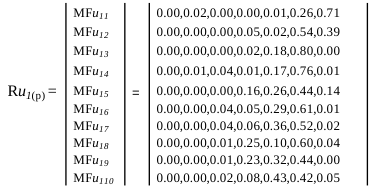
This matrix is further normalized by considering the weighting functions of the CRF within u1 (CRFG1) and produces the fuzzy evaluation matrix as:
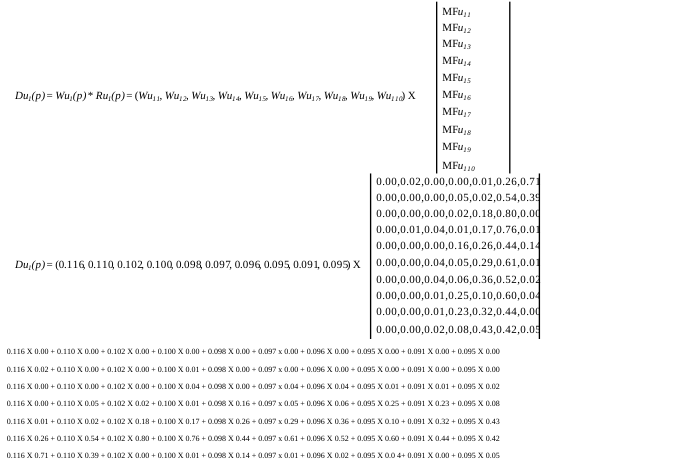 = (0.00, 0.00, 0.02, 0.09, 0.21, 0.54, and 0.15)
The same procedure was adopted for the remaining CRFG for both the risk occurrence and severity as shown in Table 5 and 6 respectively.
Having determined the fuzzy matrix of each CRFG, and combining both risk occurrence and severity; the overall risk level (ORL) in PPP MHPS can be calculated using the formula:
Where, ORL is the overall risk level of a given CRFG while subscripts p and s denotes risk probability and severity respectively. This is refers to as the defuzzification which transform or convert the resulting fuzzy numbers into crisp output in order to aid decision making. The fuzzy MF of the risk probability and risk severity are defuzzyfied using the grading scale VT.
Therefore; RLu1 = (0.00 x 1 + 0.00 x 2 + 0.02 x 3 + 0.09 x 4 + 0.21 x 5 + 0.54 x 6 + 0.15 x 7) x (0.00 x 1 + 0.00 x 2 + 0.02 x 3 + 0.08 x 4 + 0.21 x 5 + 0.56 x 6 + 0.12 x 7)
(5.76 x 5.63) = 32.43
RLu1 = 5.69
Similarly,
RLu2 = 5.28 x 5.67 = 29.94 = 5.47
RLu3 = 5.56 x 5.65 = 31.41 = 5.60
RLu4 = 5.69 x 5.65 = 32.15 = 5.67
RLu5 = 5.27 X 5.60 = 29 51 = 5.43
6.5. Evaluate the Overall Risk Level of PPP-procured Mass Housing Projects
The obtained fuzzy evaluation matrices, Di (i = u1, u2, u3, u4, u5) of each CRFG are further normalized by considering the weighting functions to generate the final fuzzy evaluation matrix of overall risk level in PPP-MHPs. The probability and severity matrices of the CRFG are presented in Table 7.
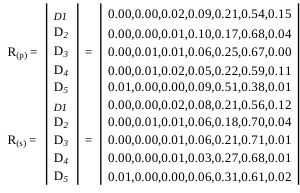
Given the weighting function set as W = (0.327, 0.293, 0.159, 0.130, 0.09), the final fuzzy evaluation matrix of overall risk probability level of PPP-procured mass housing projects can be calculated as:
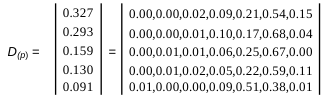 = (0.00, 0.01, 0.01, 0.08, 0.23, 0.59, and 0.08)
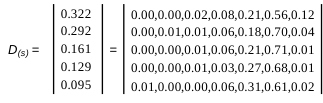 = (0.00, 0.00, 0.01, 0.06, 0.22, 0.64, and 0.07)
Now the overall risk level of PPP-procured mass housing projects is quantified using the equation as
ORLPPP mass housing = (0.00 x 1 + 0.01 x 2 + 0.01 x 3 + 0.08 x 4 + 0.23 x 5 + 0.59 x 6 + 0.08 x 7) x (0.00 x 1 + 0.00 x 2 + 0.01 x 3 + 0.06 x 4 + 0.22 x 5 + 0.64 x 6 + 0.07 x 7)
= 5.70 x 5.60
= 31.92
ORLPPP mass housing = 5.65
7. Discussion of research findings
31 risk factors were identified to be critical to the delivery of PPP Mass Housing projects in Nigeria. This is a contrast to the outcome of the research conducted by Ameyaw [16] that reported 22 critical risk factors in PPP water project in Ghana. It also contradicts the outcome of research conducted by Sanda, Anigbogu [30] that reported 25 critical risk factors associated with PPP housing projects in Nigeria and that of Awodele [25] that identified 15 risk factors that are critical to PPP private finance market in Nigeria. The 31 identified critical risk factors include the following risk factors according to the ranked order, availability of finance, high finance cost, the unstable value of the local currency, lack of creditworthiness, influential economic events (boom/recession), high bidding cost, poor financial market, financial attraction to project investors, interest rate volatility, inflation rate volatility, corruption and lack of respect for the law, non-involvement of the host community, poor execution of housing policies, wrong perception of housing need by low-income earners, illegal title to land, poor decision making process, change in government, land grabbing/encroachment, public opposition to the mass housing projects, inadequate experience in PPP, inadequate distribution of responsibility and risks, the risk regarding pricing of product/service, lack of Commitment from Public/Private partners, inadequate distribution of authority between partners, land acquisition and site availability, level of demand for the mass housing projects, prolonged negotiation period before initiation, delay in project approvals and permits, construction time delay, construction cost overrun and force majeure. The fact that availability of finance and high finance cost was ranked top concurred with the findings of Awodele [25] that cited the World Economic Forum (WEF, 2010) and concluding that availability of financial services and affordability of finance service were the most problematic factors of facilitating business in Nigeria. Sanda, Anigbogu [30] states that funding remains a key determinant of the success of any development project and that the Infrastructure Concession Regulatory Commission Act (ICRC) which was meant to encourage the participation of private sector in financing PPP projects through concession agreement did not properly address the issue of project finance, consequently, private developers are left on their own to fund the PPP housing projects which are an added burden. The outcome of this research contradicts the findings of Awodele [32] that conclude that force majeure was the topmost critical risk factor associated with PPP housing project in Nigeria as against the availability of finance. However, the study corroborated the outcome of Hwang, Zhao [35] and Xu, Yeung [24] in which availability of finance was ranked high in PPP Projects in Mainland China and Singapore which signifies that unavailability of finance and high finance cost will frustrate the goal of achieving PPP procured mass housing projects in Nigeria. The 31 critical risk factors were further fuzzified into five major group namely; financial and micro-economics risk group, legal and socio-political risk group, operation and organization risk group, design and project selection risk and construction risk group as against the outcome of the three (3) principal risk factors (PRFs) in PPP water project in Ghana conducted by Ameyaw [16], this indicates that construction risk group, design and project selection risk group and operation and organization risk group requires less attention compared to finance and microfinance group as well as legal and socio-political risk group before embarking on PPP procured Mass Housing projects. The critical risk groups (CRFG) were also defuzzified to determine the overall risk level in PPP MHPs in Nigeria which show a very high linguistic term in both probabilities of occurrence and severity. This is as informed by Khazaeni, Khanzadi [36] that linguistic principles and qualitative expert knowledge are the essential ingredients of any risk allocation process making with financial and micro-economics risk group topping the list. This make PPP procured Mass Housing scheme/projects a very risky investment to both the government and the public sector. This finding corroborates previous studies that conclude that PPP projects in developing countries are very risky that needs the commitment of both parties and this explains why such a scheme have not succeeded in the past in the housing sector.
The five critical risk groups (CRFG) as relates to PPP mass housing in Nigeria is hereby further discussed (a) Financial and Microeconomic Risk Group (CRFG 1): Financial and Microeconomic risk group were made up of availability of finance, high finance cost, unstable value of local currency, lack of creditworthiness, influential economic events (boom/recession), high bidding cost, poor financial market, financial attraction to project investors, interest rate volatility and inflation rate volatility. This classification was adopted from Ameyaw (2015) and Awodele (2012). This risk category has the highest risk level of 5.69 and with very high risk probability and severity indices of 5.76 and 5.63 respectively. Availability of finance was ranked first in this category and the success of any PPP will depend on the availability of finance and the stakeholders; especially the OPS need to adequately plan their cash flow. In a situation where the planned construction cost overrun, it can surely affect the cash flow forecast and can definitely impact on the success of the project. Also exchange rate fluctuation and interest rate volatility would normally affect other factors of production such as materials, capital and machineries as observed by Awodele (2012). When the interest rate or exchange rate is higher than anticipated, it results in higher debt servicing costs for the OPS who source these factors of production; and can definitely have a serious impact on the success of PPP projects. In case of an influential economic event such as a boom or recession, it is true that this will either have a positive or negative impact on the project. If there is a recession, then the cash-flow associated with private sector financing of the project may also be affected. (b) Legal and Socio-Political Risk Group (CRFG 2: Legal and Socio-political risk group were made up of the following critical risk factors i.e., corruption and lack of respect for law, non-involvement of the host community, poor execution of housing policies, wrong perception of housing need by low-income earners, illegal title to land, poor decision-making process, change in government, land grabbing/encroachment and public opposition to the mass housing projects as mentioned earlier; the grouping is according to their relationship with the main group. This risk category was ranked 4th with high risk level of 5.47 and high risk probability and very high severity indices of 5.28 and 5.67 respectively. This risk category shows that legal and socio-political risk does not pose so much treats to the delivery of PPP mass housing in Nigeria but can upsurge the scheme if raises its ugly head. Corruption and lack of respect for Law was ranked first under this category, this means that both the public and the private sector participants of the scheme are liable for the risk. (c) Operation and Organization Risk Group (CRFG 3): Operation and Organization risk group (CRFG 3) was made up of inadequate experience in PPP, inadequate distribution of responsibility and risks, risk regarding pricing of product/service, lack of commitment from public/private partners and inadequate distribution of authority between partners. This risk category was ranked the third highest with the risk level of 5.56 of high risk probability index and very high risk severity index of 5.65 respectively as shown in Table 4. It shows that lack of experience and good working relationship among partners in PPP procured mass housing can marred the success of the program. (d) Design and Project Selection Risk Group (CRFG 4): Design and project selection risk group (CRFG 4) was made up of risk factors such as land acquisition and site availability, level of demand for the mass housing projects, prolonged negotiation period before initiation, and delay in project approvals and permits. This risk category was ranked the second highest overall risk level of 5.67 and with very high risk probability and severity indices of 5.69 and 5.66 respectively. This indicate that apart from making money available for such scheme; design and project selection risk variables are important factors to watch out for in ensuring the successful delivery of PPP procured mass housing projects. (e) Construction Risk Group (CRFG 5): Construction related risk group (CRFG 5) is made up of construction time delay, construction cost overrun and Force Majeure. This risk category was ranked the least with overall risk level of 5.43 with high risk probability and very high severity indices of 5.27 and 5.60 respectively. This indicate that construction related risk is seldom occurred in PPP procured mass housing but can unleash a deadly blow on the project outcome.
8. Conclusion
This paper explored the critical risk factors and most risk factor group contributing to the overall risk level of PPP-MHPs in Nigeria. It is imperative to explore such risk factors in the delivery of MHPs since the adoption of the PPP option is new in the sector and government of the day has determine to use the strategy in bridging the housing gap for the middle and low income earners in the country. The administration of survey questionnaires was adopted to canvass the opinions of stakeholders with experience in PPP MHPs. The instrument relied on a catalogue of risks sourced from relevant literature and other risk factors established in previous study by Delphi panel. The study has highlighted and discussed thirty-one (31) critical risk factors and critical risk group that affect the delivery of PPP-MHPs in Nigeria but hinted that financial and microeconomics risk group is contributing the most to the overall risk level of PPP-MHPs which is also high with overall risk level of 5.65. The implication for practice is that adequate financial and budgetary allocation should be made available by both the public sector and the private sector to ensure the success of PPP MHP scheme since the study shows that investment in the sector is very risky. The study can also aid in developing PPP risk assessment guidelines in the sector and strategize on how the effect of the identified risks can be mitigated earlier in the contractual arrangement. The study, therefore, recommends the understanding of risk allocation criteria in the determination of optimal risk allocation strategies by parties to PPP-MHPs contracts. The current study was limited to Abuja the capital territory of Nigeria; the opinion of respondents in other regions of the country can be consulted for further study.
References
- Akintoye, A.S. and M.J. MacLeod, Risk analysis and management in construction. International journal of project management, 1997. 15(1): p. 31-38.[CrossRef]
- Nnadi, E.O.E., Risk Management for Sustainability Project Delivery in Industry, in Department of Civil Engineering. 2015, University of Nigeria, Nsukka.: Faculty of Engineering.
- Ibem, E.O., Public-private partnership (PPP) in housing provision in Lagos Megacity Region, Nigeria. International Journal of Housing Policy, 2011. 11(2): p. 133-154.[CrossRef]
- Ahmed, Y. and I.A.B. Sipan, Public Private Partnership for Affordable Housing in Abuja Nigeria: A Review. International Journal of Psychosocial Rehabilitation, 2020. 24(2): p. 2044-2058.[CrossRef]
- Ukoje, J. and K. Kanu, Implementation and the challenges of the mass housing scheme in Abuja, Nigeria. American International Journal of Contemporary Research, 2014. 4(4): p. 209-218.
- Umoh, N.N.E., Exploring the enabling approach to housing through the Abuja Mass Housing Scheme. 2012, Massachusetts Institute of Technology.
- Rufai, H.L., User Satisfaction Study Of Selected Public–Private Partnership Projects In Abuja in Faculty of Environmental Design, Urban and Regional Planning department. 2010, Ahmadu Bello University, Zaria.
- Oluikpe, N., Nigeria: PPP - A Failed Initiative at Affordable Housing, in Daily Independent 2015, allafrica.com: Lagos.
- Sotinwa, F., Can Public-Private Partnerships work in Nigeria?, in Africahttp://venturesafrica.com. 2013: Abuja.
- Lam, T., et al., Modelling risk allocation decision in construction contracts. International journal of project management, 2007. 25(5): p. 485-493.[CrossRef]
- Szymański, P., Risk management in construction projects. Procedia Engineering, 2017. 208: p. 174-182.[CrossRef]
- Nebo, I.J., An Assessment of Risks in Construction Projects in Institute of Management and Technology (Imt) Enugu, Nigeria. Academic Journal of Current Research, 2020. 7(10).
- Bahamid, R.A. and S.I. Doh. A review of risk management process in construction projects of developing countries. in IOP Conference Series: Materials Science and Engineering. 2017. IOP Publishing.[CrossRef]
- Zou, P.X., G. Zhang, and J. Wang, Understanding the key risks in construction projects in China. International Journal of Project Management, 2007. 25(6): p. 601-614.[CrossRef]
- Baloyi, T. and A. Ozumba. Strategic Risk Management among Small Enterprises in the Construction Industry. in MATEC Web of Conferences. 2020. EDP Sciences.[CrossRef]
- Ameyaw, E.E., Risk allocation model for public-private partnership water supply projects in Ghana. 2015, The Hong Kong Polytechnic University.[CrossRef]
- Renault, B.Y. and J.N. Agumba, Risk management in the construction industry: A new literature review. 2016.[CrossRef]
- Ameyaw, E.E. and A.P.C. Chan, Evaluation and ranking of risk factors in public–private partnership water supply projects in developing countries using fuzzy synthetic evaluation approach. Expert Systems with Applications, 2015. 42(12): p. 5102-5116.[CrossRef]
- Trangkanont, S. and C. Charoenngam, Critical failure factors of public-private partnership low-cost housing program in Thailand. Engineering, Construction and Architectural Management, 2014. 21(4): p. 421-443.[CrossRef]
- Yusuf, S., et al., Assessment of Risks in Housing Development Projects in Nigeria: A fuzzy AHP- Based Approach. The Quantity Surveyor, 2017: p. 3-11.
- Sodangi, M., et al., Towards Promoting Efficient Management Of Mass-Housing Reconstruction Schemes. International Journal of Built Environment and Sustainability, 2021. 8(1): p. 121-129.[CrossRef]
- Jiboye, A.D., Urbanization challenges and housing delivery in Nigeria: The need for an effective Policy framework for Sustainable Development. International Review of Social Sciences and Humanities, 2011. 2(1): p. 176-185.
- Ke, Y., et al., Preferred risk allocation in China’s public–private partnership (PPP) projects. International Journal of Project Management, 2010. 28(5): p. 482-492.[CrossRef]
- Xu, Y., et al., Developing a risk assessment model for PPP projects in China—A fuzzy synthetic evaluation approach. Automation in Construction, 2010. 19(7): p. 929-943.[CrossRef]
- Awodele, O.A., Framework for Managing Risk in Privately Financed Market Projects in Nigeria. 2012, School of the Built Environment Heriot-Watt University, UK: UK.
- Alireza, V., et al., An enhanced multi-objective optimization approach for risk allocation in public–private partnership projects: a case study of Malaysia. Canadian Journal of Civil Engineering, 2013. 41(2): p. 164-177.[CrossRef]
- Lasehinde, A.T., Framework for attracting investors to Public-Private Partnership Infrastructure Projects: A case study of Niger-Delta region of Nigeria, in Quantity Surveying Department. 2015, The Federal University of Technology: Akure.
- Shrestha, A., Risk allocation in public private partnerships: a principal agent approach. 2015.
- Sastoque, L.M., C.A. Arboleda, and J.L. Ponz, A proposal for risk allocation in social infrastructure projects applying PPP in Colombia. Procedia Engineering, 2016. 145: p. 1354-1361.[CrossRef]
- Sanda, Y.N., et al., Critical risk factors associated with public private partnership housing projects. Journal of Engineering, Project, and Production Management, 2020. 10(1): p. 42-49.
- Li, et al., Critical success factors for PPP/PFI projects in the UK construction industry. Construction management and economics, 2005. 23(5): p. 459-471.[CrossRef]
- Awodele, O.A., Assessment of Risk involved in Housing projects procured using Public Private Partnership system in Nigeria. International Journal of Economics, Commerce and Management, 2018. 6(12).
- Moser, C.A. and G. Kalton, Survey methods in social investigation. 2017: Routledge.[CrossRef]
- Ameyaw, E.E., et al., A fuzzy model for evaluating risk impacts on variability between contract sum and final account in government-funded construction projects. Journal of Facilities Management, 2015. 13(1): p. 45-69.[CrossRef]
- Hwang, B.-G., X. Zhao, and M.J.S. Gay, Public private partnership projects in Singapore: Factors, critical risks and preferred risk allocation from the perspective of contractors. International Journal of Project Management, 2013. 31(3): p. 424-433.[CrossRef]
- Khazaeni, G., M. Khanzadi, and A. Afshar, Fuzzy adaptive decision making model for selection balanced risk allocation. International Journal of Project Management, 2012. 30(4): p. 511-522.[CrossRef]