
Abstract
Biodiversity Conservation is a priority issue for the scientific community, and a main subject in the Biology and Geology curriculum at secondary school level in Spanish Educational System. In the present didactic proposal, we use the demographic monitoring of an endangered plant species to illustrate a research tool for estimates of biodiversity loos in nature, the local endemic Astragalus tremolsianus Pau. The aim of the proposal is to bring students closer to a real experience, which brings together knowledge of Biology, Algebra and Trigonometry, through Information and Communication Technologies (ICTs). Showing a census to monitor the populations of a threatened high mountain flora species into the classroom is an innovative teaching activity that combines and uses knowledge from different disciplines, as well as demonstrating a real application of the knowledge acquired. The use of mathematical tools encompasses a number of skills that require the application of mathematical principles and processes in the scientific context. The introduction of the structure of scientific texts is another positive aspect of this didactic experience.
1. Introduction
Biodiversity Conservation is a key issue of concern and is well established in the international scientific community. The Red List published by the International Union for Conservation of Nature represents the most comprehensive, objective and global tool for assessing the conservation status of plant and animal species.
Biological diversity is also a fundamental subject within the Biology and Geology curriculum in education programs in Spain Educational System. In fact, the Spanish Organic Law 2/2006 on Education, modified by the Organic Law 3/2020, of 29 December, mentions among its principles the need to work on knowledge of the environment, environmental values and healthy habits. On the other hand, the Royal Decree 1105/2014, which establishes the basic curriculum for Compulsory Secondary Education (Educación Secundaria Obligatoria or ESO) and the Baccalaureate in Spain, underlines as objectives: `To conceive scientific knowledge as an integrated knowledge, which is structured in different disciplines, as well as to know and apply the methods to identify problems in the various fields of knowledge and experience´ and `To critically assess social habits related to health, consumption, care of living beings and the environment, contributing to their conservation and improvement’.
The didactic proposal presented in this study is based on the use of a real-scale model as a didactic mediator, which allows us to construct representations of the ideas of ESO and Baccalaureate students about an abstract phenomenon that is difficult to represent [1], such as the conservation of the natural biodiversity of their environment. We start from a cognitive approach to science [2], taking into account that, in the field of Didactics of Experimental Sciences, special attention should be paid to the ability to apply scientific reasoning, the acquisition of knowledge and technological skills, and tools to interpret and predict different phenomena in their context, and the development of critical judgments about scientific facts [3].
From the contextual point of view, the didactic activity has been designed to be implemented with students in the 4th year of ESO and 1st year of Baccalaureate (15-17 years of age). This activity could be included in the field of educational conservation, as it is a project `of an informative or playful nature with activities aimed at raising public awareness´ [4]. In this sense, the activity described here could become an excellent starting point for educational processes related to projects involving endangered species in the environment of the participating students. Depending on their level and interest, students could seek answers to questions such as: Do I know the species of flora in my immediate environment? What is the current situation of these species from the point of view of their degree of threat? What natural, social and cultural factors intervene in their populations? What are the interactions between them? What are the threats to these species? What do the inhabitants of the areas where they live think about the local biodiversity? What are the economic implications of the conservation of their habitat? What measures need to be adopted? To answer these questions, innovative methodologies such as `problem-based learning´ can be implemented, which would include processes of enquiry, information searches, educational itineraries and other activities in the environment, role-playing, surveys, design and implementation of campaigns, press releases, internet publications, etc. All of this within the framework of environmental education [5] and education for biodiversity.
The objectives to be achieved with the development of the didactic experience are as follows:
- To disseminate the richness and importance of natural biodiversity, paying special attention to threatened flora.
- To apply a scientific approach to carry out the census and monitoring of endangered plant species in accordance with protocols established by the scientific community.
- To highlight the interdisciplinary link between Mathematics, Biology and the use of ICTs, by developing a methodology that brings together Trigonometry, Biology and the use of a computer-based tool.
- To familiarize students with the scientific method through the issuing of hypotheses, data collection, analysis of results, discussion and drawing of conclusions.
The key competencies of the educational curriculum to be worked on during the didactic experience are:
- Linguistic communication competence, essential to interpret all the oral and written information of the activity, as well as to express opinions, doubts, etc.
- Mathematical competence and basic competences in Science and Technology, brought into play in the joint use of Botany, Trigonometry and the use of computer-based tools.
- Digital competence, using computer resources for scientific purposes.
- Social and civic competence, necessary for exercising democratic citizenship in defense of environmental values.
2. Materials and Methods
2.1. Information gathering: Application of triangulations
One type of real monitoring of threatened flora is carried out through the study of permanent plots of constant area, in which the number of individuals is measured, noting their main characteristics: dimensions, number of leaves, flowers, fruits, signs of predation, etc. These data are used to construct demographic models, which are essential for knowing the state of the population and for making management decisions.
During the didactic activity, a species monitoring plot was recreated in the classroom to simulate the monitoring of the species Astragalus tremolsianus Pau. This plant species, an exclusive endemic to the Sierra de Gádor that belongs to the Leguminosae family, represents an example of the natural wealth of the province of Almería. It is found at an altitude of 2,100 meters. It lives at the bottom of dolines or small poljes, on soils rich in fine, silty-clayey materials [6]. It has been estimated that its populations have been reduced due to land clearing and that it currently numbers around 16,000 individuals [7]. This plant is legally protected and is also included in The IUCN Red List of Threatened Species [8], in the Red Book of the threatened vascular flora of Spain [9] and in the Red List of the vascular flora of Andalusia [10], catalogued as `Critically Endangered´ of extinction. The research group Conservation Biology (RNM-344) of the University of Almeria has been monitoring the conservation status of the population since 1995.
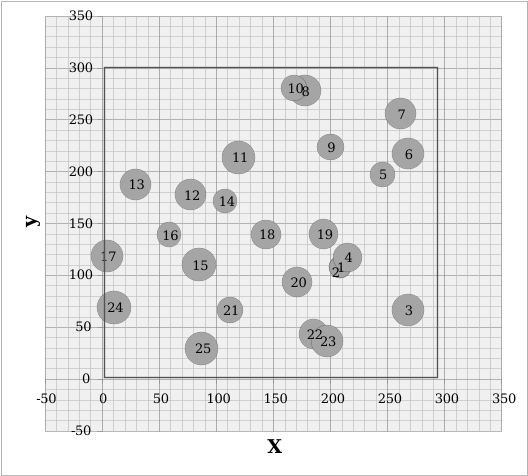
To carry out this activity in the nature would be impossible, given the characteristics both of the species and the high mountain area where it found. So, to perform the proposal, a square measuring 3x3 meters on each side was set up, with tape measures anchored at two of the corners that were used to locate the position of each of the individuals of this species by means of Cartesian coordinates, the reference system was expressed in centimeters. These individuals were represented by real images of the species cut out on cardboard, reproducing their true spatial arrangement in the wild, as shown in figure 1. The pupils participating in the activity marked and counted the individuals, as is done in sampling in the natural environment, and triangulated with the help of tape measures the position of each individual (for sampling it is more accurate to triangulate than to use Cartesian coordinates directly, then it is easy to transform the triangulations to Cartesian axes) and the corresponding distances obtained were included in an Excel spreadsheet using a laptop computer and a projection screen (Appendix A). In addition, the different sizes of each individual were sampled by measuring their largest and smallest diameters. The spreadsheet made it possible to obtain an image on the computer and the projection screen in which the different location points of the individuals and their respective sizes were inserted, see figure 2.


2.2. Data processing
During the second part of the activity, students received a file of real data collected in the field during previous years from the same sample plot that was reproduced in the classroom, but with a total of 25 individuals sampled (Appendix B). In addition, the students were provided with an exercise script with the instructions to analyze life tables using Excel software. With this information the students performed the analysis that allowed them to conclude whether the population remains stable or increases positively or negatively, and to what extent. This is a first simple analysis that consisted of dividing the number of specimens this year by the number of specimens in the previous year. This will give the λ (lambda) parameter or `finite population growth rate’. This data (λ) is the ratio between the population size at time `t’ and `t+1’. Thus, if λ > 1, the population grows; if λ = 1, the population remains stable; and if λ < 1, the population decreases. With these types of techniques, censuses and monitoring of endangered flora species are usually carried out, reproducing the methodology year after year.
2.3. Presentation of results
Finally, the students were asked to write the results and conclusions of the activity on the monitoring of the endangered flora species with the structure of a scientific paper. For this purpose, in the information dossier the sections Introduction, Material and Methods and Bibliographical References were already written, leaving the gaps for the student to write the rest of the sections (Title, Abstract, Keywords, Results, Discussion and Conclusions); and indicating that it is possible to make any extension of the sections already written.
3. Results
Figure 2, in its upper section, shows the graphic result obtained by one of the groups of students. This graph shows how the location data and the dimensions of the individuals sampled in the plot represented in the classroom were transferred to the computer program and projected on the screen. Each student marked and sampled at least one individual of the species in the monitoring plot, guided by the teacher, as shown in figure 3. On the other hand, table 1 shows the percentages of student participation in the activity and the finite population growth rate data obtained by each of the groups of students who took part in the didactic activity.

In the case of the 4th year ESO groups, the tutor had to assist a large number of students (> 80%) in order to correctly take the data and enter the parameters in the computer spreadsheet. However, the Baccalaureate groups showed almost complete autonomy in the execution of this part of the activity. In both the 4th ESO and 1st Baccalaureate groups from more than one school, there were cases of repetition in the participation of students. As for obtaining the finite growth rate `ʎ’, all students obtained without difficulty the value corresponding to their example and interpreted the state of the population.
4. Discussion and conclusions
As several authors have already pointed out, didactic activities carried out in nature are effective tools for approaching the study of the environment from an interdisciplinary perspective []. However, it is not always possible for teachers to take a group of pupils to a natural area, or to access places particularly sensitive to alternation, either because they have fragile ecosystems or because of their location. In this sense, bringing a census for monitoring the populations of an endangered high mountain flora species into the classroom is an innovative teaching activity, which combines and uses knowledge from different disciplines, as well as to show a real application of the knowledge acquired. The use of mathematical tools involved a series of skills that require the application of arithmetic principles and processes in the scientific context, as well as to make an informed judgement in the performance of calculations, the analysis of graphs and mathematical representations and the manipulation of algebraic expressions, also incorporating digital media.
This interdisciplinary activity, which connects the fields of biology, mathematics and the use of ICTs, was particularly attractive within the framework of the Science Week of the University of Almeria several academic years, if we take into account the fact that it was requested by groups of secondary schools until all the sessions were completed.
The fact that the activity was interactive and that each student was in charge of a sample, initially inhibited the groups. However, the possibility of working in teams of two or three students encouraged the participants, despite the difficulty that it is often difficult for pupils to deal with an alien environment and to participate in front of their classmates. High participation rates were achieved in the experiment. In all the groups, participation rates of over 90% of the students were obtained, with the students in the first year of the Baccalaureate showed a participation rate of 100%. Taking into account these participation data, student motivation can be considered as very high. Moreover, the understanding of the proposed activity, in terms of data collection, the use of the spreadsheet and final interpretation of the results, was quite high in all groups, although the collaboration of the activity tutor was essential in the 4th year ESO groups. In the light of this qualitative evaluation, a considerable degree of success can be inferred in the didactic proposal.
The approach to the physical world and responsible interaction with it through actions aimed at preserving and improving the natural environment are decisive for the protection and maintenance of the quality of life and the progress of society. In addition, these sorts of activities allow students to become more aware about the responsibility linked to the conservation of environmental heritage of a region [15]. According to this experience, didactic activities related to the natural environment are understood as a good resource for motivating students and complementing the programs of different subjects; and at the same time, they are able to lay the foundations for nature-protective behavior []. Furthermore, the incorporation of digital resources into learning process makes it possible to universalize content and create bridges between different areas of knowledge. The irruption of new digital technologies in the teaching-learning process is postulated as an effective tool in the cognitive process [19]. This approach also has the originality of easily transferring to the classroom an experience that takes place in the nature and of transmitting in a very direct and truthful way the work carried out by specialists in Botany, as well as the methodology for analyzing the data, considering the importance of experimentation as an exploitable resource in the learning process [20]. The analysis of these data allows simple conclusions to be drawn about the state of the populations of this species and introduces pupils to the use of the scientific language.
Author Contributions: Conceptualization, J.M. and E.M.; methodology, J.M.; software, J.M.; validation, J.M., F.M. and E.S.; formal analysis, A.M.; investigation, F.P.; resources, J.M.; data curation, A.M.; writing—original draft preparation, A.M.; writing—review and editing, A.M.; visualization, J.M.; supervision, J.M.; project administration, E.M.; funding acquisition, E.S. All authors have read and agreed to the published version of the manuscript.
Funding: This research was developed by the teaching innovation group Botánica y Fisiología vegetal en los jardines de la UAL, (21_22_1_23) funded by the University of Almería (grant 21_22_1_23), within the program innovation and good teaching practices.
Conflicts of Interest: The authors declare no conflict of interest.
Appendix A
Graphical output in an Excel spreadsheet of a census plot.
Appendix B
Spreadsheet of a census plot example.
| Plant Number | Right hand | Left hand | X | Y | Largest diameter | Smallest diameter | Average diameter |
| 1 | 235 | 142 | 208.44 | 108.54 | 9 | 7 | 8 |
| 2 | 235 | 142 | 208.44 | 108.54 | 9 | 7 | 8 |
| 3 | 276 | 74 | 267.83 | 66.64 | 20 | 15 | 17.5 |
| 4 | 245 | 145 | 215.00 | 117.47 | 15 | 13 | 14 |
| 5 | 315 | 205 | 245.33 | 197.58 | 14 | 6 | 10 |
| 6 | 345 | 220 | 267.71 | 217.62 | 19 | 14.5 | 16.75 |
| 7 | 366 | 259 | 261.46 | 256.12 | 18 | 14 | 16 |
| 8 | 330 | 304 | 177.47 | 278.21 | 17 | 16 | 16.5 |
| 9 | 300 | 245 | 199.96 | 223.64 | 14 | 9 | 11.5 |
| 10 | 327 | 310 | 168.05 | 280.52 | 13 | 10 | 11.5 |
| 11 | 245 | 280 | 119.38 | 213.95 | 21 | 14.5 | 17.75 |
| 12 | 194 | 285 | 77.35 | 177.91 | 17.5 | 14 | 15.75 |
| 13 | 190 | 330 | 28.67 | 187.82 | 19 | 13 | 16 |
| 14 | 203 | 258 | 107.74 | 172.05 | 11 | 8 | 9.5 |
| 15 | 139 | 242 | 84.60 | 110.29 | 21 | 16 | 18.5 |
| 16 | 151 | 279 | 58.27 | 139.31 | 11 | 9 | 10 |
| 17 | 119 | 319 | 4.00 | 118.93 | 18 | 15 | 16.5 |
| 18 | 200 | 210 | 143.17 | 139.65 | 16.5 | 13 | 14.75 |
| 19 | 239 | 176 | 193.58 | 140.18 | 16 | 12.5 | 14.25 |
| 20 | 195 | 160 | 170.71 | 94.25 | 18 | 12 | 15 |
| 21 | 130 | 200 | 111.50 | 66.84 | 12 | 10 | 11 |
| 22 | 190 | 123 | 184.95 | 43.51 | 15 | 14 | 14.5 |
| 23 | 200 | 110 | 196.50 | 37.25 | 19 | 16 | 17.5 |
| 24 | 70 | 298 | 10.16 | 69.26 | 20 | 17 | 18.5 |
| 25 | 92 | 215 | 87.07 | 29.73 | 20 | 16 | 18 |
References
- Gómez Galindo, A.A.; Sanmartí, N.; Pujol, R.M. Fundamentación teórica y diseño de una unidad didáctica para la enseñanza del modelo ser vivo en la escuela primaria. Enseñanza de las Ciencias, 2007, 25, 325-340.[CrossRef]
- Giere, R.N. ed. Cognitive models of science, University of Minnesota Press, Minnesota, USA, 1992.
- Soussan, G. Enseñar las ciencias experimentales: didáctica y Formación. OREAL/UNESCO: Santiago de Chile, Chile, 2003.
- González Gaudiano, E. Educación Ambiental para la biodiversidad: reflexiones sobre conceptos y prácticas. Tópicos en Educación Ambiental, 2002, 4, 76-85.
- García, J.E. Los problemas de la Educación Ambiental: ¿es posible una Educación Ambiental integradora? Investigación en la escuela 2002, 46, 5-25.
- Mota, J.F.; Cueto, M.; Merlo M.E. Flora amenazada de la provincia de Almería: una perspectiva desde la biología de la conservación. Serv. Publicaciones de la Universidad de Almería, Almería, Spain, 2003.
- Mota, J.F.; Aguilera, A.M.; Cueto, M.; Jiménez-Sánchez, M.L.; Lozano, Á.; Merlo, M.E.; Pérez-García, F.J.; Posadas, L.; Rodríguez-Tamayo, M.L.; Sola, A.J.; Soria, P. Astragalus tremolsianus Pau. In Á. Bañares, G. Blanca, J. Güemes, J.C. Moreno y S. Ortiz. eds., Atlas y Libro Rojo de la Flora Vascular Amenazada de España. (pp. 140-141). Dirección General de Conservación de la Naturaleza, Madrid, Spain, 2004.
- Mota Poveda, J.; Aguilera, A.M.; Cueto, M.; Jiménez Sánchez, M.L.; Lozano, Á.; Merlo, M.; Pérez García, F.J.; Posadas, L.; Rodríguez-Tamayo, M.L.; Sola, A.J.; Soria, P. Astragalus tremolsianus. The IUCN Red List of Threatened Species 2011, e.T161934A5515527. https://dx.doi.org/10.2305/IUCN.UK.2011-1.RLTS.T161934A5515527.en. Accessed on 12 December 2022.[CrossRef]
- Bañares, Á.; Blanca, G.; Güemes, J.; Moreno, J. C.; Ortiz, S. eds. Atlas y Libro Rojo de la Flora Vascular Amenazada de España. Adenda 2010. Dirección General de Medio Natural y Política Forestal (Ministerio de Medio Ambiente, y Medio Rural y Marino), Sociedad Española de Biología de la Conservación de Plantas. Madrid, Spain, 2010.
- Cabezudo, B.; Talavera, S.; Blanca, G.; Salazar, C.; Cueto, M.; Valdés, B. eds. Lista Roja de la flora vascular de Andalucía. Consejería de Medio Ambiente, Junta de Andalucía, Sevilla, Spain, 2005.
- López de Haro, F.; Segura Serrano, J.A. Los itinerarios didácticos: un recurso interdisciplinar y vertebrador del curriculum. Espiral. Cuadernos del Profesorado 2013, 6(12), 15-31.[CrossRef]
- Cano Ortiz A.; Piñar Fuentes J.C.; Igbareyeh J.M.H.; Quinto Canas R.; Cano E. Aspectos Didácticos en la Enseñanza de Conceptos Geobotánicos. International Journal of Humanities Social Sciences and Education (IJHSSE) 2021, 8(4), 1-6. https://doi.org/10.20431/2349- 0381.0804022[CrossRef]
- Cano Ortiz, A.; Pinar Fuentes, J.C.; Quinto Canas, R.; Cano E. Botanical education for vocational training students and primary and secondary teacher. Research Journal of Ecology and Environmental Sciences 2022a, 2(2), 1-10. https://doi.org/10.31586/rjees.2022.183[CrossRef]
- Cano Ortiz A.; Piñar Fuentes J.C.; Cano E.; Quinto Canas R.; Musarella C.M. Aspects to Consider in the Teaching of Habitats and Landscapes of Community Interest. International Journal of Humanities Social Sciences and Education (IJHSSE) 2022b, 9 (1), 132-146. https://doi.org/10.20431/2349-0381.0901011[CrossRef]
- Caruso G. Calabrian Native Project: Botanical Education Applied to Conservation and Valorization of Autochthonous Woody Plants. Research Journal of Ecology and Environmental Sciences 2022, 2(2), 47-59. https://doi.org/10.31586/rjees.2022.387[CrossRef]
- Kals E.; Schumacher D.; Montada L. Emotional affinity toward nature as a motivational basis to protect nature. Environment and Behavior 1999, 31(2), 178-202. https://doi.org/10.1177/00139169921972056[CrossRef]
- Richardson M.; Passmore H.; Barbett L.; Lumber R.; Thomas R.; Hunt A. The green care code: How nature connectedness and simple activities help explain pro-nature conservation behaviours. People and Nature 2020, 2, 821-839 https://doi.org/10.1002/pan3.10117[CrossRef]
- Torrejos C.B.; Israel G.F.G. Pro-Environmental Behavior of Undergraduate Students as a Function of Nature Relatedness and Awareness of Environmental Consequences. International Journal of Humanities Social Sciences and Education (IJHSSE) 2022, 9(1), 147-156. https://doi.org/10.20431/2349-0381.0901012[CrossRef]
- Zuluaga, J.M.; Pérez, F.E.; Gómez, J.D. Matemáticas y TIC. Ambientes virtuales de aprendizaje en clase de Matemáticas. 2014. http://reposital.cuaed.unam.mx:8080/ jspui/bitstream/123456789/4190/1/VE14.014.pdf
- Kolb D. Experience as the Source of Learning and Development. Prentice Hall. New Jersey, USA, 1984.