
Abstract
Consumption of fruit which is rich in phenolic compounds and has high antioxidant activity, prevents risk factors of various diseases. Numerous researches confirm that plants rich in such substances reduce the risks of cancer, heart diseases and hypertension. In view of the above, the goal of the research is to study prospective peach varieties in Georgia and compare them in terms of their total polyphenols content and antioxidant activity, determine the correlation between total polyphenols content and antioxidant activity during the storage of fruits. We have studied the total polyphenols content and antioxidant activity in peach fruit of different varieties before and during the storage. The conducted research showed a strong positive correlation between total polyphenols and antioxidant activity. During the storage the total polyphenols and antioxidant activity have decreased in peaches of both varieties. This change can be generalized and considered a common pattern. However, the genotype of a variety affects the strength of correlation.
1. Introduction
Consumption of fruits rich in antioxidant substances such as phenolic compounds and vitamin C is inversely associated with risks of non-communicable diseases [1]. Main compounds of phytochemicals that can contribute to the total antioxidant capacity of the plant include polyphenols and vitamins (C and E) [2]. Phenolic compounds from plants belong to a class of bioactive components with antioxidant activities [3, 4, 5, 6, 7]. Several epidemiological studies suggest that antioxidant-rich plants play a protective role in health and disease [8], and their consumption has lowered the risk of cancer [9], heart disease, and hypertension [10]. Antioxidants function through protection mechanisms at several levels within cells in human body by inhibiting the formation of free radical species, intercepting radicalchained reactions, converting existing free radicals into less harmful molecules and repairing oxidative damage [11].
Peach (Prunus persica L.) is one of the most important fruit crops in the Rosaceae family. In Georgia is increasing peach production year by year. There is 20.5% quantitative growth observed in the last 4 years. Demand for this product has increased in the market.
There are many varieties of peach fruits, showing different organoleptic qualities and economic values [12]. Peach fruits contain an abundance of phytochemicals, such as lipids, vitamins, nucleotides, phenolics (phenolic acids and flavonoids), carotenoids, triterpenes and alkaloids [13]. The content of these phytochemicals in peach fruits is not only dependent on peach cultivars and climatic conditions, but also related to fruit ripeness [14].
2. Materials and Methods
2.1. Chemicals
Ascorbic acid, Folin-Ciocalteu reagent, TPTZ-2,4,6-Tris (2-pyridyl)-s- triazine, sodium carbonate, sodium acetate, ferric (III) chloride and ethanol were purchased from Sigma-Aldrich (Steinheim, Germany). All other reagents were commercially available at the local market and were of analytical grades.
2.2. Peach samples.
Three commercially produced peach (Prunus persica L.) Fairtime and O´henry, grown in the village of Jighaura (WGS84 41° 55′ 25″ N, 44° 46′ 35″ E 41.923611, 44.776389), were selected for study. The test samples were kept in the fridge chamber at the temperature of 0-10C and the relative humidity of 90–95 %. Initially, during and at the end of storage the antioxidant properties of peach fruit of each variety were examined and compared.
2.3. Determination of antioxidant assay
The total phenolic compound content was determined using a 1.0 mL aliquot of diluted sample extract, which was vortexed with 10 mL distilled water and 1.0 mL Folin-Ciocalteau reagent [15]. After equilibrating at room temperature the solutions were mixed with 4 mL of 7.5% (w·v-1) Na2CO3. The absorbance values of the samples and standards were measured spectrophotometrically at 765 nm, with a 10 mm path length cell and the TPC was calculated as mg of gallic acid equivalents per 100 gram fresh sample weight.
2.4. The ferric reducing antioxidant power (FRAP)
The ferric reducing antioxidant power (FRAP) assay was carried out as previously described by (Benzie and Strain, 1996). The experiment was carried out at 37 °C. In the FRAP assay, the reductants (“antioxidants”) in the sample reduce the Fe(III)/tripyridyltriazine complex to the blue ferrous form, with an increase in absorbance at 593 nm. The final results were expressed as mg ascorbic acid equivalents (AAE) per 100 gram fresh weight (mg AAE100 g-1 FW) [16].
2.5. Statistical analysis.
The data represents the mean of three replicates ± standard deviation (SD). Data were subjected to the t-test. All calculations were performed with Microsoft Excel (Version 4, statistical functions, Microsoft Corp., Redmond, WA, USA).
3. Results and Discussion
Various fruit and vegetable show high correlation between the total polyphenols and antioxidant activity [17]. However, this correlation may vary depending on a specific phenolic compound in a genotype. The correlation may also change depending on fruit maturity, storage condition, etc. [18].
At the beginning of storage, the total polyphenols and antioxidant activity were measured in peaches of different varieties in order to determine the correlation between the total polyphenols and antioxidant activity and impact of variety characteristics. The results show a relatively high content of total polyphenols in Fairtime variety (136.17mg/100g) while in O’Henry peaches it is 120.31mg100g-1. The same is true for the antioxidant activity levels which reach 223.36 mg AAE100 g-1 FW and 200.12 mg AAE100 g-1 FW respectively (Table 1).
The research also analyzed the changes in the total polyphenols in different varieties. The research shows that total polyphenols in both varieties decrease during the storage but with different intensity. There is a more intensive decrease in Fairtime peaches after 45 days of storage. The content of total polyphenols in these peaches was reduced to 89.36mg100g-1 which means 34.3% reduction. At the end of the storage period the decrease is 55.52% reaching 60.56mg100g-1. There is a similar decrease in O’Henry peaches with less intensity. After 45 days of storage the decrease in this variety was 32.77% and after 90 days - 50.24% (Table 2).
The research studies the changes in the antioxidant activity by varieties. The results demonstrate decreased antioxidant activity in both varieties (Table 3).
The levels of decrease are similar in both varieties after 45 days of storage. However, at the end of the storage period there is a more significant difference between the varieties in terms of antioxidant activity decrease. In O’Henry peaches it is decreased by 49.78%, while in Fairtime – by 46.12%.
The study and comparison of the changes in total polyphenols and antioxidant activity allowed us to determine the correlation between the total polyphenols and antioxidant activity in fruit. In the stored Fairtime peaches the decrease in total polyphenols was 55.52 % and the decrease in antioxidant activity was 46.12% while in O’Henry peaches they are 50.52% and 49.78% respectively. The results, therefore, show a correlation between the total polyphenols and antioxidant activity (Figure 1).
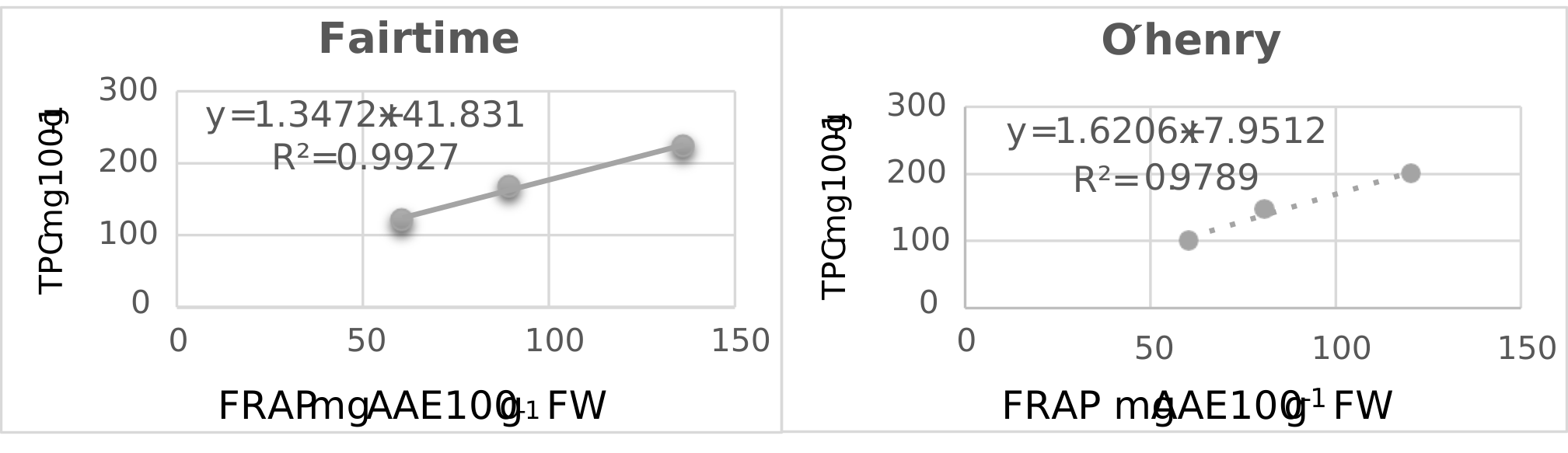
The positive correlation is stronger in Fairtime peaches (R2=0.9927) compared to O’Henry peaches (R2=0.9789). However, both varieties have quite high positive correlation.
4. Conclusion
The conducted research shows a common pattern of 45-50% decrease of total polyphenols and antioxidant activity in stored peaches. The positive correlation between them is quite strong and the intensity of the process depends on a variety and its genotype.
Funding
The project was supported by LEPL Scientific-research center of Agriculture (SRCA), Agricultural University of Georgia and Biotechnology center.
Conflicts of interest
The authors have declared no conflicts of interest related to this study.
References
- Wern, K. H., Haron, H., & Keng, C. B. (2016). Comparison of total phenolic contents (TPC) and antioxidant activities of fresh fruit juices, commercial 100% fruit juices and fruit drinks. Sains Malaysiana, 45(9), 1319–1327.
- Khiya, Z., Oualcadi, Y., Gamar, A., Berrekhis, F., Zair, T., & El Hilali, F. (2021). Correlation of total polyphenolic content with antioxidant activity of hydromethanolic extract and their fractions of Salvia officinalis leaves from different regions of Morocco. Journal of Chemistry, Article ID 8585313.[CrossRef]
- Kovatcheva-Apostolova, E. G., Georgiev, M. I., Ilieva, M. P., Skibsted, L. H., Rodtjer, A., & Andersen, M. L. (2008). Extracts of plant cell cultures of Lavandula vera and Rosa damascena as sources of phenolic antioxidants for use in foods. European Food Research and Technology, 227, 1243-1249.[CrossRef]
- Kirca, A., & Arslan, E. (2008). Antioxidant capacity and total phenolic content of selected plants from Turkey. International Journal of Food Science & Technology, 43, 2038-2046.[CrossRef]
- Ivanova, D., Gerova, D., Chervenkov, T., & Yankova, T. (2005). Polyphenols and antioxidant capacity of Bulgarian medicinal plants. Journal of Ethnopharmacology, 96, 145-150.[CrossRef] [PubMed]
- Wojdylo, A., Oszmianski, J., & Czemerys, R. (2007). Antioxidant activity and phenolic compounds in 32 selected herbs. Food Chemistry, 105, 940-949.[CrossRef]
- Celep, G. S., & Rastmanesh, R. (2013). Polyphenol consumption and metabolic diseases. Journal of Nutrition Disorders & Therapy, 3, e106.
- Milner, J. A. (1999). Functional foods and health promotion. Journal of Nutrition, 129(7), 1395S-1397S.[CrossRef]
- Weinguang, Y., Fischer, J., & Casimir, A. (2005). Study of anticancer activities of muscadine grape phenolics in vitro. Journal of Agricultural and Food Chemistry, 53, 8804-8812.[CrossRef] [PubMed]
- Wolfe, K., Wu, X., & Liu, R. H. (2003). Antioxidant activity of apple peels. Journal of Agricultural and Food Chemistry, 51(3), 609-614.[CrossRef] [PubMed]
- Kumar, S., Sandhir, R., & Ojha, S. (2014). Evaluation of antioxidant activity and total phenol in different varieties of Lantana camara leaves. BMC Research Notes, 7, 560.[CrossRef] [PubMed]
- Rodriguez, C. A., Bustamante, C. A., Budde, C. O., Müller, G. L., Drincovich, M. F., & Lara, M. V. (2019). Peach fruit development: A comparative proteomic study between endocarp and mesocarp at early stages. Frontiers in Plant Science, 10, 715.[CrossRef] [PubMed]
- Monti, L. L., Bustamante, C. A., Osorio, S., Gabilondo, J., Borsani, J., & Lauxmann, M. A. (2016). Metabolic profiling of peach fruit varieties reveals diversity and changes during ripening. Food Chemistry, 190, 879–888.[CrossRef] [PubMed]
- Kan, J., Liu, J., & Jin, C. H. (2013). Changes in cell walls during fruit ripening in Chinese ‘honey’ peach. Journal of Horticultural Science & Biotechnology, 88(1), 37–46.[CrossRef]
- Bond, T., Lewis, J., & Davis, A. (2003). Methods of polyphenols analysis. London: Royal Society of Chemistry.
- Dziadek, K., Kopec, A., & Tabaszewska, M. (2019). Potential of sweet cherry (Prunus avium L.) by-products: Bioactive compounds and antioxidant activity of leaves and petioles. European Food Research and Technology, 245, 763–772.[CrossRef]
- Jacobo-Velazquez, D. A., & Cisneros-Zevallos, L. (2009). Correlations of antioxidant activity against phenolic content revisited: A new approach in data analysis. Journal of Food Science, 74(9), 107–113.[CrossRef] [PubMed]
- Rapisarda, P., Lo Bianco, M., Pannuzzo, P., & Timpanaro, N. (2008). Effect of cold storage on vitamin C, phenolics and antioxidant activity of orange genotypes (Citrus sinensis). Postharvest Biology and Technology, 49(3), 348–354.[CrossRef]